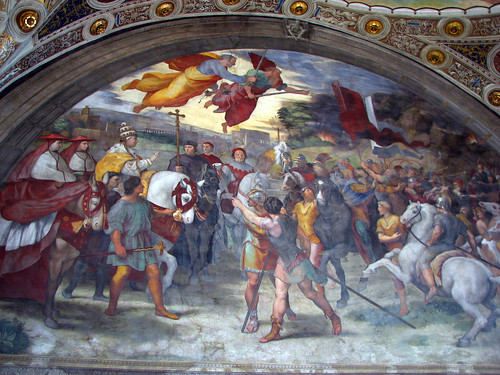
 (The encounter between Leo the Great and Attila is the last fresco painted in this room. It was completed after the death of Julius II (pontiff from 1503 to 1513), during the pontificate of his successor Leo X (pontiff from 1513 to 1521). In fact the latter appears twice in the same scene, portrayed in the guise of Pope Leo the Great and as cardinal. According to legend, the miraculous apparition of Saints Peter and Paul armed with swords during the meeting between Pope Leo the Great and Attila (452 A.D.) caused the king of the Huns to desist from invading Italy and marching on Rome. Raphael situates the scene at the gates of Rome, identified by the Colosseum, by an aqueduct, an obelisk and other buildings, even if in fact the historical event took place in the north of Italy, near Mantua.)
St. Leo the Great, who reigned as Pope from 440 to 461, was one of the greatest Popes of History. He fought against numerous heresies that agitated the Church, principally against the Manicheans and Pelagians. In 452 he faced Attila and convinced the scourge of God and his Huns not to attack Rome and to leave Italy. He was also able to thwart the destruction of Rome by Genseric three years later.
Many Africans who had been driven away by the Vandals had settled in Rome and established a secret Manichean community there. When St. Leo discovered them, he denounced them to priests and religious, and warned the people to be on their guard against this reprehensible heresy.
In Spain the heresy of Priscillianism still survived and was attracting new adherents, provoking countless riots and general agitation. St. Leo was informed of this situation by St. Turibius, Bishop of Astorga in Spain. The Pope wrote him a long letter in which he refuted the errors of the Priscillian heresy and qualified it as the “sewer of all the prior heresies.” In particular he condemned its denial of free will and the influence of astrology, considered infallible. St. Leo also showed the connection between the Priscillians and the Manicheans, and sent St. Turibius the conclusions of the juridical processes that he had made against the latter in Rome.
In these processes one can see the seed of the future Inquisition. They were presided over by the Pope, who was assisted by Bishops, clergy, senators and other illustrious personages. During them, he would declare to the faithful their obligation to denounce the heretics; question those under suspicion; try to make them retract from their errors; give penances to those who returned to the Church; and deliver to the civil authorities those who were obstinate in their positions so they might be adequately punished.
Comments of Prof. Plinio:
This selection is very beautiful because you can see how St. Leo the Great acted with the authority of a Pope and at the same time as a saint, that is, a person whom the Catholic Church declared infallibly to be one who heroically practiced all the virtues.
His sanctity, by the way, was confirmed by a colossal miracle. When he went out to meet Attila, as he approached him, St. Peter appeared over the Pope and made the barbarian retreat. This was one of the great miracles in the History of the Church. This man who was so holy was a persecutor of heretics. Manicheans who had fled from Africa to Italy because of the persecution of the Vandals received a severe reception from St. Leo. He gave sermons warning the people against them and exhorted the people to denounce them to the Church.
When the heresy of the Priscillians re-emerged in Spain, he supported the fight of St. Turibius, Bishop of Astorga, to suppress it. Further, he established a kind of Inquisition in Rome, and he was the one who presided over its sessions, assisted by Bishops and illustrious persons. He carried out the role of Inquisitor - he questioned them to see if there were heresies, tried to convert those who were in error, and ordered punishment for those who refused the Catholic doctrine. You can see, therefore, that he was practicing a holy violence against the heretics. And this in no way was opposed to his sanctity. It was a virtue, a virtue that today is poorly appreciated, because it is the opposite of the bad ecumenism.
What would St. Leo the Great say and do if he would rise up from his grave and see the Catholic Church in the sad situation she is in today where all heresies are unopposed? He would immediately order the re-installation of an Inquisition. Therefore, let us pray to St. Leo, asking him to re-ignite in the Church the spirit of the Inquisition, the spirit of discernment, of holy vigilance, of balanced intransigence, of militancy and the fight. If this were established in the Church, perhaps the world could avoid the terrible chastisement through which it needs to pass. Let us pray to him asking that we might be enflamed with this spirit and that it be maintained in the Holy Church until the end times.
(Blog Owners Note - Indeed let us pray that Our Pope Benedict XVI defends our Catholic Faith from the tide of Relativism and Socialism which is sweeping across the world today)