Evil triumphs when good men do nothing - Edmund Burke
Showing posts with label The Presentation of the BLessed Virgin Mary. Show all posts

Saturday, November 21, 2009

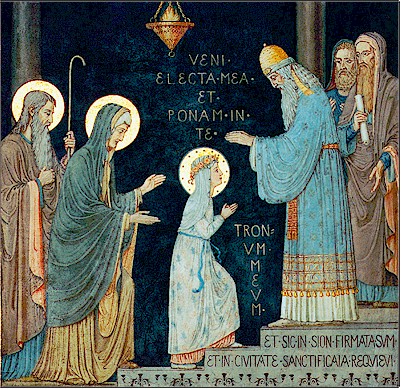
Presentation of the Virgin Mary

Many of the celebrations in honor of Mary are based in historical fact. The Sacred Scriptures tell of her acceptance of God's invitation to be the mother of the Savior at the Annunciation. We know of her maternity and of her faithfulness to her son, Jesus, even standing at the side of his cross.

The Scriptures tells us nothing of Mary's hidden life. The inspired Word of God gives us no word about her Presentation in the Temple, the feast which we celebrate each year on November 21st. However, we do have the testimonies of tradition which are based on accounts which come to us from apostolic times. That which is known about the Presentation of the Blessed Virgin Mary in the Temple is found in the Apocrypha, principally in chapter seven of the Protoevangelium of James, which has been dated by historians prior to the year 200 AD.

This book gives us a detailed account in which Mary's father, Joachim, tells Anna his wife that he wishes to bring their child to the Temple of the Lord. Anna responds that they should wait until the child is three years old lest she yearn for her parents. When the day arrived, the undefiled daughters of the Hebrews were invited to accompany Mary with their lamps burning to the Temple. There the priest received her, blessed her, and kissed her in welcome. He proclaimed, "The Lord has magnified thy name in all generations. In thee, the Lord will manifest His redemption to the sons of Israel." Mary was placed on the third step of the Temple and there danced with joy and all the house of Israel loved her. It was there that she was nurtured and her parents returned, glorifying the Almighty.

This story is a legend with no foundation in history and the point of the story is to show that even in her childhood Mary was completely dedicated to God. However, it is from this very account that arose the feast of Mary's Presentation.

Historians tell us that the Emperor Justinian built a splendid church dedicated to Mary in the Temple area in Jerusalem. It was dedicated on November 21, 543 but was destroyed by the Persians within a century. Many of the early church Fathers such as St. Germanus, Patriarch of Constantinople (+730) and St. John Damascene, his contemporary, preached magnificent homilies on this feast referring to Mary as that special plant or flower which was being nurtured for better things." She was planted in the House of God, nourished by the Holy Spirit and kept her body and soul spotless to receive God in her bosom. He Who is all-holy rests among the holy."

We know that in the Byzantine Church this feast is considered one of the twelve great feasts of the liturgical year, called the Dodecaorton. Scholars believe that Mary's Presentation in the Temple is considered a major feast for the Eastern churches celebrating the same values that the Western church celebrates in the feast of the Immaculate Conception.

It appears that this feast was not celebrated in Rome at the time of Pope St. Sergius (+701) who established four other principle feasts dedicated to Mary. By the ninth century it is celebrated in the monasteries of southern Italy which had been influenced by the traditions of the Byzantine churches. By the fourteenth century it had spread to England and it is recorded that it was celebrated in Avignon, France in 1373. Its acceptance is considered very slow and it was not until the year 1472 that Pope Sixtus IV extended its celebration to the universal church.

Pope Paul VI in the 1974 encyclical Marialis Cultus, n.8, wrote of this feast that "despite its apocryphal content, it presents lofty and exemplary values and carries on the venerable traditions having their origins in the Eastern churches."


(Courtesy http://campus.udayton.edu/mary/meditations/Nov21.html )

Friday, November 20, 2009

By faith she believed; by faith, conceived


(The following text is from the Office of Readings)


Stretching out his hand over his disciples, the Lord Christ declared: Here are my mother and my brothers; anyone who does the will of my Father who sent me is my brother and sister and my mother. I would urge you to ponder these words. Did the Virgin Mary, who believed by faith and conceived by faith, who was the chosen one from whom our Saviour was born among men, who was created by Christ before Christ was created in her – did she not do the will of the Father? Indeed the blessed Mary certainly did the Father’s will, and so it was for her a greater thing to have been Christ’s disciple than to have been his mother, and she was more blessed in her discipleship than in her motherhood. Hers was the happiness of first bearing in her womb him whom she would obey as her master.

Now listen and see if the words of Scripture do not agree with what I have said. The Lord was passing by and crowds were following him. His miracles gave proof of divine power. and a woman cried out: Happy is the womb that bore you, blessed is that womb! But the Lord, not wishing people to seek happiness in a purely physical relationship, replied: More blessed are those who hear the word of God and keep it. Mary heard God’s word and kept it, and so she is blessed. She kept God’s truth in her mind, a nobler thing than carrying his body in her womb. The truth and the body were both Christ: he was kept in Mary’s mind insofar as he is truth, he was carried in her womb insofar as he is man; but what is kept in the mind is of a higher order than what is carried in the womb.

The Virgin Mary is both holy and blessed, and yet the Church is greater than she. Mary is a part of the Church, a member of the Church, a holy, an eminent – the most eminent – member, but still only a member of the entire body. The body undoubtedly is greater than she, one of its members. This body has the Lord for its head, and head and body together make up the whole Christ. In other words, our head is divine – our head is God.
Now, beloved, give me your whole attention, for you also are members of Christ; you also are the body of Christ. Consider how you yourselves can be among those of whom the Lord said: Here are my mother and my brothers. Do you wonder how you can be the mother of Christ? He himself said: Whoever hears and fulfils the will of my Father in heaven is my brother and my sister and my mother. As for our being the brothers and sisters of Christ, we can understand this because although there is only one inheritance and Christ is the only Son, his mercy would not allow him to remain alone. It was his wish that we too should be heirs of the Father, and co-heirs with himself.

Now having said that all of you are brothers of Christ, shall I not dare to call you his mother? Much less would I dare to deny his own words. Tell me how Mary became the mother of Christ, if it was not by giving birth to the members of Christ? You, to whom I am speaking, are the members of Christ. Of whom were you born? “Of Mother Church,” I hear the reply of your hearts. You became sons of this mother at your baptism, you came to birth then as members of Christ. Now you in your turn must draw to the font of baptism as many as you possibly can. You became sons when you were born there yourselves, and now by bringing others to birth in the same way, you have it in your power to become the mothers of Christ.

Friday, November 21, 2008

The Presentation of the Blessed Virgin Mary - 21th November 2008

Today is the feast of The Presentation of the Blessed Virgin Mary which is a fixed Holy Day on the calendar. Let us contemplate on this feats by reading the commentary of Dr. Plinio.


Biographical selection:

The cult to Our Lady was born in the East; from there also we received the feast of the Presentation of Our Lady, where it was celebrated from the end of the seventh century. In the West, Pope Gregory XI adopted the feast day in 1372 at the pontifical court of Avignon.

A year later, King Charles V introduced the feast of the Presentation at the royal Chapel in Paris. In a letter dated November 10, 1374 to the masters and students of the College of Navarre, he expressed his desire that such a feast should be celebrated throughout the kingdom. The text of the letter reads:

'Charles, by the grace of God King of France, to our dearly beloved: health in Him Who ceases not to honor His Mother on earth. '

'Among other objects of our solicitude, daily occupation, and diligent meditation, that which rightly occupies our first thoughts is that the Most Blessed Virgin and Holy Empress be honored by us with very great love, and praised as it is due. For it is our duty to glorify her, and we, who raise the eyes of our soul to her on high, know what a incomparable protectress she is to all, how powerful a mediatrix she is with her Blessed Son for those who honor her with a pure heart .... This is why we wish to stimulate our faithful people to celebrate this feast, as we ourselves intend to do by God's assistance every year of our life. We send to you the liturgy of said feast to increase your joy.'
Such was the language of princes in those days. Then also at that very time, that wise and pious King, following up the work begun in Britigny by Our Lady of Chartres, rescued France from its fallen and dismembered condition.

Comments of Prof. Plinio:

In other words, the feast of the Presentation of Our Lady followed extraordinary historic circumstances. It was a Pope who introduced it in the West, and the King of France who spread it throughout his country. And from France it extended to the whole world. The King took up the feast to thank Our Lady of Chartres for her protection in the battle of Britigny, where the French army defeated its adversaries.

What does the feast of the Presentation celebrate? It celebrates the fact that the parents of Our Lady brought her to the Temple at the age of three and handed her over to live there for a long period as a virgin consecrated to the Temple, contemplating God exclusively.

What is the special beauty of this feast? Our Lady was the one chosen before time began, the Queen of Jesse from whom the Messiah would be born. The Temple was the only place in the Old Testament where sacrifices were offered to God. It represented, therefore, the only true religion. Our Lady being received at the Temple was the first step to the fulfillment of the promise that the Messiah would come to the true religion. It was the encounter of hope with reality.

When she was received at the Temple, Our Lady entered the service of God. That is, a soul incomparably holy entered the service of God. At that moment, notwithstanding the decadence of the nation of Israel, and even though the Temple had been transformed into a den of Pharisees, the Temple was filled with an incomparable light that was the sanctity of Our Lady.

It was in the Temple atmosphere that, without knowing it, she began to prepare herself to be the Mother of Our Lord Jesus Christ. It was there that she increased her love of God until she formed the ardent desire for the imminent coming of the Messiah. It was there that she asked God the honor to be the maidservant of His Mother. She did not know that she was the one chosen by God. This is so true that she wondered about the meaning of the salutation of the Archangel Gabriel when he greeted her to ask her permission for the Incarnation. That preparation for Our Lady to be the Mother of Jesus Christ began with the Presentation at the Temple, the feast the Church celebrates on November 21.

Is there a grace we should ask on this day? We should ask for spiritual help to be better prepared to serve God as Our Lady did. But the best way to serve God is to serve Our Lady herself. So, on this feast day we should re-present ourselves before Our Lady, asking her to receive our offer of service and to give us her assistance in the task of our sanctification, just as the Holy Ghost helped her at the Temple of Jerusalem.