Evil triumphs when good men do nothing - Edmund Burke

Friday, June 5, 2009

St. Boniface - 5th June 2009


Today, let us read the commentary on St. Boniface by Dr. Plinio


St. Boniface lived from around 680 to 754. He was born Winfred in the Kingdom of Wessex (now Devon), England. At age 7 he entered the monastery of Adescancastre on the site of present day Exeter. Seven years later he went to the Abbey of Nhutscelle. Here, under the direction of the holy Abbot Winbert, his fame for knowledge and preaching grew.

He set aside, however, prospects of the highest dignities in his own country, because he felt the vocation to convert the pagan Anglo-Saxons in Germany. By the order of Pope Gregory II he dedicated himself to their conversion. He helped Charles Martel in the reform of the Church in France and convened councils to combat simony.

In 719 the monk Winfred took this oath to Pope Gregory II in Rome, when he was made Bishop and given the name of Boniface:

“In the name of the Lord Our God and Savior Jesus Christ. In the sixth year of the reign of Emperor Leo IV and of his son Constantine, I, Boniface, Bishop by the grace of God, promise to thee, Blessed Peter, Prince of the Apostles, and to thy Vicar, the blessed Pope Gregory and his successors, by the indivisible Trinity, Father, Son and Holy Ghost, and by Thy Sacred Body here present, that I will conserve the purity of the holy Catholic Faith, and I will remain steadfast in the unity of this belief, in which indubitably lies the salvation of all Christians. I will never attack the unity of the Catholic Church, no matter who may seek to persuade me, but will maintain a complete fidelity to it, and a sincere commitment to thee and the interests of thy Church.

“To thee and thy successors the Lord gave the power to bind and unbind. I promise that I will never have communion with bishops who go astray from the ancient practices established by the Holy Fathers, and that, if I can, I will prevent their actions. If I cannot, I will denounce them to the Pope my Lord. If in any way, God forbid, I should act in opposition to this oath, let me assume the guilt before the judgment of God, receiving the chastisements of Ananias and Saphira, who lied to thee.

“I Boniface, humble Bishop, sign by my own hand the formula of this oath and place it over the body of Blessed Peter. As prescribed, I make this oath before God, who is Judge and Witness. I promise to fulfill it well.”

Pope Gregory II wrote this letter to present St. Boniface in his commission to evangelize Germany and reorganize the Church there:

“If anyone, God forbid, either oppose the work of Bishop Boniface, or thwart his ministry or that of his successors in the apostolate, by the Divine Judge, let him be anathema and subject to eternal condemnation.”

St. Boniface suffered martyrdom in Frisia in 754. His body rests in the cathedral crypt in Fulda, where he is venerated by all Catholic Germany. He is the patron saint of Germany and the Netherlands.

Comments of Prof. Plinio:

For you to have an idea of the role of this saint in the foundation of the Middle Ages, perhaps it is worthwhile to insert the data of this selection into the larger panorama of the times.

First, St. Boniface was a monk in an epoch when the monastic life was the most dynamic force of the Church. This energy came from the great monasteries of monks who lived a recollected life. The characteristic note of the Benedictine monasteries, unlike today, was to live away from the cities, in places of solitude. Given their prestige, often entire villages or even cities would grow up around those isolated convents.

Therefore, St. Boniface was an active participant in the most important ecclesiastical movement of his time, which brought the Middle Ages to its apogee.

Second, St. Boniface was a missionary. One of the great works of the Middle Ages was the evangelization of the barbarian peoples. At his time, most of Europe beyond the Rhine and Danube Rivers was barbarian, as barbarian as the Indians who still live today in the South American forests. The work of conversion and civilization of those peoples was enormous and had great value. One can measure this value considering the magnificent fruits these peoples gave for Christendom after their conversion. This work, in great part, was the work of monks, and particularly the work of this one monk who was St. Boniface.

Third, the part of Europe constituted by France, Italy, England and some of Spain was Catholic and constituted a first Christendom. However, that Christendom was putrid. It had inherited the rottenness of the Roman Empire. One of the most pernicious vices of the time was simony, and St. Boniface exerted an important role in combating the plague of simony.

What is simony? It is the selling of ecclesiastical positions and charges. Cardinals would sell dioceses to bishops; bishops would sell positions to priests, etc. St. Boniface convoked regional councils to eradicate simony from France. Here also, he revealed his greatness and valor.

He lived in a great epoch for the Church, because she accomplished momentous works. In most of these works, St. Boniface was present and played a capital role.

Now that you understand the grandeur of this man, let us analyze the beautiful oath he made to Pope Gregory II when he was consecrated Bishop.

That oath is beautiful because it is an act of Faith he made with regard to the Catholic Church and the Roman See. He promised to be always faithful to the Papacy. Then he promised to never have any common ground with bad bishops. Further, he promised to try to prevent those bishops from spreading their bad influence and, if he were unsuccessful, to denounce them to the Pope. That is, he vowed a total war against evil bishops.

Then, after manifesting his fidelity, he called down a chastisement upon himself if he were not faithful: the chastisement of Ananias and Saphira. What kind of punishment was that? The Acts of the Apostles report that Ananias and Saphira were a married couple who had many goods. They presented themselves to St. Peter to be received into the Catholic community, delivering a certain part of their goods, and affirmed: “This is all we have, and we give this to the Church.” St. Peter told them: “You lie to the Holy Ghost, because I know that you secretly reserved a part of your goods for yourselves.” And the two were struck dead by God.

St. Boniface mentioned this episode because in his oath, he was saying to St. Peter, “I have given everything to the Church.” So, his donation was similar to that which Ananias and Saphira pretended to have made. He faced that analogy, indicating that if, per chance, he was reserving anything for himself, he would be making a fraud like theirs. In face of such possibility, he asked for a similar chastisement.

Then, we have Pope Gregory II’s letter regarding St. Boniface. It is interesting to consider how the Pope used to act in those times. If someone were to do wrong, he would receive a strong reproach from the Pope: “Let eternal condemnation fall upon him.” Today, most people would object: “But this reflects ire and, therefore, a certain imperfection.” I don’t agree. What it reflects is ire against the sin, and against the sinner for his error.

Those were times of coherence, severity and justice. Someone might say with relief, “Fortunately this does not happen today.” I am not so sure of that. According to the chastisements predicted by Our Lady in Fatima, at a certain moment the chalice of God’s wrath will be filled, and He will let His sword fall over the world. We should be prepared for this moment, and be prepared to adore the sanctity of God as He punishes. He will chastise because He is Holy and cannot tolerate the empire of evil in which we are living. His hatred for this evil will reveal His sanctity.

We should admire severe formulas like those written by Pope Gregory II and that of St. Boniface asking a terrible chastisement to fall upon him should he fall astray in his mission. They demonstrate the abhorrence that true Popes and Saints have of evil, and by contrast, they show all the goodness that the Catholic Church possesses.

These are the comments that occur to me apropos this selection from the life of St. Boniface.

Let us ask him to give us a dedication similar to his for Holy Mother Church and the Papacy, as well as a sincere admiration for his holy severity.

Thursday, June 4, 2009

St. John de Brito - Patron Saint of Madura India


Being from India i felt it would be appropriate to introduce my readers to some saints who are well known in India but not in the west.

John de Brito (João de Brito, 1647-1693) was one of the earliest Jesuit missionaries in India to adopt elements of the local culture in his evangelization. He was eventually martyred because of his success and his steadfast refusal to accept honors and safety. He was born of Portuguese aristocracy and became a member of the royal court at age nine and a companion to the young prince later to become King Peter II. When de Brito was young, he almost died of an illness and his mother vowed he would wear a Jesuit cassock for a year if he were spared. He regained his health and walked around court like a miniature Jesuit, but there was nothing small about his heart or the desire that grew to actually become a Jesuit. Despite pressure from the prince and the king, he entered the Jesuit novitiate in Lisbon Dec. 17, 1662 when he was only 15 years-old. He studied classics, with an interruption because of health problems, then philosophy. He wrote to the superior general in 1668 asking to be sent to the east as a missionary, but had to finish theology first. He was ordained in February 1673 and left Lisbon for Goa in mid-March, arriving the following September. He studied more theology in Goa and was asked to remain as a teacher but he desired to be a missionary and to seek the glory of martyrdom.

Father de Brito worked in Madura, in the regions of Kolei and Tattuvanchery. When he studied the India caste system, he discovered that most Christians belonged to the lowest and most despised caste. He thought that members of the higher caste would also have to be converted for Christianity to have a future. He became an Indian ascetic, a pandaraswami since they were permitted to approach individuals of all castes. He changed his life style, eating just a bit of rice each day and sleeping on a mat, dressing in a red cloak and turban. He established a small retreat in the wilderness and was in time accepted as a pandaraswami. As he became well-known, the number of conversions greatly increased.

He was made superior in Madura after 11 years on the mission, but he also became the object of hostility from Brahmans, members of the highest caste, who resented his work and wanted to kill him. He and some catechists were captured by soldiers in 1686 and bound in heavy chains. When the soldiers threatened to kill the Jesuit, he simply offered his neck, but they did not act. After spending a month in prison, the Jesuit captive was released. When he got back to Madura, he was appointed to return to Portugal to report on the status of the mission in India. When he reached Lisbon ten months later, he was received like a hero. He toured the universities and colleges describing the adventurous life of an Indian missionary. His boyhood friend and now-king, Peter II noticed how thin, worn and tired his friend looked; he asked him to remain at home to tutor his two sons, but de Brito placed the needs in India above the comfort of the Portuguese court.

De Brito sailed again to Goa and returned to the mission in Madura when he arrived in November 1690. He came back despite a death threat that the raja of Marava had made four years earlier. The Jesuit missionary travelled at night from station to station so he could celebrate Mass and baptize converts.

His success in converting Prince Tadaya Theva indirectly led to his death. The prince was interested in Christianity even before the prayers of a catechist helped him recover from a serious interest. De Brito insisted that the prince could keep only one of his several wives after his baptism; he agreed to this condition, but one of the rejected wives complained to her uncle, the raja of Marava who sent soldiers to arrest the missionary on January 28, 1690. Twenty days later the raja exiled de Brito to Oriyur, a neighboring province his brother governed. The raja instructed his brother to execute the troublesome Jesuit who was taken from prison on February 4 and led to a knoll overlooking a river where an executioner decapitated him with a schimitar.

Wednesday, June 3, 2009

Shire of Don Bosco Madonna Matunga India


The Shrine of Don Bosco's Madonna at Matunga has today become a must- visit-at-any-cost spot for all Marian devotees who come to Bombay. Yet its history spans barely forty years.

Permission to build the Shrine was granted by the Bombay Municipal Corporation in 1955, but the foundation stone had already been blessed and laid the previous year, by Valerian Cardinal Gracias on December 7,1954.Thereafter, within a span of two years, the colossal monument was ready thanks to the hard and dedicated work put in by everyone involved.

Hence, on August 5, 1957, auxiliary bishop Longinus Pereira blessed the Shrine and declared it open for public veneration.

But only seven years later, on November 28, 1964, was the Shrine formally consecrated by archbishop Hubert D'Rosario along with seven other bishops, to mark the beginning of the 39th International Eucharistic Congress. Barely a week later, on December 4, 1964, no less a personage than Pope Paul VI paid a visit to the Shrine and blessed the statue of Mary Help of Christians the statue that is still used during the annual feast day procession.

Designed by two local architects, Patkil and Dadarkar, the Shrine of Mary Help of Christians is nevertheless Western in style (no one ever spoke of inculturation in those days). The plan of the church is in the form of a traditional Latin Cross. The main dome over the sanctuary, and the two smaller domes over the entrance are typical of Roman church architecture. The facade, in the style of ancient Ro- man churches, is marked by an arched doorway, imposed upon by a huge mosaic depicting Don Bosco with the Madonna. This mosaic is flanked on either side by two bell-towers with electric chimes.

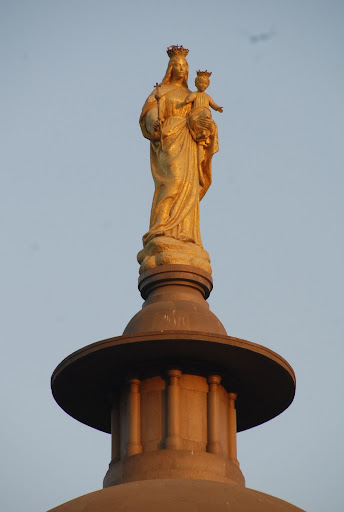
The entire Shrine has an exterior of Malad granite, golden-brown in colour. But what really catches the eye at once is the 12-foot-high gold-plated statue of Mary Help of Christians that stands majestically atop the main dome. Getting it up there in 1957 was itself a laudable engineering feat. Cast in Turin, the statue can be seen from miles around, and even today, with so many high-rise buildings mushrooming in the city, this statue is still a prominent landmark on the Matunga-Wadala skyline. The interior of the Church is totally clad with imported Italian marble of different hues, with amazingly symmetrical striations (a delight to the eyes, no doubt, but alas, a big hindrance to acoustic clarity). The natural art in the symmetry of the marble is regularly punctuated with the created art in the form of rectangular panels depicting the 14 stations of the cross. Intricately done, with attention to minute details, these panels are a sub- lime work of art.


Even more arresting, however, are the 15 mysteries of the rosary and the five scenes from Don Bosco's life, captured in stained glass, that are situated above the rectangular mosaic panels. Most imposing of all are the three stained glass panels that stand atop the main altar, with Marian motifs. Created by the renowned Italian painter Peter Flavio of Turin, all these 23 stained-glass panels were tempered by master craftsmen in special kilns, to endure brilliance. They were then shipped in segments to India and reassembled, after the manner of a jigsaw puzzle.

This is how an art lover described his impressions in the Indian Express dated January 30, 1966: The sunlight filtering in blonde shafts through the windows makes these scenes haunting... a symphony of colours that range from pale ochre and pigeon-doves to searing reds, deep saffron yellows and peacock-blues that are almost overpowering in their intensity. Veiled and unveiled in altering cycles of sunlight and shadow, these panels are projected in sharp relief for the greater part of the day. Floating to the surface, they imperceptibly anchor the "Stations" to the shadows with their deeper hues.

However, when dusk's furtive footfalls steal over the grounds, and chandeliers and candelabras join fluorescent tube- lights to bathe the interior in silver, it is the mosaic panels that surface; it is the turn of the stained glasses to dissolve and reappear outside as lofty cases of brilliant colour, at which spectators raise their eyes -- and eyebrows in wonder.

The mosaic panels depicting the "Stations" involved an even more laborious process of reassembly, as literally lakhs of tiny coloured fragments were pieced together to create fourteen unforgettable scenes which culminate in Christ's final agonies at Calvary and which faith has held in sacred trust ever since.

If the interior of the main church can evoke such poetic exuberance the crypt would have another story to tell. No pilgrim to the Shrine ever misses a visit. The school boys often gather in hushed silence to peek through the air-vents, at this little underground wonderland, whenever they find the lights on. Most of the time, however, the place is enveloped in semidarkness that only adds to the aura of mystery surrounding the crypt.

In the crypt, encased in little gilded crucibles are hundreds of relies of ancient and modern saints. These adorn the walls! And then, there are the five arched mosaic panels depicting various scenes from the life of Christ and Don Bosco.

Its calm, prayerful atmosphere makes it a favourite spot for many bridal couples who look for a quiet place to tie the nuptial knot. Having an area of 2756 square feet (besides 552 square feet of lobby area in the rear), the crypt can comfort- ably accommodate about a two hundred persons.

Of course, bigger functions such as ordinations and religious professions are held in the main church. The pews can accommodate a crowd of 800 seated devotees. Considering the extra space (6461 sq. ft. of nave area, 840 sq. ft. of choir-loft, and 1944 sq. ft. around the sanctuary area) approximately 300 more can be accommodated standing.

To many a Bombay Catholic, the Shrine is a symbol of the good "old-time religion"- with pulpit, communion rails, stately organ music, holy water fonts, statues and private confessional boxes - - "You've kept alive for us a priceless heritage," many say.

But the walls of granite and marble, the majesty of the stained glass and mosaic, the grandeur of the dome and the high altar - all these are no match for the greatest treasure of the Shrine: the faith of the countless devotees who have entered its portals over the past forty years. Young and old, rich and poor, Christians and others... they have been coming to ask for a favour, to fulfill a vow, to make an offering... or simply to be silent, away from the bustle of busy Bombay. And perhaps, the two wooden confessional boxes are the best witnesses today, of the number of sinners who have returned to God, thanks to the maternal care of Mary Help of Christians

(Courtesy http://donboscosmadonna.org/)

St. Charles Lwanga and Companions - 3rd June 2009

St. Charles was one of 22 Ugandan martyrs who converted from paganism. Though he was baptized the night before being put to death, he became a moral leader. He was the chief of the royal pages and was considered the strongest athlete of the court. He was also known as "the most handsome man of the Kingdom of the Uganda." He instructed his friends in the Catholic Faith and he personally baptized boy pages. He inspired and encouraged his companions to remain chaste and faithful. He protected his companions, ages 13-30, from the immoral acts and homosexual demands of the Babandan ruler, Mwanga.

Mwanga was a superstitious pagan king who originally was tolerant of Catholicism. However, his chief assistant, Katikiro, slowly convinced him that Christians were a threat to his rule. The premise was if these Christians would not bow to him, nor make sacrifices to their pagan god, nor pillage, massacre, nor make war, what would happen if his whole kingdom converted to Catholicism?

When Charles was sentenced to death, he seemed very peaceful, one might even say, cheerful. He was to be executed by being burnt to death. While the pyre was being prepared, he asked to be untied so that he could arrange the sticks. He then lay down upon them. When the executioner said that Charles would be burned slowly to death, Charles replied by saying that he was very glad to be dying for the True Faith. He made no cry of pain but just twisted and moaned, "Kotanda! (O my God!)." He was burned to death by Mwanga's order on June 3, 1886. Pope Paul VI canonized Charles Lwanga and his companions on June 22,1964. We celebrate his memorial on June 3rd of the Roman Calendar. Charles is the Patron of the African Youth of Catholic Action

Tuesday, June 2, 2009

The Christeros War - Catholic Church History


In 1926, a small army of Catholic peasants who took on the name "Cristeros" (followers of Christ) fought to regain religious freedom in Mexico. Before they were through, as many as 50,000 men from every socioeconomic background took up arms against the government.

The "war" produced many religious refugees, some of whom came to El Paso. The city welcomed the persecuted, and from this support stemmed the founding of new seminaries and monasteries, which still exist today.

In 1917, President Plutarco Elías Calles and the former president, General Álvaro Obregón, weakened the Catholic Church in Mexico by enforcing the Articles of the 1857 constitution included in the 1917 version. Article 3 called for secular education in the schools, thus outlawing parochial education. Article 5 closed all seminaries and convents. Article 24 forbade worship outside the physical borders of the church.

Article 27 prohibited religious groups from owning real estate, thus nationalizing all Church property. Article 130 prohibited priests and nuns from wearing religious vestments, but more importantly, it took away from the clergy the rights of voting and speech, prohibiting the criticism of government officials and comment on public affairs in religious publications.

The closing of seminaries began during the Mexican Revolution, leaving nuns and priests with no place to live or work. The government also ruled that only Mexican born clergy would be allowed to remain and participate in religious activities in Mexico. By 1917, hundreds of religious had been expelled from Mexico or had fled the country.

The Catholic Church did not want to retaliate violently against the government, so from 1919 to 1926, they obeyed the laws. However, in 1926, President Calles introduced legislation which fined priests $250 for wearing religious vestments and imprisoned them for five years for criticizing the government.

Archbishop of Mexico, José María Mora y del Río, declared that the Catholic Church could not accept the government's restraints. On July 31, 1926, the archbishop suspended all public worship by ordering Mexican clergy to refrain from administering any of the Church's sacraments.

The Cristeros felt the only way to fight the government was to take up arms: they were willing to become martyrs for their freedom of religion. Jean Meyers, a French expert on this revolution, tells us about Cristeros attending field masses, dressed in sandals and white garments and armed with machetes. They knew that soldiers could attack them with machine guns at any time.

Many priests were martyred while celebrating mass, either by being shot or beheaded. In a last affirmation of their faith, the Cristeros would shout, "Viva Cristo Rey!" (Long Live Christ the King!) just before dying.

Padre Miguel Agustin Pro was one of the best known of the martyred priests. Pro used elaborate disguises so that soldiers would not recognize him as a priest. Known for his indefatigable sense of humor, he visited the faithful often dressed as a beggar. He administered the sacraments, provided jokes and laughter, and helped financially those in need. Rich families often received the sacraments from Padre Pro in his disguise of businessman. Pro and his brother, Humberto, were arrested for being erroneously linked to a car bombing which injured ex-president Obregón. The car used in the bombing was traced back to Humberto Pro, the previous owner.

Calles took advantage of the opportunity to execute a priest publicly in an attempt to discourage other priests from participating in politics. He ordered Pro be shot at the police station and invited reporters to the execution. Padre Pro carried a small crucifix and his rosary and held his arms out forming a cross as he was shot. Pope John Paul II beatified him on September 25, 1988.

Another martyr, San Pedro de Jesus Maldonado Lucero, served the people's spiritual needs in Chihuahua, Mexico. Maldonado attended seminary in Mexico in 1914, but the political conflict forced him to leave. He came to El Paso and received his ordination on January 25, 1918, from Bishop Anthony J. Schuler at St. Patrick's Cathedral. Then he returned to Chihuahua to serve the faithful.

After Calles' anti-Catholic laws were implemented in 1926, Maldonado became a government target for performing religious ceremonies in private homes. He succeeded in celebrating night masses on one ranch or another, performing marriages and baptisms and administering other sacraments. In 1937 during Holy Week, the mayor and soldiers in Santa Isabel, Chihuahua, arrested him and beat him to death for defying government bans on hidden religious celebrations. Maldonado's murderers used riffle butts to bash in his head and dislodge an eye from its socket.

Like Maldonado, many other priests and nuns along with ordinary Catholics, Mormons and Episcopalians left the country and found refuge in border cities in the United States, among them, El Paso. Patrick Cross writes that by 1929, some 25,000 priests in approximately 12,000 parishes no longer could minister to the spiritual needs of Mexican Catholics, over 10 million strong.

In a personal interview, Dr. Jesus Cuellar, this writer's grandfather, recalled that at the age of 13, in 1927, he was helping Father Gregorio Paredes with a secret mass in a house in Guanajuato. After it concluded, soldiers came looking for a place to feed and water their horses.

In order to save the priest's life and to keep the Eucharist from desecration, Cuellar took the Chalice containing the Eucharist and ran out to hide it in a neighboring house. He and Father Paredes hid in a basement for three days, waiting for the soldiers to leave.

Persecuted Mexican Catholics received worldwide sympathy. Boston banned the new religious regulations calling them "the most brutal tyranny." New York parishioners crowded Catholic and Protestant churches to offer prayers for a peaceful solution in Mexico.

El Paso Bishop Reverend Anthony J. Schuler welcomed Juárez Catholics and even granted priests permission to perform marriages and baptisms without requiring residency for the Mexican citizens. Between 1926 and 1929, the number of people attending services at El Paso Catholic churches doubled. A dramatic increase in baptisms and marriages of people with Hispanic surnames at Catholic churches suggested that downtown churches were serving great numbers of Catholics from Mexico.

Since priests and nuns in Mexico could no longer teach there, many of them came to El Paso. Three nuns from the order of Perpetual Adoration and two from the Servants of the Sacred Heart arrived in El Paso on August 2, 1926. Sacred Heart Church received the nuns from the Sacred Heart Order with open arms.

Because there was no Perpetual Adoration order in El Paso, Bishop Schuler provided the funds for the foundation of such a monastery to train nuns. Other exiled nuns from Mexico City and Guadalajara soon joined the first nuns.

Reverend Mother María Concepción del Espíritu Santo was in charge of the nuns who came from Guadalajara. She found a suitable location for the monastery in a house at 1401 Magoffin. Along with money from the diocese, the Catholic community raised funds and helped pay $7,550 for the property in monthly installments.

Once El Paso became a diocese in 1926, it was allowed to establish seminaries and became the home to Franciscans at St. Anthony's Seminary at Hastings and Crescent in 1935. Before this, the persecuted Franciscan order of Michoacan, which had not had a seminary since 1910, had lived in Santa Barbara, Calif., after their departure from Mexico.

The monasteries and seminaries established at this time succeeded so well that an additional Perpetual Adoration Monastery in the Lower Valley and the Roger Bacon Seminary soon followed to house homeless priests and nuns.

During the religious persecution, some Mexican nationals who sought and found asylum in El Paso decided to stay here. However, many returned to Mexico but continued to enroll their children in the parochial schools here. Perhaps the trend of bringing children to school across the border began when El Paso met those needs so many years ago.

Even though Catholicism is no longer openly persecuted in Mexico, the religious persecution of the 1920s is still felt. The government prohibits priests from owning property, criticizing government officials or commenting on public affairs. The state still does not recognize weddings performed by priests.

In 2000, the Pope canonized 25 priests of the Cristero era, including San Maldonado. The blood of the thousands of Cristeros and martyrs that flooded the land nourished the spirits of those left behind; their courageous cry can still be heard in the hearts of the faithful, "Viva Cristo Rey!"

Sts. Marcellinus and Peter - 2June 2009

Sts. Marcellinus and Peter were prominent enough in the memory of Church to be included among the saints of the Roman Canon. Mention of their names is optional in our present Eucharistic Prayer I.Marcellinus was a priest and Peter was an exorcist, that is, someone authorized by the Church to deal with cases of demonic possession. They were beheaded during the persecution of Diocletian. Pope St. Damasus wrote an epitaph apparently based on the report of their executioner, and Constantine erected a basilica over the crypt in which they were buried in Rome. Numerous legends sprang from an early account of their death.

Pope St Damasus I dedicated his life to establishing and strengthening the Church after the great persecutions, and took much care over the restoration of the Roman catacombs and the proper burial of the martyrs there, including Marcellinus and Peter.

As a boy, Damasus had heard the story of these martyrs from their executioner. Marcellinus was a priest, Peter was not. They were beheaded during the emperor Diocletian’s persecution, and buried on the Via Labicana outside Rome.

After the persecutions, a basilica was built over the site of their tomb.

Monday, June 1, 2009

From the Acts of the martyrdom of Saint Justin and his companion saints

The saints were seized and brought before the prefect of Rome, whose name was Rusticus. As they stood before the judgement seat, Rusticus the prefect said to Justin: “Above all, have faith in the gods and obey the emperors.” Justin said: “We cannot be accused or condemned for obeying the commands of our Saviour, Jesus Christ.”
Rusticus said: “What system of teaching do you profess?” Justin said: “I have tried to learn about every system, but I have accepted the true doctrines of the Christians, though these are not approved by those who are held fast by error.”
The prefect Rusticus said: “Are those doctrines approved by you, wretch that you are?” Justin said: “Yes, for I follow them with their correct teaching.”
The prefect Rusticus said: “What sort of teaching is that?” Justin said: “Worship the God of the Christians. We hold him to be from the beginning the one creator and maker of the whole creation, of things seen and things unseen. We worship also the Lord Jesus Christ, the Son of God. He was foretold by the prophets as the future herald of salvation for the human race and the teacher of distinguished disciples. For myself, since I am a human being, I consider that what I say is insignificant in comparison with his infinite godhead. I acknowledge the existence of a prophetic power, for the one I have just spoken of as the Son of God was the subject of prophecy. I know that the prophets were inspired from above when they spoke of his coming among men.”
Rusticus said: “You are a Christian, then?” Justin said: “Yes, I am a Christian.”
The prefect said to Justin: “You are called a learned man and think that you know what is true teaching. Listen: if you were scourged and beheaded, are you convinced that you would go up to heaven?” Justin said: “I hope that I shall enter God’s house if I suffer that way. For I know that God’s favour is stored up until the end of the whole world for all who have lived good lives.”
The prefect Rusticus said: “Do you have an idea that you will go up to heaven to receive some suitable rewards?” Justin said: “It is not an idea that I have; it is something I know well and hold to be most certain.”
The prefect Rusticus said: “Now let us come to the point at issue, which is necessary and urgent. Gather round then and with one accord offer sacrifice to the gods.” Justin said: “No one who is right thinking stoops from true worship to false worship.”
The prefect Rusticus said: “If you do not do as you are commanded you will be tortured without mercy.” Justin said: “We hope to suffer torment for the sake of our Lord Jesus Christ, and so be saved. For this will bring us salvation and confidence as we stand before the more terrible and universal judgement-seat of our Lord and Saviour.”
In the same way the other martyrs also said: “Do what you will. We are Christians; we do not offer sacrifice to idols.”
The prefect Rusticus pronounced sentence, saying: “Let those who have refused to sacrifice to the gods and to obey the command of the emperor be scourged and led away to suffer capital punishment according to the ruling of the laws.” Glorifying God, the holy martyrs went out to the accustomed place. They were beheaded, and so fulfilled their witness of martyrdom in confessing their faith in their Saviour.

St Justin - 1st June 2009


Saint Justin was born in about the year 103 of pagan parents at Neapolis or Sichem in Samaria, site of Jacob’s well. He was well educated and applied himself in particular to the study of philosophy, always with one object — that he might come to know God. He sought this knowledge among the contending schools of philosophy, but in vain; and finally God appeased the thirst He Himself had created.

One day, while Justin was walking by the seashore, meditating on the thought of God, a majestic old gentleman met him and questioned him concerning his doubts. When he had made Justin confess that the ancient philosophers taught nothing certain about God, the elderly man told him of the writings of the inspired prophets of Israel, and of Jesus Christ whom they announced. Saint Justin himself relates how he counseled him to seek light and understanding through prayer, “for none can understand these things", he told him, “if God and His Christ do not give him understanding of them.”

The Scriptures and the constancy of the Christian martyrs led Justin from the inadequacy of human reason to the light of faith. His conversion occurred between 132 and 137. In his zeal for the Faith he traveled to Greece, Egypt, Asia Minor and Italy, gaining many to Christ. It is believed he was ordained a priest, or at least a deacon. Saint Justin wrote: “I have resolved that in all I say, my only purpose will be to speak the truth; I will say it without fear or any other consideration, even if I should at the same hour be cut up in pieces.” In Rome he did indeed seal his testimony with his blood with four of his disciples, under Marcus Aurelius.

The account of their interrogation has been preserved, for then as now, court stenographers wrote down the words of judges, witnesses and the accused, and the early Christians paid money for the right to copy the records. “Do you think,” the prefect said to Justin, “that by dying you will enter heaven, and be rewarded by God?” “I do not think,” he replied, “I know.” The five Christians were condemned to be flogged and then beheaded. Certain writings of Saint Justin are still extant and still pertinent: Among them are his Discourse to the Greeks, and his famous Apology addressed to the Roman senate and people, and the emperor Antoninus, concerning the unjust laws against Christians. His Dialogue with Tryphon, a young Jew, in which he cites the Messianic prophecies, is the longest and most popular of his writings.

Sunday, May 31, 2009

New Lectionary

I went for Mass today Pentecost Sunday. Before mass began the priest said that from today onwards, the chruch will be using the New Lectionary. This New Lectionary goes back befoe the existing one and is closer t othe mass of the ages.
The priest also said that in the new liturgical year, which begins at advent, we will be saying the I Confess which is a direct translation from Latin as well as the We Believe.
Am I dreaming, is this real. Does this New Lectionary apply to just North America or to the entire English Speaking world.

I would like to hear from you all via the combox, what you all thought of the New Lectionary, has it been implemented in your parishes. Did the preist announce the changes? etc.

Saturday, May 30, 2009

Friday, May 29, 2009

Quotes: St. Madeleine Sophie Barat


Quotes: St. Madeleine Sophie Barat
 
And what is God? Supreme happiness. That is all. 
     St. Madeleine Sophie Barat

Be humble, be simple, and bring joy to others.
     St. Madeleine Sophie Barat

Aim unceasingly at becoming a soul of prayer.
    St. Madeleine Sophie Barat

Let us respect childhood; let us honor the soul of that small creature of God who can already make choices of the best if we take the time to awaken her reason and make her use her judgment. … I am overwhelmed with love in thinking that this is the mission of the Society – and I have to spend my time in administration! 
    St. Madeleine Sophie Barat

For the sake of one child, I would have founded the Society.
    St. Madeleine Sophie Barat

What is needed for winning parents and children is to be busy about them, at their service from morning to night; to forget oneself and enter into what concerns the children, body and soul; to listen to them with interest; to console and to encourage them; finally to sacrifice for them everything except one's soul; and become for their sakes gentle, patient, indulgent, in one word, a mother.
    St. Madeleine Sophie Barat

Give only good example to the children; never correct them when out of humor or impatient. We must win them by an appeal to their piety and to their hearts. Soften your reprimands with kind words; encourage and reward them. That is, in short, our way of educating.
    St. Madeleine Sophie Barat

With the pupils keep an even tone, both gentle and firm. Show them by the care with which you help them to advance along every line for which you are responsible, that you care for their interests alone, and that you want to help them to acquire a solid and pious education, enhanced by learning, and thusmake them happy.
    St. Madeleine Sophie Barat

It is all very well to lay the foundations of solid virtue, but only the union of virtue with learning will give our work its perfection.
    St. Madeleine Sophie Barat

We must not be blind to the fact that in these times of activity in which we live, demands are made upon us and obstacles rise so that certain modifications and a certain perfectioning become indispensable.... Education, is no longer what it was a few years ago; the multiplication of institutions which follow the trends of the times make us seem behind. God forbid that we should wish to compromise with duty and sacrifice our principal end to these tendencies, but we must again examine what we can accord and review our Plan of Studies to modify and complete it.
    St. Madeleine Sophie Barat

We must know how to inspire in our pupils a passion for the beautiful. Let us put history into their souls; without that, memories will fade and we shall have wasted our time. In seeing the empires that rise and fall one after the other, they will perhaps learn to rise above their own troubles. They will thus better understand the sic transit gloria mundi, and their hearts, disillusioned with what is nothing, will be more strongly drawn to Him who alone remains in the midst of so many ruins.
    St. Madeleine Sophie Barat


In this struggle concerning education the Heart of Jesus asks from us not our blood but our minds. We must strengthen our studies by intellectual work. There is no question of flight from this task. The directors of Institutions-Catholic, Roman, and apostolic-tell us, poor women who are authorized by the Church to teach, that we must hold our own, and then measure ourselves against the University.
    St. Madeleine Sophie Barat

Let your classical methods cause faith to speak to reason in future teachers of our boarding schools and free schools. It is not here a question of memory, except to lay up a good store of it; it is a question of discernment, of application of religious principles. We must be busy with these things in order to respond fitly to the mission implied in our vow.
    St. Madeleine Sophie Barat

Women and children must have some knowledge of current errors and form their own judgments in light of Christianity, in order to conform intelligently to the enlightened teaching of the Church. The hour has come when we must give reason for our faith. Let our teachers be trained to reason that our pupils may learn to do so.
    St. Madeleine Sophie Barat

Your example, even more than your words, will be an eloquent lesson to the world.
    St. Madeleine Sophie Barat

...watch over the children. One of them wrote recently that she was bored,because discipline and piety were on the wane. How is this happening? You know children need to be held kindly and with courtesy no doubt, but this does not mean relaxing order, silence, obedience, respect for the mistresses. When these go, so does piety, for duty and fear are its foundation. To succeed, you must be sure that you and the Mistress General and the other mistresses, understand each other perfectly so that you all work along the same lines as far as possible.
    St. Madeleine Sophie Barat

What is the good of teaching various subjects, of wasting time in learning them, if at the same time we cannot teach children the words of life and touch their hearts and their consciences?
    St. Madeleine Sophie Barat

Your little Blessed Virgin isn't half-bad. When I go the tribune I often turn aside to look at her. She is of the same age as our children and speaks to me of the youth to whom I have vowed my life.
    St. Madeleine Sophie Barat to Pauline Perdrau, RSCJ

It is not merely for our own sakes that we should try to become interior souls; we should have constantly before our eyes the children who will come to claim spiritual help from us, help that without prayer we shall never be able to give them.
    St. Madeleine Sophie Barat

You know that the greatest treasure is the cross. A large portion of it is reserved for you....You will have those crosses which come from yourself; but you will sometimes have others no less painful. These are, you will say, gloomy predictions; Yes, for nature, but precious in the order of grace.
    St. Madeleine Sophie Barat

Make yourself familiar with these teaching methods, then see with them whether we should adopt them at any rate for the slower children. One of the ecclesiastical dignitaries of the town told me the other day that he had found a method of teaching a young man to write in 20 lessons, to read in half that number and to get hold of the elements of Arithmetic; and this was a young man so devoid of intelligence that until now he has been unable to learn the alphabet or to write a word. Perhaps we could adapt this method to our plan of studies especially for spelling in which in general we show up very badly. I must own that our children seem to do less well in this than many others from small schools or day-schools. This reputation has done us no good but has lost us many pupils. I have said this consistently at our councils but without success as people are afraid of what they call "innovations". This is a shortsighted point of view and I hope that people will have second thoughts on the matter.
    St. Madeleine Sophie Barat

I can see from your letter that you have begun to understand and appreciate virtue: not just in your imagination but in your heart. You realize now that holiness does not consist in doing extraordinary things nor in feeling love or any emotion, but in becoming simple, unnoticed, docile like a child. Be zealous for the good of souls but without great effort of mind. Believe that others can achieve results and that we must be happy to help and take second place. It has cost you so much to reach this stage! You kept crying out: "Peace, peace!" But peace is only found in a simple and humble heart and yours was so full of yourself! Our hearts are only happy in utter simplicity; yours will only be content, if your throw out all these conflicting desires which are destroying its peace. Be wise and good henceforth and learn from your experience.
    St. Madeleine Sophie Barat


Let us fix our eyes on the crucifix in every difficult moment and that gaze will renew our courage.
    St. Madeleine Sophie Barat

Let us pray to the Holy Spirit to guide us, then we will act on the Spirit’s gentle inspiration. Let us accustom ourselves to walking in these divine paths, following grace and not nature. When we go too fast it is easy to be influenced by the second. Ah! It is a great art to act only by the Spirit of Jesus
    St. Madeleine Sophie Barat

Mother Barat had stipulated that newcomers were not to be served sensible food like carrots but given what they wanted at no matter what trouble to the kitchen. This child demanded "potatoes that open with butter inside." While the potatoes disappeared Mother Perdrau let her talk about home, then led her to the best dormitory and tucked her into bed. The child hugged her pillow happily, then suddenly threw her arms around Mother Perdrau. "Why do you love me so much? You’ve never seen be before!
    Saint Madeleine Sophie: Her Life and Letters,
    Margaret Williams, RSCJ Pg. 520

I assure you that I have taken a firm resolution and I hope to engrave it profoundly on my soul during the retreat which I am just beginning: I want to refuse God nothing. But that’s not enough; I want to go before God’s will and embrace it no matter what it is. May God help my weakness. (Nov. 1810)
    Mother Barat wrote to Mother Duchesne

St. Madeleine Sophie Barat 29th May 2009


St. Madeleine Sophie Barat, foundress of the Society of the Sacred Heart, was born in Joigny, France on December 12, 1779. She was a frail, intensely thoughtful child, who knew with ruthless logic, before she could talk, that God alone mattered. She grew up in the simple home of a barrel maker where she received a remarkable education under the guidance of her brother, Louis. At age 16, Sophie went to Paris to study, following a demanding program that included mathematics, Latin, theology, and biblical studies. It was in Paris that she learned from Father Joseph Varin of plans for a new religious congregation whose end would be to glorify the Heart of Jesus. It was to be rooted in prayer and devoted to the ministry of education. On November 21, 1800, with three others, she consecrated her life "to make known the revelation of God's love, whose source and symbol is the Heart of Christ."

The first school was in Amiens, France. On January 18, 1806, at the age of twenty-six, Mother Barat was elected Superior General of the order, an office she held until her death in 1865. On Ascension Thursday, May 25m 1865, Madeleine Sophie Barat died in Paris. She was beatified in May 1908 and was canonized a saint in 1925. Her feast is celebrated on May 25th.

Summa Theologica - Ascension Article 6

Article 6. Whether Christ's Ascension is the cause of our salvation?

Objection 1. It would seem that Christ's Ascension is not the cause of our salvation. For, Christ was the cause of our salvation in so far as He merited it. But He merited nothing for us by His Ascension, because His Ascension belongs to the reward of His exaltation: and the same thing is not both merit and reward, just as neither are a road and its terminus the same. Therefore it seems that Christ's Ascension is not the cause of our salvation.

Objection 2. Further, if Christ's Ascension be the cause of our salvation, it seems that this is principally due to the fact that His Ascension is the cause of ours. But this was bestowed upon us by His Passion, for it is written (Hebrews 10:19): "We have [Vulgate: 'Having'] confidence in the entering into the holies by" His "blood." Therefore it seems that Christ's Ascension was not the cause of our salvation.

Objection 3. Further, the salvation which Christ bestows is an everlasting one, according to Isaiah 51:6: "My salvation shall be for ever." But Christ did not ascend into heaven to remain there eternally; for it is written (Acts 1:11): "He shall so come as you have seen Him going, into heaven." Besides, we read of Him showing Himself to many holy people on earth after He went up to heaven. to Paul, for instance (Acts 9). Consequently, it seems that Christ's Ascension is not the cause of our salvation.

On the contrary, He Himself said (John 16:7): "It is expedient to you that I go"; i.e. that I should leave you and ascend into heaven.

I answer that, Christ's Ascension is the cause of our salvation in two ways: first of all, on our part; secondly, on His.

On our part, in so far as by the Ascension our souls are uplifted to Him; because, as stated above (1, ad 3), His Ascension fosters, first, faith; secondly, hope; thirdly, charity. Fourthly, our reverence for Him is thereby increased, since we no longer deem Him an earthly man, but the God of heaven; thus the Apostle says (2 Corinthians 5:16): "If we have known Christ according to the flesh--'that is, as mortal, whereby we reputed Him as a mere man,'" as the gloss interprets the words--"but now we know Him so no longer."

On His part, in regard to those things which, in ascending, He did for our salvation. First, He prepared the way for our ascent into heaven, according to His own saying (John 14:2): "I go to prepare a place for you," and the words of Micheas (2:13), "He shall go up that shall open the way before them." For since He is our Head the members must follow whither the Head has gone: hence He said (John 14:3): "That where I am, you also may be." In sign whereof He took to heaven the souls of the saints delivered from hell, according to Psalm 67:19 (Cf. Ephesians 4:8): "Ascending on high, He led captivity captive," because He took with Him to heaven those who had been held captives by the devil--to heaven, as to a place strange to human nature. captives in deed of a happy taking, since they were acquired by His victory.

Secondly, because as the high-priest under the Old Testament entered the holy place to stand before God for the people, so also Christ entered heaven "to make intercession for us," as is said in Hebrews 7:25. Because the very showing of Himself in the human nature which He took with Him to heaven is a pleading for us. so that for the very reason that God so exalted human nature in Christ, He may take pity on them for whom the Son of God took human nature. Thirdly, that being established in His heavenly seat as God and Lord, He might send down gifts upon men, according to Ephesians 4:10: "He ascended above all the heavens, that He might fill all things," that is, "with His gifts," according to the gloss.

Reply to Objection 1. Christ's Ascension is the cause of our salvation by way not of merit, but of efficiency, as was stated above regarding His Resurrection (56, 1, ad 3,4).

Reply to Objection 2. Christ's Passion is the cause of our ascending to heaven, properly speaking, by removing the hindrance which is sin, and also by way of merit: whereas Christ's Ascension is the direct cause of our ascension, as by beginning it in Him who is our Head, with whom the members must be united.

Reply to Objection 3. Christ by once ascending into heaven acquired for Himself and for us in perpetuity the right and worthiness of a heavenly dwelling-place; which worthiness suffers in no way, if, from some special dispensation, He sometimes comes down in body to earth; either in order to show Himself to the whole world, as at the judgment; or else to show Himself particularly to some individual, e.g. in Paul's case, as we read in Acts 9. And lest any man may think that Christ was not bodily present when this occurred, the contrary is shown from what the Apostle says in 1 Corinthians 14:8, to confirm faith in the Resurrection: "Last of all He was seen also by me, as by one born out of due time": which vision would not confirm the truth of the Resurrection except he had beheld Christ's very body.

Thursday, May 28, 2009

Summa Theologica - Ascension Article 5

Article 5. Whether Christ's body ascended above every spiritual creature?

Objection 1. It would seem that Christ's body did not ascend above every spiritual creature. For no fitting comparison can be made between things which have no common ratio. But place is not predicated in the same ratio of bodies and of spiritual creatures, as is evident from what was said in I, 8, 2, ad 1,2 and I, 52, 1. Therefore it seems that Christ's body cannot be said to have ascended above every spiritual creature.

Objection 2. Further, Augustine says (De Vera Relig. lv) that a spirit always takes precedence over a body. But the higher place is due to the higher things. Therefore it does not seem that Christ ascended above every spiritual creature.

Objection 3. Further, in every place a body exists, since there is no such thing as a vacuum in nature. Therefore if no body obtains a higher place than a spirit in the order of natural bodies, then there will be no place above every spiritual creature. Consequently, Christ's body could not ascend above every spiritual creature.

On the contrary, It is written (Ephesians 1:21): "God set Him above all principality, and Power, and every name that is named, not only in this world, but also in that which is to come."

I answer that, The more exalted place is due to the nobler subject, whether it be a place according to bodily contact, as regards bodies, or whether it be by way of spiritual contact, as regards spiritual substances; thus a heavenly place which is the highest of places is becomingly due to spiritual substances, since they are highest in the order of substances. But although Christ's body is beneath spiritual substances, if we weigh the conditions of its corporeal nature, nevertheless it surpasses all spiritual substances in dignity, when we call to mind its dignity of union whereby it is united personally with God. Consequently, owing to this very fittingness, a higher place is due to it above every spiritual creature. Hence Gregory says in a Homily on the Ascension (xxix in Evang.) that "He who had made all things, was by His own power raised up above all things."

Reply to Objection 1. Although a place is differently attributed to corporeal and spiritual substances, still in either case this remains in common, that the higher place is assigned to the worthier.

Reply to Objection 2. This argument holds good of Christ's body according to the conditions of its corporeal nature, but not according to its formality of union.

Reply to Objection 3. This comparison may be considered either on the part of the places; and thus there is no place so high as to exceed the dignity of a spiritual substance: in this sense the objection runs. Or it may be considered on the part of the dignity of the things to which a place is attributed: and in this way it is due to the body of Christ to be above spiritual creatures.

St. Mary Ann of Jesus of Paredes - 28th May 2009


Daughter of Don Girolamo Flores Zenel de Paredes, a nobleman of Toledo, and Doña Mariana Cranobles de Xaramilo; her birth was accompanied by unusual celestial phenomena. Orphaned very young, she was raised by her older sister and her husband. Mary Ann was a pious child with a devotion to Mary. She was miraculously saved from death several times. 

Attracted to religious life at an early age, at ten she made vows of poverty, chastity, and obedience. She initially wanted to be a Dominican nun, but instead became a hermit in home of her sister; her life changed at that point, and except for church, she never left the house again. Given to severe austerities, she slept little, and ate an ounce of dry bread every eight or ten days, surviving solely on the Eucharist which she received during daily Communion. Given to ecstacies; had gifts of prophecy, remote viewing, reading of hearts, healing by making the Sign of the Cross or sprinkling with holy water, and at least once restored a dead person to life. 

During the 1645 earthquakes, and inevitable epidemics, in Quito, she publicly offered herself as a victim for the city and died shortly after. Immediately after her death there blossomed a pure white lily from her blood. The Republic of Ecuador has declared her a national heroine.

She was beatified on 10 November 1853 by Pope Pius IX and was canonized in 1950 by Pope Pius XII

Wednesday, May 27, 2009

Summa Theologica - Ascension Article 4

Article 4. Whether Christ ascended above all the heavens?

Objection 1. It would seem that Christ did not ascend above all the heavens, for it is written (Psalm 10:5): "The Lord is in His holy temple, the Lord's throne is in heaven." But what is in heaven is not above heaven. Therefore Christ did not ascend above all the heavens.

Objection 2. [This objection with its solution is omitted in the Leonine edition as not being in the original manuscript.]

Further, there is no place above the heavens, as is proved in De Coelo i. But every body must occupy a place. Therefore Christ's body did not ascend above all the heavens.

Objection 3. Further, two bodies cannot occupy the same place. Since, then, there is no passing from place to place except through the middle space, it seems that Christ could not have ascended above all the heavens unless heaven were divided; which is impossible.

Objection 4. Further, it is narrated (Acts 1:9) that "a cloud received Him out of their sight." But clouds cannot be uplifted beyond heaven. Consequently, Christ did not ascend above all the heavens.

Objection 5. Further, we believe that Christ will dwell for ever in the place whither He has ascended. But what is against nature cannot last for ever, because what is according to nature is more prevalent and of more frequent occurrence. Therefore, since it is contrary to nature for an earthly body to be above heaven, it seems that Christ's body did not ascend above heaven.

On the contrary, It is written (Ephesians 4:10): "He ascended above all the heavens that He might fill all things."

I answer that, The more fully anything corporeal shares in the Divine goodness, the higher its place in the corporeal order, which is order of place. Hence we see that the more formal bodies are naturally the higher, as is clear from the Philosopher (Phys. iv; De Coelo ii), since it is by its form that every body partakes of the Divine Essence, as is shown in Physics i. But through glory the body derives a greater share in the Divine goodness than any other natural body does through its natural form; while among other glorious bodies it is manifest that Christ's body shines with greater glory. Hence it was most fitting for it to be set above all bodies. Thus it is that on Ephesians 4:8: "Ascending on high," the gloss says: "in place and dignity."

Reply to Objection 1. God's seat is said to be in heaven, not as though heaven contained Him, but rather because it is contained by Him. Hence it is not necessary for any part of heaven to be higher, but for Him to be above all the heavens; according to Psalm 8:2: "For Thy magnificence is elevated above the heavens, O God!"

Reply to Objection 2. [Omitted in Leonine edition; see Objection 2] A place implies the notion of containing; hence the first container has the formality of first place, and such is the first heaven. Therefore bodies need in themselves to be in a place, in so far as they are contained by a heavenly body. But glorified bodies, Christ's especially, do not stand in need of being so contained, because they draw nothing from the heavenly bodies, but from God through the soul. So there is nothing to prevent Christ's body from being beyond the containing radius of the heavenly bodies, and not in a containing place. Nor is there need for a vacuum to exist outside heaven, since there is no place there, nor is there any potentiality susceptive of a body, but the potentiality of reaching thither lies in Christ. So when Aristotle proves (De Coelo ii) that there is no body beyond heaven, this must be understood of bodies which are in a state of pure nature, as is seen from the proofs.

Reply to Objection 3. Although it is not of the nature of a body for it to be in the same place with another body, yet God can bring it about miraculously that a body be with another in the same place, as Christ did when He went forth from the Virgin's sealed womb, also when He entered among the disciples through closed doors, as Gregory says (Hom. xxvi). Therefore Christ's body can be in the same place with another body, not through some inherent property in the body, but through the assistance and operation of the Divine power.

Reply to Objection 4. That cloud afforded no support as a vehicle to the ascending Christ: but it appeared as a sign of the Godhead, just as God's glory appeared to Israel in a cloud over the Tabernacle (Exodus 40:32; Numbers 9:15).

Reply to Objection 5. A glorified body has the power to be in heaven or above heaven. not from its natural principles, but from the beatified soul, from which it derives its glory: and just as the upward motion of a glorified body is not violent, so neither is its rest violent: consequently, there is nothing to prevent it from being everlasting.

Tuesday, May 26, 2009

Catholic Education - Cardinal Arinze, prefect emeritus of the Congregation for Divine Worship and the Discipline of the Sacraments

What does it profit us if a student is an intellectual giant but a moral baby," he asked, "if he or she can shoot out mathematical or historical facts like a computer but is unfortunately a problem for the parents, corrosive acid among companions in the college, a drug addict and sexual pervert, a disgrace to the school, a waste-pipe in the place of work and 'Case No. 23' for the criminal police? It is clear that intellectual development is not enough."

For the rest of the speech refer to EWTN

I am Upset

I have not been keeping well. Add to that the Irish Borthers abuse situation, Archbishop Weakland, Fr Cutie...and my mood just feels terrible. 
The Preisthood means a lot to me, I am an idealist, I know that preists are men, and men are human and make mistakes, but still I find this all very very saddening and heartbreaking.
I feel frustrated and powerless, I cannot do anything about this. All I can do is pray, pray to Mother Mary becasue all preists are her special sons. I can only imagine how all of this breaks her heart. 
There rant for the day over.

St. Philip Neri - 26th May 2009

Let us read what Dr. Plinio has to teach us about St. Philip Neri


Biographical selection:

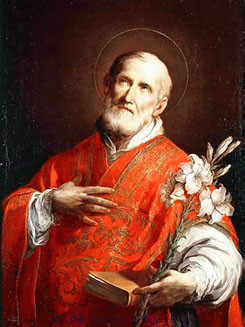
Phillip Neri (1515-1595) was born in Florence of a noble but impoverished family. He studied theology and philosophy and dedicated himself to apostolic works from his youth. Eventually he set aside his studies and founded a society to care for the sick and poor pilgrims in Rome.

He was ordained a priest in 1551, and founded the Congregation of the Oratory, the Oratorians, a group of priests dedicated to preaching and teaching. He was a great mystic, who received the gifts of prophecy and discernment of spirits. He could read the souls of penitents, and heard confessions by the hour. He was canonized some 25 years after his death along with St. Ignatius of Loyola, St. Teresa of Avila and St. Francis Xavier.

The religious crisis that took so many provinces from the Catholic Church deeply afflicted St. Phillip Neri. He suffered cruelly to see so many people being drowned in the waves of heresy. He attentively followed the maneuvers of Protestantism and planned a counter-attack against a Lutheran work of propaganda, the Magdeburg Centuries. This vast compilation was written to persuade readers that the Catholic Church had abandoned her early beliefs and practices. The multi-volume collection was filled with historical falsifications to “prove” its goal.

To counter this fabrication St. Phillip wanted a complete work of erudition to be written on the History of the Church from the time of Our Lord Jesus Christ up to his own time. He ordered the work to be done by Cesar Baronius, an Oratorian who would succeed him as Superior of the Oratory in 1593 and made a Cardinal in 1596.

Baronius alleged that he was unworthy and lacked the competence for such a great work; but St. Phillip was inflexible and ordered him under religious obedience to undertake the project. He spent close to 30 years to write it (1588–1607), covering the time up to the 12th century. This collection was called Ecclesiastical Annals. It was completed after his death.

The heresy felt the blow. The errors of the anti-Catholic Magdeburg Centuries became evident as the work of Baronius eclipsed it. The Ecclesiastical Annals contributed powerfully to stem the growing tide of Protestantism in Europe. From Baronius' work the Catholic Church emerged as she had always been, as the pillar of truth.

Comments of Prof. Plinio:

St. Phillip Neri was a man with a universal Catholic sense. He was not just interested in realizing a personal work, which certainly was important – the foundation of the Congregation of the Oratory – but he had a general concern for the Catholic Church as a whole. He was personally offended by Protestants attacking the Church through a work that was meant to be monumental – the Magdeburg Centuries. Actually it was a monumental lie. The Protestants, as heretics who hated the Church, fabricated another history of the Church full of untruths and slanders, with the specific purpose of denigrating the good name of the Catholic Church and separating her from the faithful.

These Protestants were from the same family of souls as the Pharisees, who produced false witnesses to condemn the Lamb of God. Analogously, in the beginning of the Church, groups of Jews moved by hatred against her spread many apocrypha documents – false gospels or epistles attributed to the Apostles – in order to confuse Catholics and induce them toward heresies. Until today, from time to time, the discussion of the apocrypha documents resurfaces trying to sabotage the Gospels.

Also after Protestantism, and in its wake, some authors of the Encyclopedia spread countless lies regarding the past of the Church. This in many ways was continued by Michelet in the 19th century. Today, these revolutionary authors lost credibility and their lies are universally recognized in scholarly milieus, even though they still influence badly those who do not have access to good historical sources. So, it was and still is a rule of the enemies to falsify history in order to slander Holy Mother Church.

When St. Phillip Neri saw the evil results that the Centuries of Magdeburg was having by favoring the spread of Protestantism, he decided to counter-attack. He chose the only way possible which was to make a gigantic work of erudition. A work using the best documents dating from the very beginning of the Church up to his own time, that would present the incontestable reality of the facts. To do this work he chose one of his most capable disciples, Baronius. After some hesitations Baronius dedicated some 30 years of his life to this job and the result was the Ecclesiastical Annals, one of the most serious works of all times. The work of Baronius stands forever as a point of reference for any serious historical study. His work pulverized the supposed “scientific” work of the Protestants who were left completely discredited.

The root of this work was St. Phillip Neri's amplitude of vision, his love of the Church, and his counter-revolutionary zeal.

An analogous work was made by Fr. Cornelius a Lapide from the Society of Jesus. He received an order to study all the interpretations of the Sacred Scriptures that existed, analyze them, refute the wrong ones, explain the good ones and give the best sources for each of them. Again, it was a counter-revolutionary work to destroy the pseudo-scientific Protestant interpretations which were polluting the atmosphere of piety and studies in the 16th and 17th centuries. Fr. Cornelius a Lapide wrote his monumental Commentaries to the Sacred Scriptures encompassing all its books from Genesis to the Apocalypse. To this date it is one of the most – if not the most – complete ensemble of Exegesis that the Catholic Church has. It is an everlasting source of erudition and piety for historians, preachers, and faithful in general.

Let us ask the great counter-revolutionary St. Phillip Neri to give us conditions to imitate him, hurting the Revolution at its head so that it can be completely destroyed and the Reign of Mary be established over its ruins.

Summa Theologica Ascension Article 3

Article 3. Whether Christ ascended by His own power?

Objection 1. It would seem that Christ did not ascend by His own power, because it is written (Mark 16:19) that "the Lord Jesus, after He had spoken to them, was taken up to heaven"; and (Acts 1:9) that, "while they looked on, He was raised up, and a cloud received Him out of their sight." But what is taken up, and lifted up, appears to be moved by another. Consequently, it was not by His own power, but by another's that Christ was taken up into heaven.

Objection 2. Further, Christ's was an earthly body, like to ours. But it is contrary to the nature of an earthly body to be borne upwards. Moreover, what is moved contrary to its nature is nowise moved by its own power. Therefore Christ did not ascend to heaven by His own power.

Objection 3. Further, Christ's own power is Divine. But this motion does not seem to have been Divine, because, whereas the Divine power is infinite, such motion would be instantaneous; consequently, He would not have been uplifted to heaven "while" the disciples "looked on," as is stated in Acts 1:9. Therefore, it seems that Christ did not ascend to heaven by His own power.

On the contrary, It is written (Isaiah 63:1): "This beautiful one in his robe, walking in the greatness of his strength." Also Gregory says in a Homily on the Ascension (xxix): "It is to be noted that we read of Elias having ascended in a chariot, that it might be shown that one who was mere man needed another's help. But we do not read of our Saviour being lifted up either in a chariot or by angels, because He who had made all things was taken up above all things by His own power."

I answer that, There is a twofold nature in Christ, to wit, the Divine and the human. Hence His own power can be accepted according to both. Likewise a twofold power can be accepted regarding His human nature: one is natural, flowing from the principles of nature; and it is quite evident that Christ did not ascend into heaven by such power as this. The other is the power of glory, which is in Christ's human nature; and it was according to this that He ascended to heaven.

Now there are some who endeavor to assign the cause of this power to the nature of the fifth essence. This, as they say, is light, which they make out to be of the composition of the human body, and by which they contend that contrary elements are reconciled; so that in the state of this mortality, elemental nature is predominant in human bodies: so that, according to the nature of this predominating element the human body is borne downwards by its own power: but in the condition of glory the heavenly nature will predominate, by whose tendency and power Christ's body and the bodies of the saints are lifted up to heaven. But we have already treated of this opinion in I, 76, 7, and shall deal with it more fully in treating of the general resurrection (XP, 84, 1).

Setting this opinion aside, others assign as the cause of this power the glorified soul itself, from whose overflow the body will be glorified, as Augustine writes to Dioscorus (Ep. cxviii). For the glorified body will be so submissive to the glorified soul, that, as Augustine says (De Civ. Dei xxii), "wheresoever the spirit listeth, thither the body will be on the instant; nor will the spirit desire anything unbecoming to the soul or the body." Now it is befitting the glorified and immortal body for it to be in a heavenly place, as stated above (Article 1). Consequently, Christ's body ascended into heaven by the power of His soul willing it. But as the body is made glorious by participation with the soul, even so, as Augustine says (Tract. xxiii in Joan.), "the soul is beatified by participating in God." Consequently, the Divine power is the first source of the ascent into heaven. Therefore Christ ascended into heaven by His own power, first of all by His Divine power, and secondly by the power of His glorified soul moving His body at will.

Reply to Objection 1. As Christ is said to have risen by His own power, though He was raised to life by the power of the Father, since the Father's power is the same as the Son's; so also Christ ascended into heaven by His own power, and yet was raised up and taken up to heaven by the Father.

Reply to Objection 2. This argument proves that Christ did not ascend into heaven by His own power, i.e. that which is natural to human nature: yet He did ascend by His own power, i.e. His Divine power, as well as by His own power, i.e. the power of His beatified soul. And although to mount upwards is contrary to the nature of a human body in its present condition, in which the body is not entirely dominated by the soul, still it will not be unnatural or forced in a glorified body, whose entire nature is utterly under the control of the spirit.

Reply to Objection 3. Although the Divine power be infinite, and operate infinitely, so far as the worker is concerned, still the effect thereof is received in things according to their capacity, and as God disposes. Now a body is incapable of being moved locally in an instant, because it must be commensurate with space, according to the division of whichtime is reckoned, as is proved in Physics vi. Consequently, it is not necessary for a body moved by God to be moved instantaneously, but with such speed as God disposes.