Evil triumphs when good men do nothing - Edmund Burke

Saturday, January 23, 2010

Some Statistics about the Church in the USA

The following is from the book "Index of Leading Catholic Indicators" by Kenneth C JOnes

These statistics are astounding and the situation in Canada and Western Europe are far worse.

"Priests: After skyrocketing from about 27,000 in 1930 to 58,000 in 1965, the number of priests in the United States thereafter dropped to 45,000 in 2002. By 2020, there will be about 31,000 priests — and only 15,000 will be under the age of 70. Right now there are more priests age 80 to 84 than there are age 30 to 34.

"Ordinations: In 1965 there were 1,575 American ordinations to the priesthood, in 2002 there were 450, a decline of 350 percent. Taking into account ordinations, deaths and departures, in 1965 there was a net gain of 725 priests. In 1998, there was a net loss of 810.

"Priest-less parishes: About 3 percent of U.S. parishes, or 549, were without a resident priest in 1965. In 2002 there were 2,928 priest-less parishes, about 15 percent of U.S. parishes. By 2020, a quarter of all parishes, 4,656, will have no priest.

"Seminaries: Between 1965 and 2002, the number of seminarians dropped from 49,000 to 4,700 — a 90 percent decrease. Without any students, seminaries across the country have been sold or shuttered. There were 596 seminaries in 1965, and only 200 in 2002. There were over three times as many total seminarians in 1930 as in 2002. There were over seven times as many religious order seminarians in 1945 as in 2002. There were over three times as many diocesan seminarians in 1945 as in 2002. There were more seminaries in 1955 than in 2002. Between 1965 and 2002, the number of U.S. diocesan seminaries decreased by 33 percent. In that same thirty seven year period, the number of U.S. religious seminaries decreased by 75 percent.

"Sisters: 180,000 sisters were the backbone of the American Catholic education and health systems in 1965. In 2002, there were 75,000 sisters, with an average age of 68. By 2020, the number of sisters will drop to 40,000 — and of these, only 21,000 will be age 70 or under. In 1965, 104,000 sisters were teaching, while in 2002 there were only 8,200 teachers. That is a reduction of about 92 percent. There were over nine times as many sisters teaching in 1945 as in 2002.

"Brothers: The number of professed brothers decreased from about 12,000 in 1965 to 5,700 in 2002, with a further drop to 3,100 in 2020. Between 1965 and 2002, the number of brothers teaching decreased by 80 percent. There were three times as many brothers teaching in 1945 as in 2002.

"Religious Orders: The religious orders will soon be virtually nonexistent in the United States. For example, in 1965 there were 5,277 Jesuit priests and 3,559 seminarians; in 2000 there were 3,172 priests and 389 seminarians. There were 2,534 OFM Franciscan priests and 2,251 seminarians in 1965; in 2000 there were 1,492 priests and 60 seminarians. There were 2,434 Christian Brothers in 1965 and 912 seminarians; in 2000 there were 959 Brothers and 7 seminarians. There were 1,148 Redemptorist priests in 1965 and 1,128 seminarians; in 2000 there were 349 priests and 24 seminarians. Every major religious order in the United States mirrors these statistics of decline.

"High Schools: Between 1965 and 2002 the number of diocesan high schools fell from 1,566 to 786. At the same time the number of students dropped from almost 700,000 to 386,000. There were more private Catholic high schools in 1945 than in 2002. There were more than twice as many diocesan high schools in 1945 as in 2002.

"Parochial Grade Schools: There were 10,503 parochial grade schools in 1965 and 6,623 in 2002. The number of students plummeted from 4.5 million to 1.9 million. There were more parochial grade schools in 1930 than in 2002.

"Sacramental Life: In 1965 there were 1.3 million infant baptisms, in 2002 there were 1 million. There were more infant baptisms in 1955 than in 2002. (In the same period the number of Catholics in the United States rose from 45 million to 65 million.) In 1965 there were 126,000 adult baptisms — converts — in 2002 there were 80,000. In 1965 there were 352,000 Catholic marriages, in 2002 there were 256,000. There were more Catholic marriages in 1950 than in 2002. There were extremely few annulments in the U.S. in 1968. In 1968 there were 338 annulments, in 2002 there were 50,000. Jones quotes the highly respected canon lawyer Edward Peters from his November, 1996 Homiletic and Pastoral Review article Annulments in America: "According to the 1994 Catholic Almanac, 59,220,000 American Catholics make up 6.2% of the world's 949,578,000 Catholic population. In 1991, the U.S. accounted for 63,900 (79%) of the world's 80,700 annulments."

"Mass attendance: A 1958 Gallup poll reported that 74 percent of Catholics went to Sunday Mass in 1958. A 1994 University of Notre Dame study found that the attendance rate was 26.6 percent. A more recent study by Fordham University professor James Lothian concluded that 65 percent of Catholics went to Sunday Mass in 1965, while the rate dropped to 25 percent in 2000."

Jones points out that "Mass attendance of U.S. Catholics fell precipitously in the decade following the liturgical changes and has continued to decline ever since." "This decline" he writes, "is not an isolated phenomenon, confined solely to the Church in America. In England and Wales, the time pattern of Mass attendance has been just as bad, perhaps even worse."

Jones' next point is critical: "Church attendance of Protestants, in contrast, has followed a much different path. For most of the period it was without any discernable trend, either up or down. In recent years it has actually risen. The notion that the Catholic fall off was simply one part of a larger societal trend, therefore, receives absolutely no support in these data."

But these sad statistics may even miss the worse news. That news is that the actual spiritual state of the remaining "Catholics" may be even more weakened than these miserable, falling numbers reveal. That is because those reduced numbers of "Catholic" people are still baptizing their fewer babies, are still going to deficient Novus Ordo Masses, and are still following the graduates of homosexualized seminaries. They are led by priests and religious who probably do not, doctrinally, believe what the Catholic Church requires them to believe. In other words, even these positive numbers — drastically reduced though they are — may be extremely soft because these positive "Catholics" may be practical Protestants, or even profoundly non-Christian in their beliefs.

Only 10 percent of lay religion teachers, Jones writes in citing a 2000 Notre Dame poll, accept Catholic Church teaching on artificial birth control. Although even Vatican II taught that the Eucharist was the source and summit of the Catholic faith, a New York Times/CBS poll revealed that 70 percent of Catholics age 18-44 believe the Eucharist is merely a "symbolic reminder" of Jesus. How ironic that the post-Vatican II freefall from the faith even left behind what good Traditional teaching could be gleaned from the sometimes ambiguous Council documents.

Jones presents the following data compiled from the National Catholic Reporter of October 29, 1999:

PERCENTAGE OF CATHOLICS WHO BELIEVE A PERSON CAN BE A GOOD CATHOLIC WITHOUT PERFORMING THE FOLLOWING ACTIONS:

1999

Without going to Church every Sunday: 77

Without obeying Church teaching on birth control: 72

Without obeying Church teaching on divorce and remarriage: 65

Without obeying Church teaching on abortion: 53

Without believing that in the Mass the bread and wine actually become the Body and Blood of Jesus: 38

Without their marriage being approved by the Catholic Church: 68

Without donating their time or money to help the poor: 56

Without donating their time or money to help the parish: 60

Without believing that Jesus physically rose from the dead: 23

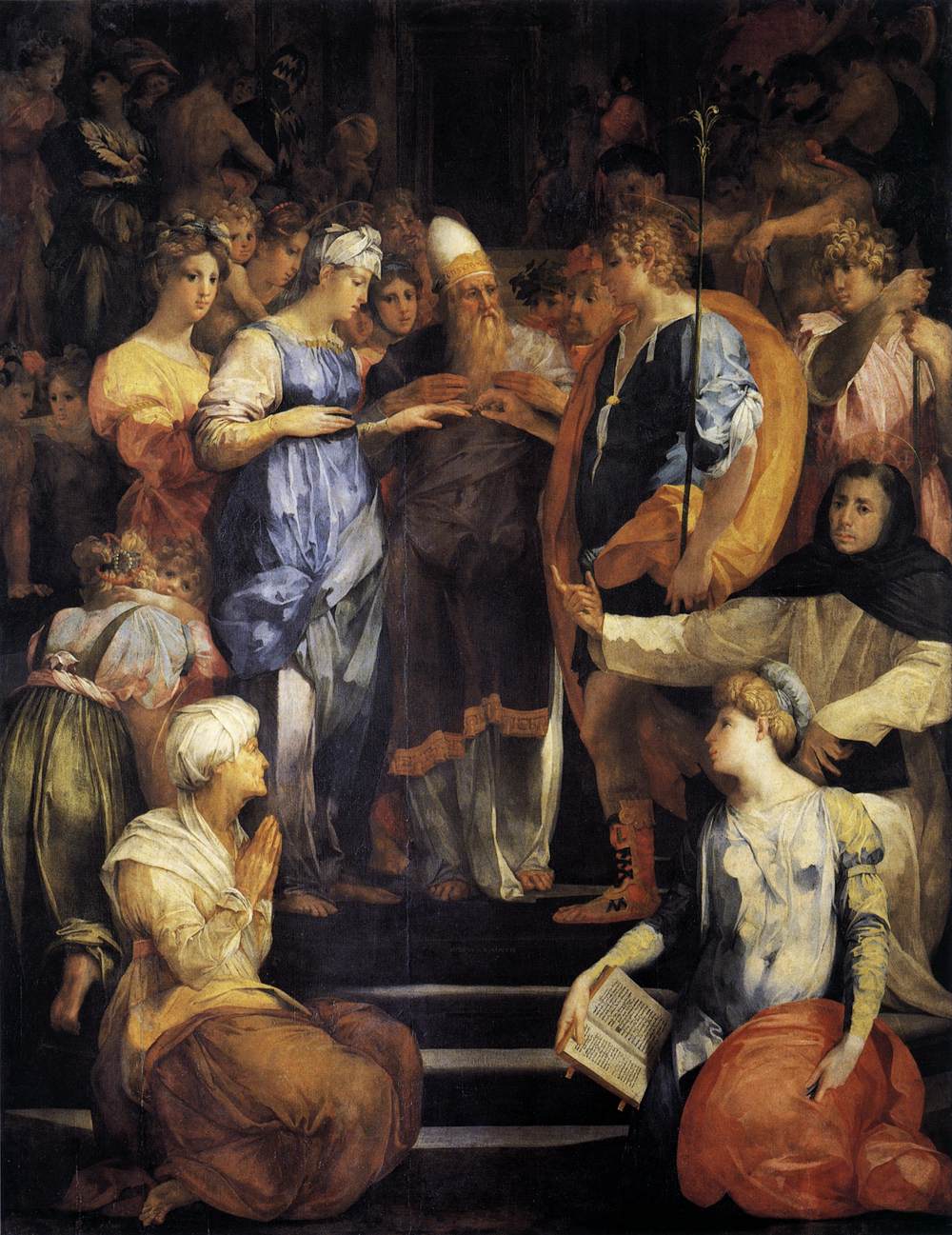
Betrothal of the Virgin - 23rd january 2010


Maybe instead of a lot of text let us look and take in the beauty and sublimity of this situation.


Friday, January 22, 2010

Saint Vincent of Saragossa - 22nd January 2010

Saint Vincent was archdeacon of the church at Saragossa, Spain. Valerian, the bishop, was prevented from preaching by a speech impediment, and named Vincent to preach in his stead. He answered in the bishop’s name when, during the persecution of Diocletian, both were brought before Dacian, the presiding officer. When the bishop was sent into banishment, Vincent was retained, to suffer and to die.

First he was stretched on the rack; and when he was almost torn asunder, Dacian asked him in mockery “how he fared now.” Vincent answered, with joy on his countenance, that he had always prayed to be as he was then. It was in vain that Dacian struck the executioners and goaded them on in their savage work. The martyr’s flesh was torn with hooks; he was bound to a chair of red-hot iron; lard and salt were rubbed into his wounds; and amid all this he kept his eyes raised to heaven, and remained unmoved.

The holy martyr was cast into a solitary dungeon, his feet placed in the stocks; but the Angels of Christ illuminated the darkness, and assured Vincent that he was near his triumph. His wounds were now ordered to be tended, to prepare him for fresh torments, and the faithful were permitted to gaze on his mangled body. They came in troops, kissed his wounds and carried away as relics, cloths colored with his blood. Before the tortures could resume, Saint Vincent’s hour came, and he breathed forth his soul in peace.

Even the dead bodies of the Saints are precious in the sight of God, and the hand of iniquity cannot touch them. A raven guarded the body of Vincent where it lay flung upon the earth. When it was sunk out at sea, the waves cast it ashore; and his relics are preserved to this day in the Augustinian monastery at Lisbon, for the consolation of the Church of Christ.

Thursday, January 21, 2010

From a treatise On Virgins by Saint Ambrose

Too young to be punished, yet old enough for a martyr's crown

Today is the birthday of a virgin; let us imitate her purity. It is the birthday of a martyr; let us offer ourselves in sacrifice. It is the birthday of Saint Agnes, who is said to have suffered martyrdom at the age of twelve. The cruelty that did not spare her youth shows all the more clearly the power of faith in finding one so young to bear it witness.
There was little or no room in that small body for a wound. Though she could scarcely receive the blow, she could rise superior to it. Girls of her age cannot bear even their parents’ frowns and, pricked by a needle, weep as for a serious wound. Yet she shows no fear of the blood-stained hands of her executioners. She stands undaunted by heavy, clanking chains. She offers her whole body to be put to the sword by fierce soldiers. She is too young to know of death, yet is ready to face it. Dragged against her will to the altars, she stretches out her hands to the Lord in the midst of the flames, making the triumphant sign of Christ the victor on the altars of sacrilege. She puts her neck and hands in iron chains, but no chain can hold fast her tiny limbs.
A new kind of martyrdom! Too young to be punished, yet old enough for a martyr’s crown; unfitted for the contest, yet effortless in victory, she shows herself a master in valour despite the handicap of youth. As a bride she would not be hastening to join her husband with the same joy she shows as a virgin on her way to punishment, crowned not with flowers but with holiness of life, adorned not with braided hair but with Christ himself.
In the midst of tears, she sheds no tears herself. The crowds marvel at her recklessness in throwing away her life untasted, as if she had already lived life to the full. All are amazed that one not yet of legal age can give her testimony to God. So she succeeds in convincing others of her testimony about God, though her testimony in human affairs could not yet be accepted. What is beyond the power of nature, they argue, must come from its creator.
What menaces there were from the executioner, to frighten her; what promises made, to win her over; what influential people desired her in marriage! She answered: “To hope that any other will please me does wrong to my Spouse. I will be his who first chose me for himself. Executioner, why do you delay? If eyes that I do not want can desire this body, then let it perish.” She stood still, she prayed, she offered her neck.
You could see fear in the eyes of the executioner, as if he were the one condemned; his right hand trembled, his face grew pale as he saw the girl’s peril, while she had no fear for herself. One victim, but a twin martyrdom, to modesty and to religion; Agnes preserved her virginity, and gained a martyr’s crown

Baby on who was to be taken off life support moves leg

There have been good and bad days for Isaac and Rebecka May these past three months; Wednesday was a good day.

First, their baby son — on the same day he was initially scheduled to be removed from life support — moved his legs in a way they hadn’t seen before, raising them to his stomach in alternating fashion.

“And (Isaiah) was wiggling his body as he was doing it, and moving his hands and his arms — just like you would see any other baby move,” 23-year-old mother Rebecka said by phone from Edmonton.

“It gives us hope.”

Second, the young family received a flood of support for the legal bid they launched earlier this week to keep their son on life support until they feel they know for certain what his medical future holds.

“Hopeful and confident — we have so much support out there,” she said, adding people are stopping and wishing them well. “It’s been very encouraging and uplifting for us. We are very humbled by it.”

On Tuesday, the couple from Rocky Mountain House, Alta., won a reprieve from the courts for their son. Last week, the first-time parents received a letter indicating doctors would take Isaiah off life support at 2 p.m. Wednesday.

The Mays are seeking 90 days to assess Isaiah’s condition in order to see if it improves and to explore alternatives. They are also seeking a second opinion.

Alberta Health Services are looking for a decision to be made within 30 days.

The board’s lawyer has said caregivers at Stollery Children’s Hospital in Edmonton have also been under considerable stress about the medical and ethical decision.

“It is appropriate to turn now to the courts for direction,” the health board said in a statement.

A judge is expected to make a decision about such a timeline on Jan. 27.

“The lawyers representing Alberta Health Services and the doctor who has primary care for Isaiah, they are professionals I very much respect and I know that we are working on this from a team perspective,” said the couple’s lawyer, Rosanna Saccomani.

Isaiah was born on Oct. 24, 2009, with his umbilical cord wrapped around his neck in the Rocky Mountain House hospital following a 40-hour labour.

Deprived of oxygen and having inhaled amniotic fluid and fecal matter, he was taken by air ambulance to Stollery Children’s Hospital, where he has been on a ventilator ever since. He is fed through an IV tube.

Rebecka and Isaac have been told that their son has severe and irreversible brain damage.

Link http://www.vancouversun.com/health/Alberta+parents+hopeful+life+support+moves+legs/2465732/story.html

St. Agnes - 21st January 2010

St. Agnes was born in Italy and lived in Rome in the 3rd Century. She was only 12 or 13 years old when she gave her life willingly to Christ.

Agnes was a beautiful girl and many men wanted to marry her. She refused them all because she wanted to remain a virgin and declared "Christ as her bridegroom."

This got her into a lot of trouble, because Christians were being persecuted and killed for declaring their faith. One of the men who wanted to marry Agnes was so upset by her declaration that he reported her faith to the government.

The governor threatened her with torture and it was said that she looked at the instruments of torture calmly. Before that he sent her to a house of prostitution to be tempted. The men who saw her there were afraid to touch her because they saw her courage. It is said one man looked at her with lust in his heart and he was struck blind. Agnes was said to have prayed for him and he regained his sight. The governor would not be outdone, he saw that she could not be persuaded to give up her faith, so he ordered her executed. St. Ambrose wrote that Agnes went to her execution more cheerfully than some go the their weddings.

The name Agnes means lamb. Often used as a sign of gentleness and innocence. She died in 304 and is the Patroness of young girls.

Wednesday, January 20, 2010

St. Fabian - 20th Jan 2010 - Alternate feast

An Alternate feast today is that of St. Fabian.

When St Cyprian had learnt of Pope Fabian’s death, he sent this letter to the presbyters and deacons of Rome (250AD):
When the report of the departure of the excellent man, my colleague, was still uncertain among us, my beloved brethren, and I was wavering doubtfully in my opinion on the matter, I received a letter sent to me from you by Crementius the sub-deacon, in which I was fully informed of his glorious end; and I rejoiced greatly that the integrity of his administration had been matched by the nobility of his end.
I greatly congratulate you that you honour his memory with so public and illustrious a testimony, through which you have made known to me not only the memory of your bishop, which confers glory upon you, but also an example of faith and strength that I should follow.
For just as the fall of a bishop tends to bring about the ruinous fall of his followers, so it is a useful and helpful thing when, by the firmness of his faith, a bishop becomes manifest to his brethren as an object of imitation.
Before receiving the above letter, the Church of Rome wrote to Cyprian, bearing witness to its steadfastness in persecution:
The church stands in faith, even though some have been driven to fall by sheer terror, whether because they were people of some eminence or that, when they were seized, they were overwhelmed by the fear of man. We did not abandon these people, although they were separated from us, but exhort them, and exhort them still, to repent, so that they may somehow receive pardon from Him who is able to pardon them, and so that they should not, by being deserted by us, become worse.
So you see, brethren, that you ought to do the same, so that even those who have fallen may be brought to their senses by your exhortation, and confess, if they are seized once more, and so make amends for their former sin. You have other duties too, which we have added here. For example, if anyone who has fallen into this temptation begins to be taken with sickness, and repents of what he has done, and desires communion, it must be granted to them in any case. And if you have widows or bedridden people who cannot maintain themselves, or people who are in prison or otherwise excluded from their own dwellings, they must always have someone to minister to them. Moreover, catechumens who are taken ill should not be disappointed in their hopes, but should also be given help.
The brethren who are in chains greet you, as do the elders and the whole Church, which also, with the deepest anxiety, keeps watch over all who call on the Lord. And we too ask that you in your turn should remember us.

St. Sebastian - 20th january 2010


Biographical selection:

We must picture to ourselves a young soldier, who tears himself away from all the ties of his home at Milan, because the persecution there was too tame, whereas at Rome it was at its fiercest. He trembles with anxiety at the thought that perhaps some of the Christians in the capital may be losing courage. He has been told that at times some of the Emperor’s soldiers, who were soldiers also of Christ, have gained admission into the prisons, and have roused up the sinking courage of the confessors. He is resolved to go on a like mission, and hopes that he may also receive the blessing of martyrdom.

He reaches Rome, he is admitted into the prisons, and encourages to the martyrdom such as had been shaken by the tears of those who were so dear to them. Some of the gaolers, converted by witnessing his faith and his miracles, become martyrs themselves; and one of the Roman Magistrates asks to be instructed in a religion that can produce such men as this Sebastian. He has won the esteem of the Emperors Diocletian and Maximian Hercules for his fidelity and courage as a soldier; they have loaded him with favors. This gives him an influence in Rome, which he so zealously turns to the advantage of the Christian religion that the holy Pope Caius calls him the Defender of the Church.

After sending innumerable martyrs to Heaven, Sebastian at length wins the crown he had so ardently desired. He incurs the displeasure of Diocletian by confessing himself a Christian. The heavenly King, for whose sake alone he had put on the helmet and soldier’s cloak, was to him above all Emperors and Princes. He is handed over to the archers of Mauritania, who strip him, bind him, and wound him from head to foot with their arrows. They let him for dead, but a pious woman named Irene took care of him, and his wounds were healed. Sebastian again approaches the Emperor, who orders him to be beaten to death in the circus, near the imperial palace.
Defender of the Church, as the Vicar of Christ called thee, lift up thy sword and defend her now. Prostate her enemies, and frustrate the plots they have laid for her destruction. Let her enjoy one of those rare periods of peace during which she prepares for fresh combats. Obtain Christian soldiers, engaged in just wars, the blessing of the God of Hosts.
From The Liturgical Year by Dom Prosper Gueranger, O.S.B.

Comments of Prof. Plinio:

One can take important historic information from this eloquent selection about St. Sebastian by D. Guéranger. St. Sebastian was a young military man living in Milan who resolved to go to Rome to help the Catholics who were in prison awaiting their execution. It is easy to imagine that many, for different reasons, would have feared martyrdom.

There were two kinds of Catholics who faced martyrdom. First, we have the true martyrs who faced death and considered it an honor to die for the Church. But, second, we have those who were called lapsi, the ones who became afraid to die and denied the faith. After that shameless sin, some returned to the catacombs to ask forgiveness, and remained there spreading their cowardice to those around them. The number of martyrs was great; but the number of lapsi was also high, and the latter exerted a bad influence over the ensemble.

Therefore, those early Christians who were in prison waiting to die in the arena ran the serious risk of apostasy. This is why Catholics who belonged to the imperial army, protected by their military condition, used to go to the prisons and encourage the prisoners, stimulate them to remain firm, and speak with them about the things of faith to give them confidence.

St. Sebastian, therefore, went to the very center of the persecution with the intention of helping the prisoners. He obviously realized he was exposing himself to the persecution. He was known by the Emperors and was chosen by them to be commander of the Praetorian Guard, a very powerful military unit that defended the Emperor. The commander of this guard not only directed this division, but he exercised a strong influence over the whole army; he was something like a Minister of Defense.

Notwithstanding his position, St. Sebastian confronted the Emperor. When questioned, he defended the Catholic Faith. For this reason he was taken to the famous column where he was bound and shot with countless arrows. He survived, and later had another trial and was condemned to death. This time he died.

You can imagine the young man, with the aura of the grandeur, power, and prestige of commander of the Praetorian Guard, going by night to the prisons looking for the Catholics in order to encourage them. He addresses with charity some old man and women here, several youth there, persons of all social conditions. He stimulates them to persevere, to stand firm in the good position, to be eager to meet Our Lord soon.

He knew, naturally, that his action would be denounced and bring martyrdom for himself also. But he tranquilly faced such a risk, he who was accustomed to face risks. He faced it with that superior deliberation of a man who had chosen to take up the Cross of Our Lord Jesus Christ. He did not tremble, he did not hesitate, he always remained master of himself, always heroic. During the two martyrdoms he suffered, he sustained this same tranquil attitude: the serenity of a soldier facing death, the soldier of Our Lord and of Our Lady.

The glory of St. Sebastian is the glory of the warrior. It is the glory of the hero who exchanged the risk of the war to face the higher risk of the arena. He did so tranquilly and led many souls to Heaven; and finally, he became a martyr himself.

We should ask St. Sebastian for the understanding of the moral profile of the Catholic hero. We should also ask him to obtain from Our Lady the grace of defeating the false piety that presents the saints to us in a sentimental and fake way.

Tuesday, January 19, 2010

New Archbishop for Mosul Iraq

Archbishop Emil Shimoun Nona, whose election as the archbishop of Mosul of the Chaldeans was confirmed Nov. 13 by Benedict XVI, was officially installed in the archeparchy Sunday.
The 2008 wave of violence claimed the life of the former archbishop of Mosul of the Chaldeans, Archbishop Paulos Faraj Rahho.

He was kidnapped in February of that year outside of a church where he had led the Way of the Cross on a Lenten Friday. During the kidnapping, his three companions were killed.

For days there was no news from the archbishop or his kidnappers. Finally, after a phone call from the assailants, the prelate's body was found March 13 in a shallow grave. He was 65.

The election of Archbishop Nona took place according to the tradition in the Eastern-rite Churches. The synod of bishops of the Chaldean Church made the decision, which was then approved by the Pope.

Sunday's ceremony for Archbishop Nona was attended by several political and Muslim leaders.

Please note that Christians in this part of the world are severely persecuted, so please keep them in your prayers

New Secretary for College of Cardinals

On October 21, Most Rev Manuel Monteiro de Castro, Apostolic Nuncio Emeritus to Spain and preset Secretary for the Congregation of Bishops was appointed Secretary for the College of Cardinals.

I missed this news early so im just updating it.

St Thomas of Cori - 19th January 2010

Born in Cori (Latina) on June 4, 1655, Thomas knew a childhood marked by the premature loss first of his mother and then of his father, thus being left alone at the age of 14 to look after his younger sister. Shepherding sheep, he learned wisdom from the simplest things. Once his sister was married, the youth was free to follow the inspiration that for some years he had kept in the silence of his heart: to belong completely to God in the Religious Life of a Franciscan. He had been able to get to know the Friars Minor in his own village at St. Francis convent. Once his two sisters were settled in good marriages and he was rendered free of all other preoccupations, he was received into the Order and sent to Orvieto (PG) to fulfill his novitiate year. After professing his vows according to the Rule of St. Francis and completing his theological studies, he was ordained to the priesthood in 1683. He was immediately nominated vice master of novices at Holy Trinity convent in Orvieto, since his superior recognized at once his gifts.
After a short time, Fr. Thomas heard of the hermitages that were beginning to bloom in the Order and the intention of the superiors of the Roman Province to inaugurate one at the convent at Civitella (today Bellegra). His request was accepted, and the young friar thus knocked at the door of the poor convent in 1684, saying, "I am Fr. Thomas of Cori, and I come here to become holy!" In speech perhaps distant from ours, he expressed his anxiousness to live the Gospel radically, after the spirit of Saint Francis.
From then, Fr. Thomas lived at Bellegra until death, with the exception of six years in which he was Guardian at the convent of Palombara, where he initiated the Hermitage modeled after the one at Bellegra. He wrote the Rule first for one and then for the other, observing it scrupulously aid consolidating by word and example the new institution of the two Hermitages.
The long years spent at Saint Francis of Bellegra can be summed up in three points:
Prayer
St. Thomas of Cori was surely - as is said of St. Francis - not so much a man who prayed as a man who became prayer. This dimension animated the entire life of the founder of the Hermitage. The most evident aspect of his spiritual life was undoubtedly the centrality of the Eucharist, as attested by St. Thomas in his celebration of the Eucharist, which was intense and attentive, and in the silent prayer of adoration during the long nights at the Hermitage after the Divine Office, celebrated at midnight. His life of prayer was marked by a persistent aridity of spirit. The total absence of sensible consolation in prayer and in his life of union with God was protracted for a good 40 years, finding him always serene and total in living the primacy of God. Truly, his prayer was configured as a remembrance of God that made concretely possible a unity of life, notwithstanding his manifold activities.
Evangelization
St. Thomas did not close himself up in the Hermitage, forgetting the good of his brothers and sisters, and the heart of the Franciscan vocation, which is apostolic. He was called with good reason the Apostle of Sublacense (the Subiaco region), having crossed the territory and its villages with the indefatigable proclamation of the Gospel, in the administration of the sacraments and the flowering of miracles at his passage, a sign of the presence and nearness of the Kingdom. His preaching was clear and simple, convincing and strong. He did not climb the most illustrious pulpits of his time; his personality was able to give its best in an ambit restricted to our territory, living his Franciscan vocation in littleness and in the concrete choice of the poorest.
Exquisite charity
St. Thomas of Cori was to his brothers a very gentle father. In face of the resistance of some brothers before his will to reform and his radicality in living the Franciscan ideal, the Saint knew how to respond with patience and humility, even finding himself alone to mind the convent. He had understood well that every true reform initiates itself.
The considerable correspondence that is here annexed demonstrates St. Thomas' attention to the smallest expectations and needs of his Friars, and of numerous friends, penitents and Friars who turned to him for his counsel. In the convent, he demonstrated his spirit of charity in his availability for every necessity, even the most humble.
Rich in merits, he fell asleep in the Lord on January 11, 1729. St. Thomas of Cori shines among us and in Rome, of which he is the co-patron, above all in his thirst for a Christian and Franciscan ideal that is pure and lived in its essentials. A provocation for all of us not to take lightly the Gospel and its all-encompassing exigencies.

Monday, January 18, 2010

St. Charles of Sezze - 18th January 2010

Charles thought that God was calling him to be a missionary in India, but he never got there. God had something better for this 17th-century successor to Brother Juniper.

Born in Sezze, southeast of Rome, Charles was inspired by the lives of Salvator Horta and Paschal Baylon to become a Franciscan; he did that in 1635. Charles tells us in his autobiography, "Our Lord put in my heart a determination to become a lay brother with a great desire to be poor and to beg alms for his love."

Charles served as cook, porter, sacristan, gardener and beggar at various friaries in Italy. In some ways, he was "an accident waiting to happen." He once started a huge fire in the kitchen when the oil in which he was frying onions burst into flames.

One story shows how thoroughly Charles adopted the spirit of St. Francis. The superior ordered Charles — then porter — to give food only to traveling friars who came to the door. Charles obeyed this direction; simultaneously the alms to the friars decreased. Charles convinced the superior the two facts were related. When the friars resumed giving goods to all who asked at the door, alms to the friars increased also.

At the direction of his confessor Charles wrote his autobiography, The Grandeurs of the Mercies of God. He also wrote several other spiritual books. He made good use of his various spiritual directors throughout the years; they helped him discern which of Charles’ ideas or ambitions were from God. Charles himself was sought out for spiritual advice. The dying Pope Clement IX called Charles to his bedside for a blessing.

Charles had a firm sense of God’s providence. Father Severino Gori has said, "By word and example he recalled in all the need of pursuing only that which is eternal" (Leonard Perotti, St. Charles of Sezze: An Autobiography, page 215).

He died at San Francesco a Ripa in Rome and was buried there. Pope John XXIII canonized him in 1959.

Terrorist mastermind of plot to bomb Toronto to spend at least 6 years in prison

Terrorist mastermind of plot to bomb Toronto to spend at least 6 years in prison

(CP) – 1 hour ago

BRAMPTON, Ont. — The "directing mind" of a terrorist bomb plot that a judge said would have killed many people and perhaps changed the lives of all Canadians forever will spend at least the next six years in prison.

Zakaria Amara, 24, a co-leader of the Toronto 18 plot to set off bombs outside the CSIS and Toronto Stock Exchange buildings in downtown Toronto and at a military base in Ontario, pleaded guilty in October and was sentenced today.

Amara will be under supervision for life but will be eligible to seek parole in 2016.

Ontario Superior Court Justice Bruce Durno said Amara's "spine-chilling" plot would have been "the most horrific crime Canada has ever seen."

You have got to be kidding me, only 6 years????? and then they will keep a watch on him. What if they lose him? Are they going to monitor his phone and email and letters? Such terrorists need to be deported back to wherever they came from.

Saturday, January 16, 2010

St Marcel - 16th January 2010

Saint Marcel was chief bishop and pope of Rome. He went to chastise and reprove Maximian the emperor of this, that he was over cruel to christian people. And the emperor had of him so great despite that he made of the house of a good woman, of which Saint Marcel had made a church, the said emperor made it a stable for horses, and in the place where Saint Marcel had sung mass, the emperor made him to keep his horse, in which service Saint Marcel was all his life after, and in that service Saint Marcel died holily the year of the incarnation of our Lord two hundred and four score and seven.

Friday, January 15, 2010

St. Paul the Hermit - 15th January 2010

St. Paul (229-342) was born in Lower ThebaĂŻd, Egypt. At age 22 during the persecution of Emperor Decius, he learned that his brother-in-law, who wanted to confiscate his estate, was planning to report him as a Christian to the pagan authorities. Paul fled, taking refuge in the desert. After the danger abated, he decided to remain a hermit.

At the end of his life, St. Anthony visited him in his cave in the desert and found an exemplar of what a holy man should be. He lived as an anchorite for more than 90 years.

His life in the desert, however, should not lead us to think that the contemplation of God left him uninterested in the glorious battles of the Church. No one walks securely on the road leading to God if he is not united to the Spouse whom Christ chose and established as the column and fundament of Truth. Among the children of the Church, those called to be most closely united to her are the contemplatives, since they traverse the sublime, arduous roads where many dangers lurk.

From the depths of his cave, Paul, enlightened by divine inspiration, followed the battles of the Church against Arianism. He was an admirer of St. Athanasius and united to those who defended that the Word was co-substantial with the Father. He asked St. Antony, to whom he left his own tunic, to bury him with the tunic of St. Athanasius, which St. Antony had received as a gift from the Patriarch of Alexandria.

Comments of Prof. Plinio:

These are good commentaries on St. Paul, the first hermit. The selection focuses on the nobility of the eremitic state, which consists of living alone in the desert making elevated meditations that seem far removed from human affairs, and, therefore, from the fight between Good and Evil.

Actually, the personal fight of the hermit between his ordered passions directed by reason and his disordered passions directed by the Devil are not antithetical to the fight. The selection clearly shows that those contemplative hermits, by special enlightenment from God, had a clear notion of the merit of the fight of the Church in their times.

The contemplative and active lives are profoundly harmonic, which can be seen in the life of St. Paul the Hermit. From the depths of his cave where he lived isolated and dedicated to meditating on the things of God, he also followed in spirit the battles of the great St. Athanasius. When he died, he asked to be buried in the tunic of St. Athanasius to manifest his enthusiasm for the battles that the great warrior was waging against Arianism. This episode illustrates how the external apostolate is linked to the interior life, how the active life is linked to the contemplative.

There is yet another consideration that can be made about the eremitic state. When speaking of it, one usually emphasizes the sacrifice and strength of will it takes to separate oneself from earthly things and be alone. In effect, the desire to talk and be with others is never so strong as when one is alone. Human nature is made in such a way that when we are with others for a long time, we want to be alone; but after we are alone for a time, we want to be among others. So, one of the greatest glories of the eremitic state would be to live alone and in silence.

This is true in a certain way. But there is another aspect of the eremitic state to consider. Its nobility lies not just in remaining silent, but also in speaking with God. Speaking with God should be understood not as having continuous apparitions and revelations, but in keeping the spirit occupied with things of God, profound thoughts, elevated aspirations, noble causes. It is to be familiar with the highest cogitations of the human spirit, which are religious thoughts. This is, in my opinion, the excellence of the eremitic state, what constitutes its principal adornment and highest respectability.

From a certain point of view, a man in the eremitic state practices the virtue of respect above all others. For the hermit nothing is small, without importance, or trivial. He understands the highest reasons for which each thing was created and its sacred, august character. When he speaks, his voice is like a bronze bell, grave and serious, calling men to the highest cogitations of the spirit.

This is what the modern world is lacking more than anything else. The modern man completely lacks the virtue of respect. He lacks respect for himself and things because he rejected this spirit and embraced triviality and banality. He only likes transitory, concrete things that offer an immediate pleasure.

The eremitic state is, on the contrary, a way of living where a man is like a flaming torch of gravity and respect. Respect for God, above all, but also respect for himself and for every created thing as it reflects God. This is what I think is the glory of the eremitic state.

We should ask St. Paul the Hermit to pray for us to have an understanding of and desire for this virtue, because without the virtue of respect, neither moral perfection nor sanctity exists.

Thursday, January 14, 2010

St. Felix of Nola - 14th January 2010

St. Felix of Nola lived in Italy in the days of the Roman persecutions. He survived, however, and went on to earn his crown as one of the early Christian ascetics.

What we know about him comes mostly from St. Paulinus of Nola, bishop of the diocese of Nola a century later, who wrote many poems in praise of Felix. Some of the biographical details may well be folkloric, but here is the basic outline of his priestly career.

A native of Nola, near Naples, Felix was the second son of a Syrian-born father. His brother joined the imperial army. Felix, however, found his joy (the name "Felix" means "happy") in the service of the Lord. Having given his belongings to the poor, he was ordained a priest by St. Maximus, the then bishop of Nola.

Now, in the year 250, Roman Emperor Decius launched a thorough persecution of Christians. Bishop Maximus, knowing that he was marked for death, followed the scriptural admonition and went into hiding, entrusting the diocesan administration to Felix. The Roman constables, failing to discover the bishop, took out their frustration on his administrator. They scourged Felix viciously and then jailed him in a cell that was in itself an instrument of torture.
One night, however, an angel appeared to Father Felix and commanded him to go to his bishop, since he was gravely ill. Thereupon the priest's shackles fell off and the door of his prison came unlocked. Hastening to Maximus's side, Felix decided to carry him off on his shoulders to his home in Nola, where at the moment he could apparently escape detection. There a kindly old woman nursed him back to health.

Felix himself then had to take to flight, now to one hideout, now to another, ever pursued by government agents. One day as they drew near, he managed to crawl into a hole in a ruined wall. There he was protected by spiders much as Jesus was during the flight into Egypt, according to the old legend. No sooner had he entered the hiding place when the spiders quickly wove a screen of cobwebs across the opening. The pursuers saw the hole, but passed on. Nobody could be inside, they concluded, because the web was intact.

The priest of Nola was living in a dry well when Decius' persecution was called off. Maximus died soon afterward, and his flock agreed as one man that Felix should succeed him as bishop. Felix declined the office, however, and persuaded the people to accept Quintus, a senior priest of the diocese. He could now have pressed the government to restore his personal property that it had confiscated, yet he did not take that step, because it contradicted his ideal of poverty. Retaining only a small plot of land, he set up a sort of hermitage, cultivating the land and sharing its produce with the needy. His constant practice was to give to the poor anything extra. When a friend made him a present of a second coat, for instance, he would give away the better garment and retain the inferior one. Sometimes, indeed, he gave a pauper his own good suit and donned the pauper's rags. Having thus led a life of joyous self-denial, he was hailed at his death as unquestionably a saint.

The tomb of Felix at Nola became the focus of international pilgrimage. When Paulinus was installed as bishop of Nola many decades later, miracles were still being wrought at the saint's shrine. Some of the wonders he recorded in his writings he himself had witnessed. Many Christians chose to be buried close to Felix's tomb, hoping that they might have a better chance of mounting to heaven if they were near him at the resurrection.

Paulinus meanwhile became a bit worried about the theology of the intercessory power of the saints. How could they know, he asked St. Augustine, that we on earth were praying to them? The great theologian calmed his fears. God, he says, reveals to them that we are asking their intercession. Then they turn to God to pray on our behalf.

Whether we pray, then, to St. Felix or to any others who live in God's presence, we may be sure that the message gets through!

Wednesday, January 13, 2010

St. Hilary of Poitiers - 13th January 2010

HILARY, Bishop of Poitiers (Pictaviurn), the place of his birth, was b. early in the fourth century; d. 366. He shone like a clear star alongside of the great champions of the Nicene Creed, - Athanasius, Basil, and the two Gregories. Among the teachers of the West of his day lie was beyond dispute the first, and bore a strong resemblance to Tertullian, both in disposition and scientific method. He employed an elegant Latin style. His parents were Pagans, and of high social standing. Hilary enjoyed fine facilities for education. In the introduction to his treatise on the Trinity he describes the stages a Pagan passes through in reaching the knowledge of God, which heathen philosophy reveals dimly, Christianity clearly. This description evidently depicts his own experience. lIe had reached the years of manhood when he professed Christianity. A statement of uncertain value speaks of his wife and daughter as following him. About the year 350 the popular voice called him to the bishopric of Poitiers.

The times were times of conflict. The Emperor Constantius determined to make Arianism the prevailing creed of the West, as it had become of the East. This end he endeavored to secure by intimidating the bishops. Hilary placed himself in antagonism to the emperor, and devoted all his energies to resist the spread of Arianism. His persuasions induced a number of the Gallic bishops to refuse communion with the Arian bishop of Arles, - Saturninus; and in a letter to the emperor (355) he calls upon him to desist from his policy of coercion. At the Council of Beziers (356), presided over by Saturninus, the Arians were in the majority, and silenced Hilary by their tumult when he arose to defend the Nicene faith. A few months afterward he was banished to Phrygia, where his leisure was employed hi studies of the Greek language and literature, and in making himself acquainted with the parties and doctrines of the Eastern Church. In 359 he wrote his work on synods (De Synodis), - an historical survey of the confessions of the Eastern Church, with a definition of his own position. The best product of the exile (359 or 360) was a treatise on the Trinity (Lib. XII. de Trinitate). Aroused by the Arian decrees of the Council of Constantinople (360), he wrote a second letter to Constantius, offering to defend his faith publicly before him and a synod. The court did not grant his proposal, but, deeming that he was doing more mischief in the East than he could do in Gaul, ordered him back to Poitiers.

On his return, Hilary was regarded as the champion of the Nicene faith. The Council of Paris (361), under his lead, excommunicated Saturninus. He now sought to clear Italy of Arianism, and appeared suddenly at Milan, to prefer charges against its bishop, Auxentius. The latter, however, stood in high favor with the emperor, and Hilary was driven out of the city. he explained his course in this matter in a work against Auxentius (365). According to Sulpicius Severus (Chron. ii. 45), he died the following year.

Hilary was one of the most conspicuous and original characters of early Christianity. His distinguishing characteristics were fidelity to the church creed, acuteness in argument, and resolution in action. He knew no fear. He wielded a keen sword when he defended apostolic truth against heretics, or vindicated the prerogatives of the Church against the encroachments of the civil power. Yet, when the differences concerned non-essentials, he displayed a conciliatory disposition. His power lay essentially in his thorough acquaintance with the Scriptures. His earliest literary labor was a Commentary on Matthew, and one of the latest an Exposition of the Psalms. His other exegetical works are lost. Much to be regretted is the loss of his collection of hymns which the Spanish churches used.

His work on the Trinity is a scriptural confirmation of the philosophic doctrine of the divinity of Christ, and is of permanent value. It was not a mere restatement of traditional orthodoxy, but a fresh and living utterance of his own experience and study. In the discussion of the co-essentiality of the Son, Hilary lays emphasis on the Scripture titles and affirmations, and especially on his birth from the Father, which he insists involves identity of essence. In the elaboration of the divine-human personality of Christ, he is more original and profound. The incarnation was a move went of the Logos towards humanity in order to lift humanity up to participation in the divine nature. It consisted in a self-emptying of himself, and the assumption of human nature. In this process lie lost none of his divine nature; and, even during the humiliation, he continued to reign everywhere in heaven and on earth. Christ assumed body, soul, and spirit, and passed through all stages of human growth, his body being really subject to pain and death. Redemption is the result of Christ’s voluntary substitution of himself, out of love, in our stead. Between the God-man and the believer there is a vital communion. As the Logos is in the Father, by reason of his divine birth, so we are in him, and become partakers of his nature, by regeneration and the sacraments of baptism and the Lord’s Supper.

The christology of Hilary is full of fresh and inspiring thoughts, which deserve to be better known than they are. He was created a doctor of the Catholic Church by Pius IX., at the synod of Bordeaux, 1851.

The Fatima Children Are Shown Hell

The Fatima Children Are Shown Hell

In 1917, during World War I and that "hell on earth," the Virgin Mary appeared to three children at Fatima, Portugal on the 13th of the month from May through October. During here appearance on July 13th, 1917, she showed these three young children, ages 7 to 10, a vision of Hell.

Lucia, who is still alive today [R.I.P. Feb. 13, 2005], the Blessed Virgin Mary opened her hands, and "rays of light seemed to penetrate the earth, and we saw as it were a sea of fire. Plunged in this fire were demons and souls in human form, like transparent burning embers, all blackened or burnished bronze, floating about in the conflagration, now raised into the air by the flames that issued from within themselves together with great clouds of smoke, now falling back on every side like sparks in huge fires, without weight or equilibrium, amid shrieks and groans of pain and despair, which horrified us and made us tremble with fear. (It must have been this sight which caused me to cry out, as people say they heard me.)

The demons could be distinguished by their terrifying and repellent likeness to frightful and unknown animals, black and transparent like burning coals. Terrified and as if to plead for help, we looked up at Our Lady, who said to us so sadly: "You have seen Hell where the souls of poor sinners go. Thus, when you say the rosary, say after each mystery: O my Jesus, forgive us our sins, save us from the fires of Hell and lead all souls to Heaven, especially those most in need of Thy Mercy." After this vision, the children lived dramatic lives of sacrifice and penance for sinners so that sinners might be converted and saved from the fires of Hell that God had shown them through His Heavenly prophetess.

Tuesday, January 12, 2010

Toronto 2010 Lift Jesus Higher Rally

Every year i attend this rally, it gives me a chance to see a lot of catholics and meet up with some friends who i only get to meet every year at the rally only. If you are going to attend please leave me a note so we can meet at the rally.

Saturday, April 24, 2010
8:30 a.m. to 6:00 p.m.

Metro Toronto Convention Centre
North Building
255 Front Street West


For more details click here

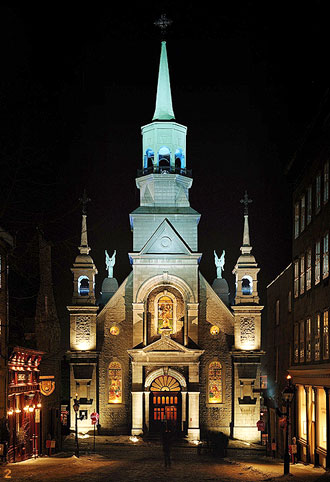
Notre-Dame-de-Bon-Secours


(Notre-Dame-de-Bon-Secours)