Evil triumphs when good men do nothing - Edmund Burke

Thursday, January 22, 2009

St. Vincent - 22 January 2009

When Jesus deliberately began his “journey” to death, Luke says that he “set his face” to go to Jerusalem. It is this quality of rocklike courage that distinguishes the martyrs.

Most of what we know about this saint comes from the poet Prudentius. His Acts have been rather freely colored by the imagination of their compiler. But St. Augustine, in one of his sermons on St. Vincent, speaks of having the Acts of his martyrdom before him. We are at least sure of his name, his being a deacon, the place of his death and burial.

According to the story we have (and as with some of the other early martyrs the unusual devotion he inspired must have had a basis in a very heroic life), Vincent was ordained deacon by his friend St. Valerius of Saragossa in Spain. The Roman emperors had published their edicts against the clergy in 303, and the following year against the laity. Vincent and his bishop were imprisoned in Valencia. Hunger and torture failed to break them. Like the youths in the fiery furnace (Book of Daniel, chapter three), they seemed to thrive on suffering.

Valerius was sent into exile, and Dacian now turned the full force of his fury on Vincent. Tortures that sound like those of World War II were tried. But their main effect was the progressive disintegration of Dacian himself. He had the torturers beaten because they failed.

Finally he suggested a compromise: Would Vincent at least give up the sacred books to be burned according to the emperor’s edict? He would not. Torture on the gridiron continued, the prisoner remaining courageous, the torturer losing control of himself. Vincent was thrown into a filthy prison cell—and converted the jailer. Dacian wept with rage, but strangely enough, ordered the prisoner to be given some rest.

Friends among the faithful came to visit him, but he was to have no earthly rest. When they finally settled him on a comfortable bed, he went to his eternal rest.

Wednesday, January 21, 2009

St. Agnes - 21st January 2009

Today we celebrate the feast of St. Agnes , let us read and contemplate what Dr. Plinio has to say about this great saint.

Biographical selection from St. Ambrose, On Virgins, Book II:

St. Ambrose speaks with great admiration of St. Agnes, who was martyred at the tender age of 12. In his work, On Virgins, he wrote: “This is a new kind of martyrdom! One not yet of fit age for punishment, but already ripe for victory. One unready for combat, but able to win the crown. One who has not yet reached the age of judgment but who has mastered virtue ....

“Joyfully she advances with unhesitating step to the place of punishment, her head not adorned with plaited hair, but with Christ. All weep; she alone is without a tear. All wonder that she is so ready to deliver her life, which she has not yet enjoyed, but which now she gives up as though she had lived it fully. All are astounded that she stands forth as God’s witness although at her age she could not yet decide about herself! And so it came about that what she said regarding God was believed, although what she said about man would not be accepted. For that which is beyond nature is from the Author of nature. ....

“She stands, she prays, she bends down her neck. You can see the executioner tremble, as though he himself has been condemned. His right hand is shaking, his face grows pale. He fears the peril of another, while the maiden fears not for her own danger. You have then in one victim a twofold martyrdom, of chastity and religion. She both remained a virgin and she obtained martyrdom."


Comments of Prof. Plinio:

St. Ambrose’s commentary on St. Agnes has a literary value that is both profound and very beautiful because it is all composed of contrasts. Through the use of these contrasts, St. Ambrose shows the points he wants to emphasize.

First, there is the contrast between her age and the martyrdom. She is too young to be condemned to death because at such a young age no one can deserve such a punishment. And yet she is already ripe for the victory. The one who is not mature in years is nonetheless ripe to win the victory. It is a glory. The immaturity of the years and maturity of the virtue.

The second contrast: She is unready for combat, but ripe for the crown. A young girl at that time did not have any conditions to fight, yet she won the highest of all the laurels, which is the crown of martyrdom.

The third contrast: She is so young that she is still under the guardianship of others. The law does not consider her capable of governing herself. All present admired her because she was a witness of the Godhead, even though she was still a minor who could not be a witness of anything in a court of human law. Her word would not have any value in a normal process of law, yet she has impressed everyone with her defense of Our Lord.

In addition to this, there are the contrasts that one can find in the actual martyrdom. She advances joyfully, with unhesitating step, to the place from which all people naturally flee.

Another contrast: her adornment is not artificially plaited tresses but rather Jesus Christ, because He is the true adornment, the real beauty of the soul who consecrates itself to Him.

Another contrast: she is not crowned with flower wreaths like the other young Roman girls of her time, but with purity. That purity in her is splendorous and makes a kind of halo around her head.

There are still other contrasts. All are weeping to see a young girl who will be killed. But she is not. It is a glorious contrast, because she is thirsting for Heaven, and not for earth. Along those lines, everyone is astonished that she can so easily give up a life that has hardly begun. Yet she sacrifices this life as if she had already lived and enjoyed it fully.

And what is the reason for all these contrasts? It is because St. Ambrose is trying to emphasize that there is something absurd in her martyrdom. For it would be natural for her to do the very opposite of what she is doing. The reason that she acts as she does with a strength that is beyond nature is because such strength can only come from the Author of nature itself. What is beyond nature is what is more that the merely natural. What is more than nature here is the One who is its author. God revealed Himself in the sanctity of St. Agnes and in the miracle of her death.

She goes forward and bends her head. She sees the executioner trembling as if he were the one who was condemned. But she – the condemned one – is calm and steady.

His right hand is shaking, his face pale. He fears the peril of another, while the maiden fears not for her own danger. The executioner trembles with fear to use the tools of punishment. But she has no fear of the executioner.

You have then in one victim a twofold martyrdom, of chastity and religion. She both remained a virgin and she obtained martyrdom.

This is the magnificent commentary of St. Ambrose on St. Agnes.

Tuesday, January 20, 2009

Euthanasia Laws in Kerela India oppsed by Catholic church

I found this article online

Church leaders in Kerala state, southern India, are up in arms against the state government's move to legalize euthanasia.

Media reports said the Kerala Law Reforms Commission has prepared a draft bill for legalizing euthanasia as one of its recommendations for legal reform. If the state government, a coalition of communist parties, accepts it, Kerala will become India's first state to legalize euthanasia.

The Kerala Catholic Bishops' Council has publicly opposed the move, releasing statements in the media since media reported on the draft bill in the last week of December.

The council's Family Commission chairman, Bishop Mathew Anikuzhikattil of Idukki, said the Church would use all democratic means to oppose legislation allowing euthanasia.

About 100 representatives from all 29 Catholic dioceses met on Jan. 14 in Kochi, the state's commercial center, 2,960 kilometers south of New Delhi, to discuss the draft bill. They protested the bill by burning a copy of it.

Having read the draft, Bishop Anikuzhikattil said legally sanctioning such a practice is "anti-humane and against basic principles of Christian faith." The commission is scheduled to submit the report of its recommendations to the government on Jan. 24, but it was released to media in advance.


For more details refer to the entire article here

Please pray for India and the Catholics there the catholic church is really facing a crisis in India.

Pope St. Fabian - 20th January 2009

"It is said that Fabian, after the death of Anteros, came from the country along with others and stayed at Rome, where he came to the office in a most miraculous manner, thanks to the divine and heavenly grace. For when the brethren were all assembled for the purpose of appointing him who should succeed to the episcopate, and very many notable and distinguished persons were in the thoughts of many, Fabian, who was there, came into nobody's mind. But all of a sudden, they relate, a dove flew down from above and settled on his head as clear imitation of the descent of the Holy Ghost in the form of a dove upon the Savior; whereupon the whole people, as if moved by one divine inspiration, with all eagerness and with one soul cried out "worthy," and without more ado took him and placed him on the episcopal throne."

According to the prosaic "Liber Pontificalis," Fabian was a Roman, the son of Fabius. He appointed seven deacons to the seven districts of Rome. He ordered subdeacons to cooperate with the notaries in gathering the acts of the martyrs. He brought back the body of St. Pontian from Sardinia and buried it in the Cemetery of Calixtus. This cemetery was enlarged and beautified. Vaults were adorned with paintings. A church rose above the cemetery. Later writers attributed all kinds of regulations to the busy time of Pope Fabian. Gregory of Tours, the famous historian of the Franks, even credits Fabian with starting the evangelization of Gaul. This is manifestly false because the Church existed in Gaul before the time of Fabian, but it is probable enough that he did something for the Gallic Church.

All this activity was made possible by the peace which the Church enjoyed at this time. The first half of the third century was in general a period of peace. Septimius Severus, at the beginning of the century, and Maximinus, just before Fabian's reign, had been persecutors, but they were exceptions. After the death of the ex-wrestler Maximinus, his successors Papienus, Balbinus, and Gordianu had left the Christians pretty much alone. And Philip who murdered and succeeded Gordian was himself a Christian-- of sorts. Philip, though he presided at pagan games, was quite friendly to the Christians, and during his reign Christianity flourished. Fabian's activity has been noted; and at the same time Gregory, the wonder-worker, bishop of Neo-Caesarea, Cyprian, bishop of Carthage, the great Origen, and others were writing to create Christian literature. It looked as if the Church were going to burst out of the catacombs to flourish in the light of day.

But the pagans were angry. Even before the death of Emperor Philip in 249 there had been isolated outbreaks against the Christians. The pagans bitterly resented Christian growth, and when Decius succeeded Philip as emperor, that resentment mounted the throne. Decius was on principle a determined and ruthless enemy of the Christian name. Septimius Severus had tried to stop conversions; Maximinus had gone after the leaders. Decius issued an edict ordering all Christians to deny Christ by some tangible sign such as offering incense to idols. The storm hit a church softened by peace. On all sides many hastened to deny Christ, but there were many too who stood up and faced the worst tortures and death for Him. Among these was St. Fabian. The details of his martyrdom are lacking, but it is historically certain. He is buried in the Cemetery of Calixtus. His feast is kept on January 20.

In the catacombs of St. Callistus, the stone that covered Fabian’s grave may still be seen, broken into four pieces, bearing the Greek words, “Fabian, bishop, martyr.”

Monday, January 19, 2009

Fra Angelico


My favourite Catholic painter is Fra Angelico. Today we will read up a bit of history of this Saint Paniter before we go into contemplating his paintings.


The life of Fra Giovanni da Fiesole, baptized as Guido di Piero (born around 1395 in Vicchio di Mugello, died in Rome in 1455) is the stuff of legend. “Angelic” was how he came to be known soon after his death; the name “Beato” was a comment on his painting and not a reference to his beatification, which happened only recently, in 1984.


Fra Angelico was a Dominican, and a mendicant, so, not being part of a closed order, he was free to meet and talk to others in the city. In 1420-1422, he entered the convent of San Domenico in Fiesole with his brother Benedetto. It was here that he produced his first works: altarpiece for the high altar, Altarpiece of the Annunciation, The Coronation of the Virgin, as well as the frescoes for his monastery.


On June 23, 1983, Pope John Paul II granted official cultus to Fra Angelico, who is now a Blessed with an office, a mass and obligatory memory (and now Patron of Artists)


Fra Angelico not only gained recognition as a painter, but must have commanded respect in his convent because he was appointed Vicario for the first time in Fiesole from 1432/33, a post he was to hold frequently in later years.


In the 1430’s the painter worked in Florentine churches. He carried out the following commissions for the Dominicans in Cortona: the Cortona Triptych and the Annunciation panel. From 1438, he worked on his most important commission, the San Marco Altarpiece and the frescoes for the convent of San Marco in Florence.


In July 1445 Fra Angelico was summoned by Eugenius IV to Rome, where he painted frescoes in the chapel of Santissimo Sacramento, which was later destroyed under Pope Paul III. For Eugenius’ successor, Pope Nicholas V, he painted the frescoes of St. Stephen and St. Lawrence between 1447 and 1449 with the assistance of Benozzo Gazzoli (1420-1497), in the Capella Niccolina in the Vatican, named after the Pope who commissioned the frescoes.


In the summer of 1447, he began work on the frescoes in the Capella di San Brizio (10), in the cathedral at Orvieto. These were competed by Luca Signorelli fifty years later. From 1450-1452, he returned to his old convent in Fiesole as Prior, before going for one last time to Rome, where he died on 18 February 1455. He is buried in Santa Maria sopra Minerva, where his grave has always drawn worshippers. After his beatification by Pope John Paul II in 1984, the headstone was placed on a plinth and surrounded by a bronze grille with floral motifs. His feast day is 18 February, the day of his death.

Sunday, January 18, 2009

Catholic Art

Today we will start a new chapter in this blog. We will look, contemplate and learn from great Catholic art.
In the middle ages, Catholics learnt about Christ and the bible from the sermons of the saints, the stained glass on the cathedrals and the paintings by painters like Giotto di Bondone, Fra Angelico etc etc.
We wont just be admiring paintings, we will look at the details and let those details touch our souls and lift us up to Christ who is the artist extraordinaire.
Two Paintings, Two Mentalities, Two Doctrines

(The Virgin and Child by the Maitre de Moulins)
(The Virgin and Child by Rouault)

Indulge in an exercise of fantasy, and suppose that by rewinding the thread of bygone centuries it has become possible for you to return to the time of Christ and walk into a room of the Holy Family's humble dwelling in Nazereth.
Imagine that you find the Virgin playing with the Child, and that both were just as Rouault depicted them in the painting on the upper right. Would such a sight fulfill your expectations? Would it correspond to what you might have hoped from the Mother of God and the Word Incarnate Himself? Would you find in those images the authentic expression of the Christian spirit and the ineffable virtues of Jesus and Mary?

Obviously not.
Therefore, whoever earnestly wants that Christian art worthily and duly reflect the spirit of the Gospel cannot be indifferent to paintings of this nature becoming widespread among the faithful. What kind of impression would people have of the Holy Family if nothing else were shown to them but paintings of this ilk? As far as it is able, Christian art has the role of an accessory to the spreading of sound doctrine. The spirit of this painting cannot be deemed proper for that end.
In order to illustrate these affirmations better, look at the painting by the Maitre de Moulins (fifteenth century), which also portrays the Virgin and Child, and consider how efficacious it is in helping us understand, through the senses, what the Church teaches about Jesus and Mary.
(Clik on both images for a larger view)


St. Charles of Sezze - 18th January 2009


Born in Sezze, southeast of Rome, Charles was inspired by the lives of Salvator Horta and Paschal Baylon to become a Franciscan; he did that in 1635. Charles tells us in his autobiography, "Our Lord put in my heart a determination to become a lay brother with a great desire to be poor and to beg alms for his love."

Charles served as cook, porter, sacristan, gardener and beggar at various friaries in Italy. In some ways, he was "an accident waiting to happen." He once started a huge fire in the kitchen when the oil in which he was frying onions burst into flames.

One story shows how thoroughly Charles adopted the spirit of St. Francis. The superior ordered Charles — then porter — to give food only to traveling friars who came to the door. Charles obeyed this direction; simultaneously the alms to the friars decreased. Charles convinced the superior the two facts were related. When the friars resumed giving goods to all who asked at the door, alms to the friars increased also.

At the direction of his confessor Charles wrote his autobiography, The Grandeurs of the Mercies of God. He also wrote several other spiritual books. He made good use of his various spiritual directors throughout the years; they helped him discern which of Charles’ ideas or ambitions were from God. Charles himself was sought out for spiritual advice. The dying Pope Clement IX called Charles to his bedside for a blessing.

Charles had a firm sense of God’s providence. Father Severino Gori has said, "By word and example he recalled in all the need of pursuing only that which is eternal" (Leonard Perotti, St. Charles of Sezze: An Autobiography, page 215).

He died at San Francesco a Ripa in Rome and was buried there. Pope John XXIII canonized him in 1959.

Saturday, January 17, 2009

Cardinal Cañizares Llovera - Holy Communion on the tongue

One of the first interviews with Cardinal Cañizares Llovera, the new Prefect of the Congregation for the Divine Worship, dealt with Communion on the Tongue

"No, it is not just a matter of form. What does it mean to receive communion in the mouth? What does it mean to kneel before the Most Holy Sacrament? What dies it mean to kneel during the consecration at Mass? It means adoration, it means recognizing the real presence of Jesus Christ in the Eucharist; it means respect and an attitude of faith of a man who prostrates before God because he knows that everything comes from Him, and we feel speechless, dumbfounded, before the wondrousness, his goodness, and his mercy. That is why it is not the same to place the hand, and to receive communion in any fashion, than doing it in a respectful way; it is not the same to receive communion kneeling or standing up, because all these signs indicate a profound meaning. What we have to grasp is that profound attitude of the man who prostrates himself before God, and that is what the Pope wants."

St Anthony of Egypt - 17th January 2009


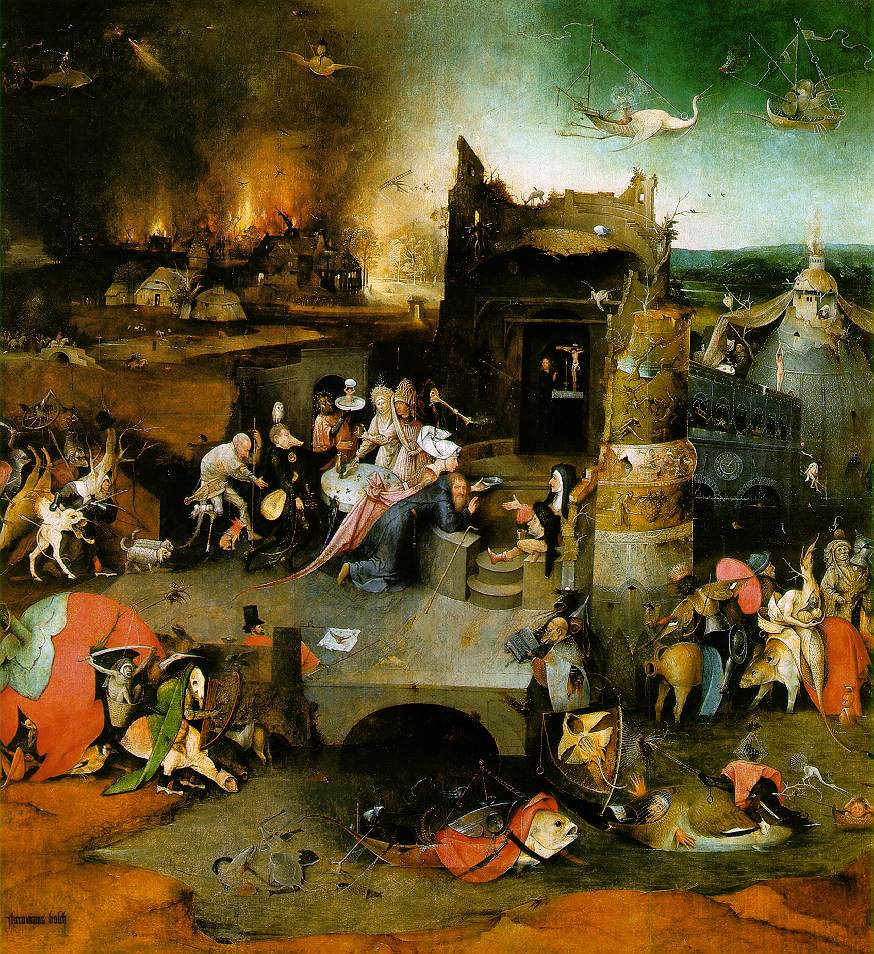
(The Temptation of St. Anthony (ca. 1500) by Hieronymous Bosch (1450-1516)

St. Anthony was born in 251 in a small village in Egypt. When he was twenty years old, his parents died. They left him a large estate and placed him in charge of the care of his younger sister. Anthony felt overwhelmed and turned to God in prayer. Gradually he became more and more aware of the power of God in his life. About six months later, he heard this quotation of Jesus from the Gospel: "Go, sell what you own and give the money to the poor, and you will have treasure in heaven" (Mark 10:21). He took the words as a personal message in answer to his prayer for guidance. He sold most of his possessions keeping only enough to support his sister and himself. Then he gave the rest of the money to people who needed it.

Anthony's sister joined a group of women living a life of prayer and contemplation. Anthony decided to become a hermit. He begged an elderly hermit to teach him the spiritual life. Anthony also visited other hermits so he could learn each one's most outstanding virtue. Then he began his own life of prayer and penance alone with God.

When he was fifty-five, Anthony built a monastery to help others. Many people heard of him and sought his advice. He would give them practical advice such as: "The devil is afraid of us when we pray and make sacrifices. He is also afraid when we are humble and good. He is especially afraid when we love Jesus very much. He runs away when we make the Sign of the Cross."

St. Anthony visited Paul the hermit whose feast is celebrated on January 15. He felt enriched by the example of Paul's holy life.

At 60, he hoped to be a martyr in the renewed Roman persecution of 311, fearlessly exposing himself to danger while giving moral and material support to those in prison. At 88, he was fighting the Arian heresy, that massive trauma from which it took the Church centuries to recover. “The mule kicking over the altar” denied the divinity of Christ.

Anthony is associated in art with a T-shaped cross, a pig and a book. The pig and the cross are symbols of his valiant warfare with the devil—the cross his constant means of power over evil spirits, the pig a symbol of the devil himself. The book recalls his preference for “the book of nature” over the printed word. Anthony died in solitude at 105.

Friday, January 16, 2009

Churchgoing linked to lower suicide risk

That is the headline of this article right here on the Washington Times.
Note that it makes a difference between being spiritual and going the church. Read the article for the specifics.

St. Berard and Companions - 16th January 2009

Today we celebrate the feast of St. Berard and Companions.

Six Franciscan friars accepted from St. Francis of Assisi an assignment to go to Morocco. They were to announce Christianity to the Muslims. Friars Berard, Peter, Adjutus, Accursio and Odo traveled by ship in 1219. Morocco is in the northwest corner of Africa and the journey was long and dangerous. The group arrived at Seville, Spain. They started preaching immediately, on streets and in public squares. People treated them as if they were crazy and had them arrested. To save themselves from being sent back home, the friars declared they wanted to see the sultan. So the governor of Seville sent them to Morocco.
The sultan received the friars and gave them freedom to preach in the city. But some of the people did not like this. They complained to the authorities. The sultan tried to save the friars by sending them to live in Marrakech, on the west coast of Morocco. A Christian prince and friend of the sultan, Dom Pedro Fernandez, took them into his home. But the friars knew that their mission was to preach the faith. They returned to the city as often as they could. This angered some people who did not want to hear the friars' message. These complaints angered the sultan so much that one day when he saw the friars preaching, he ordered them to stop or leave the country. Since they did not feel justified about doing either one, they were beheaded right then and there. It was January 16, 1220.
Dom Pedro went to claim the bodies of the martyrs. Eventually he brought their relics to Holy Cross Church in Coimbra, Portugal. The friars' mission to Morocco had been brief and an apparent failure.
These were the first Franciscan martyrs. When Francis heard of their deaths, he exclaimed, "Now I can truly say that I have five Friars Minor!"
But the results were surprising. The story of these heroes fired the first Franciscans with the desire to be missionaries and martyrs too. It was their particular witness that inspired a young man to dedicate his life to God as a Franciscan priest. We know him as St. Anthony of Padua. His feast day is June 13.
These five martyrs were canonized in 1481.

Thursday, January 15, 2009

St. Paul the Hermit - 15th January 2009


Today we read the life of St Paul the Hermit as commented on by Dr. Plinio Correa.

Biographical selection:

St. Paul (229-342) was born in Lower Thebaïd, Egypt. At age 22 during the persecution of Emperor Decius, he learned that his brother-in-law, who wanted to confiscate his estate, was planning to report him as a Christian to the pagan authorities. Paul fled, taking refuge in the desert. After the danger abated, he decided to remain a hermit.

At the end of his life, St. Anthony visited him in his cave in the desert and found an exemplar of what a holy man should be. He lived as an anchorite for more than 90 years.

His life in the desert, however, should not lead us to think that the contemplation of God left him uninterested in the glorious battles of the Church. No one walks securely on the road leading to God if he is not united to the Spouse whom Christ chose and established as the column and fundament of Truth. Among the children of the Church, those called to be most closely united to her are the contemplatives, since they traverse the sublime, arduous roads where many dangers lurk.

From the depths of his cave, Paul, enlightened by divine inspiration, followed the battles of the Church against Arianism. He was an admirer of St. Athanasius and united to those who defended that the Word was co-substantial with the Father. He asked St. Antony, to whom he left his own tunic, to bury him with the tunic of St. Athanasius, which St. Antony had received as a gift from the Patriarch of Alexandria.

Comments of Prof. Plinio:

These are good commentaries on St. Paul, the first hermit. The selection focuses on the nobility of the eremitic state, which consists of living alone in the desert making elevated meditations that seem far removed from human affairs, and, therefore, from the fight between Good and Evil.

Actually, the personal fight of the hermit between his ordered passions directed by reason and his disordered passions directed by the Devil are not antithetical to the fight. The selection clearly shows that those contemplative hermits, by special enlightenment from God, had a clear notion of the merit of the fight of the Church in their times.

The contemplative and active lives are profoundly harmonic, which can be seen in the life of St. Paul the Hermit. From the depths of his cave where he lived isolated and dedicated to meditating on the things of God, he also followed in spirit the battles of the great St. Athanasius. When he died, he asked to be buried in the tunic of St. Athanasius to manifest his enthusiasm for the battles that the great warrior was waging against Arianism. This episode illustrates how the external apostolate is linked to the interior life, how the active life is linked to the contemplative.

There is yet another consideration that can be made about the eremitic state. When speaking of it, one usually emphasizes the sacrifice and strength of will it takes to separate oneself from earthly things and be alone. In effect, the desire to talk and be with others is never so strong as when one is alone. Human nature is made in such a way that when we are with others for a long time, we want to be alone; but after we are alone for a time, we want to be among others. So, one of the greatest glories of the eremitic state would be to live alone and in silence.

This is true in a certain way. But there is another aspect of the eremitic state to consider. Its nobility lies not just in remaining silent, but also in speaking with God. Speaking with God should be understood not as having continuous apparitions and revelations, but in keeping the spirit occupied with things of God, profound thoughts, elevated aspirations, noble causes. It is to be familiar with the highest cogitations of the human spirit, which are religious thoughts. This is, in my opinion, the excellence of the eremitic state, what constitutes its principal adornment and highest respectability.

From a certain point of view, a man in the eremitic state practices the virtue of respect above all others. For the hermit nothing is small, without importance, or trivial. He understands the highest reasons for which each thing was created and its sacred, august character. When he speaks, his voice is like a bronze bell, grave and serious, calling men to the highest cogitations of the spirit.

This is what the modern world is lacking more than anything else. The modern man completely lacks the virtue of respect. He lacks respect for himself and things because he rejected this spirit and embraced triviality and banality. He only likes transitory, concrete things that offer an immediate pleasure.

The eremitic state is, on the contrary, a way of living where a man is like a flaming torch of gravity and respect. Respect for God, above all, but also respect for himself and for every created thing as it reflects God. This is what I think is the glory of the eremitic state.

We should ask St. Paul the Hermit to pray for us to have an understanding of and desire for this virtue, because without the virtue of respect, neither moral perfection nor sanctity exists.

Wednesday, January 14, 2009

St. Felix of Nola - 14th January 2009

Today we celebrate the feast of St. Felix of Nola. Let us read what Dr. Plinio has to say the about this great saint.

(St Felix hiding in the cave protected by the spider web form the Roman Soldiers)

Biographical selection:

An account tells us that one day the Bishop of Nola, Maximus, fell to the ground exhausted from hunger and cold fleeing from his persecutors [the persecution of Decius in the 3rd century]. Felix, warned by an Angel, came to help him. He squeezed a cluster of grapes he found miraculously on a bush into the Bishop’s mouth to give him some food. Then he carried the old man on his shoulders back home. When the Bishop died, Felix was elected to succeed him.

One day when he was preaching and his persecutors were looking for him, Felix slipped through a narrow opening in the wall of a ruined house and hid there. In a trice, by God’s command, spiders spun a web across the space. The pursuers, seeing the web, thought that no one could have gone through the opening, and went on their way. Then Felix took refuge in another place and a widow brought him food for three months, but she never saw his face.

Finally peace was restored and he returned to his church, were he went to his final rest in the Lord. He was buried outside the city, in a place called Pincis.

Felix had a brother also called Felix. When the persecutors tried to make him worship the idols, he said to then: “You are the enemies of your gods; if you take me to them, I will blow upon them as my brother did, and they will be shattered.”

Some pagans came to seize Felix but were stricken with intolerable pain in their hands. They howled with the pain, and Felix said to them: “Say ‘Christ is God’ and the pain wll leave you.” They said the words and were cured.

A priest of the old gods came to him and said: “Sir, my god saw you coming and took flight. I asked him why he fled, and he answered: ‘I cannot bear this Felix’ holiness!’ Therefore, if my god fears you so much, how much more should I fear you!” Felix then instructed him and he was baptized.

Comments of Prof. Plinio:

Actually we have here a series of small charming facts that would furnish matter for comment for several evenings. I will summarize them.

Naturally, one is not obliged to believe these small stories. A person overly concerned about whether these facts really happened does not understand the point of these legends. A legend is based on a truth that is disfigured or, perhaps transfigured, by the pious imagination of the people. The lives of the saints often lack pieces of information in some points, which nonetheless provide a few historical clues about what happened. The simple people who admire the saint then start to imagine what could have happened that would explain those unexplained points in harmony with the saint’s life. So, they form a hypothesis.

This hypothesis is so beautiful that it spreads to others, who in turn repeat it over and over. It ends by being transmitted as a legend. It does not have historical precision, but often it transmits an important part of the spirit of the saint.

Something like this happened with the lives of many saints, giving birth to this true masterpiece that is The Golden Legend by Jacobus of Voragine. In addition to their historical interest – which should not be disregarded – these stories have an extraordinary moral value and a great literary beauty.

Take for example the life of St. Felix of Nola. Because of his dedication, he took on the burden of a desperate situation. Maximus Bishop of Nola, a city of Italy, is fleeing a persecution of the Roman soldiers and falls to the ground in hunger and cold. The life of this unfortunate man crosses paths with St. Felix’. St. Felix goes to him, feeds him, warms him, brings him back to his home and takes care of him, thus running the risk of being persecuted also. That is, for the love of Our Lord Jesus Christ and His Church, he took it upon himself to shelter the one who was being persecuted. This is the moral profile of St. Felix that we find depicted in The Golden Legend, which perfectly fits the moral profile of a saint.

How did the legend portray this episode? It paints St. Felix as being warned by an Angel that the Bishop needed his help. It is a beautiful scene. We can imagine St. Felix praying at his place and suddenly, a splendorous Angel appears to him, causing St. Felix to marvel. Instead of giving him a pleasant task, the Angel gives him a difficult one: “The Bishop of Nola is in need and you must go and risk your life to find and save this Bishop.” St. Felix accepts; he says “yes” to the Angel as Our Lady did to St. Gabriel.

Then he goes out, finds the half-dead man, and realizes he has no provisions to give the sick man to restore him. A cluster of grapes appears miraculously on a bush and St. Felix squeezes it to give the poor Bishop some food. The Bishop feels himself relieved not only by the juice of the grapes, but also by the tenderness and care of the man who came to assist him. The selection is not clear whether St. Maximus died soon afterward or later, but this is not what matters here. Someone could ask whether those grapes actually existed as a historical fact. I don’t know if they existed or not. Perhaps they are legend. But I think that even if they were only legend, they would be more beautiful for having been born from a Catholic piety that thirsted for the marvelous than if they had actually appeared miraculously on that bush.

Then St. Felix takes that old Bishop upon his shoulders – we can see that he was a strong man – and carries him as one who carries a great treasure. He brings the Bishop back to his home, lays him in his bed, and takes care of him.

Then – either shortly afterward or some time later – St. Maximus goes to Heaven. The people gather to mourn the dead Bishop, and choose St. Felix as his successor. Now he is no longer the one who assists the man who was persecuted. Rather, he inherits the cause of the persecution. He takes the cross of the other and carries it on his own shoulders, just as he had carried the man himself some time before. The first was persecuted because he was a Bishop; the second becomes a Bishop to be persecuted.

You can see that The Golden Legend is describing the high moral profile of St. Felix that corresponds to his actions. The essence of the legend must be true. The accidents of the Angel appearing and the miraculous grapes do not change the moral lesson the life of St. Felix gives us. It also has an extraordinary literary beauty.

Another very beautiful fact is the description of how St. Felix hid from his enemies. They were close on his tracks when he hid in the wall of a ruined house. He entered through a narrow opening and immediately afterward, a spider spun a web over the passage to mislead the persecutors. They saw the web and figured that no one could have passed through that opening for some days. So they went on, leaving the saint safe.

A man protected from terrible persecutors by a spider is extremely charming and poetic. It is a very beautiful episode. Soldiers of the Roman legion, all armed, are searching every inch of the ruined house. Inside one wall is St. Felix, hearing everything. He hears their conversation as they draw near his hiding place. When they stop close to the narrow opening, he thinks: “Now, I am lost.” Then, he hears the commander say: “Let’s not waste time searching here because there are spider webs. No one has been through this opening for some time.”

Again, even if the spider did not exist – and I am not at all sure that it didn’t – it portrays a difficult situation through which St. Felix had to pass that reflects what he had to suffer for the Church, that is, a high moral profile.

Whether these facts are true or not, they tell us that St. Felix was a great saint who left a deep mark on his time. Otherwise the people would not have preserved and passed on the memory of his life. Legend gives us a marvelous image of his life. It is a charming perspective that already has something of Heaven.

Let us pray to St. Felix, asking him to give us dedication in the service of the Church, the courage to face persecution, and the desire for Heaven and a sense of the marvelous that we glean listening to his life narrated by Blessed Jacobus of Voragine.

Tuesday, January 13, 2009

St. Hilary - 13th January 2009

This staunch defender of the divinity of Christ was a gentle and courteous man, devoted to writing some of the greatest theology on the Trinity, and was like his Master in being labeled a “disturber of the peace.” In a very troubled period in the Church, his holiness was lived out in both scholarship and controversy.

Raised a pagan, he was converted to Christianity when he met his God of nature in the Scriptures. His wife was still living when he was chosen, against his will, to be the bishop of Poitiers in France. He was soon taken up with battling what became the scourge of the fourth century, Arianism, which denied the divinity of Christ.

The heresy spread rapidly. St. Jerome said “The world groaned and marveled to find that it was Arian.” When Emperor Constantius ordered all the bishops of the West to sign a condemnation of Athanasius, the great defender of the faith in the East, Hilary refused and was banished from France to far off Phrygia. Eventually he was called the “Athanasius of the West.” While writing in exile, he was invited by some semi-Arians (hoping for reconciliation) to a council the emperor called to counteract the Council of Nicea. But Hilary predictably defended the Church, and when he sought public debate with the heretical bishop who had exiled him, the Arians, dreading the meeting and its outcome, pleaded with the emperor to send this troublemaker back home. Hilary was welcomed by his people.

Comment:

Christ said his coming would bring not peace but a sword (see Matthew 10:34). The Gospels offer no support for us if we fantasize about a sunlit holiness that knows no problems. Christ did not escape at the last moment, though he did live happily ever after—after a life of controversy, problems, pain and frustration. Hilary, like all saints, simply had more of the same.

For the works of St Hiliary please refer to the following link:


http://www.ccel.org/ccel/schaff/npnf209.toc.html


Monday, January 12, 2009

St. Marguerite Bourgeoys - 12th January 2009


On November 12, 1950 Pope Pius XII beatified Marguerite Bourgeoys. Canonizing her this October 31, 1982, Pope John Paul II gives the Canadian Church its first woman saint.

St. Marguerite Bourgeoys was born in Troyes, in the province of Champagne (France), on Good Friday, April 17, 1620. She was baptized on the same day in the church of Saint-Jean, a church that was located near her home. Marguerite was the sixth child in a family of twelve. Her parents were Abraham Bourgeoys and Guillemette Gamier, and she was privileged to grow up in a milieu that was middle class and thoroughly Christian.

Marguerite was nineteen years of age when she lost her mother. In the following year, 1640, in the course of a procession held on October 7 in honor of Our Lady of the Rosary, she had an unforgettable experience. Her eyes rested on a statue of the Blessed Virgin, and at that moment she felt inspired to withdraw from the world and to consecrate herself to the service of God. With that unchanging fidelity to what she believed to be God's will for her, a fidelity that characterized her life thenceforth, she set about to discern her specific vocation.

She registered, at once, as a member of the extern Congregation of Troyes, an association of young girls devoted to the charitable work of teaching children in the poor districts of the
town. While engaged in this apostolate she learned about the foundation of Ville Marie (Montreal) in Canada. The year was 1642, and at that time she sensed a first call to missionary life. This call was rendered concrete in 1652 when she met Monsieur de Maisonneuve, founder and governor of the settlement begun in New France, who was in search of someone who would volunteer her services for the gratuitous instruction of the French and Indian children. Our Lady confirmed the call addressed to her: "Go, I will not forsake you", she said. Thus assured, Marguerite left Troyes in February, 1653, in a spirit of complete detachment. She arrived in Montreal on the following 16th of November, and without delay she set to work to promote the best interests of the colony. She is rightly considered co-foundress of Montreal, with the nurse, Jeanne Mance, and the master designer, Monsieur de Maisonneuve.

In order to encourage the colonists in their faith expression, she arranged for the restoration of the Cross on Mount Royal after it has been destroyed by hostile Indians, and she undertook the construction of a chapel dedicated to Notre-Dame de Bon Secours. Convinced of the importance of the family in the building of this new country, and perceiving the significance of the role to be exercised by women, she devoted herself to the task of preparing those whose vocation it would be to preside in a home. In 1658, in a stable which had been given to her by the governor for her use, she opened the first school in Montreal. She also organized an extern Congregation, patterned after the one which she had known in Troyes but adapted to the actual needs. In this way, she could respond to the needs of the women and young girls on whom much depended as far as the instruction of children was concerned. In 1659, she began receiving girls who were recommended by "les cures" in France, or endowed by the King, to come to establish homes in Montreal, and she became a real mother to them. Thus were initiated a school system and a network of social services which gradually extended through the whole country, and which led people to refer to Marguerite as "Mother of the Colony".

On three occasions, Marguerite Bourgeoys made a trip to France to obtain help. As of
1658, the group of teachers who associated themselves with her in her life of prayer, of heroic poverty, and of untiring devotedness to the service of others, presented the image of a religious institute. The group was inspired by the "vie voyagere" of Our Lady, and desired to remain uncloistered, the concept of an uncloistered community being an innovation at that time. Such a foundation occasioned much suffering and the one who took the initiative was not spared. But the work progressed. The Congregation de Notre-Dame received its civil charter from Louis XIV in 1671, and canonical approbation by decree of the Bishop of Quebec in 1676. The Constitutions of the Community were approved in 1698.

The foundation having been assured, Sister Bourgeoys could leave the work to others. She died in Montreal on January 12, 1700, acknowledged for her holiness of life. Her last generous act was to offer herself as a sacrifice of prayer for the return to health of a young Sister. Forty memberg of the Congregation de Notre-Dame were there to continue her work.

The educative and apostolic efforts of Marguerite Bourgeoys continue through the commitment of the members of the community that she founded. More than 2,600 Sisters of the Congregation de Notre-Dame work in fields of action according to the needs of time and place - from school to college or university, in the promotion of family, parish and diocesan endeavours. They are on mission in Canada, in the United States, in Japan, in Latin America, in Cameroon, and most recently they have established a house in France.


Sunday, January 11, 2009

The Baptism of Our Lord Jesus Christ - 11th January 2009


The baptism of Christ Christ is bathed in light; let us also be bathed in light. Christ is baptized; let us also go down with him, and rise with him.
John is baptizing when Jesus draws near. Perhaps he comes to sanctify his baptiser; certainly he comes to bury sinful humanity in the waters. He comes to sanctify the Jordan for our sake and in readiness for us; he who is spirit and flesh comes to begin a new creation through the Spirit and water.
The Baptist protests; Jesus insists. Then John says: I ought to be baptized by you. He is the lamp in the presence of the sun, the voice in the presence of the Word, the friend in the presence of the Bridegroom, the greatest of all born of woman in the presence of the firstborn of all creation, the one who leapt in his mother’s womb in the presence of him who was adored in the womb, the forerunner and future forerunner in the presence of him who has already come and is to come again. I ought to be baptized by you: we should also add, “and for you,” for John is to be baptized in blood, washed clean like Peter, not only by the washing of his feet.
Jesus rises from the waters; the world rises with him. The heavens, like Paradise with its flaming sword, closed by Adam for himself and his descendants, are rent open. The Spirit comes to him as to an equal, bearing witness to his Godhead. A voice bears witness to him from heaven, his place of origin. The Spirit descends in bodily form like the dove that so long ago announced the ending of the flood and so gives honour to the body that is one with God.
Today let us do honour to Christ’s baptism and celebrate this feast in holiness. Be cleansed entirely and continue to be cleansed. Nothing gives such pleasure to God as the conversion and salvation of men, for whom his every word and every revelation exist. He wants you to become a living force for all mankind, lights shining in the world. You are to be radiant lights as you stand beside Christ, the great light, bathed in the glory of him who is the light of heaven. You are to enjoy more and more the pure and dazzling light of the Trinity, as now you have received – though not in its fullness – a ray of its splendour, proceeding from the one God, in Christ Jesus our Lord, to whom be glory and power for ever and ever. Amen.

Saturday, January 10, 2009

St Gregory of Nyssa - 10th January 2009


The son of two saints, Basil and Emmilia, young Gregory was raised by his older brother, St. Basil the Great, and his sister, Macrina, in modern-day Turkey. Gregory's success in his studies suggested great things were ahead for him. After becoming a professor of rhetoric, he was persuaded to devote his learning and efforts to the Church. By then married, Gregory went on to study for the priesthood and become ordained (this at a time when celibacy was not a matter of law for priests).

He was elected Bishop of Nyssa (in Lower Armenia) in 372, a period of great tension over the Arian heresy, which denied the divinity of Christ. Briefly arrested after being falsely accused of embezzling Church funds, Gregory was restored to his see in 378, an act met with great joy by his people.

It was after the death of his beloved brother, Basil, that Gregory really came into his own. He wrote with great effectiveness against Arianism and other questionable doctrines, gaining a reputation as a defender of orthodoxy. He was sent on missions to counter other heresies and held a position of prominence at the Council of Constantinople. His fine reputation stayed with him for the remainder of his life.

For the works of this saint please refer to the CCEL web site at the following link

http://www.ccel.org/ccel/schaff/npnf205.toc.html

Wednesday, January 7, 2009

St. Raymond of Penyafort - 7th January 2009

Today we celebrate the feast of St. Raymond of Penyafort. Let us contemplate about this saint through the insights of Dr. Plinio


Biographical selection:

Raymond (1175-1275) was born into a wealthy and noble family related to the royal family of Aragon. He was born at the Castle of Peñafort in Villafranca, near Barcelona, Spain, in 1175.

At age 20 he was already teaching philosophy at Barcelona. After 15 years, he resigned from that chair and went to Bologna to study civil and canon law. He received his doctorate in 1216 and occupied a first chair of canon law in the university for three years.

The city Senate, hoping to retain him in the city, presented him with special rewards for his work. However, he did not remain, because Pope Honorius III asked him to return to Spain to tutor King James I of Aragon.

He had been attracted to the Dominican Order by the preaching of Blessed Reginald, prior of Bologna, and also met St. Dominic of Gusman there. In Barcelona he received the Dominican habit in 1222. His example attracted many great personages to the Order.

During his novitiate, he asked a penance for his past vanities while teaching, and he was ordered to write a book on cases of conscience for the guidance of confessors and moralists. This work, entitled The Summa of Penitential Cases, or Summa Casuum, was the first guide of this kind to be compiled. His work was praised by Pope Clement VIII.

In 1229 Pope Gregory IX sent the Cardinal of Sabina, John of Abbeville, to Spain to convoke the princes of the region and stimulate them to continue the valiant fight against the Moors. The Cardinal invited St. Raymond, who had been his theologian and penitentiary, to be his first assistant. St. Raymond would enter a city, preach the crusade to the people, and hear confessions in order to prepare the public for the arrival of the Cardinal. Then the Cardinal of Sabina would come to bless the crusade and grant the Papal indulgences for it.

When the Cardinal of Sabina returned to Rome, he reported to the Pope the great merits of St. Raymond. Pope Gregory IX was impressed and summoned him to Rome to be his chaplain and confessor. One of the penances Raymond would give the Pope was to not delay in seeing to the needs of the poor.

Pope Gregory IX gave St. Raymond the job of ordering and codifying the canon laws of the Church. It was an immense work, since he had to rewrite and condense decrees that had been accumulating for centuries. Completed in 1234, the work remained the most authoritative compilation within the body of canon law until 1917, when a new code was published. Due to the excess of work, St. Raymond fell ill. Fearful that he would die if he remained in Rome, his physicians recommended that he return to his monastery in Barcelona.

At the request of various Bishops, he set out the ceremonial to be followed by Bishops when they visited diocesan churches. He also composed a treatise on fair price in commerce to keep merchants from stealing from the public.

One of the most brilliant rays of St. Raymond’s glory was to assist in founding the Order of Our Lady of the Mercy, or Mercedarians, for the redemption of the captives. The order was established because of a heavenly revelation made simultaneously to King James I of Aragon, St. Raymond, and St. Peter Nolasco.

To inaugurate the new Order, the King with his court and the Magistrates of the city of Barcelona assisted at solemn ceremony in the Cathedral of the Holy Cross. Bishop Berengarius said the Holy Mass, and St. Raymond delivered the sermon in which he described the triple heavenly revelation ordering the founding of the new order. At the Offertory the King and St. Raymond presented St. Peter Nolasco to the Bishop as its first superior and he received the new habit from the Bishop. In his turn, St. Peter received thirteen nobles as the first members of the newly-born Order. When the Mass ended, the Monarch processed out with St. Peter and his monks to his palace, where he had reserved a wing of it to be their first Monastery. St. Raymond never ceased his work in spreading the Order of the Mercedarians until the end of his life.

By another revelation from God, St. Raymond was given to know that God wanted the conversion of the Moors and Jews who were numerous in Spain. From then on, he made special efforts to achieve this aim. He founded institutes at Barcelona and Tunis for the study of Eastern languages in order to convert the Moors and Jews. By 1256, he was able to write to his Superior telling him that 2,000 Mohammedans had received Baptism.

Many Muslim clerics, however, were very proud and did not want to change their thinking. So St. Raymond asked St. Thomas Aquinas to write a work to convince them of their errors and help them convert to the truth of the Catholic Church. This is how the Summa contra gentiles, The Summa against the Gentiles, one of St. Thomas’ most famous works, was born. It occasioned many conversions of the Muslim clergy.

St. Raymond reached an extreme old age. He died peacefully on January 6, the Feast of the Epiphany, in 1275, at age 100. On the feast day when God was glorified by the Kings symbolizing all the peoples, this man who had fought so much for the conversion of the gentiles died. During his last moments, the Kings of Aragon and Castile were visiting him and had the privilege to receive his last blessing.


Comments of Prof. Plinio:

The life of St. Raymond, which is characteristic of the Middle Ages, suggests some considerations regarding the good acceptation of the Saints by society and its consequences for the glory of God.

According to Catholic doctrine, it is very difficult for anyone to be in the state of grace. Because of original sin, it is impossible, naturally speaking, for anyone to be in the state of grace, that is, to share the supernatural life of God. Even after Baptism, man cannot practice durably all the Commandments of God. He may practice all of them at times, or else habitually practice only this or that Commandment, but he cannot practice all the Commandments durably. He needs supernatural grace for that.

God gives sufficient grace to practice the Commandments to all Catholics. No one is excluded. As long as one prays for this, he will receive abundant graces that will reinforce the actual grace and help him to do what is right. With this, then, a man can be in the state of grace and durably maintain it.

Given man’s social nature, when many persons are in the state of grace it becomes easier for each individual to maintain it. Therefore, when you have a considerable number of persons in a city who live in the state of grace, you can say with a certain imprecision that this city is in the state of grace.

Properly speaking a city does not have a soul. It has something analogous to a soul which is the moral entity formed by the interaction among the individuals of the city and their mutual influence on one another. This moral entity has a certain unity that defines the city. Our Lord himself confirmed this reality when He cried over Jerusalem and lamented as if He were speaking to a person: “O Jerusalem, Jerusalem, thou that kills the prophets, and stoned them that are sent to thee, how often would I have gathered together thy children, even as a hen gathers her chickens under her wings, and thou would not?” (Mat. 23:37)

Therefore, one can say that God has determined plans for this or that city. One can also say that a city is or is not faithful to the grace, or even that a city is or is not in a state of grace.

Now then, how can one know when this or that city is in a state of grace and is corresponding to the plans God has for it?

Someone might immediately object: It is impossible to know when an ensemble of individuals is in a state of grace, because those persons can be pretending that they are in the state of grace when they really are not.

The objection presents a good point. Further, along those same lines, if someone were to ask an individual if he is in the state of grace, he would have the right to hide his interior state. He is only required to answer to his confessor, no one else. Therefore, it would seem impossible to know when an ensemble of persons is in a state of grace.

Notwithstanding, there is a test that we can apply to know when a city or an epoch is in a state of grace, and it works very well.

When persons in the state of mortal sin are together, there are three possible degrees of evil that can result. In the first degree, there are simply those who are in mortal sin, and nothing further. In the second degree, there are those who are glad to be in mortal sin; they have antipathy toward those who are in the state of grace. In the third and worse degree, there are those who promote mortal sin; they are openly hostile to those in the state of grace; they hate those who are good. Among those who represent these three degrees a curious psychological phenomenon takes place: they instinctively form a front against the good.

The consequence is that in a city where many people are in state of mortal sin, good persons are not well-received. On the contrary, in a city where many people are in the state of grace, the good are very well-received.

In epochs when saints are the object of general enthusiasm, one can say that most of the population is living in the grace of God. On the contrary, in epochs when saints are persecuted, it can be said that most of the population is not in the grace of God. The way an epoch treats a saint is the way it treats God. Most of the inhabitants of that epoch reveal their position before God in this way. The saint is an image of God; whoever loves the image, loves God, and whoever hates the image, hates God.

When we study the lives of the saints, we can analyze how the people of their times treated them. If they were treated well, this reveals an epoch in which most of the people were in the grace of God. The opposite is also true.

When an epoch is living in the grace of God, the seeds of a Catholic Civilization are planted and, from there will take root and grow. When this Civilization is established, it will influence more people to live in the grace of God.

The life of St. Raymond of Peñafort is a remarkable example of this. His brilliant career, the influence he exerted on Popes and Cardinals, Kings and Magistrates, the cities that he conquered by his wisdom and that sought to keep him and not let him go, the unremitting success of his sermons and exhortations, and the fruitful result of his initiatives show the general approval he received from the people of his epoch. That epoch must have been an epoch in which most of the people were in the grace of God.

From these considerations about the life of St. Raymond of Peñafort, we see that to build a Catholic Civilization is not an impossible dream. To work for the Reign of Mary is not a chimera. It is a promise of Our Lady of Fatima that will be realized. She foretold: “In the end my Immaculate Heart shall triumph.” Her heart symbolizes her spirit, her mentality. What will she triumph over? First, she will triumph over the errors of Russia – Communism – that she came to denounce, and then the entire Revolution of which Communism is just one step.

This promise points to an enormous chastisement that will come to open the doors of an epoch when saints with the mentality of Our Lady will govern humankind. She will govern through her saints. They will return to influence Popes and Kings, the great and small ones on earth, and bring all to her.

Let us ask Our Lady through the intercession of St. Raymond of Peñafort to make us worthy of be living stones of this new era.

Tuesday, January 6, 2009

St. Gregory Nazianzen - 6th January 2009

Today we celebrate the feast of St. Gregory Nazianzen. Let us read what Dr. Plinio has to say about this saint. I particularly like the section dealing with Temperance, a virtue which I need to practice more.


Biographical section

St. Gregory of Nazianzus, or St. Gregory Nazianzen, fourth century, was Patriarch of Constantinople and a close friend of St. Basil. A writer and orator, he fought against the Arians. He is a Father and a Doctor of the Church.

When he was already advanced in the practice of virtue and piety, Gregory was favored with a mystical vision that gave him a special esteem for chastity. He described it:
“I saw two young virgins dressed in white. They wore no superfluous ornaments, as is so common to women, but they were very beautiful. A veil covered each of their heads and also hid part of their faces. They kept their eyes modestly lowered and were silent. I felt a great joy penetrating my whole soul. I asked them who they were and whence they came.

"‘We are chastity and temperance,’ they replied. ‘We stand on either side of the throne of Christ. Join us, and we will bring you to contemplate the Eternal Trinity.’

“From that moment on, I sought out the company of those who were chaste, and renounced the pleasures of the flesh, even the legitimate bonds of matrimony. I bent myself to the yoke of temperance and frugality and dedicated myself to the reading of books about God. I also avidly read works against heretics. I continued to cultivate the arts with the sole purpose of helping me to acquire true knowledge, for I never preferred human science to the Divine Scriptures.”
Comments of Prof. Plinio:

This beautiful vision of St. Gregory of Nazianzus reflects elements of classical culture. You know that the time in which he lived was still influenced by the art and symbolism of classical Roman-Greek culture. One of the artistic customs was to symbolize virtues and qualities by abstract personages – men or women.

You can see that in this vision God Himself used the same artistic practice to make St. Gregory understand the worth of chastity and temperance. He presented them as two young ladies, equally beautiful, with a symmetric grace and charm that allowed them to stand at both sides of the throne of Our Lord Jesus Christ. That is, they are symmetric adornments for the King of glory and Redeemer of the human race.

St. Gregory described the young ladies as modest and recollected, with lowered gaze, to indicate that such virtues require one to be concerned about superior things and to avoid dissipation and superficiality. These two virtues are placed on either side of the throne of Christ to show that Our Lord has a special love for these virtues and wants to honor them in a singular way.

Why are chastity and temperance sister-virtues?

What is chastity? Chastity, you know, is abstention from the pleasures of the flesh. Even if the person is married, if both the husband and wife agree to the arrangement, perfect chastity can be practiced. It represents the complete triumph of the spirit over the flesh, a complete detachment from the flesh’s instincts to leave the spirit greater freedom to rise to higher spheres of thought, which are the proper habitation for the soul.

What is temperance? Temperance is a cardinal virtue, one of the four fundamental virtues of Catholic moral behavior. Temperance is the virtue by which the person regulates his actions following the norms of reason. Instead of conceding to the impetus of his instincts, he acts following the counsels of reason in all things. It is wise, because the first responses of the instincts are disordered; they need to be corrected and tamed. This means that there is a temperate way of speaking, eating, sleeping, studying, and doing everything else. The essence of temperance, therefore, is the submission of the instincts to the guidance of reason. Temperance is wisdom governing all human internal movements.

What is the relation between temperance and chastity? It is simple, chastity is temperance applied to the sexual instinct. It is an aspect of temperance. But it is such an important aspect that normally it is considered as a separate virtue. This affinity of chastity and temperance explains why they appear as twin virtues that stand near the throne of Christ in St. Gregory’s vision.

This subject matter raises a parallel question that seems opportune to address. As single lay people, should we strive to acquire such virtues? Should we be chaste and temperate? Of course we should. But let me answer an objection that says the opposite.

During the pontificate of Pius XII, some second-rate theologians came up with a bizarre thesis that proposed every lay person should either marry, or become priests or religious. According to their theory, anyone who wants to be single and chaste should become a priest; if not, he or she should marry. These theologians represented a small minority, and no one learned in Church History paid any attention to them. Soon, the theory was no longer even mentioned. However, this narrow mentality remained present in some traditionalist ambiences that suffered the influence of those theologians. For this reason, still today at times we face an accusation that stems from this false view: “You cannot be lay, single and chaste; you should either marry or enter the priesthood.”

The reality is much more subtle and diversified than the simplified alternative: “Marry or be a priest.” This sophism is based on a generalization that supposes there are only two kinds of people, those able to maintain complete chastity and those who cannot. The former should not marry and serve the Church as priests or consecrated religious; the latter should marry in order not to sin and to perpetuate the species.

Even though the rule is correct, and this is actually one of the reasons for marriage, the argument is wrong because it does not consider the many exceptions the rule supposes. According to this false presupposition, it would be not possible to marry and remain a virgin, as St. Joseph and the Blessed Virgin Mary did; as St. Henry, Emperor of the Holy Roman Empire, and his wife Empress St. Cunegundes did, as well as many other saints. Also it would be impossible for a lay man to be single and be chaste as was St. Casimir, King of Poland, or St. Rose of Lima, who never became a religious. The list of saints who represent exceptions to the rule is long. But this is not my point at the moment. I mention it to show that the simple existence of such saints destroys the narrow-minded sophism.

Here I will present two other arguments. First, St. Thomas Aquinas offers a picturesque metaphor to explain the rule of marriage and chastity. He says that marriage represents the feet of mankind, since it is by means of marriage that the human race perpetuates itself and therefore walks onward. Chastity represents the eyes of mankind, given that it is by means of chaste persons that humanity sees the far horizons. He stresses that one of the main characteristics of chastity is to give broad horizons.

It is a valid comparison, because to consider only the practical aspect, married persons normally are so taken up with raising their families, they usually have little time to think of other things. The single person can maintain himself with much less effort, and therefore has more time for higher studies or causes.

If we were to take this comparison of St. Thomas, however, and apply it to the simplified rule we are refuting, “Marry or be a religious,” then the lay man or woman would be excluded from viewing the broad horizons of Christendom and the Catholic Church, which is perfectly absurd, given the enormous number of single lay people who became great warriors, politicians, scientists, poets etc. exactly because they had such horizons.

Second, it was so common in History for persons to choose to be lay, single, and chaste that they formed movements that assisted the Church in fields where ecclesiastics cannot act. For instance, what would the Middle Ages be without the knights errant, most of them living single, chaste, and turned to the defense of widows and orphans? But a priest, who is forbidden to shed human blood, could not be a knight errant.

What about the many Orders of Chivalry dedicated to defending the Catholic possessions in the Holy Land? The same is true, since ecclesiastics could not perform this task. Until today, some of these orders have a special status for their single and chaste members. How many centers of studies and arts, diverse movements that brought great benefits for Christendom – in the past or present – were made up of single chaste lay men or women? We see that the sophism incurs an erroneous generalization.

These are some lessons we can learn from the beautiful vision described by St. Gregory of Nazianzus. Let us ask him to help us to more firmly maintain and constantly increase our understanding of the fight for Christendom and the Catholic Church, and for that, to be chaste and temperate as he was.


Saturday, January 3, 2009

The twin commandments of love

The Lord himself came, the Teacher of love, full of love, shortening the word upon the earth, as it was foretold that he would do. He showed that from the two precepts of love depend the whole of the Law and the prophets.

What are these two commandments? Join me, my brethren, in recollecting them. They ought to be thoroughly familiar to you and not just come into your mind when we recite them: they ought never to be blotted out from your hearts. Always and everywhere, bear in mind that you must love God and your neighbour, love God with all your heart, and with all your soul, and with all your mind; and love your neighbour as you would love yourself.
We must always ponder these words, meditate them, hold them in our minds, practise them and bring them to fruition. As far as teaching is concerned, the love of God comes first; but as far as doing is concerned, the love of our neighbour comes first. Whoever sets out to teach you these two commandments of love must not commend your neighbour to you first, and then God, but God first and then your neighbour. You, on the other hand, do not yet see God, but loving your neighbour will bring you that sight. By loving your neighbour you purify your eyes so that they are ready to see God, as John clearly says: If you do not love your brother, whom you see, how can you love God, whom you do not see?

You are told “Love God”. If you say to me “Show me whom I should love”, what can I say except what John says? No man has ever seen God. But you must not think yourself wholly unsuited to seeing God: God is love, says John, and whoever dwells in love dwells in God. So love whoever is nearest to you and look inside you to see where that love is coming from: thus, as far as you are capable, you will see God.

So start to love your neighbout. Share your bread with the hungry, bring the homeless pauper into your house. Clothe the naked, and do not despise the servants of your kin.
What will you get from doing all this? Your light will break forth like the dawn. Your light is your God, your dawn, because he will come to you to end the night of this world — he who, himself, neither rises nor sets but is eternal.

By loving your neighbour, by having care for your neighbour, you are travelling on a journey. Where are you journeying, except to the Lord God, whom we must love with all our heart and all our soul and all our mind? We have not yet reached the Lord, but our neighbour is with us already. So support your neighbour, who is travelling with you, so that you may reach him with whom you long to dwell.