Evil triumphs when good men do nothing - Edmund Burke

Saturday, February 6, 2010

St. Paul Miki and companions - 6th February 2010

SS Paul Miki and Companions, Martyrs, SJ (Memorial)

Paul Miki, born into a rich family, was the son of a Japanese military leader. He was born at Tounucumada, Japan and educated at the Jesuit college of Anziquiama. He joined the Jesuits in 1580, and became known for his eloquent preaching.Fearing their influence, the Jesuits became an object of persecution by the authorities. Miki was jailed along with other Christians. He and his Christian companions were forced to walk about 1,000 km (600 miles) from Kyoto as a punishment for the whole community. On the way they sang the Te Deum, the Church’s hymn of praise and thanksgiving. Finally they arrived at Nagasaki, the city which had the most conversions to Christianity. Paul, still a Jesuit scholastic [Jesuit in training] and aged 35, was crucified on February 5, 1597, along with 25 other Catholics. He preached his last sermon from the cross and it is maintained that, like his Master, he forgave his executioners, stating that he himself was a Japanese. Together with him died Santiago Kisai, also a Jesuit scholastic, and Diego Kisai (or Kizayemon), a Jesuit brother, in addition to 22 priests and lay people. This took place during the persecution of Christians under the Taiko, Toyotomi Hideyoshi, who ruled Japan in the name of the emperor.

Among the other Japanese who died were: Francis, a carpenter who was arrested while watching the executions and then crucified; Gabriel, the 19-year-old son of the Franciscans’ doorkeeper; Leo Kinuya, a 28-year-old carpenter from Miyako; Joachim Sakakibara, cook for the Franciscans at Osaka; Peter Sukejiro, sent by a Jesuit priest to help the prisoners and who was himself arrested; Cosmas Takeya from Owari, who had preached in Osaka; and Ventura from Miyako, who had been baptized by the Jesuits, gave up his faith on the death of his father, became a bonze, and was brought back to the Church by the Franciscans. All were canonized as the Martyrs of Japan by Pope Pius IX in 1862.

Friday, February 5, 2010

A homily on Saint Agatha by Saint Methodius of Sicily, bishop


My fellow Christians, our annual celebration of a martyr’s feast has brought us together. She achieved renown in the early Church for her noble victory; she is well known now as well, for she continues to triumph through her divine miracles, which occur daily and continue to bring glory to her name.
She is indeed a virgin, for she was born of the divine Word, God’s only Son, who also experienced death for our sake. John, a master of God’s word, speaks of this: He gave the power to become children of God to everyone who received him.
The woman who invites us to this banquet is both a wife and virgin. To use the analogy of Paul, she is the bride who has been betrothed to one husband, Christ. A true virgin, she wore the glow of pure conscience and the crimson of the Lamb’s blood for her cosmetics. Again and again she meditated on the death of her eager lover. For her, Christ’s death was recent, his blood was still moist. Her robe is the mark of her faithful witness to Christ. It bears the indelible marks of his crimson blood and the shining threads of her eloquence. She offers to all who come after her these treasures of her eloquent confession.
Agatha, the name of our saint, means “good.” She was truly good, for she lived as a child of God. She was also given as the gift of God, the source of all goodness to her bridegroom, Christ, and to us. For she grants us a share in her goodness.
What can give greater good than the Sovereign Good? Whom could anyone find more worthy of celebration with hymns of praise than Agatha?
Agatha, her goodness coincides with her name and way of life. She won a good name by her noble deeds, and by her name she points to the nobility of those deeds. Agatha, her mere name wins all men over to her company. She teaches them by her example to hasten with her to the true Good. God alone.

St. Agatha - 5th February 2010

We have little reliable information about this martyr, who has been honoured since ancient times, and whose name is included in the canon of the Mass. Young, beautiful and rich, Agatha lived a life consecrated to God. When Decius announced the edicts against Christians, the magistrate Quinctianus tried to profit by Agatha’s sanctity; he planned to blackmail her into sex in exchange for not charging her. Handed over to a brothel, she refused to accept customers. After rejecting Quinctianus’s advances, she was beaten, imprisoned, tortured, her breasts were crushed and cut off. She told the judge, “Cruel man, have you forgotten your mother and the breast that nourished you, that you dare to mutilate me this way?” One version has it that Saint Peter healed her. She was then imprisoned again, then rolled on live coals; when she was near death, an earthquake stuck. In the destruction that followed, a friend of the magistrate was crushed, and the magistrate fled. Agatha thanked God for an end to her pain, and died.

Legend says that carrying her veil, taken from her tomb in Catania, in procession has averted eruptions of Mount Etna. Her intercession is reported to have saved Malta from Turkish invasion in 1551.

Ohh this is sooo cute

Ok i normally dont post non religious stuff, but im a big Peanuts fan and Calvin and Hobbes fan. Lookie what i found on the interwebs.

Thursday, February 4, 2010

St. Joan of Valois - 4th Feb 2010

Let us read the commentary on St. Joan of Valois by Prof Plinio Correa De Olivera

Biographical selection:

Joan of Valois (1464-1505) was the second daughter of Louis XI, King of France. She was betrothed to Louis, Duke of Orleans, and the marriage took place in 1476. On her husband’s succession to the throne, he obtained a declaration that the marriage was invalid. She later founded the Order of the Annunciation.

Comments of Prof. Plinio:

Joan of Valois was a lady extraordinarily ugly and deformed. Because of her ugliness her husband despised her at a time when the spirit of frivolity had already begun to grow, giving origin to the cult to beauty of our days. Her husband, who became King of France, refused to live with her. Her father, the King Louis XI, was also ashamed to be with her, and only visited her a few times a year.

Placed in this situation of general scorn, she demonstrated a very commendable virtue, that is, she remained secure and confident. She maintained a great dignity and composure that came from an indomitable state of spirit. In effect she responded like this to her situation:

“The reason why people despise me is not a valid one. For the value of a person comes not from the beauty of the body, but from the beauty of the soul. I have value as a princess, a daughter of a king, a wife of a king and a Catholic, and there is no ugliness that can annul these values. This is part of the moral order. Men can think whatever they want, judge whatever they desire, I will behave without arrogance but in full accordance with my dignity.”

She never displayed shame over her situation or showed herself insecure in face of her ugliness. She never allowed herself self-pity or permitted anyone to look down on her. Even after her marriage was annulled, she carried her cross peacefully and calmly with her head raised high. Repudiated as spouse of the King Louis XII, she received the title of Duchess of Berry and governed over a vast amount of properties. She also founded a religious order, the Order of the Annunciation. She gave, therefore, a great meaning to her life, which was an external expression of her profound moral value. She acquired a virtue that was heroic, and in acknowledgement of this the Church raised her to the honor of the altars.

What is the lesson for us?

It means that even when people want to despise us, persecute us, or annul things that we have a right to, we should remain secure and certain of our position. For if one knows that he is acting according to Catholic doctrine, he should have a peaceful conscience. The man who acts in accordance with Catholic doctrine has nothing to fear or be ashamed of. Rather, he should be proud of it and self-assured.

Even if the Revolution arrogantly offends or scorns us, our position should be that of St. Joan of Valois. In face of lies and calumnies, we should carry ourselves the way she did. We should remind ourselves:

“The facts prove that I am acting according to Catholic doctrine. My conscience tells me that there is nothing to reproach in my action. Therefore, before the eyes of God and his Angels, I can be serene and peaceful, certain that I will never be despised by them. It does not matter if men despise me. I have the Catholic Faith and I know that I am following the truth taught by the true Church. Let others think what they will, judge what they want, I will not cede one inch of my position to please them.”

This is the teaching, the lesson of true human dignity given to us by St. Joan of Valois.

Wednesday, February 3, 2010

St. Blaise - 3rd February 2010

Saint Blaise devoted the earlier years of his life to the study of philosophy, and afterwards became a physician. In the practice of his profession he saw so much of the miseries of life and the hollowness of worldly pleasures, that he resolved to spend the rest of his days in the service of God. From being a healer of bodily ailments, he became a physician of souls, then retired for a time, by divine inspiration, to a cavern where he remained in prayer.

When the bishop of Sebaste in Armenia died, Blaise, much to the gratification of the inhabitants of that city, was chosen to succeed him. Saint Blaise at once began to instruct his people, as much by his example as by his words, and the great virtues and sanctity of the servant of God were attested by many miracles. From all parts, the people came flocking to him for the cure of bodily and spiritual ills.

When the governor of Cappadocia and Lesser Armenia, Agricolaus, began a persecution by order of the Emperor Licinius, Saint Blaise was seized. After interrogation and a severe scourging, he was hurried off to prison. While he was under custody, a distraught mother, whose only child was dying of a throat disease, threw herself at his feet and implored his intercession. Touched at her grief, he offered up his prayers, and the child was cured.

The prisoner was brought before Agricolaus again for further questioning, and again was whipped while tied to a pillar. He was spared from drowning when thrown into a lake; the governor ordered then that he be beheaded. At the execution site he prayed aloud to God for his persecutors, and asked that in the future those who would invoke him might be aided, as he had been permitted to assist them during his lifetime. Our Lord appeared to him and said in a voice which all bystanders heard, that He granted his prayer. Since that time his intercession has often been effectually solicited, especially in cases of all kinds of throat problems.

Tuesday, February 2, 2010

Our Lady of Good Success and the Purification - 2nd February 2010


Our Lady of Good Success! Our Lady of the Purification! What can be said about these two invocations? In what sense does the feast day of Good Success relate to the Feast of the Purification? And how can these invocations be understood in relation to our fight in the present days?

According to the precept of the Old Testament, a mother would take her son 40 days after his birth to the Temple to present herself to be purified and to offer the child to God. This was a precept that every good Israelite mother observed. It was, moreover, a beautiful law that reflected the holiness of God.

A child is born amid the dangers that accompany every gestation. But, finally, he is born. Oh! Happy success! As soon as the mother recovers enough to travel, she takes the child and goes to the Temple. She goes and presents her child to God because He was the one who created him so he might be offered to God and live for Him. The Old Law made this presentation obligatory.

Because she did not have original sin, Our Lady was above the Old Law. Likewise Our Lord, who is God, was not subject to the Law that He Himself made. The Legislator is superior to the Law. So, in principle, He was not obliged to go, and Our Lady was not obliged to take Him to the Temple in Jerusalem. But she wanted to do so. She wanted to do out of respect for the law, for tradition. Loving tradition and animated by her intense love for God, she took her Son, the Second Person of the Holy Trinity, to the Temple of Jerusalem.

Then we have the story in the Gospels on that episode at the Temple. It is God Incarnate Who enters the Temple built to worship Him. Even if the Temple had been much more splendid than the Temple of Jerusalem, it still would not have been sufficient for the Incarnate God to enter. It was the greatest hour, the blessed hour, the perfect hour. Never before in its history was the presence of God so intense and complete in that Temple as it was in that hour. One can say that at that moment, the angels filled the Temple and began to sing to celebrate the solemn moment. Our Lady entered holding Our Lord. Yet almost no one realized the magnitude of the event.

The religious decadence of the Chosen People was great at that time. The faithful were divided into two main currents: One wanted to adapt to the Greco-Roman influence that dominated the temporal world. They were the Saducees, in many points analogous to the present day progressivists. The other current pretended to follow the influential party of the Macabees and keep the old traditions of Israel. But unfortunately, this initial good intention had been deviated, and most of this group were now simply practicing a religion of formulas and rites, empty of any soul. They were the Pharisees, in many points similar to some false traditionalists of our days. Thirty years later, the heads of the Pharisees who revolted against the doctrine of Our Lord were the ones who led the plot to crucify Him.

At the time Our Lord was born, both currents were far from the right path of God. The Temple was filled with booths of people doing business of all kinds. Almost everything was in ruins, a moral decadence.

Then, the One Who is the Author of all things entered into this spiritual ruins. And those men of ruin did not perceive Who He was. He came to fulfill the ritual of presentation, and a prophet, Simeon, who was the Prophet chosen by God for this act of receiving the Son of God in the Temple, came forward. Receiving the Divine Child in his arms, he spoke the words of that canticle: “Nunc dimittis servum tuum Domine …”

“Now thou dost dismiss thy servant in peace, O Lord, according to thy word.
Because my eyes have seen my salvation,
Which thou hast prepared in the face of all peoples,
A Light to the revelation of the Gentiles and the glory of thy people Israel.”

Our Lady, joyous, heard these words spoken by that old man, who seemed embittered by life, by a promise that still had not been fulfilled. The promise of God that he would see the Messiah before he died. Then, when he saw the Messiah arrive, he cried out “Now, Lord, I can die in peace because my eyes have seen the Savior.”

He blessed them, and told the mother the future of that Child. He foresaw the Glory and the Cross. He said: “Behold this child is set for the fall and for the resurrection of many in Israel, and for a sign which shall be contradicted.”

The Prophetess Anna also sang the glories of the Child. By divine inspiration, Simeon and Anna were given to know that which until then only St. Joseph and Mary and a few others knew, that He was the Son of God.

What is the relation of this event to Our Lady of Good Success? What is success? It is an event worthy of note, something that demands care, sacrifice, and dedication, and which gives a result. When this result is good, one says that it is a good success. There was much good success in the birth of Our Lord: the gestation of Our Lady was perfect; it was followed by a blessed and happy delivery, and the Child was healthy and perfect. Therefore, to commemorate such good success and to fulfill the precept of purification Our Lady took Him to the Temple.

In the broadest sense of the word, good success applies also to all those who carry out an arduous work, who take on a great responsibility, who desire to do difficult things to reach the result they were striving for. When their efforts are accomplished with the desired good result, they have a good success. Our Lady is the patroness of all those who seek a good success in the service of her cause.

You can see how apt it is for our days, how those who work and strive in the darkness of the night of the neopaganism of our days to see the sun of the Reign of Mary rise can rightfully call the result a good success. Can’t it be said that Our Lady of Good Success will be the so happily chosen patroness of the hour in which the Reign of Mary will finally be born on Earth?

Monday, February 1, 2010

St. Brigid of Ireland - 1st February 2010

Daughter of Dubtach, pagan Scottish king of Leinster, and Brocca, a Christian Pictish slave who had been baptized by Saint Patrick. Just before Brigid’s birth, her mother was sold to a Druid landowner. Brigid remained with her mother till she was old enough to serve her legal owner Dubtach, her father.
She grew up marked by her high spirits and tender heart, and as a child, she heard Saint Patrick preach, which she never forgot. She could not bear to see anyone hungry or cold, and to help them, often gave away things that were Dubtach’s. When Dubtach protested, she replied that “Christ dwelt in every creature”. Dubtach tried to sell her to the King of Leinster, and while they bargained, she gave a treasured sword of her father’s to a leper. Dubtach was about to strike her when Brigid explained she had given the sword to God through the leper, because of its great value. The King, a Christian, forbade Dubtach to strike her, saying “Her merit before God is greater than ours”. Dubtach solved this domestic problem by giving Brigid her freedom.
Brigid’s aged mother was in charge of her master’s dairy. Brigid took charge ,and often gave away the produce. But the dairy prospered under her (hence her patronage of milk maids, dairy workers, cattle, etc.), and the Druid freed Brigid’s mother.
Brigid returned to her father, who arranged a marriage for her with a young bard. Bride refused, and to keep her virginity, went to her Bishop, Saint Mel of Ardagh, and took her first vows. Legend says that she prayed that her beauty be taken from her so no one would seek her hand in marriage; her prayer was granted, and she regained her beauty only after making her vows. Another tale says that when Saint Patrick heard her final vows, he mistakenly used the form for ordaining priests. When told of it he replied, “So be it, my son, she is destined for great things.”
Her first convent started c.468 with seven nuns. At the invitation of bishops, she started convents all over Ireland. She was a great traveller, especially considering the conditions of the time, which led to her patronage of travellers, sailors, etc. Brigid invented the double monastery, the monastery of Kildara, which means Church of the Oak, that she ran on the Liffey river being for both monks and nuns. Saint Conleth became its first bishop; this connection and the installation of a bell that lasted over 1000 years apparently led to her patronage of blacksmiths and those in related fields.

Sunday, January 31, 2010

Considerations on Catholic Culture - Part 5 - Prof Plinio Correa De Olivera

Non-Catholic cultures
Can man develop a true culture outside the Church? No one would deny that the Egyptians, the Greeks, or the Chinese possessed authentic and admirable elements of culture. However, it is undeniable that the Christianization of the classical world gave it much higher cultural values.
Saint Thomas teaches that human intelligence is able, of itself, to know the principles of moral law but that, in consequence of Original Sin, men easily deviate from the knowledge of this law, wherefore it became necessary for God to reveal the Ten Commandments. What is more, without the help of grace, no one can enduringly practice the law in its entirety. And though grace is given to all men, we know that the Catholic peoples, with the superabundant graces they receive from the Church, are those who do manage to practice all the Commandments. On the other hand, a human society is only in its normal state when the greater part of its members observe the natural law. And from this it follows that if non-Catholic peoples are able to have admirable cultural attainments, their culture is always gravely lacking in some capital points, depriving it of integrity and full harmony, so necessary to all that is excellent or even simply normal. Again, in the Church alone is found true and perfect culture.

Saturday, January 30, 2010

Considerations on Catholic Culture -Part 4 - Prof Plinio Correa De Olivera

Catholic culture
For a culture to be founded upon true principles, it is necessary that it contain exact notions concerning the perfection of man—be it in the powers of the soul or in the relations of the soul with the body—and concerning the means by which it ought to attain this perfection, the obstacles it may encounter, and so on.

It is easy to see that culture, thus understood, must be entirely nourished by the doctrinal sap of the true Religion. For it belongs to the true Religion to teach us in what man’s perfection consists, the ways to attain it, and the obstacles opposed to it. And Our Lord Jesus Christ, the ineffable personification of all perfection, is thus the embodiment, the sublime model, the focus, the vigor, the life, the glory, the standard, and the delight of true culture.

This is to say that true culture can only be based on the true Religion, and that only from the spiritual atmosphere created by the interrelationship of profoundly Catholic souls can the perfect culture be born, as the dew is formed in the sound and vivacious atmosphere of the early morning.

This is also demonstrated in the light of other considerations. We said above that man is susceptible to the influence of all he sees with the eyes of the body or the soul. All the natural marvels with which God filled the universe are made so that the human soul, considering them, may refine itself. But the realities that transcend the senses are intrinsically more admirable than the sensible ones. And if the contemplation of a flower, a star, or a droplet of water can refine man, how much more the contemplation of that which the Church teaches us concerning God, His angels, His saints, paradise, grace, eternity, providence, hell, evil, the devil, and so many other truths? On earth, the image of Heaven is the Holy Church, God’s masterpiece. The consideration of the Church, her dogmas, her sacraments, her institutions, is for this very reason a supreme element of human refinement. A man born in the tunnels of some mine, who never sees the light of day, would lose a precious, perhaps even capital, element of cultural enrichment. He who does not know the Church, of which the sun is naught but a pallid figure in the most literal sense of the word, loses much culturally.

But there is more. The Church is the Mystical Body of Christ. In her circulates grace, coming to us through the infinitely precious Redemption of Our Lord Jesus Christ. By grace men are elevated to participation in the very life of the Most Holy Trinity. It suffices to say this in order to affirm the incomparable element of culture the Church gives us by opening the doors of the supernatural order. Therefore, the highest ideal of culture is contained in God’s Holy Church.

Friday, January 29, 2010

Considerations on Catholic Culture- Part 3 - Prof Plinio Correa de Olivera

How one acquires culture
Everything a man learns with the senses or intelligence exercises an effect over the powers of his soul. A person may free himself more, less, or even entirely from this effect, according to the case, but in itself each measure of knowledge acquired tends to exercise an effect over him. As we already said, cultural action consists in accentuating all the effects that refine and in curbing those that do not. Well understood, reflection is the first of the positive means of action. Much, much more than a bookworm, a walking encyclopedia of facts, dates, names, and texts, the man of culture ought to be a thinker. And for the man who thinks, the principal book is the reality before his eyes, the author most consulted is himself, while the other authors and books, albeit precious elements, are clearly subsidiary. Nevertheless, mere reflection is not enough. Man is not a pure spirit. Through an affinity that is not just conventional, there exists a link between the superior realities he considers with his intelligence and the colors, sounds, forms, and aromas he perceives through his senses. The cultural effort is only complete when man absorbs, through these sensible channels, the entire essence of the values his intelligence considers. Song, poetry, and art have exactly this as their end. And it is through an accurate and superior interrelationship with what is beautiful (rightfully understood, it is clear) that the soul entirely absorbs truth and good.

Thursday, January 28, 2010

Sexualization of kids

I found the following bit of news very disturbing.


In its new report "Stand and Deliver," the International Planned Parenthood Federation (IPPF) is demanding that governments, religious institutions and society at large provide "comprehensive sexuality education" for children as young as ten years old.

In a foreword, Bert Koenders of the Development Cooperation of the Netherlands, which helped fund the publication, asserts that, "Young people have the right to be fully informed about sexuality and to have access to contraceptives and other services. These rights are enshrined in various internationally agreed human rights convention and treaties, but – unfortunately – they are still not universally respected."

According to IPPF, as "young people are sexual beings," it should be self-evident that "sexuality education promotes individual well-being and the advancement of broader societal and public health goals." IPPF argues that
"
comprehensive sexuality education" must be mandatory in school, and governments must also ensure that this education is delivered to those young people who are out of school (I find this particularly designed against home schooled kids and kids in private catholic schools).

IPPF claims that "With young people as partners, today's adult decision-makers have the chance to recast sex and sexuality as a positive force for change and development, as a source of pleasure, an embodiment of human rights and an expression of self."

IPPF contends that comprehensive sexuality education is necessary to encourage young people's "self-esteem, thoughtful decision-making and negotiation skills and it helps them to develop satisfying and pleasurable sexual lives." Moreover,
IPPF expounds that the "power" of comprehensive sexuality education "to challenge traditional gender roles" must not be underestimated.

The IPPF report stresses granting young people "unconstrained" access to sexuality education and services, "free from administrative restrictions and obstacles," like requiring health providers to obtain parental or spousal permission before providing contraceptives. IPPF demands that young people be able to "obtain the services they need and want, unconstrained by psychological, attitudinal, cultural or social factors."


IPPF targets religion and religious groups as one of the main barriers to adolescent access to sexuality education and sexual and reproductive "services." IPPF criticizes that many religious teachings "deny the pleasurable and positive aspects of sex and limited guidelines for sexual education often focus on abstinence before marriage," which IPPF claims has been ineffective in many settings.

According to IPPF, religious institutions – like the Catholic Church and Islamic schools – need to be "pragmatic" to accommodate young people as "sexual beings" and amend their teachings to "find a way of explaining and providing guidance on issues of sex and sexual relationships among young people, which supports rather than denies their experiences and needs."


Sexual education has been a topic of heated debates at the United Nations, with many critics fearing that parental rights to educate their children will be violated. Just last year, the United Nations Educational, Scientific and Cultural Organization (UNESCO) released a set of sexual education guidelines that were met with such staunch resistance from conservatives that the organization was forced to take down the document from its website and review.

Critics expect more debates over "comprehensive sexuality education" to flare up in the coming months as UN Commission season gets underway.

(Article from http://www.c-fam.org/publications/id.1563/pub_detail.asp)

Considerations on Catholic Culture - Part 2 - Prof Plinio Correa De Olivera

Culture and instruction
At first sight and in the general understanding, the distinction between instruction and culture is less clear. But, things being well analyzed, one sees that such a distinction exists and rests upon a solid foundation. A person who reads a great deal is generally considered very cultured, at least as compared with another who reads little. And, between two who read a lot, the one who reads more will be seen as the more cultured. As instruction in itself refines the spirit, it is natural that, all else being equal, one who is better read is considered more cultured. The danger of error in this proposition arises from the fact that many people inadvertently simplify notions and end up considering culture a mere consequence of the number of books read. It is a flagrant error, for reading is advantageous not so much in the quantity as in the quality of the books read, and principally in function of the quality of the one who reads and the reason for which he reads.

That is, reading, in thesis, instructs—in the sense of merely providing information. But a person well read and instructed, or as it may be, a person informed of many facts or notions of scientific, historical, or artistic interest, may well be less cultured than another with a lesser store of knowledge. Instruction only fully refines the spirit when followed by profound assimilation resulting from sound reflection. And for this reason, he who has read little but assimilated much is more cultured than he who has read much but assimilated little. For example, a museum guide is usually quite informed about the exhibits he shows visitors, but, not infrequently, he is little cultured. He limits himself to memorization and looks not to assimilation.

Wednesday, January 27, 2010

A visitor from Vatican City visted my blog

I was looking at the stats on my blog and look what I found

I could not save it any better. But it reads

Holy See (Vatican City State) arrived on "Dies Irae: The Judging Panel of the "Angelicum" in Rome awarded the highest Possible grade to the doctoral thesis of Msgr. Joao Scognamiglio Cla Dias,EP, entitle".

The browser used is Firefox on and Mac computer and they came in directly.

I wonder who it was?

Considerations on Catholic Culture - Part 1 - Prof. Plinio Correa De Olivera

Today I will publish an article of Prof Plinio. Since it is quite large i am braking it up in parts which will publish from today onwards.

Considerations on Catholic Culture - Part 1

What is culture? The question has received a variety of responses, some inspired in the study of literature, others in philosophic or social systems of every kind. So complicated are the contradictions surrounding this term and another related to it—civilization—that international congresses of professors and other learned men have met especially to define them. As usually happens, much discussion shed little light on the subject.

It is impossible in the space we have here to mention all the theses and arguments of the various currents, to affirm and justify our own thesis, and afterwards to treat of Catholic culture. We can, however, seriously consider the subject, taking the term culture in the thousand modes in which it has been clothed by the language of so many peoples, social classes, and schools of thought. We begin by showing that in all of them, “culture” contains an invariable basic element, the refinement of the human spirit. At the heart of the notion of refinement is the idea that every man has in his spirit qualities susceptible of development and defects that can be restrained.

Refinement, then, has two aspects: one positive, signifying the growth of what is good, and the other negative, the removal of what is bad. Many current ways of thinking and feeling about culture are explained in light of this principle. Thus, we do not hesitate to recognize as cultural a university, a school of music or acting, or even a chess club. These entities or social groups directly seek the refinement of the spirit, or at least pursue ends that in themselves refine the spirit. We also recognize that a university or any other cultural institution may work against Culture, however, as happens when, because of errors of any kind, its action deforms the spirit. One could affirm this, for example, about certain schools that impress upon their students disdain for everything philosophical or artistic. A person whose state of spirit moves him to adore technology as the value supreme and the only foundation of the soul, to deny every certainty not derived from laboratory experiment, and to scornfully reject everything beautiful is, without a doubt, suffering from a deformation of spirit. Deformed also would be the spirit that, moved by an inordinate philosophical appetite, were to deny any worth to art, poetry, or even more modest activities that also require intelligence and culture, such as technology.

We would say that universities which form their students according to some of these false orientations exercise an anti-cultural action or propagate a false culture. In this current sense, fencing is recognized as an exercise of a certain cultural value, for it supposes physical dexterity, vivacity of soul, and elegance. But it would be contrary to common sense to attribute any cultural value to boxing, which, aiming heavy and brutal blows at the very face of a man, is inherently degrading to the spirit.

Msgr Joao Cla Dias audience with the Holy Father


On the occasion of the defence of his doctoral thesis in Canon Law, at the Pontifical University of St. Thomas Aquinas (Angelicum) in Rome, Msgr. Joao Scognamiglio Cla Dias, was received by Pope Benedict XVI,on November 26, 2009. At the start of the audience, the Holy Father made mention of the characteristic cross of the Heralds, which the founder wore on his cassock. Upon being thanked for granting the pontifical approval of the Clerical Society Virgo Flos Carmeli and the feminine Society Regina Virginum, the Pope said: "You deserved it, you deserved it." When he was told that the Heralds would soon have 112 doctors in Theology, Philosophy and Canon Law, Pope Benedict XVI asked in which universities these studies were being pursued. He was informed that they were the Angelicum, Gregorian and Salesianum in Rome; as well as the Pontifical Bolivarian University in Medellin; the Pontifical and Civil Faculty of Theology, Lima, and the Pontifical Post Graduate Institute of Canon Law in Rio de Janeiro.


As a token of fidelity to the Church and the Chair of Peter, Msgr. Joao presented a Rosary of rubies and diamonds to the Pope, crafted by artisans of the Heralds of the Gospel. Benedict XVI received it, saying: "How precious!" Finally, the Holy Father granted an apostolic blessing to all the members of the Heralds throughout the world.

(Pictures and article from The Heralds of Gospel magazine)

Tuesday, January 26, 2010

The Judging Panel of the "Angelicum" in Rome awarded the highest Possible grade to the doctoral thesis of Msgr. Joao Scognamiglio Cla Dias,EP, entitle

In Rome-the worldwide centre for academic formation of the clergy the renowned Pontifical University of ST. Thomas Aquinas, commonly known as the Angelicum stands out. Belonging to the Order of Preachers, this institution of higher learning dales back to the medieval Studium established in 1220. Its faculties of Philosophy and Canon Law have more than a century of tradition; the former was founded in 1882 and the latter in 1896.

Content of the Doctoral Thesis

On November 27, 2009 Msgr. Joao Scognamiglio Cla Dias defended his doctoral thesis in Canon Law in this renowned university. Entitled “The Genesis and Development of the Heralds of the Gospel Movement and Its Canonical Recognition”, the work is aimed at "assessing which juridical model most suits the Heralds' Movement."

The thesis is composed of three chapters. The first chapter examines various existing association models within the present canonical legislation. The second chapter outlines the vocational journey of the founder, and the juridical evolution of the Movement, from its genesis until the present. Also in this chapter, is a detailed explanation of the import ant role of Prof. Plinio Correa de Oliveira in the religious, philosophical and cultural formation of , Msgr. Joao Scognamiglio CIa Dias, showing clearly how the thought and personality of this Outstanding Catholic lay figure of the Twentieth century influenced the charism of the Heralds of the Gospel. The third chapter presents the essential elements of the charism and spirituality of the Movement, which can be summarized as an ardent devotion to the Holy Eucharist, Mary and the Pope. Finally, the author of the thesis draws important and valuable conclusions.

The opinion of the Judges

The judging panel was composed of Rev. Fr. Bruno Esposito, OP, Dean of the Faculty of Canon Law and Thesis Moderator; Rev. Fr. Jan Sliwa, Vice-Dean of the Faculty of Canon Law; and Rev. Fr. Marcelo Santos das Neves, OP, acclaimed professor of the Faculty of Canon Law and Thesis Censor. After the exposition, Fr. Bruno Esposito and Fr. Marcelo Santos das Neves addressed various questions to Msgr. Joao and, subsequently, gave their assessment of the work presented. They noted that this had been the first defence of a thesis made by a founder in the Angelicum. The thesis of Msgr. Joao Scognamiglio Cla Dias received the highest possible grade.

(This article is from the Heralds of the Gospel Magazine)

Persecution

Here is a link to a very interesting document about persecution of Christians globally

http://www.aidtochurch.org/pdf/Persecuted_&_Forgotton_comp.pdf

Saturday, January 23, 2010

Some Statistics about the Church in the USA

The following is from the book "Index of Leading Catholic Indicators" by Kenneth C JOnes

These statistics are astounding and the situation in Canada and Western Europe are far worse.

"Priests: After skyrocketing from about 27,000 in 1930 to 58,000 in 1965, the number of priests in the United States thereafter dropped to 45,000 in 2002. By 2020, there will be about 31,000 priests — and only 15,000 will be under the age of 70. Right now there are more priests age 80 to 84 than there are age 30 to 34.

"Ordinations: In 1965 there were 1,575 American ordinations to the priesthood, in 2002 there were 450, a decline of 350 percent. Taking into account ordinations, deaths and departures, in 1965 there was a net gain of 725 priests. In 1998, there was a net loss of 810.

"Priest-less parishes: About 3 percent of U.S. parishes, or 549, were without a resident priest in 1965. In 2002 there were 2,928 priest-less parishes, about 15 percent of U.S. parishes. By 2020, a quarter of all parishes, 4,656, will have no priest.

"Seminaries: Between 1965 and 2002, the number of seminarians dropped from 49,000 to 4,700 — a 90 percent decrease. Without any students, seminaries across the country have been sold or shuttered. There were 596 seminaries in 1965, and only 200 in 2002. There were over three times as many total seminarians in 1930 as in 2002. There were over seven times as many religious order seminarians in 1945 as in 2002. There were over three times as many diocesan seminarians in 1945 as in 2002. There were more seminaries in 1955 than in 2002. Between 1965 and 2002, the number of U.S. diocesan seminaries decreased by 33 percent. In that same thirty seven year period, the number of U.S. religious seminaries decreased by 75 percent.

"Sisters: 180,000 sisters were the backbone of the American Catholic education and health systems in 1965. In 2002, there were 75,000 sisters, with an average age of 68. By 2020, the number of sisters will drop to 40,000 — and of these, only 21,000 will be age 70 or under. In 1965, 104,000 sisters were teaching, while in 2002 there were only 8,200 teachers. That is a reduction of about 92 percent. There were over nine times as many sisters teaching in 1945 as in 2002.

"Brothers: The number of professed brothers decreased from about 12,000 in 1965 to 5,700 in 2002, with a further drop to 3,100 in 2020. Between 1965 and 2002, the number of brothers teaching decreased by 80 percent. There were three times as many brothers teaching in 1945 as in 2002.

"Religious Orders: The religious orders will soon be virtually nonexistent in the United States. For example, in 1965 there were 5,277 Jesuit priests and 3,559 seminarians; in 2000 there were 3,172 priests and 389 seminarians. There were 2,534 OFM Franciscan priests and 2,251 seminarians in 1965; in 2000 there were 1,492 priests and 60 seminarians. There were 2,434 Christian Brothers in 1965 and 912 seminarians; in 2000 there were 959 Brothers and 7 seminarians. There were 1,148 Redemptorist priests in 1965 and 1,128 seminarians; in 2000 there were 349 priests and 24 seminarians. Every major religious order in the United States mirrors these statistics of decline.

"High Schools: Between 1965 and 2002 the number of diocesan high schools fell from 1,566 to 786. At the same time the number of students dropped from almost 700,000 to 386,000. There were more private Catholic high schools in 1945 than in 2002. There were more than twice as many diocesan high schools in 1945 as in 2002.

"Parochial Grade Schools: There were 10,503 parochial grade schools in 1965 and 6,623 in 2002. The number of students plummeted from 4.5 million to 1.9 million. There were more parochial grade schools in 1930 than in 2002.

"Sacramental Life: In 1965 there were 1.3 million infant baptisms, in 2002 there were 1 million. There were more infant baptisms in 1955 than in 2002. (In the same period the number of Catholics in the United States rose from 45 million to 65 million.) In 1965 there were 126,000 adult baptisms — converts — in 2002 there were 80,000. In 1965 there were 352,000 Catholic marriages, in 2002 there were 256,000. There were more Catholic marriages in 1950 than in 2002. There were extremely few annulments in the U.S. in 1968. In 1968 there were 338 annulments, in 2002 there were 50,000. Jones quotes the highly respected canon lawyer Edward Peters from his November, 1996 Homiletic and Pastoral Review article Annulments in America: "According to the 1994 Catholic Almanac, 59,220,000 American Catholics make up 6.2% of the world's 949,578,000 Catholic population. In 1991, the U.S. accounted for 63,900 (79%) of the world's 80,700 annulments."

"Mass attendance: A 1958 Gallup poll reported that 74 percent of Catholics went to Sunday Mass in 1958. A 1994 University of Notre Dame study found that the attendance rate was 26.6 percent. A more recent study by Fordham University professor James Lothian concluded that 65 percent of Catholics went to Sunday Mass in 1965, while the rate dropped to 25 percent in 2000."

Jones points out that "Mass attendance of U.S. Catholics fell precipitously in the decade following the liturgical changes and has continued to decline ever since." "This decline" he writes, "is not an isolated phenomenon, confined solely to the Church in America. In England and Wales, the time pattern of Mass attendance has been just as bad, perhaps even worse."

Jones' next point is critical: "Church attendance of Protestants, in contrast, has followed a much different path. For most of the period it was without any discernable trend, either up or down. In recent years it has actually risen. The notion that the Catholic fall off was simply one part of a larger societal trend, therefore, receives absolutely no support in these data."

But these sad statistics may even miss the worse news. That news is that the actual spiritual state of the remaining "Catholics" may be even more weakened than these miserable, falling numbers reveal. That is because those reduced numbers of "Catholic" people are still baptizing their fewer babies, are still going to deficient Novus Ordo Masses, and are still following the graduates of homosexualized seminaries. They are led by priests and religious who probably do not, doctrinally, believe what the Catholic Church requires them to believe. In other words, even these positive numbers — drastically reduced though they are — may be extremely soft because these positive "Catholics" may be practical Protestants, or even profoundly non-Christian in their beliefs.

Only 10 percent of lay religion teachers, Jones writes in citing a 2000 Notre Dame poll, accept Catholic Church teaching on artificial birth control. Although even Vatican II taught that the Eucharist was the source and summit of the Catholic faith, a New York Times/CBS poll revealed that 70 percent of Catholics age 18-44 believe the Eucharist is merely a "symbolic reminder" of Jesus. How ironic that the post-Vatican II freefall from the faith even left behind what good Traditional teaching could be gleaned from the sometimes ambiguous Council documents.

Jones presents the following data compiled from the National Catholic Reporter of October 29, 1999:

PERCENTAGE OF CATHOLICS WHO BELIEVE A PERSON CAN BE A GOOD CATHOLIC WITHOUT PERFORMING THE FOLLOWING ACTIONS:

1999

Without going to Church every Sunday: 77

Without obeying Church teaching on birth control: 72

Without obeying Church teaching on divorce and remarriage: 65

Without obeying Church teaching on abortion: 53

Without believing that in the Mass the bread and wine actually become the Body and Blood of Jesus: 38

Without their marriage being approved by the Catholic Church: 68

Without donating their time or money to help the poor: 56

Without donating their time or money to help the parish: 60

Without believing that Jesus physically rose from the dead: 23

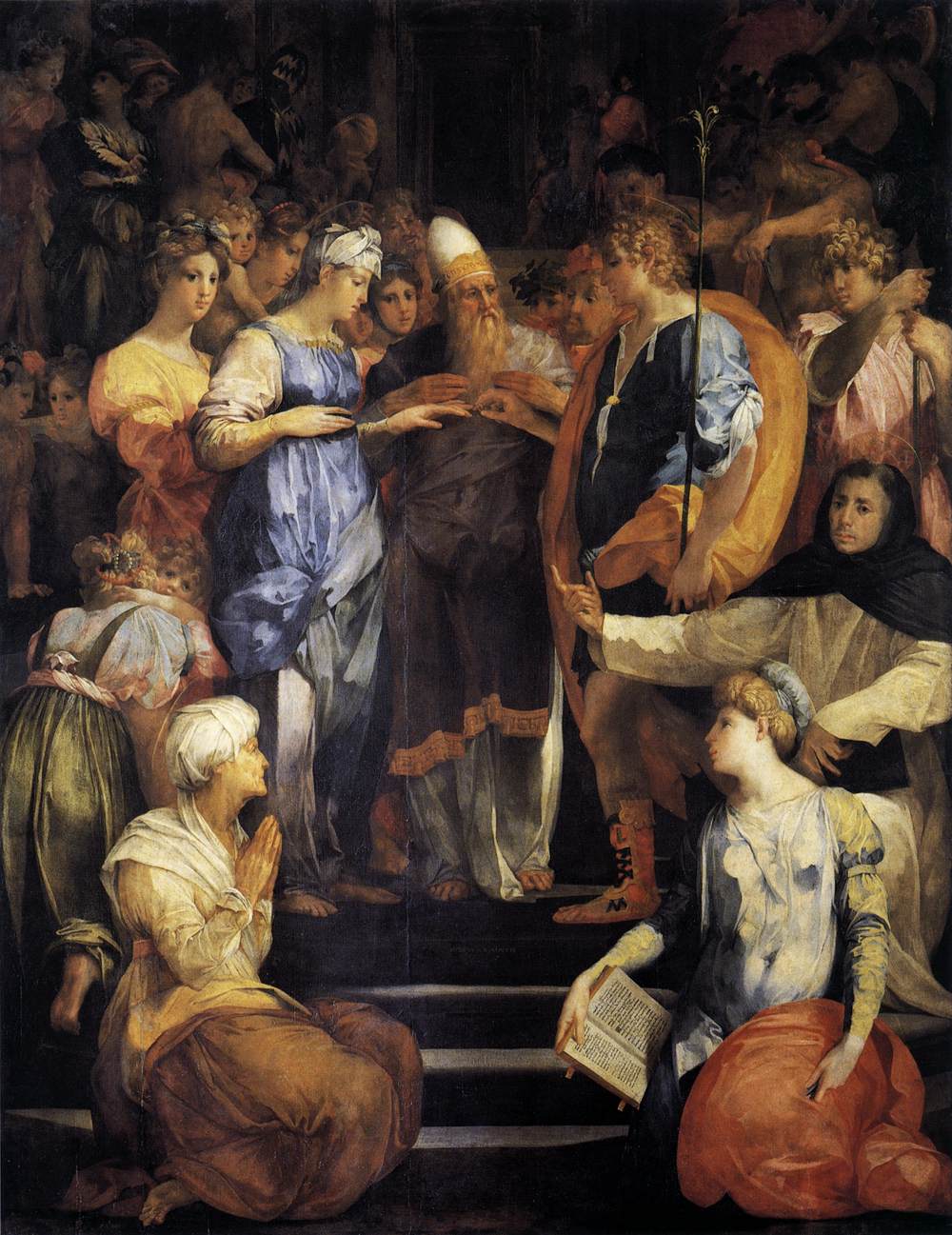
Betrothal of the Virgin - 23rd january 2010


Maybe instead of a lot of text let us look and take in the beauty and sublimity of this situation.