Evil triumphs when good men do nothing - Edmund Burke

Friday, January 15, 2010

St. Paul the Hermit - 15th January 2010

St. Paul (229-342) was born in Lower Thebaïd, Egypt. At age 22 during the persecution of Emperor Decius, he learned that his brother-in-law, who wanted to confiscate his estate, was planning to report him as a Christian to the pagan authorities. Paul fled, taking refuge in the desert. After the danger abated, he decided to remain a hermit.

At the end of his life, St. Anthony visited him in his cave in the desert and found an exemplar of what a holy man should be. He lived as an anchorite for more than 90 years.

His life in the desert, however, should not lead us to think that the contemplation of God left him uninterested in the glorious battles of the Church. No one walks securely on the road leading to God if he is not united to the Spouse whom Christ chose and established as the column and fundament of Truth. Among the children of the Church, those called to be most closely united to her are the contemplatives, since they traverse the sublime, arduous roads where many dangers lurk.

From the depths of his cave, Paul, enlightened by divine inspiration, followed the battles of the Church against Arianism. He was an admirer of St. Athanasius and united to those who defended that the Word was co-substantial with the Father. He asked St. Antony, to whom he left his own tunic, to bury him with the tunic of St. Athanasius, which St. Antony had received as a gift from the Patriarch of Alexandria.

Comments of Prof. Plinio:

These are good commentaries on St. Paul, the first hermit. The selection focuses on the nobility of the eremitic state, which consists of living alone in the desert making elevated meditations that seem far removed from human affairs, and, therefore, from the fight between Good and Evil.

Actually, the personal fight of the hermit between his ordered passions directed by reason and his disordered passions directed by the Devil are not antithetical to the fight. The selection clearly shows that those contemplative hermits, by special enlightenment from God, had a clear notion of the merit of the fight of the Church in their times.

The contemplative and active lives are profoundly harmonic, which can be seen in the life of St. Paul the Hermit. From the depths of his cave where he lived isolated and dedicated to meditating on the things of God, he also followed in spirit the battles of the great St. Athanasius. When he died, he asked to be buried in the tunic of St. Athanasius to manifest his enthusiasm for the battles that the great warrior was waging against Arianism. This episode illustrates how the external apostolate is linked to the interior life, how the active life is linked to the contemplative.

There is yet another consideration that can be made about the eremitic state. When speaking of it, one usually emphasizes the sacrifice and strength of will it takes to separate oneself from earthly things and be alone. In effect, the desire to talk and be with others is never so strong as when one is alone. Human nature is made in such a way that when we are with others for a long time, we want to be alone; but after we are alone for a time, we want to be among others. So, one of the greatest glories of the eremitic state would be to live alone and in silence.

This is true in a certain way. But there is another aspect of the eremitic state to consider. Its nobility lies not just in remaining silent, but also in speaking with God. Speaking with God should be understood not as having continuous apparitions and revelations, but in keeping the spirit occupied with things of God, profound thoughts, elevated aspirations, noble causes. It is to be familiar with the highest cogitations of the human spirit, which are religious thoughts. This is, in my opinion, the excellence of the eremitic state, what constitutes its principal adornment and highest respectability.

From a certain point of view, a man in the eremitic state practices the virtue of respect above all others. For the hermit nothing is small, without importance, or trivial. He understands the highest reasons for which each thing was created and its sacred, august character. When he speaks, his voice is like a bronze bell, grave and serious, calling men to the highest cogitations of the spirit.

This is what the modern world is lacking more than anything else. The modern man completely lacks the virtue of respect. He lacks respect for himself and things because he rejected this spirit and embraced triviality and banality. He only likes transitory, concrete things that offer an immediate pleasure.

The eremitic state is, on the contrary, a way of living where a man is like a flaming torch of gravity and respect. Respect for God, above all, but also respect for himself and for every created thing as it reflects God. This is what I think is the glory of the eremitic state.

We should ask St. Paul the Hermit to pray for us to have an understanding of and desire for this virtue, because without the virtue of respect, neither moral perfection nor sanctity exists.

Thursday, January 14, 2010

St. Felix of Nola - 14th January 2010

St. Felix of Nola lived in Italy in the days of the Roman persecutions. He survived, however, and went on to earn his crown as one of the early Christian ascetics.

What we know about him comes mostly from St. Paulinus of Nola, bishop of the diocese of Nola a century later, who wrote many poems in praise of Felix. Some of the biographical details may well be folkloric, but here is the basic outline of his priestly career.

A native of Nola, near Naples, Felix was the second son of a Syrian-born father. His brother joined the imperial army. Felix, however, found his joy (the name "Felix" means "happy") in the service of the Lord. Having given his belongings to the poor, he was ordained a priest by St. Maximus, the then bishop of Nola.

Now, in the year 250, Roman Emperor Decius launched a thorough persecution of Christians. Bishop Maximus, knowing that he was marked for death, followed the scriptural admonition and went into hiding, entrusting the diocesan administration to Felix. The Roman constables, failing to discover the bishop, took out their frustration on his administrator. They scourged Felix viciously and then jailed him in a cell that was in itself an instrument of torture.
One night, however, an angel appeared to Father Felix and commanded him to go to his bishop, since he was gravely ill. Thereupon the priest's shackles fell off and the door of his prison came unlocked. Hastening to Maximus's side, Felix decided to carry him off on his shoulders to his home in Nola, where at the moment he could apparently escape detection. There a kindly old woman nursed him back to health.

Felix himself then had to take to flight, now to one hideout, now to another, ever pursued by government agents. One day as they drew near, he managed to crawl into a hole in a ruined wall. There he was protected by spiders much as Jesus was during the flight into Egypt, according to the old legend. No sooner had he entered the hiding place when the spiders quickly wove a screen of cobwebs across the opening. The pursuers saw the hole, but passed on. Nobody could be inside, they concluded, because the web was intact.

The priest of Nola was living in a dry well when Decius' persecution was called off. Maximus died soon afterward, and his flock agreed as one man that Felix should succeed him as bishop. Felix declined the office, however, and persuaded the people to accept Quintus, a senior priest of the diocese. He could now have pressed the government to restore his personal property that it had confiscated, yet he did not take that step, because it contradicted his ideal of poverty. Retaining only a small plot of land, he set up a sort of hermitage, cultivating the land and sharing its produce with the needy. His constant practice was to give to the poor anything extra. When a friend made him a present of a second coat, for instance, he would give away the better garment and retain the inferior one. Sometimes, indeed, he gave a pauper his own good suit and donned the pauper's rags. Having thus led a life of joyous self-denial, he was hailed at his death as unquestionably a saint.

The tomb of Felix at Nola became the focus of international pilgrimage. When Paulinus was installed as bishop of Nola many decades later, miracles were still being wrought at the saint's shrine. Some of the wonders he recorded in his writings he himself had witnessed. Many Christians chose to be buried close to Felix's tomb, hoping that they might have a better chance of mounting to heaven if they were near him at the resurrection.

Paulinus meanwhile became a bit worried about the theology of the intercessory power of the saints. How could they know, he asked St. Augustine, that we on earth were praying to them? The great theologian calmed his fears. God, he says, reveals to them that we are asking their intercession. Then they turn to God to pray on our behalf.

Whether we pray, then, to St. Felix or to any others who live in God's presence, we may be sure that the message gets through!

Wednesday, January 13, 2010

St. Hilary of Poitiers - 13th January 2010

HILARY, Bishop of Poitiers (Pictaviurn), the place of his birth, was b. early in the fourth century; d. 366. He shone like a clear star alongside of the great champions of the Nicene Creed, - Athanasius, Basil, and the two Gregories. Among the teachers of the West of his day lie was beyond dispute the first, and bore a strong resemblance to Tertullian, both in disposition and scientific method. He employed an elegant Latin style. His parents were Pagans, and of high social standing. Hilary enjoyed fine facilities for education. In the introduction to his treatise on the Trinity he describes the stages a Pagan passes through in reaching the knowledge of God, which heathen philosophy reveals dimly, Christianity clearly. This description evidently depicts his own experience. lIe had reached the years of manhood when he professed Christianity. A statement of uncertain value speaks of his wife and daughter as following him. About the year 350 the popular voice called him to the bishopric of Poitiers.

The times were times of conflict. The Emperor Constantius determined to make Arianism the prevailing creed of the West, as it had become of the East. This end he endeavored to secure by intimidating the bishops. Hilary placed himself in antagonism to the emperor, and devoted all his energies to resist the spread of Arianism. His persuasions induced a number of the Gallic bishops to refuse communion with the Arian bishop of Arles, - Saturninus; and in a letter to the emperor (355) he calls upon him to desist from his policy of coercion. At the Council of Beziers (356), presided over by Saturninus, the Arians were in the majority, and silenced Hilary by their tumult when he arose to defend the Nicene faith. A few months afterward he was banished to Phrygia, where his leisure was employed hi studies of the Greek language and literature, and in making himself acquainted with the parties and doctrines of the Eastern Church. In 359 he wrote his work on synods (De Synodis), - an historical survey of the confessions of the Eastern Church, with a definition of his own position. The best product of the exile (359 or 360) was a treatise on the Trinity (Lib. XII. de Trinitate). Aroused by the Arian decrees of the Council of Constantinople (360), he wrote a second letter to Constantius, offering to defend his faith publicly before him and a synod. The court did not grant his proposal, but, deeming that he was doing more mischief in the East than he could do in Gaul, ordered him back to Poitiers.

On his return, Hilary was regarded as the champion of the Nicene faith. The Council of Paris (361), under his lead, excommunicated Saturninus. He now sought to clear Italy of Arianism, and appeared suddenly at Milan, to prefer charges against its bishop, Auxentius. The latter, however, stood in high favor with the emperor, and Hilary was driven out of the city. he explained his course in this matter in a work against Auxentius (365). According to Sulpicius Severus (Chron. ii. 45), he died the following year.

Hilary was one of the most conspicuous and original characters of early Christianity. His distinguishing characteristics were fidelity to the church creed, acuteness in argument, and resolution in action. He knew no fear. He wielded a keen sword when he defended apostolic truth against heretics, or vindicated the prerogatives of the Church against the encroachments of the civil power. Yet, when the differences concerned non-essentials, he displayed a conciliatory disposition. His power lay essentially in his thorough acquaintance with the Scriptures. His earliest literary labor was a Commentary on Matthew, and one of the latest an Exposition of the Psalms. His other exegetical works are lost. Much to be regretted is the loss of his collection of hymns which the Spanish churches used.

His work on the Trinity is a scriptural confirmation of the philosophic doctrine of the divinity of Christ, and is of permanent value. It was not a mere restatement of traditional orthodoxy, but a fresh and living utterance of his own experience and study. In the discussion of the co-essentiality of the Son, Hilary lays emphasis on the Scripture titles and affirmations, and especially on his birth from the Father, which he insists involves identity of essence. In the elaboration of the divine-human personality of Christ, he is more original and profound. The incarnation was a move went of the Logos towards humanity in order to lift humanity up to participation in the divine nature. It consisted in a self-emptying of himself, and the assumption of human nature. In this process lie lost none of his divine nature; and, even during the humiliation, he continued to reign everywhere in heaven and on earth. Christ assumed body, soul, and spirit, and passed through all stages of human growth, his body being really subject to pain and death. Redemption is the result of Christ’s voluntary substitution of himself, out of love, in our stead. Between the God-man and the believer there is a vital communion. As the Logos is in the Father, by reason of his divine birth, so we are in him, and become partakers of his nature, by regeneration and the sacraments of baptism and the Lord’s Supper.

The christology of Hilary is full of fresh and inspiring thoughts, which deserve to be better known than they are. He was created a doctor of the Catholic Church by Pius IX., at the synod of Bordeaux, 1851.

The Fatima Children Are Shown Hell

The Fatima Children Are Shown Hell

In 1917, during World War I and that "hell on earth," the Virgin Mary appeared to three children at Fatima, Portugal on the 13th of the month from May through October. During here appearance on July 13th, 1917, she showed these three young children, ages 7 to 10, a vision of Hell.

Lucia, who is still alive today [R.I.P. Feb. 13, 2005], the Blessed Virgin Mary opened her hands, and "rays of light seemed to penetrate the earth, and we saw as it were a sea of fire. Plunged in this fire were demons and souls in human form, like transparent burning embers, all blackened or burnished bronze, floating about in the conflagration, now raised into the air by the flames that issued from within themselves together with great clouds of smoke, now falling back on every side like sparks in huge fires, without weight or equilibrium, amid shrieks and groans of pain and despair, which horrified us and made us tremble with fear. (It must have been this sight which caused me to cry out, as people say they heard me.)

The demons could be distinguished by their terrifying and repellent likeness to frightful and unknown animals, black and transparent like burning coals. Terrified and as if to plead for help, we looked up at Our Lady, who said to us so sadly: "You have seen Hell where the souls of poor sinners go. Thus, when you say the rosary, say after each mystery: O my Jesus, forgive us our sins, save us from the fires of Hell and lead all souls to Heaven, especially those most in need of Thy Mercy." After this vision, the children lived dramatic lives of sacrifice and penance for sinners so that sinners might be converted and saved from the fires of Hell that God had shown them through His Heavenly prophetess.

Tuesday, January 12, 2010

Toronto 2010 Lift Jesus Higher Rally

Every year i attend this rally, it gives me a chance to see a lot of catholics and meet up with some friends who i only get to meet every year at the rally only. If you are going to attend please leave me a note so we can meet at the rally.

Saturday, April 24, 2010
8:30 a.m. to 6:00 p.m.

Metro Toronto Convention Centre
North Building
255 Front Street West


For more details click here

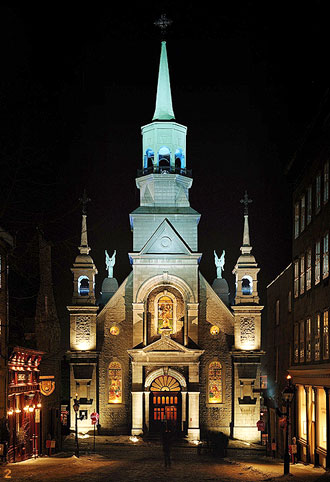
Notre-Dame-de-Bon-Secours


(Notre-Dame-de-Bon-Secours)


Saint Marguerite Bourgeoys- 12th January 2010


Marguerite was born in Troyes in the Champagne region of France in 1620. At the age of 20, she experienced a profound change in herself during a church procession that led her to set aside the frivolous things of life. By the time she met Monsieur de Maisonneuve, her qualities of leadership and her ability to gather people together for a common cause were well recognized.

Marguerite Bourgeoys listened to Maisonnneuve’s request and agreed to accompany the recruitment of 1653 that would shore up the defences of Ville-Marie and its fifty-some inhabitants against the constant attacks of the Iroquois. During the treacherous sea voyage to the New World, she became nurse, confidante, support and firm friend to the men and women whose arrival tripled the population of Montreal.

Marguerite joined Maisonneuve and Jeanne Mance, the hospital administrator, as an equal in the affairs of the settlement. She understood that the women of the colony had a significant role to play in the future of Canada. Ever practical, she opened workshops where ordinary women learned skills that enabled them to earn a living. She welcomed the filles du roi whose coming provided stable families and guaranteed the survival of the country. She lived with them, prepared them for their new role and witnessed their marriage contracts.

In 1655, she rallied the inhabitants of the town to help realize her dream of building a chapel of pilgrimage within easy walking distance of the settlement. After delays and some uncertainty, in 1675 Montreal’s first stone chapel was erected.

In the stable-school opened in 1658, the children of the colony learned the basics of their faith, as well as counting, reading and writing. The older girls learned household skills to prepare for their responsibilities as wives and mothers. And traditionally, on the feast of Saint Catherine in November, they all made taffy!

Once the school had opened, Marguerite Bourgeoys returned to France to find companions who shared her vision. Together they formed the nucleus of the Congrégation de Notre-Dame, a community of uncloistered women. Ecclesiastical approval for such a radical lifestyle for women, unheard of at the time, was not granted until just two years before Marguerite’s death in 1700.

Saint Marguerite Bourgeoys was canonized in 1982. A pioneer woman who worked in an outpost of the French empire, she built houses and established a farm, and opened schools for native children as well as for children of the colony. She was deterred by neither bishop nor king in the pursuit of her mission. The Church presents her to us now as a model for modern times. In a moving ceremony in May 2005, the sisters of her community and the people of Montreal brought her mortal remains in procession to Notre-Dame-de-Bon-Secours through the neighbourhood where she had lived and worked and died, back to her chapel. A woman of courage, vision, compassion and deep spiritual strength remains with us today, part of the fabric of our lives.

Monday, January 11, 2010

Yet Another church attacked in Malaysia

A ninth church was vandalized Monday in Malaysia in a series of arson attacks that have raised religious tensions surrounding a dispute over the use of the word "Allah" by Christians in this mostly Muslim nation.

"Allah" is the common term for God in Malay-language Bibles, but the government and many Muslim groups insist that the word should be reserved for use in Islam.

The attacks, which began on Friday, came after a court ruling on Dec. 31 that overturned a government ban on the use of "Allah" by Christians. That ruling has been stayed while the government appeals.

Only one of the churches has been seriously damaged, and some of the attacks were minor. In Monday's attack, the Sidang Injil Borneo Church in the central state of Negeri Sembilan was slightly damaged when its door was burned, according to local reports.

Government officials condemned the violence Monday but defended their position, saying conditions are different in Malaysia from those in neighboring Indonesia or in Arab nations where "Allah" is the common term for God


Refer to this link

St. Theodosius - 11th January 2010


St Theodosius was born at Mogariassus, called in latter ages Marissa, in Cappadocia, in 423. He imbibed the first tincture of virtue from the fervent example and pious instructions of his virtuous parents. He was ordained reader, but some time after being moved by Abraham's example to quit his country and friends, he resolved to put this motion in execution. He accordingly set out for Jerusalem, but went purposely out of his road to visit the famous St. Simeon Stylites on his pillar, who foretold him several circumstances of his life, and gave him proper instructions for his behaviour in each. Having satisfied his devotion in visiting the holy places in Jerusalem, he began to consider in what manner he should dedicate himself to God in a religious state. The dangers of living without a guide made him prefer a monastery to a hermitage; and he therefore put himself under the directions of a holy man named Longinus, to whom his virtue soon endeared him in a very particular manner. A pious lady having built a church under the invocation of the Blessed Virgin, on the high road to Bethlehem, Longinus could not well refuse her request that his pupil should undertake the charge of it; but Theodosius, who loved only to obey, could not be induced by any entreaties to consent to this proposal: absolute commands were necessary to force him to a compliance. Nor did he govern long; for dreading the poison of vanity from the esteem of men, he retired into a cave at the top of a neighbouring desert mountain, and employed his time in fasting, watching, prayers, and tears, which almost continually flowed from his eyes. His food was coarse pulse and wild herbs: for thirty years he never tasted so much as a morsel of bread. Many desired to serve God under his direction: he at first determined only to admit six or seven, but was soon obliged to receive a greater number, and at length came to a resolution, which charity extorted from him, never to reject any that presented themselves with dispositions that seemed sincere. The first lesson which he taught his monks was that the continual remembrance of death is the foundation of religious perfection; to imprint this more deeply in their minds, he caused a great grave or pit to be dug, which might serve for the common burial-place of the whole community, that by the presence of this memorial of death, and by continually meditating on that object, they might more perfectly learn to die daily. The burial-place being made, the abbot one day, when he had led his monks to it, said, The grave is made, who will first perform the dedication?" Basil, a priest, who was one of the number, falling on his knees, said to St. Theodosius, "I am the person, be pleased to give me your blessing." The abbot ordered the prayers of the church for the dead to be offered up for him, and on the fortieth day Basil wonderfully departed to our Lord in peace without any apparent sickness. When the holy company of disciples were twelve in number it happened that at the great feast at Easter they had nothing to eat; they had not even bread for the sacrifice: some murmured; the saint bid them trust in God and he would provide; which was soon remarkably verified by the arrival of certain mules loaded with provisions. The lustre of the sanctity and miracles of St. Theodosius drawing great numbers to him who desired to serve God under his direction, his cave was too little for their reception, therefore, having consulted heaven by prayer, he, by its particular direction, built a spacious monastery at a place called Cathismus, not far from Bethlehem, at a small distance from his cave, and it was soon filled with holy monks. To this monastery were annexed three infirmaries: one for the sick, the gift of a pious lady in that neighbourhood; the two others St. Theodosius built himself, one for the aged and feeble, the other for such as had been punished with the loss of their senses, or by falling under the power of the devil, for rashly engaging in a religious state through pride, and without a due dependence on the grace of God to carry them through it. All succours, spiritual and temporal, were afforded in these infirmaries, with admirable order, care, and affection. He erected also several buildings for the reception of strangers, in which he exercised an unbounded hospitality, entertaining all that came, for whose use there were one day above a hundred tables served with provisions: these, when insufficient for the number of guests, were more than once miraculously multiplied by his prayers. The monastery itself was like a city of saints in the midst of a desert, and in it reigned regularity, silence, charity, and peace. There were four churches belonging to it, one for each of the three several nations of which his community was chiefly composed, each speaking a different language; the fourth was for the use of such as were in a state of penance, which those that recovered from their lunatic or possessed condition before-mentioned, were put into, and detained till they had expiated their fault. The nations into which his community was divided were the Greeks, which was by far the most numerous, and consisted of all those that came from any provinces of the empire; the Armenians, with whom were joined the Arabians and Persians; and, thirdly, the Bessi, who comprehended all the northern nations below Thrace, or all who used the Runic or Sclavonian tongue. Each nation sung the first part of the mass to the end of the gospel in their own church, but after the gospel all met in the church of the Greeks, where they celebrated the essential part of the sacrifice in Greek, and communicated all together.

The monks passed a considerable part of the day and night at their devotions in the church, and at the times not set apart for public prayer and necessary rest every one was obliged to apply himself to some trade or manual labour, not incompatible with recollection that the house might be supplied with conveniences. Sallust, Bishop of Jerusalem, appointed St. Sabas superior general of the hermits and our saint of the Cenobites, or religious men living in community throughout all Palestine, whence he was styled the Cenobiarch. These two great servants of God lived in strict friendship, and had frequent spiritual conferences together; they were also united in their zeal and sufferings for the church.

The Emperor Anastasius patronised the Eutychian heresy, and used all possible means to engage our saint in his party. In 513 he deposed Elias, Patriarch of Jerusalem, as he had banished Flavian II, Patriarch of Antioch, and intruded Severus, an impious heretic, into that see, commending the Syrians to obey and hold communion with him. SS. Theodosius and Sabas maintained boldly the right of Elias, and of John his successor; whereupon the imperial officers thought it most advisable to connive at their proceedings, considering the great authority they had acquired by their sanctity. Soon after, the emperor sent Theodosius a considerable sum of money, for charitable uses in appearance, but in reality to engage him in his interest. The saint accepted of it, and distributed it all among the poor. Anastasius, now persuading himself that he was as good as gained over to his cause, sent him a heretical profession of faith, in which the divine and human natures in Christ were confounded into one, and desired him to sign it. The saint wrote him an answer full of apostolic spirit; in which, besides solidly confuting the Eutychian error, he added that he was ready to lay down his life for the faith of the church. The emperor admired his courage and the strength of his reasoning, and, returning him a respectful answer, highly commended his generous zeal, made some apology for his own inconsiderateness, and protested that he only desired the peace of the church. But it was not long ere he relapsed into his former impiety, and renewed his bloody edicts against the orthodox, dispatching troops everywhere to have them put in execution. On the first intelligence of this, Theodosius went over all the deserts and country of Palestine, exhorting every one to be firm in the faith of the four general councils. At Jerusalem, having assembled the people together, he from the pulpit cried out with a loud voice: "If any one receives not the four general councils as the four gospels, let him be anathema." So bold an action in a man of his years inspired with courage those whom the edicts had terrified. His discourses had a wonderful effect on the people, and God gave a sanction to his zeal by miracles: one of these was, that on his going out of the church at Jerusalem, a woman was healed of a cancer on the spot by only touching his garments. The emperor sent an order for his banishment, which was executed; but, dying soon after, Theodosius was recalled by his catholic successor, Justin, who, from a common soldier, had gradually ascended the imperial throne.

Our saint survived his return eleven years, never admitting the least relaxation in his former austerities. Such was his humility that, seeing two monks at variance with each other, he threw himself at their feet, and would not rise till they were perfectly reconciled; and once having excommunicated one of his subjects for a crime, who contumaciously pretended to excommunicate him in his turn, the saint behaved as if he had been really excommunicated, to gain the sinner's soul by this unprecedented example of submission, which had the desired effect. During the last year of his life he was afflicted with a painful distemper, in which he gave proof of a heroic patience, and an entire submission to the will of God. Perceiving the hour of his dissolution at hand, he gave his last exhortations to his disciples, and foretold many things, which accordingly came to pass after his death; this happened in the one hundred and fifth year of his age, and of our Lord 529. Peter, Patriarch of Jerusalem, and the whole country, assisted with the deepest sentiments of respect at the solemnity of his interment, which was honoured by miracles. He was buried in his first cell called the Cave of the Magi, because the wise men who came to adore Christ soon after his birth were said to have lodged in it. A certain count being on his march against the Persians, begged the hair shirt which the saint used to wear next his skin, and believed that he owed the victory which he obtained over them to the saint's protection through the pledge of that relic. Both the Romans and Greek calendars mention his festival on the 11th of January.

It is the opinion of St. Gregory the Great that the world is to some persons so full of ambushes and snares, or dangerous occasions of sin, that they cannot be saved but by choosing a safe retreat. Yet there are some who find the greatest dangers in solitude itself; so that it is necessary for every one to sound his own heart, take a survey of his own forces and abilities, and consult God, that he may best be able to learn the designs of his providence with regard to his soul; in doing which, a great purity of intention is the first requisite. Ease and enjoyment must not be the end of Christian retirement, but penance, labour, and assiduous contemplation; without great fervour and constancy in which, close solitude is the road to perdition. If greater safety, or an unfitness for a public station, or a life of much business (in which several are only public nuisances), may be just motives to some for embracing a life of retirement, the means of more easily attaining to perfect virtue may be such to many. Nor do true contemplatives bury their talents, or cease either to be members of the republic of mankind, or to throw in their mite towards its welfare.

From the prayers and thanksgivings which they daily offer to God for the peace of the world, the preservation of the church, the conversion of sinners, and the salvation of all men, doubtless more valuable benefits often accrue to mankind than from the alms of the rich or the labours of the learned. Nor is it to be imagined how far and how powerfully their spirit, and the example of their innocence and perfect virtue, often spread their influence; and how serviceable persons who lead a holy and sequestered life may be to the good of the world; nor how great glory redounds to God by the perfect purity of heart and charity to which many souls are thus raised.

Sunday, January 10, 2010

Circumcision of Our Lord - 10th January 2010


Let us read the insights that Dr. Plinio has to reveal about this feast.


(The Circumcision of Our Lord - Jacques Daret, c. 1404)


You are all familiar with what entails the ceremony of circumcision that was imposed by the Old Law on every male of the race of Israel. Our Lord Jesus Christ was not obliged to follow that law, because being the true God, He could dispense Himself from the law He had made. But He decided to subject Himself to that law for the highest reasons.

He wanted to show His love for that law as a reflection of His love for all laws, for the whole order He established in the universe, and for the authorities established by Him to maintain it. Therefore, the Man-God made an act of humility and subjected Himself to the law like any other man.

The circumcision was a pre-figure of Baptism and symbolized that the male child was purified and united to God. On the eighth day following His birth, the Divine Child was presented in the Temple and circumcised according to the Law existing in Israel since the time of Abraham. On this occasion, He was given the name Jesus.

With this example, there is a lesson for us: we should love, observe, and follow just and reasonable laws that are in accordance with Divine Law and Natural Law. It is, in effect, an example instructing us to love the Law of God.

There are three elements to consider when speaking of the Law of God.

First, there are the Ten Commandments God revealed to Moses. Those Commandments were a codification of the principles of Natural Law. Human nature in itself stipulates these ways of acting. Those rules were inscribed in the very nature of all of mankind. But as consequence of original sin and the resultant accumulation of hereditary sins, human intelligence lost its compass that pointed out what was good and evil. For this reason God revealed the Decalogue to Moses as a summary of Natural Law so that mankind could better follow the right path.

We must love the Commandments because they are a summary of the natural order. They reflect the wise order God put in the universe and are, therefore, the proper expression of His wisdom and holiness. For us to have an appropriate idea of the Eternal Wisdom of God and His Infinite Holiness, we should analyze and admire the ensemble of the universe synthesized in the Commandments He gave us.

Second, by revealing the law, God raised those precepts to the plane of Divine Law. This is the second element, the supernatural character introduced in that synthesis of Natural Law. We must love these Commandments because they were revealed by God. They are orders given by God. As long as we must love God above everything, we must follow His will and, therefore, obey the Commandments.

Third, God also gave Moses detailed laws to govern the worship and establish the State of Israel. These as well should be studied and admired. In this legislation there were many items that were not demands of Natural Law, but were positive religious laws instituted by God.

In the New Covenant Our Lord Jesus Christ added various moral points to the Law, but He did not touch the Ten Commandments, which will remain the same until the end of time. Our Lord came to complete the Law, not to revoke the Old Law.

Our Lord was the perfect model of obedience not only to the Ten Commandments but also to all the detailed Mosaic laws instituted by God. His obedience was as expression of His love for the Eternal Father.

The Gospel reports numerous times Our Lord directed Himself to the Father in expressions of great love, union and obedience right up to that moment in the Garden of Olives when He said: “Father, if Thou wilt, remove this chalice from Me: but yet not My will, but Thine be done." His last words were these: “Father, into Thy hands I commend My Spirit.” This was His last communication with the Father: an act of adoration, submission, and obedience. This was what Our Lord Jesus Christ taught us from the beginning of his life – at the circumcision – until the end from the height of the Cross.

In the circumcision He shed His first drop of blood for humankind. Many theologians sustain that with that simple drop of blood, the Redemption of mankind could had been accomplished. But by the mysterious designs of Divine Providence, a great outpouring of blood, His death and even His last drop of blood that issued forth from the wound inflicted by Longinus’ spear were necessary for our Redemption. He accepted all this to accomplish the will of the Eternal Father.

We see how the spirit of Our Lord is the opposite of the spirit of the Revolution, which is a spirit adverse to laws, without any love for the authority that legislates. It considers laws as shackles, and obedience as coercion. According to this revolutionary spirit, man should revolt against the laws and follow only his own reason and instincts.

On the contrary, Our Lord gave us a profound counter-revolutionary teaching: His unremitting obedience to God, to Eternal Law, Divine Law, positive law and all the customs established by Tradition in the Old Covenant and, by anticipation, in the Catholic Church. This legacy should be loved in its letter and spirit. We should also love the civil laws insofar as they are a reflection or an application of the principles contained in Revelation, that is, in Scriptures and Tradition.

One could ask me: Is this obedience to Church laws valid in the sad days in which we live, in the desolate situation into which the Catholic Church has fallen?

I answer: Yes, more than ever. But what laws should be obeyed? We must follow those laws which are in accordance with the perennial Magisterium and Tradition of the Church. These are the laws that have the same spirit of Our Lord.

That same love for God should induce us not to obey laws that are contrary to that spirit. For instance, the recently released ecumenical directive by the Vatican saying that Catholics can receive sacraments in Schismatic and heretic temples. A Catholic can neither love this law nor accept it as legitimate because it is intrinsically bad. The same love that leads us to be obedient to the Catholic Church also leads us to resist and not obey this bad law.

There are two forms of submission. One is to bend our heads as a sign that we renounce our wills to follow God’s will alone. Another is to raise our heads to defend the will of God against those who want to impose something contrary to it.

Interesting article about a transgendered person who used to work at a Church

It began innocuously enough when the incoming priest at St. Catherine of Siena Catholic Student Center at Drake University noticed a piece of paper on a copy machine in the parish office.

On it was a counselor's authorization of hormone therapy for a transgendered person about to undergo a sex change. On a letterhead that included the center's name and address.

What came quickly after is changing a community:

The intervention of the bishop, worried about liability for the Diocese of Des Moines. The firing of the transgendered woman who worked part time as parish housekeeper and who, as an independent social worker, used parish offices to provide counseling for transgendered clients. Nearly 100 parishioners organizing separate prayer services instead of going to Mass because they said they sought a welcoming place for all. And angst in a once-tight faith community about how the church should minister to those whose lifestyles aren't condoned by the church.

Some in the parish believe the Catholic Church must adhere to 2,000 years of teaching because, even in a changing world, what kind of religion is permissive of everything? Others believe the church should welcome everyone because, after all, isn't that what Jesus did?

"It brought up these other issues: 'What's the place for people who have alternative lifestyles, whether they're transgender or homosexual?' " said Phil James, who recently left St. Catherine's, partly because of the controversy, partly because the father of three wanted a parish with more children.

"Clearly, they had reason to fire this woman," he said. "But the perception opened up a lot of wounds about the Catholic Church in general. ... We want to be a welcoming Christian faith, but how is that possible when we kick people out that aren't like us? That's the perception, anyway. I'm not saying it's real."

His father, parishioner Larry James Sr., sees the firing as straightforward.

"I believe bishop couldn't have done anything else," James Sr. said, even though he believes the counselor helped people and the fallout hurt. "It was tough on the church and tough on the priest and bishop, because they truly had empathy for that woman."

The person who sparked the divide is Susan McIntyre, 57, who for 10 years worked as a housekeeper at the student center. Many didn't know it, but the quiet woman who kept the place spick-and-span used to be named Jim Ford. In 1988, he had gender-reassignment surgery and became Susan McIntyre. (In the eyes of the Vatican, McIntyre is still a man.)

McIntyre converted to Catholicism in the 1990s. A few years ago, the priest at St. Catherine's gave her permission to use parish space to see counseling clients on Saturday mornings, she said. McIntyre never spoke directly to the priest about being transgendered, but she believes he knew. She formed a transgender support group that met at the church, and the priest, Jim Laurenzo, sometimes stopped by the support group to say hello, McIntyre said. (Laurenzo, now retired, did not return telephone messages.)

Then the parish - a Newman Center, which ministers to students at the non-Catholic university as well as the nonstudent community - got a new priest, Joel McNeil. McNeil spotted the letter on the copy machine, took it to the bishop, and found himself in a sticky situation.

"He's not on the same page as people like me, but he is a good person who came into a hornet's nest," said parishioner Mary Kay Shanley, who describes St. Catherine's as liberal. "We're very aware of the rules of the Roman Catholic Church. But maybe if we had a theme song, I've often thought it would be one we sing at church that's called, 'All Are Welcome in This Place.' "

To McNeil, though, the theological discussion arising from the firing is about much more than one parish's bent toward inclusiveness. It's about 2,000 years of consistent church teaching.

"All are welcome, but not everything goes," McNeil said. "The bottom line is: What does Jesus want? And here at a Catholic church, we understand Christianity in a historical context. We are not free to reinvent Christianity."

On its surface, what some in the church call "the Susan McIntyre affair" is a simple case of a person overstepping her bounds and putting the diocese in a precarious situation regarding liability.

Richard Pates, bishop of Des Moines, mailed McIntyre a three-sentence termination letter saying her firing was based on "your unauthorized representation indicating that you are employed by and operating on behalf of the Newman Center as a counselor or social worker." Nowhere does the letter refer to gender identity.

In an interview, Pates called the matter a personnel issue, nothing more.

Susan McIntyre admits her life has been weird.

Born Jim Ford, he grew up on Des Moines' east side, a sensitive boy who sometimes broke into tears at a beautiful sunset. As a lifeguard, Ford once saved a 15-year-old from drowning. But every time he looked in a mirror, the image looked different from what he felt inside.

He got a master's degree in social work from the University of Iowa, then a job with psychiatric patients at Broadlawns Medical Center: "I'd always wanted to work with the sickest of the sick and the poorest of the poor."

Ford was working at the hospital in 1987 when he witnessed a patient's death. With that came a profound understanding that life is fleeting. He decided it was time to be his true self, and Ford became Susan McIntyre. She began an independent counseling practice - the only transgendered licensed independent social worker in Iowa, she said - to help other transgendered people.

"I would have died," likely committing suicide, without the sex change, she said. "I wanted my outsides to match my insides."

As McIntyre, she felt at home in the Catholic faith, even with its teachings that homosexual behavior and some types of sexual reassignment are sins.

Under church teachings, a transgendered person with ambiguous sexual organs may have surgery to correct the problem. However, in McIntyre's case, she felt her brain and soul were born female, but not the sexual organs. The church believes cases like McIntyre's are psychological and calls sex-change surgery mutilation.

Pates said the church's views on homosexuality and transgenderism fall in line with two millennia of teaching, part and parcel with its overall stance on human sexuality: that sex should be reserved for marriage between a man and a woman, and in cooperation with God to create new life. Any sexual act outside marriage is thus sinful.

McIntyre has found Catholicism a deep faith and loved the tradition even as she hated some of the church's views. Once she wrote to Pope John Paul II about the pain caused by the church's teachings on transgendered people.

Why would McIntyre convert to a faith that deems a sin something she believes is integral to her identity?

Internally, she says, she always thought of herself as a woman. She believed the church's view on transgendered people doesn't acknowledge modern science and that, in time, it would change. And she saw so much good in her new faith that she didn't want one teaching to push her away.

And so McIntyre got the job at St. Catherine of Siena and asked the priest to use church space for counseling. McIntyre said she never represented her counseling as being done through the church but admits to using the parish name and address on letterhead.

"It wasn't a secret," she said. "I was actually proud of it. I was doing a service for folks who were incredibly poor."

Then, in late September, the bishop's secretary asked McIntyre to visit the next day. In a 15-minute meeting with the bishop and his attorney, McIntyre was fired.

She cried for a month, feeling as if her church family had rejected her. She tried to get a lawyer, but none would take her case, she said.

McIntyre believes the real issue isn't about her; it's about how the church responds to homosexuals and transgendered people. There's a movement in psychiatric circles to reclassify transgenderism as a medical condition instead of a mental illness, similar to a movement that two decades ago succeeded in removing homosexuality from a list of mental disorders.

"The bishop made it pretty clear that I was not welcome," McIntyre said. "(So) can I be Catholic, or actually not? That's what the big deal is."

For defenders of the Catholic Church, the McIntyre case is open and shut.

Bishop Pates said that McIntyre's firing as parish janitor was based on her representing her counseling services as being under the auspices of the church. It had nothing to do with her gender identity.

"We want to be very, very clear this instance is strictly a personnel issue," Pates said.

Diocesan attorney Frank Harty said McIntyre's use of letterhead that made it appear she was a church counselor violated her professional code of ethics as a licensed social worker, even if she had the priest's permission. That exposed the diocese to a potential lawsuit if, say, McIntyre counseled someone going through a sex change and the person later regretted doing so, Harty said.

Some in the parish were angry that McIntyre was fired as housekeeper instead of just being told to quit counseling on church property, and they told the bishop so in a meeting he held with about 60 parishioners.

Eric Morse, a liturgy coordinator at the parish who is searching for another church home, holds that view.

"The bishop just brought the hammer down on her instead of being a Christian and showing her some mercy. The Christian way to handle this was to tell Susan she would not be able to do counseling at the church any more. ... That punishment was too great for the crime."

According to McNeil, the bishop considered other alternatives in consultation with the diocesan attorney. But since McIntyre's counseling practice put the diocese at risk of a liability lawsuit, McNeil said, the diocese decided firing was the most appropriate measure.

In a room just inside the doors of St. Catherine of Siena parish recently, McNeil spoke about his tumultuous first few months as pastor. He knows this situation can be painted as the powerful Catholic Church trampling on a housekeeper's individual rights. But he rankled at some parishioners' comments that this incident showed St. Catherine's had become an unwelcoming place.

There's a sign out front of the church that identifies it as Catholic, McNeil noted. It's a matter of truth in advertising, he said: Would the parish stick by Catholic teachings or have a set of beliefs that went outside the Catholic tent?

"For a person who sees Christianity as fidelity to what Christ began 2,000 years ago, we can't change that teaching," he said.

Part of the Catholic belief, McNeil said, is that those who are oriented to homosexuality are called to lives of chastity, and those who believe their inward gender is different from their outward gender must battle that as a psychological problem, not with surgery.

"Heresy is overstressing one truth at the expense of other truths," McNeil said. "There is some truth that the church must be welcoming, but not to the point where it ceases being the church."

Three-hundred families make up the nonstudent parishioners at St. Catherine of Siena, the parish where former Gov. Tom Vilsack attended Mass before moving to Washington, D.C. The church was born in a room above the Varsity Theater in 1969 and dedicated to supporting Catholic students at Drake. Students come Sunday nights for a home-cooked meal.

The parish gained a reputation as a congregation with an appetite for social justice. Members traveled to El Salvador to rebuild a church destroyed by an earthquake.

For its parishioners, the McIntyre matter has involved more than liability or church doctrine.

It was personal, and it has hurt.

"It's just gut-wrenching for me and a lot of other people in the parish," said parishioner Larry James Sr., who supports the bishop's actions.

McNeil is confident that his parish is already rebounding from its rough patch. The arrival of a new priest always brings difficulties, he said, and McIntyre's situation exacerbated them.

He hopes the parish recalibrates in coming months, having strayed too far left in the Catholic spectrum.

Shanley, the parishioner who described herself as "not on the same page" with McNeil, acknowledged that "the bishop is doing his job." Then she added, "But most of us wish we could have been left alone."

Additional Facts
National views
John Haas, president of the National Catholic Bioethics Center, said that transgendered people have a psychological disorder, and that surgery to change one's gender is offensive to God.
His independent organization, which directly follows the teachings of the Catholic Church, promotes "human dignity in health care and the life sciences."
"We would say this is a gravely disordered act, an assault upon God's creation, an act of mutilation that renders an otherwise healthy body dysfunctional," Haas said. "There can be surgical interventions to heal, cure or overcome pathologies to save lives. If it doesn't hold to those ends, the church holds them to be acts of mutilation."
Haas said transgendered people who have had sexual reassignment surgery should not receive communion in the church unless they have repented.

Marianne Duddy-Burke, executive director of DignityUSA, an organization of gay, lesbian, bisexual and transgender Catholics, has heard of two situations nationally where unpaid volunteers lost their ministry jobs at Catholic parishes after telling a priest they were switching their gender. In a third situation, a paid transgender organist was fired after he began to dress as a woman.
"Transgender people fight the experience of exclusion and misunderstanding, and the fear of being exposed so often in their lives," Duddy-Burke said. "I can only imagine the pain of no longer having a home in the parish."
Asked about church teachings that prohibit what her organization stands for, Duddy-Burke said the question turns on how you define "the church." Many people equate the Catholic Church with the leadership and the hierarchy, Duddy-Burke said, but she believes the Catholic Church is "the broad people of God." It's an example of pastoral practice versus doctrinalism, she said.


(Your Opinions on the matter are sought)


The importance of Suffering


Saint Therese of the Infant Jesus referred often to suffering, saying "if the good Lord gave us the entire universe, with all its treasures, it could not be compared to the lightest of sufferings."

And she wrote that:

"Holiness does not consist in saying beautiful things, it does not even consist in thinking them, in feeling them! It consists in suffering and in suffering everything."

Saint Therese teaches us so much about holiness and suffering, in this simple and serene manner.

And Saint Francis de Sales called suffering "the eighth sacrament."

At Fatima, Our Lady asked the three children to practice "the eighth sacrament" to save the souls of poor sinners.

"Pray, pray a great deal and make sacrifices for sinners. So many souls go to hell because there is no one to pray and sacrifice for them."

So we know we are on the right track when we suffer and offer our sufferings to Our Lady, as She requested at Fatima.

Two of the three Fatima seers, Jacinta and Francisco, died young because of the need for victim souls to give necessary fecundity to Our Lady’s plan. Their lives were proof that nothing great is done without suffering.

Indeed, suffering helps those souls who are absorbed with themselves and unwilling to open up. We should see suffering as normal for man and we should practice it with courage and daring.

Clearly, this includes not only passive suffering like, for example, allowing another to strike us. It also means active suffering that is, taking the initiative in find suffering. This can be done by confronting bad public opinion or overcoming human respect. In short, it means accepting suffering entirely, embracing it fearlessly and daringly, and taking the initiative to look for ways to sacrifice for an ideal. This is what it means to suffer par excellence and we should seek to do this.

The Hollywood myth of the “happy end” is a great obstacle to accepting suffering and sacrifice. Not all things turn out well in the end as in the movies.

Not everything is joy and success. Thus, we should not look at suffering as a kind of seven-headed monster that invades people’s lives uninvited. To the contrary, we should realize that everyone suffers and a life without crosses is worthless. Saint Louis Marie Grignion de Montfort goes so far as to say that when a person does not suffer, he should ask for crosses. For a person to whom God gives no sufferings should be wary of his eternal salvation.

Saturday, January 9, 2010

Allah's terrorist are at it again in Malaysia

Arsonists in Malaysia struck a fourth church on Saturday as the government tried to soothe tensions arising from a row over the use of the word "Allah" to refer to the Muslim God.
The unprecedented attacks risk dividing the mainly Muslim nation of 28 million people, which has significant religious minorities, and complicating Prime Minister Najib Razak's plan to win back support from the non-Muslims before the next elections by 2013.
The row, over a court ruling that allowed a Catholic newspaper to use Allah in its Malay-language editions, prompted Muslims to protest at mosques on Friday and sparked arson attacks on three churches that saw one Pentecostalist church gutted.
While Najib visited the badly damaged Pentecostalist church and offered a government grant of half a million ringgit ($148,100) to maintain "a harmonious society," church leaders said they wanted more concrete assurances of safety.
"We ask the government to make a strong statement to these wrongdoers so we can worship in peace on Sunday," Reverend Hermen Shastri, secretary-general to the Council of Churches Malaysia, told Reuters.
Malaysia is mainly Muslim and Malay but there are substantial ethnic Chinese and Indian minorities who mainly practice Christianity, Buddhism and Hinduism.
These minorities handed the government its biggest losses in 2008 state and national elections in part due to feelings of religious marginalization and growing disillusionment with corruption.
In the latest attack on early Saturday, unidentified attackers flung a home-made petrol bomb at the Good Shepherd Lutheran Church in a suburb in Selangor state. The two-storey bungalow sustained minor damage, church officials said.
Police said they have stepped up security at all places of worship but faced a manpower shortage. Inspector General of Police Musa Hasan told churches across the country to hire more security guards.

Christians account for nine percent of the 28 million population, with a sizable number of non-English speaking Christians in Malaysia's Borneo island states of Sabah and Sarawak who have used the word "Allah" for decades.
Najib's handling of the issue will determine whether he can keep the support of the Malays and win back ethnic Chinese and Indian voters to solidify his grip on power after taking control of the government last year.
"Till today we are protecting the interests of other races besides championing those of the Malays," Najib was earlier quoted as saying by state news agency Bernama.
"Don't point fingers and say UMNO is racist...when churches are burned," he said referring to his party, the United Malays National Organization (UMNO) that is the linchpin of the National Front that has ruled the country for 52 years.
But Malay-Muslims, including those in UMNO, fear the word could be used by Christians to proselytize to Muslims, which is already illegal in the Southeast Asian country.
More than 169,000 Malaysians have joined a group page on social networking site Facebook called "Protesting the use of the name Allah by non-Muslims," a fourfold increase from the start of this week that signals growing Islamic anger.
($1=3.375 Malaysian Ringgit)

Miserere mei, Deus

Wow, when I heard this is froze. I think it sounds really awesome when sung by an all boys school choir as opposed to professional crossover artists

Friday, January 8, 2010

Portugal almost ready to approve gay marriage

The Portuguese parliament on Friday (8th January 2010) passed the Socialist government's bill to legalise same-sex marriages, which Prime Minister Jose Socrates said was an historic step in the country's fight against discrimination.

Socrates' minority government pushed the bill through the house with support from left wing parties, while alternative proposals by the centre-right opposition for civil partnerships and a referendum on the issue were rejected.

"It is a small change in the law, but a very important and symbolic step to fully realise values that are pillars of open, tolerant and democratic societies; freedom, equality and non-discrimination," Socrates told parliament ahead of the vote.

The bill gives gay marriages the same rights as heterosexual marriages, including those on taxes, inheritance and housing, but does not offer them the right to adopt children.

CHURCH WARNING

It marks another modernising step for this predominantly Catholic country, especially after abortion was legalised in 2007. But the Catholic Church warned against the move.

"Millenary culture deems marriage as a contract between a man and a woman. Changing this understanding of what is a family can have extremely grave consequences in the future," said Bishop Dom Jose Policarpo, Lisbon patriarch.

The bill now needs to be ratified by conservative President Anibal Cavaco Silva. If he approves it, Portugal will join Spain, Belgium, the Netherlands, Norway, Sweden, South Africa and Canada in allowing gay marriages, all of which allow gay married couples to adopt children as well.

Gay and lesbian hopes had been dented by the rejection of the Left Bloc party's gay marriage bill and by a Constitutional Court upholding a ban last year.

Ontario may get an openly Gay Mayor

(Gay George and his wife/husband/sin partner)

Ontario Premier McGuinty has accepted the resignation of George Smitherman, who is noticeable for being a public gay, from office to compete for mayor of Toronto, the Office of the Premier said Monday.

The openly gay Smitherman is regarded as a political attack dogand raised his municipal profile by leading a cleanup of city streets during the city workers' strike this summer.

George Smitherman and his wife/husband/sin partner Christopher Peloso were "married" on the 5th August 2007.

I wonder when Canada will have a homosexual Prime Minister. It cant be far away. I dont know if I want to live in such a place.

Democracy is classically defined as a government of, for and by the people. The people have a set of values based on which they elect representatives who form the government.The government passes laws based on the values of the people as the government shares the same values as the people.

Democracies have achieved greatness because they were based on the values of the people which they represented. However the edifice of democracy breaks down when the value system of the people changes.

Western democracy was based on Judeo-Christian values. These values laid the foundation of society and laws were based around these values. However as the people moved away from these values their elected representatives also passed laws which reflected these new values.

For example, society frowned upon adultery and laws were passed against adultery. However as people accepted adultery government had to pass laws which not only allowed divorces, but also recognized common law spouses and common law spousal benefits. Now a negative value - adultery - gets rewarded with the same benefits as monogamy and the value of monogamy is diminished.

Progressing on the same example, as adultery becomes more and more acceptable in society and loses all its stigma, fornication also becomes acceptable and soon all forms of sexuality becomes acceptable. Soon homosexuality is common and the government which is elected by people whose values now include support for a perverse sexuality passes law in support of such perversion. Homosexual unions are given the status of marriage and education systems are forced to teach sexual perversion as part of curriculum.

As the values of the people move further away from the Judeo-Christian value system each of the 10 commandments is broken and anti-values come to the fore, rights of choice (abortion and euthanasia) triumph of right to life. Government passes laws supporting abortion and euthanasia, the right to chose is taught in schools and any from of dissent is punished legally via human right tribunals.

As relativism grows a democracy fails and is replaced by a tyrannical government which makes laws to allow anti-values and punish real values. This is already seen in Canada and many parts of western Europe.

Churches Attacked in Malaysian ‘Allah’ Dispute

KUALA LUMPUR, Malaysia — Three Christian churches were attacked with firebombs Friday as tensions rose in a dispute over whether Christians could use the word “Allah” in this largely Muslim nation.

Later in the day, small crowds rallied outside two major mosques in the capital, in a growing protest over a court ruling that overturned a government ban on the use of “Allah” by Roman Catholics as a translation for God.

The government has appealed that ruling, insisting that the ban should remain in force, and made no move to bar the unsanctioned rallies, as it commonly does.

But a police helicopter hovered low over the front of the city’s central mosque, drowning out the words of the speakers on its balcony.

“Allah is only for us,” said Faedzah Fuad, 28, who participated in the rally. “The Christians can use any word, we don’t care, but please don’t use the word Allah.”

Despite escalating political rhetoric and the early-morning violence, the rallies of 200 to 300 people were far smaller than the thousands predicted by organizers.

Hand-lettered signs reading “Please respect the name of Allah” remained in a stack on the ground where Ms. Faedzah had prepared them.

Though Malaysia is 60 percent Malay and Muslim, sizable minorities of Chinese and Indians practice Christianity, Hinduism and Buddhism in this country of 28 million.

Ethnic and religious politics have grown more intense since the government suffered severe losses in a general election last March. Much of the reverse came at the hands of minority voters who were disturbed by the government’s increasingly conservative Islamic tone.

The government has appealed and has been granted a stay of the High Court ruling on Dec. 31 that allowed a Catholic newspaper to use the word “Allah” in its Malay-language editions.

The word has been widely used as a translation for the word “God” in Malay-language texts and services, particularly among Christian indigenous tribes in the remote states of Sabah and Sarawak.

It is also the common word used to describe the Christian God in Arabic-speaking countries like Egypt and Syria and in Indonesia, the world’s most populous Muslim-majority nation, whose language is a variant of the Malay language.

During the current dispute, many Muslims here have argued that the use of the word by other religions could confuse believers and tempt them to convert from Islam.

Prime Minister Najib Razak condemned the attacks on the churches Friday and defended the government against accusations that it had at least tacitly sanctioned the violence. “We have always been very responsible,” he said at a news conference.

In the first attack, shortly after midnight, the police said that a firebomb had destroyed the ground-level office of the Metro Tabernacle Church. They said that worship areas on the two upper floors were undamaged and that no one had been injured.

Two other churches were attacked by arsonists before dawn, with only one of them sustaining minor damage, according to the police.
-------------------------------------------------

Allah's terrorists are at it again.

Blessed Angela of Foligno - 8th January 2010

Blessed Angela of Foligno is another "real" saint who is more a person we can identify with than simply an other-worldly saint. Angela lived during the twelfth and thirteenth centuries in Umbria, Italy. She was married at a young age to a wealthy man and she became a mother, but Angela loved the world and its delights and neglected her duties to her family. It is said that her life for thirty years was "scandalous" and one of "adultery" although it is difficult to know exactly what her life entailed...she simply referred to it as "mortally sinful." Apparently she was so embarrassed about her sins that she made a "bad confession" and took Communion anyway...a serious sacrilege. She felt tormented by this and prayed to St. Francis of Assisi who appeared to her in a vision and called her to honesty. The following day she was able to make a true confession and then began a life of penance and prayer, much to the annoyance of her husband.

Angela's husband, mother, and children all died eventually and Angela was left alone. She then became a member of the Franciscan Third Order and began living as a poor beggar and penitent while serving others. However, she suffered much ridicule for her piety and spirituality her whole life.

As Angela's spiritual life progressed, she became a person of deep prayer and eventually her spiritual director began recording the mystical visions she received during prayer. She also began to attain followers and together they formed a community dedicated to serving the poor. She is reported to have borne the stigmata of Christ.

She has become known as the "Mistress of Theologians" for her many recorded writings and visions. Many miracles were worked at her grave site in the Church of St. Francis at Foligno. Her Feast Day is January 8 and she is the patron for those ridiculed for their piety, those who struggle with sexual temptation and temptation in general, widows, and those who have lost children. Her writings are contained in two books called, "The Book of Divine Consolations of the Blessed Angela of Foligno" and "The Book of Visions and Instructions."

Thursday, January 7, 2010

St. Raymond of Penyafort - 7th January 2010

St. Raymond of Penyafort was born in Barcelona, Spain, in 1175 A.D, and died in 1275 at age 99. A relative of the King of Aragon, St. Raymond taught law at the Universities of Barcelona and Bologna until deciding to become a Dominican monk at the age of 47. His reason for leaving his highly respected position within academia was because he felt increasingly uncomfortable with his self-pride at his accomplishments. Upon entering the Dominican order, he respectfully requested a position and responsibilities that would help him tame his pride. Upon discovering Raymond's intelligence and knowledge of law, the Dominicans gave Raymond the responsibility of collecting and organizing all of the Church's laws relating to sins of men and women. At the order of Pope Gregory IX, St. Raymond later produced a collection of canon law. The "Summa casuum", which treats the correct and fruitful administration of the sacrament of penance, is his best known work. St. Raymond is the Patron Saint of canonists and lawyers.

Wednesday, January 6, 2010

Oratory of Saint Joseph - Montreal


In the city of Montreal, Province of Quebec, Canada, on a rise of earth known as Mount Royal, there stands a religious edifice of staggering proportions. It is three hundred and sixty-one feet high, taller than either Saint Patrick’s Cathedral in New York or the Cathedral of Notre Dame in Paris. Its girth is so massive that it could hold within itself any one of most of the world’s great shrines, including Saint Anne de Beaupré and Saint Paul of London. The cross atop its domed roof can be seen for miles around, guiding the millions of pilgrims who come there each year. It is the Oratory of Saint Joseph, a worthy tribute to him who is the head of the Holy Family and the Patron of the Universal Church.


Bl. Andre Bessette - 6th January 2010


Brother André was born Alfred Bessette in 1845 in a small town near Montreal. He was the sixth of ten children of a carpenter and woodcutter. At his birth, Alfred was so frail that the midwife baptized him immediately. Throughout life, his health remained poor. No one would have predicted that he would live to the ripe old age of ninety-one. Orphaned at the age of 12, he tried his hand at various trades but was not successful in any of them. He could barely read and write and was sickly most of his life. At the age of 15 he became a Brother of Holy Cross but was rejected at the end of the novitiate. At the insistence of the bishop of Montreal, however, Brother Andre was allowed to make religious profession. For forty years he worked as porter at the College of Notre Dame, until he was needed full time at the shrine of St. Joseph. People from all over Canada came to him for cures or for spiritual direction. The Oratory that he built in honor of St. Joseph was solemnly dedicated in 1955 and raised to the rank of a minor basilica.

Message And Relevance

The Opening Prayer of the Mass describes two characteristics of the spirituality of Brother Andre: his deep devotion to St. Joseph and his "commitment to the poor and afflicted. " For many years he gathered funds to replace the primitive chapel with a suitable church, even cutting the hair of the students at five cents each. His concern for those who needed spiritual healing and support led him to spend 8 to 10 hours a day receiving clients. He became so well known that secretaries had to be assigned to answer the 80,000 letters he received annually.

If one were to seek the outstanding virtue of Brother Andre one would have to say that it was his humility. He once said: "I am ignorant. If there were anyone more ignorant, the good God would choose him in my place. " And when the power of healing was attributed to him, he responded: "It is St. Joseph who cures. I am only his little dog."

The significance of the life and works of Brother Andre for today's Christian is the fact that this humble Brother, who could scarcely read or write, was chosen by God as an instrument for good. As we read in the Preface for Martyrs, God reveals his power shining through our human weakness.

Opening Prayer Lord our God, friend of the lowly, you gave your servant, Brother Andre, a great devotion to St. Joseph and a special commitment to the poor and afflicted. Through his intercession help us to follow his example of prayer and love and so come to share with him in your glory.

Tuesday, January 5, 2010

St. John Neumann - 5th January 2010

St. John Neumann was known as "The Little Bishop" because he stood only five feet, two inches tall. Despite his diminutive stature, the Little Bishop's contributions were enormous.

When he arrived in New York City in 1896 from Bohemia, John Neumann was just another immigrant with no money and no contacts. However, he possessed a vocation to be a missionary to his fellow German Catholics that was so strong that he had left his homeland after theological studies without waiting to be ordained. Fortunately, the Bishop of New York was in short supply of German- speaking priests. He promptly ordained John Neumann and sent him to western New York to serve immigrant parishes. John Neumann worked for several years as a missionary in rural New York, and eventually joined the Redemptorist Order. He served as a parish priest for the Redemptorists in Pittsburgh and Baltimore. In Baltimore, John Neumann met Bishop Kenrick, who recommended to Pope Leo X, over John Neumann's objections, that this Redemptorist succeed him as Bishop of Philadelphia.

John Neumann served as the fourth Bishop of Philadelphia from 1852 to 1860. During his tenure, John Neumann organized the first Diocesan school system, which serves as the model for Catholic education in America to this day. The new schools used to the Baltimore Catechism which John Neumann had written and which became a standard text. He also initiated the tremendous expansion of the Philadelphia Diocese at a time when anti-Catholic prejudice was prevalent. During his eight years as Bishop, eighty parishes were founded and thirty four plus schools built, sometimes opening at the rate of one per month. John Neumann also initiated the weekly practice of Forty Hours Devotion.

John Neumann died at the age of 48, suffering a fatal stroke while walking down Vine Street in Philadelphia. His body is entombed at St. Peter's Church at 5th and Girard Avenue, a Redemptorist parish where St. John attended weekly confession as Bishop. In 1963, Pope Paul VI beatified John Neumann after two miraculous cures were attributed to his intervention. Beatification permitted the public worship of John Neumann. Michael Flanigan was six years old when doctors discovered he had bone cancer. The late Dr. William MacNamee, a former parishioner and Lector at Mass, was Michael's orthopedic surgeon. The cancer was Metastatic Ewings Sarcoma, a disease with no known cure, and which was always fatal. Dr. MacNamee recommended surgery to attempt to save his life. However, the boy's mother resisted, so the doctors gave the boy a less radical treatment. At the same time, Mrs. Flanigan began saying novenas to John Neumann. Within two years, the disease disappeared. According to Dr. MacNamee, this "cure" outcome was unexplainable by normal means.

The Sacred Congregation certified the cure as the miracle attributable to Bishop John Neumann, and recommended that he be enrolled as a Saint of the Roman Catholic Church. On November 13, 1976, Pope Paul VI decreed the appointment of Bishop John Neumann as the first American male Saint. On June 19, 1977, Philadelphia's "Little Bishop" was canonized Saint John Neumann.

Monday, January 4, 2010

New Blog by a Heralds of the Gospel Seminarian

Dear Reader,

I would like to bring to your attention a new blog by a Herald of the Gospel seminarian.

http://thabor.blog.arautos.org/

The blog bears the bane Thabor which is the name of the Major Seminary of the Heralds of the Gospel as well as where their main church is Our Lady of the Rosary.

Please click on the link to see this lovely monastery. I have been there on two occasions and to me it is the closest I will ever get to heaven on earth. Just looking at the pictures makes me joyful.

St. Elizabeth Ann Seton - 4th January 2010


Mother Seton is one of the keystones of the American Catholic Church. She founded the first American religious community for women, the Sisters of Charity. She opened the first American parish school and established the first American Catholic orphanage. All this she did in the span of 46 years while raising her five children.

Elizabeth Ann Bayley Seton is a true daughter of the American Revolution, born August 28, 1774, just two years before the Declaration of Independence. By birth and marriage, she was linked to the first families of New York and enjoyed the fruits of high society. Reared a staunch Episcopalian by her mother and stepmother, she learned the value of prayer, Scripture and a nightly examination of conscience. Her father, Dr. Richard Bayley, did not have much use for churches but was a great humanitarian, teaching his daughter to love and serve others.

The early deaths of her mother in 1777 and her baby sister in 1778 gave Elizabeth a feel for eternity and the temporariness of the pilgrim life on earth. Far from being brooding and sullen, she faced each new “holocaust,” as she put it, with hopeful cheerfulness.

At 19, Elizabeth was the belle of New York and married a handsome, wealthy businessman, William Magee Seton. They had five children before his business failed and he died of tuberculosis. At 30, Elizabeth was widowed, penniless, with five small children to support.

While in Italy with her dying husband, Elizabeth witnessed Catholicity in action through family friends. Three basic points led her to become a Catholic: belief in the Real Presence, devotion to the Blessed Mother and conviction that the Catholic Church led back to the apostles and to Christ. Many of her family and friends rejected her when she became a Catholic in March 1805.

To support her children, she opened a school in Baltimore. From the beginning, her group followed the lines of a religious community, which was officially founded in 1809.

The thousand or more letters of Mother Seton reveal the development of her spiritual life from ordinary goodness to heroic sanctity. She suffered great trials of sickness, misunderstanding, the death of loved ones (her husband and two young daughters) and the heartache of a wayward son. She died January 4, 1821, and became the first American-born citizen to be beatified (1963) and then canonized (1975). She is buried in Emmitsburg, Maryland.

Sunday, January 3, 2010

Epiphany - 3rd January 2010


Let us read what Dr. Plinio has to teach us about the Feast of the Epiphany

The feast of the Epiphany, the adoration of Our Lord in Bethlehem by the “Magi from the East” (Matthew 7), shows us the value of representation and symbolism in the plans of Divine Providence.

It is generally said that the Three Magi came to adore Our Lord as representatives of the Gentile peoples. It is also common to say that they were magi because they represented the ancient wisdom of the East paying homage to Our Lord Jesus Christ. Magus, a word derived from the Greek, means a man of a great wisdom. The Three Magi came from different parts of the world to adore Our Lord as a sign that all nations were called to the light of the Faith.

Many progressivists and Protestants have expressed misgivings that they were kings. I do not see any reason for such doubt since Scripture foretold that Kings from different parts of the world would come to adore the Messiah (Psalm 2:10-12; 71:10-11; Is 60:11; 62:2).

At any rate, they were men from different races representing the old world and ancient wisdom who came to adore Our Lord and pay Him homage with gifts of gold, frankincense and myrrh. They traveled to Bethlehem moved by a very noble cause. According to their wise previsions and an interior call they received from God, they knew that the Messiah had been born.

This interior call shows us that God Himself chose them as representatives of the Gentile peoples. They fulfilled the vocation for which they were called, and on the Epiphany they paid homage to Our Lord. Each King who was present at the Manger kneeling before the Divine Infant represented his own personal fidelity, of course, but he also represented the fidelity of all the past kings as well as all the kings to come in History. They were only three, but they fulfilled that representation.

We find something similar in the Passion and at the foot of the Cross. Our Lady, St. John, and the Holy Women represented everyone who had been, was, or would be faithful through the ages. For example, every faithful soul in History is represented by the act of Veronica wiping the Holy Face of Our Lord. The select group that was faithful on that solemn occasion represented the whole genre of faithful people.

We can ask if we can apply this rule to ourselves. Today the Catholic Church is humiliated by her own authorities, persecuted by Progressivism within her walls, immersed in the worst confusion that has ever fallen over her in History. We are just a few who want to remain faithful to the Church as she always was and to restore her to her past glory. In a certain way, we represent fidelity, purity, orthodoxy, courage, and the spirit of initiative and battle at the very moment when everything pressures everyone to give up, to step back, to flee.

Whom are we representing? In this new crucifixion of Our Lord, which is the crucifixion of the Church, we represent the faithful of the past who rest in the peace of the Lord and loved the Church. If St. Gregory VII, St. Louis of France, St. Ferdinand of Castile, St. Louis Grignon de Montfort, or Blessed Nuno Alvares could have seen in their times the crisis through which the Church is passing now and the few souls who would remain faithful, they would have blessed us from that distance. They would have considered themselves our cohorts and felt a relief that at least there were some small number doing what they would like to do.
We also are representing those unknown faithful souls spread throughout the world today who are smashed by Progressivism inside the Church and do not know what to do or where to go to be faithful. They would like to do what we are doing.

Finally, we are representing those who will come after us and who will be enthused when they look back and see what we are doing now. They will wish that they could have been with us now to assist us.

In History some of these representations are quite impressive. For example, when St. Remigius was teaching King Clovis and his men the Catholic Faith to prepare them for Baptism and they heard about the Passion of Our Lord, Clovis cried out loudly and drove his lance in the ground saying: “Would that I were there with my Franks to prevent such an injustice!”

As he spoke, his Frankish warriors pounded their lances on the ground to signal their acquiescence. They did not realize it, but in a certain sense they were present at the Passion. For during it, Our Lord foresaw that action of Clovis and his Franks and it gave Him consolation.

There is, therefore, a kind of reversibility of action beyond time, where all the past and future fidelities converge in a single, grandiose scene that represents them all.

Today, Our Lady is like a prisoner who is insulted and ill-treated by men, and especially by the progressivist religious authorities. She came to warn mankind at La Salette and Fatima about this general apostasy in the Church. Her words were not heard. She also wept in various places – Syracuse, Rocca Corneta, New Orleans, Granada. Her tears beseech the few who remain faithful to save her from the horrible suffering of this passion of the Holy Church. It is an honor to be called to act at this extraordinary hour. If we correspond to this call, we will be wiping the holy face of Our Lady, as Veronica did for Our Lord, and we will be representing every faithful soul throughout History.

This doctrine of how a few persons can represent a whole genre, which we see in the adoration of the Three Magi, should encourage us. Let us ask them, who certainly are in Heaven with Our Lord, to give us the courage that we need:
* the courage to stand alone, as they did in the pagan world;
* the courage to wait for the appearance of a star, the signal that the hour of God has arrived for us to carry out His will;
* and the courage to do so promptly and with complete fidelity, as they did.

Saturday, January 2, 2010

Sow Integrity By Works of Mercy - St. Basil the Great

O man, be like the earth. Bear fruit like her and do not fall short of what mere inanimate matter can achieve. The earth bears crops not for her own benefit but for yours. You, on the other hand, when you give to the poor, are bearing fruit which you will gather in for yourself, since the reward for good deeds goes to those who perform them. Give to a hungry man, and what you give becomes yours, and indeed it returns to you with interest. Just as the wheat that falls on the ground falls there to the great profit of the one who sowed it, so the bread given to a hungry man will bring you great profit in the world to come. Let your husbandry be aimed at sowing this heavenly seed: as scripture says, Sow integrity for yourselves.
You are going to leave your money behind you here whether you want to or not. As for whatever share of glory you have received through your good works, that you can take with you to the Lord. All the people will stand round you in the presence of him who judges you all: they will acclaim you as one who feeds the hungry and gives to the poor, they will name you as a merciful benefactor.
Do you not see how people throw away their wealth for a moment’s glory, for the shouts and praise of the crowds in the theatre, at sporting events, at fights with wild beasts in the arena? Where can you get that sort of glory for yourself if you hold on to your money or spend it meanly? God will give his approbation; the angels will praise you; all people who have existed since the beginning of the world will call you blessed. You will receive eternal glory and the crown of righteousness as a prize for rightly disposing of your wealth – wealth that in any case cannot last and must decay.
Why do you think nothing of the future hopes that are stored up by those who despise the cares of the present time? Come, spread your wealth around, be generous, give splendidly to those who are in need. Then it will be said of you as it is in the psalms: He gave alms and helped the poor: his righteousness will endure for ever.
How grateful you should be to your own benefactor; how cheerful you should be at the honour he has conferred on you, that you do not have to make a nuisance of yourself at other people’s doors, but other people come and bother you at your own! But at the moment you are grumpy and no-one can get to you. You avoid meeting people in case you might be obliged be part with even a little of what you have. You can say only one thing: “I have nothing to give you. I am only a poor man.” Indeed you are poor and utterly destitute. Poor in love, poor in humanity, poor in faith in God, and destitute of any hope of eternal happiness.

Friday, January 1, 2010

Happy New Year

Dear Readers,

Happy New Year to you all. What a lovely day for New Year, a First Friday. This blog has been up for about 2 years now so we have covered a lot of saints and their lives. This year, I will try to cover the sermons and teachings of the saints as well as Catholic Church History.
To read Church History is to see the hand of God working through time, this is exactly like reading the Old Testament: the hand of God working through time for the people of Israel.

I wish you all a very happy new year. May you all be filled with the Peace of Christ, despite the desperate times we live in. May the Joy of our Lord envelope you all so that this vale of tears is not so bitter. May Our Lady cover you in Her Mantle that as her little Children we will one day se and live forever with Our Elder Brother.

Love and regards
Smiley