A continuation of quotes from the book THE WAY by St. Josemaria Escriva
56. The "stuff" of saint. That's what is said about some people - that they have the stuff of saints. But apart from the fact that saints are not made of "stuff", having "stuff is not sufficient.
A great spirit of obedience to a director and a great readiness to correspond to grace are required. For if you dont allow God's grace and your director to do thier work, the sculptured image of Christ, into which the sainly man is shaped will never apper.
And that "stuff" of which we have been speaking will be only a rough, unshaped log fit for the fire - for a good fire if it is a good "stuff"
57. Get to know the Holy Spirit, the Great Unknown, the one who has to sanctify you.
Dont forget that you are a temple of God. The Paraclete is in the center of your soul: listen to him, and follow his inspirations with docility.
58. Dont hinder the work of the Paraclete. Be united to Christ in order to purify yourself, and together with him experince the insults, the spit, the blows and the thorns...Experince with him the wieght of the corss, the nails tearing your flesh, and the agony of a forsaken death...And enter into the pierced side of our Lord Jesus until you find secure shelter in his wounded heart.
59. It's good for you to know this doctrine, which is always sound: your own spirit is a bad advisor, a poor pilot to steer your soul through the squalls and storms and across the reefs of the interior life.
That's why it is the will of God that the command of the ship be entrusted to a master who, with his light and knowledge, can guide us to a safe port.
60. You wouldn't think of building a good house to live in here on earthe without and architect. How can you ever hope, without a director, to build the castle of your sanctification in order to live forever in Heaven?
61. When a layman sets himself up as a arbiter of morals, he frequently errs; laymen can be only disciples.
62. A director - you need one, in order to offer yourself, to surrender yourself...by obedience. You need a director who undersatnd your apostolate, who knoes what God wants. SUch a one will effectively help to forward the work of the Holy Spirit in your soul, without taking you from your palce, filling you with peace and teaching you how your work can be fruitful.
63. YOu think you are really somebody: your studies - your research, your publications, your social position - your name, your political acomplishments - the offices you hold; your welath; your age..no longer a child!
Precisely becasue of all of this, you - more than others - need a director for your soul.
64. Dont hide the suggestions of the devil from your director. When you confide them to him, your victory brings you more grace from God. Moreover, you now have the gift of counsel and the prayers of a spiritual father to help you keep right on conquering.
65. Why do you hesitate to know yourself and to let your director know you as you really are?
YOu'll have won a great battle if you lose the fear of letting yourself be known.
66. A priest - whoever he may be - is always another Christ.
67. Though you know it well, I want to remind you again that a preist is "another Chirst" and that the HOly Spirit has said "nolite tangere Christos meos" - "Do not tuch my Christs"
68. Presbyter - priest - stymologically means and elderly man. If old age deserves reverance, think how much more you ought to revere the priest.
69. What a lack of refinement - and waht a lack of respect - to play a trick on a preist, whoever he may be, under any circumstances!
70. I insist: those tricks or jokes about a preist, in spite of what may seem to you to be attenuating circumstances, awlays are at least vulgar, a lack of good manners.
71. How we should admire purity in the preisthood! It is its treasure. No tyrant will ever be able to wrest this crown from the Chruch.
72. Dont ever make a preist run the risk of losing his dignity. Its is a virtur which, without pompusness, he simply must have.
How hard that young priest- a friend of ours- prayed for it: " Lord grant me... eighty years of dignity1"
You too should pray for it for all priests, and you'll have done something good.
73. It hurt you like a dagger in your heart to hear people say you had spoken badly of those priests. And I'm glad it hurt, for now I'm quite sure you have the right spirit.
74. To love God and not to revere the priest...This is not possible.
75. Like the good sons of Noah, cover the weaknesses you may see in your father, the priest, with the coack of charity.
76. If you dont have a plan of life, you'll never have order.
77. You told me that to tie yourself to a plan of life, to a schedule, would be so monotonous!
And I answered, "It is monotonous becasue you lack love."
78 If you dont get up at a set hour, you'll never fulfill your plan of life.
79 Virtur with out order? strange virtue!
80. With order, your time will be multiplied, and you will be able to give more glory to God by doing more work in his service.
Friday, April 16, 2010


Thursday, April 15, 2010
Quotes by St. Jose Maria Escriva Part II
The following are quoes from the book THE WAY by St. Josemaria Escriva.
39. "Pray that I may never be satisfied with what is easy" you say. I've already prayed. Now it it up to you to carry out that fine resolution.
40. Faith, joy, optimism. But not the folly of closing your eyes to reality.
41. What a sublime way of carrying on with your empty follies, and what a way of getting somewhere in the world: rising, always rising simply by "weighing little", by having nothing inside - neither in your head nor in your heart!
42. Why thos variations in your character? When are you going to apply your will to something? Drop that craze for laying cornerstones, and finish at least one of your projects.
43. Don't be so touchy. The least thing offends you. People have to weigh thier wrods to talk to you even about the most trivial matter.
Dont feel hurt if I tell you that you are...unbearable. Unless you change, you will never be of any use.
44. Use the polite excuse that Chritian charity and good manners require. But then...keep on going with holy shamelesness, without stopping until you have reached the summit in the fulfilment of your duty.
45. Why feel hurt by the unjust things people say of you? You would be even worse, if God ever left you. Keep on doing good, and shrug your shoulders.
46. Dont you think that equality, as many people undersatnd it, is synonymous with injustice?
47. That pose and those important airs don't fit you well. It's obvious that they are false. At least, try not to use them either with God, or your director, or with your brothers; and then there will be between them and you one barrier less.
48. You lack character. What mania for interfering in everything. You are bent on being the salt of every dish. And you won't mind if i speak clearly- you haven't the qualities of salt: you can't be dissolved and pass unnoticed, as salt does. You lack a spirit of sacrifice. And you abound in a spirit of curiosity and ostentation.
49. Keep quite. Don't be "babyish", a caricature of a child, a tattle-tale, a trouble maker, a squaler. With your stories and tales you have cilled the warm glow on charity; you couldn't have done more hard. And if by chance you-your wagging tongue- have shaken down the strong walls of other people's perseverance, your own perserverance ceases to be a grace of God. It has become a treacherous instrument of the enemy.
50. You're curious and inquisitive, prying nad nosey. Aren't you ashamed that even in your defects you are not much of a man. Be a man, and instead of poking into other people's lives, get to know what you really are yourself.
51. your manly spirit - simple and straightforward - is crushed when you find yourself entangled in gossip and scandalous talk. You dont understand how it could happen, and you never wished to be involved in it anyway. Suffer the humiliation that such talk causes you, and let the experience urge you to greater discretion.
52. When you must judge others, why put into your criticism the bitterness of your own failures?
53. That critical spirit - granted you mean well - should never be directed toward your apostolate in which you work nor towards your bothers. In your supernatural undertakings that critical spirit - forgive me for saying it - can do a lot of harm. For when you get involved in judging the work of others, you are not doing anything constructive. Really you have no right to judge, even if you have the highest possible motives, as I admit. And with your negative attitude you hold up the progress of others.
"Then" you ask worriedly "my critical spirit, which is the keynote of my character?
Listen. I'll set your mind at east. Take pen and paper. Write down simple and confidently- yes briefly - what is worrying you. Give the note to your superior, and dont think any more about it.
He is in charge and has he grace of state. He will file the note..or will throw it in the waste basket, And since your criticism is not gossip and you do it for the higherst motives, it is all the same to you.
54. Conform? It is a word found only in the vocabulary of those who have no will to fight - the lazy, the cunning, the cowardly - becasue they know they are defeated before they start.
55. Man, Listen! even though you may be like a child - and you really are one in the eyes of God - be a little less naive: don't put your brothers "on the spot" before strangers.
39. "Pray that I may never be satisfied with what is easy" you say. I've already prayed. Now it it up to you to carry out that fine resolution.
40. Faith, joy, optimism. But not the folly of closing your eyes to reality.
41. What a sublime way of carrying on with your empty follies, and what a way of getting somewhere in the world: rising, always rising simply by "weighing little", by having nothing inside - neither in your head nor in your heart!
42. Why thos variations in your character? When are you going to apply your will to something? Drop that craze for laying cornerstones, and finish at least one of your projects.
43. Don't be so touchy. The least thing offends you. People have to weigh thier wrods to talk to you even about the most trivial matter.
Dont feel hurt if I tell you that you are...unbearable. Unless you change, you will never be of any use.
44. Use the polite excuse that Chritian charity and good manners require. But then...keep on going with holy shamelesness, without stopping until you have reached the summit in the fulfilment of your duty.
45. Why feel hurt by the unjust things people say of you? You would be even worse, if God ever left you. Keep on doing good, and shrug your shoulders.
46. Dont you think that equality, as many people undersatnd it, is synonymous with injustice?
47. That pose and those important airs don't fit you well. It's obvious that they are false. At least, try not to use them either with God, or your director, or with your brothers; and then there will be between them and you one barrier less.
48. You lack character. What mania for interfering in everything. You are bent on being the salt of every dish. And you won't mind if i speak clearly- you haven't the qualities of salt: you can't be dissolved and pass unnoticed, as salt does. You lack a spirit of sacrifice. And you abound in a spirit of curiosity and ostentation.
49. Keep quite. Don't be "babyish", a caricature of a child, a tattle-tale, a trouble maker, a squaler. With your stories and tales you have cilled the warm glow on charity; you couldn't have done more hard. And if by chance you-your wagging tongue- have shaken down the strong walls of other people's perseverance, your own perserverance ceases to be a grace of God. It has become a treacherous instrument of the enemy.
50. You're curious and inquisitive, prying nad nosey. Aren't you ashamed that even in your defects you are not much of a man. Be a man, and instead of poking into other people's lives, get to know what you really are yourself.
51. your manly spirit - simple and straightforward - is crushed when you find yourself entangled in gossip and scandalous talk. You dont understand how it could happen, and you never wished to be involved in it anyway. Suffer the humiliation that such talk causes you, and let the experience urge you to greater discretion.
52. When you must judge others, why put into your criticism the bitterness of your own failures?
53. That critical spirit - granted you mean well - should never be directed toward your apostolate in which you work nor towards your bothers. In your supernatural undertakings that critical spirit - forgive me for saying it - can do a lot of harm. For when you get involved in judging the work of others, you are not doing anything constructive. Really you have no right to judge, even if you have the highest possible motives, as I admit. And with your negative attitude you hold up the progress of others.
"Then" you ask worriedly "my critical spirit, which is the keynote of my character?
Listen. I'll set your mind at east. Take pen and paper. Write down simple and confidently- yes briefly - what is worrying you. Give the note to your superior, and dont think any more about it.
He is in charge and has he grace of state. He will file the note..or will throw it in the waste basket, And since your criticism is not gossip and you do it for the higherst motives, it is all the same to you.
54. Conform? It is a word found only in the vocabulary of those who have no will to fight - the lazy, the cunning, the cowardly - becasue they know they are defeated before they start.
55. Man, Listen! even though you may be like a child - and you really are one in the eyes of God - be a little less naive: don't put your brothers "on the spot" before strangers.
Wednesday, April 14, 2010
Quotes from St. Josemaria Escriva
Forgive me not not posting daily, I have some personal isseuse to deal with.
I am reading a book called THE WAY by St. Josemaria Escriva. Here are some quotes from the book.
1. Don't let your life be sterile. Be useful. Blaze a trail. Shine forth with the light of your faith and of your love. With your apostolic life wipe out the slimy and filthy mark left by the impure sowers of hatered. And light up all the ways of the earth with the fire of Christ that you carry in your heart.
2 May youe behaviour and your conversation be such that every one who sees or hears you can say : this man read the life of Jesus Christ
3 Maturity. Stop making faces and acting up like a child! Your bearing ought to reflect the prace and order in your soul.
4. Dont say "That's the way i am - it's my character" It's your lack of character. Esto vir! - Be a man!
5. Get used to saying No.
6. Turn your back on the deceiver when he whispers in your ear, "Why complicate your life?"
7. Dont have a "small town" outlook. Enlarge your heart until it becomes universal - "catholic". Dont fly like a barnyard hen when you can soar like an eagle.
8. Serenity. why lose your temper if by losing it you offend God, you trouble your neighbor, your give yourself a bad time... and in the end you have to set things aright anyway?
9. What you have just said, say it in another tone, without anger, and what you say will have more force.. and above all, you wont offend God.
10. Never reprimand anyone while you feel provoked over a fault that ahs been committed. Wait until the next day, or even longer. Then make your remonstrance calmly and with a purified intention. You'll gain more with an affectionate word that you ever would from three hours of quarreling. Control your temper.
11. Will-power. Energy. Example. What has to be done is done... without wavering... without worrying about what others think...
Otherwise Cisneros would not have been Cisneros; nor Theresa of Ahumada, Saint Theresa; nor Inigo of Loyola St Ignaitus.
God and Daring! Regnare Christum volumus!- "We want Christ to reign1"
12. Let obstacles only make you bigger. the grace of our Lord will not be lacking: Inter medium montium pertransibunt aquae! - "through the very midst of the mountains the waters shall pass" You will pass through mountains!
What does it matter that you have to curtial your activity for the moment, if later, like a spring which has been compressed, you'll advance much farther than you ever dreamed?
13. Get rid of thouse useless thoughts which are at best a waste of time.
14. Don't waste your energy and your time - which belongs to God - throwing stones at the dogs that bark at you on the way - Ignore them.
15. Don't put off your work until tomorrow.
16. Give in? Be just commonplace? You, a sheep-like follower? You were born to be a leader?
Among us there is no place for the lukewarm. Humble yourself and Christ will kindle in you again the fire of love.
17. Don't succumb to that disease of character whose symptoms are a general lack of seriousness, unsteadiness in action and speech, foolishness - in a word, frivolty.
And that frivolty, mind you, which makes your plans so void - "so filled with emptiness" - will amke of you a lifeless and useless dummy, unless you ract in time - not tomorrow, but now!
18. You go on being worldly, frivolous, and giddy becasue you are a coward. What is it, if not cowardice, to refuse to face yourself?
19. Will-power. A very important quality. Dont disregard the little things, which are really never futile or trivial. For by the constant practice of repeated self denial in little things, with God's grace you will increase in strenght and manliness of character. In that way you will first become master of yourself, and then a guide and leader: to compel, to urge, to draw others with your example and with your word and with your knowledge and with your pwoer.
20 You clash with the character of one person or another... It has to be that way - you are no a dollar bill to be liked by everyone. Besides with out those clashes which arise in dealing with your neighbors, how could you ever lose those sharp corners, the edges - imperfections and defects of your character - and acquire the order, the smotthness, and the firm mildness of charity, of perfection?
If your character and that of those around you were soft and sweet like marshmallows, you would never become a saint.
21. Excuses. You'll never lack them if you want to avoid your duties. What a lot of rationalizing!
Dont stop to think about excuses. Get rid of them and do what you should.
22 Be Frim! Be Strong! Be a Man! and then...be an angel!
23 You say you can't do more? Couldn't it be... that you can't do less?
24 YOu are ambitious: for knowledge...for leadership. YOu want to be daring. Good. Fine. But let it be for Christ, for Love.
25 Don't argue. Arguments usually bring no light becasue the light is smothered by emotion.
26 Matrimony is a holy sacrament. When the time comes for you to receive it, ask your spiritual directo or your confessor to suggest an appropriate book. Then you will be better prepared to bear worthily the burdens of a home.
27 Do you laugh becasue I tell you that you have a "vocation to marriage"? Well, you have just that - a vocation.
Commend yourself to Saint Raphael that he may keep you pure, as he did Tobias, until the end of the way.
28 Marriage is for the rank and file, not for the officers of Christ's army. For, unlike food, which is necessary for every individual, procreation is necessary only for the species, and individuals can dispense with it.
A Desire to have children? Behind us we shall leave children - many children...and a lasting trail of light, if we sacrifice the selfishness of the flesh. **** What is really important is that each person should follow his vocation, in the same battle a soldier can win a medal while a general flees shamfully.
29 The limited and pitiful happiness of the selfish man, who withdraes into his shell, his ivory tower...is not difficult to attain in this world. But that happiness of the selfish is not lasting.
For the false semblance of Heaven are you going to forsake the Joy of Glory with out end?
30 You're shrewd. Dont don't tell me you are young. Youth gives all it can - it gives itself without reserve.
31 Selfish! You... always looking out for yourself. You seem unable to feel the brotherhook of Christ. In others you don't see brothers; you see steeping-stones.
I can forsee your complete failure. And wehn you are down, you'll expect others to treat you with the charity you're unwilling to show them.
32 You'll never be a leader if you see others only as stepping stones to get ahead. You'll be a leader if you are ambitious for the salvation of all souls.
You can't live iwth you back turned on everyone; you have to be eager to make others happy.
33 You never want" to get to the bottom of things." At times, becasue of politeness. Other times- most times - becasue you fear hurting yourself. Sometimes again, becasue you fear hurting others. But always because of fear!
With that fear of digging for the truth you'll never be a man of good judgement.
34 Don't be afraid of the truth, even though the truth may mean your death.
35 There are many pretty terms I don't like: you call cowardice "prudence". Your "prudence" gives an oppurtunity to those enemies of God, without any ideas in thier heads, to pass themselves off as scholars, and so reach positions that they should never attain.
36 Yes, that abuse can be eradicated. It's lack of character to let it continue as something hopeless- without any possible remedy.
Don't evade your duty. Do it in a forthright way, even though others may not.
37 You have, as they say, "the gift of the gab." But in spite of all of your talk, you can't get me to justify - by calling it "providential" - what has no justification.
38 Can it be true (I just can't believe it!) that on earth there are no men - only bellies?
I am reading a book called THE WAY by St. Josemaria Escriva. Here are some quotes from the book.
1. Don't let your life be sterile. Be useful. Blaze a trail. Shine forth with the light of your faith and of your love. With your apostolic life wipe out the slimy and filthy mark left by the impure sowers of hatered. And light up all the ways of the earth with the fire of Christ that you carry in your heart.
2 May youe behaviour and your conversation be such that every one who sees or hears you can say : this man read the life of Jesus Christ
3 Maturity. Stop making faces and acting up like a child! Your bearing ought to reflect the prace and order in your soul.
4. Dont say "That's the way i am - it's my character" It's your lack of character. Esto vir! - Be a man!
5. Get used to saying No.
6. Turn your back on the deceiver when he whispers in your ear, "Why complicate your life?"
7. Dont have a "small town" outlook. Enlarge your heart until it becomes universal - "catholic". Dont fly like a barnyard hen when you can soar like an eagle.
8. Serenity. why lose your temper if by losing it you offend God, you trouble your neighbor, your give yourself a bad time... and in the end you have to set things aright anyway?
9. What you have just said, say it in another tone, without anger, and what you say will have more force.. and above all, you wont offend God.
10. Never reprimand anyone while you feel provoked over a fault that ahs been committed. Wait until the next day, or even longer. Then make your remonstrance calmly and with a purified intention. You'll gain more with an affectionate word that you ever would from three hours of quarreling. Control your temper.
11. Will-power. Energy. Example. What has to be done is done... without wavering... without worrying about what others think...
Otherwise Cisneros would not have been Cisneros; nor Theresa of Ahumada, Saint Theresa; nor Inigo of Loyola St Ignaitus.
God and Daring! Regnare Christum volumus!- "We want Christ to reign1"
12. Let obstacles only make you bigger. the grace of our Lord will not be lacking: Inter medium montium pertransibunt aquae! - "through the very midst of the mountains the waters shall pass" You will pass through mountains!
What does it matter that you have to curtial your activity for the moment, if later, like a spring which has been compressed, you'll advance much farther than you ever dreamed?
13. Get rid of thouse useless thoughts which are at best a waste of time.
14. Don't waste your energy and your time - which belongs to God - throwing stones at the dogs that bark at you on the way - Ignore them.
15. Don't put off your work until tomorrow.
16. Give in? Be just commonplace? You, a sheep-like follower? You were born to be a leader?
Among us there is no place for the lukewarm. Humble yourself and Christ will kindle in you again the fire of love.
17. Don't succumb to that disease of character whose symptoms are a general lack of seriousness, unsteadiness in action and speech, foolishness - in a word, frivolty.
And that frivolty, mind you, which makes your plans so void - "so filled with emptiness" - will amke of you a lifeless and useless dummy, unless you ract in time - not tomorrow, but now!
18. You go on being worldly, frivolous, and giddy becasue you are a coward. What is it, if not cowardice, to refuse to face yourself?
19. Will-power. A very important quality. Dont disregard the little things, which are really never futile or trivial. For by the constant practice of repeated self denial in little things, with God's grace you will increase in strenght and manliness of character. In that way you will first become master of yourself, and then a guide and leader: to compel, to urge, to draw others with your example and with your word and with your knowledge and with your pwoer.
20 You clash with the character of one person or another... It has to be that way - you are no a dollar bill to be liked by everyone. Besides with out those clashes which arise in dealing with your neighbors, how could you ever lose those sharp corners, the edges - imperfections and defects of your character - and acquire the order, the smotthness, and the firm mildness of charity, of perfection?
If your character and that of those around you were soft and sweet like marshmallows, you would never become a saint.
21. Excuses. You'll never lack them if you want to avoid your duties. What a lot of rationalizing!
Dont stop to think about excuses. Get rid of them and do what you should.
22 Be Frim! Be Strong! Be a Man! and then...be an angel!
23 You say you can't do more? Couldn't it be... that you can't do less?
24 YOu are ambitious: for knowledge...for leadership. YOu want to be daring. Good. Fine. But let it be for Christ, for Love.
25 Don't argue. Arguments usually bring no light becasue the light is smothered by emotion.
26 Matrimony is a holy sacrament. When the time comes for you to receive it, ask your spiritual directo or your confessor to suggest an appropriate book. Then you will be better prepared to bear worthily the burdens of a home.
27 Do you laugh becasue I tell you that you have a "vocation to marriage"? Well, you have just that - a vocation.
Commend yourself to Saint Raphael that he may keep you pure, as he did Tobias, until the end of the way.
28 Marriage is for the rank and file, not for the officers of Christ's army. For, unlike food, which is necessary for every individual, procreation is necessary only for the species, and individuals can dispense with it.
A Desire to have children? Behind us we shall leave children - many children...and a lasting trail of light, if we sacrifice the selfishness of the flesh. **** What is really important is that each person should follow his vocation, in the same battle a soldier can win a medal while a general flees shamfully.
29 The limited and pitiful happiness of the selfish man, who withdraes into his shell, his ivory tower...is not difficult to attain in this world. But that happiness of the selfish is not lasting.
For the false semblance of Heaven are you going to forsake the Joy of Glory with out end?
30 You're shrewd. Dont don't tell me you are young. Youth gives all it can - it gives itself without reserve.
31 Selfish! You... always looking out for yourself. You seem unable to feel the brotherhook of Christ. In others you don't see brothers; you see steeping-stones.
I can forsee your complete failure. And wehn you are down, you'll expect others to treat you with the charity you're unwilling to show them.
32 You'll never be a leader if you see others only as stepping stones to get ahead. You'll be a leader if you are ambitious for the salvation of all souls.
You can't live iwth you back turned on everyone; you have to be eager to make others happy.
33 You never want" to get to the bottom of things." At times, becasue of politeness. Other times- most times - becasue you fear hurting yourself. Sometimes again, becasue you fear hurting others. But always because of fear!
With that fear of digging for the truth you'll never be a man of good judgement.
34 Don't be afraid of the truth, even though the truth may mean your death.
35 There are many pretty terms I don't like: you call cowardice "prudence". Your "prudence" gives an oppurtunity to those enemies of God, without any ideas in thier heads, to pass themselves off as scholars, and so reach positions that they should never attain.
36 Yes, that abuse can be eradicated. It's lack of character to let it continue as something hopeless- without any possible remedy.
Don't evade your duty. Do it in a forthright way, even though others may not.
37 You have, as they say, "the gift of the gab." But in spite of all of your talk, you can't get me to justify - by calling it "providential" - what has no justification.
38 Can it be true (I just can't believe it!) that on earth there are no men - only bellies?
Wednesday, April 7, 2010
Please visit this website and support this Brave and Holy Man
Dear Readers,
This morning I was listening to Catholic Radio and one of the callers spoke about his dad who is bravely fighting the pro life fight. He is Canadian please refer to the link below for all the details
Sunday, April 4, 2010

Saturday, April 3, 2010
The Lesson of Our Lady’s Sword of Sorrow

The following is a commentary by Dr. Plinio
The concept of Our Lady of Sorrows comes from the prophecy of Simeon who, thirty-three years in advance, foretold to Our Lady that a sword would pierce her heart. This prophecy proves that we can suffer spiritual reversals even when we live a glorious life. Given the existence of sin, life is full of expiation and struggle.
The Presentation begins with the prophet Simeon taking the Child Jesus in his arms and prophesizing: "Now Thou dost dismiss thy servant, O Lord, according to Thy word in peace; because my eyes have seen Thy salvation which Thou hast prepared before the face of all peoples: A light to the revelation of the Gentiles, and the glory of Thy people Israel." Hearing that prophecy, Our Lady became even more aware of the immense glory of the Divine Child.
After blessing Our Lady, Simeon then said: "Behold this Child is set for the fall, and for the resurrection of many in Israel, and for a sign which shall be contradicted." Thus, after predicting a magnificent future, he announced a life of terrible struggle. Then, turning to her, he said: "And thy own soul a sword shall pierce, that, out of many hearts, thoughts may be revealed."
He thus announced to Our Lady not only the terrible struggle Our Lord would face but also that a sword would pierce her soul. In other words, she knew in advance that she would have to endure one of the most atrocious sufferings a person could bear.
Lessons for Modern Man
This sequence of events has valuable lessons for modern man. It is evident that God wanted the Christ Child to be the victorious king mentioned in Simeon’s prophecy, yet modern man finds it difficult to explain logically how a wise and consistent God would put Him through all those struggles that would end up in defeat.
Modern man reasons that it would be according to the natural order of things established by God’s wisdom not to allow this suffering and defeat. Why should there be the mystery of this terrible moment announcing this sword that would pierce Our Lady’s Heart? How can we understand God allowing such great suffering and apparent defeat?
The reason for this perplexity comes from a modern mentality that does not know how to deal with the setbacks of the spiritual life and apostolate. Many people simply do not understand why they should be tempted when they are doing well in their spiritual life. Why does Our Lady allow us to sin and displease her? It appears to be a contradiction. If the objective of sanctity is clear, then it would seem normal for everything to move orderly and consistently toward that end? How do we explain the setbacks?
"Happy End" Mindset
Here we see a reflection of the "happy end" mentality found in Hollywood films where things always end up right. According to this erroneous mindset, we must harbor the certainty that everything must have a happy ending, for man is called to be happy and victorious on this earth. When things do not end up well, then we have the sensation that life is a failure.
This "happy end" mentality intoxicates our minds so that we are unable to understand how God’s plans are accomplished. Given the existence of sin, the fall of the angels and the fall of man, human life has a character not only of trial, but also of expiation and struggle. Divine Providence acts with wisdom, when allowing the good to have setbacks, sicknesses, temptations, or fights with adversaries. Providence also allows all these things to befall us in situations in which we do not understand why they are happening to us. Suffering is normal in this life. It is normal that many things yield bad results and even turn out wrong or at least, different than intended.
However, for His greater glory, God draws from bad results, something better and more brilliant than we could imagine even if we had good results. These unexpected sufferings and trials are not only something that sinful man must suffer, they also correspond to a punishment for the sins we may have committed. They are a proof of our love to God since we must lovingly render to Him, blind confidence, detachment and abnegation. This is highly formative for men. However it only has value to the degree that we accept these sufferings with a supernatural spirit rather than complaining about them. We must accept these trials as a soldier who moves forward in the fight.
The Mystery of Simeon’s Prophecy
Here one understands the mystery of Simeon’s prophecy. According to the modern mindset, it would have been better not to advise Our Lady of her sorrow thirty-three years in advance. It would have been better to circumvent the issue and keep quiet about it. Even at the hour Our Lord was to be crucified, she should be spared that terrible sorrow by avoiding it altogether.
However, Our Lady carried the knowledge of this sorrow her whole life. She saw it coming from afar. Thus, her immaculate soul, conceived without Original Sin, gradually grew in perfection and sanctity by the long consideration and acceptance of the sorrow that was to come.
Even for Our Lady’s immaculate soul, we can understand that a strong, courageous, reasonable and, we could even say, manly calculation of future sorrows would be an element of growing union with God. From the very first instant of her being, Our Lady’s very intense union with God was unfathomable. However, she was intentionally given to carry her sorrow for thirty three years with the understanding that we were born to suffer. It is normal for us to suffer and it is necessary to accept pain entirely before it comes. And when suffering does come, it should find us calm, faithful, dauntless and heroic, for this is how we must be in the face of pain and sorrow.
The Garden of Olives
Thus, we can find an analogy between the life of Our Lord and Our Lady. She spent thirty-three years of her life in the Garden of Olives. She foresaw all the sorrow amidst indescribable joys. She saw her Divine Son grow and prepare for His public life. She could see that piercing sword of sorrow awaiting her as she saw Him leave home, heard the rumors being spread about Him, and noticed the growing hatred against Him from all sides. The forces of evil were preparing the most atrocious coup against her Son, and she, who adored Him as her God and Son, sensing the horrible sin being prepared, accepted the trial of facing up to the coming events.
The end result of this preparation was that she was ready for the most magnificent hour of her life. While all men deserted Our Crucified Lord, Our Lady stood at the foot of the Cross. In spite of the terrible suffering, at no moment was she disoriented. She did not lose her self- control or wish to flee. All these vile passions would be unbefitting for her, filled as she was with the most excellent virtues elevated to the highest degree. No one had ever suffered so much while maintaining such complete self-control and understanding of the logic of what was happening. Our Lady did this with so much strength and poise, and hatred of evil. We can even sense her hatred for evil in that she knew that evil would be entirely crushed at the moment that her Divine Son expired.
While all men deserted
Our Crucified Lord,
Our Lady stood at the foot of the Cross.
A Hatred of Evil
During the whole time of the Passion, she took the following attitude: I adore my Son, but if it be necessary to sacrifice Him to crush the devil, defeat the power of darkness and annihilate the Revolution, I consent to His death. I immolate Him for this end, so to speak. This sword I plunge into my own heart, so that the devil and his Revolution be crushed forever. I unite myself with the most holy intentions of the Father and Holy Ghost to make this frightful sacrifice. With this in mind, I want what is happening on the Cross and I want it at every instant with all the intensity of my being.
If this does not define a combative and fighting spirit and disposition to crush the enemy, then nothing can define it. This stance was a consequence of her preparation during those thirty-three years.
Analogy with Our Lord
What does this have in common with the life of Our Lord and the Garden of Olives? Our Lord meditated and saw everything that would befall Him in the Garden of Olives. He then began to feel horror and terror at what was going to happen and prayed: "Father, if thou wilt, remove this chalice from me, but yet not my will, but Thine be done."
In saying this, He affirmed that He wanted all this suffering in order to attain a certain result. This shows supreme control, supreme calm, and supreme generosity. It indicates what the temperament of a Catholic must be when facing suffering and the love that we must have for suffering. To fulfill our vocation, we must understand this well and practice it.
Our Sword of Sorrow
This teaches us to be imbued with the following idea: It is normal in our tremendous fight that there will be many moments when a sword of sorrow will pierce our souls.
As has happened in the past, we may appear defeated, disoriented and abandoned by Providence. However we must recite the psalm Our Lord prayed on the Cross: My God, my God, why hast Thou forsaken me? We have to place ourselves before this perspective because these things will happen since our fight is not always a victory parade.
We should ask Our Lady to obtain for us the grace to love and desire this sword of sorrow and start preparing our life immediately for that hour. For just as the finest hour in Our Lady’s life was that of the sword and fidelity, together with the Incarnation, so we can also say that the great hour of our life was not the one when we were called to the struggles of life but when we persevered – the hour of the sword piercing our heart. What must characterize us should be our vision, resignation, and even more, our healthy and balanced desire for this hour.
It is said that when Our Lord received the Cross, he wept, embraced and kissed it with great tenderness, for He had always longed for it. Would that at the hour of our sword we might also weep in a manly fashion with emotion, kiss that sword with great tenderness and say we have always longed for it. On this feast of Sorrows, let us ask Our Lady to obtain for us the grace of loving
Friday, April 2, 2010
An Invitation to Love the Holy Cross of Our Lord Jesus Christ
While commemorating the forty days Our Lord fasted in the desert, we should remember a great and supreme truth that should illuminate all Lenten meditations.
The holy Gospels clearly show how much our merciful Savior pitied our spiritual and physical pains. Hence, He performed spectacular miracles to mitigate them. However, let us not imagine that these healings were the greatest gift He gave mankind.
This would not take into consideration the central aspect of Our Lord’s life: He was our Redeemer, Who willingly endured the cruelest sufferings to carry out His mission.
Even at the height of His Passion, Our Lord could have put an end to all His pains instantly by a mere act of His Divine will. From the first moment of His Passion to the last, He could have ordered His wounds to heal, His precious blood to stop pouring forth and the lacerations on His Divine body to disappear without a scar. He could have overcome the persecution that was dragging Him to death and gained a brilliant and jubilant victory.
However, He did not will this. He wanted to be led along the Via Dolorosa to the height of Golgotha. He willed to see His most holy Mother engulfed in the depths of sorrow and He wanted to cry out in piercing words that will echo until the consummation of the ages: “My God, My God, why hast Thou forsaken Me?” (Matt. 27:46).
We understand that by calling each of us to suffer a portion of His Passion, He clearly indicated the unrivaled role of the cross in the history of the world, His glorification and the whole of men’s lives. Thus, we still must pronounce our own consummatum est at death, despite the pains and sorrows of life.
If we misunderstand the role of the cross, refuse to love it and fail to walk along our own Via Dolorosa, we will shirk Providence’s designs for us. We will be unable, with our dying breaths, to repeat the sublime exclamation of Saint Paul: “I have fought a good fight, I have finished my course, I have kept the faith. As for the rest, there is laid up for me a crown of justice, which the Lord the just judge will render to me in that day” (2 Tim. 4:7-8).
Any quality, however exalted, will be useless, unless it is founded on a love of Our Lord’s cross, with which we obtain everything, though weighed down by the holy burden of purity and other virtues, unceasing attacks and mockeries of the Church’s enemies and betrayals of false friends.
The greatest foundation, of Christian civilization is a generous love for the Holy Cross of Our Lord Jesus Christ in each and every person.
May Mary help us, and through her omnipotent intercession, we shall reconquer for her Divine Son, the reign of God that flickers so faintly in the hearts of men.
The holy Gospels clearly show how much our merciful Savior pitied our spiritual and physical pains. Hence, He performed spectacular miracles to mitigate them. However, let us not imagine that these healings were the greatest gift He gave mankind.
This would not take into consideration the central aspect of Our Lord’s life: He was our Redeemer, Who willingly endured the cruelest sufferings to carry out His mission.
Even at the height of His Passion, Our Lord could have put an end to all His pains instantly by a mere act of His Divine will. From the first moment of His Passion to the last, He could have ordered His wounds to heal, His precious blood to stop pouring forth and the lacerations on His Divine body to disappear without a scar. He could have overcome the persecution that was dragging Him to death and gained a brilliant and jubilant victory.
However, He did not will this. He wanted to be led along the Via Dolorosa to the height of Golgotha. He willed to see His most holy Mother engulfed in the depths of sorrow and He wanted to cry out in piercing words that will echo until the consummation of the ages: “My God, My God, why hast Thou forsaken Me?” (Matt. 27:46).
We understand that by calling each of us to suffer a portion of His Passion, He clearly indicated the unrivaled role of the cross in the history of the world, His glorification and the whole of men’s lives. Thus, we still must pronounce our own consummatum est at death, despite the pains and sorrows of life.
If we misunderstand the role of the cross, refuse to love it and fail to walk along our own Via Dolorosa, we will shirk Providence’s designs for us. We will be unable, with our dying breaths, to repeat the sublime exclamation of Saint Paul: “I have fought a good fight, I have finished my course, I have kept the faith. As for the rest, there is laid up for me a crown of justice, which the Lord the just judge will render to me in that day” (2 Tim. 4:7-8).
Any quality, however exalted, will be useless, unless it is founded on a love of Our Lord’s cross, with which we obtain everything, though weighed down by the holy burden of purity and other virtues, unceasing attacks and mockeries of the Church’s enemies and betrayals of false friends.
The greatest foundation, of Christian civilization is a generous love for the Holy Cross of Our Lord Jesus Christ in each and every person.
May Mary help us, and through her omnipotent intercession, we shall reconquer for her Divine Son, the reign of God that flickers so faintly in the hearts of men.
Thursday, April 1, 2010
Judas betrays Our Lord
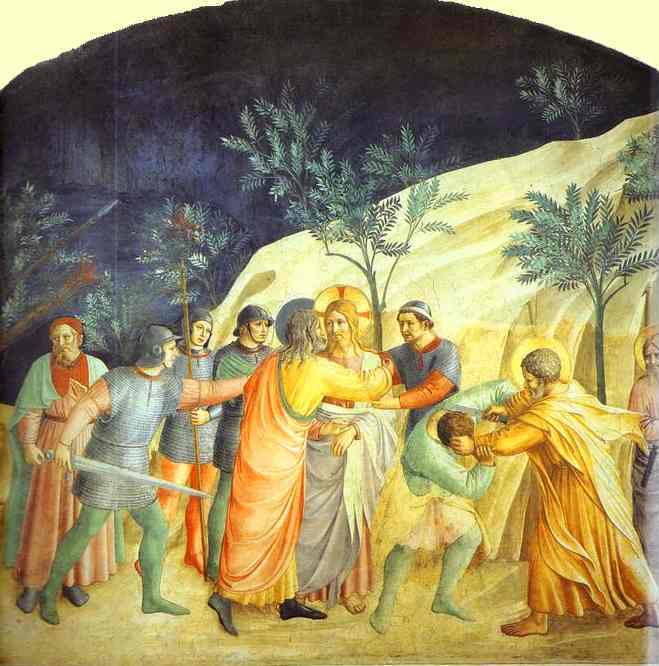
This painting is by Fra Angelico. I love this painting and is my second favourite Fra Angelico painting. What I love most about this painting is the look of Jesus. When I look at His face I see sadness in His eyes. He is not condemning Judas, in fact the look is not even reproachful, it is a look of sadness. A two fold sadness, one because one of His very own has betrayed him and sadder still because Jesus being God knows the heart of man (Judas) and knows that Judas will despair and commit suicide.
I love this painting because often I think Jesus looks at me the same way, when I do terrible sinful things, He looks at me. He who carved me in the palm of His hand, who waited till 1979 for me to be born, He who decided that I be born and raised Catholic, He looks at me with the same sad look. He who feeds me with His own body, He looks at me because I have partaken of the divine feast and yet I have kissed and betrayed Him.
Oh my Heavenly Mother, have mercy of me, implore your Son our Lord Jesus to stir up real contrition in me that I may never betray Him again. And if I dare to fall into the clutches of sin, my Mother please never let me despair but humbly with thy prayers and graces return humbly to thy Son seeking his mercy and forgiveness.
Our Lord’s Agony in the Garden - Dr. Plinio
There are five sorrowful mysteries of the rosary. Each represents a different aspect of Our Lord’s Passion. Rather than comment on all five, I prefer to speak only of the first and develop it in a detailed manner.
Our Lord’s Agony in the Garden
In Latin, the first sorrowful mystery is called the: Oratio in Horto, meaning the “prayer” in the garden, while in English it is named the Agony in the Garden. The word agony comes from the Greek word meaning “fight.” Thus, this mystery could be aptly termed the “fight” of Our Lord in the Garden of Olives.
The evening of Our Lord’s agony began with the Last Supper and institution of the Blessed Sacrament. Afterwards, Our Lord left the Cenacle, singing the Pascal Hymn with the Apostles and approached the garden.
Joy, Laced with Sadness
These events are commemorated in the Church during Holy Thursday Mass. The ceremony is festive, but imbued with a mounting sadness. After Mass, the Sacred Species are placed in a wooden tabernacle and adored only in this “Sepulcher” until Holy Saturday.
This represents the retreat of Our Lord’s soul. Though He left supper happy, having just established the Church and given Our Lady, her first communion, His happiness was darkened with sadness. Judas was shortly to betray Him, His Passion was approaching and His surroundings were melancholic compared to the evening’s earlier events.
Leaving the Cenacle, He greeted His Mother for the last time until they would meet on His way to Calvary, when she would stay at His side until His death. After this sorrowful separation, He went alone to accomplish His mission. The Apostles had only a vague notion of all this, as they fell asleep. Then, the prayer, agony and fight in the Garden began.
Our Lord already knew that Judas had sold Him; that the Jews and Romans were coming to arrest Him; and that His Passion was beginning. He knew the extent of his aborning physical and moral torments. He measured individually the ingratitude, wickedness, injuries, coldness and perversities that would occur on the long road to Calvary. He considered the pains His mother would endure because of all this. He had compassion on the holy women who would suffer at His sight. He suffered, seeing every sin of History and how ungrateful humanity would abuse everything he was about to do.
What Use Is There in My Blood?
Indeed, the following Psalm aptly summarizes His thoughts on that evening: “Quae utilitas sanguine meo?” (What use is there in my blood?) He considered all those who would burn in Hell for all eternity because they would refuse to love Him and His anguish multiplied.
He also saw the torments His Sacred Body would endure. He foresaw how It would be disfigured. He envisaged the evil that He would face, and accepted everything. He faced these torments, saying: “I have seen everything that I must endure, and I want it all! If this is the price of fallen humanity, I will pay it!”
However there were other considerations mounting within Our Redeemer. Since His humanity was perfect, His instincts were upright and strong. Thus, His instinct of self-preservation was unequalled. The thought of His aborning Passion and death overcame Him. His body was seized with panic and His human soul became afraid.
As the sinister vision of what was to come impressed itself upon Him, scripture tells us that He experienced a sort of heaviness and terror, while the tide of sadness rose within Him.
Though He was fully committed to do the Eternal Father’s will and never vacillated, His humanity recoiled at the prospect of what was to come. His sacred lips opened like a flower and He prayed with unfathomable sweetness, identifying as “Father,” He Who was asking Him to pay such a terrible ransom. He said: “My Father, if possible let this chalice pass from me, but let Thy Will, and not Mine, be done.”
What does He mean by saying: “if it be possible?” Being divine, Our Lord knew perfectly well this would be impossible. However, His humanity still clamored: “I do not see how I can confront this, but I will it if Thou doth will it.”
Then an angel appeared and offered Him a chalice with a liquid to console and strengthen Him. Fortified, He recomposed Himself and arose, ready for the sacrifice. However, His holocaust was so great that He, the God-man, started to sweat blood and the Redemption began.
Our Lord Regains His Strength
Meanwhile, Our Savoir went to the place of His arrest quickly, proudly and on foot. His bearing was such, that, when asked if He were Jesus of Nazareth, He responded: “Ego sum,” (I am He) with such strength and grandeur, that His captors fell prostrate on the ground.
Still, His sufferings were augmented by the Apostle’s abandonment. Three times, He had looked to them for consolation and three times they preferred to sleep. He complained: “Could you not watch one hour with Me?” The tepid Apostles slept on through the event that all the saints of History, past and future, have contemplated and will contemplate with veneration, until the end of time.
It was not important to them, they preferred to dream rather than contemplate the mysteries that were unfolding before them. Much less did they want to participate in His sadness. They could not bear it. Consequently, Our Lord remained alone to fight against the just terror that rose within Him.
This terror was perfect, but His reaction to it was also perfect. Thus, He dominated His fear. He faced it like a victorious warrior.
The Romans and Jews came against Him and Judas’ fetid lips worked their treason. In all this, Our Lord remained standing. He was like a soldier Who had triumphed during that moment in the battle upon which the outcome hinges.
Our Lord’s Fight and Ours
While it is absurd to imagine that the God-man could have been defeated, for argument’s sake, let us imagine that fear had dominated Him. If He had said: “I have had enough. There will be no Passion or Redemption,” his whole life would have been a failure. Everything hinged upon His ability to conquer Himself. His triumph was a result of this victory.
We, too, must fight against ourselves at every moment of life, from birth to death. While Our Lord’s fight was a battle of perfections, within us, malice, imperfection and the effects of original sin rise up like a colony of ants that continually strives to swarm and overcome us.
Facing Struggles Head on
To succeed in this battle, we should never shield ourselves from coming sufferings. Doing so makes us incapable of facing them and concedes half the battle.
Rather, we must measure our trials in advance, difficult though they may be, and beseech Our Lady for help. Paraphrasing the words of Our Lord, we should pray: “My Holy Mother, Mother of God and my Mother, if this chalice is necessary, I want to drink it to the end. Above all, I want to do thy will. If this means suffering, I want to suffer.” With this spirit, we will conquer one victory after another.
For example: To effectively maintain chastity, we should consider all that this will cost us and accept everything. If we are afraid, we should remember that every soldier is frightened before the battle. We should imitate Our Lord, Who dealt with His fear in two ways.
First, He offered Himself to God. Then, He humbly asked that His sufferings be lessened in any way possible, always reaffirming His willingness to do the divine Will. Through this prayer, He gained the necessary strength to accomplish His mission and rose from the ground like a giant, like a sun.
Do I Imitate the Apostles?
Contrarily, we often lack the courage to face our sufferings head on and thus imitate the Apostles, who refused to watch with Our Lord. This is not merely figurative. On Holy Thursday night, all humanity passed individually before Our Lord’s eyes. He saw each of us, and our defects made Him suffer.
That is why we should often repeat the penitential Psalm: “Misere mei Dei, secundum magna misericordiam Tuam.” (Have compassion on me Lord, though Thy great mercy.) We should beseech Our Lord’s mercy, remembering that we caused Him to suffer, we made His sadness sadder; we made His agony harder. When we have the slightest load, we look for someone to lighten it, but all the while, we add to His immense burden. O Mother of Mercy, obtain pardon for us!
A Remedy for Our Weakness
However, we should not lose confidence or be surprised when we feel our insufficiency. When Our Lord felt weak, He prayed to the Eternal Father and obtained supernatural strength, which all men need to remain faithful amid the struggles of life. We must pray to Our Lady to obtain this strength. We must acknowledge our nothingness, but realize that through her intercession, we can do anything. Then, we must embolden ourselves, get up and push ahead. Sooner or later, Our Lady will grant us victory and we will arise like Our Lord and confront the danger. We will face it head on and say: “Ego sum!” (I am he!)
Someone could object, saying: “Even if I face my sufferings, they will not fall prostrate before me. When the martyrs proclaimed ‘Ego sum!’ the whole world laughed and spectators happily watched as beasts devoured them. ”
This is true. Nevertheless, centuries later the victory came and the Roman emperor fell prostrate before the cross.
We may have very difficult battles, but if we face them head on and beseech Our Lady’s assistance, sooner or later, the enemy will fall prostrate. When this happens, our blood, sweat and tears will have been crowned with victory.
Our Lord’s Agony in the Garden
In Latin, the first sorrowful mystery is called the: Oratio in Horto, meaning the “prayer” in the garden, while in English it is named the Agony in the Garden. The word agony comes from the Greek word meaning “fight.” Thus, this mystery could be aptly termed the “fight” of Our Lord in the Garden of Olives.
The evening of Our Lord’s agony began with the Last Supper and institution of the Blessed Sacrament. Afterwards, Our Lord left the Cenacle, singing the Pascal Hymn with the Apostles and approached the garden.
Joy, Laced with Sadness
These events are commemorated in the Church during Holy Thursday Mass. The ceremony is festive, but imbued with a mounting sadness. After Mass, the Sacred Species are placed in a wooden tabernacle and adored only in this “Sepulcher” until Holy Saturday.
This represents the retreat of Our Lord’s soul. Though He left supper happy, having just established the Church and given Our Lady, her first communion, His happiness was darkened with sadness. Judas was shortly to betray Him, His Passion was approaching and His surroundings were melancholic compared to the evening’s earlier events.
Leaving the Cenacle, He greeted His Mother for the last time until they would meet on His way to Calvary, when she would stay at His side until His death. After this sorrowful separation, He went alone to accomplish His mission. The Apostles had only a vague notion of all this, as they fell asleep. Then, the prayer, agony and fight in the Garden began.
Our Lord already knew that Judas had sold Him; that the Jews and Romans were coming to arrest Him; and that His Passion was beginning. He knew the extent of his aborning physical and moral torments. He measured individually the ingratitude, wickedness, injuries, coldness and perversities that would occur on the long road to Calvary. He considered the pains His mother would endure because of all this. He had compassion on the holy women who would suffer at His sight. He suffered, seeing every sin of History and how ungrateful humanity would abuse everything he was about to do.
What Use Is There in My Blood?
Indeed, the following Psalm aptly summarizes His thoughts on that evening: “Quae utilitas sanguine meo?” (What use is there in my blood?) He considered all those who would burn in Hell for all eternity because they would refuse to love Him and His anguish multiplied.
He also saw the torments His Sacred Body would endure. He foresaw how It would be disfigured. He envisaged the evil that He would face, and accepted everything. He faced these torments, saying: “I have seen everything that I must endure, and I want it all! If this is the price of fallen humanity, I will pay it!”
However there were other considerations mounting within Our Redeemer. Since His humanity was perfect, His instincts were upright and strong. Thus, His instinct of self-preservation was unequalled. The thought of His aborning Passion and death overcame Him. His body was seized with panic and His human soul became afraid.
As the sinister vision of what was to come impressed itself upon Him, scripture tells us that He experienced a sort of heaviness and terror, while the tide of sadness rose within Him.
Though He was fully committed to do the Eternal Father’s will and never vacillated, His humanity recoiled at the prospect of what was to come. His sacred lips opened like a flower and He prayed with unfathomable sweetness, identifying as “Father,” He Who was asking Him to pay such a terrible ransom. He said: “My Father, if possible let this chalice pass from me, but let Thy Will, and not Mine, be done.”
What does He mean by saying: “if it be possible?” Being divine, Our Lord knew perfectly well this would be impossible. However, His humanity still clamored: “I do not see how I can confront this, but I will it if Thou doth will it.”
Then an angel appeared and offered Him a chalice with a liquid to console and strengthen Him. Fortified, He recomposed Himself and arose, ready for the sacrifice. However, His holocaust was so great that He, the God-man, started to sweat blood and the Redemption began.
Our Lord Regains His Strength
Meanwhile, Our Savoir went to the place of His arrest quickly, proudly and on foot. His bearing was such, that, when asked if He were Jesus of Nazareth, He responded: “Ego sum,” (I am He) with such strength and grandeur, that His captors fell prostrate on the ground.
Still, His sufferings were augmented by the Apostle’s abandonment. Three times, He had looked to them for consolation and three times they preferred to sleep. He complained: “Could you not watch one hour with Me?” The tepid Apostles slept on through the event that all the saints of History, past and future, have contemplated and will contemplate with veneration, until the end of time.
It was not important to them, they preferred to dream rather than contemplate the mysteries that were unfolding before them. Much less did they want to participate in His sadness. They could not bear it. Consequently, Our Lord remained alone to fight against the just terror that rose within Him.
This terror was perfect, but His reaction to it was also perfect. Thus, He dominated His fear. He faced it like a victorious warrior.
The Romans and Jews came against Him and Judas’ fetid lips worked their treason. In all this, Our Lord remained standing. He was like a soldier Who had triumphed during that moment in the battle upon which the outcome hinges.
Our Lord’s Fight and Ours
While it is absurd to imagine that the God-man could have been defeated, for argument’s sake, let us imagine that fear had dominated Him. If He had said: “I have had enough. There will be no Passion or Redemption,” his whole life would have been a failure. Everything hinged upon His ability to conquer Himself. His triumph was a result of this victory.
We, too, must fight against ourselves at every moment of life, from birth to death. While Our Lord’s fight was a battle of perfections, within us, malice, imperfection and the effects of original sin rise up like a colony of ants that continually strives to swarm and overcome us.
Facing Struggles Head on
To succeed in this battle, we should never shield ourselves from coming sufferings. Doing so makes us incapable of facing them and concedes half the battle.
Rather, we must measure our trials in advance, difficult though they may be, and beseech Our Lady for help. Paraphrasing the words of Our Lord, we should pray: “My Holy Mother, Mother of God and my Mother, if this chalice is necessary, I want to drink it to the end. Above all, I want to do thy will. If this means suffering, I want to suffer.” With this spirit, we will conquer one victory after another.
For example: To effectively maintain chastity, we should consider all that this will cost us and accept everything. If we are afraid, we should remember that every soldier is frightened before the battle. We should imitate Our Lord, Who dealt with His fear in two ways.
First, He offered Himself to God. Then, He humbly asked that His sufferings be lessened in any way possible, always reaffirming His willingness to do the divine Will. Through this prayer, He gained the necessary strength to accomplish His mission and rose from the ground like a giant, like a sun.
Do I Imitate the Apostles?
Contrarily, we often lack the courage to face our sufferings head on and thus imitate the Apostles, who refused to watch with Our Lord. This is not merely figurative. On Holy Thursday night, all humanity passed individually before Our Lord’s eyes. He saw each of us, and our defects made Him suffer.
That is why we should often repeat the penitential Psalm: “Misere mei Dei, secundum magna misericordiam Tuam.” (Have compassion on me Lord, though Thy great mercy.) We should beseech Our Lord’s mercy, remembering that we caused Him to suffer, we made His sadness sadder; we made His agony harder. When we have the slightest load, we look for someone to lighten it, but all the while, we add to His immense burden. O Mother of Mercy, obtain pardon for us!
A Remedy for Our Weakness
However, we should not lose confidence or be surprised when we feel our insufficiency. When Our Lord felt weak, He prayed to the Eternal Father and obtained supernatural strength, which all men need to remain faithful amid the struggles of life. We must pray to Our Lady to obtain this strength. We must acknowledge our nothingness, but realize that through her intercession, we can do anything. Then, we must embolden ourselves, get up and push ahead. Sooner or later, Our Lady will grant us victory and we will arise like Our Lord and confront the danger. We will face it head on and say: “Ego sum!” (I am he!)
Someone could object, saying: “Even if I face my sufferings, they will not fall prostrate before me. When the martyrs proclaimed ‘Ego sum!’ the whole world laughed and spectators happily watched as beasts devoured them. ”
This is true. Nevertheless, centuries later the victory came and the Roman emperor fell prostrate before the cross.
We may have very difficult battles, but if we face them head on and beseech Our Lady’s assistance, sooner or later, the enemy will fall prostrate. When this happens, our blood, sweat and tears will have been crowned with victory.
Wednesday, March 31, 2010
Thought for the day
Should we truly desire to become holy, we should be careful to ask ourselves, especially after attending the Holy Sacrifice of the Mass and receiving the Holy Eucharist:
"Does our conduct correspond with our Faith?"
~St. Jean Marie Vianney, the Curé of Ars
"Does our conduct correspond with our Faith?"
~St. Jean Marie Vianney, the Curé of Ars
The Three Falls of Our Lord and the Three Degrees of Tiredness
The following considerations are summarized from the original text of a conference given by Prof. Plinio Corrêa de Oliveira.
Although not an exegete, I naturally try to reason things out. Knowing that nothing happens fortuitously in the New and Old Testaments, it is according to the good rules of exegesis to ask why Our Lord fell three times.
This was not mere chance, like a plumber who falls three times while carrying a very heavy pipe. He fell once because he stumbled on a stone, another time because he was really tired or a third time because he was lazy. It was not something accidental.
Since Our Lord fell three times, the number three must correspond to high considerations and elevated reflections about weariness, suffering and even the number three itself. Therefore, I will try to draw conclusions from the fact that the tiredness of Our Lord Jesus Christ was manifested in three falls as He carried His Cross.
I cannot investigate this matter as an exegete, but rather as a reasonable man with common sense.
Legitimate and Illegitimate Tiredness
Clearly, there are two forms of tiredness. One is illegitimate, which Our Lord did not have. The other is legitimate tiredness that Our Lord did have.
Illegitimate tiredness exists when a person lacks love of God and carries his burden unwillingly. This is the tiredness of the slothful.
For example, a man who is accustomed to sleeping twelve hours a day, wakes up tired and spends the whole day tired, because he is lazy. Obviously, Our Lord never had this tiredness since He was Perfection Itself.
True Tiredness Has Three Degrees of Intensity
The First Degree: When Common Energies Become Exhausted
Common experience teaches us that there is also the tiredness of an active or dedicated man, which has three degrees of intensity. There are also three corresponding degrees of exertion and human resistance. Thus, it is reasonable to imagine that these three degrees relate to the three falls of Our Lord.
The first degree of tiredness is when a man carries a burden until all his common energies are exhausted and falls under its weight.
The very act of falling causes him to recover a bit and he has a second inspiration, whereby he mobilizes his more profound energy. Admirably controlling his body, he calls upon all the latent strength inside him. Although not accustomed to mobilizing this energy in daily life, he harnesses it and forges ahead.
During the first fall, man reasons: “This is terribly difficult! I cannot do it. However since it must be done, I want to carry this burden and make this effort despite its difficulty. I want to make this act of dedication and accomplish my mission.”
He reflects: “If I really dig deep, maybe I can summon new courage and find the strength I need to continue.”
Thus, there is a second mobilization of the soul’s energy. The soul makes a greater effort and moves on until the next fall: the second degree of tiredness.
The Second Degree of Tiredness: The Soul Makes Use of All It Has and Falls Again
In this second degree, the soul reflects: “I mobilized all that I had and did all that I could. Still, I have fallen again under the weight of this burden. Now, my energies are more exhausted than during the first fall. Nevertheless, I have already drawn from myself more than I ever imagined possible and I still want to move forward. I don’t want to give up.”
Tempted to discouragement, he considers: “Although my mission is noble and worthwhile, the weight of my burden has increased.” He has no more energy, so he increases his prayers and turns to Our Lady, saying: “My Mother, thou seest that, on my own, I can go no further. Either thou wilt help me more than before, or I will be unable to do what thou biddest me.”
Observing himself more closely, groping honestly through his energy reserves, he finds that there is still something left to sacrifice. His prayer has been answered. Besides the energy of which he was unaware, he finds new supernatural strength that permits him to continue. He rises a second time and advances, supported more by the angels than by himself.
He realizes that there was something more to give. Though unable to walk, he can still drag himself along. He has decided to accomplish his mission, even if he has to ask God for a miracle.
The Third Stage of Tiredness: Everything Is Exhausted
In the third stage, he falls once again. He is a wreck and realizes he no longer has any capacity to resist. His available energies are completely exhausted. Still, he does not give in. He turns to himself and says:
“I must hope against all hope. Although I only have energy to stand, I must at least get back on my feet and try to take one step. Beyond this, everything is blind confidence, a dark night and total exhaustion, but I will walk no matter what. I will arrive at the end.”
He gets back on his feet and walks. In so doing, he gives something from the very depth of his being that he never imagined he possessed. He exhausts what truly is the last breath of his soul and performs the most complete act of love. Only then, when he gives himself entirely does he attain the clearest vision of his ideal.
He rises from the third fall, and takes a few more stumbling steps to arrive at the place of sacrifice. There, he is nailed to the cross and utterly immolated.
The Three Degrees Summarized
These are the three degrees of tiredness, which correspond to the three stages of human dedication. In the first stage, one expends the energy that he knows he has. He asks for Our Lady’s help and the common assistance of grace.
In the second stage, he expends energy he scarcely thought he had and asks Our Lady with greater insistence to send special help, because he doubts that he can continue to walk with only the common assistance of grace.
In the third stage, he gives something far beyond what he thought he had. He finds a capacity for dedication and effort, beyond what he thought was possible. He advances amid total darkness, more by a miracle and absolute faith, than by any natural means.
Nevertheless, he continues to move forward. Finally, he fulfills his mission by a truly miraculous action. He is completely united with the supernatural.
When the Soul Has Given All It Can, It Attracts Souls
To the degree that he rises after each legitimate fall, man increasingly exudes the beauty of self-denial. This increases his capacity to attract others, because men loath egoism and flee from it. Men only follow those who deny themselves. Thus, only the man who has reached this ultimate point of self-denial and given all he can, is ready to attract souls.
This is why Our Lord, after having fallen three times, was ready to be shown to all peoples from the height of the Cross. He had already passed through this interior immolation. He had been despoiled of everything.
Still, the inexpressible sublimity of the Crucifixion takes place after the sacrifice is made. Our Lord had already carried the Cross all the way to Calvary and there, with even greater pains, allowed Himself to be crucified. His suffering increases until the moment He pronounces the “Consummatum est.” However, with the Crucifixion, He ceases to carry the Cross. From the moment He is nailed to it, the Cross carries Him.
There are stages in the spiritual life of every man, where he must carry his cross. Moreover, at times Our Lord calls man not only to accept what befalls him, but also to seek out what is terrible, tragic and apocalyptic and advance towards it. Only then, is he ready to go where Our Lord wishes. Then, he is ready to be nailed to the Cross and unite himself with Christ for all time.
Therefore, there are two stages and three dimensions of suffering. The first stage is to meet the Cross. The second is to let oneself be nailed to it. In the first stage, man goes to the apex of renunciation, successfully despoiling himself. In a second stage, having arrived at the apex of renunciation, he disposes himself to remain in it throughout his life and the cross becomes his support.
Although not an exegete, I naturally try to reason things out. Knowing that nothing happens fortuitously in the New and Old Testaments, it is according to the good rules of exegesis to ask why Our Lord fell three times.
This was not mere chance, like a plumber who falls three times while carrying a very heavy pipe. He fell once because he stumbled on a stone, another time because he was really tired or a third time because he was lazy. It was not something accidental.
Since Our Lord fell three times, the number three must correspond to high considerations and elevated reflections about weariness, suffering and even the number three itself. Therefore, I will try to draw conclusions from the fact that the tiredness of Our Lord Jesus Christ was manifested in three falls as He carried His Cross.
I cannot investigate this matter as an exegete, but rather as a reasonable man with common sense.
Legitimate and Illegitimate Tiredness
Clearly, there are two forms of tiredness. One is illegitimate, which Our Lord did not have. The other is legitimate tiredness that Our Lord did have.
Illegitimate tiredness exists when a person lacks love of God and carries his burden unwillingly. This is the tiredness of the slothful.
For example, a man who is accustomed to sleeping twelve hours a day, wakes up tired and spends the whole day tired, because he is lazy. Obviously, Our Lord never had this tiredness since He was Perfection Itself.
True Tiredness Has Three Degrees of Intensity
The First Degree: When Common Energies Become Exhausted
Common experience teaches us that there is also the tiredness of an active or dedicated man, which has three degrees of intensity. There are also three corresponding degrees of exertion and human resistance. Thus, it is reasonable to imagine that these three degrees relate to the three falls of Our Lord.
The first degree of tiredness is when a man carries a burden until all his common energies are exhausted and falls under its weight.
The very act of falling causes him to recover a bit and he has a second inspiration, whereby he mobilizes his more profound energy. Admirably controlling his body, he calls upon all the latent strength inside him. Although not accustomed to mobilizing this energy in daily life, he harnesses it and forges ahead.
During the first fall, man reasons: “This is terribly difficult! I cannot do it. However since it must be done, I want to carry this burden and make this effort despite its difficulty. I want to make this act of dedication and accomplish my mission.”
He reflects: “If I really dig deep, maybe I can summon new courage and find the strength I need to continue.”
Thus, there is a second mobilization of the soul’s energy. The soul makes a greater effort and moves on until the next fall: the second degree of tiredness.
The Second Degree of Tiredness: The Soul Makes Use of All It Has and Falls Again
In this second degree, the soul reflects: “I mobilized all that I had and did all that I could. Still, I have fallen again under the weight of this burden. Now, my energies are more exhausted than during the first fall. Nevertheless, I have already drawn from myself more than I ever imagined possible and I still want to move forward. I don’t want to give up.”
Tempted to discouragement, he considers: “Although my mission is noble and worthwhile, the weight of my burden has increased.” He has no more energy, so he increases his prayers and turns to Our Lady, saying: “My Mother, thou seest that, on my own, I can go no further. Either thou wilt help me more than before, or I will be unable to do what thou biddest me.”
Observing himself more closely, groping honestly through his energy reserves, he finds that there is still something left to sacrifice. His prayer has been answered. Besides the energy of which he was unaware, he finds new supernatural strength that permits him to continue. He rises a second time and advances, supported more by the angels than by himself.
He realizes that there was something more to give. Though unable to walk, he can still drag himself along. He has decided to accomplish his mission, even if he has to ask God for a miracle.
The Third Stage of Tiredness: Everything Is Exhausted
In the third stage, he falls once again. He is a wreck and realizes he no longer has any capacity to resist. His available energies are completely exhausted. Still, he does not give in. He turns to himself and says:
“I must hope against all hope. Although I only have energy to stand, I must at least get back on my feet and try to take one step. Beyond this, everything is blind confidence, a dark night and total exhaustion, but I will walk no matter what. I will arrive at the end.”
He gets back on his feet and walks. In so doing, he gives something from the very depth of his being that he never imagined he possessed. He exhausts what truly is the last breath of his soul and performs the most complete act of love. Only then, when he gives himself entirely does he attain the clearest vision of his ideal.
He rises from the third fall, and takes a few more stumbling steps to arrive at the place of sacrifice. There, he is nailed to the cross and utterly immolated.
The Three Degrees Summarized
These are the three degrees of tiredness, which correspond to the three stages of human dedication. In the first stage, one expends the energy that he knows he has. He asks for Our Lady’s help and the common assistance of grace.
In the second stage, he expends energy he scarcely thought he had and asks Our Lady with greater insistence to send special help, because he doubts that he can continue to walk with only the common assistance of grace.
In the third stage, he gives something far beyond what he thought he had. He finds a capacity for dedication and effort, beyond what he thought was possible. He advances amid total darkness, more by a miracle and absolute faith, than by any natural means.
Nevertheless, he continues to move forward. Finally, he fulfills his mission by a truly miraculous action. He is completely united with the supernatural.
When the Soul Has Given All It Can, It Attracts Souls
To the degree that he rises after each legitimate fall, man increasingly exudes the beauty of self-denial. This increases his capacity to attract others, because men loath egoism and flee from it. Men only follow those who deny themselves. Thus, only the man who has reached this ultimate point of self-denial and given all he can, is ready to attract souls.
This is why Our Lord, after having fallen three times, was ready to be shown to all peoples from the height of the Cross. He had already passed through this interior immolation. He had been despoiled of everything.
Still, the inexpressible sublimity of the Crucifixion takes place after the sacrifice is made. Our Lord had already carried the Cross all the way to Calvary and there, with even greater pains, allowed Himself to be crucified. His suffering increases until the moment He pronounces the “Consummatum est.” However, with the Crucifixion, He ceases to carry the Cross. From the moment He is nailed to it, the Cross carries Him.
There are stages in the spiritual life of every man, where he must carry his cross. Moreover, at times Our Lord calls man not only to accept what befalls him, but also to seek out what is terrible, tragic and apocalyptic and advance towards it. Only then, is he ready to go where Our Lord wishes. Then, he is ready to be nailed to the Cross and unite himself with Christ for all time.
Therefore, there are two stages and three dimensions of suffering. The first stage is to meet the Cross. The second is to let oneself be nailed to it. In the first stage, man goes to the apex of renunciation, successfully despoiling himself. In a second stage, having arrived at the apex of renunciation, he disposes himself to remain in it throughout his life and the cross becomes his support.
Tuesday, March 30, 2010
Thought for the day
The ordinary acts we practice every day at home are of more importance to the soul than their simplicity might suggest.
~ St. Thomas Moore, martyr
~ St. Thomas Moore, martyr
The Crowning with Thorns - commentary by Dr. Plinio Correa
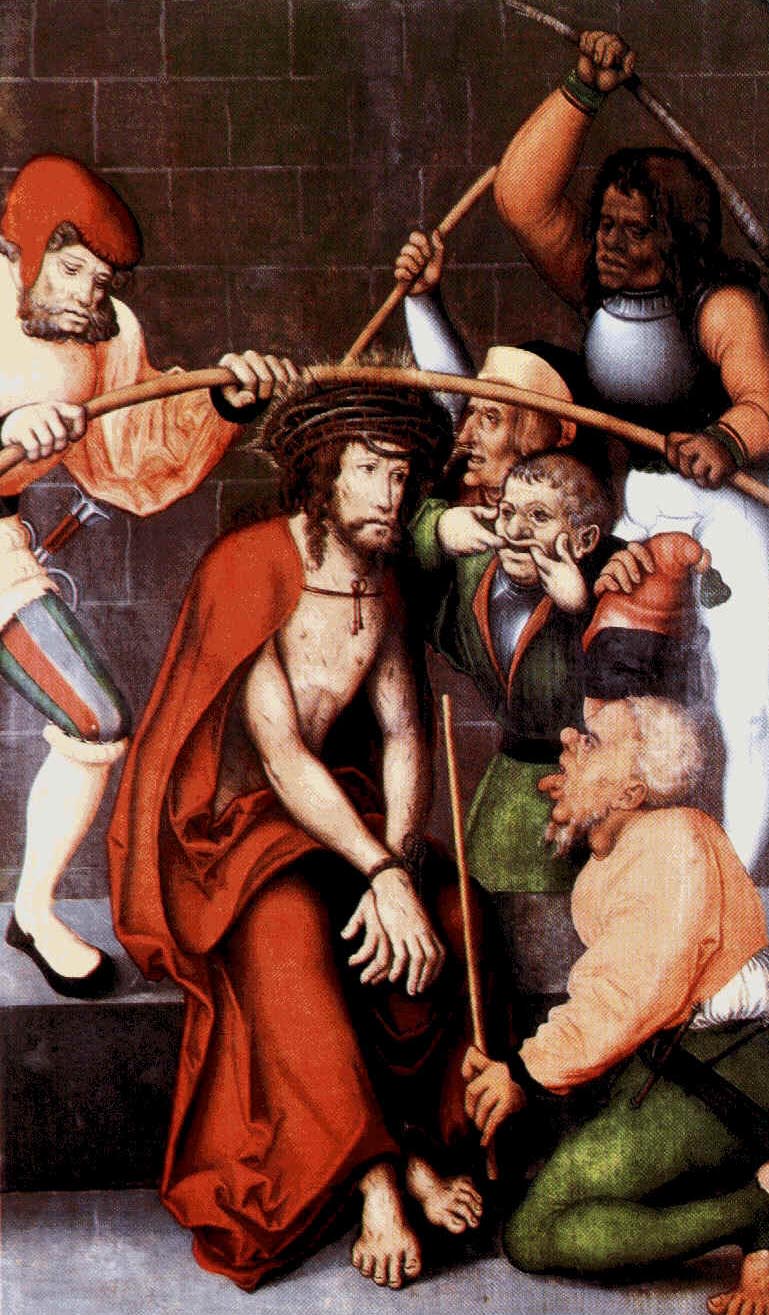 HERE we see a picture by Lucas Cranach the Elder (1472-1553), The Crowning of Thorns, preserved in the Museum of Ghent, Belgium. Five men gather around the Divine Redeemer, tied up and mockingly dressed in purple. In the foreground, a man offers Him a stick as a scepter, and at the same time, in a satiric greeting, tips his cap and sticks out his tongue. At His side, another stretches his mouth in an attitude of jeering. The others in the background try to force an immense hat of thorns, like a crown, on the Savior's adorable head. The Son of God shows signs of physical pain, but above all, of intense moral suffering that surpasses His bodily torment and completely absorbs the Divine Victim. One would say that Our Lord suffers because of the deep-seated hate of these wretched tormenters but that this hatred is nothing but the threshold of an immense ocean of rancor which extends far beyond, to the ends of the horizon. It is to this ocean that the gaze of Jesus extends in sorrowful meditation.
This picture by Lucas Cranach focuses on a very important aspect of the Passion: the contrast between the infinite holiness and ineffable love of the Redeemer and the unfathomable vileness and implacable hatred of those who tortured and killed Him. In it, the irreducible opposition between the Light— "erat lux vera" (John 1:9)—and the children of darkness, between truth and error, order and disorder, good and evil, becomes obvious.
"Popule meus, quid feci tibi? Aut in quo contristavi te?" (O my people, what evil have I done you? Or in what did I sadden you?) These words, which the liturgy of Good Friday puts on the lips of Our Lord, are in the very center of the topic we have just enunciated.
Although it may be censurable for a man to hate one who wrongs him, it is not incomprehensible. But how can a man hate someone who is good, who did good to him?
This problem is almost as old as mankind. Why did Cain hate Abel? Why did the Jews persecute and not rarely kill the prophets? Why did the Romans persecute the Christians?
Later on, why was so much blood of martyrs shed by the Protestants, by the French Revolution, by the Bolshevik Revolution in Russia? More recently, how can one explain the hatred of the communists in the Spanish Civil War, in the persecutions in Mexico, Hungary and Yugoslavia, the land that in 1960 wept over the death of Cardinal Stepinac? We ask: why was he so hated?
We well know that these questions, so worded, will seem to many a bit oversimplified. The hatred of the enemies of the Church was not always gratuitous. At times, on the part of Catholics as well, provocations and excesses were not lacking and caused reactions. Indeed, there were a certain number of cases in which mistakes and misunderstandings provoked violence. Then there were martyrs, not because the Church was duly known and nonetheless hated as such, but precisely because she was unduly unknown or disfigured.
We deny none of this. But to reduce the hatred of darkness against light, of evil against good, to these causes is indeed to singularly oversimplify the matter.
This is seen very clearly in the Passion.
* * *
WE observe at the outset that, although Catholics can have faults, Our Lord had none. Whether regarding the depth and the form of His preaching; whether regarding the tact and the opportunity with which He taught; whether still regarding the edifying character of His examples, the apologetic value of His miracles, and the most holy and striking aspect of His Person, there can be no doubt. He gave no pretext to any legitimate objection or to any solid complaint.
On the contrary, He only provided occasions for people to adore Him and follow Him. However, He was also hated, but hated even more than His faithful throughout the ages. How can this be explained? In the children of darkness there is a hatred which is precisely turned against the truth and good.
It is useless then to wish to attribute everything to a mere set of mistakes. They have existed, but they do not resolve the problem.
* * *
SOMEONE might say that this hatred is quite simple to explain. God's Law is austere. Whoever does not want to subject himself to the sacrifices inherent to its observance disobeys and easily revolts. Revolt in its turn begets hatred, especially hatred against truth and goodness. Thus, everything is explained.
We do not deny that in the generality of cases the root of hatred against God lies therein. But to understand the problem well, it is necessary to go slowly.
All sin is an offense against God. But there are some sinners who retain some sadness for the evil they practice and a certain admiration for the good they do not practice. Hence, they regret the life they lead, they advise others not to follow their example, and they honor those who practice good. On account of this humble attitude, Our Lord often grants them great graces and they return to the way of salvation.
Had only these sinners existed in Israel, I believe that Jesus would not have been persecuted and, much less, crucified. If Cain were of this number, he would not have killed Abel. If all the sinners in history had been like these, history would not record the horrible persecutions that were mentioned a little while ago.
What moves the sinners who constitute the ungodly souls of the persecutions against the Church? That is the problem.
* * *
THE saddened and shameful sinner we spoke of cannot properly be called wicked. If he becomes so steeped in sin that he comes to lose his sadness at committing it and his admiration for those who practice virtue, he will slide into wickedness. Then a first-level wickedness will be born, so to speak, that will redound in indifference for religion and morality. Only personal interests matter to the wicked of this genre. For him it is the same to live in a good environment or a bad environment. As long as he makes money and has his career or has fun, anything will do for him.
Evidently, this wickedness is very censurable. All those in Jerusalem who attended the Passion as mere curiosity-seekers were culprits of this. So are those throughout history who think they have the right to witness the struggle between the children of light and the children of darkness without taking a stand, like an egoistic "third party." Even this type of people alone, however, would not have committed the deicide.
* * *
BUT there are souls that go farther. Moved by sensuality, pride or some other vice, they take malice so far, they are so identified with sin, that they feel good only when they satisfy their bad habits. They put up with nothing that censures or even merely disagrees with their behavior. Thence arises a hatred for the good and for Goodness, for the paladins of truth and the very Truth, which gives them as it were a negative ideal. Voltaire expressed this very well in his motto "écrasez 1'infâme" —crush the infamous one (the "infamous one" being the Word Incarnate!). To make this a constant aspiration, the "ideal" of a life, behold, this is the quintessence of impiety. People like this have all the requisites to plan, plot and execute persecution. Had people like this not existed in Israel, Our Lord would not have been crucified.
* * *
GOD does not deny His grace to anyone. Evil men like these can also convert, and with all their heart. Nevertheless, it is fitting to add that, until they do so, they already have here on earth the most important characteristic of those damned to hell.
Actually, it is generally thought that all the damned would flee to heaven if they could. Not true. They hate God somuch that, even if they could free themselves from their imprisonment in eternal fire, they would not do so if for this they would have to render an act of love and obedience to God.
Such is the force of this hatred. And it is in light of this that one understands well what we would call a second-level wicked man.
This refined impiety was the moving force that animated the Synagogue in the revolt against the Messias. It has moved the fight of the wicked against the Church and against the good Catholics throughout the ages.
* * *
CHILDREN of darkness, these are the wicked. Prince of darkness, this is Satan. What relationship is there between the two? Judas was a son of darkness. The Gospel tells us that the devil entered into him (cf. Luke 22:3). We know through the faith that evil spirits "roam throughout the world seeking the ruin of souls." When the devil is able to accomplish his complete work in a soul, he takes it to this state of impiety. Reciprocally, such a soul is an open field for the devil's temptations. It is easy to see, then, that such wicked men are the best aids of hell in the fight against the Church.
* * *
LORD, in this moment of mercy, in which we consider Thy holy Body shedding Thy redeeming Blood all over, we beseech Thee, through the infinite merits of this same precious Blood, and through the tears of Thy Mother and ours, keep us very, very far from any impiety: separated from Thee let us never be, with all our heart we beseech Thee.
Wherever the wicked persecute the children of light, and most especially in the Church of Silence, be, O Lord, the strength of the persecuted, not only that they may not die, but that they may raise up, join together and crush Thy adversary. We ask Thee this through the Immaculate Heart of Mary.
And as at the last moment Thou didst still promise Paradise to a criminal, Lord, by the merits of Thy agony we beseech Thee, in union with Mary, that Thy mercy come upon even the hidden dens of impiety, so as to invite even Thy worst adversaries to the ways of virtue.
Still through mercy, Lord, confound, humiliate and reduce to complete impotency those who, refusing the most extreme appeals of Thy love, persist in working to destroy Christian civilization and even—as if it were possible—Thy mystical Bride, the Holy Church.
Monday, March 29, 2010
They Tied His Hands Because He Did Good
The following commentary is by Dr. Plinio Correa.
Why didst Thy executioners bind Thee, O Lord?
What had Thy hands done, that they should be tied?
Who can say, Lord, what glory these hands gave to God when they first received the kisses of Our Lady and Saint Joseph? Who can tell the tenderness with which Mary Most Holy first caressed them? With what piety they first joined in prayer? With what strength, nobility and humility they worked in Saint Joseph’s shop?
These hands which were so gentle for the innocent, like Saint Joseph, and the penitent, like Mary Magdalen; these hands which were fiercely against the world, flesh and devil – why are they tied down and worn raw?
What hatred and fear necessitated this?
Was someone afraid to be cured or caressed? Was someone afraid of health or tenderness? Lord, only the existence of evil can explain this awful reality. However, all men tend toward evil, and their nature easily revolts against sacrifice. Once they revolt, men are capable of all manner of infamy and disorder.
My Jesus, when someone says no to Thee, they begin to hate Thee. Hating Thee, they detest all goodness, truth and perfection, which Thou personified. Therefore, if Thou art not visibly present to persecute, they strike out against the Church, profane the Eucharist, blaspheme, spread immorality and preach revolt and rebellion.
Thou art bound, my Jesus, and where are the lame, paralytics, blind and mutes whom Thou didst cure? Where are the dead whom Thou didst resurrect, possessed whom Thou didst free, sinners whom Thou didst lift up and the just to whom Thou didst reveal eternal life?
Why are they not present to break the knots that bind Thy hands, Lord?
Why didst Thy executioners bind Thee, O Lord?
What had Thy hands done, that they should be tied?
Who can say, Lord, what glory these hands gave to God when they first received the kisses of Our Lady and Saint Joseph? Who can tell the tenderness with which Mary Most Holy first caressed them? With what piety they first joined in prayer? With what strength, nobility and humility they worked in Saint Joseph’s shop?
These hands which were so gentle for the innocent, like Saint Joseph, and the penitent, like Mary Magdalen; these hands which were fiercely against the world, flesh and devil – why are they tied down and worn raw?
What hatred and fear necessitated this?
Was someone afraid to be cured or caressed? Was someone afraid of health or tenderness? Lord, only the existence of evil can explain this awful reality. However, all men tend toward evil, and their nature easily revolts against sacrifice. Once they revolt, men are capable of all manner of infamy and disorder.
My Jesus, when someone says no to Thee, they begin to hate Thee. Hating Thee, they detest all goodness, truth and perfection, which Thou personified. Therefore, if Thou art not visibly present to persecute, they strike out against the Church, profane the Eucharist, blaspheme, spread immorality and preach revolt and rebellion.
Thou art bound, my Jesus, and where are the lame, paralytics, blind and mutes whom Thou didst cure? Where are the dead whom Thou didst resurrect, possessed whom Thou didst free, sinners whom Thou didst lift up and the just to whom Thou didst reveal eternal life?
Why are they not present to break the knots that bind Thy hands, Lord?
Passion of Christ, Passion of the Church
The following is a reflection by Dr. Plinio Correa.
There is often a defect in our meditations that diminishes their effectiveness. It is to ponder episodes from the life of Our Lord without linking them to our lives and to what happens around us. Accordingly, we are shocked at the inconsistency and ingratitude of the Jews, when, shortly after having honored Jesus with a solemn procession as Savior they crucified Him with a hatred many find hard to understand.
The Jews of 2000 years ago, when Our Lord walked the earth, are not alone in exhibiting this ingratitude and inconsistency. Still today, in the hearts of so many of the faithful, Our Lord must bear this recurring swing between adoration and insults. And this happens not only in the unseen depths of the consciences. In many countries, Our Lord has been successively glorified and offended in a short period of time.
Let us not spend our time only in horrified contemplation of the infamy of the deicide people. For our salvation, it is far more useful that we contemplate our own infamy. Trusting in God’s goodness, this is how we can truly amend our lives.
Reparation for today’s offenses against God
Everyone knows that sin is an insult to God. The person who commits a mortal sin expels God from his heart, breaks the filial relations he owes God as his Creator and rejects His grace. Here we have a revealing analogy between the Jews who killed Our Lord and ourselves when we commit a mortal sin. Yet, again and again, after having ardently glorified Our Lord by good deeds or at least by going through the motions, we commit a mortal sin and crucify Him in our heart!
There is no doubt that Our Lord is gravely offended in our days. Let us become souls of reparation. If we are not able to make reparation with the light of our virtue, at least we can do so by the sincerity of our humility. Sincere humility is intelligent, reasonable, and solid, not flowery words and emotional chest-beating. During this Holy Lenten season our humility can make reparation before the throne of God for the countless offenses committed against Him at every moment.
There is often a defect in our meditations that diminishes their effectiveness. It is to ponder episodes from the life of Our Lord without linking them to our lives and to what happens around us. Accordingly, we are shocked at the inconsistency and ingratitude of the Jews, when, shortly after having honored Jesus with a solemn procession as Savior they crucified Him with a hatred many find hard to understand.
The Jews of 2000 years ago, when Our Lord walked the earth, are not alone in exhibiting this ingratitude and inconsistency. Still today, in the hearts of so many of the faithful, Our Lord must bear this recurring swing between adoration and insults. And this happens not only in the unseen depths of the consciences. In many countries, Our Lord has been successively glorified and offended in a short period of time.
Let us not spend our time only in horrified contemplation of the infamy of the deicide people. For our salvation, it is far more useful that we contemplate our own infamy. Trusting in God’s goodness, this is how we can truly amend our lives.
Reparation for today’s offenses against God
Everyone knows that sin is an insult to God. The person who commits a mortal sin expels God from his heart, breaks the filial relations he owes God as his Creator and rejects His grace. Here we have a revealing analogy between the Jews who killed Our Lord and ourselves when we commit a mortal sin. Yet, again and again, after having ardently glorified Our Lord by good deeds or at least by going through the motions, we commit a mortal sin and crucify Him in our heart!
There is no doubt that Our Lord is gravely offended in our days. Let us become souls of reparation. If we are not able to make reparation with the light of our virtue, at least we can do so by the sincerity of our humility. Sincere humility is intelligent, reasonable, and solid, not flowery words and emotional chest-beating. During this Holy Lenten season our humility can make reparation before the throne of God for the countless offenses committed against Him at every moment.
Friday, March 19, 2010
Saint Joseph: Marytr of Grandeur
The following text is by Dr. Plinio Correa
To even begin to comprehend the nature of Saint Joseph, Patron of the Universal Church, we must bear in mind two awe-inspiring facts. St. Joseph is the virgin-husband of Our Lady and the guardian-father of Our Lord.
The husband must be proportional to the wife. Saint Joseph's spouse is the Blessed Virgin Mary, the most perfect of all creatures and masterpiece of the Creator's handiwork. In her incomparable person, we find the sum of all the virtues of all the angels, and saints, indeed all creation until the end of time. Even these poor considerations, of course, fail to convey adequately the sublime perfection of the Most Holy Mother of God.
From among all men, God chose one man worthy to love and honor the Mother of His Only-Begotten Son as her husband He was a husband proportional to his wife in love of God, purity, wisdom, justice-in every virtue. Saint Joseph was that man. However there remains something even more incomprehensible. The father must be proportional to his son, and, as we have noted, the Son for Whom God sought an earthly father was none other than His Own. There could be but one man fit for such an awesome responsibility, the man God created for precisely this vocation and whose soul He crowned with every virtue. That man, too, was Saint Joseph.
Saint Joseph is proportional to the Blessed Mother and her Divine Son. What greater homage could we render him? It is beyond our power to imagine the grandeur of Saint Joseph's exaltation. Words cannot express the depth of his penetration of the most holy soul of Our Lady and the degree of his intimacy with the Incarnate Word.
Saint Anthony of Padua is commonly depicted holding the Child Jesus. Because the Divine Child rested in his arms for a few moments, we deem Saint Anthony particularly blessed. Yet how many times did Saint Joseph hold the Christ Child in his arms?
Saint Joseph's were the pure lips that taught Jesus and answered His questions. Consider Saint Joseph's carpenter shop in Nazareth, where a son learns the trade of his father. If you can conceive of a man with the purity, humility, and wisdom to govern the Holy Family as its lord, you may begin to appreciate the sublime virtue of Saint Joseph. But how did Saint Joseph's contemporaries react in the face of this grandeur? Saint Luke provides clear testimony. "And she brought forth her firstborn son, and wrapped him up in swaddling clothes, and laid him in a manger; because there was no room for them in the inn." (Luke 2:7)
These last words reveal a bitter truth. In their petty selfishness, men find it difficult to accept that which is great - much less that which is divine. We may think that men like to deal with important matters. Indeed some men do enjoy such things, but in a superficial and selfish manner. What attracts men is not so much grandeur as mediocrity, a mixture of good and evil in which evil predominates. So we can understand why the innkeepers of Bethlehem were unwilling to make room for the Holy Family. Saint Joseph and Mary showed them the most tender kindness. Their majesty was unmistakable, even in their poverty.
However distinction is only acceptable when it is accompanied by wealth, for the latter pardons the former. Moreover, greed incites flattery, which takes the place of respect. Thus, when a poor man of great distinction knocks at the door, there is no room. It would have taken but five minutes to arrange ample accommodation for mediocre rich men, but there was no room in the inn for Saint Joseph or for his wife with Child. Even had they known that the Child was the promised Messiah, they still would not have received them. As Donoso Cortes aptly reminds us, "The human spirit hungers for absurdity and sin."
The Child Jesus resembled Our Lady. She was the prefigure of the Redeemer. Saint Joseph also looked like Him, but there was no room in the inn for the Holy Family. Thus history records the first refusal of the Hebrew people. Our Lord knocks at the doors - at the hearts of men, through the paternal intercession of Saint Joseph and He is refused.
Saint Joseph, prince of the House of David, the royal family from which would come the Hope of the Nations - knocks at the door and is rejected, but in this rejection lies his glory. Taking another step toward martyrdom, he leads his august spouse to a poor stable, where the Lord of the Universe will be born.
To this glory would be added many others: the glory of being considered a person of little worth; the glory of taking upon himself the humiliation, ignominy and opprobrium that was to fall upon Our Lord; or the glory of being scorned by men for the grandeur of his soul. Even to this day, that same glory leads us to implore, "Saint Joseph, Martyr of Grandeur, Pray for us!"
To even begin to comprehend the nature of Saint Joseph, Patron of the Universal Church, we must bear in mind two awe-inspiring facts. St. Joseph is the virgin-husband of Our Lady and the guardian-father of Our Lord.
The husband must be proportional to the wife. Saint Joseph's spouse is the Blessed Virgin Mary, the most perfect of all creatures and masterpiece of the Creator's handiwork. In her incomparable person, we find the sum of all the virtues of all the angels, and saints, indeed all creation until the end of time. Even these poor considerations, of course, fail to convey adequately the sublime perfection of the Most Holy Mother of God.
From among all men, God chose one man worthy to love and honor the Mother of His Only-Begotten Son as her husband He was a husband proportional to his wife in love of God, purity, wisdom, justice-in every virtue. Saint Joseph was that man. However there remains something even more incomprehensible. The father must be proportional to his son, and, as we have noted, the Son for Whom God sought an earthly father was none other than His Own. There could be but one man fit for such an awesome responsibility, the man God created for precisely this vocation and whose soul He crowned with every virtue. That man, too, was Saint Joseph.
Saint Joseph is proportional to the Blessed Mother and her Divine Son. What greater homage could we render him? It is beyond our power to imagine the grandeur of Saint Joseph's exaltation. Words cannot express the depth of his penetration of the most holy soul of Our Lady and the degree of his intimacy with the Incarnate Word.
Saint Anthony of Padua is commonly depicted holding the Child Jesus. Because the Divine Child rested in his arms for a few moments, we deem Saint Anthony particularly blessed. Yet how many times did Saint Joseph hold the Christ Child in his arms?
Saint Joseph's were the pure lips that taught Jesus and answered His questions. Consider Saint Joseph's carpenter shop in Nazareth, where a son learns the trade of his father. If you can conceive of a man with the purity, humility, and wisdom to govern the Holy Family as its lord, you may begin to appreciate the sublime virtue of Saint Joseph. But how did Saint Joseph's contemporaries react in the face of this grandeur? Saint Luke provides clear testimony. "And she brought forth her firstborn son, and wrapped him up in swaddling clothes, and laid him in a manger; because there was no room for them in the inn." (Luke 2:7)
These last words reveal a bitter truth. In their petty selfishness, men find it difficult to accept that which is great - much less that which is divine. We may think that men like to deal with important matters. Indeed some men do enjoy such things, but in a superficial and selfish manner. What attracts men is not so much grandeur as mediocrity, a mixture of good and evil in which evil predominates. So we can understand why the innkeepers of Bethlehem were unwilling to make room for the Holy Family. Saint Joseph and Mary showed them the most tender kindness. Their majesty was unmistakable, even in their poverty.
However distinction is only acceptable when it is accompanied by wealth, for the latter pardons the former. Moreover, greed incites flattery, which takes the place of respect. Thus, when a poor man of great distinction knocks at the door, there is no room. It would have taken but five minutes to arrange ample accommodation for mediocre rich men, but there was no room in the inn for Saint Joseph or for his wife with Child. Even had they known that the Child was the promised Messiah, they still would not have received them. As Donoso Cortes aptly reminds us, "The human spirit hungers for absurdity and sin."
The Child Jesus resembled Our Lady. She was the prefigure of the Redeemer. Saint Joseph also looked like Him, but there was no room in the inn for the Holy Family. Thus history records the first refusal of the Hebrew people. Our Lord knocks at the doors - at the hearts of men, through the paternal intercession of Saint Joseph and He is refused.
Saint Joseph, prince of the House of David, the royal family from which would come the Hope of the Nations - knocks at the door and is rejected, but in this rejection lies his glory. Taking another step toward martyrdom, he leads his august spouse to a poor stable, where the Lord of the Universe will be born.
To this glory would be added many others: the glory of being considered a person of little worth; the glory of taking upon himself the humiliation, ignominy and opprobrium that was to fall upon Our Lord; or the glory of being scorned by men for the grandeur of his soul. Even to this day, that same glory leads us to implore, "Saint Joseph, Martyr of Grandeur, Pray for us!"
Thursday, March 18, 2010
Faith - St. Cyril of Jerusalem
The one word “faith” can have two meanings. One kind of faith concerns doctrines. It involves the soul’s ascent to and acceptance of some particular matter.
It also concerns the soul’s good according to the words of the Lord: Whoever hears my voice and believes in him who sent me has eternal life, and will not come to be judged. And again: He who believes in the Son is not condemned, but has passed from death to life.
How great is God’s love for men! Some good men have been found pleasing to God because of years of work. What they achieved by working for many hours at a task pleasing to God
is freely given to you by Jesus in one short hour. For if you believe that Jesus Christ is Lord and that God raised him from the dead, you will be saved and taken up to paradise by him, just as he brought the thief there. Do not doubt that this is possible. After all, he saved the thief on the holy hill of Golgotha because of one hour’s faith; will he not save you too since you have believed?
The other kind of faith is given by Christ by means of a special grace. To one wise sayings are given through the Spirit, to another perceptive comments by the same Spirit, to another faith by the same Spirit, to another gifts of healing. Now this kind of faith, given by the Spirit as a special favour, is not confined to doctrinal matters, for it produces effects beyond any human capability. If a man who has this faith says to this mountain move from here to there, it will move. For when anybody says this in faith, believing it will happen and having no doubt in his heart, he then receives that grace.
It is of this kind of faith, moreover, that it is said: If you have faith like a grain of mustard seed. The mustard seed is small in size but it holds an explosive force; although it is sown in a small hole, it produces great branches, and when it is grown birds can nest there. In the same way faith produces great effects in the soul instantaneously. Enlightened by faith, the soul pictures God and sees him as clearly as any soul can. It circles the earth; even before the end of this world it sees the judgement and the conferring of promised rewards. So may you have the faith which depends on you and is directed to God, that you may receive from him that faith too which transcends man’s capacity.
It also concerns the soul’s good according to the words of the Lord: Whoever hears my voice and believes in him who sent me has eternal life, and will not come to be judged. And again: He who believes in the Son is not condemned, but has passed from death to life.
How great is God’s love for men! Some good men have been found pleasing to God because of years of work. What they achieved by working for many hours at a task pleasing to God
is freely given to you by Jesus in one short hour. For if you believe that Jesus Christ is Lord and that God raised him from the dead, you will be saved and taken up to paradise by him, just as he brought the thief there. Do not doubt that this is possible. After all, he saved the thief on the holy hill of Golgotha because of one hour’s faith; will he not save you too since you have believed?
The other kind of faith is given by Christ by means of a special grace. To one wise sayings are given through the Spirit, to another perceptive comments by the same Spirit, to another faith by the same Spirit, to another gifts of healing. Now this kind of faith, given by the Spirit as a special favour, is not confined to doctrinal matters, for it produces effects beyond any human capability. If a man who has this faith says to this mountain move from here to there, it will move. For when anybody says this in faith, believing it will happen and having no doubt in his heart, he then receives that grace.
It is of this kind of faith, moreover, that it is said: If you have faith like a grain of mustard seed. The mustard seed is small in size but it holds an explosive force; although it is sown in a small hole, it produces great branches, and when it is grown birds can nest there. In the same way faith produces great effects in the soul instantaneously. Enlightened by faith, the soul pictures God and sees him as clearly as any soul can. It circles the earth; even before the end of this world it sees the judgement and the conferring of promised rewards. So may you have the faith which depends on you and is directed to God, that you may receive from him that faith too which transcends man’s capacity.
Tuesday, March 16, 2010
St. Clement Mary Hofbauer - 16th March 2010
For more about this saint, please refer to the link to this web site by a Religious brother from Cistercian Abbey of Our Lady of Spring Bank.
Monday, March 15, 2010
St. Louise de Marillac - 15th March 2010
Born in 1591, Louise was illegitimate and never knew who her mother was but was acknowledged and raised by her father, a member of the aristocracy. When her father married, Louise had a difficult time adjusting as was sent as a resident student to a Dominican convent where her aunt was a religious. This experience deepened Louise's introspective ways, her many intellectual skills, as well as her desire to be a religious. When her father died and resources were limited, she lived in a boarding house where she had the opportunity to learn many basic domestic and organizational skills. This experience rounded out her classical, upper-class education and prepared her well for her future service.
Louise married Antoine le Gras, secretary to the Queen of France, but their marital happiness was short-lived because of his poor health. As a young matron, Louise travelled and socialised among both the royalty and aristocracy of France, but she was equally comfortable with the poor, no matter how their desperate situations. She held a leadership role in the Ladies of Charity, an organization of rich women dedicated to assisting the poor.
Suffering was never far from Louise. During civil unrest, her two uncles who held high rank within the government were imprisoned. One was publicly executed and the other died in prison. In 1623, when illness was wasting Antoine who died in 1625, depression was overcoming Louise. While at prayer, Louise had a vision in which she saw herself serving the poor and living the vows of religion in community.
She wrote this "lumiere" on parchment and carried it on her person as a reminder that despite her difficulties, God was guiding her life. In that vision a priest appeared to her, whom she later identified as Vincent de Paul, her future confidante and collaborator in ministry
In 1629, Vincent de Paul, who in 1625 had established the Congregation of the Mission (the Vincentians), invited Louise to assist him with the Confraternities of Charity in the parishes of France. These tasks were therapeutic for Louise and formative for her future work and that of the Vincentian family. She conducted site visits to assure the quality of the service being offered; reviewed financial accounts for stewardship reports; and encouraged the workers and volunteers to see Christ in those whom they served.
Through this work, she gained a deep knowledge of the needs of the poor, developed her own innate management skills and identified effective structures for service. On November 29, 1633 in her own home she began to train young women to address the needs of the poor and to gain support from their life together. From this humble beginning, the community of Daughters of Charity emerged. Louise provided leadership and expert management to the evolving network of services she and Vincent inspired.
Louise, who died on March 15, 1660 just a few months before Vincent de Paul, was proclaimed a Saint of the Church in 1934. In 1960 Pope John XXIII proclaimed her the Patroness of all Social Works. As a wife, mother, teacher, nurse, social worker and religious foundress, she stands as a model to all women. She lives today in the 21,000 Daughters of Charity serving throughout the world, as well as in their many lay collaborators.
Louise married Antoine le Gras, secretary to the Queen of France, but their marital happiness was short-lived because of his poor health. As a young matron, Louise travelled and socialised among both the royalty and aristocracy of France, but she was equally comfortable with the poor, no matter how their desperate situations. She held a leadership role in the Ladies of Charity, an organization of rich women dedicated to assisting the poor.
Suffering was never far from Louise. During civil unrest, her two uncles who held high rank within the government were imprisoned. One was publicly executed and the other died in prison. In 1623, when illness was wasting Antoine who died in 1625, depression was overcoming Louise. While at prayer, Louise had a vision in which she saw herself serving the poor and living the vows of religion in community.
She wrote this "lumiere" on parchment and carried it on her person as a reminder that despite her difficulties, God was guiding her life. In that vision a priest appeared to her, whom she later identified as Vincent de Paul, her future confidante and collaborator in ministry
In 1629, Vincent de Paul, who in 1625 had established the Congregation of the Mission (the Vincentians), invited Louise to assist him with the Confraternities of Charity in the parishes of France. These tasks were therapeutic for Louise and formative for her future work and that of the Vincentian family. She conducted site visits to assure the quality of the service being offered; reviewed financial accounts for stewardship reports; and encouraged the workers and volunteers to see Christ in those whom they served.
Through this work, she gained a deep knowledge of the needs of the poor, developed her own innate management skills and identified effective structures for service. On November 29, 1633 in her own home she began to train young women to address the needs of the poor and to gain support from their life together. From this humble beginning, the community of Daughters of Charity emerged. Louise provided leadership and expert management to the evolving network of services she and Vincent inspired.
Louise, who died on March 15, 1660 just a few months before Vincent de Paul, was proclaimed a Saint of the Church in 1934. In 1960 Pope John XXIII proclaimed her the Patroness of all Social Works. As a wife, mother, teacher, nurse, social worker and religious foundress, she stands as a model to all women. She lives today in the 21,000 Daughters of Charity serving throughout the world, as well as in their many lay collaborators.
Subscribe to:
Posts (Atom)