Evil triumphs when good men do nothing - Edmund Burke

Thursday, August 5, 2010

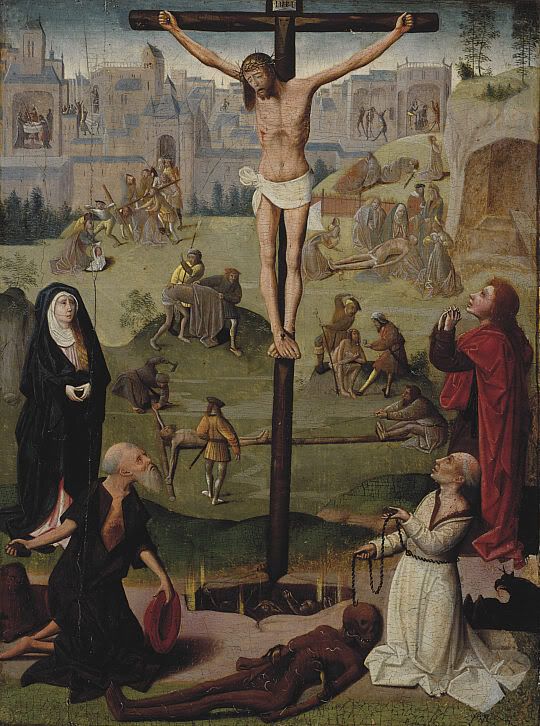
Christ's Cross - a message of sorrow and salvation - Pope John Paul II


Christ's Cross - a message of sorrow and salvation

Although he was the light to enlighten all nations, Jesus was destined in his own day and in every age to be a sign disparaged, a sign opposed, a sign of contradiction.

This had been true for the prophets of Israel before him. It was true for John the Baptist and would be true for the lives of his future followers. He performed great signs and miracles: he healed the sick, multiplied the loaves and fishes, calmed tempests, restored the dead to life. Crowds flocked to him from everywhere and listened to him carefully because he spoke with authority. And yet he met harsh opposition from those who refused to open their hearts and minds to him. Finally we find the most tangible expression of this contradiction in his suffering and death on the Cross. Simeon's prophecy came true - true regarding the life of Jesus, and true regarding the lives of those who follow him, in every land and in every age. So the Cross becomes light; the Cross becomes salvation. Isn't this perhaps the Good News for the poor and for all who know the bitter taste of suffering?

The cross of poverty, the cross of hunger, the cross of every other sort of suffering can be transformed, since Christ's Cross has become a light in our world. It is a light of hope and salvation. It gives meaning to all human suffering. It brings with it the promise of an eternal life, free from sorrow, free from sin.

The Cross was followed by the Resurrection. Death was vanquished by life. And all who are united to the crucified and risen Lord can look forward to sharing in this selfsame victory.

Jesus, the way that leads us to the Father - Pope John Paul II


Jesus, the way that leads us to the Father

We 'reach' God through the truth about God and through the truth about everything outside God: about the creation, the macrocosm, and about human nature, the microcosm. We 'reach' God through the truth proclaimed by Christ, through the truth that Christ actually is. We reach God in Christ, who continually assures us: 'I am the truth.' And this 'reaching' God through the truth which is Christ is the source of life. It is the source of eternal life, which begins on earth in 'the darkness of faith' to reach its fullness in the vision of God 'face to face' - in the light of the glory where he abides for ever.

Christ gives us this life, for he is life, exactly as he says: 'I am the life.' 'I am the way, the truth and the life.'

Jesus is the Son of God and he is of the same substance as the Father. God from God and Light from Light, he became a human being to be the way which would lead us to the Father. During his earthly life he spoke ceaselessly about the Father. To him, to the Father, he directed the thoughts and hearts of all who listened to him. In a sense, he shared God's Fatherhood with them, and this appears particularly in the prayer he taught to his own disciples: the Our Father.

At the end of his messanic mission on earth, the day before his passion and death, Jesus said to the Apostles: 'In my Father's house there are many places to live in; otherwise I would have told you. I am going now to prepare a place for you' (John 14:2).

If the Gospel is a revelation of the truth that human life is a pilgrimage towards the Father's house, it is also a summons to the faith by which we journey as pilgrims: a call to pilgrim faith. Christ says: 'I am the way, the truth and the life.'

The human being, 'a pilgrim of the Absolute' - Pope John Paul II

The human being, 'a pilgrim of the Absolute'


Human life on earth is a pilgrimage. We are all aware of being in transit in this world. Our lives begin and end, they start at birth and go on till the moment of death. We are transitory beings. And on life's pilgrimage religion helps us to live in such a way as to reach our true destination. We are constantly kept aware of the transitory nature of this life, which we know to be extremely important as the preparation for life eternal. Our pilgrim faith directs us towards God and guides us in discharging those choices which will help us to win eternal life. So, every moment of our earthly pilgrimage is important - important as to its challenges, as to the choices we make.

In the Revelation of the Old and New Covenants,we who live in the visible world amid temporal things are also deeply aware of God's presence penetrating every aspect of our lives. This living God is in fact our last and absolute bulwark amid all the trials and sufferings of earthly existence. We yearn to possess this God once and for all, the moment we experience his presence. We strive to attain the vision of his face. In the words of the psalmist 'As the heart longs for flowing streams, so my soul longs for you O God.'

While we strive to know God, to see his face and experience his presence, God turns to us to reveal his own life to us. The Second Vatican Council dwelt at length on the importance of God's activities in the world, explaining that 'with the divine revelation God wished to manifest and communicate himself and his will's eternal decrees with regard to the salvation of mankind.'
This notwithstanding, this merciful and loving God who communicates himself through Revelation still remains an inscrutable mystery to us. And we, pilgrims of the Absolute, keep seeking the face of God throughout our lives. But, at the end of the pilgrimage of faith, we reach 'the Father's house', and being in this house' means seeing God face to face' (1 Corinthians 13:12)."

From the very beginning the human race has been called by God 'to subdue the earth and master it' (Genesis 1:28). We have received this earth from the Lord as a gift and as a responsibility. Made in his image and likeness, we have a special dignity. We are master and lord of the good things placed by the Creator in what he has made. We are collaborators with our Creator.

This being so, we for our part must never forget that all the good things that fill the created world are the Creator's gift. For so Holy Scripture advises us: 'Beware of thinking for yourself, "My own strength and the might of my own hand have given me the power to act like this." Remember the Lord your God; he was the one who gave you the strength to acquire riches, so as to keep, as he does today, the covenant which he swore to your ancestors' (Deuteronomy 8:17-18).

How apposite this advice has been in the course of human history! How especially apposite it is at the present day, with our progress in science and technology! For as we contemplate our brilliant achievements, the works of our mind and of our hands, we seem to grow more and more forgetful of him who is the author of all these works and of all the good things which the earth and the created world contain. The more we subdue the earth and master it, the more we seem to forget the Lord who has given us the earth and all the good things it contains.

Tuesday, August 3, 2010

love of truth is love of Christ - Pope John Paul II

Love of truth is love of Christ


There is a pollution of ideas and manners that can lead to human destruction. The pollution is sin, which generates falsehood.
Truth and falsehood. We must realize that falsehood very often presents itself to us under the garb of truth. Our discernment has to be the sharper, therefore, so that we can recognize the truth, the word that comes from God, and shun the temptations that come from the Father of Lies. I have in mind that sin which consists in denying God, in rejecting the light. As it says in St. John's Gospel, ' the true light' was in the world: the Word 'by whom the world was made but whom the world did not acknowledge (cf John 1:9 - 10).
' The truth contained in the Father's word. ' Yes, that is what we ought to say when we recognize Jesus Christ as the Truth. 'What is Truth?' Pilate asked Him. Pilate's tragedy was that he had the Truth in front of him in the person of Jesus Christ and couldn't recognize it.
This tragedy must not be repeated in our own lives. Christ is the centre of the Christian faith which the Church proclaims today as she has always done, to every man and woman. God was made man. 'The Word became flesh and dwelt among us' (John 1:14). In Jesus Christ the eye of faith beholds the human being as it can be and as God wishes it to be. At the same time Jesus reveals the Father's love for us. But the Truth is Jesus Christ. Love the Truth! live in the Truth! Carry the Truth to the world! Be witnessed to the Truth. Jesus is the Truth that saves; he is the whole Truth to which the Spirit of Truth will leads us (cf. John 16:13).

Dear young people, let us seek the truth about Christ and about his Church! but we must be consistent: let us love the Truth, live in the Truth, proclaim the Truth! O Christ, show us the Truth. Be the only Truth for us!'


Christian Faith and courage in life - Pope John Paul II

Christian Faith and courage in life

We have to make a conscious decision that we mean to be professing Christians, and we must have the courage to be different, if need be, from other members of our social group. Our decision to bear Christian witness presupposes that we perceive and understand the faith as a precious opportunity in life, transcending the views and manners of our environment. We must take every opportunity to experience how the Faith can enrich our existence, make us genuinely steadfast in the struggle for life, strengthen our hope against attacks of every kind of pessimism and despair, and prompt us to avoid all extremism and to commit ourselves thoughtfully to furthering justice and peace in the world; lastly, the Faith can console and cheer us in sorrow. And so it is our task and opportunity in this diaspora situation to experience more consciously how the Faith can helps us to live more fully and more deeply.

The first thing i want to offer you is an invitation to optimism, hope and trust. Certainly, the human race is going through a difficult patch, and we often have a painful impression that the forces of evil, in many manifestations of social life, have got the upper hand. All too often honesty, justice and respect for human dignity have to mark time or seem to be on their last legs. And yet, we are called to overcome the world by our faith (cf John 5:4), since we belong to him who by his death and resurrection obtained for every one of us the victory over sin and death, and so has made us able to affirm humbly, serenely but certainly, that good will triumph over evil.

We belong to Christ and it is he who conquers in us. We must believe this deeply; we must live this certainty. If we do not, through the problems which are constantly arising those insidious beasts called discouragement at, tolerance of , and supine adaptation to the arrogance of evil will worm their way into our souls.

The subtlest temptation afflicting Christians today, and especially young people, is precisely that of giving up hope in Christ's affirmation of victory. The author of all guile, the Evil One, has long been fiercely committed to dowsing the light of this hope in each individual heart. It is no easy path - that of the Christian soldier. But we must follow it, knowing that we possess an inner strength for transformation, communicated to us with the divine life that we have been given in Christ the Lord. BY your witness, you will make others understand that the highest of human values are taken up in a Christianity lived consistently, and that the Gospel faith not only offers a new vision of humanity and the world, but more important still, makes it possible to bring this renewal about.

Monday, August 2, 2010

Encounter with God in Jesus Christ in the Church - Pope John Paul II

Encounter with God in Jesus Christ in the Church

Opinions, private points of view and speculations no longer suffice for anyone weighing up their effect on the course of human life, and whose respect for humanity is awake. They certainly do not satisfy anyone who is conscious of being able to arrive by means of theological responses at the first cause of truth. God has manifested his word to us. We cannot find it and grasp it unaided by the power of our intellect alone, however much may be conceded to our diligence in illuminating the credibility of this word and how it corresponds to our questions and to out various forms of human knowledge. It is in the inner logic of Revelation that the defence and interpretation of this word require the special gift of the Spirit. It follows, then, that the study of Catholic theology must always be subject to a willingness to listen to the binding testimony of the Church and to accept the decisions of those who, in their capacity as pastors of the Church, are responsible before God for protecting the deposit of faith.

Without the church, the word of God would not have been handed down and preserved; one cannot want God's word without the Church. Intellectual comprehension of the faith must of course be integrated with another aspect: the faith, besides being known, must be lived. In the New Testament itself a faith based uniquely on knowing would be rejected as a perversion. For example, according to the Letter of St James, the demonic forces know the One God but, since they do not accept this knowledge with their inner nature, all that remains for them is to tremble before this God. For them punishment not salvation is in store (Cf James 2:19)
When God addresses his word to us, he does not tell us some fact about things or other people; he does not communicate something - he communicates himself. Thus God's word demands a response, which ought to be given with our entire person. The reality of God eludes those who confine themselves to thinking of his word and of his truth only as objects of impartial research. On the contrary, the way to draw near to God as God is by worship alone. One of the great mystics, Meister Eckhart, used to urge his listeners ' to get rid of the imaged God'. If God remains purely and simply 'he', we remain alone and empty. god gives himself to us as 'you'. We only find him when we too say 'you'. It follows, as Eckhart used to say, that we ought to have God present 'in our heart, in our search and in our love'.

Learn to know Christ and make yourselves known to him! he knows each one of you individually. this is no knowledge giving rise to opposition and rebellion, a knowledge from which one needs to flee in order to safeguard one's own personal mystery. This is no knowledge composed of hypotheses which reduce human being to socio-utilitarin dimensions. His is a knowledge full of simple truth about human nature and, above all, full of love. Submit to being known by the Good Shepherd, his knowledge is simple and full of love. Be sure, he knows each of you better than you know yourselves. He knows because he has given his life for you (John 15:13) Allow him to find you. At times people, young people, lose their bearing in the world surrounding them, in the vast network of human affairs enveloping them. Allow Christ to find you. Let him know all about you, let him guide you. True, in order to follow someone, you must at the same time make demands on yourself; such is the law of friendship. If we wish to travel together, we shall have to give thought to the road we are taking. if it leads up into the mountains, we shall have to follow the signposts. If we have to climb a mountain, we must not leave the rope behind. And besides, we must keep in contact with our divine Friend whose name is Jesus Christ. We have to co-operate with him.

Worshippers at Malad church attacked (India)

Worshippers at Malad church attacked, 2 detained
TNN, Aug 2, 2010, 01.44am IST

MUMBAI: Eight persons allegedly ransacked St Emmanuel in Orlem, Malad (W) on Sunday evening. Joseph Dias, secretary, Catholic Secular Forum, said that the men, who were drunk, barged into the church when a prayer meeting was on.

The accused allegedly started molesting the women in the congregation. When the women objected, the accused beat up the worshippers.

Ponkumar Nadar, who sustained serious injuries, was taken to Bhagwati Hospital. The others were undergoing treatment at a private hospital.

The Malwani police has detained two persons. Abraham Mathai, vice-chairman, state minorities commission, said the police should carry out an impartial probe.

The crisis in Catholic Christian faith - Pope John Paul II


The crisis in Catholic Christian faith


Even among many Catholics who still identify themselves as such, there is a remarkable weakening of faith in God as a person, and consequently of faith in Christ as Son of God. They also fail to see the Church as a sacrament, an objective, not-to-be- manipulated gift from him. This is why, all too often, interior life or spirituality is equated with philanthropy and socio-political action in the cause of peace, justice, ecology and so forth, and why some people regard prayer, meditation and lectio divina as lacking particular importance.
Some lay people too, engaged in parochial, diocesan and national church structures, exhibit this secularized forma mentis, as also do some males and female religious who get more and more involved in social mission, which they often identify with their actual work as missionaries.
The publication of the new Cathecism of the Catholic Church cannot fail to reassure and strengthen those of the faithful who have lost their bearings in the theological fragment of these latter years, and to bring back to the genuine sources of the faith those who have gone astray after false prophets.
In point of fact, studying theology, being a believer and feeling onself to be an active member of the Church are three components which students sometimes find hard to integrate into their lives. We must not over dramatize this: to go through crisis can even be salutary and positive, inasmuch as it can make one's faith more mature and foster responsible Church membership. For this to happen, however, there must be careful pastoral support.

Rejecting the truth - Pope John Paul II

Rejecting the truth

The mystery of iniquity, the forsaking of God, has, according to the words of St. Paul's letter, a well- defined inner structure and dynamic sequence: ' the wicked one will appear, who raises himself above every so called God or object of worship to enthrone himself in God's sanctuary and flaunts the claim that he is God' (2 Thessalonians 2:3-4)
Here we find an inner structure of negation, of the uprooting of God from people's hearts and the forsaking of God by human society: and all this with the aim, as is commonly said, of a full 'humanization' of the human being - that is to say, of making the human person human in the full sense and , in a certain way, putting the human being in the place of God, thus 'deifying' humanity. this structure, of course, is very ancient; it has been known since the beginning of the world, from the first chapter of Genesis; I mean the temptation to confer the Creator's 'divinity' on human beings (made in God's image and likeness), to take God's place, with the 'divinization' of humanity against God or without God, as is clear from the atheistic statements of many of today's systems.
Those who reject the fundamental truth of things, who set themselves up as a yardstick for everything, and thus put themselves in God's place; who more or less consciously think they can do without God, the Creator of the world or without Christ, the Redeemer of the human race; who instead of seeking God run back to idols, will always turn their backs on the one supreme and fundamental truth.

Sunday, August 1, 2010

Pope John Paul II - Faith and Reason

Faith and Reason

Between a reason which, in conformity with its own nature that comes to it from God, is directed to the truth and is accustomed to know what is true, and a faith which reinforces itself at the selfsame divine source of every truth, no basic conflict can arise. for rather, faith confirms the rights which are proper to natural reason. it presupposes them. For its acceptance presupposes that freedom which is proper only to a rational being. that said, it is nonetheless true that faith and science belong to two different orders of knowledge, which cannot be superimposed the one on the other. And here, furthermore, it becomes plain that reason cannot do everything of itself; it is finite. It has to be embodied in a multiplicity of partial types of knowledge and is expressed in a plurality of individual sciences. It can grasp the unity binding the world and truth to their origins only within partial modes of knowledge. In so far as they are sciences, even philosophy and theology are limited attempts that can only grasp the complex unity of truth in its diversity - that is, within a latticework of open and complementary kinds of knowledge.
The 'learned' and the 'clever' have worked out their own view of God and the world, and they are disinclined to change it. They believe that they know all there is to know about God , that they have the final answer, that they have nothing more to learn. And This is why they reject 'the good news', for its strikes them as quite alien and conflicting with the main tenets of their Weltanschauung. The Gospel message proposes certain paradoxical reversals which their 'common sense' cannot accept.
As it was in the day of Jesus, so it is today, and yet today in perhaps a very particular way. We live in a culture which subjects everything to critical analysis, and which does this while often regarding partial criteria as absolute. By their very nature these criteria are unsuitable for perceiving the world of realities and values which eludes verification by the senses.
Christ didn't ask us to give up our reason. How indeed could he, since it as he who gave it to us? What He does ask is that we should not give in to the Tempter's old suggestion that we can be 'like God' (cf Genesis 3:5)
Only those who accept their intellectual and moral limitations and recognize their need for salvation can make themselves once more open to faith and in faith encounter, in Christ, their redeemer.

The Galileo case: science and faith - Pope John Paul II

The Galileo case: science and faith

From the century of the Enlightenment down to our own today, the Galileo case has been a kind of myth in which the account of what happened has been very remote from the facts. Seen like this, the Galileo case was a symbol of the alleged rejection of scientific progress by the Church, or of 'dogmatic' obscurantism opposed to the free quest for truth. Culturally speaking, this myth has played a considerable role; it has helped to wed many scientist, acting in good faith, to the idea that the scientific spirit and its research ethic are incompatible with the Christian religion. A tragic mutual incomprehension has been construed as reflecting a constitutive opposition between science and faith. Clarifications afforded by recent historical studies allow us to state that this unhappy misunderstanding is now a thing of the past.
Galileo, who virtually invented the experimental method, had understood, through his brilliant physicist's intuition and by relying on various lines of reasoning, why only the sun could act as the centre of the world as it was then known, or as we should say, of the planetary system. The error of the theologians of the day in upholding the centrality of the earth was that of the thinking that our knowledge of the structure of the physical world is in some way imposed by the literal sense of Holy Scripture. But we should remember the famous quip attributed to Baronius: ' Spiritui Sancto mentem fuisse nos docere quomodo ad coelum eatur, non quomodo coelum gradiatur.' For the fact is, Scpriture is not concerned with the details of the physical world, knowledge of which is entrusted to human experience and reasoning. There are two fields of knowledge: that which has its source in Revelation, and that which reason can discover by its own efforts. To this last belong the experimental sciences and philosophy. The distinction between the two fields of knowledge must not be understood as opposition. The two sectors are not at all aligned to one another, but have points in contact. The methodologies proper to each allow different aspect of reality to be brought to light.
I am Happy to take as the starting point for my reflection one of the bronze inscriptions unveiled here today: " Science and faith are both gifts of God". This synthesizing statement not only precludes science and faith from regarding each other with mutual suspicion, but points out the deeper reason summoning them to establish a constructive and cordial relationship: God, the common foundation of both... In God therefore, despite their different paths, science and faith find their unifying principle.
If human life incurs enormous dangers today, this is not because of the truth discovered by scientific research; rather, it is due to the deadly application of technology. ' As in the time of spears and swords, so in the age of missiles,' the Holy Father said, quoting another inscription in the Centro Majorana: 'First to perish by these weapons if the human heart."

Saturday, July 31, 2010

The tragedy of atheism - Pope John Paul II

Today, in the world, and especially in our Western world, we realize the need 'to rebuild', in its essential components, a civilization truly worthy of human beings. Economic inequalities which still subsist and which will gradually get worse, are symptomatic of deeper needs impinging on the spiritual sphere.
Materialistic ideologies on the one hand and moral permissiveness on the other have led many people to believe that it is possible to build a new and better society while excluding God and eliminating and reference to transcendental values. However, experience shows us all to clearly that, without God, society is dehumanized and the human person is deprived of his or her greatest riches. The closer human beings are to the Creator and Redeemer, the more truly human the future of the world will be.
Christianity does not deaden human nature but exalts its noblest potentialities, placing them at the service of the authentic progress of the individual and the community. 'In Christ, true man as well as true God, we can discover the full truth about ourselves and the purpose of our existence' (Redemptor hominis 11)
I urge you to preserve intact your faith in Jesus the Saviour, who died and rose again for us. Listen carefully to his Gospel, which the Church continues preaching to you with unchanging fidelity to what has been taught from the beginning. Bring up your children to obey the commandments, teaching them to ask God for the courage they will need to defy the dominant opinion, when this is in opposition to the Gospel. Do not be afraid to swim against the tide.
Today as never before the world has need of the newness of the Gospel, so as not to drown in the overwhelming conformism of mass civilization.
Some people claim to be seekers; others think of themselves as non-believers, or perhaps they are unable to believe or they are indifferent to religion. Others again reject a God whose face has been misrepresented to them. Others yet again, who are blinded by the outbursts of the 'philosophies of suspicion' which present religion as illusion or alienation, are sometimes tempted to construct a humanism without God.
I beg all of these people, in all fairness, at least to leave their windows open to God. Otherwise they are in danger of walking past the man in the street who is Christ, of cutting themselves off by the attitudes of revolt and violence, and of being satisfied with sighs, impotence and resignation. Sooner or later, a world without God is built against the human being.

Faith - by Pope John Paul II

The Difficulty of believing today

As we are well aware, contemporary civilization is permeated with different currents - not only Christian ones but alto anti-Christian, non-Christian, non religious and anti-religious ones. And sometimes these latter currents seem to dominate the thinking of contemporary society. This situation needs commitment if it is to be overcome: the commitment of all Christians who are aware of what it means to be a Christian. Christ says that his Father too has a 'culture', a culture in the deepest sense of the word: that culture which is the true perfection of the human spirit, its completeness in the natural, human sense and in the supernatural sense too.
It isn't easy to be authentic Christians in the context of modern society, with the strands of renascent paganism running through it. But it wasn't easy yesterday either, when circumstances were different. It is harder still to create a wider social environment inspired by the great Gospel Values. But we must strive to do this, putting our trust in the creative power that flows from the grace of the Risen Christ.
There are no types of society that can claim to be free of negative elements. Even roses have thorns.

Saturday, July 10, 2010

Act of Consecration to the Most Precious Blood

Blood of Jesus, inebriate me! O Jesus, my Beloved Savior, ever present in the Tabernacle, to be the strength, the joy and the food of souls, I come to consecrate myself to Thy Precious Blood, and to pledge Thee my sincere love and fidelity. Pierced with sorrow at the remembrance of Thy sufferings, the contemplation of the Cross, and the thought of the outrages and contempt lavished by ungrateful souls upon Thy dear Blood, I long, O my Jesus, to bring joy to Thy Heart, and to make Thee forget my sins, and those of the whole world, by consecrating my body and soul to Thy service. I desire, my Jesus, to live henceforth, only by Thy Blood and for Thy Blood. I now choose It as my greatest treasure and the dearest object of my love.

O merciful Redeemer, deign to regard me as a perpetual adorer of Thy Most Precious Blood, and be pleased to accept my prayers, my deeds and my sacrifices, as so many acts of reparation and love.

Heavenly Wine, giver of purity and strength, pour down upon my soul. Make of my heart a living chalice from which grace shall constantly flow on those that love Thee, and especially on poor sinners that offend Thee. Teach me to honor Thee and to make Thee honored by others. Give me power to draw to Thee cold and hardened hearts, that they may feel how infinitely Thy consolations surpass those of the world.

O Blood of my Crucified Savior, detach me from the world, and the spirit of the world. Make me love suffering and sacrifice, after the example of St. Catherine of Sienna, who loved Thee so much [and whom I choose again today as my special patroness].

O Precious Blood, be my strength amid the trials and struggles of exile. Grant that at the hour of death I may be able to bless Thee for having been the comfort and the sanctification of my soul, before becoming, in Heaven, the everlasting object of my love and praise.

Saints of God, who owe thy happiness to the Blood of Jesus; Angelic spirits, who sing Its glory and power, august Virgin, who to It owest the privileges of thine Immaculate Conception and Divine Maternity, help me to pay to the Precious Blood of my Redeemer a perpetual homage of adoration, reparation and thanksgiving. Amen.

Friday, July 9, 2010

Gregorian - Pange lingua

Keeping with our theme on the Precious Blood of Our Lord Jesus Chirst, let us listen to this meditation in musical form.


Sing, my tongue, the Saviour's glory,
Of His Flesh the mystery sing;
Of the Blood, all price exceeding,
Shed by our immortal King,
Destined, for the world's redemption,
From a noble womb to spring.

Of a pure and spotless Virgin
Born for us on earth below,
He, as Man with man conversing,
Stay'd, the seeds of truth to sow;
Then He closed in solemn order
Wondrously His life of woe.

On the night of that Last Supper,
Seated with His chosen band,
He the Paschal victim eating,
First fulfils the Law's command;
Then, as Food to His Apostles
Gives Himself with His own hand.

Word made Flesh, the bread of nature
By His word to Flesh He turns;
Wine into His Blood He changes:-
What though sense no change discerns?
Only be the heart in earnest,
Faith her lesson quickly learns.

Therefore, we, before It bending,
This great Sacrament adore;
Types and shadows have their ending
In the new rite evermore:
Faith, our outward sense amending,
Maketh good defects before.

Honor, laud, and praise addressing
To the Father and the Son,
Might ascribe we, virtue, blessing,
And eternal benison:
Holy Ghost, from both progressing,
Equal laud to Thee be done. Amen.

Thursday, July 8, 2010

The Two Companies

The following is an exceprt from the book 'Letter to the Friends of the Cross" by St. Louis De Montfort.


My dear brothers and sisters, there are two companies that appear before you each day: the followers of Christ and the followers of the world.

Our dear Saviour's company is on the right, climbing up a narrow road, made all the narrower by the world's immorality. Our Master leads the way, barefooted, crowned with thorns, covered with blood, and laden with a heavy cross. Those who follow him, though most valiant, are only a handful, either because his quiet voice is not heard amid the tumult of the world, or because people lack the courage to follow him in his poverty, sufferings, humiliations and other crosses which his servants must carry all the days of their life.

On the left hand is the company of the world or of the devil. This is far more numerous, more imposing and more illustrious, at least in appearance. Most of the fashionable people run to join it, all crowded together, although the road is wide and is continually being made wider than ever by the crowds that pour along it like a torrent. It is strewn with flowers, bordered with all kinds of amusements and attractions, and paved with gold and silver.

On the right, the little groups which follow Jesus speak about sorrow and penance, prayer and indifference to worldly things. They continually encourage one another saying, "Now is the time to suffer and to mourn, to pray and do penance, to live in retirement and poverty, to humble and mortify ourselves; for those who do not possess the spirit of Christ, which is the spirit of the cross, do not belong to him. Those who belong to Christ have crucified all self-indulgent passions and desires. We must be true images of Christ or be eternally lost."

"Have confidence," they say to each other. If God is on our side, within us and before us, who can be against us? He who is within us is stronger than the one who is in the world. The servant is not greater than his master. This slight and temporary distress we suffer will bring us a tremendous and everlasting glory. The number of those who will be saved is not as great as some people imagine. It is only the brave and the daring who take heaven by storm, where only those are crowned who strive to live according to the law of the Gospel and not according to the maxims of the world. Let us fight with all our strength, let us run with all speed, that we may attain our goal and win the crown.

Such are some of the heavenly counsels with which the Friends of the Cross inspire each other.

Those who follow the world, on the contrary, urge each other to continue in their evil ways without scruple, calling to one another day after day, "Let us eat and drink, sing and dance, and enjoy ourselves. God id good; he has not made us to damn us. He does not forbid us to amuse ourselves. We shall not be damned for so little. We are not to be scrupulous. 'No, you will not die'."

Dear brothers and sisters, remember that our loving Saviour has his eyes on you at this moment, and he says to each one of you individually, "See how almost everyone deserts me on the royal road of the Cross. Pagans in their blindness ridicule my Cross as foolishness; obstinate Jews are repelled by it as by an object of horror; heretics pull it down and break it to pieces as something contemptible.

"Even my own people - and I say this with tears in my eyes and grief in my heart - my own children whom I have brought up and instructed in my ways, my members whom I have quickened with my own Spirit, have turned their backs on me and forsaken me by becoming enemies of my Cross. 'Will you also go away?' Will you also desert me by running away from my Cross like the worldlings, who thus become so many antichrists? Will you also follow the world; despise the poverty of my Cross in order to seek after wealth; shun the sufferings of my Cross to look for enjoyment; avoid the humiliations of my Cross in order to chase after the honours of the world? 'There are many who pretend they are friends of mine and protest that they love me, but in their hearts they hate me. I have many friends of my table, but very few of my Cross.' (Imit. II, 11, 1)."

At this loving appeal of Jesus, let us rise above our human nature; let us not be seduced by our senses, as Eve was; but keep our eyes fixed on Jesus crucified, who leads us in our faith and brings it to perfection (Heb 12.2). Let us keep ourselves apart from the evil practices of the world; let us show our love for Jesus in the best way, that is, through all kinds of crosses. Reflect well on these remarkable words of our Saviour, "If anyone wants to be a follower of mine, let him renounce himself, and take up his cross and follow me" (Mt 16.24; Lk 9.23).

Wednesday, July 7, 2010

The Lanciano Miracle


In keeping with the theme of the month which is the Precious Blood of Christ, let us recall the miracle of Lanciano.

A Basilian monk, wise in the ways of the world, but not in the ways of faith, was having a trying time with his belief in the real presence of Our Lord Jesus in the Eucharist. He prayed constantly for relief from his doubts, and from the fear that he was losing his vocation. He suffered through the routine of his priesthood day after day, with these doubts gnawing at him.

The situation in the world did not help strengthen his faith. There were many heresies cropping up all the time, which kept chipping away at his faith. They were not all from outside the church either. Brother priests and bishops were victims of these heresies, and they were being spread throughout the church. This priest couldn't seem to help being more and more convinced by the logic of these heresies, especially the one concerning his particular problem, the physical presence of Jesus in the Eucharist.

One morning, while he was having a strong attack of doubt, he began the Consecration of the Mass for the people of the town. He used the same size host which is used in the Latin Rite masses today. What he beheld as he consecrated the bread and wine caused his hands to shake, indeed his whole body. He stood for a long time with his back to the people, and then slowly turned around to them.

He said; "O fortunate witnesses to whom the Blessed God, to confound my disbelief, has wished to reveal Himself in this Most Blessed Sacrament and to render Himself visible to our eyes.

Come, brethren, and marvel at our God so close to us. Behold the Flesh and Blood of our most beloved Christ." The host had turned into Flesh. The wine had turned into Blood.

The people, having witnessed the miracle for themselves, began to wail, asking for forgiveness, crying for mercy. Others began beating their breasts, confessing their sins, declaring themselves unworthy to witness such a miracle. Still others went down on their knees in respect, and thanksgiving for the gift the Lord had bestowed on them. All spread the story throughout the town and surrounding villages.

Modern Anaylysis

At the initiative of Archbishop Pacifico Perantoni of Lanciano, and of the provincial minister of the Franciscan Conventuals of Abruzzo, and with authorization from Rome, in November 1970 the Franciscans of Lanciano decided to have the relics examined scientifically.

Dr. Edoardo Linoli says he held real cardiac tissue in his hands, when some years ago he analyzed the relics of the Eucharistic miracle of Lanciano, Italy

Linoli was entrusted with the study. He was assisted by Dr. Ruggero Bertelli, retired professor of human anatomy at the University of Siena.

Linoli extracted parts of the relics with great care and then analyzed the remains of "miraculous flesh and blood." He presented his findings on March 4, 1971.

His study confirmed that the flesh and blood were of human origin. The flesh was unequivocally cardiac tissue, and the blood was of type AB.

In regard to the blood, the scientist emphasized that "the blood group is the same as that of the man of the holy Shroud of Turin, and it is particular because it has the characteristics of a man who was born and lived in the Middle East regions."

"The AB blood group of the inhabitants of the area in fact has a percentage that extends from 0.5% to 1%, while in Palestine and the regions of the Middle East it is 14-15%," Linoli said.

Linoli's analysis revealed no traces of preservatives in the elements, meaning that the blood could not have been extracted from a corpse, because it would have been rapidly altered.
For more about this Miracle refer here

Tuesday, July 6, 2010

Litany of the Most Precious Blood of Jesus

Litany of the Most Precious Blood of Jesus

Lord, have mercy.
Christ, have mercy.
Lord, have mercy.
Christ, hear us.
Christ, graciously hear us.

God, the Father of Heaven, have mercy on us.
God the Son, Redeemer of the world, have mercy on us.
God, the Holy Spirit, have mercy on us.
Holy Trinity, One God, have mercy on us.

Blood of Christ, only-begotten Son of the Eternal Father, save us.
Blood of Christ, Incarnate Word of God, save us.
Blood of Christ, of the New and Eternal Testament, save us.
Blood of Christ, falling upon the earth in the Agony, save us.
Blood of Christ, shed profusely in the Scourging, save us.
Blood of Christ, flowing forth in the Crowning with Thorns, save us.
Blood of Christ, poured out on the Cross, save us.
Blood of Christ, price of our salvation, save us.
Blood of Christ, without which there is no forgiveness, save us.
Blood of Christ, Eucharistic drink and refreshment of souls, save us.
Blood of Christ, stream of mercy, save us.
Blood of Christ, victor over demons, save us.
Blood of Christ, courage of Martyrs, save us.
Blood of Christ, strength of Confessors, save us.
Blood of Christ, bringing forth Virgins, save us.
Blood of Christ, help of those in peril, save us.
Blood of Christ, relief of the burdened, save us.
Blood of Christ, solace in sorrow, save us.
Blood of Christ, hope of the penitent, save us.
Blood of Christ, consolation of the dying, save us.
Blood of Christ, peace and tenderness of hearts, save us.
Blood of Christ, pledge of eternal life, save us.
Blood of Christ, freeing souls from purgatory, save us.
Blood of Christ, most worthy of all glory and honour, save us.
Lamb of God, who take away the sins of the world, spare us, O Lord!.
Lamb of God, who take away the sins of the world, graciously hear us, O Lord!.
Lamb of God, who take away the sins of the world, have mercy on us. .

V. You have redeemed us, O Lord, in your Blood.
R. And made us, for our God, a kingdom.

Let us pray. Almighty and eternal God, you have appointed your
only-begotten Son the Redeemer of the world, and willed to be appeased by his Blood. Grant we beg of you, that we may worthily adore this price of our salvation, and through its power be safeguarded from the evils of the present life, so that we may rejoice in its fruits forever in heaven.
Through the same Christ our Lord. R. Amen.

Monday, July 5, 2010

St. Anthony Mary Zaccaria - 5th July 2010

(Relic of St. Anthony Mary Zaccaria)
Anthony Mary Zaccaria was born in 1502, in Cremona, a city of Lombardy, fifty miles southeast of Milan. His father, Lazzaro, died when Anthony Mary was two years old. His mother, Antonia Pescaroli, a widow at eighteen, devoted herself completely to the education of her son.

Little is known of Anthony Mary’s childhood. His biographers have handed down a significant episode. One day, on his way home from school the boy gave his cape to a destitute man. It is not clear whether he studied the humanities in Cremona or in Pavia. What is certain is that in 1520 (incidentally, the year of Exsurge Domine, the papal bull that condemned Luther), he went to Padua to study philosophy and medicine. Before leaving for Padua, he irrevocably bequeathed his whole inheritance to his mother.

After graduation he returned to Cremona, but never practiced medicine. A historically shadowy Dominican friar, Fra Marcello, became his spiritual director. The twenty-two-year old university graduate deliberately opted for an uncompromising and active Christian lifestyle. Contiguous to the Zaccaria residence, there was a small church, St. Vitalis. Here, Anthony Mary, still a layman, began to gather on Sundays, first, children to teach them catechism; then, adults for Scripture reading and meditation. Later on, his spiritual director steered him toward the priesthood. Under Dominican guidance, Anthony Mary’s theological studies were thoroughly based on the Bible and Church Fathers and Doctors, particularly St. Thomas Aquinas. In January 1529 he was ordained to the priesthood. Surrounded by a few close relatives and friends and without the customary solemnity, he celebrated his first Mass in the church of St. Vitalis. According to a charming tradition, angels were seen around the altar.

His priesthood enabled him to refine and enhance his previous work in St. Vitalis. His audience evolved into a structured Oratory, possibly styled "Amicizia." To this group Anthony Mary preached his Sermons. One of his spiritual disciples was Valeria degli Alieri, a distant relative and a member of Anthony Mary’s Oratory. Under his guidance she gathered a group of young women in her house and Anthony Mary became their spiritual director. After his death, they obtained the authorization to become a convent of Angelic Sisters.

In addition to his work of spiritual direction and formation, Anthony Mary engaged in active apostolate among the poor and the sick, particularly during the plague of 1528. This exertion earned him the name "father of the city" from his townsmen.

Meanwhile, Anthony Mary chose a new spiritual director from the Dominican monastery of Santa Maria delle Grazie in Milan, Fra Battista Carioni da Crema (1460-1534), a disciple of Sebastiano Maggi and a confrere of Gerolamo Savonarola.

A few years earlier, Fra Battista persuaded Cajetan Thiene to leave Vicenza and go to Rome to engage in the work of reform. At this time the Dominican friar was the confessor of Ludovica Torelli (1500-1569), Countess of Guastalla. Quite probably, it was at his urging that Ludovica chose Anthony Mary as her chaplain. Accordingly, at the direction of Fra Battista, Anthony Mary took up residence in Ludovica’s castle.

In 1531 Ludovica, Anthony Mary, and Fra Battista went to Milan where they joined the Oratory of Eternal Wisdom. Here Anthony Mary met two Milanese noblemen, Giacomo Antonio Morigia (1497-1546) and Bartolomeo Ferrari (1499-1544). Toward the end of 1532, he brought to maturity their common project of transforming that waning oratory into a new and original religious community, consisting of three families: priests, sisters, and laypeople. The priests’ family, Sons of St. Paul, was quickly approved by Clement VII on February 18, 1533 with the brief Vota per quae. It was highly unusual to have a new religious family approved before it started functioning. On July 24, 1535, with the bull Dudum felicis recordationis, Paul III accorded them a second approval and their new religious name of Clerics Regular. After they took over the church of St. Barnabas in Milan in 1545, they were given the popular name of Barnabites.

In Milan, Countess Torelli began gathering in her house young women inclined to the spiritual life. Anthony Mary became their confessor and spiritual director. In this role he steered them toward becoming the female family of his foundation. On January 15, 1535 Paul III with a bull, Debitum pastoralis, authorized them to organize as a religious congregation under the Rule of St. Augustine. The new religious were briefly guided by some Dominican Sisters and adopted their habit. They chose the name Angelics to which Anthony Mary added "of St. Paul." In October 1535 they settled in their first convent named after St. Paul, located in Milan. The formal name of Angelics of St. Paul was approved by Paul III on August 6, 1545. At this time, the Angelics were not cloistered because they shared in the apostolate of the Barnabites.

The third family of Anthony Mary’s foundation consisted of lay people and was styled Marrieds of Saint Paul. They shared the same spirituality of Barnabites and Angelics.

These three families soon became known throughout Milan because of their lifestyle, their penitential practices, their way of dressing and their preaching which was at times provocative. Some of their initiatives later became customary in Milan, such as the ringing of bells at 3 p.m. on Fridays to commemorate the death of the Lord on the cross. They also actively promoted the solemn exposition of the Most Blessed Sacrament by turn in various city churches (the so-called Forty Hours).

Not everyone in Milan was pleased with the zeal of this new spiritual family. Its members were threatened. They were accused of Pelagianism and of being followers of controversial Fra Battista (d. January 1, 1534). They were also suspected of embracing the heresies of the Beguines and the Poor Men of Lyons. Milanese civil and Church authorities intervened. Two trials ensued. The first one, against the Sons of St. Paul, was held on October 5, 1534. It shelved the whole matter and issued no verdict. The second one, against the Sons of St. Paul and the Angelics of St. Paul, began in June 1536 and was concluded on August 21, 1537 with full acquittal.

It was a bracing experience for the Sons of St. Paul. On the eve of the first trial, October 4, 1534, in what could be termed his finest hour, Anthony Mary addressed a crucial talk to his religious. "Here we are," he impassionedly intoned, "fools for the sake of Christ, who can boast about our sufferings, because those whom the world thinks common and contemptible are the ones God has chosen to show up those who are everything. Let us not lose sight of Jesus, who endured the cross, disregarding its shamefulness and we shall prove that we are servants of God by great fortitude in times of suffering, prepared for honor or disgrace, taken for impostors while we are genuine."

It was after this bruising experience that the Sons of St. Paul, who had begun common life in the summer of 1534 but without the rule of poverty, now embraced it without hesitation. Similarly, in 1537, in the course of the second trial, Anthony Mary promptly accepted a request from the bishop of Vicenza, Cardinal Nicola Ridolfi and sent a group of his priests, sisters, and married couples to reform the monasteries of that city.

In May 1539 Anthony Mary was back in Guastalla. The reason for his return is controverted. In any event, he was already in poor health and his exertions in Guastalla and the hot and humid climate of the lower Po valley aggravated his condition. The last week of June he felt so ill that he requested to be taken home to his mother in Cremona.

Surrounded by his family and closest friends, he spoke his last words and, comforted by the Church’s sacraments, died, as he had predicted, on the octave of the feast of Saints Peter and Paul, July 5, 1539. A pious tradition holds that, before expiring, Anthony Mary was granted a vision of St. Paul.

After a Cremona funeral, his body was taken to Milan and buried in St. Paul’s Convent of the Angelics. His saintliness was instantly recognized, and he was venerated as a Blessed until 1634, five years short of a century, which would have automatically given him the title of Saint. Instead, when Urban VIII issued new canonization rules in 1634, Anthony Mary lost the popular title of Blessed. In 1802 his cause was reintroduced. By 1888 three miracles were about to be approved for his official beatification. An alert Barnabite cardinal, Giuseppe Granniello, close to Pope Leo XIII, obtained that Anthony Mary be beatified as a result of the previous 95 years of popular devotion (1539-1634). The three miracles approved on February 14, 1897 finally led to his canonization on May 27,1897.

Month of the Precious Blood

The month of July is dedicated to the Most Precious Blood of the Redeemer. Supreme homage is given to the Sacred Blood. As we adore the Sacred Heart, because it is the Heart of Jesus, who is God, so we adore the Most Precious Blood.

The Blood of Jesus is the fountain of salvation. Each drop that flowed from the wounds of the Saviour is a pledge of man’s eternal salvation. All races of the earth have been ransomed, and all individuals, who will allow the saving power of the Sacred Blood to be applied to their soul, are heirs of heaven. St. John Chrysostom calls the Precious Blood “the saviour of souls”; St. Thomas Aquinas, “the key to heaven’s treasures”; St. Ambrose, “pure gold of ineffable worth”; St. Mary Magdalene de Pazzi, “a magnet of souls and pledge of eternal life”. The sins of mankind, in their number, in their offense to the Supreme Being, in the effects on transgressors, are immense; yet, the Precious Blood of Jesus is not frightened by numbers, it has in Itself the power to appease an angered God and to heal wounded creatures.

The Precious Blood is a cleansing bath. Unlike all other blood, which stains, the Blood of Jesus washes clean and white. According to the words of St. John, in the Apocalypse, the Angels wonder, and the question is asked: “These that are clothed in white robes, who are they?” The Lord answers: “These are they that have washed their robes, and have made them white in the Blood of the Lamb.” For no other reason did the Precious Blood flow but to regain for the souls of men the beautiful dress of innocence, and , once regained, to preserve it throughout life and into eternity.

The Blood of the Saviour is a well of consolation for troubled hearts. Can anyone, confidingly, look at the Sacred Blood trickling down from the Cross without taking courage to carry on, in spite of the difficulties which are the common lot of all? One glance at the Cross must be able to drive away fear. And, another, must be able to instill trust in Him who did not rest until the last drop, mingled with water, flowed out of an opened Heart. He, who was willing to do so much for men, must be willing to overlook and forget the frailties which they deeply regret; He must be willing to come to their assistance when harassed, to defend them when tempted, to comfort them when afflicted. The Blood of Jesus must be for Christians what the north-star is to sailors.

Would that men on earth honored the Precious Blood in the manner in which they who are in heaven give honor and praise and thanksgiving! They proclaim that It purchased the glory which they enjoy. Without It, they would have remained slaves of Satan and outcasts from the eternal mansions of God. Let us profess that we owe to the Sacred Blood of Jesus all that we have in this life, and that to It we shall owe all that we shall enjoy in a better and eternal life!

(Courtesy Magnificat)