Evil triumphs when good men do nothing - Edmund Burke
Showing posts with label Battle of Lepanto. Show all posts

Thursday, October 7, 2010

Our lady of the Rsary and the Battle of Lepanto


On October 7, 1571, a great victory over the mighty Turkish fleet was won by Catholic naval forces primarily from Spain, Venice, and Genoa under the command of Don Juan of Austria. It was the last battle at sea between "oared" ships, which featured the most powerful navy in the world, a Moslem force with between 12,000 to 15,000 Christian slaves as rowers. The patchwork team of Catholic ships was powered by the Holy Rosary of the Blessed Virgin Mary.

Knowing that the Christian forces were at a distinct material disadvantage, the holy pontiff, St. Pope Pius V called for all of Europe to pray the Rosary for victory. We know today that the victory was decisive, prevented the Islamic invasion of Europe, and evidenced the Hand of God working through Our Lady. At the hour of victory, St. Pope Pius V, who was hundreds of miles away at the Vatican, is said to have gotten up from a meeting, went over to a window, and exclaimed with supernatural radiance: "The Christian fleet is victorious!" and shed tears of thanksgiving to God.

What you may not know is that one of three admirals commanding the Catholic forces at Lepanto was Andrea Doria. He carried a small copy of Mexico's Our Lady of Guadalupe into battle. This image is now enshrined in the Church of San Stefano in Aveto, Italy. Not many know that at the Monastery of Our Lady of Guadalupe in Spain, one can view a huge warship lantern that was captured from the Moslems in the Battle of Lepanto. In Rome, look up to the ceiling of S. Maria in Aracoeli and behold decorations in gold taken from the Turkish galleys. In the Doges' Palace in Venice, Italy, one can witness a giant Islamic flag that is now a trophy from a vanquished Turkish ship from the Victory. At Saint Mary Major Basilica in Rome, close to the tomb of the great St. Pope Pius V, one was once able to view yet another Islamic flag from the Battle, until 1965, when it was returned to Istanbul in an intended friendly token of concord.

At Lepanto, the Victory over the Moslems was won by the faithful praying the Rosary. Even though they had superior numbers, the Turks really were overmatched. Blessed Padre Pio, the Spiritual Father of the Blue Army, said: "The Rosary is the weapon," and how right he was!

The Battle of Lepanto was at first celebrated liturgically as "Our Lady of Victory." Later, the feast of October 7th was renamed "Our Lady of the Rosary" and extended throughout the Universal Church by Pope Clement XI in 1716 (who canonized Pope Pius V in 1712).

(Courtesy - EWTN)

Wednesday, October 7, 2009

Special Lepanto Mass for Our lady of The Rosary

The Oratory of St. Philip Neri & Holy Family Church will be having a mass in the Usus Antiquior format to celebrate the Feast of Our Lady of the Rosary as well as the Victory at Lepanto

Location: 1372 King Street West
Toronto, Ontario, Canada M6K 1H3

Date: 10th October 2009
Time 11:00AM

For more details click the link

Tuesday, October 7, 2008

Our Lady of the Rosary – 7 October 2008

Today is the feast of Our Lady of the Rosary. Let us read the commentary of Dr. Plinio Correa.

The feast day of Our Lady of the Rosary was instituted by St. Pius V in commemoration of the victory of the Battle of Lepanto on October 7, 1571 against the Turks who were threatening Europe. In 1716, the feast was extended to the entire Church in thanksgiving for the defeat of the Muslim Crescent in Hungary.

The devotion of the rosary was revealed to St. Dominic by Our Lady. It was born, therefore, in a private revelation. And we know that such revelations are abhorred by the enemies of the Church – internal and external. Although it came from a private revelation, the praying of the Rosary was extended to the entire Catholic Church, and was considered by St. Louis Grignion de Montfort as the characteristic devotion of predestined souls.

Before Vatican II, the habits of many religious Orders had rosaries that hung on their cinctures, and good Catholics used to carry the rosary with them all day. It was considered not only an item for counting the Hail-Mary’s, but a blessed object, the seal of a special liaison of the person with Our Lady. Many times, the mere physical presence of the rosary would repel the Devil and attract special graces. It became the classic religious object to fight against the Devil.

What is the rosary? The rosary is a series of mediations on the mysteries from the lives of Our Lord and Our Lady. These mysteries are simultaneously prayers that one says vocally and meditations that one makes mentally. This mixture of vocal prayer and meditation is a splendid thing, because while the lips pronounce a plea, the mind concentrates on a point of the mystery. It is a dual activity that intimately unites one with God.

The practice of praying the rosary to beg a grace from God supposes the theological truth that Our Lady is the Universal Mediatrix of all graces. It is, therefore, a small masterpiece of spirituality and Catholic doctrine as they should be understood. The rosary is not a religious custom relying on emotions, but rather a serious, solid, and meditative pious practice, which explains why the rosary has obtained so many graces.

It is very beautiful and valuable to meditate on the mysteries of the rosary, because for each decade, one contemplates a different thing with its special graces: There are particular graces for the mystery of the Annunciation, others for the Agony in the Garden, yet others associated with the Ascension of Our Lord. Each one of the decades has its special graces, and the person who meditates on all of them attracts to his soul the ensemble of graces from the lives of Our Lord and Our Lady. It is a complete circumnavigation that brings a supernatural plenitude to the soul of the person, which helps us to better understand the salutary influence of the rosary.

A Catholic, thinking and reflecting on things of the Faith, should draw conclusions that build upon each other and constitute a kind of architectural construct. This should be the spiritual life of a Catholic. It follows in accordance with the way God governs the universe. He wisely judges the weight and measure of everything. This is another reason why the rosary is an excellent devotion.

We know that the victory of the Battle of Lepanto was achieved when St. Pius V interrupted a meeting with Cardinals at the Vatican and went to a window and started to pray the rosary. He was deeply concerned about the future of the Church and Christendom that was being decided in those Mediterranean waters. After the Pontiff finishing praying the rosary, he returned to the meeting and told the Cardinals that the Catholic fleet had been victorious. That is, he had a revelation while he was praying the rosary. It was the way Our Lady showed him that she linked that victory to his praying of the rosary. Understanding this, St. Pius V instituted the feast of Our Lady of the Rosary, which was extended to the whole Church in commemoration for another great victory over the Mohammedans in 1716.

The fact that this devotion is specially linked to victories over the enemies of the Church and Christendom induces us to think that it will protect all those who fight against the enemies of the Catholic cause. It is a devotion that most probably will endure until the end time, when the enemies of the Church will be more dangerous than ever.

Therefore, also during the chastisement predicted at Fatima, the assiduous recitation of the holy rosary should be a decisive factor of victory for those who would be defending the Catholic cause. The historical antecedents of the value of the rosary are a pledge of analogous future victories.

When St. Alphonsus of Liguori was already old, sick, and in a wheelchair, a lay brother used to wheel him around the cloister of his monastery in the evening so he could take some fresh air. Engaging the brother in conversation, St. Alphonsus asked him:

“Did you pray your rosary today?”
“I don’t remember,” the brother answered,
“Then, let us pray it now,” the Saint said.
“But you are already so tired. What difference does it make if we don’t pray the rosary for one day?” protested the brother.
St. Alphonsus answered: “If I did not pray my rosary for even one day, I would fear for my eternal salvation.”


This is what a Saint said. I like this episode because it teaches us that we should do precisely the same. The daily rosary is a great guarantee of final perseverance and fidelity for the times ahead when the prophecies of Fatima will be fulfilled. The victory in our everyday Lepanto is linked to the recitation of the rosary.

Let us ask Our Lady of the Rosary to bless this intention of saying the Rosary daily and give us the grace to carry it out.

Thursday, September 11, 2008

Solemn Mass in Toronto

I cannot believe it. This is a Solemn mass in Toronto. I hope all my blog readers who are in Toronto and the vicinity will be able to attend this. Please drop me a line if you can we can meet before or after the mass. This mass commemorates Our Lady of the Rosary, remember the Battle of Lepanto.

Tuesday, August 19, 2008

Battle of Lepanto

If you belong to the generation that I am a part of, chances are you have not studied or heard a lot of the history of the Catholic Church. The tragedy of not knowing the History of the Catholic Church is that one is then forced to learn a warped version of Church history from the popular media. A consequence of this is that one ends up with wrong notions of the Crusades and the Knights Templar and one is unable to defend the Church in the face of such calumnies.

Our history lesson today covers one of the greatest naval battles in history; The battle of Lepanto.


(Please Click on Picture to see a large image of it. Mexico_San_Miguel_de_allende_atotonilco_chapel_of_the_rosary)

When Saint Pius V ascended the Papacy in 1566, Christendom faced perils both internal and external. One of the greatest external threats came from the agitated and violent followers of Mohammed. All the information and intelligence that Pope Pius V had been gathering indicated that the Ottoman juggernaut was about to roll across the Mediterranean and adjacent lands, spearheaded by the Turkish fleet. Its target was Italy and Rome. No nation could stand up to the marauding infidels and the candidates for an alliance were few. Northern Europe had risen up in armed rebellion against the Church with France deeply involved in the conflict, this was a part of the internal struggles in the Church. The Ottoman Empire felt that neutrality was the best policy after the Turks occupied a large chunk of its land in the Danube River Valley.

Only Spain and Venice had the resources to resist, and they hated each other with a deep mistrust. Yet Saint Pius through means of prayer forged an alliance with them as the core of an organized fleet of over 200 galleys. With his considerable tact and diplomatic skills, he not only kept them unified, but he convinced them to attack the enveloping menace.

A Christian naval fleet was assembled under the overall command of Admiral Don John of Austria. Although just in his twenties, Don John was a capable naval commander. The Spaniards were led by Santa Cruz, the Genoese by Andrea Doria, and the Venetians by Agostin Barbarigo and Sebastian Veniero. The fleet under Don John's command was some 300 ships strong, with over 100 ships and 30,000 men being supplied by Philip II of Spain alone. The Pope personally outfitted and supplied 12 Papal galleys, and provided funding for many of the others as well. The Venetian contingent was around 100 ships, manned in part by additional Spanish soldiers. In the Venetian fleet there were six galleys. Heavier, broader, and much slower than conventional galleys, they were nonetheless technologically advanced - the heavy gun platforms and battleships of their day. All total, over 50,000 men served the fleet as rowers, and another 30,000 were fighting soldiers.

In September of 1571, Don John moved the Catholic fleet East to intercept the Turks at Corfu, but the Turks had already landed, terrorized the population, and then moved on. While anchored off the coast of Cephalonia, news reached Don John that the Christian stronghold at Famagusta on Cyprus had fallen to the Turks, with all prisoners being tortured and then executed by the Moslems.

Don John then pulled up anchor and moved to engage the Turkish fleet in the Gulf of Lepanto, off the southern coast of Greece. The Turkish fleet, some 330 ships strong, under the command of Ali Pasha, had been reinforced by Uluch Ali, the Bey of Algiers, and head of the notorious band of Moslem corsairs (pirates) that had long terrorized Catholic ships in the Mediterranean.

On the night of October 6, with a favorable wind behind him, Ali Pasha moved his fleet westward toward the mouth of the Gulf of Patras to intercept the approaching ships of the Holy League.

At dawn, on October 7, 1571, the two fleets met. Don Juan split his fleet into three sections: on the left (north), the Venetians under Agostin Barbarigo; on the right (south), Andrea Doria led the Genoese and Papal galleys; in the center, Don John commanded his flagship and galleys. Santa Cruz, with a force of 35 Spanish and Venetian ships, was held in reserve. He ordered his captains not to fire until 'close enough to be splattered with Moslem blood.' The iron rams were removed from the Christian ships, as the plan was for boarding and close quarter fighting. Two of the large Venetian galleasses were towed into position in front of each of the three Christian divisions.

Ali Pasha's fleet approached in a giant crescent formation, and seeing the opposing fleet, he also ordered his fleet split into three divisions. Ali Pasha himself took up the middle position opposite Don John, and charged forward to engage Don John's ships. The Venetian galleasses opened fire, and almost immediately eight Moslem ships were hit and began to sink. The Catholic galleys, their decks filled with soldiers, opened fire with arquebuses and crossbows as the Moslem ships drew alongside. Ali Pasha's men attempted to board the Catholic ships, but the Spanish soldiers were experienced and well disciplined. Attack after attack was beaten back with deadly shots from their crossbows and arquebuses.

Don John ordered the ship of Ali Pasha to be boarded and taken. Two times the boarding attack of the Spanish soldiers was beaten back, but on the third attempt they swarmed over the deck, now awash in blood, and took the ship. Ali Pasha was captured and beheaded on the spot (against the wishes of Don John), and the Battle Flag of the Ottoman Fleet came down off the mainmast. The head of the Turkish admiral was spitted on a long pike and raised on high for all the enemy ships to see. The Turkish attack in the center collapsed, and Don John sent his ships in pursuit of the retreating Turks, and also turned to aid in the battles raging on his flanks.

On the Catholic right, Uluch Ali and his pirates had broken through Doria's lines and managed to capture the flagship of the Knights of St. John. Santa Cruz, seeing what had happened, came up to the rescue, and Uluch Ali was forced to abandon his prize. The Genoese were in a fight for their lives with the remainder of Uluch Ali's ships, but after Don John had broken the enemy fleet in the center, he turned and came to the aid of the Genoese. The Algerian corsairs were finally overcome, and fled for their lives in full retreat.

Admiral Mahomet Sirocco, commanding the Turkish right (on the Catholic left), sailed close to the rocks and shallows on the northern shore of the gulf and was able to outflank Barbarigo's Venetian galleys. Barbarigo's flagship was surrounded by eight enemy galleys, and the Catholic Admiral fell dead from Turkish arrows. His flagship was taken for a time, but aid finally arrived, and Sirocco's flagship galley was sunk. The Turkish admiral was yanked out of the water, and, like Ali Pasha, killed right on the spot.

The engagement lasted, all total, around four to five hours. When it was all over, 8,000 men who had sailed with Don John were dead and another 16,000 wounded. The Turks and Uluch Ali's corsairs had over 25,000 dead, and untold thousands more wounded and captured. Over 12,000 Catholic galley slaves had also been rescued from the Moslems. The Venetian galleasses had taken a heavy toll on the Turkish fleet. It was a major victory for the Holy League and Christendom.

During this battle, Pope Pius V, a Dominican prelate before his elevation, did what Catholics have always done in times of acute danger: fly into the arms of the most powerful Mother of God. He ordered all monasteries and convents in Rome to increase their prayers for the impending battle and organized rosary processions in which he, as sick as he was, participated.

As the Christian fleet sailed toward the great clash of cultures, Mass was celebrated and the rosary recited daily on each vessel. This heartfelt request for divine assistance resulted in a crushing defeat of the Ottomans at Lepanto that ended their dominance in the Mediterranean.

At dawn, on October 7, 1571, as recorded in the Vatican Archives, Pope Pius V, accompanied by a group of the faithful, entered the Basilica of Santa Maria Maggiore to pray the Rosary and ask Our Lady to intercede for a Catholic victory. The prayers continued in Rome as the Catholic and Moslem fleets battled far away in the Gulf of Lepanto. Later in the day, the Pope is said to have suddenly interrupted his business with some Cardinals, and looking up, cried out,

"A truce to business! Our great task at present is to thank God for the victory which He has just given the Catholic army."

The Pope, of course, had no way of knowing that the battle was taking place and being decided on that very day.

To celebrate Our Lady’s intercession, the Church has designated October 7 as the Feast of the Holy Rosary and Saint Pius V added Help of Christians (Auxilium Christianorum) to the Litany of Our Lady (Loreto).
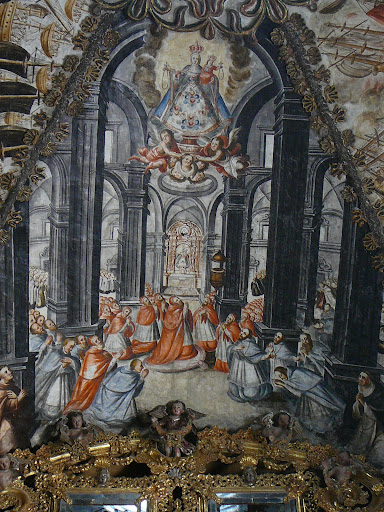


(Pope Pius V Praying to Our Lady Mexico_San_Miguel_de_allende_atotonilco_chapel_of_the_rosary)


Sources : Tradition in Action and TFP