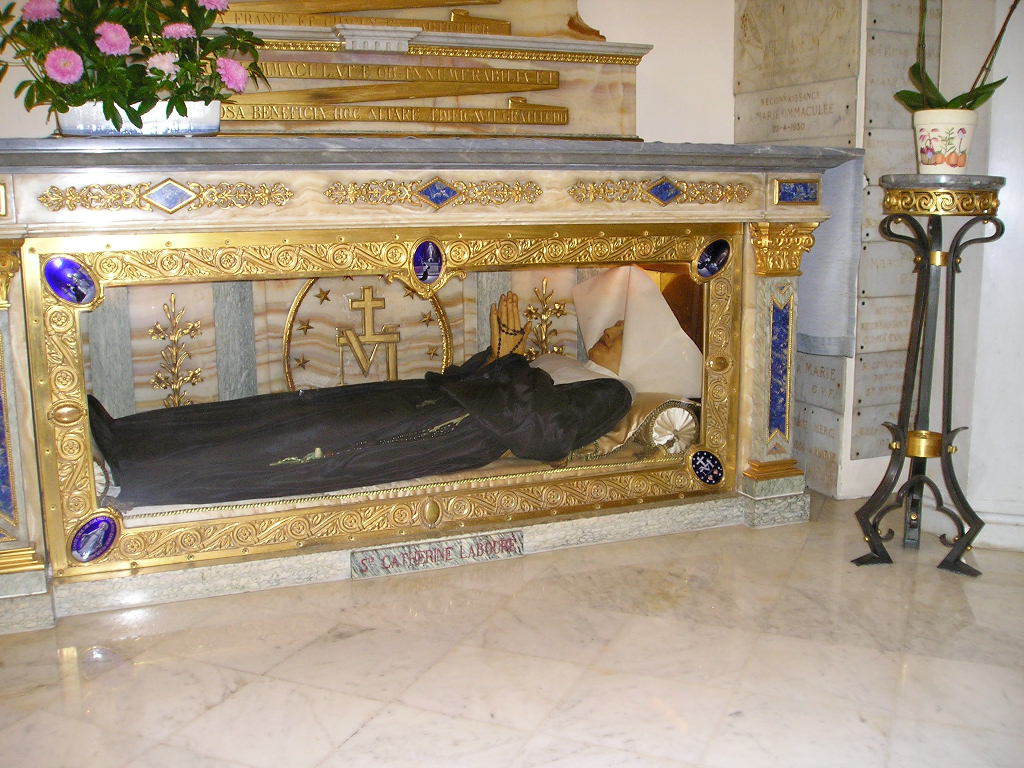
The following is a commentary by Dr. Pilnio about St. Catherine Laboure
Biographical selection:
Zoé Labouré, the future Catherine, was born on May 2, 1806 , the ninth of eleven children born to a farm family in Fain-les-Moutiers, Côte d’Or, France. She never learned to read or write. At age 8, her mother died and she was put in charge of running the house and helping her father. Her father allowed her at age 22 to enter the convent of the Daughters of Charity of St. Vincent of Paul.
In religion she took the name of Catherine and was sent to the convent at Rue du Bac, Paris. At half past 11 o’clock on the night of July 18, 1830, she was awakened by the vision of a child who led her to the chapel where Our Lady spoke to her for more than two hours. She told Catherine that God wished to charge her with a mission.
On November 27 of that same year, Our Lady appeared to her a second time in the chapel. She held a globe in her hands upon which the word France was written. Our Lady told St. Catherine that it represented the entire world, but that she wanted to help France in particular.
Then, the vision changed and she saw Our Lady standing on a globe crushing the serpent under her feet, with rays of light streaming from her hands. These words in French surrounded the vision: “O Mary conceived without sin, Pray for us who have recourse to thee.” Then Catherine saw another picture with a capital M with a cross above it, and below it, two hearts, one thorn-crowned and the other pierced with a sword. The Virgin spoke, this time giving a direct order: "Have a medal struck as I have shown you. All who wear it will receive great graces."

She told only her confessor Fr. Father Jean Marie Aladel about these visions, and at first he did not believe her. No one but he and the Archbishop of Paris knew that it was she who received the revelations. In 1832 the first medals were issued and many miracles were worked because of them. In a few years the fame of the Miraculous Medal of Our Lady spread all over France and Europe.
In 1842 the Jew Alphonse Ratisbonne was visiting Rome. He was wearing the medal when he received a vision of Our Lady in the Church of St. Andrea delle Frate in Rome. This was the cause of his conversion, and later he founded the Congregation of the Sisters of Sion for the conversion of the Jews. This incident contributed significantly to the dissemination of the Miraculous Medal.
In the convent where St. Catherine lived, not even the Superior Mother knew who had received the revelations. St. Catherine was transferred to the convent of Enghien-Reuilly and lived there for over 40 years unknown, carrying out the humble functions as gate-keeper, head of the poultry yard, and caring for the aged in the convent’s hospice. Only eight months before her death did she receive permission from her confessor to reveal to her Superior, Mother Dufès, that she was the one who had received the apparitions of Our Lady. She died on December 31, 1876. Soon after her funeral miracles were worked through her intercession.
When her body was exhumed in 1933 it was found completely fresh and supple. Her incorrupt body is encased in glass beneath the side altar at 140 Rue du Bac, Paris, beneath one of the spots where our Lady appeared to her.

Comments of Prof. Plinio:
Given the extraordinary diffusion of the Miraculous Medal, I think we can say that St. Catherine Labouré was the woman who played the greatest role in History in spreading devotion to Our Lady. The greatest man was St. Louis Grignion de Monfort. However, their lives and how they spread Marian devotion were profoundly different.
St. Louis de Montfort was a founder of two religious Congregations, a missionary, a pilgrim walking from one place to another, fighting, preaching, writing books, being attacked and counter-attacking in his turn. Therefore, he was constantly appearing in public in those few French provinces where he was allowed to preach by the Jansenist Bishops who had infiltrated the Catholic Church in France at that time. In those places his public example of virtue and continuous preaching about Our Lady caused his life and devotion to make a mark on History. His name appears wherever one speaks of true devotion to Our Lady.
The life of St. Catherine Labouré was the exact opposite. She was so unknown, so humble, so useless that the very sisters of her order did not know it was she who had received those revelations. Even her religious Superiors were unaware of this. They knew that some sister of their order had received revelations from Our Lady, but they did not know which one it was. Notwithstanding, she was the cause of an enormous diffusion of devotion to Our Lady. Our Lady wanted this devotion of the Miraculous Medal to be spread through St. Catherine, but in opposition to the life of St. Louis de Montfort, St. Catherine remained completely unknown.
She was also different from St. Bernadette Soubirous since everyone knew that St. Bernadette was the one who had seen Our Lady. St. Catherine’s vocation was only to report the revelations and the order for the medal to be struck. The miracles that immediately began to take place did all the rest.
There are many other comments that could be made about the different ways God acts in accordance with the various psychologies of His saints. But here I want to highlight only one general facet of the life of St. Catherine.
Let me point out that it is appropriate for a woman to live in obscurity when she enters a religious order. When she lives in the world, it is appropriate for her to remain within the limits of the family. Normally women do not have a public mission to fulfill. It is an exception to the rule when women are known in the Church for the public missions they exercised during their lives. Even when Divine Providence wants to use them for a mission of great relevance, they generally continue to live in the seclusion of their convents, away from the eyes of the public.
This is in accordance with the moral characteristics of a woman, with her role in the general plan of creation. In the life of St. Catherine Labouré, which is permeated with the supernatural in the accomplishment of a sublime mission, God was faithful to the general rule He established. He kept her in obscurity.
This leads us to see how mistaken modern civilization is in pushing women to have a public life either in the civil or religious sphere, entrusting them with tasks that normally should be given to men. What the Revolution presents as the emancipation of women is actually to enslave them to many kinds of work that are not according to their nature.
St. Catherine Labouré shows us the healthy characteristics of a woman. Being reserved and living in the obscurity of her religious order, she accomplished a work incomparably superior to that of I don’t know how many social leaders, business women and public representatives in Congress. God wanted her to remain entirely feminine, because to each sex God has a plan proper to its nature.
As counter-revolutionaries, we must highlight such aspects in the lives of the saints. Otherwise, we remain in the realm of common pious and respectable comments that do not prevent the Revolution from going forward. We must show the counter-revolutionary aspects of the Saints; otherwise we do not accomplish the mission Divine Providence gave us.