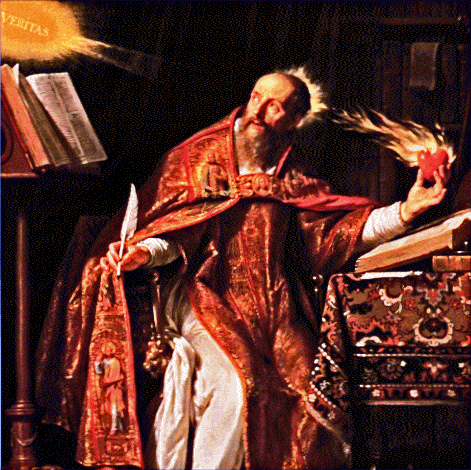
Today we celebrate the fest of St. Augustine. I like St. Augustine, because as a saint he shows the mercy and goodness of God. St. Augustine before his conversion was a very worldly man. He has an illegitimate son, was an intellectual giant and was generally having what we 20th century moderns call a good time.
If one reads the Confessions one will realize that despite having a mighty good time deep inside he was seeking the truth. Most of us go through this. I like At Augustine because he seems so human and yet after his conversion we see the greatness of his transformation all because of the mercy and love of God.
At times of despair one need only think of what St. Augustine was pre conversion to what he became post conversion and realize what God is capable of if only we let him and this is enough to lift one out of the despair.
Let us now consider the words of Dr. Plinio.
 Comments of Prof. Plinio:
Reading the works of St. Augustine is one of the greatest pleasures a man can have. The Confessions is a wonderful and highly edifying book from many points of view. In it, St. Augustine describes the moral abysses of pride and sensuality into which he had fallen and narrates how he turned away from his innumerable sins. Then he relates his first contacts with St. Ambrose and how the light of the Catholic Religion began to enter his soul through the presence of St. Ambrose.
He expresses his enthusiasm for the Bishop of Milan and his visits to him. St. Augustine could not speak often with St. Ambrose since the Bishop was usually busy writing and studying, but he would remain there just to watch St. Ambrose at his work. The latter knew that his presence was making a better apostolate with St. Augustine than his words would do.
You can imagine the scene. St. Ambrose, the great Doctor of the Church, writing in an infolio, his features those of a venerable old man, placid, enlightened by the grace of God, wise, recollected, sublime in his judgments. Once in a while, he would stop to make a short interior prayer, then he would return to his thinking until he reached the final conclusion. Observing him was St. Augustine, whose face still reflected the turbulence of the crisis through which he was passing. But the grace of God was entering the soul of St. Augustine and transforming his personality through his admiration for St. Ambrose.
And so he goes on to narrate his interior crisis, the peace he experienced upon entering the church and hearing the sacred music, the psalms, the beauty of God’s worship. Then his strong movements of repentance and the voice he heard ordering him: Tolle et lege – take it and read. He took up Sacred Scriptures and the page opened to a verse that applied perfectly to his past life ["Not in riots and drunken parties, not in eroticisms and indecencies, not in strife and rivalry, but put on the Lord Jesus Christ and make no provision for the flesh in its lusts" (Romans 13:13-14)]. He received a decisive grace that completed his conversion.
Further on he describes the famous colloquium at Ostia with St. Monica, his mother. She was a very holy woman, while he had been a very bad son. When they were in Carthage preparing for a voyage to Rome, St. Monica went to a church and spent the night praying there. Augustine took advantage of the opportunity to flee from her and embarked for Rome by himself, leaving her alone.
Afterward she followed him, always weeping and praying for his conversion. Once she went to the Bishop of Milan, St. Ambrose, to ask him if her son would ever convert. He replied to her with those famous words: “Woman, the child of so many tears shall never perish." That is, she would see his rebirth through her intense and profound suffering.
You can imagine her joy when her son converted. St. Augustine and his mother spent some months together as he prepared for his Baptism. Then they planned to return to Africa. Before embarking on the voyage, they stayed at an inn in Ostia, a port city near Rome on the Mediterranean Sea. Standing at a window watching the sea, they began to converse about heavenly things.
One who reads this conversation between the saintly mother and son realizes they were experiencing a supernatural ecstasy. This gave him strength for the fights ahead he would have to face. For her it was a pre-taste of Heaven, because she would die there in Ostia, before the ship departed. He describes movingly how he assisted at her funeral. Then he went to Africa and became the Bishop of Hippo.
In Hippo, he wrote another of his great books The City of God. The theme of that extraordinary work is the perpetual and irreconcilable fight that takes place between the two cities in History – the city he speaks of comes from the Latin, civitas, and should be understood more as a state. These two cities are the City of God and the City of the Devil. He conceives all History as a battle between the Catholic Church and the power of darkness. The struggle results from two different loves. In the City of God there is the love of God to the oblivion of oneself; in the city of man, or City of the Devil, there is the love of oneself to the oblivion of God.
To live for self is to consider oneself the minuscule center of the universe, with everything turned toward one’s own pleasures and interests. This egotism is the starting point for every bad thing. On the contrary, to love God is to turn oneself entirely toward the transcendent realities we find in Revelation. It is to have a metaphysical spirit, a religious spirit turned toward the highest things. This is to live for God. With these two principles, he summarizes all of History.
An analogous philosophy of History is taught by St. Louis Grignion de Monfort. He argues that everything God does is good. Since the enmity between Our Lady and the serpent, and therefore between her spiritual descendents and those of the serpent, was decreed by God, this enmity is also good. It is the same thesis of St. Augustine, with more combativeness.
Because of this unequivocal presentation of good and evil, Progressivism attacks St. Augustine today by saying that he was Manichean. According to this stupid accusation everyone who admits that there is good and evil would be a Manichean. It is nonsensical because the Magisterium of the Catholic Church has always admitted the existence of good and evil, as have all of her Saints. If this were the only criterium, then they would all be Manichean. It is absurd!
In passing, let me say that Manichaeism was a Gnostic doctrine that appeared in the first centuries of the Church proposing that there would be two gods equal in origin and power, a good one and a bad one, in constant struggle against each other. Catholic doctrine says something completely different. It says that there is only one God, Eternal and Omnipotent, and that the Devil, a mere creature, revolted against Him and fights Him throughout History.
The heresy of Manichaeism supposes a different order of being than what Catholic doctrine teaches. For the former, the fight is on the ontological level; for the latter it is in the moral sphere. Also according to Manichaeism the fight will never end; in Catholic doctrine the fight ends at the Last Judgment when God will eternally triumph over his infinitely inferior enemy. Progressivism is aware of these differences, but still continues to spread that anyone who doesn’t support its ecumenism is a Manichaean. It is an absurd affirmation and a manifestation of bad faith.
There is a very beautiful point to consider about St. Augustine. He wrote his books as the Roman Empire of the West was falling, when everything pointed to the probability that the Catholic Religion would be swept from the earth after the barbarian invasions. In fact, Hippo and Carthage in North Africa were so devastated that almost nothing was left of these cities and the Catholic Religion did not re-establish itself in that area. Notwithstanding, St. Augustine serenely wrote his books for a future that was uncertain. He died as the Vandals were entering his city.
The world he knew fell; the Middle Ages came. And then it was the works of St. Augustine that inspired the medieval conception of State, Empire, and Christendom. Charlemagne used to listen to the reading of the City of God during his meals, and the Empire he founded was inspired directly by St. Augustine. The Middle Ages, in a certain way is a lily born from the works of St. Augustine. Centuries after his death, his confidence was rewarded.
There is a lesson for us in this. In our times when the new Vandals are destroying both the cultural values and material buildings of Christian Civilization, we should carry on our work with faith and confidence, knowing that it will serve to build the Reign of Mary when God so decides.