Pope Pius XI universally instituted The Feast of Christ the King in 1925 in his encyclical Quas Primas. Pope Pius connected the denial of Christ as king to the rise of secularism. At the time of Quas Primas, secularism was on the rise, and many Christians, even Catholics, were doubting Christ's authority, as well as the Church's, and even doubting Christ's existence. Pius XI, and the rest of the Christian world, witnessed the rise of dictatorships in Europe, and saw Catholics being taken in by these earthly leaders. Just as the Feast of Corpus Christi was instituted when devotion to the Eucharist was at a low point, the Feast of Christ the King was instituted during a time when respect for Christ and the Church was waning, when the feast was most needed. In fact, it is still needed today, as these problems have not vanished, but instead have worsened.
Pius hoped the institution of the feast would have various effects. They were:
1. That nations would see that the Church has the right to freedom, and immunity from the state (Quas Primas, 32).
2. That leaders and nations would see that they are bound to give respect to Christ (Quas Primas, 31).
3. That the faithful would gain strength and courage from the celebration of the feast, as we are reminded that Christ must reign in our hearts, minds, wills, and bodies (Quas Primas, 33).
Today, the same distrust of authority exists, although the problem has gotten worse. Individualism has been embraced to such an extreme, that for many, the only authority is the individual self. The idea of Christ as ruler is rejected in such a strongly individualistic system. Also, many balk at the idea of kings and queens, believing them to be oppressive. Some even reject the titles of "lord" and "king" for Christ because they believe that such titles are borrowed from oppressive systems of government. However true these statements might be (some kings have been oppressive), these individuals miss the point: Christ's kingship is one of humility and service. Jesus said:
You know that those who are recognized as rulers over the Gentiles lord it over them, and their great ones make their authority over them felt. But it shall not be so among you. Rather, whoever wishes to become great among you will be your servant; whoever wishes to be first among you will be the slave of all. For the Son of Man did not come to be served, but to serve, and to give his life as a ransom for many (Mark 10:42-45, NAB).
and
Pilate said to Jesus, "Are you the King of the Jews?"... Jesus answered, "My kingdom does not belong to this world. If my kingdom did belong to this world, my attendants would be fighting to keep me from being handed over to the Jews. But as it is, my kingdom is not here." So Pilate said to him, "Then you are a king?" Jesus answered, "You say I am a king. For this I was born and for this I came into the world,to testify to the truth (John 18:33b, 36-37).
Thus, Jesus knew the oppressive nature of secular kings, and in contrast to them, he connected his role as king to humble service, and commanded his followers to be servants as well. In other passages of Scripture, his kingdom is tied to his suffering and death. While Christ is coming to judge the nations, his teachings spell out a kingdom of justice and judgment balanced with radical love, mercy, peace, and forgiveness. When we celebrate Christ as King, we are not celebrating an oppressive ruler, but one willing to die for humanity and whose "loving-kindness endures forever." Christ is the king that gives us true freedom, freedom in Him. Thus we must never forget that Christ radically redefined and transformed the concept of kingship.
Christ the King Sunday used to be celebrated on the last Sunday of October, but since the calendar reforms of 1969, the feast falls on the last Sunday of Ordinary Time, which is the Sunday before Advent. It is fitting that the feast celebrating Christ's kingship is observed right before Advent, when we liturgically wait for the promised Messiah (King).
Showing posts with label Pope Pius XI. Show all posts
Showing posts with label Pope Pius XI. Show all posts
Sunday, November 21, 2010


Monday, August 30, 2010
The Popes on Socialism
The following is a list of quotes what the Popes have to say about Socialism.
PIUS IX (1846-1878):
“Overthrow [of] the entire order of human affairs”
“You are aware indeed, that the goal of this most iniquitous plot is to drive people to overthrow the entire order of human affairs and to draw them over to the wicked theories of this Socialism and Communism, by confusing them with perverted teachings.” (Encyclical Nostis et Nobiscum, December 8, 1849)
LEO XIII (1878-1903):
Hideous monster
“...communism, socialism, nihilism, hideous deformities of the civil society of men and almost its ruin.” (Encyclical Diuturnum, June 29, 1881)
Ruin of all institutions
“... For, the fear of God and reverence for divine laws being taken away, the authority of rulers despised, sedition permitted and approved, and the popular passions urged on to lawlessness, with no restraint save that of punishment, a change and overthrow of all things will necessarily follow. Yea, this change and overthrow is deliberately planned and put forward by many associations of communists and socialists” (Encyclical Humanum Genus, April 20, 1884, n. 27).
A sect “that threatens civil society with destruction”
Leo XIII (1877-1903):
Socialists assail the right of property sanctioned by natural law.
“…We speak of that sect of men who, under various and almost barbarous names, are called socialists, communists, or nihilists, and who, spread over all the world, and bound together by the closest ties in a wicked confederacy, no longer seek the shelter of secret meetings, but, openly and boldly marching forth in the light of day, strive to bring to a head what they have long been planning - the overthrow of all civil society whatsoever. Surely, these are they who, as the sacred Scriptures testify, ‘Defile the flesh, despise dominion and blaspheme majesty.’ (Jud. 8).” (Encyclical Quod Apostolici Muneris, December 28, 1878, n. 1)
Socialists debase the natural union of man and woman and assail the right of property
“They [socialists, communists, or nihilists] debase the natural union of man and woman, which is held sacred even among barbarous peoples; and its bond, by which the family is chiefly held together, they weaken, or even deliver up to lust. Lured, in fine, by the greed of present goods, which is ‘the root of all evils, which some coveting have erred from the faith’ (1 Tim. 6:10.3), they assail the right of property sanctioned by natural law; and by a scheme of horrible wickedness, while they seem desirous of caring for the needs and satisfying the desires of all men, they strive to seize and hold in common whatever has been acquired either by title of lawful inheritance, or by labor of brain and hands, or by thrift in one's mode of life.” (Encyclical Quod Apostolici Muneris, December 28, 1878, n. 1)
Destructive sect
“...socialists and members of other seditious societies, who labor unceasingly to destroy the State even to its foundations.” (Encyclical Libertas Praestantissimum, June 20, 1888)
Enemy of society and of Religion
“...there is need for a union of brave minds with all the resources they can command. The harvest of misery is before our eyes, and the dreadful projects of the most disastrous national upheavals are threatening us from the growing power of the socialistic movement. They have insidiously worked their way into the very heart of the community, and in the darkness of their secret gatherings, and in the open light of day, in their writings and their harangues, they are urging the masses onward to sedition; they fling aside religious discipline; they scorn duties; they clamor only for rights; they are working incessantly on the multitudes of the needy which daily grow greater, and which, because of their poverty are easily deluded and led into error. It is equally the concern of the State and of religion, and all good men
Saint Pius X (1903-1914) :
should deem it a sacred duty to preserve and guard both in the honor which is their due.” (Encyclical Graves de Communi Re, January 18, 1901, n. 21)
The dream of re-shaping society will bring socialism
“But stranger still, alarming and saddening at the same time, are the audacity and frivolity of men who call themselves Catholics and dream of re-shaping society under such conditions, and of establishing on earth, over and beyond the pale of the Catholic Church, ‘the reign of love and justice’ ... What are they going to produce? ... A mere verbal and chimerical construction in which we shall see, glowing in a jumble, and in seductive confusion, the words Liberty, Justice, Fraternity, Love, Equality, and human exultation, all resting upon an ill-understood human dignity. It will be a tumultuous agitation, sterile for the end proposed, but which will benefit the less Utopian exploiters of the people. Yes, we can truly say that the Sillon, its eyes fixed on a chimera, brings Socialism in its train.” (Apostolic Letter Notre Charge Apostolique ["Our Apostolic Mandate"] to the French Bishops, August 15, 1910, condemning the movement Le Sillon)
BENEDICT XV (1914-1922):
The condemnation of socialism should never be forgotten
“It is not our intention here to repeat the arguments which clearly expose the errors of Socialism and of similar doctrines. Our predecessor, Leo XIII, most wisely did so in truly memorable Encyclicals; and you, Venerable Brethren, will take the greatest care that those grave precepts are never forgotten, but that whenever circumstances call for it, they should be clearly expounded and inculcated in Catholic associations and congresses, in sermons and in the Catholic press.” (Encyclical Ad Beatissimi Apostolorum, November 1, 1914, n. 13)
PIUS XI (1922-1939):
"No one can be at the same time a good Catholic and a true socialist."
Socialism, fundamentally contrary to Christian truth
“... For Socialism, which could then be termed almost a single system and which maintained definite teachings reduced into one body of doctrine, has since then split chiefly into two sections, often opposing each other and even bitterly hostile, without either one however abandoning a position fundamentally contrary to Christian truth that was characteristic of Socialism.” (Encyclical Quadragesimo Anno, May 15, 1931, n. 111)
Socialism cannot be reconciled with Catholic Doctrine
“But what if Socialism has really been so tempered and modified as to the class struggle and private ownership that there is in it no longer anything to be censured on these points? Has it thereby renounced its contradictory nature to the Christian religion? This is the question that holds many minds in suspense. And numerous are the Catholics who, although they clearly understand that Christian principles can never be abandoned or diminished seem to turn their eyes to the Holy See and earnestly beseech Us to decide whether this form of Socialism has so far recovered from false doctrines that it can be accepted without the sacrifice of any Christian principle and in a certain sense be baptized. That We, in keeping with Our fatherly solicitude, may answer their petitions, We make this pronouncement: Whether considered as a doctrine, or an historical fact, or a movement, Socialism, if it remains truly Socialism, even after it has yielded to truth and justice on the points which we have mentioned, cannot be reconciled with the teachings of the Catholic Church because its concept of society itself is utterly foreign to Christian truth.” (Ibid. n. 117)
Catholic Socialism, a contradiction
“[Socialism] is based nevertheless on a theory of human society peculiar to itself and irreconcilable with true Christianity. Religious socialism, Christian socialism, are contradictory terms; no one can be at the same time a good Catholic and a true socialist.” (Ibid. n. 120)
PIUS XII (1939-1958):
The Church will fight to the end, in defense of supreme values threatened by socialism
“[The Church undertook] the protection of the individual and the family against a current threatening to bring about a total socialization which in the end would make the specter of the 'Leviathan' become a shocking reality. The Church will fight this battle to the end, for it is a question of supreme values: the dignity of man and the salvation of souls." (“Radio message to the Katholikentag of Vienna,” September 14, 1952 in Discorsi e Radiomessaggi, vol. XIV, p. 314)
The state can not be regarded as being above all
"To consider the State as something ultimate to which everything else should be subordinated and directed, cannot fail to harm the true and lasting prosperity of nations." (Encyclical Summi Pontificatus, October 20, 1939, n. 60)
JOHN XXIII (1958-1963):
“No Catholic could subscribe even to moderate socialism”
“Pope Pius XI further emphasized the fundamental opposition between Communism and Christianity, and made it clear that no Catholic could subscribe even to moderate Socialism. The reason is that Socialism is founded on a doctrine of human society which is bounded by time and takes no account of any objective other than that of material well-being. Since, therefore, it proposes a form of social organization which aims solely at production, it places too severe a restraint on human liberty, at the same time flouting the true notion of social authority.” (Encyclical Mater et Magistra, May 15, 1961, n. 34)
PAUL VI (1963-1978):
Too often Christians tend to idealize socialism
“Too often Christians attracted by socialism tend to idealize it in terms which, apart from anything else, are very general: a will for justice, solidarity and equality. They refuse to recognize the limitations of the historical socialist movements, which remain conditioned by the ideologies from which they originated.” (Apostolic Letter Octogesima Adveniens, May 14, 1971, n. 31)
JOHN PAUL II (1978-2005):
Socialism: Danger of a “simple and radical solution”
“It may seem surprising that ‘socialism’ appeared at the beginning of the Pope's critique of solutions to the ‘question of the working class’ at a time when ‘socialism’ was not yet in the form of a strong and powerful State, with all the resources which that implies, as was later to happen. However, he correctly judged the danger posed to the masses by the attractive presentation of this simple and radical solution to the ‘question of the working class.’" (Encyclical Centesimus Annus − On the 100th anniversary of Pope Leo XIII's Rerum Novarum, May 1, 1991, n. 12)
Fundamental error of socialism: A mistaken conception of the person
“Continuing our reflections, ... we have to add that the fundamental error of socialism is anthropological in nature. Socialism considers the individual person simply as an element, a molecule within the social organism, so that the good of the individual is completely subordinated to the functioning of the socio-economic mechanism. Socialism likewise maintains that the good of the individual can be realized without reference to his free choice, to the unique and exclusive responsibility which he exercises in the face of good or evil. Man is thus reduced to a series of social relationships, and the concept of the person as the autonomous subject of moral decision disappears, the very subject whose decisions build the social order. From this mistaken conception of the person there arise both a distortion of law, which defines the sphere of the exercise of freedom, and an opposition to private property.” (Ibid, n. 13)
BENEDICT XVI (2005 - present):
“We do not need a State which regulates and controls everything”
“The State which would provide everything, absorbing everything into itself, would ultimately become a mere bureaucracy incapable of guaranteeing the very thing which the suffering person − every person − needs: namely, loving personal concern. We do not need a State which regulates and controls everything, but a State which, in accordance with the principle of subsidiarity, generously acknowledges and supports initiatives arising from the different social forces and combines spontaneity with closeness to those in need. … In the end, the claim that just social structures would make works of charity superfluous masks a materialist conception of man: the mistaken notion that man can live ‘by bread alone’ (Mt 4:4; cf. Dt 8:3) − a conviction that demeans man and ultimately disregards all that is specifically human.” (Encyclical Deus Caritas Est, December 25, 2005, n. 28)
PIUS IX (1846-1878):
“Overthrow [of] the entire order of human affairs”
“You are aware indeed, that the goal of this most iniquitous plot is to drive people to overthrow the entire order of human affairs and to draw them over to the wicked theories of this Socialism and Communism, by confusing them with perverted teachings.” (Encyclical Nostis et Nobiscum, December 8, 1849)
LEO XIII (1878-1903):
Hideous monster
“...communism, socialism, nihilism, hideous deformities of the civil society of men and almost its ruin.” (Encyclical Diuturnum, June 29, 1881)
Ruin of all institutions
“... For, the fear of God and reverence for divine laws being taken away, the authority of rulers despised, sedition permitted and approved, and the popular passions urged on to lawlessness, with no restraint save that of punishment, a change and overthrow of all things will necessarily follow. Yea, this change and overthrow is deliberately planned and put forward by many associations of communists and socialists” (Encyclical Humanum Genus, April 20, 1884, n. 27).
A sect “that threatens civil society with destruction”
Leo XIII (1877-1903):
Socialists assail the right of property sanctioned by natural law.
“…We speak of that sect of men who, under various and almost barbarous names, are called socialists, communists, or nihilists, and who, spread over all the world, and bound together by the closest ties in a wicked confederacy, no longer seek the shelter of secret meetings, but, openly and boldly marching forth in the light of day, strive to bring to a head what they have long been planning - the overthrow of all civil society whatsoever. Surely, these are they who, as the sacred Scriptures testify, ‘Defile the flesh, despise dominion and blaspheme majesty.’ (Jud. 8).” (Encyclical Quod Apostolici Muneris, December 28, 1878, n. 1)
Socialists debase the natural union of man and woman and assail the right of property
“They [socialists, communists, or nihilists] debase the natural union of man and woman, which is held sacred even among barbarous peoples; and its bond, by which the family is chiefly held together, they weaken, or even deliver up to lust. Lured, in fine, by the greed of present goods, which is ‘the root of all evils, which some coveting have erred from the faith’ (1 Tim. 6:10.3), they assail the right of property sanctioned by natural law; and by a scheme of horrible wickedness, while they seem desirous of caring for the needs and satisfying the desires of all men, they strive to seize and hold in common whatever has been acquired either by title of lawful inheritance, or by labor of brain and hands, or by thrift in one's mode of life.” (Encyclical Quod Apostolici Muneris, December 28, 1878, n. 1)
Destructive sect
“...socialists and members of other seditious societies, who labor unceasingly to destroy the State even to its foundations.” (Encyclical Libertas Praestantissimum, June 20, 1888)
Enemy of society and of Religion
“...there is need for a union of brave minds with all the resources they can command. The harvest of misery is before our eyes, and the dreadful projects of the most disastrous national upheavals are threatening us from the growing power of the socialistic movement. They have insidiously worked their way into the very heart of the community, and in the darkness of their secret gatherings, and in the open light of day, in their writings and their harangues, they are urging the masses onward to sedition; they fling aside religious discipline; they scorn duties; they clamor only for rights; they are working incessantly on the multitudes of the needy which daily grow greater, and which, because of their poverty are easily deluded and led into error. It is equally the concern of the State and of religion, and all good men
Saint Pius X (1903-1914) :
should deem it a sacred duty to preserve and guard both in the honor which is their due.” (Encyclical Graves de Communi Re, January 18, 1901, n. 21)
The dream of re-shaping society will bring socialism
“But stranger still, alarming and saddening at the same time, are the audacity and frivolity of men who call themselves Catholics and dream of re-shaping society under such conditions, and of establishing on earth, over and beyond the pale of the Catholic Church, ‘the reign of love and justice’ ... What are they going to produce? ... A mere verbal and chimerical construction in which we shall see, glowing in a jumble, and in seductive confusion, the words Liberty, Justice, Fraternity, Love, Equality, and human exultation, all resting upon an ill-understood human dignity. It will be a tumultuous agitation, sterile for the end proposed, but which will benefit the less Utopian exploiters of the people. Yes, we can truly say that the Sillon, its eyes fixed on a chimera, brings Socialism in its train.” (Apostolic Letter Notre Charge Apostolique ["Our Apostolic Mandate"] to the French Bishops, August 15, 1910, condemning the movement Le Sillon)
BENEDICT XV (1914-1922):
The condemnation of socialism should never be forgotten
“It is not our intention here to repeat the arguments which clearly expose the errors of Socialism and of similar doctrines. Our predecessor, Leo XIII, most wisely did so in truly memorable Encyclicals; and you, Venerable Brethren, will take the greatest care that those grave precepts are never forgotten, but that whenever circumstances call for it, they should be clearly expounded and inculcated in Catholic associations and congresses, in sermons and in the Catholic press.” (Encyclical Ad Beatissimi Apostolorum, November 1, 1914, n. 13)
PIUS XI (1922-1939):
"No one can be at the same time a good Catholic and a true socialist."
Socialism, fundamentally contrary to Christian truth
“... For Socialism, which could then be termed almost a single system and which maintained definite teachings reduced into one body of doctrine, has since then split chiefly into two sections, often opposing each other and even bitterly hostile, without either one however abandoning a position fundamentally contrary to Christian truth that was characteristic of Socialism.” (Encyclical Quadragesimo Anno, May 15, 1931, n. 111)
Socialism cannot be reconciled with Catholic Doctrine
“But what if Socialism has really been so tempered and modified as to the class struggle and private ownership that there is in it no longer anything to be censured on these points? Has it thereby renounced its contradictory nature to the Christian religion? This is the question that holds many minds in suspense. And numerous are the Catholics who, although they clearly understand that Christian principles can never be abandoned or diminished seem to turn their eyes to the Holy See and earnestly beseech Us to decide whether this form of Socialism has so far recovered from false doctrines that it can be accepted without the sacrifice of any Christian principle and in a certain sense be baptized. That We, in keeping with Our fatherly solicitude, may answer their petitions, We make this pronouncement: Whether considered as a doctrine, or an historical fact, or a movement, Socialism, if it remains truly Socialism, even after it has yielded to truth and justice on the points which we have mentioned, cannot be reconciled with the teachings of the Catholic Church because its concept of society itself is utterly foreign to Christian truth.” (Ibid. n. 117)
Catholic Socialism, a contradiction
“[Socialism] is based nevertheless on a theory of human society peculiar to itself and irreconcilable with true Christianity. Religious socialism, Christian socialism, are contradictory terms; no one can be at the same time a good Catholic and a true socialist.” (Ibid. n. 120)
PIUS XII (1939-1958):
The Church will fight to the end, in defense of supreme values threatened by socialism
“[The Church undertook] the protection of the individual and the family against a current threatening to bring about a total socialization which in the end would make the specter of the 'Leviathan' become a shocking reality. The Church will fight this battle to the end, for it is a question of supreme values: the dignity of man and the salvation of souls." (“Radio message to the Katholikentag of Vienna,” September 14, 1952 in Discorsi e Radiomessaggi, vol. XIV, p. 314)
The state can not be regarded as being above all
"To consider the State as something ultimate to which everything else should be subordinated and directed, cannot fail to harm the true and lasting prosperity of nations." (Encyclical Summi Pontificatus, October 20, 1939, n. 60)
JOHN XXIII (1958-1963):
“No Catholic could subscribe even to moderate socialism”
“Pope Pius XI further emphasized the fundamental opposition between Communism and Christianity, and made it clear that no Catholic could subscribe even to moderate Socialism. The reason is that Socialism is founded on a doctrine of human society which is bounded by time and takes no account of any objective other than that of material well-being. Since, therefore, it proposes a form of social organization which aims solely at production, it places too severe a restraint on human liberty, at the same time flouting the true notion of social authority.” (Encyclical Mater et Magistra, May 15, 1961, n. 34)
PAUL VI (1963-1978):
Too often Christians tend to idealize socialism
“Too often Christians attracted by socialism tend to idealize it in terms which, apart from anything else, are very general: a will for justice, solidarity and equality. They refuse to recognize the limitations of the historical socialist movements, which remain conditioned by the ideologies from which they originated.” (Apostolic Letter Octogesima Adveniens, May 14, 1971, n. 31)
JOHN PAUL II (1978-2005):
Socialism: Danger of a “simple and radical solution”
“It may seem surprising that ‘socialism’ appeared at the beginning of the Pope's critique of solutions to the ‘question of the working class’ at a time when ‘socialism’ was not yet in the form of a strong and powerful State, with all the resources which that implies, as was later to happen. However, he correctly judged the danger posed to the masses by the attractive presentation of this simple and radical solution to the ‘question of the working class.’" (Encyclical Centesimus Annus − On the 100th anniversary of Pope Leo XIII's Rerum Novarum, May 1, 1991, n. 12)
Fundamental error of socialism: A mistaken conception of the person
“Continuing our reflections, ... we have to add that the fundamental error of socialism is anthropological in nature. Socialism considers the individual person simply as an element, a molecule within the social organism, so that the good of the individual is completely subordinated to the functioning of the socio-economic mechanism. Socialism likewise maintains that the good of the individual can be realized without reference to his free choice, to the unique and exclusive responsibility which he exercises in the face of good or evil. Man is thus reduced to a series of social relationships, and the concept of the person as the autonomous subject of moral decision disappears, the very subject whose decisions build the social order. From this mistaken conception of the person there arise both a distortion of law, which defines the sphere of the exercise of freedom, and an opposition to private property.” (Ibid, n. 13)
BENEDICT XVI (2005 - present):
“We do not need a State which regulates and controls everything”
“The State which would provide everything, absorbing everything into itself, would ultimately become a mere bureaucracy incapable of guaranteeing the very thing which the suffering person − every person − needs: namely, loving personal concern. We do not need a State which regulates and controls everything, but a State which, in accordance with the principle of subsidiarity, generously acknowledges and supports initiatives arising from the different social forces and combines spontaneity with closeness to those in need. … In the end, the claim that just social structures would make works of charity superfluous masks a materialist conception of man: the mistaken notion that man can live ‘by bread alone’ (Mt 4:4; cf. Dt 8:3) − a conviction that demeans man and ultimately disregards all that is specifically human.” (Encyclical Deus Caritas Est, December 25, 2005, n. 28)
Monday, April 20, 2009
St. Conrad of Parzham - 20th April 2009

St. Conrad was not a founder of an order, a priest or a doctor yet his love of God and his devotion to Mary made him a hero of Christ. St. Conrad excelled in the virtue of Charity, showing itself in love of God and neighbour, devotion to the Holy Eucharist and a childlike confidence in Mary, the Mother of God.
St Conrad received a good training in Catholicism from his parents whom he helped on the farm. We are told that he spent many hours in prayer while going about his work, so it may not be surprising that this holy youth sought entry to the Capuchins after attending a mission in his town. He entered as a humble lay brother. In his notes we find written, "The Cross is my book". Because Christ had given all to us, Conrad decided to give all he could possibly give for Christ and souls. He held the office of Porter at Altoetting for over forty years. As the monastery was a place of pilgrimage, it was besieged by thousand calls a day. To young and old alike, to polite and impolite, the saint was kind and gentle. By living in union with God he was able to let Christ act through him. In answering questions and discussing God he led many souls to the Divine Redeem. Conrad ate little, slept less and worked hard, but always in communion with Christ, the God of his heart. He had a great longing for the Eucharist and served Mass with great devotion. The Mass was the greatest joy of Conrad's long and hard life. Whatever extra time he had from his work, the Saint spent before the Blessed Sacrament.
To the strong devotion to the Eucharist and the Crucified Lord, Conrad added a special devotion to Mary. She was his Queen and Advocate in all his trials and above all his guide to Christ. He prayed before the statue of Our Lady of Sorrows and the Crucifix in the Porter's Office and was always ready to spread devotion to Mary by the distribution of Rosary Beads. Finally crippled, Conrad served his last Mass on April 18th, 1894; three days later, while the children who he had taught the Rosary, recited it outside his window, Conrad died. His heroic virtues and the miracles he performed won for him the distinction to be ranked among the Blessed by Pope Pius XI in the year 1930. Four years later, the same Pope approving additional miracles which had been performed, solemnly inscribed his name in the list of Saints. The feast of St. Conrad is celebrated on April 21st.
Sunday, February 15, 2009
St. Claude la Colombiere - 15th Febraury 2009
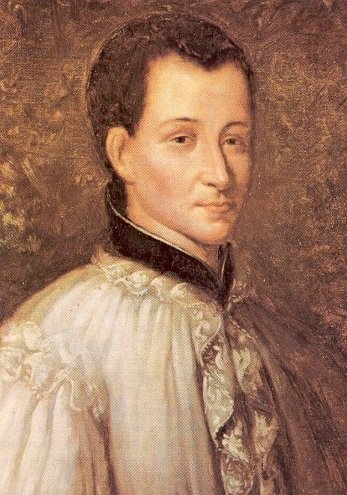
This is a special day for the Jesuits, who claim today’s saint as one of their own. It’s also a special day for people who have a special devotion to the Sacred Heart of Jesus—a devotion Claude la Colombière promoted, along with his friend and spiritual companion, St. Margaret Mary Alacoque. The emphasis on God’s love for all was an antidote to the rigorous moralism of the Jansenists, who were popular at the time.
He was the third child of the notary Bertrand La Colombière and Margaret Coindat, was born on 2nd February 1641 at St. Symphorien d'Ozon in the Dauphine, southeastern France. After the family moved to Vienne Claude began his early education there, completing his studies in rhetoric and philosophy in Lyon.
It was during this period that Claude first sensed his vocation to the religious life in the Society of Jesus. We know nothing of the motives which led to this decision. We do know, however, from one of his early notations, that he "had a terrible aversion for the life embraced". This affirmation is not hard to understand by any who are familiar with the life of Claude, for he was very close to his family and friends and much inclined to the arts and literature and an active social life. On the other hand, he was not a person to be led primarily by his sentiments.
At 17 he entered the Jesuit Novitiate at Avignon. In 1660 he moved from the Novitiate to the College, also in Avignon, where he pronounced his first vows and completed his studies in philosophy. Afterwards he was professor of grammar and literature in the same school for another five years.
In 1666 he went to the College of Clermont in Paris for his studies in theology. Already noted for his tact, poise and dedication to the humanities, Claude was assigned by superiors in Paris the additional responsibility of tutoring the children of Louis XIV's Munster of Finance, Jean Baptiste Colbert.
His theological studies concluded and now a priest, Claude returned to Lyon. For a time he was teacher in the College, then full-time preacher and moderator of several Marian congregations.
Claude became noted for solid and serious sermons. They were ably directed at specific audiences and, faithful to their inspiration from the gospel, communicated to his listeners serenity and confidence in God. His published sermons produced and still produce significant spiritual fruits. Given the place and the short duration of his ministry, his sermons are surprisingly fresh in comparison with those of better-known orators.
The year 1674 was a decisive one for Claude, the year of his Third Probation at Maison Saint-Joseph in Lyon. During the customary month of the Exercises the Lord prepared him for the mission for which he had been chosen. His spiritual notes from this period allow one to follow step-by-step the battles and triumphs of the spirit, so extraordinarily attracted to everything human, yet so generous with God.
He took a vow to observe all the constitutions and rules of the Society of Jesus, a vow whose scope was not so much to bind him to a series of minute observances as to reproduce the sharp ideal of an apostle so richly described by St. Ignatius. So magnificent did this ideal seem to Claude that he adopted it as his program of sanctity. That it was indeed an invitation from Christ himself is evidenced by the subsequent feeling of interior liberation Claude experienced, along with the broadened horizons of the apostolate he witnesses to in his spiritual diary.
On 2nd February 1675 he pronounced his solemn profession and was named rector of the College at Paray-le-Monial. Not a few people wondered at this assignment of a talented young Jesuit to such an out-of the-way place as Paray. The explanation seems to be in the superiors' knowledge that there was in Paray an unpretentious religious of the Monastery of the Visitation, Margaret Mary Alacoque, to whom the Lord was revealing the treasures of his Heart, but who was overcome by anguish and uncertainty. She was waiting for the Lord to fulfill his promise and send her "my faithful servant and perfect friend" to help her realize the mission for which he had destined her: that of revealing to the world the unfathomable riches of his love.
After Father Colombière's arrival and her first conversations with him, Margaret Mary opened her spirit to him and told him of the many communications she believed she had received from the Lord. He assured her he accepted their authenticity and urged her to put in writing everything in their regard, and did all he could to orient and support her in carrying out the mission received. When, thanks to prayer and discernment, he became convinced that Christ wanted the spread of the devotion to his Heart, it is clear from Claude's spiritual notes that he pledged himself to this cause without reserve. In these notes it is also clear that, even before he became Margaret Mary's confessor, Claude's fidelity to the directives of St. Ignatius in the Exercises had brought him to the contemplation of the Heart of Christ as symbol of his love.
After a year and half in Paray, in 1676 Father La Colombière left for London. He had been appointed preacher to the Duchess of York - a very difficult and delicate assignment because of the conditions prevailing in England at the time. He took up residence in St. James Palace in October.
In addition to sermons in the palace chapel and unremitting spiritual direction both oral and written, Claude dedicated his time to giving thorough instruction to the many who sought reconciliation with the Church they had abandoned. And even if there were great dangers, he had the consolation of seeing many reconciled to it, so that after a year he said: "I could write a book about the mercy of God I've seen Him exercise since I arrived here!"
The intense pace of his work and the poor climate combined to undermine his health, and evidence of a serious pulmonary disease began to appear. Claude, however, made no changes in his work or life style.
Of a sudden, at the end of 1678, he was calumniously accused and arrested in connection with the Titus Oates "papist plot". After two days he was transferred to the severe King's Bench Prison where he remained for three weeks in extremely poor conditions until his expulsion from England by royal decree. This suffering further weakened Claude's health which, with ups and downs, deteriorated rapidly on his return to France.
During the summer of 1681 he returned to Paray, in very poor condition. On 15th February 1682, the first Sunday of Lent, towards evening Claude suffered the severe hemorrhage which ended his life.
On the 16th of June 1929 Pope Pius XI beatified Claude La Colombière, whose charism, according to St. Margaret Mary Alacoque, was that of bringing souls to God along the gospel way of love and mercy which Christ revealed to us.
Sunday, November 16, 2008
St. Albert the Great - 15th November 2008
Today we wil contemplate the life of St. Albert the Great.

Albert the Great, the eldest son of the Count of Bollstadt, was born around 1206 in Lauingen, in Swabia, Germany. After a careful formation he went to study Law at the University of Padua in Italy. There he became familiar with Blessed Jordan of Saxony, General of the Dominicans, whose counsels led him to enter the Dominican Order. Soon he became known for his filial devotion to Our Lady and attention to monastic observance. He was sent to Cologne to finish his studies, earning a reputation for an erudition in the natural sciences greater than all his peers.
After completing his studies, he was sent to teach theology at Hildesheim, Freiburg-im-Breisgau, Regensburg, Strasburg and Cologne. In 1245, he was sent to the University of Paris, where he demonstrated the accord between faith and reason and between the sacred and profane sciences. The most illustrious of his disciples, St. Thomas Aquinas, would succeed him at the Sorbonne.
St. Albert retuned to Cologne in 1248 in order to direct the studies of his Order as Regent of the Studium Generale. In 1254 he was elected Dominican provincial of Germany, and in 1260 was appointed Bishop of Regensburg. He resigned the bishopric after three years, and returned to teach at Cologne.
Often, he was also called to act as arbiter and peacemaker between various German Princes and Bishops. He attended the second Council of Lyons (1274), where he took an active part in the deliberations. He died in Cologne on November 15, 1280. On December 16, 1931 he was canonized and declared a Doctor of the Church by Pope Pius XI.
Since the year 1300, under a stain-glass window in the Dominican church of St. Andreas in Cologne, one can read these words:
'This sanctuary was built by Bishop Albert, flower of philosophers and wise men, model of good customs, brilliant and splendorous destroyer of heresies, and scourge of evil men. Place him, O Lord, in the number of Thy Saints.'
"By nature he had an instinct for great things. Thus, like Solomon, he begged God for the gift of wisdom, which intimately unites man to God, expands hearts, and raises the souls of the faithful to the heights. Wisdom taught him how to unite an intensive intellectual life with a profound spiritual life, for he was at the same time an initiator of a powerful intellectual movement, a great contemplative, and a man of action"
Comments of Prof. Plinio:
The life of St. Albert the Great is expressed well in the description of how he excelled in these three things he was an intellectual, a contemplative and a man of action. This made him one of the greatest figures of the Middle Ages, one of those who consolidated the Middle Ages.
God gave him the gift to be remarkable in many things. Had he shone in only one of these things, he would be a man of immortal fame. To mention just two of his intellectual accomplishments, St. Albert is considered the founder of Scholasticism, and he was the master of St. Thomas Aquinas, who in his turn brought Scholasticism to its apex. If he were only this great intellectual, he would have gone down in history for this. But he was more. He was also renowned for his religious spirit, he was a great contemplative, a great saint, which would give him all possible glory. Finally, he was also an illustrious Bishop who acquired an enormous fame in his homeland.
Why does Providence make such a brilliant man, who stands out on three different roads at the same time? It is to show that the interior life should have precedence over the others. We understand that if St. Albert had not been a man with a strong interior life, he could not have been the extraordinary scholar that he was. The interior life gives the means for a man to execute God's will for him to perfection. Doing this, a man fully develops his natural talents. Often God gives additional charismas and extraordinary graces to those who are faithful in order to multiply their natural qualities and help them accomplish their missions.
This reminds me of a saying of Dom Chautard, the author of the famous book The Soul of the Apostolate. Once he was with Georges Clemenceau, the very revolutionary French prime-minister. Knowing that Dom Chautard was a very busy man, Clemenceau asked him: 'How do you manage to do so many things in just 24 hours?' Dom Chautard answered, 'It is because I pray the Rosary. If you would also pray it, you would find more time to accomplish your tasks.'
It is a paradox, because to pray the Rosary takes time from other activities. Someone might think that Dom Chautard was just joking with Clemenceau. This is not true. In that apparent contradiction there is a profound truth. If we take time to develop our interior life, God will take care of the other things we need, and will multiply our capacity to accomplish what we are called to do.
This is the great truth that we learn from St. Albert's life.
Those beautiful words written in 1300 under that stain-glass window in St. Andreas Church reveal how much the modern religious mentality has changed. Today, who would say that a saint is a 'brilliant and splendorous destroyer of heresies and scourge of evil men'? Such a eulogy ' which fills our souls with Catholic joy ' has completely disappeared from the present day religious panorama. That this is so reveals the difference between the mentality of the Progressivism that unfortunately dominates the Church today and the true Catholic spirit. It is not difficult to see which one is the position of the Saints.
Let us ask St. Albert the Great to help us to see the full extension of the progressivist errors and combat them with the same brilliancy and splendor that he combated the heresies of his time.

(St Albert and St Thomas Aquinas)
Albert the Great, the eldest son of the Count of Bollstadt, was born around 1206 in Lauingen, in Swabia, Germany. After a careful formation he went to study Law at the University of Padua in Italy. There he became familiar with Blessed Jordan of Saxony, General of the Dominicans, whose counsels led him to enter the Dominican Order. Soon he became known for his filial devotion to Our Lady and attention to monastic observance. He was sent to Cologne to finish his studies, earning a reputation for an erudition in the natural sciences greater than all his peers.
After completing his studies, he was sent to teach theology at Hildesheim, Freiburg-im-Breisgau, Regensburg, Strasburg and Cologne. In 1245, he was sent to the University of Paris, where he demonstrated the accord between faith and reason and between the sacred and profane sciences. The most illustrious of his disciples, St. Thomas Aquinas, would succeed him at the Sorbonne.
St. Albert retuned to Cologne in 1248 in order to direct the studies of his Order as Regent of the Studium Generale. In 1254 he was elected Dominican provincial of Germany, and in 1260 was appointed Bishop of Regensburg. He resigned the bishopric after three years, and returned to teach at Cologne.
Often, he was also called to act as arbiter and peacemaker between various German Princes and Bishops. He attended the second Council of Lyons (1274), where he took an active part in the deliberations. He died in Cologne on November 15, 1280. On December 16, 1931 he was canonized and declared a Doctor of the Church by Pope Pius XI.
Since the year 1300, under a stain-glass window in the Dominican church of St. Andreas in Cologne, one can read these words:
'This sanctuary was built by Bishop Albert, flower of philosophers and wise men, model of good customs, brilliant and splendorous destroyer of heresies, and scourge of evil men. Place him, O Lord, in the number of Thy Saints.'
"By nature he had an instinct for great things. Thus, like Solomon, he begged God for the gift of wisdom, which intimately unites man to God, expands hearts, and raises the souls of the faithful to the heights. Wisdom taught him how to unite an intensive intellectual life with a profound spiritual life, for he was at the same time an initiator of a powerful intellectual movement, a great contemplative, and a man of action"
Comments of Prof. Plinio:
The life of St. Albert the Great is expressed well in the description of how he excelled in these three things he was an intellectual, a contemplative and a man of action. This made him one of the greatest figures of the Middle Ages, one of those who consolidated the Middle Ages.
God gave him the gift to be remarkable in many things. Had he shone in only one of these things, he would be a man of immortal fame. To mention just two of his intellectual accomplishments, St. Albert is considered the founder of Scholasticism, and he was the master of St. Thomas Aquinas, who in his turn brought Scholasticism to its apex. If he were only this great intellectual, he would have gone down in history for this. But he was more. He was also renowned for his religious spirit, he was a great contemplative, a great saint, which would give him all possible glory. Finally, he was also an illustrious Bishop who acquired an enormous fame in his homeland.
Why does Providence make such a brilliant man, who stands out on three different roads at the same time? It is to show that the interior life should have precedence over the others. We understand that if St. Albert had not been a man with a strong interior life, he could not have been the extraordinary scholar that he was. The interior life gives the means for a man to execute God's will for him to perfection. Doing this, a man fully develops his natural talents. Often God gives additional charismas and extraordinary graces to those who are faithful in order to multiply their natural qualities and help them accomplish their missions.
This reminds me of a saying of Dom Chautard, the author of the famous book The Soul of the Apostolate. Once he was with Georges Clemenceau, the very revolutionary French prime-minister. Knowing that Dom Chautard was a very busy man, Clemenceau asked him: 'How do you manage to do so many things in just 24 hours?' Dom Chautard answered, 'It is because I pray the Rosary. If you would also pray it, you would find more time to accomplish your tasks.'
It is a paradox, because to pray the Rosary takes time from other activities. Someone might think that Dom Chautard was just joking with Clemenceau. This is not true. In that apparent contradiction there is a profound truth. If we take time to develop our interior life, God will take care of the other things we need, and will multiply our capacity to accomplish what we are called to do.
This is the great truth that we learn from St. Albert's life.
Those beautiful words written in 1300 under that stain-glass window in St. Andreas Church reveal how much the modern religious mentality has changed. Today, who would say that a saint is a 'brilliant and splendorous destroyer of heresies and scourge of evil men'? Such a eulogy ' which fills our souls with Catholic joy ' has completely disappeared from the present day religious panorama. That this is so reveals the difference between the mentality of the Progressivism that unfortunately dominates the Church today and the true Catholic spirit. It is not difficult to see which one is the position of the Saints.
Let us ask St. Albert the Great to help us to see the full extension of the progressivist errors and combat them with the same brilliancy and splendor that he combated the heresies of his time.
Subscribe to:
Posts (Atom)


