Evil triumphs when good men do nothing - Edmund Burke
Showing posts with label St. John Chrysostom. Show all posts

Monday, March 7, 2011

The Parables of the Kingdom - Part 3 - Mons Joao Cla Dias EP


The Parables of the Kingdom - Part 3 - Mons Joao Cla Dias EP

III - Parable of the Pearl of Great Value

"The kingdom of heaven is like a merchant in search of fine pearls, who, on finding one pearl of great value, went and sold all that he had and bought it."

"The kingdom of heaven is similar not to the merchant, but rather to the pearl; just as in the present parable, it is not like the man who finds the treasure, but rather the treasure in question." In Antiquity, pearls were considered to be of inestimable value. Hence, whoever found a pearl of excellent quality for sale was willing to vend all his goods to purchase it. The text speaks to us of 'a merchant in search of fine pearls.' Upon acquiring a pearl of the highest quality, he does not consider selling it - at least the Gospels mention nothing in this respect.

Many authors debate the secondary details. What is important to bear in mind is that this parable "has the same meaning as the previous one, differing only in matter," in other words, if circumstances should demand it, one must abandon everything one owns to obtain this treasure or pearl which is non other than the Kingdom of Heaven.

St. John Chrysostom ponders this subject: "The gospel preaching is not only a font of multiple riches - as is a treasure - but it is also precious as a pearl." And further on, completing his though, he affirms: "The truth is one; it cannot be divided into various parts. Therefore only one pearl is said to be found. And just as one who possesses a pearl of great value, knows well its wealth, while it often goes unknown by others because it is so small it can be concealed in a hand, so it is in the preaching of the Gospel; they who posses it know that they are rich, while unbelievers, not knowing of this treasure know not its value."

In Fact, in those early times, how many pagan thinkers adhered to the truth of Christianity, feeling attracted by its doctrine - some even giving their lives for love of it? They were "good pearl merchants".

On the other hand, many today have abandoned the "pearl" of the truth, preferring to descend the precipice of error, equivocation and confusion. They throw themselves fearlessly into the murky waters of indifference and tepidity with regard to their eternal salvation, the Kingdom, and even God. For these souls, the sense of being becomes increasingly torpid, almost reaching the point of no longer distinguishing between good and evil, beauty and ugliness, truth and error.

And how many know the truth, yet fail to dedicate themselves to it merely through a lack of generosity? They do not "sell everything they possess..." And who, in today's world, is willing to sacrifice all to remain in a state of grace?

The two parables complement each other harmoniously. One refers to the pulchrum of the Kingdom (that of the pearl); the other seeks to instil the concept of gain, utility and reward (that of the treasure). In the latter, the Kingdom is reflected as a freely bestowed gift ("find"); in the former, the effort ("search") is emphasized. In both, it becomes obvious that everyone seeking to acquire the Kingdom of Heaven must become detached from the goods of this earth.

Thursday, May 14, 2009

Call of St. Matthias by St.John Chrysostom

Because he was a witness to the resurrection of Jesus Christ, Saint Matthias was chosen by the other apostles to take the place of Judas (Acts 1;15-26).  This commentary on the call of St. Matthias comes from a homily on the Acts of the Apostles by Satnt John Chrysostom (Hom 3, 1.2.3: PG 60, 33-36, 38).  It is used in the Roman office of readings for the Feast of Saint Matthias on May 14.
 
In those days, Peter, stood up in the midst of the disciples and said... As the fiery spirit to whom the flock was entrusted by Christ and as the leader in the band of the apostles, Peter always took the initiative in speaking: My brothers, we must choose from among our number. He left the decision to the whole body, at once augmenting the honour of those elected and avoiding any suspicion of partiality. For such great occasions can easily lead to trouble.

Did not Peter then have the right to make the choice himself? Certainly he had the right, but he did not want to give the appearance of showing special favour to anyone. Besides he was not yet endowed with the Spirit. And they nominated two, we read, Joseph, who was called Barsabbas and surnamed Justus, and Matthias. He himself did not nominate them; all present did. But it was he who brought the issue forward, pointing out that it was not his own idea but had been suggested to him by a scriptural prophecy. So he was speaking not as a teacher but as an interpreter.

So, he goes on, we must choose from those men who lived in our company. Notice how insistent he is that they should be eyewitnesses. Even though the Spirit would come to ratify the choice, Peter regards this prior qualification as most important.

Those who lived in our company, he continued, all through the time when the Lord Jesus came and went among us. He refers to those who had dwelt with Jesus, not just those who had been his disciples. For of course from the very beginning many had followed him. Notice how it is written that Peter himself was one of the two who had listened to John, and followed Jesus.

All through the time when the Lord Jesus came and went among us, beginning with the baptism of John – rightly so, because no one knew what had happened before that time, although they were to know of it later through the Spirit.

Up to the day, Peter added, on which he was taken up from us – one of these must be made a witness along with us of his resurrection. He did not say “a witness of the rest of his actions” but only a witness of the resurrection. That witness would be more believable who could declare that he who ate and drank and was crucified also rose from the dead. He needed to be a witness not of the times before or after that event, and not of the signs and wonders, but only of the resurrection itself. For the rest happened by general admission, openly; but the resurrection took place secretly, and was known to these men only.

And they all prayed together, saying: You, Lord, know the hearts of men; make your choice known to us. “You”, not “we”. Appropriately they said that he knew the hearts of men, because the choice was to be made by him, not by others.

They spoke with such confidence, because someone had to be appointed. They did not say “choose” but make known to us the chosen one; the one you choose, they said, fully aware that everything was pre-ordained by God. They then drew lots. For they did not think themselves worthy to make the choice of their own accord, and therefore they wanted some sign for their instruction.

Saturday, September 13, 2008

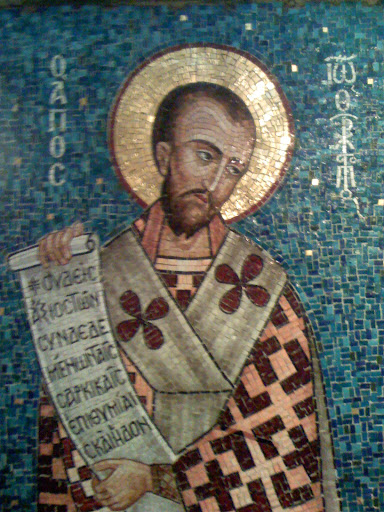
Feast of St John Chrysotom - 13 September 08


Today we celebrate the feast of the life of St. John Chrysotom. Chrysotom actually means 'Golden Mouth'.

He is on of the four great doctors of the Church, and born in 347 in Antioch, Syria. He was prepared for a career in law under the renowned Libanius, who marveled at his pupil's eloquence and foresaw a brilliant career for his pupil as statesman and lawgiver. But John decided, after he had been baptised at the age of 23, to abandon the law in favour of service to the Saviour. He entered a monastery which served to educate him in preparation for his ordination as a priest in 386 AD. From the pulpit there emerged John, a preacher whose oratorical excellence gained him a reputation throughout the Christian world, a recognition which spurred him to even greater expression that found favour with everyone but the Empress Eudoxia, whom he saw fit to examine in some of his sermons.

When St. John was forty-nine years old, his immense popularity earned him election to the Patriarchate of Constantinople, a prestigious post from which he launched a crusade against the excessiveness and extreme wealth which the Empress construed as a personal affront to her and her royal court. This also gave rise to sinister forces that envied his tremendous influence. His enemies found an instrument for his indictment when they discovered that he had harboured some pious monks who had been excommunicated by his arch rival Theophilos, Bishop of Alexandria, who falsely accused John of treason and surreptitiously plotted his exile.

When it was discovered that the great St. John had been exiled by the puppets of the state, there arose such a clamour of protest, promising a real threat of civil disobedience, that not even the royal court dared to confront the angry multitudes and St John was restored to his post. At about this time he put a stop to a practice which was offensive to him, although none of his predecessors outwardly considered it disrespectful; this practice was applauding in church, which would be considered extremely vulgar today, and the absence of which has added to the solemnity of Church services.

St. John delivered a sermon in which he deplored the adulation of a frenzied crowd at the unveiling of a public statue of the Empress Eudoxia. His sermon was grossly exaggerated by his enemies, and by the time it reached the ears of the Empress it resulted in his permanent exile from his beloved city of Constantinople. The humiliation of banishment did not deter the gallant, golden-mouthed St. John, who continued to communicate with the Church and wrote his precious prose until he died in the lonely reaches of Pontus in 407.

Fore more details about the life of St John Chrysotom refer to http://www.chrysostom.org/life.html

For the writings of St John Chrysotom refer to http://www.chrysostom.org/writings.html

Wednesday, September 10, 2008

St. Thomas of Villanova - 10th September 2008

Thomas García Martínez was born in 1486 in Fuenllana, Ciudad Real, Spain. He spent his childhood in the family home in Villanova de los Infantes.

A gifted student, Thomas entered the University of Alcalá at the age of 15. He earned a degree in Theology in a very short time, and was asked to join the faculty of this famous university.

His reputation as an excellent teacher spread, and the prestigious University of Salamanca offered Thomas a professorship in 1516. He refused the position, instead seeking admission into the Order of Saint Augustine.

He professed his vows as an Augustinian in 1517 and was ordained a Priest in 1518. Recognizing his leadership ability, his fellow Augustinians chose him to serve as Prior (local superior) and later as Provincial (regional superior). In this position, Thomas encouraged a more faithful adherence to the principles of Augustinian life. He also promoted missionary activity by Augustinians in the New World.

Thomas grew into a deeply spiritual life. He lived simply, giving away the small fortune that he inherited from his parents.

Asked to become Bishop of Granada, Thomas refused, preferring the simple life to a life of power and prestige. Several years later, Thomas was asked to become Bishop of Valencia. When he refused again, the authorities persuaded Thomas' religious superiors to order him under his vow of obedience to accept.

He reluctantly accepted, and became Archbishop of Valencia in 1545. There he found an archdiocese in spiritual chaos. He began his episcopacy by visiting every parish in the Archdiocese to discover what were the needs of the people. He then set up programs in which funds provided by the wealthy would help to provide for the poor.

The money his cathedral chapter gave him to furnish his house was given to a hospital instead. His explanation to them was that "our Lord will be better served by your money being spent on the poor in the hospital. What does a poor friar like myself want with furniture?"

He wore the same habit that he had received in the novitiate, mending it himself. The canons and domestics were ashamed of him, but they could not convince him to change. Several hundred poor came to Thomas's door each morning and received a meal, wine and money. When criticized because he was at times being taken advantage of, he replied, "If there are people who refuse to work, that is for the governor and the police to deal with. My duty is to assist and relieve those who come to my door." He took in orphans and paid his servants for every deserted child they brought to him. He encouraged the wealthy to imitate his example and be richer in mercy and charity than they were in earthly possessions.

In order to have a well-formed clergy, Thomas started Presentation Seminary in 1550. He established schools where the young would have access to a quality education. He turned his own home into a sort of soup kitchen and shelter, giving to the poor and the homeless food to eat and a place to sleep. For that reason he was known as Beggar Bishop and Father of the Poor.

Criticized because he refused to be harsh or swift in correcting sinners, he said, "Let him (the complainer) inquire whether St. Augustine and St. John Chrysostom used anathemas and excommunication to stop the drunkenness and blasphemy which were so common among the people under their care."

Thomas became ill in 1551. As his illness progressed and he grew weaker, he gave away all of his remaining possessions. As he lay dying, Thomas commanded that all the money he possessed be distributed to the poor. His material goods were to be given to the rector of his college. Mass was being said in his presence when after Communion he breathed his last, reciting the words: "Into your hands, O Lord, I commend my spirit."He died September 8, 1555 in Valencia. His remains are preserved at the Cathedral there. He was canonized in 1658.