How a soul, elevated by desire of the honor of God, and of the salvation of her neighbors, exercising herself in humble prayer, after she had seen the union of the soul, through love, with God, asked of God four requests.
The soul, who is lifted by a very great and yearning desire for the honor of God and the salvation of souls, begins by exercising herself, for a certain space of time, in the ordinary virtues, remaining in the cell of self-knowledge, in order to know better the goodness of God towards her. This she does because knowledge must precede love, and only when she has attained love, can she strive to follow and to clothe herself with the truth. But, in no way, does the creature receive such a taste of the truth, or so brilliant a light therefrom, as by means of humble and continuous prayer, founded on knowledge of herself and of God; because prayer, exercising her in the above way, unites with God the soul that follows the footprints of Christ Crucified, and thus, by desire and affection, and union of love, makes her another Himself.
Christ would seem to have meant this, when He said: To him who will love Me and will observe My commandment, will I manifest Myself; and he shall be one thing with Me and I with him. In several places we find similar words, by which we can see that it is, indeed, through the effect of love, that the soul becomes another Himself. That this may be seen more clearly, I will mention what I remember having heard from a handmaid of God, namely, that, when she was lifted up in prayer, with great elevation of mind, God was not wont to conceal, from the eye of her intellect, the love which He had for His servants, but rather to manifest it; and, that among other things, He used to say: "Open the eye of your intellect, and gaze into Me, and you shall see the beauty
of My rational creature. And look at those creatures who, among the beauties which I have given to the soul, creating her in My image and similitude, are clothed with the nuptial garment (that is, the garment of love), adorned with many virtues, by which they are united with Me
through love. And yet I tell you, if you should ask Me, who these are, I should reply" (said the sweet and amorous Word of God) "they are another Myself, inasmuch as they have lost and denied their own will, and are clothed with Mine, are united to Mine, are conformed to Mine."
It is therefore true, indeed, that the soul unites herself with God by the affection of love.
So, that soul, wishing to know and follow the truth more manfully, and lifting her desires first for herself--for she considered that a soul could not be of use, whether in doctrine, example, or prayer, to her neighbor, if she did not first profit herself, that is, if she did not acquire virtue in herself--addressed four requests to the Supreme and Eternal Father. The first was for herself; the second for the reformation of the Holy Church; the third a general prayer for the whole world, and in particular for the peace of Christians who rebel, with much lewdness and persecution, against the Holy Church; in the fourth and last, she besought the Divine Providence to provide for things in general, and in particular, for a certain case with which she was concerned.
Showing posts with label Church History. Show all posts
Showing posts with label Church History. Show all posts
Monday, May 3, 2010


Thursday, March 4, 2010
The Story of Our Lady of Genazzano

A few miles from the city of Rome, lies Genazzano—a city rich in history and blessed with the presence of a miraculous painting of the Blessed Virgin that has an amazing story.
The origins of Genazzano date back to the times of the Roman emperors. Because of its proximity to Rome, the city was chosen by many patricians and imperial courtiers as a site for their country villas. The vast gardens surrounding these villas often served as the stage for perverse feasts, pagan games and heathen rituals in honor of the gods to whom the Romans attributed the fertility of their fields.
One of these celebrations was held every April 25 in honor of the goddess Flora or Venus. For this event, people of all social classes—freemen and slaves, patricians and plebeians—gathered together for a great feast. This practice gradually dissolved and the temples fell into ruins as the life-giving breath of Christianity regenerated the peoples of Europe.
In the third century, an order was given to build a shrine dedicated to the Mother of God under the tender invocation of Mother of Good Counsel on the ruins of the Roman temples.
As the years went by, the city became more populous and the shrine grew in fame. During the Middle Ages, the Franciscans and the Augustinians founded monasteries nearby. With the passing of years, the primitive temple erected in honor of the Mother of Good Counsel began to show signs of disrepair. Moreover, as the shrine was small, the faithful built larger and richer churches for their solemn functions.
In 1356, about a century before the appearance of the miraculous painting that would introduce Genazzano into the annals of marvels in the Church, Prince Pietro Giordan Colonna, whose family had acquired lordship of the city, assigned the most ancient church of the city and its parish to the care of the Hermits of St. Augustine. The faithful would thereby have the necessary pastoral assistance, and repairs could be made on the old church.
Although the prayers of the faithful intensified, financial difficulties prevented the necessary and urgent restoration of the ancient temple. But the Mother who gives wise counsel in every circumstance and attentively provides for the necessities of men chose a Third Order Augustinian, Petruccia de Nocera, to carry out a supernatural prodigy that would bring about the much-desired restoration.
Petruccia had been left a modest fortune following the death of her husband in 1436. Living alone, she dedicated most of her time to prayer and services in the church of the Mother of Good Counsel. It grieved her to see the deplorable state of the sacred premises, and she prayed fervently that they would be restored. Finally, she resolved to take the initiative. After obtaining permission from the friars, she donated her goods to initiate the restoration in the hope that others would help complete it once it was commenced.
A plan was drawn up for the building of a magnificent church. However, once that arduous undertaking had begun, Petruccia, who was already eighty years old, found that her generous offering was scarcely enough to complete the first phase of the new construction. To make matters worse, no one came forth to help.
To her dismay, the building had hardly risen three feet when construction came to a halt due to lack of resources. Her friends and neighbors began to ridicule her, and detractors accused her of imprudence. Others severely reprimanded her in public. To all of them she would say: "My dear children, do not put too much importance on this apparent misfortune. I assure you that before my death the Blessed Virgin and our holy father Augustine will finish the church begun by me."
On April 25, 1467, the feast day of the city's patron, Saint Mark, a solemn celebration began with Mass. It was Saturday, and the crowd began to gather in front of the church of the Mother of Good Counsel. The only discrepant note in the celebration was the unfinished work of Petruccia.
At about four in the afternoon, everyone heard the chords of a beautiful melody that seemed to come from heaven. The people looked up toward the towers of the churches and saw a white cloud that shone with a thousand luminous rays; it gradually neared the stupefied crowd to the sound of an exceptionally beautiful melody. The cloud descended on the church of the Mother of Good Counsel and poised over the wall of the unfinished chapel of Saint Biagio, which Petruccia had started.
Suddenly, the bells of the old tower began to ring by themselves, and the other bells of the town rang miraculously in unison. The rays that emanated from the little cloud faded away, and the cloud itself gradually vanished, revealing a beautiful object to the enchanted gaze of the spectators. It was a painting that represented Our Lady tenderly holding her Divine Son in her arms. Almost immediately, the Virgin Mary began to cure the sick and grant countless consolations, the memory of which was recorded for posterity by the local ecclesiastical authority.
The news of the painting and its miracles spread throughout the province and beyond, attracting multitudes. Some cities formed enthusiastic processions to see the picture that the people called the Madonna of Paradise because of its celestial entrance into the city. Numerous alms were donated as an answer to the unwavering confidence that Our Lady had inspired in Petruccia.
Amidst the general enthusiasm caused by the painting, Our Lady wished to divulge the true origin of the marvelous fresco to her devotees. Two foreigners named Giorgio and De Sclavis entered the city among a group of pilgrims that had come from Rome. They wore strange clothes and spoke a foreign tongue, saying they had arrived in Rome earlier that year from Albania. While most people had refused to believe their story, it had a special significance for the inhabitants of Genazzano.
***
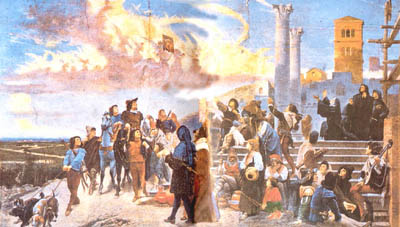
January of 1467 saw the death of the last great Albanian leader, George Castriota, better known as Scanderbeg. Raised by an Albanian chief, he placed himself at the head of his own people.
Subsequently, Scanderbeg inflicted stunning defeats on the Turkish army and occupied fortresses all over Albania.
With Scanderbeg’s death, the Turkish army, finally free from the Fulminating Lion of War, poured into Albania, occupying all its fortresses, cities and provinces with the exception of Scutari, in the north of the country.
However, the city's capacity to resist was limited, and its capture was expected at any moment. With its fall, Christian Albania would be defeated. Faced with this prospect, those who wished to practice their faith in Christian lands began a sad exodus. Giorgio and De Sclavis also studied the possibility of fleeing, but something kept them in Scutari, where there was a small church, considered the shrine of the whole Albanian kingdom. In this church the faithful venerated a picture of Our Lady which had mysteriously descended from the heavens two hundred years before.
According to tradition, it had come from the east. Having poured out innumerable graces over the whole population, its church became the principal center of pilgrimage in Albania. Scanderbeg himself had visited this shrine more than once to ardently ask for victory in battle. Now the shrine was threatened with imminent destruction and profanation.
The two Albanians were torn by the idea of leaving the great treasure of Albania in the hands of the enemy in order to flee the Turkish terror. In their perplexity, they went to the old church to ask their Blessed Mother for the good counsel they needed.
That night, the Consoler of the Afflicted inspired both of them in their sleep. She commanded them to prepare to leave their country, which they would never see again. She added that the miraculous fresco was also going to leave Scutari for another country to escape profanation at the hands of the Turks. Finally, she ordered them to follow the painting wherever it went.
The next morning, the two friends went to the shrine. At a certain moment they saw the picture detach itself from the wall on which it had hung for two centuries. Leaving its niche, it hovered for a moment and was then suddenly wrapped in a white cloud through which the image continued to be visible.
The pilgrim painting left the church and the environs of Scutari. It traveled slowly through the air at a considerable altitude and advanced in the direction of the Adriatic Sea at a speed that allowed the two walkers to follow; after covering some twenty-four miles, they reached the coast.
Without stopping, the picture left the land and advanced over the waters while the faithful Giorgio and De Sclavis continued to follow, walking on the waves much like their Divine Master had done on Lake Genesareth. When night would fall, the mysterious cloud, which had protected them with its shade from the heat of the sun during the day, guided them by night with light, like the column of fire in the desert that guided the Jews in their exodus from Egypt.
They traveled day and night until they reached the Italian coast. There, they continued following the miraculous picture, climbing mountains, fording rivers and passing through valleys. Finally, they reached the vast plain of Lazio from where they could see the towers and domes of Rome. Upon reaching the gates of the city, the cloud suddenly disappeared before their disappointed eyes.
Giorgio and De Sclavis began to search the city, going from church to church asking if the painting had descended there. All their attempts to find the painting failed, and the Romans incredulously regarded the two foreigners and their strange tale.
Shortly thereafter, amazing news came to Rome: a picture of Our Lady had appeared in the skies of Genazzano to the sound of beautiful music and had come to rest over the wall of a church that was being rebuilt. The two Albanians rushed to find their country's beloved treasure miraculously suspended in the air next to the wall of the chapel where it remains to this day.
Although some inhabitants found the strangers' story difficult to believe, careful investigation later proved that the two were telling the truth and that the image was indeed the same one that graced the shrine in Scutari.
Friday, September 18, 2009
St. Januarius - 19 September 2009
In the time of Diocletian, emperor, and in the fifth consulate of Constantine [Constantius], and seventh [probably "fifth"] of Maximian, there was a great persecution of the Christians. At that time Diocletian appointed Timothy, a pagan, governor in the province of Campania and ordered him to offer sacrifices to idols and to compel all who believed in Christ to do the same. It happened as he was making the customary round of cities, he came to the city of Nola. There he ordered the officials to present themselves before him and when they were present he began to inquire from them concerning the judgments of his predecessors.
To him the officials related their deeds and among them, when they reached the affairs of the blessed martyrs Sosius, deacon of the church at Miseno and Proculus, deacon of the church at Pozzuoli, and Eutychetes and Acutius, and how they had been tormented by various tortures and had been recast into prison by the order of the judge, he asked the officials what had been done with them. They replied saying that they for a long time were detained in chains and they uttered in addition evil remarks concerning the Blessed Januarius, bishop of Benevento.
This most unjust Timothy having heard these remarks regarding Januarius, ordered him to be brought before him and when he was presented before his tribunal at Nola, Timothy the judge said to him: "Januarius, having heard of the reputation of your family I exhort you to sacrifice to the gods in obedience to the decrees of the invincible rulers. But if you are unwilling I shall subject you to horrible torments which the God whom you worship when he shall see them he himself shall fear."
St. Januarius however replied: "Be silent, O unhappy man, and do not insult in my hearing Him who created heaven and earth, lest the Lord God may hear such a blasphemy as that which proceeds from you mouth and he may destroy you and you shall be mute and deaf, not hearing and like a blind man not seeing."
Having heard these things the tyrant Timothy says to the saint: "Is it in your power that by any enchantments whatever you or your god can prevail against me?"
St. Januarius replies: "My power is nothing but there is a God in heaven who can resist you and all who obey and abet you." And when he had said this the tyrant ordered him back to prison.
Being very angry he ordered a furnace to be heated for three days and the saint to be cast into it. The holy man made the sign of the cross on his forehead, looked up to heaven sighing and extending his hands, and having entered the fiery furnace he was praising God, saying: "O Lord Jesus Christ for the sake of thy holy name I embrace willingly this suffering and I expect every promise which thou hast promised to those who love Thee. Hear me praying to Thee and deliver me from this flame, thou who wert present with the three children, Ananias, Azarias, Misael in the fiery furnace, and be with me in this my trial to deliver me from the hands of the enemy." Saying these things, Blessed Januarius began to walk with holy angels in the midst of the fire praising the Father and Son and Holy Ghost.
When the soldiers who were around the furnace heard St. Januarius in its depth praising God they feared with a great fear and ran in great haste and told the judge saying, "We beseech thee, sir, not to be angry with us but we have heard the voice of Januarius in the furnace invoking his Lord, and being greatly terrified we fled." Timothy hearing this ordered the furnace to be opened and when it was opened the flames shot out and devoured some incredulous pagans who were around about it. But St. Januarius appeared in the midst glorifying the Lord Jesus Christ so that the fire could not touch either his clothes or his hair.
Timothy however when he had heard this ordered him before him and said to him: "Of what avail is it that the magic you exercise is powerful? By various torments I will make you perish." Bl. Januarius replied: "It will not be well for thee, thou cruel tyrant, to alienate the servant of Christ from the truth of Christ or to cause me to obey through fear. I will hope in the Lord. I will not fear no matter what men may do to me," and thus replying the judge ordered him led back to prison.
On another day early in the morning Timothy had Januarius before him: "How long, unhappy man, will you refuse to sacrifice to the immortal gods? Approach now and offer incense. If not I shall order you to be beheaded and if he can, let your God free you from my hands." The saint replied: "You do not know that the power of God is great. Would that you would repent so that my God might pardon you whom you say to be unable to free me from your hands! When you speak thus you are heaping up wrath for yourself on the day of wrath."
The judge not liking this speech ordered his shackels [-nervi-] to be removed. Januarius prayed God saying: "O Lord Jesus Christ who hast not abandoned me from my mother's womb now hear thy servant crying to thee and command me to depart this world and obtain thy mercy." The judge thinking how he would kill him sent him back to prison.
While guarded by soldiers in hard captivity, two of his clergy, the deacon Festus and the reader Desiderius, learned of their bishop's captivity and being moved by the Holy Ghost they immediately set out from Beneventum and came to Nola, and there weeping they cried: "Why is such a man in custody? What crimes did he commit? When did he fail to aid those in trouble? What sick man was visted by him without regaining health? Who approached him weeping and went away not rejoicing?"
Their words were reported to Timothy who ordered them at once to be detained and along with Januarius to be brought before him, whereupon he asked Januarius who were these two and the saint replied: "One is my deacon and the other is my reader." "Do they proclaim themselves Christians?" "Certainly, for if you ask them, I hope in my Lord Jesus Christ that they will not deny themselves to be Christians," and being asked, they said: "We are Christians and we are prepared to die for the love of God."
Then Timothy filled with anger ordered Januarius the bishop, along with Festus the deacon and Desiderius the reader, to be bound in chains and to be dragged before his chariot to the city of Pozzuoli, determining that there along with Sosius, Proculus, Eutyches and Acutius, they should be delivered up to wild beasts. When they were come to Pozzuoli, they were kept in prison until the arena was prepared. On the day appointed they were led into the amphitheatre and Timothy coming ordered the wild beasts to be let loose; and when this was done, St. Januarius cried: "O brethren, seize the shield of faith and let us pray to the Lord our Helper in the name of the Lord who made heaven and earth." And the mercy of God was so present that to the feet of Januarius like sheep with heads down ran the wild beasts.
The unbelieving judge had the beasts removed and the saints of God taken from the arena and brought before his tribunal, where sitting in state he dictated their sentence: "We order to be beheaded, Januarius bishop, Sosius, Proculus and Festus deacons, Desiderius reader, Eutyches and Acutius, citizens of Pozzuoli, who have professed themselves Christians and have despised the sacrifices of the gods and the commands of the emperor." But Bl. Januarius looking up to heaven said: "Lord Jesus Christ who descended from on high for the redemption of the human race, deliver me and free me from the hand of this enemy and I beg thee my God that you punish Timothy for the things he did against me thy servant and that thou blind his eyes so that he may not see the light of heaven."
When he had finished his prayer darkness fell on his [Timothy's] eyes and suddenly he was made blind. Then prayed Januarius to the Lord, and said: "I give thanks to thee, Father of our Lord Jesus Christ, who hast heard thy servant and destroyed the eyes of the impious Timothy because many souls on account of him have been perverted to the evil spirits."
Then Timothy was suffering with his stricken eyes and the pain was increasing. Repentant he began to cry out and say to the officials: "Go, bring Januarius to me." And they going found him lead along by the executioners on the incline that leads to the Solfatara and bringing him back they set him before the judge and a great multitude of people was attracted by the sight. But Timothy began to cry out with a great cry and to say to Bl. Januarius: "Januarius, servant of the most high God, pray the Lord, thy God, for me blind that I may recover the sight which I have lost."
Then Januarius raising his eyes to heaven prayed: "God of Abraham, God of Isaac, God of Jacob, hear my prayer and restore to Timothy though unworthy his eyes that all the people present may know that thou art God and there is no other but thee; for we may not return evil for evil." And when St. Januarius had finished his prayer his were opened.
The multitude seeing the wonderful things which the Lord wrought by Januarius his martyr, many of the bystanders believed in the Lord Jesus Christ, almost five thousand, and they cried out raising their voices: "Will not the God of such and so great a man be feared? Will he not perhaps take revenge for their sufferings and death and will we not all likewise perish?" Januarius was very beautiful both in body and disposition. Then the impious judge Timothy seeing such a crowd turned toward the Lord was troubled and (lest the servant of the Lord Jesus Christ might be deprived of his crown) fearing the commands of the emperor the judge ordered the soldiers to take him away quickly and to behead him with the holy martyrs.
When they were on their way to martyrdom a certain old and very poor man, hoping favor from Januarius placed himself in his way and fell at his feet and besought him that he might receive some of his clothes. But Januarius said to that old man: "When my body has been buried thou wilt see that I myself will give thee my orarium with which I will have bound my eyes." The mother also of St. Januarius residing at Benevento, three days before her son suffered, saw in a dream that Januarius was flying in the air to heaven and when she was puzzled by the dream and would inquire what it meant, suddenly it was announced to her that her son was imprisoned for the love of God. She however greatly terrified, prostrating herself in prayer before the Lord, gave up her spirit.
In the meantime when the saints had arrived at the place where they were to be beheaded, that is at the Solfatara, St. Januarius kneeling prayed: "O Lord, omnipotent God, into thy hands I commend my spirit" and then rising he took his orarium and bound his eyes and kneeling again he placed his hand on his neck and asked the executioner to strike. The executioner struck with great force and cut off at the same time a finger of the saint's hand and his head. The other saints received likewise their crown.
St. Januarius after his execution appeared to the old man and offered him as he had promised the orarium which had bound his eyes and said: "Behold what I promised you, take it as I promised it," and he took it and hid it in his bosom with great reverence.
The executioners and two other officials seeing the old man, laughingly asked him: "Have you got what he who was beheaded promised?" But he said, "Yes," and showed them the orarium which they recognized and wondered greatly.
On the very same hour at which St. Januarius and the holy martyrs were beheaded the cruel Timothy began to suffer very much and he was exclaiming aloud: "I suffer these pains for having treated Januarius the servant of God so impiously. The angels of God torment [me]." And when he had been long tormented he gave up the ghost.
The Christians of various cities were guarding the bodies of the saints that they might carry them off at night to their own cities and they kept a careful though secret watch; and when night was come and all were sleeping, St. Januarius in the silence of the night appeared to one of those who were prepared to take away his body and said to him: "Brother, when you take away my body know that the finger of my hand is missing. Seek it and place it with my body." And so it was done as the saint himself had admonished. The bodies of the saints lay at the Solfatara where later was founded a church worthy of St. Januarius the martyr.
Here ends the passion of Januarius Martyr.
Tuesday, August 25, 2009
King Saint Louis's Last Instructions to his Eldest Son, Philip III
King Saint Louis's Last Instructions
to his Eldest Son, Philip III
1. To his dear first-born son, Philip, greeting, and his father's love.
2. Dear son, since I desire with all my heart that you be well "instructed in all things, it is in my thought to give you some advice this writing. For I have heard you say, several times, that you remember my words better than those of any one else.
3. Therefore, dear son, the first thing I advise is that you fix your whole heart upon God, and love Him with all your strength, for without this no one can be saved or be of any worth.
4. You should, with all your strength, shun everything which you believe to be displeasing to Him. And you ought especially to be resolved not to commit mortal sin, no matter what may happen and should permit all your limbs to be hewn off, and suffer every manner of torment, rather than fall knowingly into mortal sin.
5. If our Lord send you any adversity, whether illness or other in good patience, and thank Him for it, thing, you should receive it in good patience and be thankful for it, for you ought to believe that He will cause everthing to turn out for your good; and likewise you should think that you have well merited it, and more also, should He will it, because you have loved Him but little, and served Him but little, and have done many things contrary to His will.
6. If our Lord send you any prosperity, either health of body or other thing you ought to thank Him humbly for it, and you ought to be careful that you are not the worse for it, either through pride or anything else, for it is a very great sin to fight against our Lord with His gifts.
7. Dear son, I advise you that you accustom yourself to frequent confession, and that you choose always, as your confessors, men who are upright and sufficiently learned, and who can teach you what you should do and what you should avoid. You should so carry yourself that your confessors and other friends may dare confidently to reprove you and show you your faults.
8. Dear son, I advise you that you listen willingly and devoutly the services of Holy Church, and, when you are in church, avoid to frivolity and trifling, and do not look here and there; but pray to God with lips and heart alike, while entertaining sweet thoughts about Him, and especially at the mass, when the Body and Blood of our Lord Jesus Christ are consecrated, and for a little time before.
9. Dear son, have a tender pitiful heart for the poor, and for all those whom you believe to be in misery of heart or body, and, according to your ability, comfort and aid them with some alms.
10. Maintain the good customs of your realm, and put down the bad ones. Do not oppress your people and do not burden them with tolls or tailles, except under very great necessity.
11. If you have any unrest of heart, of such a nature that it may be told, tell it to your confessor, or to some upright man who can keep your secret; you will be able to carry more easily the thought of your heart.
12. See to it that those of your household are upright and loyal, and remember the Scripture, which says: "Elige viros timentes Deum in quibus sit justicia et qui oderint avariciam"; that is to say, "Love those who serve God and who render strict justice and hate covetousness"; and you will profit, and will govern your kingdom well.
13. Dear son, see to it that all your associates are upright, whether clerics or laymen, and have frequent good converse with them; and flee the society of the bad. And listen willingly to the word of God, both in open and in secret; and purchase freely prayers and pardons.
14. Love all good, and hate all evil, in whomsoever it may be.
15. Let no one be so bold as to say, in your presence, words which attract and lead to sin, and do not permit words of detraction to be spoken of another behind his back.
!6. Suffer it not that any ill be spoken of God or His saints in your presence, without taking prompt vengeance. But if the offender be a clerk or so great a person that you ought not to try him, report the matter to him who is entitled to judge it.
17. Dear son, give thanks to God often for all the good things He has done for you, so that you may be worthy to receive more, in such a manner that if it please the Lord that you come to the burden and honor of governing the kingdom, you may be worthy to receive the sacred unction wherewith the kings of France are consecrated.
18. Dear son, if you come to the throne, strive to have that which befits a king, that is to say, that in justice and rectitude you hold yourself steadfast and loyal toward your subjects and your vassals, without turning either to the right or to the left, but always straight, whatever may happen. And if a poor man have a quarrel with a rich man, sustain the poor rather than the rich, until the truth is made clear, and when you know the truth, do justice to them.
19. If any one have entered into a suit against you (for any injury or wrong which he may believe that you have done to him), be always for him and against yourself in the presence of your council, without showing that you think much of your case (until the truth be made known concerning it); for those of your council might be backward in speaking against you, and this you should not wish; and command your judges that you be not in any way upheld more than any others, for thus will your councillors judge more boldly according to right and truth.
20. If you have anything belonging to another, either of yourself or through your predecessors, if the matter is certain, give it up without delay, however great it may be, either in land or money or otherwise. If the matter is doubtful, have it inquired into by wise men, promptly and diligently. And if the affair is so obscure that you cannot know the truth, make such a settlement, by the counsel of s of upright men, that your soul, and the soul your predecessors, may be wholly freed from the affair. And even if you hear some one say that your predecessors made restitution, make diligent inquiry to learn if anything remains to be restored; and if you find that such is the case, cause it to be delivered over at once, for the liberation of your soul and the souls of your predecessors.
21. You should seek earnestly how your vassals and your subjects may live in peace and rectitude beneath your sway; likewise, the good towns and the good cities of your kingdom. And preserve them in the estate and the liberty in which your predecessors kept them, redress it, and if there be anything to amend, amend and preserve their favor and their love. For it is by the strength and the riches of your good cities and your good towns that the native and the foreigner, especially your peers and your barons, are deterred from doing ill to you. I will remember that Paris and the good towns of my kingdom aided me against the barons, when I was newly crowned.
22. Honor and love all the people of Holy Church, and be careful that no violence be done to them, and that their gifts and alms, which your predecessors have bestowed upon them, be not taken away or diminished. And I wish here to tell you what is related concerning King Philip, my ancestor, as one of his council, who said he heard it, told it to me. The king, one day, was with his privy council, and he was there who told me these words. And one of the king's councillors said to him how much wrong and loss he suffered from those of Holy Church, in that they took away his rights and lessened the jurisdiction of his court; and they marveled greatly how he endured it. And the good king answered: "I am quite certain that they do me much wrong, but when I consider the goodnesses and kindnesses which God has done me, I had rather that my rights should go, than have a contention or awaken a quarrel with Holy Church." And this I tell to you that you may not lightly believe anything against the people of Holy Church; so love them and honor them and watch over them that they may in peace do the service of our Lord.
23. Moreover, I advise you to love dearly the clergy, and, so far as you are able, do good to them in their necessities, and likewise love those by whom God is most honored and served, and by whom the Faith is preached and exalted.
24. Dear son, I advise that you love and reverence your father and your mother, willingly remember and keep their commandments, and be inclined to believe their good counsels.
25. Love your brothers, and always wish their well-being and their good advancement, and also be to them in the place of a father, to instruct them in all good. But be watchful lest, for the love which you bear to one, you turn aside from right doing, and do to the others that which is not meet.
26. Dear son, I advise you to bestow the benefices of Holy Church which you have to give, upon good persons, of good and clean life, and that you bestow them with the high counsel of upright men. And I am of the opinion that it is preferable to give them to those who hold nothing of Holy Church, rather than to others. For, if you inquire diligently, you will find enough of those who have nothing who will use wisely that entrusted to them.
27. Dear son, I advise you that you try with all your strength to avoid warring against any Christian man, unless he have done you too much ill. And if wrong be done you, try several ways to see if you can find how you can secure your rights, before you make war; and act thus in order to avoid the sins which are committed in warfare.
28. And if it fall out that it is needful that you should make war (either because some one of your vassals has failed to plead his case in your court, or because he has done wrong to some church or to some poor person, or to any other person whatsoever, and is unwilling to make amends out of regard for you, or for any other reasonable cause), whatever the reason for which it is necessary for you to make war, give diligent command that the poor folk who have done no wrong or crime be protected from damage to their vines, either through fire or otherwise, for it were more fitting that you should constrain the wrongdoer by taking his own property (either towns or castles, by force of siege), than that you should devastate the property of poor people. And be careful not to start the war before you have good counsel that the cause is most reasonable, and before you have summoned the offender to make amends, and have waited as long as you should. And if he ask mercy, you ought to pardon him, and accept his amende, so that God may be pleased with you.
29. Dear son, I advise you to appease wars and contentions, whether they be yours or those of your subjects, just as quickly as may be, for it is a thing most pleasing to our Lord. And Monsignore Martin gave us a very great example of this. For, one time, when our Lord made it known to him that he was about to die, he set out to make peace between certain clerks of his archbishopric, and he was of the opinion that in so doing he was giving a good end to life.
30. Seek diligently, most sweet son, to have good baillis and good prevots in your land, and inquire frequently concerning their doings, and how they conduct themselves, and if they administer justice well, and do no wrong to any one, nor anything which they ought not do. Inquire more often concerning those of your household if they be too covetous or too arrogant; for it is natural that the members should seek to imitate their chief; that is, when the master is wise and well-behaved, all those of his household follow his example and prefer it. For however much you ought to hate evil in others, you shoud have more hatred for the evil which comes from those who derive their power from you, than you bear to the evil of others; and the more ought you to be on your guard and prevent this from happening.
3!. Dear son, I advise you always to be devoted to the Church of Rome, and to the sovereign pontiff, our father, and to bear him the the reverence and honor which you owe to your spiritual father.
32. Dear son, freely give power to persons of good character, who know how to use it well, and strive to have wickednesses expelled from your land, that is to say, nasty oaths, and everything said or done against God or our Lady or the saints. In a wise and proper manner put a stop, in your land, to bodily sins, dicing, taverns, and other sins. Put down heresy so far as you can, and hold in especial abhorrence Jews, and all sorts of people who are hostile to the Faith, so that your land may be well purged of them, in such manner as, by the sage counsel of good people, may appear to you advisable.
33. Further the right with all your strength. Moreover I admonish you you that you strive most earnestly to show your gratitude for the benefits which our Lord has bestowed upon you, and that you may know how to give Him thanks therefore
34. Dear son, take care that the expenses of your household are reasonable and moderate, and that its moneys are justly obtained. And there is one opinion that I deeply wish you to entertain, that is to say, that you keep yourself free from foolish expenses and evil exactions, and that your money should be well expended and well acquired. And this opinion, together with other opinions which are suitable and profitable, I pray that our Lord may teach you.
35. Finally, most sweet son, I conjure and require you that, if it please our Lord that I should die before you, you have my soul succored with masses and orisons, and that you send through the congregations of the kingdom of France, and demand their prayers for my soul, and that you grant me a special and full part in all the good deeds which you perform.
36. In conclusion, dear son, I give you all the blessings which a good and tender father can give to a son, and I pray our Lord Jesus Christ, by His mercy, by the prayers and merits of His blessed Mother, the Virgin Mary, and of angels and archangels and of all the saints, to guard and protect you from doing anything contrary to His will, and to give you grace to do it always, so that He may be honored and served by you. And this may He do to me as to you, by His great bounty, so that after this mortal life we may be able to be together with Him in the eternal life, and see Him, love Him, and praise Him without end. Amen. And glory, honor, and praise be to Him who is one God with the Father and the Holy Spirit; without beginning and without end. Amen.
to his Eldest Son, Philip III
1. To his dear first-born son, Philip, greeting, and his father's love.
2. Dear son, since I desire with all my heart that you be well "instructed in all things, it is in my thought to give you some advice this writing. For I have heard you say, several times, that you remember my words better than those of any one else.
3. Therefore, dear son, the first thing I advise is that you fix your whole heart upon God, and love Him with all your strength, for without this no one can be saved or be of any worth.
4. You should, with all your strength, shun everything which you believe to be displeasing to Him. And you ought especially to be resolved not to commit mortal sin, no matter what may happen and should permit all your limbs to be hewn off, and suffer every manner of torment, rather than fall knowingly into mortal sin.
5. If our Lord send you any adversity, whether illness or other in good patience, and thank Him for it, thing, you should receive it in good patience and be thankful for it, for you ought to believe that He will cause everthing to turn out for your good; and likewise you should think that you have well merited it, and more also, should He will it, because you have loved Him but little, and served Him but little, and have done many things contrary to His will.
6. If our Lord send you any prosperity, either health of body or other thing you ought to thank Him humbly for it, and you ought to be careful that you are not the worse for it, either through pride or anything else, for it is a very great sin to fight against our Lord with His gifts.
7. Dear son, I advise you that you accustom yourself to frequent confession, and that you choose always, as your confessors, men who are upright and sufficiently learned, and who can teach you what you should do and what you should avoid. You should so carry yourself that your confessors and other friends may dare confidently to reprove you and show you your faults.
8. Dear son, I advise you that you listen willingly and devoutly the services of Holy Church, and, when you are in church, avoid to frivolity and trifling, and do not look here and there; but pray to God with lips and heart alike, while entertaining sweet thoughts about Him, and especially at the mass, when the Body and Blood of our Lord Jesus Christ are consecrated, and for a little time before.
9. Dear son, have a tender pitiful heart for the poor, and for all those whom you believe to be in misery of heart or body, and, according to your ability, comfort and aid them with some alms.
10. Maintain the good customs of your realm, and put down the bad ones. Do not oppress your people and do not burden them with tolls or tailles, except under very great necessity.
11. If you have any unrest of heart, of such a nature that it may be told, tell it to your confessor, or to some upright man who can keep your secret; you will be able to carry more easily the thought of your heart.
12. See to it that those of your household are upright and loyal, and remember the Scripture, which says: "Elige viros timentes Deum in quibus sit justicia et qui oderint avariciam"; that is to say, "Love those who serve God and who render strict justice and hate covetousness"; and you will profit, and will govern your kingdom well.
13. Dear son, see to it that all your associates are upright, whether clerics or laymen, and have frequent good converse with them; and flee the society of the bad. And listen willingly to the word of God, both in open and in secret; and purchase freely prayers and pardons.
14. Love all good, and hate all evil, in whomsoever it may be.
15. Let no one be so bold as to say, in your presence, words which attract and lead to sin, and do not permit words of detraction to be spoken of another behind his back.
!6. Suffer it not that any ill be spoken of God or His saints in your presence, without taking prompt vengeance. But if the offender be a clerk or so great a person that you ought not to try him, report the matter to him who is entitled to judge it.
17. Dear son, give thanks to God often for all the good things He has done for you, so that you may be worthy to receive more, in such a manner that if it please the Lord that you come to the burden and honor of governing the kingdom, you may be worthy to receive the sacred unction wherewith the kings of France are consecrated.
18. Dear son, if you come to the throne, strive to have that which befits a king, that is to say, that in justice and rectitude you hold yourself steadfast and loyal toward your subjects and your vassals, without turning either to the right or to the left, but always straight, whatever may happen. And if a poor man have a quarrel with a rich man, sustain the poor rather than the rich, until the truth is made clear, and when you know the truth, do justice to them.
19. If any one have entered into a suit against you (for any injury or wrong which he may believe that you have done to him), be always for him and against yourself in the presence of your council, without showing that you think much of your case (until the truth be made known concerning it); for those of your council might be backward in speaking against you, and this you should not wish; and command your judges that you be not in any way upheld more than any others, for thus will your councillors judge more boldly according to right and truth.
20. If you have anything belonging to another, either of yourself or through your predecessors, if the matter is certain, give it up without delay, however great it may be, either in land or money or otherwise. If the matter is doubtful, have it inquired into by wise men, promptly and diligently. And if the affair is so obscure that you cannot know the truth, make such a settlement, by the counsel of s of upright men, that your soul, and the soul your predecessors, may be wholly freed from the affair. And even if you hear some one say that your predecessors made restitution, make diligent inquiry to learn if anything remains to be restored; and if you find that such is the case, cause it to be delivered over at once, for the liberation of your soul and the souls of your predecessors.
21. You should seek earnestly how your vassals and your subjects may live in peace and rectitude beneath your sway; likewise, the good towns and the good cities of your kingdom. And preserve them in the estate and the liberty in which your predecessors kept them, redress it, and if there be anything to amend, amend and preserve their favor and their love. For it is by the strength and the riches of your good cities and your good towns that the native and the foreigner, especially your peers and your barons, are deterred from doing ill to you. I will remember that Paris and the good towns of my kingdom aided me against the barons, when I was newly crowned.
22. Honor and love all the people of Holy Church, and be careful that no violence be done to them, and that their gifts and alms, which your predecessors have bestowed upon them, be not taken away or diminished. And I wish here to tell you what is related concerning King Philip, my ancestor, as one of his council, who said he heard it, told it to me. The king, one day, was with his privy council, and he was there who told me these words. And one of the king's councillors said to him how much wrong and loss he suffered from those of Holy Church, in that they took away his rights and lessened the jurisdiction of his court; and they marveled greatly how he endured it. And the good king answered: "I am quite certain that they do me much wrong, but when I consider the goodnesses and kindnesses which God has done me, I had rather that my rights should go, than have a contention or awaken a quarrel with Holy Church." And this I tell to you that you may not lightly believe anything against the people of Holy Church; so love them and honor them and watch over them that they may in peace do the service of our Lord.
23. Moreover, I advise you to love dearly the clergy, and, so far as you are able, do good to them in their necessities, and likewise love those by whom God is most honored and served, and by whom the Faith is preached and exalted.
24. Dear son, I advise that you love and reverence your father and your mother, willingly remember and keep their commandments, and be inclined to believe their good counsels.
25. Love your brothers, and always wish their well-being and their good advancement, and also be to them in the place of a father, to instruct them in all good. But be watchful lest, for the love which you bear to one, you turn aside from right doing, and do to the others that which is not meet.
26. Dear son, I advise you to bestow the benefices of Holy Church which you have to give, upon good persons, of good and clean life, and that you bestow them with the high counsel of upright men. And I am of the opinion that it is preferable to give them to those who hold nothing of Holy Church, rather than to others. For, if you inquire diligently, you will find enough of those who have nothing who will use wisely that entrusted to them.
27. Dear son, I advise you that you try with all your strength to avoid warring against any Christian man, unless he have done you too much ill. And if wrong be done you, try several ways to see if you can find how you can secure your rights, before you make war; and act thus in order to avoid the sins which are committed in warfare.
28. And if it fall out that it is needful that you should make war (either because some one of your vassals has failed to plead his case in your court, or because he has done wrong to some church or to some poor person, or to any other person whatsoever, and is unwilling to make amends out of regard for you, or for any other reasonable cause), whatever the reason for which it is necessary for you to make war, give diligent command that the poor folk who have done no wrong or crime be protected from damage to their vines, either through fire or otherwise, for it were more fitting that you should constrain the wrongdoer by taking his own property (either towns or castles, by force of siege), than that you should devastate the property of poor people. And be careful not to start the war before you have good counsel that the cause is most reasonable, and before you have summoned the offender to make amends, and have waited as long as you should. And if he ask mercy, you ought to pardon him, and accept his amende, so that God may be pleased with you.
29. Dear son, I advise you to appease wars and contentions, whether they be yours or those of your subjects, just as quickly as may be, for it is a thing most pleasing to our Lord. And Monsignore Martin gave us a very great example of this. For, one time, when our Lord made it known to him that he was about to die, he set out to make peace between certain clerks of his archbishopric, and he was of the opinion that in so doing he was giving a good end to life.
30. Seek diligently, most sweet son, to have good baillis and good prevots in your land, and inquire frequently concerning their doings, and how they conduct themselves, and if they administer justice well, and do no wrong to any one, nor anything which they ought not do. Inquire more often concerning those of your household if they be too covetous or too arrogant; for it is natural that the members should seek to imitate their chief; that is, when the master is wise and well-behaved, all those of his household follow his example and prefer it. For however much you ought to hate evil in others, you shoud have more hatred for the evil which comes from those who derive their power from you, than you bear to the evil of others; and the more ought you to be on your guard and prevent this from happening.
3!. Dear son, I advise you always to be devoted to the Church of Rome, and to the sovereign pontiff, our father, and to bear him the the reverence and honor which you owe to your spiritual father.
32. Dear son, freely give power to persons of good character, who know how to use it well, and strive to have wickednesses expelled from your land, that is to say, nasty oaths, and everything said or done against God or our Lady or the saints. In a wise and proper manner put a stop, in your land, to bodily sins, dicing, taverns, and other sins. Put down heresy so far as you can, and hold in especial abhorrence Jews, and all sorts of people who are hostile to the Faith, so that your land may be well purged of them, in such manner as, by the sage counsel of good people, may appear to you advisable.
33. Further the right with all your strength. Moreover I admonish you you that you strive most earnestly to show your gratitude for the benefits which our Lord has bestowed upon you, and that you may know how to give Him thanks therefore
34. Dear son, take care that the expenses of your household are reasonable and moderate, and that its moneys are justly obtained. And there is one opinion that I deeply wish you to entertain, that is to say, that you keep yourself free from foolish expenses and evil exactions, and that your money should be well expended and well acquired. And this opinion, together with other opinions which are suitable and profitable, I pray that our Lord may teach you.
35. Finally, most sweet son, I conjure and require you that, if it please our Lord that I should die before you, you have my soul succored with masses and orisons, and that you send through the congregations of the kingdom of France, and demand their prayers for my soul, and that you grant me a special and full part in all the good deeds which you perform.
36. In conclusion, dear son, I give you all the blessings which a good and tender father can give to a son, and I pray our Lord Jesus Christ, by His mercy, by the prayers and merits of His blessed Mother, the Virgin Mary, and of angels and archangels and of all the saints, to guard and protect you from doing anything contrary to His will, and to give you grace to do it always, so that He may be honored and served by you. And this may He do to me as to you, by His great bounty, so that after this mortal life we may be able to be together with Him in the eternal life, and see Him, love Him, and praise Him without end. Amen. And glory, honor, and praise be to Him who is one God with the Father and the Holy Spirit; without beginning and without end. Amen.
Tuesday, June 2, 2009
The Christeros War - Catholic Church History

In 1926, a small army of Catholic peasants who took on the name "Cristeros" (followers of Christ) fought to regain religious freedom in Mexico. Before they were through, as many as 50,000 men from every socioeconomic background took up arms against the government.
The "war" produced many religious refugees, some of whom came to El Paso. The city welcomed the persecuted, and from this support stemmed the founding of new seminaries and monasteries, which still exist today.
In 1917, President Plutarco Elías Calles and the former president, General Álvaro Obregón, weakened the Catholic Church in Mexico by enforcing the Articles of the 1857 constitution included in the 1917 version. Article 3 called for secular education in the schools, thus outlawing parochial education. Article 5 closed all seminaries and convents. Article 24 forbade worship outside the physical borders of the church.
Article 27 prohibited religious groups from owning real estate, thus nationalizing all Church property. Article 130 prohibited priests and nuns from wearing religious vestments, but more importantly, it took away from the clergy the rights of voting and speech, prohibiting the criticism of government officials and comment on public affairs in religious publications.
The closing of seminaries began during the Mexican Revolution, leaving nuns and priests with no place to live or work. The government also ruled that only Mexican born clergy would be allowed to remain and participate in religious activities in Mexico. By 1917, hundreds of religious had been expelled from Mexico or had fled the country.
The Catholic Church did not want to retaliate violently against the government, so from 1919 to 1926, they obeyed the laws. However, in 1926, President Calles introduced legislation which fined priests $250 for wearing religious vestments and imprisoned them for five years for criticizing the government.
Archbishop of Mexico, José María Mora y del Río, declared that the Catholic Church could not accept the government's restraints. On July 31, 1926, the archbishop suspended all public worship by ordering Mexican clergy to refrain from administering any of the Church's sacraments.
The Cristeros felt the only way to fight the government was to take up arms: they were willing to become martyrs for their freedom of religion. Jean Meyers, a French expert on this revolution, tells us about Cristeros attending field masses, dressed in sandals and white garments and armed with machetes. They knew that soldiers could attack them with machine guns at any time.
Many priests were martyred while celebrating mass, either by being shot or beheaded. In a last affirmation of their faith, the Cristeros would shout, "Viva Cristo Rey!" (Long Live Christ the King!) just before dying.
Padre Miguel Agustin Pro was one of the best known of the martyred priests. Pro used elaborate disguises so that soldiers would not recognize him as a priest. Known for his indefatigable sense of humor, he visited the faithful often dressed as a beggar. He administered the sacraments, provided jokes and laughter, and helped financially those in need. Rich families often received the sacraments from Padre Pro in his disguise of businessman. Pro and his brother, Humberto, were arrested for being erroneously linked to a car bombing which injured ex-president Obregón. The car used in the bombing was traced back to Humberto Pro, the previous owner.
Calles took advantage of the opportunity to execute a priest publicly in an attempt to discourage other priests from participating in politics. He ordered Pro be shot at the police station and invited reporters to the execution. Padre Pro carried a small crucifix and his rosary and held his arms out forming a cross as he was shot. Pope John Paul II beatified him on September 25, 1988.
Another martyr, San Pedro de Jesus Maldonado Lucero, served the people's spiritual needs in Chihuahua, Mexico. Maldonado attended seminary in Mexico in 1914, but the political conflict forced him to leave. He came to El Paso and received his ordination on January 25, 1918, from Bishop Anthony J. Schuler at St. Patrick's Cathedral. Then he returned to Chihuahua to serve the faithful.
After Calles' anti-Catholic laws were implemented in 1926, Maldonado became a government target for performing religious ceremonies in private homes. He succeeded in celebrating night masses on one ranch or another, performing marriages and baptisms and administering other sacraments. In 1937 during Holy Week, the mayor and soldiers in Santa Isabel, Chihuahua, arrested him and beat him to death for defying government bans on hidden religious celebrations. Maldonado's murderers used riffle butts to bash in his head and dislodge an eye from its socket.
Like Maldonado, many other priests and nuns along with ordinary Catholics, Mormons and Episcopalians left the country and found refuge in border cities in the United States, among them, El Paso. Patrick Cross writes that by 1929, some 25,000 priests in approximately 12,000 parishes no longer could minister to the spiritual needs of Mexican Catholics, over 10 million strong.
In a personal interview, Dr. Jesus Cuellar, this writer's grandfather, recalled that at the age of 13, in 1927, he was helping Father Gregorio Paredes with a secret mass in a house in Guanajuato. After it concluded, soldiers came looking for a place to feed and water their horses.
In order to save the priest's life and to keep the Eucharist from desecration, Cuellar took the Chalice containing the Eucharist and ran out to hide it in a neighboring house. He and Father Paredes hid in a basement for three days, waiting for the soldiers to leave.
Persecuted Mexican Catholics received worldwide sympathy. Boston banned the new religious regulations calling them "the most brutal tyranny." New York parishioners crowded Catholic and Protestant churches to offer prayers for a peaceful solution in Mexico.
El Paso Bishop Reverend Anthony J. Schuler welcomed Juárez Catholics and even granted priests permission to perform marriages and baptisms without requiring residency for the Mexican citizens. Between 1926 and 1929, the number of people attending services at El Paso Catholic churches doubled. A dramatic increase in baptisms and marriages of people with Hispanic surnames at Catholic churches suggested that downtown churches were serving great numbers of Catholics from Mexico.
Since priests and nuns in Mexico could no longer teach there, many of them came to El Paso. Three nuns from the order of Perpetual Adoration and two from the Servants of the Sacred Heart arrived in El Paso on August 2, 1926. Sacred Heart Church received the nuns from the Sacred Heart Order with open arms.
Because there was no Perpetual Adoration order in El Paso, Bishop Schuler provided the funds for the foundation of such a monastery to train nuns. Other exiled nuns from Mexico City and Guadalajara soon joined the first nuns.
Reverend Mother María Concepción del Espíritu Santo was in charge of the nuns who came from Guadalajara. She found a suitable location for the monastery in a house at 1401 Magoffin. Along with money from the diocese, the Catholic community raised funds and helped pay $7,550 for the property in monthly installments.
Once El Paso became a diocese in 1926, it was allowed to establish seminaries and became the home to Franciscans at St. Anthony's Seminary at Hastings and Crescent in 1935. Before this, the persecuted Franciscan order of Michoacan, which had not had a seminary since 1910, had lived in Santa Barbara, Calif., after their departure from Mexico.
The monasteries and seminaries established at this time succeeded so well that an additional Perpetual Adoration Monastery in the Lower Valley and the Roger Bacon Seminary soon followed to house homeless priests and nuns.
During the religious persecution, some Mexican nationals who sought and found asylum in El Paso decided to stay here. However, many returned to Mexico but continued to enroll their children in the parochial schools here. Perhaps the trend of bringing children to school across the border began when El Paso met those needs so many years ago.
Even though Catholicism is no longer openly persecuted in Mexico, the religious persecution of the 1920s is still felt. The government prohibits priests from owning property, criticizing government officials or commenting on public affairs. The state still does not recognize weddings performed by priests.
In 2000, the Pope canonized 25 priests of the Cristero era, including San Maldonado. The blood of the thousands of Cristeros and martyrs that flooded the land nourished the spirits of those left behind; their courageous cry can still be heard in the hearts of the faithful, "Viva Cristo Rey!"
Monday, May 25, 2009
The Investirue Issue - Church History

The monk Hildebrand, who had already become a great power in the Church was elected as pope. He chose the name of Gregory VII, and under that name he became even more powerful than he had been as Hildebrand. Between him and Henry IV a bitter struggle for supremacy began.
Two years after his inauguration Gregory issued a decree declaring that henceforth bishops should not be chosen by the emperor nor by any lay person, but that the investiture should be entirely in the hands of the Church. Now emperor after emperor had tried to strengthen the clergy in order to curb the power of the nobles. And to do this emperor after emperor had given them lands to hold in fief, until at length a great part of the soil of Germany was in their hands. If, then, the pope alone had power to appoint bishops, all these lands would pass into his control, and the imperial authority would be seriously lessened.
Henry was at this time only twenty-five. He was passionate and ill-balanced, and little calculated to cope with a pope of overweening pride and terrible severity. He was in no mood to yield up any of his authority, and he deposed the pope. For had not his father elected and deposed popes as he would. But Gregory was no German pope, ready to bow to the commands of a German king. Instead of being cowed by this show of imperial power, he replied to it by excommunicating Henry and threatening to depose him if he remained impenitent.
Never before had a pope dared to use such arrogance towards an emperor, and had Henry been surrounded by faithful vassals, had he ruled over a united people, the thunders of the pope might have fallen harmless upon him; but because of that dream of world dominion Germany was not united. There was little German loyalty to a ruler who claimed the world as his dominion. Every prince of the Empire was constantly seeking an opportunity to become an independent ruler. Now many saw their opportunity, for the pope had set them free from their allegiance, and Henry found his empire filled with rebellion and his authority vanishing into thin air.
Henry soon saw that only by submitting to the pope could he regain his authority over his rebellious subjects, and he made up his mind to submit at once. It was no repentance for his deed which urged him to this, but merely political necessity. In midwinter he crossed the Alps, and after incredible hardships reached Canossa, where the haughty pope awaited him. There, one bitter winter morning, while the snow lay on the ground, the proud emperor appeared before the castle gates of the still prouder pope. Clad in the garb of a penitent, with head and feet bare, he humbly knocked, begging admission. But the door remained closed. A second and a third day passed, and still Henry stood without the gates, waiting the pleasure of the stern old man within.
At length Gregory relented. The penitent king was admitted to his presence, and received absolution. Thus did the inexorable priest uphold before the eyes of all Christendom the papal right to judge kings. Thus did he make good his claim to loose and to bind in earthly as in heavenly Matters, "to give and to take away empires, kingdoms, princedoms, and the possessions of all men." Without striking a blow, without even having an army behind him, this little, grey-haired priest had conquered "the lord of the world."
But the pope, had made an implacable enemy of Henry, and as soon as he felt himself strong enough he defied the pope anew. Again he was excommunicated, and again he replied by deposing the pope. This time he set up an anti-pope and marching to Rome beseiged Gregory there.
After a siege of three years Henry entered the city and received the imperial crown at the hands of his own pope, Clement III. Gregory's day was over, and he fled to Salerno. There he died, but even in death he did not forgive the recreant emperor, and he died leaving his enemy still under the ban of the Church.
Rebellion and civil war filled Henry's last days, and at length, deposed, betrayed, and beggared, he died. But the pope's curse followed him even beyond the grave, and not until five years later was the ban removed and the bones of Henry IV laid to rest in consecrated ground.
Concordat of Worms
Gregory VII was dead, Henry IV was dead, but the struggle over the investiture continued. For succeeding popes clung to the great powers Gregory had claimed, succeeding emperors resisted them. Henry V succeeded his father, Henry IV. He had rebelled against his father during his lifetime, and now the new pope, Paschal II, hoped to find in him an obedient servant; but he was mistaken, and the struggle continued. At length, however, at the Concordat of Worms, Calixtus II being now pope, an agreement was come to. It was agreed that the pope should have the right to investiture with ring and crozier, but that bishops should be chosen with the consent of the emperor, and that they should do homage to him for their fiefs in the same way as laymen.
Thus the struggle of fifty years ended. The pope was, in the main, victorious, for although he had not been able to make good all his claims, he had won much prestige, whereas the emperor had lost much. But although the question of investiture might be settled, the rivalry between pope and emperor, each claiming to rule the world, continued as before. More and more the popes strove to make good their claim to be not only the chief priests but the chief princes of Christendom. But it is not uninteresting to note the difference in the treatment meted out by them to Henry of Germany and William of England.
In England the king was supreme in Church and state. There the people alone could give or take away the crown, there the king made and unmade bishops without reference to the pope. But in the hope of making England a fief of the Church the pope, Alexander II, blessed the enterprise of William of Normandy when he set forth to conquer the kingdom from Harold the Saxon. William, however, pious Churchman as he was, having conquered England, meant to rule there as sole master. Gregory VII also meant to rule there as elsewhere, and after some preliminary skirmishes in which William yielded nothing, he sent a messenger to demand from the king of England an oath probably of fealty, together with the assurance that Peter's Pence should be more punctually paid.
William's reply was very short, very decisive. Bluntly he refused to own himself the pope's man. The kings of England who had gone before him had never sworn fealty to the pope; neither would he. As to Peter's Pence, from ancient times it had been paid, and he would continue to pay it. What was lawfully due to the pope the pope should have. The respect due to the chief priest of Christendom he should also have, and nothing more. The right of investiture, over which pope and emperor quarrelled so fiercely, was never even mentioned, and whatever wrath Gregory may have felt at William's refusal of fealty, no thunders of the Church were launched at the recreant king. This was partly, doubtless, because Gregory was otherwise [100] occupied. His arch-enemy the emperor was again defiant, and had enthroned an anti-pope, and Gregory, gathering his forces to combat him, had little leisure to fight the king of England.
But if the popes were unsuccessful in pressing their claims in England, in Germany they were more successful. During the reign of Lothaire the Saxon, who followed Henry V as ruler of Germany, their power increased. For Lothaire was weakly fearful of arousing the pope's wrath, and he even went so far as to acknowledge the pope as his overlord, in respect of some Italian lands, of which he might have claimed possession outright.
Tuesday, August 19, 2008
Battle of Lepanto
If you belong to the generation that I am a part of, chances are you have not studied or heard a lot of the history of the Catholic Church. The tragedy of not knowing the History of the Catholic Church is that one is then forced to learn a warped version of Church history from the popular media. A consequence of this is that one ends up with wrong notions of the Crusades and the Knights Templar and one is unable to defend the Church in the face of such calumnies.
Our history lesson today covers one of the greatest naval battles in history; The battle of Lepanto.

(Please Click on Picture to see a large image of it. Mexico_San_Miguel_de_allende_atotonilco_chapel_of_the_rosary)
When Saint Pius V ascended the Papacy in 1566, Christendom faced perils both internal and external. One of the greatest external threats came from the agitated and violent followers of Mohammed. All the information and intelligence that Pope Pius V had been gathering indicated that the Ottoman juggernaut was about to roll across the Mediterranean and adjacent lands, spearheaded by the Turkish fleet. Its target was Italy and Rome. No nation could stand up to the marauding infidels and the candidates for an alliance were few. Northern Europe had risen up in armed rebellion against the Church with France deeply involved in the conflict, this was a part of the internal struggles in the Church. The Ottoman Empire felt that neutrality was the best policy after the Turks occupied a large chunk of its land in the Danube River Valley.
Only Spain and Venice had the resources to resist, and they hated each other with a deep mistrust. Yet Saint Pius through means of prayer forged an alliance with them as the core of an organized fleet of over 200 galleys. With his considerable tact and diplomatic skills, he not only kept them unified, but he convinced them to attack the enveloping menace.
A Christian naval fleet was assembled under the overall command of Admiral Don John of Austria. Although just in his twenties, Don John was a capable naval commander. The Spaniards were led by Santa Cruz, the Genoese by Andrea Doria, and the Venetians by Agostin Barbarigo and Sebastian Veniero. The fleet under Don John's command was some 300 ships strong, with over 100 ships and 30,000 men being supplied by Philip II of Spain alone. The Pope personally outfitted and supplied 12 Papal galleys, and provided funding for many of the others as well. The Venetian contingent was around 100 ships, manned in part by additional Spanish soldiers. In the Venetian fleet there were six galleys. Heavier, broader, and much slower than conventional galleys, they were nonetheless technologically advanced - the heavy gun platforms and battleships of their day. All total, over 50,000 men served the fleet as rowers, and another 30,000 were fighting soldiers.
In September of 1571, Don John moved the Catholic fleet East to intercept the Turks at Corfu, but the Turks had already landed, terrorized the population, and then moved on. While anchored off the coast of Cephalonia, news reached Don John that the Christian stronghold at Famagusta on Cyprus had fallen to the Turks, with all prisoners being tortured and then executed by the Moslems.
Don John then pulled up anchor and moved to engage the Turkish fleet in the Gulf of Lepanto, off the southern coast of Greece. The Turkish fleet, some 330 ships strong, under the command of Ali Pasha, had been reinforced by Uluch Ali, the Bey of Algiers, and head of the notorious band of Moslem corsairs (pirates) that had long terrorized Catholic ships in the Mediterranean.
On the night of October 6, with a favorable wind behind him, Ali Pasha moved his fleet westward toward the mouth of the Gulf of Patras to intercept the approaching ships of the Holy League.
At dawn, on October 7, 1571, the two fleets met. Don Juan split his fleet into three sections: on the left (north), the Venetians under Agostin Barbarigo; on the right (south), Andrea Doria led the Genoese and Papal galleys; in the center, Don John commanded his flagship and galleys. Santa Cruz, with a force of 35 Spanish and Venetian ships, was held in reserve. He ordered his captains not to fire until 'close enough to be splattered with Moslem blood.' The iron rams were removed from the Christian ships, as the plan was for boarding and close quarter fighting. Two of the large Venetian galleasses were towed into position in front of each of the three Christian divisions.
Ali Pasha's fleet approached in a giant crescent formation, and seeing the opposing fleet, he also ordered his fleet split into three divisions. Ali Pasha himself took up the middle position opposite Don John, and charged forward to engage Don John's ships. The Venetian galleasses opened fire, and almost immediately eight Moslem ships were hit and began to sink. The Catholic galleys, their decks filled with soldiers, opened fire with arquebuses and crossbows as the Moslem ships drew alongside. Ali Pasha's men attempted to board the Catholic ships, but the Spanish soldiers were experienced and well disciplined. Attack after attack was beaten back with deadly shots from their crossbows and arquebuses.
Don John ordered the ship of Ali Pasha to be boarded and taken. Two times the boarding attack of the Spanish soldiers was beaten back, but on the third attempt they swarmed over the deck, now awash in blood, and took the ship. Ali Pasha was captured and beheaded on the spot (against the wishes of Don John), and the Battle Flag of the Ottoman Fleet came down off the mainmast. The head of the Turkish admiral was spitted on a long pike and raised on high for all the enemy ships to see. The Turkish attack in the center collapsed, and Don John sent his ships in pursuit of the retreating Turks, and also turned to aid in the battles raging on his flanks.
On the Catholic right, Uluch Ali and his pirates had broken through Doria's lines and managed to capture the flagship of the Knights of St. John. Santa Cruz, seeing what had happened, came up to the rescue, and Uluch Ali was forced to abandon his prize. The Genoese were in a fight for their lives with the remainder of Uluch Ali's ships, but after Don John had broken the enemy fleet in the center, he turned and came to the aid of the Genoese. The Algerian corsairs were finally overcome, and fled for their lives in full retreat.
Admiral Mahomet Sirocco, commanding the Turkish right (on the Catholic left), sailed close to the rocks and shallows on the northern shore of the gulf and was able to outflank Barbarigo's Venetian galleys. Barbarigo's flagship was surrounded by eight enemy galleys, and the Catholic Admiral fell dead from Turkish arrows. His flagship was taken for a time, but aid finally arrived, and Sirocco's flagship galley was sunk. The Turkish admiral was yanked out of the water, and, like Ali Pasha, killed right on the spot.
The engagement lasted, all total, around four to five hours. When it was all over, 8,000 men who had sailed with Don John were dead and another 16,000 wounded. The Turks and Uluch Ali's corsairs had over 25,000 dead, and untold thousands more wounded and captured. Over 12,000 Catholic galley slaves had also been rescued from the Moslems. The Venetian galleasses had taken a heavy toll on the Turkish fleet. It was a major victory for the Holy League and Christendom.
During this battle, Pope Pius V, a Dominican prelate before his elevation, did what Catholics have always done in times of acute danger: fly into the arms of the most powerful Mother of God. He ordered all monasteries and convents in Rome to increase their prayers for the impending battle and organized rosary processions in which he, as sick as he was, participated.
As the Christian fleet sailed toward the great clash of cultures, Mass was celebrated and the rosary recited daily on each vessel. This heartfelt request for divine assistance resulted in a crushing defeat of the Ottomans at Lepanto that ended their dominance in the Mediterranean.
At dawn, on October 7, 1571, as recorded in the Vatican Archives, Pope Pius V, accompanied by a group of the faithful, entered the Basilica of Santa Maria Maggiore to pray the Rosary and ask Our Lady to intercede for a Catholic victory. The prayers continued in Rome as the Catholic and Moslem fleets battled far away in the Gulf of Lepanto. Later in the day, the Pope is said to have suddenly interrupted his business with some Cardinals, and looking up, cried out,
"A truce to business! Our great task at present is to thank God for the victory which He has just given the Catholic army."
The Pope, of course, had no way of knowing that the battle was taking place and being decided on that very day.
To celebrate Our Lady’s intercession, the Church has designated October 7 as the Feast of the Holy Rosary and Saint Pius V added Help of Christians (Auxilium Christianorum) to the Litany of Our Lady (Loreto).
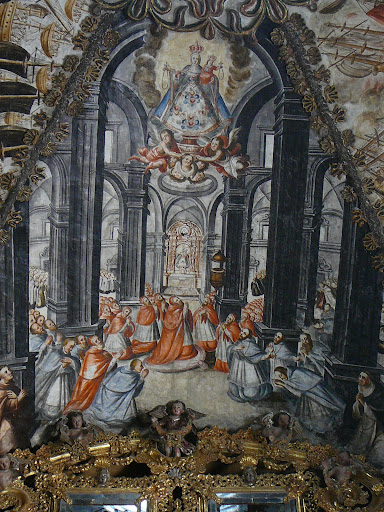
(Pope Pius V Praying to Our Lady Mexico_San_Miguel_de_allende_atotonilco_chapel_of_the_rosary)
Sources : Tradition in Action and TFP
Our history lesson today covers one of the greatest naval battles in history; The battle of Lepanto.

(Please Click on Picture to see a large image of it. Mexico_San_Miguel_de_allende_atotonilco_chapel_of_the_rosary)
When Saint Pius V ascended the Papacy in 1566, Christendom faced perils both internal and external. One of the greatest external threats came from the agitated and violent followers of Mohammed. All the information and intelligence that Pope Pius V had been gathering indicated that the Ottoman juggernaut was about to roll across the Mediterranean and adjacent lands, spearheaded by the Turkish fleet. Its target was Italy and Rome. No nation could stand up to the marauding infidels and the candidates for an alliance were few. Northern Europe had risen up in armed rebellion against the Church with France deeply involved in the conflict, this was a part of the internal struggles in the Church. The Ottoman Empire felt that neutrality was the best policy after the Turks occupied a large chunk of its land in the Danube River Valley.
Only Spain and Venice had the resources to resist, and they hated each other with a deep mistrust. Yet Saint Pius through means of prayer forged an alliance with them as the core of an organized fleet of over 200 galleys. With his considerable tact and diplomatic skills, he not only kept them unified, but he convinced them to attack the enveloping menace.
A Christian naval fleet was assembled under the overall command of Admiral Don John of Austria. Although just in his twenties, Don John was a capable naval commander. The Spaniards were led by Santa Cruz, the Genoese by Andrea Doria, and the Venetians by Agostin Barbarigo and Sebastian Veniero. The fleet under Don John's command was some 300 ships strong, with over 100 ships and 30,000 men being supplied by Philip II of Spain alone. The Pope personally outfitted and supplied 12 Papal galleys, and provided funding for many of the others as well. The Venetian contingent was around 100 ships, manned in part by additional Spanish soldiers. In the Venetian fleet there were six galleys. Heavier, broader, and much slower than conventional galleys, they were nonetheless technologically advanced - the heavy gun platforms and battleships of their day. All total, over 50,000 men served the fleet as rowers, and another 30,000 were fighting soldiers.
In September of 1571, Don John moved the Catholic fleet East to intercept the Turks at Corfu, but the Turks had already landed, terrorized the population, and then moved on. While anchored off the coast of Cephalonia, news reached Don John that the Christian stronghold at Famagusta on Cyprus had fallen to the Turks, with all prisoners being tortured and then executed by the Moslems.
Don John then pulled up anchor and moved to engage the Turkish fleet in the Gulf of Lepanto, off the southern coast of Greece. The Turkish fleet, some 330 ships strong, under the command of Ali Pasha, had been reinforced by Uluch Ali, the Bey of Algiers, and head of the notorious band of Moslem corsairs (pirates) that had long terrorized Catholic ships in the Mediterranean.
On the night of October 6, with a favorable wind behind him, Ali Pasha moved his fleet westward toward the mouth of the Gulf of Patras to intercept the approaching ships of the Holy League.
At dawn, on October 7, 1571, the two fleets met. Don Juan split his fleet into three sections: on the left (north), the Venetians under Agostin Barbarigo; on the right (south), Andrea Doria led the Genoese and Papal galleys; in the center, Don John commanded his flagship and galleys. Santa Cruz, with a force of 35 Spanish and Venetian ships, was held in reserve. He ordered his captains not to fire until 'close enough to be splattered with Moslem blood.' The iron rams were removed from the Christian ships, as the plan was for boarding and close quarter fighting. Two of the large Venetian galleasses were towed into position in front of each of the three Christian divisions.
Ali Pasha's fleet approached in a giant crescent formation, and seeing the opposing fleet, he also ordered his fleet split into three divisions. Ali Pasha himself took up the middle position opposite Don John, and charged forward to engage Don John's ships. The Venetian galleasses opened fire, and almost immediately eight Moslem ships were hit and began to sink. The Catholic galleys, their decks filled with soldiers, opened fire with arquebuses and crossbows as the Moslem ships drew alongside. Ali Pasha's men attempted to board the Catholic ships, but the Spanish soldiers were experienced and well disciplined. Attack after attack was beaten back with deadly shots from their crossbows and arquebuses.
Don John ordered the ship of Ali Pasha to be boarded and taken. Two times the boarding attack of the Spanish soldiers was beaten back, but on the third attempt they swarmed over the deck, now awash in blood, and took the ship. Ali Pasha was captured and beheaded on the spot (against the wishes of Don John), and the Battle Flag of the Ottoman Fleet came down off the mainmast. The head of the Turkish admiral was spitted on a long pike and raised on high for all the enemy ships to see. The Turkish attack in the center collapsed, and Don John sent his ships in pursuit of the retreating Turks, and also turned to aid in the battles raging on his flanks.
On the Catholic right, Uluch Ali and his pirates had broken through Doria's lines and managed to capture the flagship of the Knights of St. John. Santa Cruz, seeing what had happened, came up to the rescue, and Uluch Ali was forced to abandon his prize. The Genoese were in a fight for their lives with the remainder of Uluch Ali's ships, but after Don John had broken the enemy fleet in the center, he turned and came to the aid of the Genoese. The Algerian corsairs were finally overcome, and fled for their lives in full retreat.
Admiral Mahomet Sirocco, commanding the Turkish right (on the Catholic left), sailed close to the rocks and shallows on the northern shore of the gulf and was able to outflank Barbarigo's Venetian galleys. Barbarigo's flagship was surrounded by eight enemy galleys, and the Catholic Admiral fell dead from Turkish arrows. His flagship was taken for a time, but aid finally arrived, and Sirocco's flagship galley was sunk. The Turkish admiral was yanked out of the water, and, like Ali Pasha, killed right on the spot.
The engagement lasted, all total, around four to five hours. When it was all over, 8,000 men who had sailed with Don John were dead and another 16,000 wounded. The Turks and Uluch Ali's corsairs had over 25,000 dead, and untold thousands more wounded and captured. Over 12,000 Catholic galley slaves had also been rescued from the Moslems. The Venetian galleasses had taken a heavy toll on the Turkish fleet. It was a major victory for the Holy League and Christendom.
During this battle, Pope Pius V, a Dominican prelate before his elevation, did what Catholics have always done in times of acute danger: fly into the arms of the most powerful Mother of God. He ordered all monasteries and convents in Rome to increase their prayers for the impending battle and organized rosary processions in which he, as sick as he was, participated.
As the Christian fleet sailed toward the great clash of cultures, Mass was celebrated and the rosary recited daily on each vessel. This heartfelt request for divine assistance resulted in a crushing defeat of the Ottomans at Lepanto that ended their dominance in the Mediterranean.
At dawn, on October 7, 1571, as recorded in the Vatican Archives, Pope Pius V, accompanied by a group of the faithful, entered the Basilica of Santa Maria Maggiore to pray the Rosary and ask Our Lady to intercede for a Catholic victory. The prayers continued in Rome as the Catholic and Moslem fleets battled far away in the Gulf of Lepanto. Later in the day, the Pope is said to have suddenly interrupted his business with some Cardinals, and looking up, cried out,
"A truce to business! Our great task at present is to thank God for the victory which He has just given the Catholic army."
The Pope, of course, had no way of knowing that the battle was taking place and being decided on that very day.
To celebrate Our Lady’s intercession, the Church has designated October 7 as the Feast of the Holy Rosary and Saint Pius V added Help of Christians (Auxilium Christianorum) to the Litany of Our Lady (Loreto).
(Pope Pius V Praying to Our Lady Mexico_San_Miguel_de_allende_atotonilco_chapel_of_the_rosary)
Sources : Tradition in Action and TFP
Subscribe to:
Posts (Atom)


