Today we celebrate the feast of St. Catherine of Alexandria. Let us contemplate what Dr. Plinio has to say about this saint.
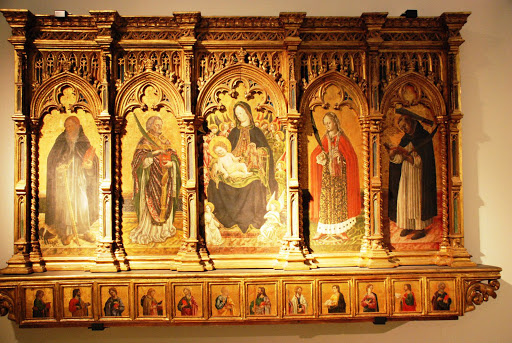
(
Torchiara Polyptych. 1462 Madonna and Child and Angels, St. Nicodemus, St Catherine of Alexandria, and St. Peter. On the predella, the twelve Apostles.)Biographical SectionAfter the unsuccessful attempt to kill St. Catherine on the wheel, Emperor Maxentius ordered her to be beheaded. She was conducted to the place of her martyrdom followed by a multitude, mainly ladies of high condition who wept at her fate. The virgin walked with a great calm. Before dying she said this prayer:
“Lord Jesus Christ, my God, I thank Thee for having firmly set my feet on the rock of the Faith and directed my steps on the pathway of salvation. Open now Thy arms wounded on the cross to receive my soul, which I offer in sacrifice to the glory of Thy Name.
“Forgive the faults I committed in ignorance and wash my soul in the blood I will shed for Thee. Do not leave my body, slaughtered by love for Thee, in the power of those who hate me. Kindly regard this people and give them the knowledge of the truth. Finally, O Lord, in Thy infinite mercy exalt those who will invoke Thee through me so that Thy name be always glorified.”
After saying these words, she told the soldiers to execute their orders, and she was beheaded with but one blow of the sword. It was November 25 (around the year 310).
Soon numerous miracles began to take place. Her body, as she had asked, was carried away by Angels and buried on Mount Sinai so that she might rest where God had written on stone His law, which she had so faithfully kept written on her heart.
Comments of Prof. Plinio:This excerpt from the life of St. Catherine of Alexandria is so elevated that I lament commenting on it. It would be better to leave it shining alone on the horizon. But since I am asked to analyze it, I will say some words.
The first thing that occurs to me is the good position of the ladies of high society of those times. Today, such ladies often form a network that slanders and disparages the good cause. What a great potential there was in that country, where the ladies of high condition followed St. Catherine to the place of martyrdom, weeping for her, sympathetic for her, a martyr whose life would be snuffed out by the Emperor’s hatred. The Emperor was omnipotent; he could condemn any of them to death; notwithstanding they were there with St. Catherine.
It is beautiful to see the contrast of spirits in the picture and the different graces the Holy Ghost was giving. The ladies were weeping, probably touched by the gift of tears. But St. Catherine did not weep, she was calm, serene, and walked unswervingly toward death, inundated by another kind of grace of the Holy Ghost. She did not weep over her own situation, that martyrdom which grace moved the others to lament. One can imagine how impressive it was to see that cortège of ladies walking between aisles of soldiers and then to find that the only one who was serene, counseling the others to be tranquil, was St. Catherine, who was shortly to die.
Then, before her life ended, she said a prayer. It has the beauty of shining lights that fill the skies and emanate from many places. They do not come from just one source, from one central idea.
So, she began: “Lord Jesus Christ, my God.” Even as the Emperor tried to oblige her to adore the idols, she affirmed the divinity of Our Lord to show that she did not recognize any other god but Him.
The next thing she said, “I thank Thee for having firmly set my feet on the rock of the Faith and directed my steps on the pathway of salvation.” That is to say: I thank You for making me belong to You, the source of my salvation. You are the origin of every good that exists in me. I am good because You are good and gave me the solidity of the Catholic Faith; You made me love virtue and gave me the firmness to practice it. I recognize that everything that exists in me came from You.
She continued: “Open now Thy arms wounded on the cross to receive my soul, which I offer in sacrifice to the glory of Thy Name.” Nothing more beautiful can exist! She asked her Crucified Lord to open His bloodied arms to receive her soul as she left this life, which also saw its earth soaked with the blood of her martyrdom. What a marvelous intimacy! What an encounter: the Martyr of martyrs Our Lord Jesus Christ and this heroic and grandiose martyr St. Catherine of Alexandria! What a magnificent thought, that her blood should intermingle with the blood of Our Lord! What a profound idea of the communion of saints is expressed in such a desire! She had such a great certainty that she would be received into Heaven that she asked Our Lord to embrace her. How admirable such certainty is!
Then she said: “Forgive the faults I committed in ignorance and wash my soul in the blood I will shed for Thee.” She was afraid that she had committed some faults, and she asked to be washed clean by the merit of her martyrdom.
“Do not leave my body, slaughtered by love for Thee, in the power of those who hate me.” After having asked Our Lord to attend to her soul, she asked refuge for her body. You can see the respect she had for her own body, for the sanctity of the body that was her companion in the practice of virtue. And what a magnificent response to this request! Soon after she died, the Angels came and transported her body to the most majestic mountain that exists on earth after Mount Calvary, which is Mount Sinai, where God gave His Law to men.
“Kindly regard this people and give them the knowledge of the truth.” She was no longer thinking of herself, but of the ones she was leaving behind.
“Finally, O Lord, in Thy infinite mercy, exalt those who will invoke Thee through me, in order that Thy name be always glorified.” She was so certain that she would go to Heaven that she was already interceding for those who would pray to her.
Once this prayer was said, she calmly told the soldiers to carry out her sentence. No trembling, no desire to prolong her life a little more. Also, no precipitation, which sometimes is a reflection of fear. No. She said everything she wanted to say, and when she finished, she delivered herself into the hands of God. The soldiers beheaded her, and immediately afterward, her prayer started to be answered.
What grace should we ask of St. Catherine of Alexandria? We should ask her that when the chastisement predicted in Fatima will be realized and we face the enemies of the Church and Christendom, that we have the same serenity she had in face of death. It is a serenity that only grace can give. In face of death, there are two kinds of serenity: one is the serenity of the idiot, another is the serenity that comes from grace. Death, the separation of the body and soul, the apparent plunging into nothingness, is such a terrible thing that only two kinds of serenity are comprehensible: that of the idiot who never measures the consequences of anything, or the serenity of the man inundated by grace.
So then, let us ask St. Catherine to help us be calm in every situation in our lives, and especially in the risks and dangers of life, and even in the extreme sacrifice of death, if that should be the will of Our Lady for us.
 (Michelangelo Merisi da Caravaggio - St Catherine of Alexandria)


