Thursday, April 28, 2011
The Church and art - Pope John Paul II
(Giotto di Bondone - Last Supper - Cappella Scrovegni padua 1304-06)
Art too in all its manifestations - and to these must be added the potential offered by the cinema and television - has humanity as its fundamental theme: the human image, human truth. Though appearance may often be to the contrary, even contemporary art is cognizant of these deep-down assertions and demands. The religious and Christian origin of art is by no means exhausted. Themes such as guilt and grace, deceit and liberation, injustice and justice, compassion and freedom, solidarity with and love for one's neighbor, hope and consolation, all have their place in today's literature, in text-books and film scripts, and get ample feed-back.
Collaboration between the Church and art regarding humanity is based on the fact that both seek to set humanity free from slavery and want it to become self-aware. They open the way to freedom for humanity: freedom from the pressures of needs, of productivity at any cost, of efficiency, of programming and functionalism.
Sunday, August 15, 2010
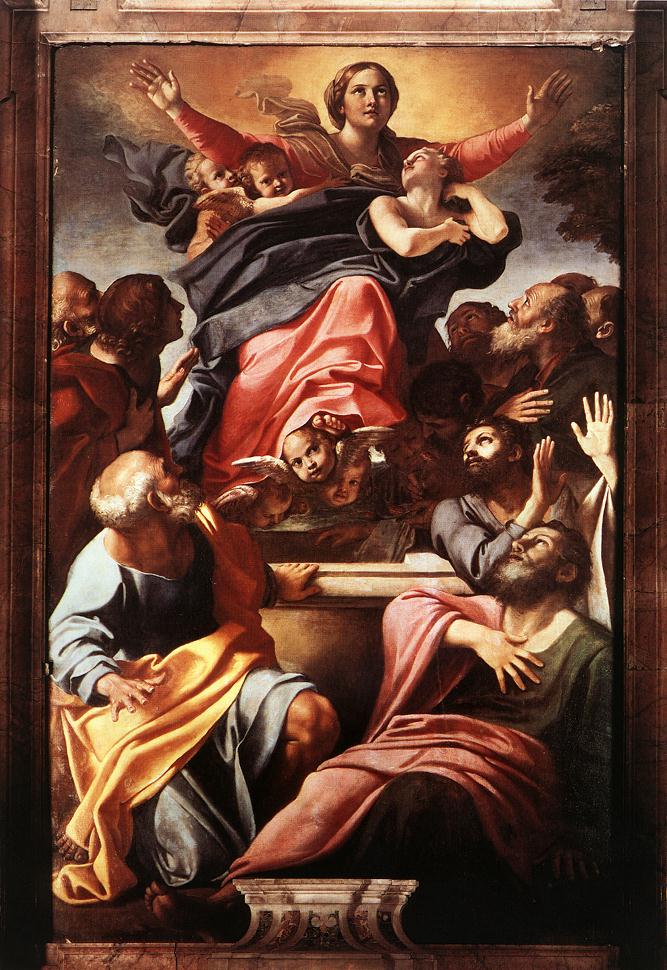
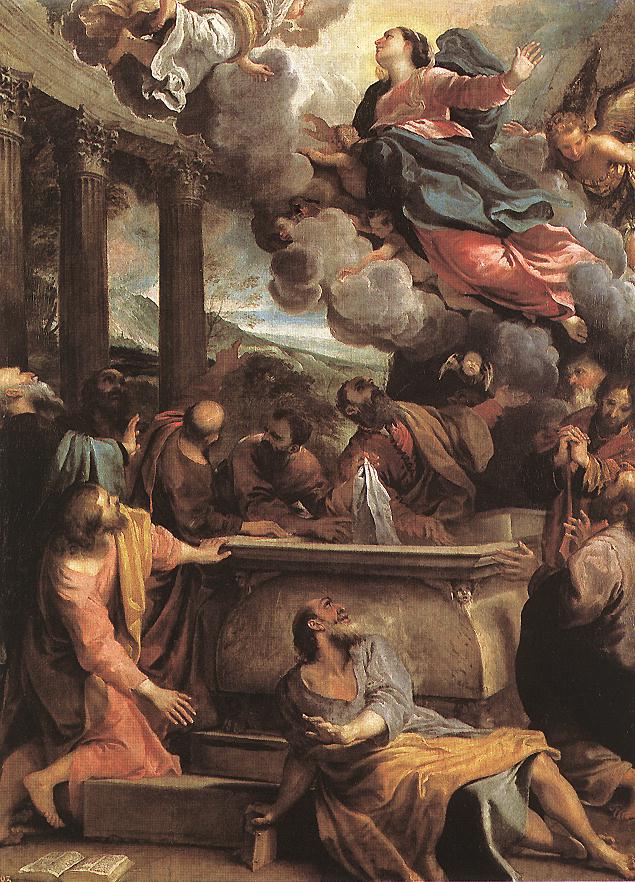
Paintings of the Assumption of Our Lady
Bernardo Daddi, The Assumption of the Virgin
Aussumption Of the Virgin - Fra Angelico
Assumption of the Virgin - Correggio
Assumption of the Virgin - Annibale Carracci
The Lady of the Assumption Gives St. Thomas Her Belt - Bartolomeo della Gatta
According to the one section of the Golden Legend, "St. Thomas was not there [at the Assumption], and when he came he would not believe this. And anon the girdle with which her body was girt came to him from the air, which he received, and thereby he understood that she was assumpt into heaven."
The flowers in the sarcophagus and the musical instruments refer to the "marvellous odour" and "voice of angels" that another section of the Legend describes at the time of the Assumption.
Bartolomeo intended the two figures in the foreground as St. Benedict and St. Scholastica, but when the painting came into the possession of the Servants of Mary they had the figures repainted to represent two of their own saints, Filippo Benizzi and Giuliana Falconeri.
Sunday, April 4, 2010
Sunday, December 27, 2009
Baby Jesus and Baby St John the Baptist
Saturday, May 30, 2009
Saturday, May 23, 2009
Friday, May 22, 2009
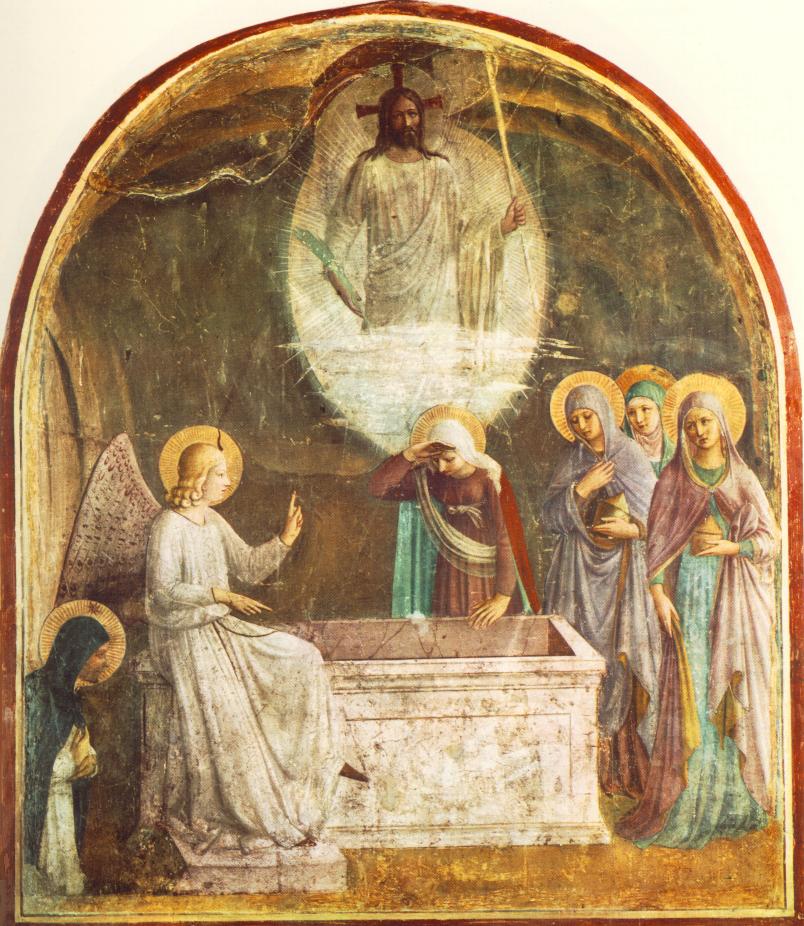
Painting of the Crucifixion, Resurrection and Ascension of our Lord
Thursday, May 21, 2009
Ascension painting by Giotto
Let us today admire this fresco by Giotto di Bondone as we prepare our hearts for this Feast.
Saturday, April 25, 2009
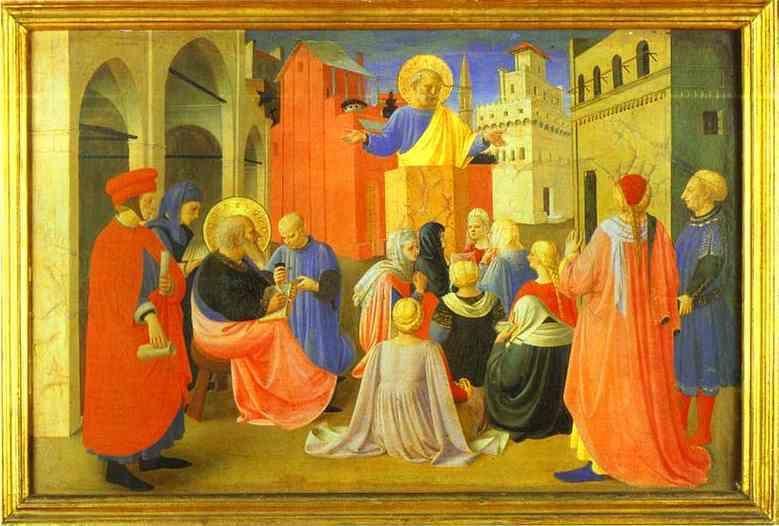
Fra Angelico - Linaiuoli Tabernacle: Peter Preaching with Mark
As today is the feast of St Mark let us enjoy this painting by Fra Angelico. The details of the image is Fra Angelico. Linaiuoli Tabernacle: Peter Preaching with Mark. Predella. 1433. Tempera on panel. 39 x 56 cm. Museo di San Marco, Florence, Italy.
Thursday, January 29, 2009
The Annuciation - Fra Angelico
(Fra Angelico. Altarpiece of the Annunciation. c. 1430-1432. Tempera on panel. 194 x 194. Museo del Prado, Madrid, Spain.)
This is the Annunciation, Our Lady has already given her Fiat to God as you can see the golden rays indicate her being overshadowed by the Holy Spirit. The Angel Gabriel is waiting with eyes bowed low for the Mother of God to say but one word and the Angel is ready to obey Her. God the Father looks down on them in approval. Notice how colourfully dressed our Lady is as well as the angle. They reflect the colourfulness of heaven and in their faces one sees the joy of heaven.
Notice in the top left corner, St Michael the Archangel is leading Adam and Eve out of the garden. The garden is lush in greenery, St Micheal is sad as he assists them out of the garden, He knows what is to happen to man. Adam and Eve themselves are sad becasue they know that things have changed and they are aware of what they have lost. notice that their clothes are grey and sad, unline the angels and the mother of God.
Lastly notice Angel Gabriels wings are a bit outside, indicating that while he is with Mother Mary he is also outside in the world doing what She tells him to do (distribute God's graces). I personally love the look on Angel Gabriels face
Monday, January 19, 2009
Fra Angelico
Fra Angelico was a Dominican, and a mendicant, so, not being part of a closed order, he was free to meet and talk to others in the city. In 1420-1422, he entered the convent of San Domenico in Fiesole with his brother Benedetto. It was here that he produced his first works: altarpiece for the high altar, Altarpiece of the Annunciation, The Coronation of the Virgin, as well as the frescoes for his monastery.
Fra Angelico not only gained recognition as a painter, but must have commanded respect in his convent because he was appointed Vicario for the first time in Fiesole from 1432/33, a post he was to hold frequently in later years.
In the 1430’s the painter worked in Florentine churches. He carried out the following commissions for the Dominicans in Cortona: the Cortona Triptych and the Annunciation panel. From 1438, he worked on his most important commission, the San Marco Altarpiece and the frescoes for the convent of San Marco in Florence.
In July 1445 Fra Angelico was summoned by Eugenius IV to Rome, where he painted frescoes in the chapel of Santissimo Sacramento, which was later destroyed under Pope Paul III. For Eugenius’ successor, Pope Nicholas V, he painted the frescoes of St. Stephen and St. Lawrence between 1447 and 1449 with the assistance of Benozzo Gazzoli (1420-1497), in the Capella Niccolina in the Vatican, named after the Pope who commissioned the frescoes.
In the summer of 1447, he began work on the frescoes in the Capella di San Brizio (10), in the cathedral at Orvieto. These were competed by Luca Signorelli fifty years later. From 1450-1452, he returned to his old convent in Fiesole as Prior, before going for one last time to Rome, where he died on 18 February 1455. He is buried in Santa Maria sopra Minerva, where his grave has always drawn worshippers. After his beatification by Pope John Paul II in 1984, the headstone was placed on a plinth and surrounded by a bronze grille with floral motifs. His feast day is 18 February, the day of his death.
Sunday, January 18, 2009
Catholic Art
(The Virgin and Child by Rouault)
Indulge in an exercise of fantasy, and suppose that by rewinding the thread of bygone centuries it has become possible for you to return to the time of Christ and walk into a room of the Holy Family's humble dwelling in Nazereth.
Obviously not.
In order to illustrate these affirmations better, look at the painting by the Maitre de Moulins (fifteenth century), which also portrays the Virgin and Child, and consider how efficacious it is in helping us understand, through the senses, what the Church teaches about Jesus and Mary.