Evil triumphs when good men do nothing - Edmund Burke
Showing posts with label Protestantism. Show all posts

Tuesday, May 26, 2009

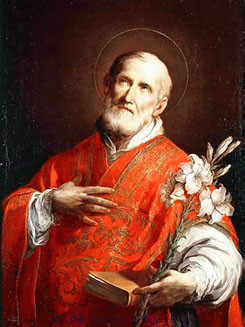
St. Philip Neri - 26th May 2009

Let us read what Dr. Plinio has to teach us about St. Philip Neri


Biographical selection:

Phillip Neri (1515-1595) was born in Florence of a noble but impoverished family. He studied theology and philosophy and dedicated himself to apostolic works from his youth. Eventually he set aside his studies and founded a society to care for the sick and poor pilgrims in Rome.

He was ordained a priest in 1551, and founded the Congregation of the Oratory, the Oratorians, a group of priests dedicated to preaching and teaching. He was a great mystic, who received the gifts of prophecy and discernment of spirits. He could read the souls of penitents, and heard confessions by the hour. He was canonized some 25 years after his death along with St. Ignatius of Loyola, St. Teresa of Avila and St. Francis Xavier.

The religious crisis that took so many provinces from the Catholic Church deeply afflicted St. Phillip Neri. He suffered cruelly to see so many people being drowned in the waves of heresy. He attentively followed the maneuvers of Protestantism and planned a counter-attack against a Lutheran work of propaganda, the Magdeburg Centuries. This vast compilation was written to persuade readers that the Catholic Church had abandoned her early beliefs and practices. The multi-volume collection was filled with historical falsifications to “prove” its goal.

To counter this fabrication St. Phillip wanted a complete work of erudition to be written on the History of the Church from the time of Our Lord Jesus Christ up to his own time. He ordered the work to be done by Cesar Baronius, an Oratorian who would succeed him as Superior of the Oratory in 1593 and made a Cardinal in 1596.

Baronius alleged that he was unworthy and lacked the competence for such a great work; but St. Phillip was inflexible and ordered him under religious obedience to undertake the project. He spent close to 30 years to write it (1588–1607), covering the time up to the 12th century. This collection was called Ecclesiastical Annals. It was completed after his death.

The heresy felt the blow. The errors of the anti-Catholic Magdeburg Centuries became evident as the work of Baronius eclipsed it. The Ecclesiastical Annals contributed powerfully to stem the growing tide of Protestantism in Europe. From Baronius' work the Catholic Church emerged as she had always been, as the pillar of truth.

Comments of Prof. Plinio:

St. Phillip Neri was a man with a universal Catholic sense. He was not just interested in realizing a personal work, which certainly was important – the foundation of the Congregation of the Oratory – but he had a general concern for the Catholic Church as a whole. He was personally offended by Protestants attacking the Church through a work that was meant to be monumental – the Magdeburg Centuries. Actually it was a monumental lie. The Protestants, as heretics who hated the Church, fabricated another history of the Church full of untruths and slanders, with the specific purpose of denigrating the good name of the Catholic Church and separating her from the faithful.

These Protestants were from the same family of souls as the Pharisees, who produced false witnesses to condemn the Lamb of God. Analogously, in the beginning of the Church, groups of Jews moved by hatred against her spread many apocrypha documents – false gospels or epistles attributed to the Apostles – in order to confuse Catholics and induce them toward heresies. Until today, from time to time, the discussion of the apocrypha documents resurfaces trying to sabotage the Gospels.

Also after Protestantism, and in its wake, some authors of the Encyclopedia spread countless lies regarding the past of the Church. This in many ways was continued by Michelet in the 19th century. Today, these revolutionary authors lost credibility and their lies are universally recognized in scholarly milieus, even though they still influence badly those who do not have access to good historical sources. So, it was and still is a rule of the enemies to falsify history in order to slander Holy Mother Church.

When St. Phillip Neri saw the evil results that the Centuries of Magdeburg was having by favoring the spread of Protestantism, he decided to counter-attack. He chose the only way possible which was to make a gigantic work of erudition. A work using the best documents dating from the very beginning of the Church up to his own time, that would present the incontestable reality of the facts. To do this work he chose one of his most capable disciples, Baronius. After some hesitations Baronius dedicated some 30 years of his life to this job and the result was the Ecclesiastical Annals, one of the most serious works of all times. The work of Baronius stands forever as a point of reference for any serious historical study. His work pulverized the supposed “scientific” work of the Protestants who were left completely discredited.

The root of this work was St. Phillip Neri's amplitude of vision, his love of the Church, and his counter-revolutionary zeal.

An analogous work was made by Fr. Cornelius a Lapide from the Society of Jesus. He received an order to study all the interpretations of the Sacred Scriptures that existed, analyze them, refute the wrong ones, explain the good ones and give the best sources for each of them. Again, it was a counter-revolutionary work to destroy the pseudo-scientific Protestant interpretations which were polluting the atmosphere of piety and studies in the 16th and 17th centuries. Fr. Cornelius a Lapide wrote his monumental Commentaries to the Sacred Scriptures encompassing all its books from Genesis to the Apocalypse. To this date it is one of the most – if not the most – complete ensemble of Exegesis that the Catholic Church has. It is an everlasting source of erudition and piety for historians, preachers, and faithful in general.

Let us ask the great counter-revolutionary St. Phillip Neri to give us conditions to imitate him, hurting the Revolution at its head so that it can be completely destroyed and the Reign of Mary be established over its ruins.

Friday, October 10, 2008

St. Francis Borgia - 10th October 2008

Today we celebrate the feast of St. Francis Borgia. Lets us contemplate the life of this saint through the words of Dr. Plinio Correa.


(The adoration of the Eucharist in the hands of St. Francis Borgia is the subject of one of the quadrants of the dome of the Gesù.)

Biographical selection:

For the Church, the 16th century was a dolorous epoch. The rebirth of Paganism, the spread of Protestantism and then Jansenism devastated Catholic Europe, while Islamism became an arrogant and menacing danger. In Golkun, Holland, 40 Catholics were martyred; in England St. John Fisher and St. Thomas More were beheaded, and Blessed Ignatius of Azevedo along with his 39 blessed companions were massacred by the Calvinists on their way to Brazil.

To remedy so many evils, Divine Providence raised up saints all over Europe. In Spain, St. Ignatius of Loyola, St. Francis Xavier, St. John of the Cross, St. Therese of Ávila, St. Peter of Alcantara, St. Paschal Baylon, and St. Thomas of Villanova carried out spiritual reforms that encompassed all Christendom. Others, such as St. Charles Borromeo, St. Felipe Neri, St. Peter Canisius, St. Francis of Paula, St. Jerome Emilianus and the great St. Pius V spread light over Christendom in their fight against the darkness of heresy.

During that stormy century, St. Francis Borgia shone for his nobility, virtue, and combativeness in Catholic Spain. He was born in Valencia into a family of royal blood that was related to the principal reigning houses of Europe, including that of Emperor Charles V. When Francis Borgia entered his service and came to court at age 17, the Emperor was so impressed by his noble and modest behavior that he determined to keep Francis always at his side. Charles V maintained this admiring friendship all his life.

After he became a widower, however, Francis Borgia made the decision to enter the Society of Jesus. St. Ignatius advised him to ask the Emperor’s permission. Since Charles V was in the Netherlands, Francis addressed a letter to him there. The Emperor replied with these words:

“I am very sorry to lose the company of a man of your merit, a shining light of counsel, a model in the exercise of the highest offices of State, and, because of your virtue and piety, a factor of edification for all my court. But I recognize that it would be unreasonable to dispute over you with the Master you have chosen to serve. It is, therefore, with sorrow that I grant you the permission you are requesting. I authorize you to renounce your fiefs and titles in favor of your firstborn son.

“The number of those who will envy you will be greater than those who will imitate you, since it is easy to admire beautiful examples, but difficult to follow them. I recommend myself to your prayers and I count upon you to attract divine blessings over me, my States, and all Christendom.”

After holding the office of Superior of the Society of Jesus in Spain, Portugal and the West Indies, St Francis Borgia was elected the third General of the Order when Fr. Laynes died in 1560.

One of the first tasks he faced was that of refuting and fighting the calumnies that the Lutherans and other enemies of the Church were spreading about the Society of Jesus in attempts to bring it to ruin. They were trying to stimulate dissension between the Dominican Order and the Society of Jesus. When Cardinal Alessandrini, a Dominican, was elected Pope, a member of the College of Cardinals tried to influence him to suppress the Jesuits. St. Pius V answered:

“God preserve me from so great a sin. The Lord wants to use these priests for His glory. Their Society is called to produce great fruits for the Church.”

The next day St. Pius V was to be crowned Supreme Pontiff at the solemn ceremony in the Basilica of St. John Lateran. He was carried in the gestatory chair followed by all the dignitaries of the Roman Court. An enormous multitude filled the streets. When the cortege arrived in front of the House of the Society of Jesus, the Pope ordered it to stop. St. Pius V called for St. Francis Borgia, who respectfully approached. The Pope embraced him and offered his friendship and support for whatever he would need. He also thanked him for the service the Order had already given to the Church and expressed his warmest wishes to see their members work for the glory of God and the salvation of souls. The cortege then continued on its way.


Comments of Prof. Plinio:

This selection has two distinct parts. The first is a brief description of the life of St. Francis Borgia when he was a layman, and the second presents an episode from his government as General of the Society of Jesus.

To evaluate the biographical data in this selection, one needs to consider the general panorama of the times. His Sovereign was Charles V, Emperor of the Holy Roman and German Empire. He was Emperor, and also King of Hungary, King of Bohemia, Lord of numerous Italian territories, and King of Spain, and, therefore, of the Spanish colonies spread all over the world. It was at this time that it became common to say that the sun never set on his Empire. That is, when the sun was rising in one part of his Empire, night had not yet fallen in another. There was always daylight within the domains of his Empire.

He was one of the most powerful Monarchs in History. The 16th century was certainly already a decadent century in comparison with the Middle Ages, but it was not that distant from those blessed centuries, and many of its values were still alive at that time. One of these values was that people still appreciated justice more than power. It was generally recognized that Charles V, as Emperor, deserved the most honor and reverence. The Emperor of the Holy Roman Empire was considered the natural head of all Christendom, superior to all Kings. Above him was only the Pope.

St. Francis Borgia was a man of high lineage who descended from a royal family that had reigned over Valencia. The different kingdoms of Spain had united to face the Moorish invasion, and even though many of those royal families no longer had thrones, they were still very highly considered. St. Francis Borgia was a descendent of one of those families, which still had fiefs. His situation was similar to that of a prince.

As a youth he was sent to Charles V’s court. Since it was the highest court in the world, it attracted countless men of value: nobles, personages, famous artists, financial magnates, reputed diplomats, and brilliant military officers. It was a gathering point for the best of Europe. Over all them was the Emperor, who successfully ruled over his numerous Kingdoms. Into this extraordinary scenario an adolescent of 17-years entered. He was so remarkable that he attracted the attention of the Emperor. That is to say, he stood out among those countless princes and outstanding men who were there vying for the Emperor’s attention.

The selection tells us that he was very noble and modest, which means he possessed a great superiority and dignity in manners. We should not think of modest in the modern sense of the term, as describing a man who is trying to flee social life. Rather, the word would retain its old-fashioned meaning, coming from modus – that is, someone who had distinguished and reserved manners in his way of being.

The sanctity of St. Francis Borgia attracted the Emperor so much that he wanted him always near to give him counsel. St. Francis was Duke of Gandia, which he governed. He married and founded a large family with many descendants. That is, he had many temporal matters to deal with on a daily basis.

In 1539 the wife of Charles V, Empress Isabel, was struck with fever and died. As the Marquis of Lombay, Francis Borgia was required to head the funeral cortege to Granada, where a Requiem Mass was sung and official identification of the body made before burial. When Francis opened the coffin and lifted the cloth from the face of the dead Empress, the cadaver had already beginning to deteriorate. This sight made a strong impression on St. Francis Borgia, who realized the futility of all the glories of the world. He resolved to abandon them and ask St. Ignatius to enter the Society of Jesus.

One condition that St. Ignatius made was that he must obtain the Emperor’s permission. Then Charles V wrote him the beautiful letter we just read. It is a high eulogy of St. Francis Borgia, which ended with the line that expresses well the spirit of the time: Many people will admire you, but only a few will follow you.

This explains the difference between that time and the Middle Ages. In the Middle Ages, many admired the good examples, and many followed them. In the time of Charles V, many admired the good examples, and just a few followed them. Today the good examples are neither admired nor followed. You have here the different steps of the Revolution.


St. Francis Borgia entered the Society of Jesus and became its General. There was a rivalry between the two Orders: the Dominicans and the Jesuits. The enemies of the Church were interested in destroying the Society of Jesus because of its more zealous combativeness against the Protestants. So they stimulated rumors and calumnies that were spread against the Jesuits. When St. Pius V, a Dominican, was elected Pope, those same enemies found ways to influence Vatican ecclesiastics, who immediately tried to maneuver the new Pope to close the Jesuits. Instead, St. Pius V planned a way to do the opposite, to confer added prestige to their Order.

You know that until Paul VI, the Popes used the gestatory chair, which was a portable throne for the Pope carried on the shoulders of a dozen men so that the Pontiff could be seen by all the public. That custom, which began in the early days of the Church, was enriched as time passed with a ceremonial cortege and trumpets.

St. Pius V resolved to break the long established protocol of the cortege of coronation. He did so, stopping its progression in front of the House of the Jesuits and calling for St. Francis Borgia, who most probably was standing outside with the other directors of the Society of Jesus waiting for the Pope to pass.

You can imagine the scene: St. Pius V a man who had been Inquisitor, tall, thin, with a great sharp nose like an eagle, already advanced in years, sublime, approaching the highest phase of his life where he would shine brilliantly as the militant Pope who broke the Muslim power at the Battle of Lepanto. St. Francis Borgia, General of the Society of Jesus, with the air of a grand-seigneur beneath his Jesuit cassock. St. Francis Borgia approached the Pontiff with respect and admiration, venerating the Saint whom God had sent the world to be the Pope of the Church. He knelt before him, and St. Pius V bent to embrace him. Then they exchanged some words.

St. Pius V said that he loved the Society of Jesus with all his heart, that he wished every good for its priests, and that he considered himself its protector. His only desire was that the Society of Jesus fight for the glory of God. St. Francis Borgia thanked the Pope and promised the complete fidelity of the Order to St. Pius V and the Papacy.

Then the cortege continued on. St. Francis Borgia and his Jesuits entered the Church of Gesù, next to the Jesuit house in Rome, to make an act of thanksgiving before the Blessed Sacrament. What splendor, what an exquisite perfume emanates from the encounter of those two saints!

I think it is legitimate for us to turn our eyes from the contemporary epoch – filled with corruption and treason – to end the day admiring the encounter of those two saints. That encounter, the words they exchanged, and their mutual admiration for one another express something of the supreme happiness we will have in Heaven.

Let us ask St. Francis Borgia to give us his Catholic spirit, which impressed everyone in his life, including Emperor Charles V, and his dedication to the Papacy, which was the main characteristic of the Society of Jesus in its first times.


(God, Francis Xavier, Francis Borgia, and Ignatius Loyola are the subjects of the quadrants of the dome. Note the railing below and high up a part of the name of Alessandro Farnese, a cardinal and Pope Paul III's nephew, whose financial patronage made the Gesù possible.)

Wednesday, September 17, 2008

Feast of Saint Robert Bellarmine - 17 September 2008

We live in an age of liberalism and relativism. Today we celebrate the feast of St. Robert Bellarmine who fought these very issues. Let us read about this saint through the explanations of Dr. Plinio Correa


Since the founding of the Church until our days, Divine Providence has always called illustrious men, who by their knowledge and sanctity have conserved and defended the truths of Catholic Faith against the attacks of heretics.

Among these men shines St. Robert Bellarmine (1542-1621), who was celebrated for his teachings and polemic works as well as for his virtue and zeal for the Church. In truth, it would seem that the holy Cardinal had received from God the threefold gift of teaching the people, guiding the faithful, and confounding the Protestant heretics of the 16th century, a time when Protestantism was growing and spreading.

He was great as a preacher, professor and polemicist, receiving the title of 'hammer of heresies' from Benedict XV. He wrote prodigiously, and to understand the worth of his books one need only read what St. Francis of Sales, his contemporary and friend, said about them: 'I preached five years in Chablais with no other books than the Bible and the works of the great Bellarmine.'

His most famous work is The Controversies, a collection of the lectures he delivered at the Roman College. In it he set out the teaching of the Fathers, the Councils and the Church Law to victoriously defend the dogmas attacked by the Protestants. Clear, balanced, and forceful, this work is so well done that many considered it insuperable. When it was published, it raised as much joy among Catholics as hatred among the Church's enemies. Theodore of Baise, a Protestant leader, used to say: 'This is the work that defeated us.' Given the number of conversions for which it was responsible, reading it was forbidden under penalty of death in England by Queen Elizabeth. Only doctors of theology were permitted to read
it.

Comments of Prof. Plinio:

Permit me to provide another fact from his life: St. Robert Bellarmine was the spiritual director of St. Louis Gonzaga. This alone would be honor enough in the life of a man.

What can be said about St. Robert Bellarmine? He was praised as 'the hammer of heresies.' There was a time, before Vatican II, when this was a great eulogy. Pope Benedict XV granted him this title. Various other great saints who worked considerable damage on the heresies received similar epithets. He wrote many books demonstrating the Catholic truth and attacking the heretics. His arguments were forceful and hard, but they converted many of them.

Theodore of Blaise, an important Protestant leader who succeeded Calvin, was fearful of St. Robert Bellarmine's work. This man had a famous debate with St. Francis of Sales. Elizabeth I, the Queen of England, was also in panic over his works, given the number of conversions they had occasioned. She was so fearful that she decreed that whosoever was not a doctor in theology was forbidden to read his works.

St. Robert Bellarmine understood that one cannot do away with a heresy only by preaching the truth. It is also necessary to attack and smash the error. Using this method he converted heretics, bringing them back into union with the Church. When the Catholic Church canonized him, she approved this method. She said that St. Bellarmine had practiced all the virtues in a heroic degree. Therefore, he acted according to charity, since it is one of the three theological virtues, faith, hope, and charity. He also acted according to justice and prudence since they are included in the four cardinal virtues: justice, prudence, temperance, and fortitude. If his method was wrong, the Church would not have canonized him.

This is an important point to remember, since from the time of Vatican Council II, we have been taught that to attack heresy and heretics is harmful to the union of the churches. According to this conciliar mentality, every work of apostolate should praise and applaud the heretics, and never forthrightly combat their errors. The life of St. Robert Bellarmine proves precisely the opposite.

It is also interesting to note the presence of harmonic contrasts in the life of St. Robert Bellarmine. He was a champion of orthodoxy and a great fighter, but at the same time he was a man able to direct the sensitive soul of St. Louis of Gonzaga, and guide him to sanctity. St. Louis Gonzaga was very pure and so concerned about guarding his chastity that some bad persons close to him spread that he was unbalanced. St. Robert Bellarmine was the one who understood that difficult-to-understand soul, knew how to deal with him and to guide him to become a masterpiece of sanctity.

Therefore, at the same time that he was a very busy polemicist, St. Robert Bellarmine made the time to direct souls and to write profound spiritual treatises that earned him the title of Doctor of the Church. This capacity to revert back and forth from the middle of a fight and the direction of souls, along with maintaining a spirit of meditation to write his books, is only possible when a man has a great calmness of spirit. This calm is, in a certain sense, one of the most profound notes of the soul of St. Robert Bellarmine.

Let us admire such a great saint and ask him to do with each one of us what he did with St. Louis Gonzaga, that is, to lead us on the road of sanctity.

Wednesday, September 10, 2008

St. Thomas ov Villanova - Commentary by Dr. Plinio Correaf

Let us read the commentary of Dr. Plinio Correa about St. Thomas of Villanova.


Comments of Prof. Plinio:

This is not a very easy selection to comment on since it primarily reports facts about St. Thomas of Villanova that are characteristic of many saints. They are admirable and praiseworthy, but a little too generic and repeat what we hear about the others. I limit myself, therefore, to comment on some more distinctive points here and there for our meditation.

First, it is remarkable the fact that Charles V chose St. Thomas of Villanova as a preacher and councilor. He was a person who in many ways directed the conscience of the Emperor. You see the finger of Divine Providence directing this great statesman.

Charles V, Emperor of the Holy Roman German Empire, a man over whose domains the sun never set, was an extraordinarily important man. He continued the vocation of the Hapsburgs of the House of Austria. There is a text by Mary de Agreda describing the designs of Providence for the House of Austria and all the graces God gave the Hapsburgs to fulfill them. It is very beautiful to see how Divine Providence assisted the realization of those designs by sending St. Thomas of Villanova to be the court preacher and councilor to Charles V.

Charles V, we must add with sadness, did not entirely correspond to those plans of God. He had a saint as a councilor, but he was a man whose softness and spirit of tolerance permitted Protestantism to expand in his lands. It is true that he had many different enemies to fight. One of them was the league formed by Muslim Turkey and Catholic France, which also became indirectly responsible for the expansion of Protestantism.

But Charles V had long periods of peace when he could have opposed the expansion of Protestantism. His famous temporizations have made him the subject of strong, objective critiques by Church historians.

But he ended his life well. He left aside all his possessions and goods and retired to a monastery as a penitent. He spent his last years there living a life that edified all Christendom. Did the good counsels of St. Thomas of Villanova finally move his heart? He used to say that St. Thomas had the gift of moving hearts. Did St. Thomas also bend his own heart of iron? It is a point to consider.

Someone could object: Why do you say that he had an iron heart? A man who makes concessions is a soft man and cannot be consider a man with an iron heart.

I would answer that long experience of life has shown me that nothing is harder to change than the heart of a soft man and make him an energetic man. It is harder to make a soft man energetic than to make an energetic man become soft. I think that a saint who could have made Louis XVI lose his softness would have performed a supernatural exploit greater than one who would convince Louis XIV to refrain from using force. So, the change of Charles V, who went to a monastery to make penance, may have been due to a good counsel of St. Thomas of Villanova.

Second, it is interesting to see that St. Thomas had so many ecstasies that he used to speak about them in his sermons. It is admirable to see how he reported, sincerely and nobly, without vanity, the manifestations of grace in his soul from the pulpit. Only a truly superior soul can do this because he understands that grace does not rely on his personal merit but only on the largesse of God.

This attitude is the opposite of a certain Calvinist way of understanding humility that has infiltrated many Catholic milieus. According to it, an individual is proud if he ever praises himself or lets someone else know of his qualities or gifts, because humility would always demand that he hide such things. This is not always true. It is a simplified picture.

I know, of course, that it can be dangerous to tell a person he can praise his own qualities. Often it happens that the person does not have an objective view of himself, but exaggerates his qualities and becomes proud. I know this, and I agree that we must be careful about encouraging this kind of pride.

But this is different from obliging everyone to hide his qualities in the name of humility. You can see in the life of St. Thomas of Villanova how he made a beautiful and natural manifestation of the graces he received and the marvelous things God did in his soul. He could talk about them even in a sermon because he was detached from them and was glorifying God alone, and not himself.

In the richness of the Catholic Church, we can find the models for both the rule, which is to be silent about one’s qualities, and also for the exception, which is to praise one’s own graces and qualities in order to honor God.

This is another beautiful facet of the life of St. Thomas of Villanova.