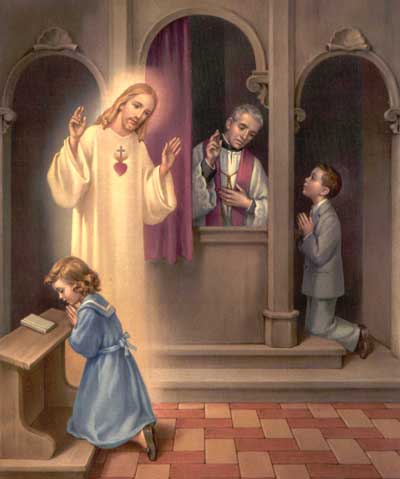
Not so long ago, a cocky individual came to me [SaintJohn Bosco—Ed.] and asserted that he could cite many instances when priests had violated the seal of confession. I replied that even if a priest should betray his ministry, this would not lessen the sanctity of the sacrament. Are we to blame all the Apostles because Judas was a traitor?
Since my opponent insisted that he knew what he was talking about,I said:“I will wager five hundred lire that neither you nor any of your friends can prove even one such case.”
“Fine!” he replied.“Put the money down. I’ll be back here Saturday.”‘Wait,”I said.“I’ve been through this sort of thing before!One fellow said he would return, but he never did.”
“I’ll be back without fail,” the man asserted.“I give you my word of honor.”
Well,I never saw the man again! Nor do I expect to see him because he will never be able to prove his claim. Time and again I have found that those who decry confession have no better arguments than vague allegations.
There is not the slightest doubt that our Faith is being bitterly attacked in these tragic times. Since the forces of evil will fail unless they can first persuade Catholics to give up confession,they will direct their major attacks against this wholesome practice. One who abandons confession, if left to himself,will sink deeper in sin;like a frail plant exposed to the fury of the winds,he will fall into most deplorable excesses. To destroy the very idea of confession,Protestant publications are continually telling Catholics that confession is not of Divine institution and must therefore be rejected.
Meanwhile, deeply grieved by the harm daily perpetrated against the Church,I urge all Catholics to be brave and steadfast in the Faith.Yes,dear fellow Catholics, be brave! Let us cling firmly to the Church founded by Jesus Christ, and to His Vicar, the Pope. Let us hold fast to the Church that has been persecuted through the centuries but has always triumphed.
Showing posts with label Confession. Show all posts
Showing posts with label Confession. Show all posts
Tuesday, April 16, 2013


Friday, May 7, 2010
Confession: manifestation of God's mercy - St. Catherine of Siena
Today is first Friday, If you get a chance to go for Holy Hour, Mass and Benedition, please also try to go for Confession. Let us now read this document by St. Catherine of Siena on Confession
Confession: manifestation of God's mercy
"The soul also receives Baptism in another way, speaking in figurative terms, by special providence of my divine love. I was well aware of human fragility and weakness, that leads human beings to offend me. Persons are not constrained by this nor by any other thing to commit the fault, if they do not wish, but being weak they commit mortal sins, thus losing the grace they received in holy baptism by virtue of the Blood. For this reason it was necessary that Divine Love should make available a continual baptism of the Blood. This baptism comes about through a contrite heart and through confession of sins to a priest, when possible, for they have the keys of the Blood, the Blood the priest pours upon the soul when he absolves the person. If some one is unable to confess, contrition of heart is sufficient. Then my mercy bestows on you the fruit of this precious Blood, but if you can confess I want you to do so, and whoever being able does not confess, will remain deprived of the benefit of the Blood. However, it is true that whoever, at the moment of death wants to confess and is unable to do it, he likewise shall receive the fruit of the Blood. But let nobody be so foolish at life's end, hoping to set his soul in order, because it is not certain that I, due to his obstinacy, may say in consonance with my divine justice: "You did not remember me during your life, when you had time. I do not remember you now at the point of death!"
Let no one procrastinate it, but even if there should be somebody who has wilfully done so, he ought not omit baptizing himself with hope in the Blood even if it were the last day. You see then how this baptism is continual and the soul must be baptized in it until life's end, as I have indicated. Through this baptism you can understand that the torment of the cross ended, but the fruit of this torment, which you received from me is infinite. This is due to my infinite divine nature, united to finite human nature. This human nature suffered in me, Word, clothed with your humanity. Since one nature is joined and kneaded with the other, the eternal divinity brought upon itself the torment which I bore with such ardent love.
That is why this my action can be said to be infinite, not because the torment suffered bodily is infinite, nor the torment of my desire of accomplishing your redemption, which really finished and came to an end on the cross when the soul was separated from the body. But the fruit that sprang from that torment and the desire for your salvation are infinite. That is the reason why you can unsparingly receive this fruit. If it had not been infinite then humanity would not have been redeemed: people of the past, the present and the future. It would not have been possible for persons who sin to be purified from their sins, if this baptism of blood had not been offered without measure, because the fruit of the Blood is infinite.
I showed you this in my open side, where you discover the secret of my heart: namely, that I love you much more than what I could show you with the finite torment. I have shown you that my love is infinite. In what way? With the baptism of the Blood, joined to the fire of my charity, that out of love was poured out; and through baptism, understood in the common sense, given to Christians, to whoever wishes to receive it, baptism of water joined to blood and to fire, in which the soul is kneaded with my blood. To show you all this I wanted blood and water to flow forth from my side. Now I have answered your request."
St. Catherine of Siena, Doctor of the Church: The Dialogue LXXV
Prayer:
Oh God, You showed St. Catharine the infinite love which burns in Your Heart for all Your human creatures. She generously shared this revelation and imitated its consequences to a heroic degree. Grant that we may follow her example, trusting in Your promises and increasing our faith in Your presence in every sacrament, especially in the sacrament of Your forgiveness. We ask this through Christ, Our Lord...... Amen.
Confession: manifestation of God's mercy
"The soul also receives Baptism in another way, speaking in figurative terms, by special providence of my divine love. I was well aware of human fragility and weakness, that leads human beings to offend me. Persons are not constrained by this nor by any other thing to commit the fault, if they do not wish, but being weak they commit mortal sins, thus losing the grace they received in holy baptism by virtue of the Blood. For this reason it was necessary that Divine Love should make available a continual baptism of the Blood. This baptism comes about through a contrite heart and through confession of sins to a priest, when possible, for they have the keys of the Blood, the Blood the priest pours upon the soul when he absolves the person. If some one is unable to confess, contrition of heart is sufficient. Then my mercy bestows on you the fruit of this precious Blood, but if you can confess I want you to do so, and whoever being able does not confess, will remain deprived of the benefit of the Blood. However, it is true that whoever, at the moment of death wants to confess and is unable to do it, he likewise shall receive the fruit of the Blood. But let nobody be so foolish at life's end, hoping to set his soul in order, because it is not certain that I, due to his obstinacy, may say in consonance with my divine justice: "You did not remember me during your life, when you had time. I do not remember you now at the point of death!"
Let no one procrastinate it, but even if there should be somebody who has wilfully done so, he ought not omit baptizing himself with hope in the Blood even if it were the last day. You see then how this baptism is continual and the soul must be baptized in it until life's end, as I have indicated. Through this baptism you can understand that the torment of the cross ended, but the fruit of this torment, which you received from me is infinite. This is due to my infinite divine nature, united to finite human nature. This human nature suffered in me, Word, clothed with your humanity. Since one nature is joined and kneaded with the other, the eternal divinity brought upon itself the torment which I bore with such ardent love.
That is why this my action can be said to be infinite, not because the torment suffered bodily is infinite, nor the torment of my desire of accomplishing your redemption, which really finished and came to an end on the cross when the soul was separated from the body. But the fruit that sprang from that torment and the desire for your salvation are infinite. That is the reason why you can unsparingly receive this fruit. If it had not been infinite then humanity would not have been redeemed: people of the past, the present and the future. It would not have been possible for persons who sin to be purified from their sins, if this baptism of blood had not been offered without measure, because the fruit of the Blood is infinite.
I showed you this in my open side, where you discover the secret of my heart: namely, that I love you much more than what I could show you with the finite torment. I have shown you that my love is infinite. In what way? With the baptism of the Blood, joined to the fire of my charity, that out of love was poured out; and through baptism, understood in the common sense, given to Christians, to whoever wishes to receive it, baptism of water joined to blood and to fire, in which the soul is kneaded with my blood. To show you all this I wanted blood and water to flow forth from my side. Now I have answered your request."
St. Catherine of Siena, Doctor of the Church: The Dialogue LXXV
Prayer:
Oh God, You showed St. Catharine the infinite love which burns in Your Heart for all Your human creatures. She generously shared this revelation and imitated its consequences to a heroic degree. Grant that we may follow her example, trusting in Your promises and increasing our faith in Your presence in every sacrament, especially in the sacrament of Your forgiveness. We ask this through Christ, Our Lord...... Amen.
Wednesday, February 24, 2010
Papal Angelus about the Leper who is healed
Dear Reader,
Dear brothers and sisters!
In the Sunday Gospels at this time, the evangelist St. Mark offers a series of miraculous healings by Jesus for our reflection.
Today, we are presented with a singular case, a leper who was cured (cfr Mk 1, 4045) after approaching Jesus and imploring on his knees: "If you wish, you can make me clean".
Moved with pity, Jesus stretched out his hand, touched him, and said to him, "I do will it. Be made clean."
And instantly, the man was healed, and Jesus asked him not to tell anybody, but to present himself to a priest to offer the sacrifice prescribed by Mosaic law.
But the cured leper could not keep silent about it, and proclaimed to everyone what had happened to him.
As a result, the evangelist tells us, even more sick people came to Jesus from everywhere, finally forcing him to stay away from towns in order not to be assailed by crowds.
Jesus told the leper, "Be made clean". According to ancient Jewish law (cfr Lv 13-14), leprosy was considered not just a disease but also the gravest form of 'impurity'.
It was the duty of the priests to diagnose it and declare the sick person unclean, who must then keep apart from the community and live away from inhabited places until any eventual certified healing.
Leprosy therefore constituted a kind of religious and civilian death, and its healing a kind of resurrection. We can see in leprosy a symbol for sin, which is the true impurity of the heart, one able to keep us away from God.
It is not the physical ailment of leprosy, as the old laws saw it, that separates us from him, but sin, the spiritual and moral evil.
That is why the Psalmist exclaims: "Happy the sinner whose fault is removed, whose sin is forgiven" and then, addressing God, "I declared my sin to you; my guilt I did not hide. I said, 'I confess my faults to the LORD', and you took away the guilt of my sin" (Ps 31/32, 1.5).
The sins we commit keep us away from God, and if they are not humbly confessed, with confidence in divine mercy, they can even come to produce the death of the soul.
Thus this miracle [in Mark's Gospel] takes on a strong symbolic value. Jesus, as Isaiah had prophesied, is the Servant of the Lord who "bore our infirmities and endured our sufferings" (cfr Is 53,4).
In his passion, he would become like the leper, made unclean by our sins, separated from God: and all this he would do out of love, in order to obtain reconciliation, forgiveness and salvation for us.
In the Sacrament of Penance, the crucified and resurrected Christ, through his ministers, purifies us with his infinite mercy, restores us to communion with the heavenly Father and with our brothers, makes us a gift of his love, his joy and his peace.
Dear brothers and sisters, let us invoke the Virgin Mary, whom God preserved from every stain of sin, so that she may help us avoid sin and make frequent use of the Sacrament of Confession, the sacrament of forgiveness, which today more than ever must be rediscovered for its value and its importance in our life as Christians.
This is from last year, it is the text of the papal angelus but worth reading as we are on our lenten journey
Dear brothers and sisters!
In the Sunday Gospels at this time, the evangelist St. Mark offers a series of miraculous healings by Jesus for our reflection.
Today, we are presented with a singular case, a leper who was cured (cfr Mk 1, 4045) after approaching Jesus and imploring on his knees: "If you wish, you can make me clean".
Moved with pity, Jesus stretched out his hand, touched him, and said to him, "I do will it. Be made clean."
And instantly, the man was healed, and Jesus asked him not to tell anybody, but to present himself to a priest to offer the sacrifice prescribed by Mosaic law.
But the cured leper could not keep silent about it, and proclaimed to everyone what had happened to him.
As a result, the evangelist tells us, even more sick people came to Jesus from everywhere, finally forcing him to stay away from towns in order not to be assailed by crowds.
Jesus told the leper, "Be made clean". According to ancient Jewish law (cfr Lv 13-14), leprosy was considered not just a disease but also the gravest form of 'impurity'.
It was the duty of the priests to diagnose it and declare the sick person unclean, who must then keep apart from the community and live away from inhabited places until any eventual certified healing.
Leprosy therefore constituted a kind of religious and civilian death, and its healing a kind of resurrection. We can see in leprosy a symbol for sin, which is the true impurity of the heart, one able to keep us away from God.
It is not the physical ailment of leprosy, as the old laws saw it, that separates us from him, but sin, the spiritual and moral evil.
That is why the Psalmist exclaims: "Happy the sinner whose fault is removed, whose sin is forgiven" and then, addressing God, "I declared my sin to you; my guilt I did not hide. I said, 'I confess my faults to the LORD', and you took away the guilt of my sin" (Ps 31/32, 1.5).
The sins we commit keep us away from God, and if they are not humbly confessed, with confidence in divine mercy, they can even come to produce the death of the soul.
Thus this miracle [in Mark's Gospel] takes on a strong symbolic value. Jesus, as Isaiah had prophesied, is the Servant of the Lord who "bore our infirmities and endured our sufferings" (cfr Is 53,4).
In his passion, he would become like the leper, made unclean by our sins, separated from God: and all this he would do out of love, in order to obtain reconciliation, forgiveness and salvation for us.
In the Sacrament of Penance, the crucified and resurrected Christ, through his ministers, purifies us with his infinite mercy, restores us to communion with the heavenly Father and with our brothers, makes us a gift of his love, his joy and his peace.
Dear brothers and sisters, let us invoke the Virgin Mary, whom God preserved from every stain of sin, so that she may help us avoid sin and make frequent use of the Sacrament of Confession, the sacrament of forgiveness, which today more than ever must be rediscovered for its value and its importance in our life as Christians.
Thursday, November 26, 2009
The Little Number of Those Who Are Saved - Sermon by St Leonard of Port Maurice
 (Domenico di Michelino paints Dante's Inferno)
The Teaching of the Fathers of the Church
It is not vain curiosity but salutary precaution to proclaim from the height of the pulpit certain truths which serve wonderfully to contain the indolence of libertines, who are always talking about the mercy of God and about how easy it is to convert, who live plunged in all sorts of sins and are soundly sleeping on the road to hell. To disillusion them and waken them from their torpor, today let us examine this great question: Is the number of Christians who are saved greater than the number of Christians who are damned?
Pious souls, you may leave; this sermon is not for you. Its sole purpose is to contain the pride of libertines who cast the holy fear of God out of their heart and join forces with the devil who, according to the sentiment of Eusebius, damns souls by reassuring them. To resolve this doubt, let us put the Fathers of the Church, both Greek and Latin, on one side; on the other, the most learned theologians and erudite historians; and let us put the Bible in the middle for all to see. Now listen not to what I will say to you – for I have already told you that I do not want to speak for myself or decide on the matter – but listen to what these great minds have to tell you, they who are beacons in the Church of God to give light to others so that they will not miss the road to heaven. In this manner, guided by the triple light of faith, authority and reason, we will be able to resolve this grave matter with certainty.
Note well that there is no question here of the human race taken as a whole, nor of all Catholics taken without distinction, but only of Catholic adults, who have free choice and are thus capable of cooperating in the great matter of their salvation. First let us consult the theologians recognized as examining things most carefully and as not exaggerating in their teaching: let us listen to two learned cardinals, Cajetan and Bellarmine. They teach that the greater number of Christian adults are damned, and if I had the time to point out the reasons upon which they base themselves, you would be convinced of it yourselves. But I will limit myself here to quoting Suarez. After consulting all the theologians and making a diligent study of the matter, he wrote, "The most common sentiment which is held is that, among Christians, there are more damned souls than predestined souls."
Add the authority of the Greek and Latin Fathers to that of the theologians, and you will find that almost all of them say the same thing. This is the sentiment of Saint Theodore, Saint Basil, Saint Ephrem, and Saint John Chrysostom. What is more, according to Baronius it was a common opinion among the Greek Fathers that this truth was expressly revealed to Saint Simeon Stylites and that after this revelation, it was to secure his salvation that he decided to live standing on top of a pillar for forty years, exposed to the weather, a model of penance and holiness for everyone. Now let us consult the Latin Fathers. You will hear Saint Gregory saying clearly, "Many attain to faith, but few to the heavenly kingdom." Saint Anselm declares, "There are few who are saved." Saint Augustine states even more clearly, "Therefore, few are saved in comparison to those who are damned." The most terrifying, however, is Saint Jerome. At the end of his life, in the presence of his disciples, he spoke these dreadful words: "Out of one hundred thousand people whose lives have always been bad, you will find barely one who is worthy of indulgence."
The Words of Holy Scripture
But why seek out the opinions of the Fathers and theologians, when Holy Scripture settles the question so clearly? Look in to the Old and New Testaments, and you will find a multitude of figures, symbols and words that clearly point out this truth: very few are saved. In the time of Noah, the entire human race was submerged by the Deluge, and only eight people were saved in the Ark. Saint Peter says, "This ark was the figure of the Church," while Saint Augustine adds, "And these eight people who were saved signify that very few Christians are saved, because there are very few who sincerely renounce the world, and those who renounce it only in words do not belong to the mystery represented by that ark." The Bible also tells us that only two Hebrews out of two million entered the Promised Land after going out of Egypt, and that only four escaped the fire of Sodom and the other burning cities that perished with it. All of this means that the number of the damned who will be cast into fire like straw is far greater than that of the saved, whom the heavenly Father will one day gather into His barns like precious wheat.
I would not finish if I had to point out all the figures by which Holy Scripture confirms this truth; let us content ourselves with listening to the living oracle of Incarnate Wisdom. What did Our Lord answer the curious man in the Gospel who asked Him, "Lord, is it only a few to be saved?" Did He keep silence? Did He answer haltingly? Did He conceal His thought for fear of frightening the crowd? No. Questioned by only one, He addresses all of those present. He says to them: "You ask Me if there are only few who are saved?" Here is My answer: "Strive to enter by the narrow gate; for many, I tell you, will seek to enter and will not be able." Who is speaking here? It is the Son of God, Eternal Truth, who on another occasion says even more clearly, "Many are called, but few are chosen." He does not say that all are called and that out of all men, few are chosen, but that many are called; which means, as Saint Gregory explains, that out of all men, many are called to the True Faith, but out of them few are saved. Brothers, these are the words of Our Lord Jesus Christ. Are they clear? They are true. Tell me now if it is possible for you to have faith in your heart and not tremble.
For the rest of the sermon click here

Monday, November 23, 2009
A Call to Repentance
The following is the test from the Letter of Pope St. Clement to the Church of Corinth.

These things, beloved, we write unto you, not merely to admonish you of your duty, but also to remind ourselves. For we are struggling on the same arena, and the same conflict is assigned to both of us. Wherefore let us give up vain and fruitless cares, and approach to the glorious and venerable rule of our holy calling. Let us attend to what is good, pleasing, and acceptable in the sight of Him who formed us. Let us look steadfastly to the blood of Christ, and see how precious that blood is to God which, having been shed for our salvation, has set the grace of repentance before the whole world. Let us turn to every age that has passed, and learn that, from generation to generation, the Lord has granted a place of repentance to all such as would be converted unto Him. Noah preached repentance, and as many as listened to him were saved. Jonah proclaimed destruction to the Ninevites; Jonah iii but they, repenting of their sins, propitiated God by prayer, and obtained salvation, although they were aliens [to the covenant] of God.
The ministers of the grace of God have, by the Holy Spirit, spoken of repentance; and the Lord of all things has himself declared with an oath regarding it, "As I live, says the Lord, I desire not the death of the sinner, but rather his repentance;" Ezekiel 33:11 adding, moreover, this gracious declaration, "Repent, O house of Israel, of your iniquity." Ezekiel 18:30 Say to the children of my people, Though your sins reach from earth to heaven, and though they be redder Isaiah 1:18 than scarlet, and blacker than sack-cloth, yet if you turn to me with your whole heart, and say, Father! I will listen to you, as to a holy people. And in another place He speaks thus: "Wash you and become clean; put away the wickedness of your souls from before my eyes; cease from your evil ways, and learn to do well; seek out judgment, deliver the oppressed, judge the fatherless, and see that justice is done to the widow; and come, and let us reason together. He declares, Though your sins be like crimson, I will make them white as snow; though they be like scarlet, I will whiten them like wool. And if you be willing and obey me, you shall eat the good of the land; but if you refuse, and will not hearken unto me, the sword shall devour you, for the mouth of the Lord has spoken these things." Isaiah 1:16-20 Desiring, therefore, that all His beloved should be partakers of repentance, He has, by His almighty will, established [these declarations].
(From New Advent)
These things, beloved, we write unto you, not merely to admonish you of your duty, but also to remind ourselves. For we are struggling on the same arena, and the same conflict is assigned to both of us. Wherefore let us give up vain and fruitless cares, and approach to the glorious and venerable rule of our holy calling. Let us attend to what is good, pleasing, and acceptable in the sight of Him who formed us. Let us look steadfastly to the blood of Christ, and see how precious that blood is to God which, having been shed for our salvation, has set the grace of repentance before the whole world. Let us turn to every age that has passed, and learn that, from generation to generation, the Lord has granted a place of repentance to all such as would be converted unto Him. Noah preached repentance, and as many as listened to him were saved. Jonah proclaimed destruction to the Ninevites; Jonah iii but they, repenting of their sins, propitiated God by prayer, and obtained salvation, although they were aliens [to the covenant] of God.
The ministers of the grace of God have, by the Holy Spirit, spoken of repentance; and the Lord of all things has himself declared with an oath regarding it, "As I live, says the Lord, I desire not the death of the sinner, but rather his repentance;" Ezekiel 33:11 adding, moreover, this gracious declaration, "Repent, O house of Israel, of your iniquity." Ezekiel 18:30 Say to the children of my people, Though your sins reach from earth to heaven, and though they be redder Isaiah 1:18 than scarlet, and blacker than sack-cloth, yet if you turn to me with your whole heart, and say, Father! I will listen to you, as to a holy people. And in another place He speaks thus: "Wash you and become clean; put away the wickedness of your souls from before my eyes; cease from your evil ways, and learn to do well; seek out judgment, deliver the oppressed, judge the fatherless, and see that justice is done to the widow; and come, and let us reason together. He declares, Though your sins be like crimson, I will make them white as snow; though they be like scarlet, I will whiten them like wool. And if you be willing and obey me, you shall eat the good of the land; but if you refuse, and will not hearken unto me, the sword shall devour you, for the mouth of the Lord has spoken these things." Isaiah 1:16-20 Desiring, therefore, that all His beloved should be partakers of repentance, He has, by His almighty will, established [these declarations].
(From New Advent)
Saturday, November 21, 2009
When did you last go for Confession
It will soon be Advent 2009, when was the last time you went for confession.

The next time you feel like GOD can't use you, just remember...
Noah was a drunk
Abraham was too old
Isaac was a daydreamer
Jacob was a liar
Leah was ugly
Joseph was abused
Moses had a stuttering problem
Gideon was afraid
Samson had long hair and was a womanizer
Rahab was a prostitute
Jeremiah and Timothy were too young
David had an affair and was a murderer
Elija h was suicidal
Isaiah preached naked
Jonah ran from God
Naomi was a widow
Job went bankrupt
Peter denied Christ (3 times!)
The Disciples fell asleep while praying
Martha worried about everything
Mary Magdalene was the Samaritan woman who was divorced, more than once...
Zaccheus was too small
Paul was too religious
Timothy had an ulcer... AND
Lazarus was dead!
Now! No more excuses!
God can use you to your full potential.
Besides, you aren't the message, you are just the messenger.
And one more thing...
Share this with a friend or two...
In the Circle of God's love, God is waiting to use your full potential.
(Another email gem from mummy)

The next time you feel like GOD can't use you, just remember...
Noah was a drunk
Abraham was too old
Isaac was a daydreamer
Jacob was a liar
Leah was ugly
Joseph was abused
Moses had a stuttering problem
Gideon was afraid
Samson had long hair and was a womanizer
Rahab was a prostitute
Jeremiah and Timothy were too young
David had an affair and was a murderer
Elija h was suicidal
Isaiah preached naked
Jonah ran from God
Naomi was a widow
Job went bankrupt
Peter denied Christ (3 times!)
The Disciples fell asleep while praying
Martha worried about everything
Mary Magdalene was the Samaritan woman who was divorced, more than once...
Zaccheus was too small
Paul was too religious
Timothy had an ulcer... AND
Lazarus was dead!
Now! No more excuses!
God can use you to your full potential.
Besides, you aren't the message, you are just the messenger.
And one more thing...
Share this with a friend or two...
In the Circle of God's love, God is waiting to use your full potential.
(Another email gem from mummy)
Subscribe to:
Posts (Atom)


