Evil triumphs when good men do nothing - Edmund Burke
Showing posts with label Fra Angelico. Show all posts

Sunday, August 15, 2010

Paintings of the Assumption of Our Lady


Bernardo Daddi, The Assumption of the Virgin


Aussumption Of the Virgin - Fra Angelico


Assumption of the Virgin - Correggio


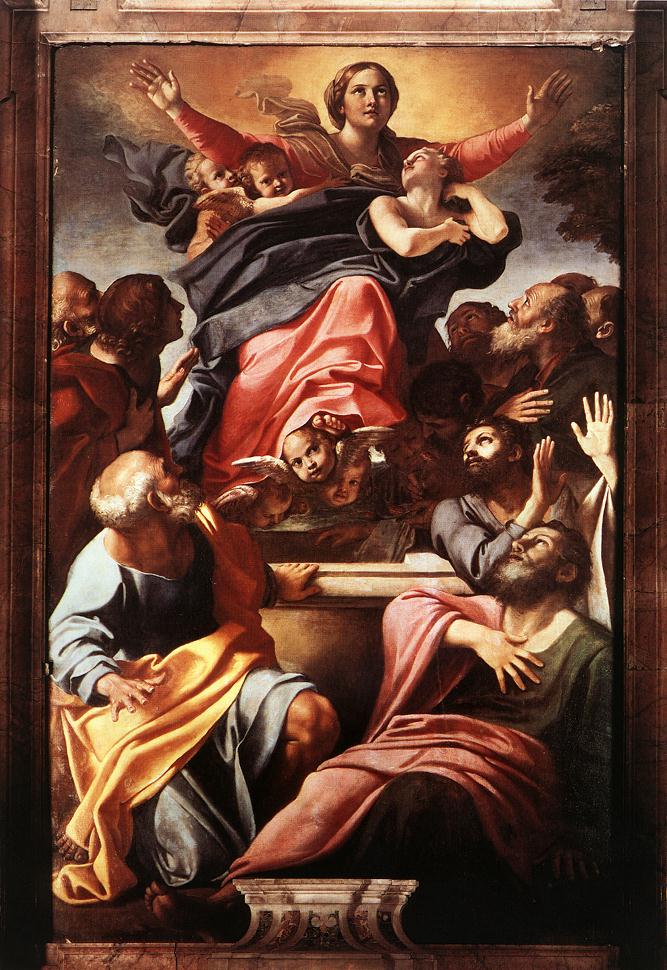
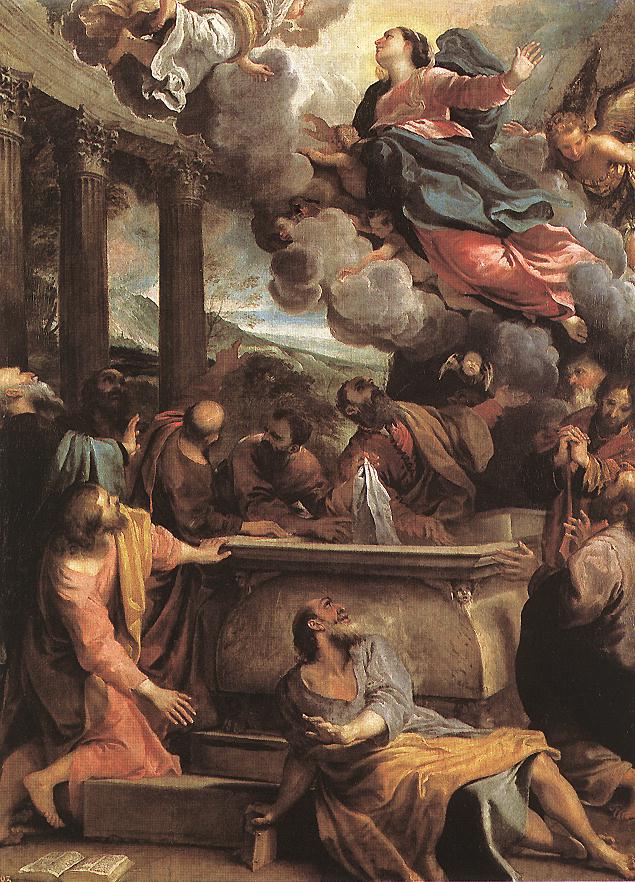
Assumption of the Virgin - Annibale Carracci


Assumption of the Virgin - Annibale Carracci


The Assumption of the Virgin by Peter Paul Rubens


The Lady of the Assumption Gives St. Thomas Her Belt - Bartolomeo della Gatta


According to the one section of the Golden Legend, "St. Thomas was not there [at the Assumption], and when he came he would not believe this. And anon the girdle with which her body was girt came to him from the air, which he received, and thereby he understood that she was assumpt into heaven."

The flowers in the sarcophagus and the musical instruments refer to the "marvellous odour" and "voice of angels" that another section of the Legend describes at the time of the Assumption.


Bartolomeo intended the two figures in the foreground as St. Benedict and St. Scholastica, but when the painting came into the possession of the Servants of Mary they had the figures repainted to represent two of their own saints, Filippo Benizzi and Giuliana Falconeri.

The Assumption of The Virgin - Francesco Botticini


Thursday, April 1, 2010

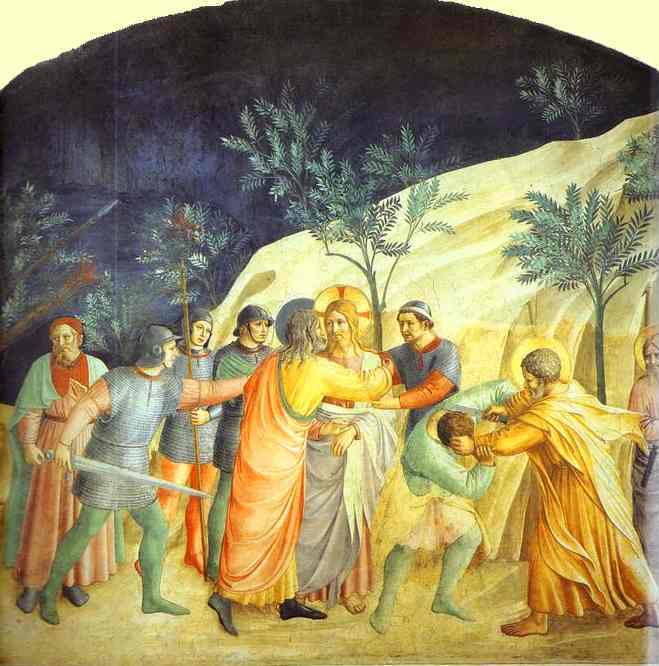
Judas betrays Our Lord


This painting is by Fra Angelico. I love this painting and is my second favourite Fra Angelico painting. What I love most about this painting is the look of Jesus. When I look at His face I see sadness in His eyes. He is not condemning Judas, in fact the look is not even reproachful, it is a look of sadness. A two fold sadness, one because one of His very own has betrayed him and sadder still because Jesus being God knows the heart of man (Judas) and knows that Judas will despair and commit suicide.

I love this painting because often I think Jesus looks at me the same way, when I do terrible sinful things, He looks at me. He who carved me in the palm of His hand, who waited till 1979 for me to be born, He who decided that I be born and raised Catholic, He looks at me with the same sad look. He who feeds me with His own body, He looks at me because I have partaken of the divine feast and yet I have kissed and betrayed Him.

Oh my Heavenly Mother, have mercy of me, implore your Son our Lord Jesus to stir up real contrition in me that I may never betray Him again. And if I dare to fall into the clutches of sin, my Mother please never let me despair but humbly with thy prayers and graces return humbly to thy Son seeking his mercy and forgiveness.

Saturday, April 25, 2009

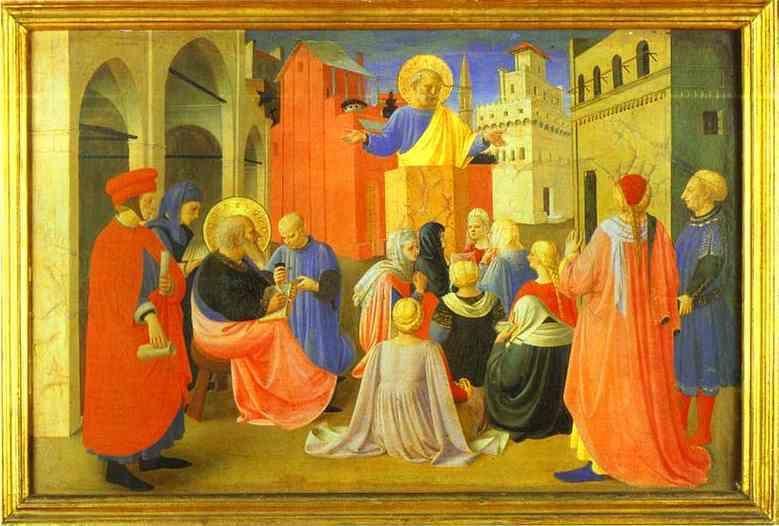
Fra Angelico - Linaiuoli Tabernacle: Peter Preaching with Mark


As today is the feast of St Mark let us enjoy this painting by Fra Angelico. The details of the image is Fra Angelico. Linaiuoli Tabernacle: Peter Preaching with Mark. Predella. 1433. Tempera on panel. 39 x 56 cm. Museo di San Marco, Florence, Italy.


Wednesday, February 18, 2009

Blessed John of Fiesole - 18th February 2009

A famous painter of the Florentine school, born near Castello di Vicchio in the province of Mugello, Tuscany, 1387; died at Rome, 1455. He was christened Guido, and his father's name being Pietro he was known as Guido, or Guidolino, di Pietro, but his full appellation today is that of "Blessed Fra Angelico Giovanni da Fiesole". He and his supposed younger brother, Fra Benedetto da Fiesole, or da Mugello, joined the order of Preachers in 1407, entering the Dominican convent at Fiesole. Giovanni was twenty years old at the time the brothers began their art careers as illustrators of manuscripts, and Fra Benedetto, who had considerable talent as an illuminator and miniaturist, is supposed to have assisted his more celebrated brother in his famous frescoes in the convent of San Marco in Florence.

Fra Benedetto was superior at San Dominico at Fiesole for some years before his death in 1448. Fra Angelico, who during a residence at Foligno had come under the influence of Giotto whose work at Assisi was within easy reach, soon graduated from the illumination of missals and choir books into a remarkably naive and inspiring maker of religious paintings, who glorified the quaint naturalness of his types with a peculiarly pious mysticism. He was convinced that to picture Christ perfectly one must need be Christlike, and Vasari says that he prefaced his paintings by prayer. His technical equipment was somewhat slender, as was natural for an artist with his beginnings, his work being rather thin dry and hard. His spirit, however, glorified his paintings. His noble holy figures, his beautiful angels, human but in form, robed with the hues of the sunrise and sunset, and his supremely earnest saints and martyrs are permeated with the sincerest of religious feeling. His early training in miniature and illumination had its influence in his more important works, with their robes of golden embroidery, their decorative arrangements and details, and pure, brilliant colours. As for the early studies in art of Fra Angelico, nothing is known. His painting shows the influence of the Siennese school, and it is thought he may have studied under Gherardo, Starnina, or Lorenzo Monaco.

On account of the struggle for the pontifical throne between Gregory XII, Benedict XIII, and Alexander V, Fra Giovanni and his brother, being adherents of the first named, had in 1409 to leave Fiesole, taking refuge in the convent of their order established at Foligno in Umbria. The pest devastating that place in 1414, the brothers went to Cortona, where they spent four years and then returned to Fiesole. There Fra Angelico remained for sixteen years. He was then invited to Florence to decorate the new Convent of San Marco which had just been allotted to his order, and of which Cosmo de' Medici was a munificent patron. At Cortona are found some of his best pictures.

It was at Florence, however, where he spent nine years, that he painted his most important works. In 1445, Pope Eugenius IV invited Fra Angelico to Rome and gave him work to do in the Vatican, where he painted for him and for his successor, Pope Nicholas V, the frescoes of two chapels. That of the cappella del Sacramento, in the Vatican, was destroyed later by Paul III. Eugenius IV than asked him to go to Orvieto to work in the chapel of the Madonna di San Brizio in the cathedral. This work he began in 1447, but did not finish, returning to Rome in the autumn of that year. Much later the chapel was finished by Luca Signorelli. Pope Eugenius is said to have offered the painter the place of Archbishop of Florence, which through modesty and devotion to his art he declined. At Rome, besides his great paintings in the chapels of the Vatican, he executed some beautiful miniatures for choral books. He is buried in Rome in the church of Santa Maria sopra Minerva.

Among the thirty works of Fra Angelico in the cloisters and chapter house of the convent of San Marco in Florence (which has been converted into a national museum) is notable the famous "Crucifixion", with the Saviour between the two thieves surrounded by a group of twenty saints, and with bust portraits of seventeen Dominican fathers below. Here is shown to the full the mastery of the painter in depicting in the faces of the monks the emotions evoked by the contemplation of heavenly mysteries. In the Uffizi Gallery are "The Coronation of the Virgin", "The Virgin and Child with Saints", "Naming of John the Baptist", "The Preaching of St. Peter", "The Martyrdom of St. Mark", and "The Adoration of the Magi", while among the examples at the Florence Academy are "The Last Judgement", "Paradise", "TheDeposition from the Cross", "The Entombment", scenes from the lives of St. Cosmas and St. Damian, and various subjects from the life of Christ. At Fiesole are a "Madonna and Saints" and a "Crucifixion". The predella in London is in five compartments and shows Christ with the Banner of the Resurrection surrounded by a choir of angels and a great throng of the blessed. There is also there an "Adoration of the Magi". At Cortona appear at the Convent of San Domenico the fresco "The Virgin and Child with four Evangelists" and the altar-piece "Virgin and Child with Saints", and at the baptistry an "Annunciation" with scenes from the life of the Virgin and a "Life of St. Dominic". In the Turin Gallery "Two Angels kneeling on Clouds", and at Rome, in the Corsini Palace, "The Ascension", "The Last Judgment", and "Pentecost". At the Louvre in Paris are "The Coronation of the Virgin", "The Crucifixion", and "The Martyrdom of St. Cosmas and St. Damian". Berlin has, at the Museum, a "Last Judgment", and Dublin, at the National Gallery, "The Martyrdom of St. Cosmas and St. Damian". At Madrid is "The Annunciation", in Munich "Scenes from the Lives of St. Cosmas and St. Damian", and in St. Petersburg a "Madonna and Saints". Mrs. John L. Gardner has in the art gallery of her Boston residence an "Assumption" and a "Dormition of the Virgin". There are other works at Parma, Perugia, and Pisa. At San Marco, Florence, in addition to the works already mentioned are "Madonna della Stella", "Coronation of the Virgin", "Adoration of the Magi", and "St. Peter Martyr". The Chapel of St. Nicholas in the Vatican at Rome contains frescoes of the "Lives of St. Lawrence and St. Stephen", "The Four Evangelists", and "The Teachers of the Church". In the gallery of the Vatican are "St. Nicholas of Bari", and "Madonna and Angels". The work at Orvieto finished by Signorelli shows Christ in "a glory of angels with sixteen saints and prophets".

(Courtesy Catholic Encyclopedia)

Thursday, January 29, 2009

The Annuciation - Fra Angelico

Today let us just admire this work of art by Fra Angelico. Let us go beyond admiration and contemplate it.

(Fra Angelico. Altarpiece of the Annunciation. c. 1430-1432. Tempera on panel. 194 x 194. Museo del Prado, Madrid, Spain.)


This is the Annunciation, Our Lady has already given her Fiat to God as you can see the golden rays indicate her being overshadowed by the Holy Spirit. The Angel Gabriel is waiting with eyes bowed low for the Mother of God to say but one word and the Angel is ready to obey Her. God the Father looks down on them in approval. Notice how colourfully dressed our Lady is as well as the angle. They reflect the colourfulness of heaven and in their faces one sees the joy of heaven.

Notice in the top left corner, St Michael the Archangel is leading Adam and Eve out of the garden. The garden is lush in greenery, St Micheal is sad as he assists them out of the garden, He knows what is to happen to man. Adam and Eve themselves are sad becasue they know that things have changed and they are aware of what they have lost. notice that their clothes are grey and sad, unline the angels and the mother of God.

Lastly notice Angel Gabriels wings are a bit outside, indicating that while he is with Mother Mary he is also outside in the world doing what She tells him to do (distribute God's graces). I personally love the look on Angel Gabriels face

Monday, January 19, 2009

Fra Angelico


My favourite Catholic painter is Fra Angelico. Today we will read up a bit of history of this Saint Paniter before we go into contemplating his paintings.


The life of Fra Giovanni da Fiesole, baptized as Guido di Piero (born around 1395 in Vicchio di Mugello, died in Rome in 1455) is the stuff of legend. “Angelic” was how he came to be known soon after his death; the name “Beato” was a comment on his painting and not a reference to his beatification, which happened only recently, in 1984.


Fra Angelico was a Dominican, and a mendicant, so, not being part of a closed order, he was free to meet and talk to others in the city. In 1420-1422, he entered the convent of San Domenico in Fiesole with his brother Benedetto. It was here that he produced his first works: altarpiece for the high altar, Altarpiece of the Annunciation, The Coronation of the Virgin, as well as the frescoes for his monastery.


On June 23, 1983, Pope John Paul II granted official cultus to Fra Angelico, who is now a Blessed with an office, a mass and obligatory memory (and now Patron of Artists)


Fra Angelico not only gained recognition as a painter, but must have commanded respect in his convent because he was appointed Vicario for the first time in Fiesole from 1432/33, a post he was to hold frequently in later years.


In the 1430’s the painter worked in Florentine churches. He carried out the following commissions for the Dominicans in Cortona: the Cortona Triptych and the Annunciation panel. From 1438, he worked on his most important commission, the San Marco Altarpiece and the frescoes for the convent of San Marco in Florence.


In July 1445 Fra Angelico was summoned by Eugenius IV to Rome, where he painted frescoes in the chapel of Santissimo Sacramento, which was later destroyed under Pope Paul III. For Eugenius’ successor, Pope Nicholas V, he painted the frescoes of St. Stephen and St. Lawrence between 1447 and 1449 with the assistance of Benozzo Gazzoli (1420-1497), in the Capella Niccolina in the Vatican, named after the Pope who commissioned the frescoes.


In the summer of 1447, he began work on the frescoes in the Capella di San Brizio (10), in the cathedral at Orvieto. These were competed by Luca Signorelli fifty years later. From 1450-1452, he returned to his old convent in Fiesole as Prior, before going for one last time to Rome, where he died on 18 February 1455. He is buried in Santa Maria sopra Minerva, where his grave has always drawn worshippers. After his beatification by Pope John Paul II in 1984, the headstone was placed on a plinth and surrounded by a bronze grille with floral motifs. His feast day is 18 February, the day of his death.

Sunday, January 18, 2009

Catholic Art

Today we will start a new chapter in this blog. We will look, contemplate and learn from great Catholic art.
In the middle ages, Catholics learnt about Christ and the bible from the sermons of the saints, the stained glass on the cathedrals and the paintings by painters like Giotto di Bondone, Fra Angelico etc etc.
We wont just be admiring paintings, we will look at the details and let those details touch our souls and lift us up to Christ who is the artist extraordinaire.
Two Paintings, Two Mentalities, Two Doctrines

(The Virgin and Child by the Maitre de Moulins)
(The Virgin and Child by Rouault)

Indulge in an exercise of fantasy, and suppose that by rewinding the thread of bygone centuries it has become possible for you to return to the time of Christ and walk into a room of the Holy Family's humble dwelling in Nazereth.
Imagine that you find the Virgin playing with the Child, and that both were just as Rouault depicted them in the painting on the upper right. Would such a sight fulfill your expectations? Would it correspond to what you might have hoped from the Mother of God and the Word Incarnate Himself? Would you find in those images the authentic expression of the Christian spirit and the ineffable virtues of Jesus and Mary?

Obviously not.
Therefore, whoever earnestly wants that Christian art worthily and duly reflect the spirit of the Gospel cannot be indifferent to paintings of this nature becoming widespread among the faithful. What kind of impression would people have of the Holy Family if nothing else were shown to them but paintings of this ilk? As far as it is able, Christian art has the role of an accessory to the spreading of sound doctrine. The spirit of this painting cannot be deemed proper for that end.
In order to illustrate these affirmations better, look at the painting by the Maitre de Moulins (fifteenth century), which also portrays the Virgin and Child, and consider how efficacious it is in helping us understand, through the senses, what the Church teaches about Jesus and Mary.
(Clik on both images for a larger view)


Sunday, January 11, 2009

The Baptism of Our Lord Jesus Christ - 11th January 2009


The baptism of Christ Christ is bathed in light; let us also be bathed in light. Christ is baptized; let us also go down with him, and rise with him.
John is baptizing when Jesus draws near. Perhaps he comes to sanctify his baptiser; certainly he comes to bury sinful humanity in the waters. He comes to sanctify the Jordan for our sake and in readiness for us; he who is spirit and flesh comes to begin a new creation through the Spirit and water.
The Baptist protests; Jesus insists. Then John says: I ought to be baptized by you. He is the lamp in the presence of the sun, the voice in the presence of the Word, the friend in the presence of the Bridegroom, the greatest of all born of woman in the presence of the firstborn of all creation, the one who leapt in his mother’s womb in the presence of him who was adored in the womb, the forerunner and future forerunner in the presence of him who has already come and is to come again. I ought to be baptized by you: we should also add, “and for you,” for John is to be baptized in blood, washed clean like Peter, not only by the washing of his feet.
Jesus rises from the waters; the world rises with him. The heavens, like Paradise with its flaming sword, closed by Adam for himself and his descendants, are rent open. The Spirit comes to him as to an equal, bearing witness to his Godhead. A voice bears witness to him from heaven, his place of origin. The Spirit descends in bodily form like the dove that so long ago announced the ending of the flood and so gives honour to the body that is one with God.
Today let us do honour to Christ’s baptism and celebrate this feast in holiness. Be cleansed entirely and continue to be cleansed. Nothing gives such pleasure to God as the conversion and salvation of men, for whom his every word and every revelation exist. He wants you to become a living force for all mankind, lights shining in the world. You are to be radiant lights as you stand beside Christ, the great light, bathed in the glory of him who is the light of heaven. You are to enjoy more and more the pure and dazzling light of the Trinity, as now you have received – though not in its fullness – a ray of its splendour, proceeding from the one God, in Christ Jesus our Lord, to whom be glory and power for ever and ever. Amen.