Sunday, September 11, 2011
Discovering the Wisdom of Saint Ignatius - Dr. Plinio Corrêa de Oliveira
While all these treasures are found in this work, we need to have an even broader vision that will allow us to see yet another treasure that is rarely pointed out. That treasure is his wisdom. If someone wants to have mental balance, nervous equilibrium and wisdom, let him read The Spiritual Exercises of Saint Ignatius of Loyola. His way of thinking is not just speculative reasoning. Rather there is no more sensible or logical way to think about the concrete problems of life today than that of Saint Ignatius of Loyola. Anyone who becomes familiar with, and used to, his reasoning acquires a truly extraordinary and structured soul.
What is it about The Spiritual Exercises of St. Ignatius that we should especially praise? First of all, the wisdom by which he lays out the topics. He always goes straight to the central points of a topic. For example, his consideration of sin leads us to reflect upon the gravity of sin and the rights of God. By taking conclusions about the gravity of sin, people then gauge the gravity of their own sins. From a central point, he always develops his reasoning in a logical, simple, direct and irrefutable way. We are left with the alternative of either admitting we have no faith or that he is right.
Secondly, Saint Ignatius teaches us to be completely honest when considering our private lives. The Exercises are laid out in such a way as to make us fully objective when considering our defects, virtues, circumstances and duties. The saint teaches us to fight against those numerous and devious (although mostly semi-subconscious) maneuvers that we often employ to avoid knowing ourselves. His logic is like a straight arrow that forces us to look at things head on and with all honesty. We see and recognize ourselves as we are. At the time of our spiritual self-examination, we are put in a position where we will not lie to ourselves or to God.
However comforting or painful this honest vision may be, we can then draw helpful conclusions and resolutions.
Finally, Saint Ignatius supplies us with an admirable equilibrium between the intelligence and the will on the one hand, and the sensibility on the other. He bases his arguments on reason, not sensibility or feelings. Nevertheless, once reason dominates, he asks man’s sensibility to follow reason. Thus, Saint Ignatius asks us to think about a topic and then imagine a place or situation that will help stir up good movements in our souls. That is to say, he tries to bring human sensibility into line with the logical arguments. If however, your sensibility or feelings are not moved by the argument, he advises us to carry on with the exercise without them because that is what reason indicates we should do. This is a marvelous equilibrium!
Saint Ignatius also strikes a balance between the supernatural and the natural. At every moment he asks us to make an act of love or make an act of the will. He asks our souls to “exercise” but he also constantly asks us to stop and ask God for an insight to consider this or that thing. We are asked to stop and ask God to move our souls in the direction He desires for us. In other words, he bends over backward to stir in us the right natural dispositions to accept the orientation God wishes to give us. This truly shows an extraordinary fullness of wisdom.
In this regard, Saint Ignatius is so opposed to everything that our times have of arbitrary, wild and crazy. All saints are the opposite of the hippie. Charles Manson, for example, was characteristically unbalanced, with regard for neither thinking nor law, a kind of wild beast loose in the world.
In Saint Ignatius we have the exact opposite. We have composure, logic, common sense and a sense of measure. From this standpoint, he is an incomparable master of wisdom.
Tuesday, May 26, 2009
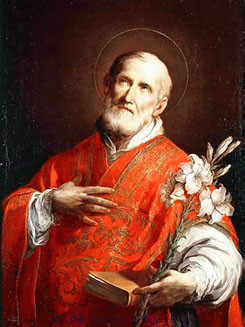
St. Philip Neri - 26th May 2009
Biographical selection:
Phillip Neri (1515-1595) was born in Florence of a noble but impoverished family. He studied theology and philosophy and dedicated himself to apostolic works from his youth. Eventually he set aside his studies and founded a society to care for the sick and poor pilgrims in Rome.
He was ordained a priest in 1551, and founded the Congregation of the Oratory, the Oratorians, a group of priests dedicated to preaching and teaching. He was a great mystic, who received the gifts of prophecy and discernment of spirits. He could read the souls of penitents, and heard confessions by the hour. He was canonized some 25 years after his death along with St. Ignatius of Loyola, St. Teresa of Avila and St. Francis Xavier.
The religious crisis that took so many provinces from the Catholic Church deeply afflicted St. Phillip Neri. He suffered cruelly to see so many people being drowned in the waves of heresy. He attentively followed the maneuvers of Protestantism and planned a counter-attack against a Lutheran work of propaganda, the Magdeburg Centuries. This vast compilation was written to persuade readers that the Catholic Church had abandoned her early beliefs and practices. The multi-volume collection was filled with historical falsifications to “prove” its goal.
To counter this fabrication St. Phillip wanted a complete work of erudition to be written on the History of the Church from the time of Our Lord Jesus Christ up to his own time. He ordered the work to be done by Cesar Baronius, an Oratorian who would succeed him as Superior of the Oratory in 1593 and made a Cardinal in 1596.
Baronius alleged that he was unworthy and lacked the competence for such a great work; but St. Phillip was inflexible and ordered him under religious obedience to undertake the project. He spent close to 30 years to write it (1588–1607), covering the time up to the 12th century. This collection was called Ecclesiastical Annals. It was completed after his death.
The heresy felt the blow. The errors of the anti-Catholic Magdeburg Centuries became evident as the work of Baronius eclipsed it. The Ecclesiastical Annals contributed powerfully to stem the growing tide of Protestantism in Europe. From Baronius' work the Catholic Church emerged as she had always been, as the pillar of truth.
Comments of Prof. Plinio:
St. Phillip Neri was a man with a universal Catholic sense. He was not just interested in realizing a personal work, which certainly was important – the foundation of the Congregation of the Oratory – but he had a general concern for the Catholic Church as a whole. He was personally offended by Protestants attacking the Church through a work that was meant to be monumental – the Magdeburg Centuries. Actually it was a monumental lie. The Protestants, as heretics who hated the Church, fabricated another history of the Church full of untruths and slanders, with the specific purpose of denigrating the good name of the Catholic Church and separating her from the faithful.
These Protestants were from the same family of souls as the Pharisees, who produced false witnesses to condemn the Lamb of God. Analogously, in the beginning of the Church, groups of Jews moved by hatred against her spread many apocrypha documents – false gospels or epistles attributed to the Apostles – in order to confuse Catholics and induce them toward heresies. Until today, from time to time, the discussion of the apocrypha documents resurfaces trying to sabotage the Gospels.
Also after Protestantism, and in its wake, some authors of the Encyclopedia spread countless lies regarding the past of the Church. This in many ways was continued by Michelet in the 19th century. Today, these revolutionary authors lost credibility and their lies are universally recognized in scholarly milieus, even though they still influence badly those who do not have access to good historical sources. So, it was and still is a rule of the enemies to falsify history in order to slander Holy Mother Church.
When St. Phillip Neri saw the evil results that the Centuries of Magdeburg was having by favoring the spread of Protestantism, he decided to counter-attack. He chose the only way possible which was to make a gigantic work of erudition. A work using the best documents dating from the very beginning of the Church up to his own time, that would present the incontestable reality of the facts. To do this work he chose one of his most capable disciples, Baronius. After some hesitations Baronius dedicated some 30 years of his life to this job and the result was the Ecclesiastical Annals, one of the most serious works of all times. The work of Baronius stands forever as a point of reference for any serious historical study. His work pulverized the supposed “scientific” work of the Protestants who were left completely discredited.
The root of this work was St. Phillip Neri's amplitude of vision, his love of the Church, and his counter-revolutionary zeal.
An analogous work was made by Fr. Cornelius a Lapide from the Society of Jesus. He received an order to study all the interpretations of the Sacred Scriptures that existed, analyze them, refute the wrong ones, explain the good ones and give the best sources for each of them. Again, it was a counter-revolutionary work to destroy the pseudo-scientific Protestant interpretations which were polluting the atmosphere of piety and studies in the 16th and 17th centuries. Fr. Cornelius a Lapide wrote his monumental Commentaries to the Sacred Scriptures encompassing all its books from Genesis to the Apocalypse. To this date it is one of the most – if not the most – complete ensemble of Exegesis that the Catholic Church has. It is an everlasting source of erudition and piety for historians, preachers, and faithful in general.
Let us ask the great counter-revolutionary St. Phillip Neri to give us conditions to imitate him, hurting the Revolution at its head so that it can be completely destroyed and the Reign of Mary be established over its ruins.
Sunday, February 15, 2009
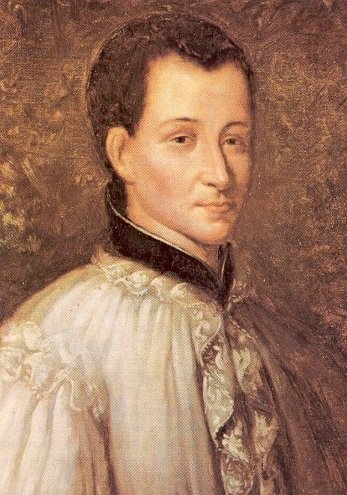
St. Claude la Colombiere - 15th Febraury 2009
This is a special day for the Jesuits, who claim today’s saint as one of their own. It’s also a special day for people who have a special devotion to the Sacred Heart of Jesus—a devotion Claude la Colombière promoted, along with his friend and spiritual companion, St. Margaret Mary Alacoque. The emphasis on God’s love for all was an antidote to the rigorous moralism of the Jansenists, who were popular at the time.
He was the third child of the notary Bertrand La Colombière and Margaret Coindat, was born on 2nd February 1641 at St. Symphorien d'Ozon in the Dauphine, southeastern France. After the family moved to Vienne Claude began his early education there, completing his studies in rhetoric and philosophy in Lyon.
It was during this period that Claude first sensed his vocation to the religious life in the Society of Jesus. We know nothing of the motives which led to this decision. We do know, however, from one of his early notations, that he "had a terrible aversion for the life embraced". This affirmation is not hard to understand by any who are familiar with the life of Claude, for he was very close to his family and friends and much inclined to the arts and literature and an active social life. On the other hand, he was not a person to be led primarily by his sentiments.
At 17 he entered the Jesuit Novitiate at Avignon. In 1660 he moved from the Novitiate to the College, also in Avignon, where he pronounced his first vows and completed his studies in philosophy. Afterwards he was professor of grammar and literature in the same school for another five years.
In 1666 he went to the College of Clermont in Paris for his studies in theology. Already noted for his tact, poise and dedication to the humanities, Claude was assigned by superiors in Paris the additional responsibility of tutoring the children of Louis XIV's Munster of Finance, Jean Baptiste Colbert.
His theological studies concluded and now a priest, Claude returned to Lyon. For a time he was teacher in the College, then full-time preacher and moderator of several Marian congregations.
Claude became noted for solid and serious sermons. They were ably directed at specific audiences and, faithful to their inspiration from the gospel, communicated to his listeners serenity and confidence in God. His published sermons produced and still produce significant spiritual fruits. Given the place and the short duration of his ministry, his sermons are surprisingly fresh in comparison with those of better-known orators.
The year 1674 was a decisive one for Claude, the year of his Third Probation at Maison Saint-Joseph in Lyon. During the customary month of the Exercises the Lord prepared him for the mission for which he had been chosen. His spiritual notes from this period allow one to follow step-by-step the battles and triumphs of the spirit, so extraordinarily attracted to everything human, yet so generous with God.
He took a vow to observe all the constitutions and rules of the Society of Jesus, a vow whose scope was not so much to bind him to a series of minute observances as to reproduce the sharp ideal of an apostle so richly described by St. Ignatius. So magnificent did this ideal seem to Claude that he adopted it as his program of sanctity. That it was indeed an invitation from Christ himself is evidenced by the subsequent feeling of interior liberation Claude experienced, along with the broadened horizons of the apostolate he witnesses to in his spiritual diary.
On 2nd February 1675 he pronounced his solemn profession and was named rector of the College at Paray-le-Monial. Not a few people wondered at this assignment of a talented young Jesuit to such an out-of the-way place as Paray. The explanation seems to be in the superiors' knowledge that there was in Paray an unpretentious religious of the Monastery of the Visitation, Margaret Mary Alacoque, to whom the Lord was revealing the treasures of his Heart, but who was overcome by anguish and uncertainty. She was waiting for the Lord to fulfill his promise and send her "my faithful servant and perfect friend" to help her realize the mission for which he had destined her: that of revealing to the world the unfathomable riches of his love.
After Father Colombière's arrival and her first conversations with him, Margaret Mary opened her spirit to him and told him of the many communications she believed she had received from the Lord. He assured her he accepted their authenticity and urged her to put in writing everything in their regard, and did all he could to orient and support her in carrying out the mission received. When, thanks to prayer and discernment, he became convinced that Christ wanted the spread of the devotion to his Heart, it is clear from Claude's spiritual notes that he pledged himself to this cause without reserve. In these notes it is also clear that, even before he became Margaret Mary's confessor, Claude's fidelity to the directives of St. Ignatius in the Exercises had brought him to the contemplation of the Heart of Christ as symbol of his love.
After a year and half in Paray, in 1676 Father La Colombière left for London. He had been appointed preacher to the Duchess of York - a very difficult and delicate assignment because of the conditions prevailing in England at the time. He took up residence in St. James Palace in October.
In addition to sermons in the palace chapel and unremitting spiritual direction both oral and written, Claude dedicated his time to giving thorough instruction to the many who sought reconciliation with the Church they had abandoned. And even if there were great dangers, he had the consolation of seeing many reconciled to it, so that after a year he said: "I could write a book about the mercy of God I've seen Him exercise since I arrived here!"
The intense pace of his work and the poor climate combined to undermine his health, and evidence of a serious pulmonary disease began to appear. Claude, however, made no changes in his work or life style.
Of a sudden, at the end of 1678, he was calumniously accused and arrested in connection with the Titus Oates "papist plot". After two days he was transferred to the severe King's Bench Prison where he remained for three weeks in extremely poor conditions until his expulsion from England by royal decree. This suffering further weakened Claude's health which, with ups and downs, deteriorated rapidly on his return to France.
During the summer of 1681 he returned to Paray, in very poor condition. On 15th February 1682, the first Sunday of Lent, towards evening Claude suffered the severe hemorrhage which ended his life.
On the 16th of June 1929 Pope Pius XI beatified Claude La Colombière, whose charism, according to St. Margaret Mary Alacoque, was that of bringing souls to God along the gospel way of love and mercy which Christ revealed to us.
Friday, October 10, 2008
St. Francis Borgia - 10th October 2008
(The adoration of the Eucharist in the hands of St. Francis Borgia is the subject of one of the quadrants of the dome of the Gesù.)
Biographical selection:
For the Church, the 16th century was a dolorous epoch. The rebirth of Paganism, the spread of Protestantism and then Jansenism devastated Catholic Europe, while Islamism became an arrogant and menacing danger. In Golkun, Holland, 40 Catholics were martyred; in England St. John Fisher and St. Thomas More were beheaded, and Blessed Ignatius of Azevedo along with his 39 blessed companions were massacred by the Calvinists on their way to Brazil.
To remedy so many evils, Divine Providence raised up saints all over Europe. In Spain, St. Ignatius of Loyola, St. Francis Xavier, St. John of the Cross, St. Therese of Ávila, St. Peter of Alcantara, St. Paschal Baylon, and St. Thomas of Villanova carried out spiritual reforms that encompassed all Christendom. Others, such as St. Charles Borromeo, St. Felipe Neri, St. Peter Canisius, St. Francis of Paula, St. Jerome Emilianus and the great St. Pius V spread light over Christendom in their fight against the darkness of heresy.
During that stormy century, St. Francis Borgia shone for his nobility, virtue, and combativeness in Catholic Spain. He was born in Valencia into a family of royal blood that was related to the principal reigning houses of Europe, including that of Emperor Charles V. When Francis Borgia entered his service and came to court at age 17, the Emperor was so impressed by his noble and modest behavior that he determined to keep Francis always at his side. Charles V maintained this admiring friendship all his life.
After he became a widower, however, Francis Borgia made the decision to enter the Society of Jesus. St. Ignatius advised him to ask the Emperor’s permission. Since Charles V was in the Netherlands, Francis addressed a letter to him there. The Emperor replied with these words:
“I am very sorry to lose the company of a man of your merit, a shining light of counsel, a model in the exercise of the highest offices of State, and, because of your virtue and piety, a factor of edification for all my court. But I recognize that it would be unreasonable to dispute over you with the Master you have chosen to serve. It is, therefore, with sorrow that I grant you the permission you are requesting. I authorize you to renounce your fiefs and titles in favor of your firstborn son.
“The number of those who will envy you will be greater than those who will imitate you, since it is easy to admire beautiful examples, but difficult to follow them. I recommend myself to your prayers and I count upon you to attract divine blessings over me, my States, and all Christendom.”
After holding the office of Superior of the Society of Jesus in Spain, Portugal and the West Indies, St Francis Borgia was elected the third General of the Order when Fr. Laynes died in 1560.
One of the first tasks he faced was that of refuting and fighting the calumnies that the Lutherans and other enemies of the Church were spreading about the Society of Jesus in attempts to bring it to ruin. They were trying to stimulate dissension between the Dominican Order and the Society of Jesus. When Cardinal Alessandrini, a Dominican, was elected Pope, a member of the College of Cardinals tried to influence him to suppress the Jesuits. St. Pius V answered:
“God preserve me from so great a sin. The Lord wants to use these priests for His glory. Their Society is called to produce great fruits for the Church.”
The next day St. Pius V was to be crowned Supreme Pontiff at the solemn ceremony in the Basilica of St. John Lateran. He was carried in the gestatory chair followed by all the dignitaries of the Roman Court. An enormous multitude filled the streets. When the cortege arrived in front of the House of the Society of Jesus, the Pope ordered it to stop. St. Pius V called for St. Francis Borgia, who respectfully approached. The Pope embraced him and offered his friendship and support for whatever he would need. He also thanked him for the service the Order had already given to the Church and expressed his warmest wishes to see their members work for the glory of God and the salvation of souls. The cortege then continued on its way.
Comments of Prof. Plinio:
This selection has two distinct parts. The first is a brief description of the life of St. Francis Borgia when he was a layman, and the second presents an episode from his government as General of the Society of Jesus.
To evaluate the biographical data in this selection, one needs to consider the general panorama of the times. His Sovereign was Charles V, Emperor of the Holy Roman and German Empire. He was Emperor, and also King of Hungary, King of Bohemia, Lord of numerous Italian territories, and King of Spain, and, therefore, of the Spanish colonies spread all over the world. It was at this time that it became common to say that the sun never set on his Empire. That is, when the sun was rising in one part of his Empire, night had not yet fallen in another. There was always daylight within the domains of his Empire.
He was one of the most powerful Monarchs in History. The 16th century was certainly already a decadent century in comparison with the Middle Ages, but it was not that distant from those blessed centuries, and many of its values were still alive at that time. One of these values was that people still appreciated justice more than power. It was generally recognized that Charles V, as Emperor, deserved the most honor and reverence. The Emperor of the Holy Roman Empire was considered the natural head of all Christendom, superior to all Kings. Above him was only the Pope.
St. Francis Borgia was a man of high lineage who descended from a royal family that had reigned over Valencia. The different kingdoms of Spain had united to face the Moorish invasion, and even though many of those royal families no longer had thrones, they were still very highly considered. St. Francis Borgia was a descendent of one of those families, which still had fiefs. His situation was similar to that of a prince.
As a youth he was sent to Charles V’s court. Since it was the highest court in the world, it attracted countless men of value: nobles, personages, famous artists, financial magnates, reputed diplomats, and brilliant military officers. It was a gathering point for the best of Europe. Over all them was the Emperor, who successfully ruled over his numerous Kingdoms. Into this extraordinary scenario an adolescent of 17-years entered. He was so remarkable that he attracted the attention of the Emperor. That is to say, he stood out among those countless princes and outstanding men who were there vying for the Emperor’s attention.
The selection tells us that he was very noble and modest, which means he possessed a great superiority and dignity in manners. We should not think of modest in the modern sense of the term, as describing a man who is trying to flee social life. Rather, the word would retain its old-fashioned meaning, coming from modus – that is, someone who had distinguished and reserved manners in his way of being.
The sanctity of St. Francis Borgia attracted the Emperor so much that he wanted him always near to give him counsel. St. Francis was Duke of Gandia, which he governed. He married and founded a large family with many descendants. That is, he had many temporal matters to deal with on a daily basis.
In 1539 the wife of Charles V, Empress Isabel, was struck with fever and died. As the Marquis of Lombay, Francis Borgia was required to head the funeral cortege to Granada, where a Requiem Mass was sung and official identification of the body made before burial. When Francis opened the coffin and lifted the cloth from the face of the dead Empress, the cadaver had already beginning to deteriorate. This sight made a strong impression on St. Francis Borgia, who realized the futility of all the glories of the world. He resolved to abandon them and ask St. Ignatius to enter the Society of Jesus.
One condition that St. Ignatius made was that he must obtain the Emperor’s permission. Then Charles V wrote him the beautiful letter we just read. It is a high eulogy of St. Francis Borgia, which ended with the line that expresses well the spirit of the time: Many people will admire you, but only a few will follow you.
This explains the difference between that time and the Middle Ages. In the Middle Ages, many admired the good examples, and many followed them. In the time of Charles V, many admired the good examples, and just a few followed them. Today the good examples are neither admired nor followed. You have here the different steps of the Revolution.
St. Francis Borgia entered the Society of Jesus and became its General. There was a rivalry between the two Orders: the Dominicans and the Jesuits. The enemies of the Church were interested in destroying the Society of Jesus because of its more zealous combativeness against the Protestants. So they stimulated rumors and calumnies that were spread against the Jesuits. When St. Pius V, a Dominican, was elected Pope, those same enemies found ways to influence Vatican ecclesiastics, who immediately tried to maneuver the new Pope to close the Jesuits. Instead, St. Pius V planned a way to do the opposite, to confer added prestige to their Order.
You know that until Paul VI, the Popes used the gestatory chair, which was a portable throne for the Pope carried on the shoulders of a dozen men so that the Pontiff could be seen by all the public. That custom, which began in the early days of the Church, was enriched as time passed with a ceremonial cortege and trumpets.
St. Pius V resolved to break the long established protocol of the cortege of coronation. He did so, stopping its progression in front of the House of the Jesuits and calling for St. Francis Borgia, who most probably was standing outside with the other directors of the Society of Jesus waiting for the Pope to pass.
You can imagine the scene: St. Pius V a man who had been Inquisitor, tall, thin, with a great sharp nose like an eagle, already advanced in years, sublime, approaching the highest phase of his life where he would shine brilliantly as the militant Pope who broke the Muslim power at the Battle of Lepanto. St. Francis Borgia, General of the Society of Jesus, with the air of a grand-seigneur beneath his Jesuit cassock. St. Francis Borgia approached the Pontiff with respect and admiration, venerating the Saint whom God had sent the world to be the Pope of the Church. He knelt before him, and St. Pius V bent to embrace him. Then they exchanged some words.
St. Pius V said that he loved the Society of Jesus with all his heart, that he wished every good for its priests, and that he considered himself its protector. His only desire was that the Society of Jesus fight for the glory of God. St. Francis Borgia thanked the Pope and promised the complete fidelity of the Order to St. Pius V and the Papacy.
Then the cortege continued on. St. Francis Borgia and his Jesuits entered the Church of Gesù, next to the Jesuit house in Rome, to make an act of thanksgiving before the Blessed Sacrament. What splendor, what an exquisite perfume emanates from the encounter of those two saints!
I think it is legitimate for us to turn our eyes from the contemporary epoch – filled with corruption and treason – to end the day admiring the encounter of those two saints. That encounter, the words they exchanged, and their mutual admiration for one another express something of the supreme happiness we will have in Heaven.
Let us ask St. Francis Borgia to give us his Catholic spirit, which impressed everyone in his life, including Emperor Charles V, and his dedication to the Papacy, which was the main characteristic of the Society of Jesus in its first times.
(God, Francis Xavier, Francis Borgia, and Ignatius Loyola are the subjects of the quadrants of the dome. Note the railing below and high up a part of the name of Alessandro Farnese, a cardinal and Pope Paul III's nephew, whose financial patronage made the Gesù possible.)