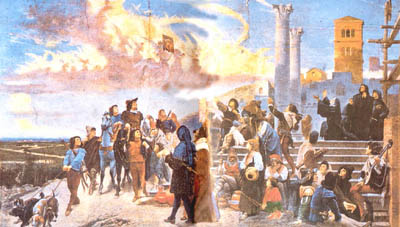
A few miles from the city of Rome, lies Genazzano—a city rich in history and blessed with the presence of a miraculous painting of the Blessed Virgin that has an amazing story.
The origins of Genazzano date back to the times of the Roman emperors. Because of its proximity to Rome, the city was chosen by many patricians and imperial courtiers as a site for their country villas. The vast gardens surrounding these villas often served as the stage for perverse feasts, pagan games and heathen rituals in honor of the gods to whom the Romans attributed the fertility of their fields.
One of these celebrations was held every April 25 in honor of the goddess Flora or Venus. For this event, people of all social classes—freemen and slaves, patricians and plebeians—gathered together for a great feast. This practice gradually dissolved and the temples fell into ruins as the life-giving breath of Christianity regenerated the peoples of Europe.
In the third century, an order was given to build a shrine dedicated to the Mother of God under the tender invocation of Mother of Good Counsel on the ruins of the Roman temples.
As the years went by, the city became more populous and the shrine grew in fame. During the Middle Ages, the Franciscans and the Augustinians founded monasteries nearby. With the passing of years, the primitive temple erected in honor of the Mother of Good Counsel began to show signs of disrepair. Moreover, as the shrine was small, the faithful built larger and richer churches for their solemn functions.
In 1356, about a century before the appearance of the miraculous painting that would introduce Genazzano into the annals of marvels in the Church, Prince Pietro Giordan Colonna, whose family had acquired lordship of the city, assigned the most ancient church of the city and its parish to the care of the Hermits of St. Augustine. The faithful would thereby have the necessary pastoral assistance, and repairs could be made on the old church.
Although the prayers of the faithful intensified, financial difficulties prevented the necessary and urgent restoration of the ancient temple. But the Mother who gives wise counsel in every circumstance and attentively provides for the necessities of men chose a Third Order Augustinian, Petruccia de Nocera, to carry out a supernatural prodigy that would bring about the much-desired restoration.
Petruccia had been left a modest fortune following the death of her husband in 1436. Living alone, she dedicated most of her time to prayer and services in the church of the Mother of Good Counsel. It grieved her to see the deplorable state of the sacred premises, and she prayed fervently that they would be restored. Finally, she resolved to take the initiative. After obtaining permission from the friars, she donated her goods to initiate the restoration in the hope that others would help complete it once it was commenced.
A plan was drawn up for the building of a magnificent church. However, once that arduous undertaking had begun, Petruccia, who was already eighty years old, found that her generous offering was scarcely enough to complete the first phase of the new construction. To make matters worse, no one came forth to help.
To her dismay, the building had hardly risen three feet when construction came to a halt due to lack of resources. Her friends and neighbors began to ridicule her, and detractors accused her of imprudence. Others severely reprimanded her in public. To all of them she would say: "My dear children, do not put too much importance on this apparent misfortune. I assure you that before my death the Blessed Virgin and our holy father Augustine will finish the church begun by me."
On April 25, 1467, the feast day of the city's patron, Saint Mark, a solemn celebration began with Mass. It was Saturday, and the crowd began to gather in front of the church of the Mother of Good Counsel. The only discrepant note in the celebration was the unfinished work of Petruccia.
At about four in the afternoon, everyone heard the chords of a beautiful melody that seemed to come from heaven. The people looked up toward the towers of the churches and saw a white cloud that shone with a thousand luminous rays; it gradually neared the stupefied crowd to the sound of an exceptionally beautiful melody. The cloud descended on the church of the Mother of Good Counsel and poised over the wall of the unfinished chapel of Saint Biagio, which Petruccia had started.
Suddenly, the bells of the old tower began to ring by themselves, and the other bells of the town rang miraculously in unison. The rays that emanated from the little cloud faded away, and the cloud itself gradually vanished, revealing a beautiful object to the enchanted gaze of the spectators. It was a painting that represented Our Lady tenderly holding her Divine Son in her arms. Almost immediately, the Virgin Mary began to cure the sick and grant countless consolations, the memory of which was recorded for posterity by the local ecclesiastical authority.
The news of the painting and its miracles spread throughout the province and beyond, attracting multitudes. Some cities formed enthusiastic processions to see the picture that the people called the Madonna of Paradise because of its celestial entrance into the city. Numerous alms were donated as an answer to the unwavering confidence that Our Lady had inspired in Petruccia.
Amidst the general enthusiasm caused by the painting, Our Lady wished to divulge the true origin of the marvelous fresco to her devotees. Two foreigners named Giorgio and De Sclavis entered the city among a group of pilgrims that had come from Rome. They wore strange clothes and spoke a foreign tongue, saying they had arrived in Rome earlier that year from Albania. While most people had refused to believe their story, it had a special significance for the inhabitants of Genazzano.
***

January of 1467 saw the death of the last great Albanian leader, George Castriota, better known as Scanderbeg. Raised by an Albanian chief, he placed himself at the head of his own people.
Subsequently, Scanderbeg inflicted stunning defeats on the Turkish army and occupied fortresses all over Albania.
With Scanderbeg’s death, the Turkish army, finally free from the Fulminating Lion of War, poured into Albania, occupying all its fortresses, cities and provinces with the exception of Scutari, in the north of the country.
However, the city's capacity to resist was limited, and its capture was expected at any moment. With its fall, Christian Albania would be defeated. Faced with this prospect, those who wished to practice their faith in Christian lands began a sad exodus. Giorgio and De Sclavis also studied the possibility of fleeing, but something kept them in Scutari, where there was a small church, considered the shrine of the whole Albanian kingdom. In this church the faithful venerated a picture of Our Lady which had mysteriously descended from the heavens two hundred years before.
According to tradition, it had come from the east. Having poured out innumerable graces over the whole population, its church became the principal center of pilgrimage in Albania. Scanderbeg himself had visited this shrine more than once to ardently ask for victory in battle. Now the shrine was threatened with imminent destruction and profanation.
The two Albanians were torn by the idea of leaving the great treasure of Albania in the hands of the enemy in order to flee the Turkish terror. In their perplexity, they went to the old church to ask their Blessed Mother for the good counsel they needed.
That night, the Consoler of the Afflicted inspired both of them in their sleep. She commanded them to prepare to leave their country, which they would never see again. She added that the miraculous fresco was also going to leave Scutari for another country to escape profanation at the hands of the Turks. Finally, she ordered them to follow the painting wherever it went.
The next morning, the two friends went to the shrine. At a certain moment they saw the picture detach itself from the wall on which it had hung for two centuries. Leaving its niche, it hovered for a moment and was then suddenly wrapped in a white cloud through which the image continued to be visible.
The pilgrim painting left the church and the environs of Scutari. It traveled slowly through the air at a considerable altitude and advanced in the direction of the Adriatic Sea at a speed that allowed the two walkers to follow; after covering some twenty-four miles, they reached the coast.
Without stopping, the picture left the land and advanced over the waters while the faithful Giorgio and De Sclavis continued to follow, walking on the waves much like their Divine Master had done on Lake Genesareth. When night would fall, the mysterious cloud, which had protected them with its shade from the heat of the sun during the day, guided them by night with light, like the column of fire in the desert that guided the Jews in their exodus from Egypt.
They traveled day and night until they reached the Italian coast. There, they continued following the miraculous picture, climbing mountains, fording rivers and passing through valleys. Finally, they reached the vast plain of Lazio from where they could see the towers and domes of Rome. Upon reaching the gates of the city, the cloud suddenly disappeared before their disappointed eyes.
Giorgio and De Sclavis began to search the city, going from church to church asking if the painting had descended there. All their attempts to find the painting failed, and the Romans incredulously regarded the two foreigners and their strange tale.
Shortly thereafter, amazing news came to Rome: a picture of Our Lady had appeared in the skies of Genazzano to the sound of beautiful music and had come to rest over the wall of a church that was being rebuilt. The two Albanians rushed to find their country's beloved treasure miraculously suspended in the air next to the wall of the chapel where it remains to this day.
Although some inhabitants found the strangers' story difficult to believe, careful investigation later proved that the two were telling the truth and that the image was indeed the same one that graced the shrine in Scutari.