Monday, May 9, 2011
allocutions of Pope Pius XII
Wednesday, August 26, 2009
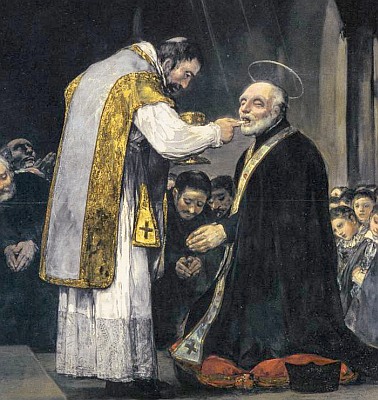
ST. JOSEPH CALASANZ - 26th August 2009
Joseph was born in 1556, in his father's castle in Spain. He went to college and became a lawyer. He was ordained a priest at the age of twenty-eight. Joseph was given high positions and he did his work well. Yet he felt that God was calling him to do some special work for poor children in Rome. Obedient to the Lord's call, he gave up everything he had in Spain and went to Rome. There his heart was filled with pity for all the orphans and homeless children he saw everywhere. They were ignorant and neglected. Joseph began to gather them together to teach them all the regular subjects, and especially their religion. Other priests joined him. Soon Joseph became the superior of a new religious order. But he never let his duties as founder and superior stop him from teaching his beloved children. He would even sweep the classrooms himself. He often led the little ones to their homes after school was over.
St. Joseph had much to suffer from people who tried to take over his order. They wanted to run it their way. Once he was even led through the streets like a criminal. He was almost put in jail, although the good priest had done nothing wrong. When he was ninety years old, the saint received terrible news. His order had been forbidden to continue in the way he had started it. Yet despite this suffering, Joseph only said: "The Lord gave and the Lord has taken away. Blessed be the name of the Lord. My work has been done simply out of love for God."
Two years later, in 1648, the saint died a calm, peaceful death. He was ninety-two years old. Several years afterward, his order, the Piarist Fathers, was allowed to continue St. Joseph's wonderful mission. He was proclaimed a saint by Pope Clement XIII in 1767. Pope Pius XII declared him patron of Christian schools in 1948.
Sometimes events or situations turn out differently from what we had planned. We might not be able to understand why. St. Joseph Calasanz shows us how to trust God and be patient. When we find that difficult, we can ask this saint to strengthen us.
Saturday, June 20, 2009
A Solemn Act of Consecration to the Immaculate Heart of Mary
Most Holy Virgin Mary, tender Mother of men, to fulfill the desires of the Sacred Heart of Jesus and the request of the Vicar of Your Son on earth, we consecrate ourselves and our families to your Sorrowful and Immaculate Heart, O Queen of the Most Holy Rosary, and we recommend to You, all the people of our country and all the world.
Please accept our consecration, dearest Mother, and use us as You wish to accomplish Your designs in the world.
O Sorrowful and Immaculate Heart of Mary, Queen of the Most Holy Rosary, and Queen of the World, rule over us, together with the Sacred Heart of Jesus Christ, Our King. Save us from the spreading flood of modern paganism; kindle in our hearts and homes the love of purity, the practice of a virtuous life, an ardent zeal for souls, and a desire to pray the Rosary more faithfully.
We come with confidence to You, O Throne of Grace and Mother of Fair Love. Inflame us with the same Divine Fire which has inflamed Your own Sorrowful and Immaculate Heart. Make our hearts and homes Your shrine, and through us, make the Heart of Jesus, together with your rule, triumph in every heart and home.
Amen.
Venerable Pope Pius XII
Thursday, May 28, 2009
St. Mary Ann of Jesus of Paredes - 28th May 2009
Friday, April 17, 2009
Bl. Kateri Tekakwitha - 17th April 2009
Kateri Tekakwitha, known as “the Lily of the Mohawk”, was born in 1656 of a captive Algonquin mother and an Iroquois chieftain. Her mother was a Christian but dared not baptize Kateri or her younger brother. When an epidemic of smallpox broke out in 1660, the little girl lost her mother and brother, perhaps also her father at that time; she herself nearly succumbed to the malady.
Her uncle, who adopted her, later wanted her to marry a young Iroquois her own age, but she refused, having already experienced the horror of the Iroquois brutalities. When in 1675 Father Jacques de Lamberville, Jesuit missionary, discovered on the banks of the Mohawk River this “beautiful lily”, he transplanted her to the mission of St. Francis Xavier near Montreal, which had been founded a few years before. She received her first Communion there on Christmas day of 1676.
In 1679, on the feast of the Annunciation, with the authorization of one of the Fathers at the mission, Kateri privately pronounced a vow of perpetual chastity and consecrated herself to the Blessed Virgin. From that time on, she and her rosary were inseparable. Her health had never been strong, and her penances contributed to weakening it further. It was during Holy Week of 1680 that this young Indian maiden quietly expired, invoking the names of Jesus and Mary. Miracles and favors were attributed to her soon after her death.
In 1943, Pope Pius XII admitted the cause of beatification, approving the decree on the heroism of her virtues. Saint Kateri had appeared to some Polish prisoners during World War II, telling them she was named a patron of their country and brought about their release. They described to the Jesuits of their own country, the young Indian girl whom they had all seen in their vision, and learned who she was — Kateri, Lily of the Mohawk, the Canadian Indian girl who had attained sanctity very young and died at the age of 24 years. She was beatified in 1980, canonized in 1991.
The oldest portrait of Kateri Tekakwitha is an oil painting on canvas 41"x37" painted by Father Chauchetière between 1682-1693. It hangs in the sacristy of St. Francis Xavier Church on the Kanawaké Mohawk Reservation on the south bank of the St. Lawrence River, near Montréal, Québec.
For more about this saint please refer to the following link
Monday, January 12, 2009
St. Marguerite Bourgeoys - 12th January 2009

On November 12, 1950 Pope Pius XII beatified Marguerite Bourgeoys. Canonizing her this October 31, 1982, Pope John Paul II gives the Canadian Church its first woman saint.
St. Marguerite Bourgeoys was born in Troyes, in the province of Champagne (France), on Good Friday, April 17, 1620. She was baptized on the same day in the church of Saint-Jean, a church that was located near her home. Marguerite was the sixth child in a family of twelve. Her parents were Abraham Bourgeoys and Guillemette Gamier, and she was privileged to grow up in a milieu that was middle class and thoroughly Christian.
Marguerite was nineteen years of age when she lost her mother. In the following year, 1640, in the course of a procession held on October 7 in honor of Our Lady of the Rosary, she had an unforgettable experience. Her eyes rested on a statue of the Blessed Virgin, and at that moment she felt inspired to withdraw from the world and to consecrate herself to the service of God. With that unchanging fidelity to what she believed to be God's will for her, a fidelity that characterized her life thenceforth, she set about to discern her specific vocation.
She registered, at once, as a member of the extern Congregation of Troyes, an association of young girls devoted to the charitable work of teaching children in the poor districts of the
town. While engaged in this apostolate she learned about the foundation of Ville Marie (Montreal) in Canada. The year was 1642, and at that time she sensed a first call to missionary life. This call was rendered concrete in 1652 when she met Monsieur de Maisonneuve, founder and governor of the settlement begun in New France, who was in search of someone who would volunteer her services for the gratuitous instruction of the French and Indian children. Our Lady confirmed the call addressed to her: "Go, I will not forsake you", she said. Thus assured, Marguerite left Troyes in February, 1653, in a spirit of complete detachment. She arrived in Montreal on the following 16th of November, and without delay she set to work to promote the best interests of the colony. She is rightly considered co-foundress of Montreal, with the nurse, Jeanne Mance, and the master designer, Monsieur de Maisonneuve.
In order to encourage the colonists in their faith expression, she arranged for the restoration of the Cross on Mount Royal after it has been destroyed by hostile Indians, and she undertook the construction of a chapel dedicated to Notre-Dame de Bon Secours. Convinced of the importance of the family in the building of this new country, and perceiving the significance of the role to be exercised by women, she devoted herself to the task of preparing those whose vocation it would be to preside in a home. In 1658, in a stable which had been given to her by the governor for her use, she opened the first school in Montreal. She also organized an extern Congregation, patterned after the one which she had known in Troyes but adapted to the actual needs. In this way, she could respond to the needs of the women and young girls on whom much depended as far as the instruction of children was concerned. In 1659, she began receiving girls who were recommended by "les cures" in France, or endowed by the King, to come to establish homes in Montreal, and she became a real mother to them. Thus were initiated a school system and a network of social services which gradually extended through the whole country, and which led people to refer to Marguerite as "Mother of the Colony".
On three occasions, Marguerite Bourgeoys made a trip to France to obtain help. As of
1658, the group of teachers who associated themselves with her in her life of prayer, of heroic poverty, and of untiring devotedness to the service of others, presented the image of a religious institute. The group was inspired by the "vie voyagere" of Our Lady, and desired to remain uncloistered, the concept of an uncloistered community being an innovation at that time. Such a foundation occasioned much suffering and the one who took the initiative was not spared. But the work progressed. The Congregation de Notre-Dame received its civil charter from Louis XIV in 1671, and canonical approbation by decree of the Bishop of Quebec in 1676. The Constitutions of the Community were approved in 1698.
The foundation having been assured, Sister Bourgeoys could leave the work to others. She died in Montreal on January 12, 1700, acknowledged for her holiness of life. Her last generous act was to offer herself as a sacrifice of prayer for the return to health of a young Sister. Forty memberg of the Congregation de Notre-Dame were there to continue her work.
The educative and apostolic efforts of Marguerite Bourgeoys continue through the commitment of the members of the community that she founded. More than 2,600 Sisters of the Congregation de Notre-Dame work in fields of action according to the needs of time and place - from school to college or university, in the promotion of family, parish and diocesan endeavours. They are on mission in Canada, in the United States, in Japan, in Latin America, in Cameroon, and most recently they have established a house in France.
Friday, October 10, 2008
Papal Texts regarding Abortion
Papal texts:
* "Those who hold the reins of government should not forget that it is the duty of public authority by appropriate laws and sanctions to defend the lives of the innocent, and this all the more so since those whose lives are endangered and assailed cannot defend themselves. Among whom we must mention in the first place infants hidden in the mother's womb. And if the public magistrates not only do not defend them, but by their laws and ordinances betray them to death at the hands of doctors or of others, let them remember that God is the Judge and Avenger of innocent blood which cries from earth to Heaven.”(1) Pius XI
* "But another very grave crime is to be noted, Venerable Brethren, which regards the taking of the life of the offspring hidden in the mother's womb. Some wish it to be allowed and left to the will of the father or the mother; others say it is unlawful unless there are weighty reasons which they call by the name of medical, social, or eugenic `indications.' . . . There are those, moreover, who ask that the public authorities provide aid for these death-dealing operations, a thing, which, sad to say, everyone knows is of very frequent occurrence in some places... What could ever be a sufficient reason for excusing in any way the direct murder of the innocent? This is precisely what we are dealing with here. Whether inflicted upon the mother or upon the child, it is against the precept of God and the law of nature: 'Thou shall not kill.' The life of each is equally sacred, and no one has the power, not even the public authority, to destroy it." (2) Pius XI
* "Moreover, every human being, even the child in its mother's womb, receives its right to life directly from God, not from his parents, nor from any human society or authority. Therefore there is no man, no human authority, no science, no 'indication' whether medical, eugenical, social, economic or moral, that can show or give a valid juridical title for a deliberate and direct disposing of an innocent human life, that is to say, for an action which aims at its destruction, whether such destruction be intended as an end or as a means towards some other end which may itself be in no way illicit. So, for example, to save the life of the mother is a most noble end, but the direct killing of the child as a means to that end is not lawful. The direct killing of the so-called 'valueless life,' whether born or unborn, which was practiced a few years ago in numerous instances, can in no way be justified." (3) Pius XII
* "Indeed, all must regard the life of man as sacred, since from its inception, it requires the action of God the Creator. Those who depart from this plan of God not only offend His divine majesty and dishonor themselves and the human race, but they also weaken the inner fiber of the commonwealth." (4) John XXIII
* "Vatican II reiterated the point: 'Abortion and infanticide are abominable crimes.' . . . The first and most fundamental right of man is the right to life, that is, to the protection of his life. And no one can have a contrary right where an innocent person is concerned. The weaker the subject is, the more he needs protection, and the more all have a duty to protect him. The mother is particularly accountable as long as she has the baby in her womb." (5) Paul VI
* "I do not hesitate to proclaim before you and before the world that all human life—from the moment of conception and through all subsequent stages—is sacred, because human life is created in the image and likeness of God. . . . Let me repeat what I told the people during my recent pilgrimage to my homeland: "If a person's right to life is violated at the moment in which he is first conceived in his mother's womb, an indirect blow is struck also at the whole of the moral order, which serves to ensure the inviolable goods of man. Among those goods, life occupies the first place. The Church defends the right to life not only in regard to the majesty of the Creator, who is the first giver of life, but also in respect to the essential good of the human person." (6) John Paul II
* "I wish to recall emphatically to your memory today only the following: the killing of unborn life is not a legitimate means of family planning. I repeat what I said on May 31st of this year to workers in the Parisian suburb of Saint-Denis: 'The first right of man is the right to life. We must defend this right and this value. In the contrary case, the whole logic of faith in man, the whole program of really human progress, would be shaken and collapse.' " (7) John Paul II
* "On my part I owe it to my apostolic office to reaffirm as clearly and as strongly as possible what the Church of Christ teaches in this respect, and to reiterate vigorously her condemnation of artificial contraception and abortion. Yes, from the moment of conception and through all subsequent stages, all human life is sacred, for it is created in the image and likeness of God." (8) John Paul II
* "Dear brothers and sisters: on this evening when we celebrate life, we are also mindful of the many threats to life which exist in our technological society. Of incalculable danger to all humanity is the rate of abortion in society today. This unspeakable crime against human life which rejects and kills life at its beginning sets the stage for despising, negating and eliminating the life of adults, and for attacking the life of society." (9) John Paul II
* "Over the last twenty years, many states have renounced their dignity as defenders of innocent human life, enacting laws permitting abortion. A real slaughter of the innocents is being carried out every day throughout the world ." (10) John Paul II
________________________
1. On Christian Marriage, St. Paul Editions, Boston, pp. 33-34.
2. Ibid., pp. 31-32.
3. Address of Pope Pius XII to the Italian Catholic Union of Midwives, The Clergy Review, vol. 36, no. 6, pp. 382-383.
4. Mater et Magistra, St. Paul Editions, Boston, p. 55.
5. The Pope Speaks, vol. 17, no. 1, pp. 334-335.
6. Homily at the Mass on the Capitol Mall, Washington, D.C., October 7, 1979, Sacred in All Its Forms, St. Paul Editions, Boston, pp. 160-161.
7. Homily at the Mass for families, in Cologne, Germany, November 15, 1980, Sacred in All Its Forms, St. Paul Editions, Boston, p. 196.
8. Homily at the Mass for families, in Cebu City, the Philippines, February 19, 1981, Sacred in All Its Forms, St. Paul Editions, Boston, p. 204.
9. Address to the youth, to the aging, and the disabled in Vancouver, B.C., L'Osservatore Romano, English edition, October 8, 1984, p. 17.
10. L'Osservatore Romano, English edition, April 11, 1988, p. 6.