Evil triumphs when good men do nothing - Edmund Burke
Showing posts with label Progressivism. Show all posts

Saturday, January 31, 2009

St. John Bosco - 31 January 2009


Today we celebrate the feast of St. John Bosco. Lets us read what Dr. Plinio has to say about this saint.

These are two excerpts from the book Some Pedagogical Ideas of Don Bosco.

• It is undisputable that the personality of Don Bosco’s mother, Mamma Margherita, influenced his formation. This woman, a widow at age 29, profoundly marked the souls of her three sons. She had little formal education but remarkably good sense. Her uprightness of judgment, great piety and virile firmness made her an exemplary educator. Margherita required her sons to work either in the house or the fields. From the break of dawn, after morning prayer the children worked hard all day long. “Life is too short to lose the best part of the day,” she would say.

Laziness was not permitted. The meals were simple and at night they slept on the floor. She never allowed self-complacence and had always her mind turned toward heaven: “We are soldiers of Christ always with our weapons ready, facing the enemy, and we must win,” she used to say. This is the way she prepared her sons for life.

• In addition to the work of his religious congregation, the building of churches, the foundation of numerous orphanages and preparing missions in faraway countries, Don Bosco dedicated time by day and night to write. He knew how to serve the Church with the pen, at times combating errors, at times strengthening souls. As a man of his time, he was aware of the great influence of that new modern giant, the press. He used his pen for more than 45 years producing a variety of works according to the needs of his fight.

When Protestantism launched offensive attacks against the Catholic Church with popular periodic brochures, Don Bosco countered with his Catholic Lectures, a monthly publication with timely articles and questions that responded to the Protestant propaganda.

(Mamma Margherita)
Comments of Prof. Plinio:

Let me comment on these excerpts one at a time.

Regarding Mamma Margherita, she fits the description of that strong woman of the Scripture who fulfills her duties and whose value is "far and from the uttermost coasts." She lived her life uprightly, she formed her sons perfectly, and one of them became the great St. John Bosco.

Her life offers proof of just how erroneous the progressivist mentality inundating the Church today is. Indeed, for this flawed mentality, anyone who has to bear hunger, cold and suffering cannot have a spiritual life. According to it, the first step is to do away with poverty and hunger. Only then can one begin to talk about a spiritual life. Therefore, the beginning of all apostolate is this material action. Doing away with poverty becomes, then, one of the main if not the principal ends of the Catholic Church.

The life of Mamma Margherita demonstrates precisely the opposite. Her house was so poor that all the members of the family slept on the floor; the meals were frugal; the family members were subjected to much hard work. They led a typical poor life. Notwithstanding, she knew how to profit from this life and sanctified it by means of fortitude and the spirit of abnegation and sacrifice. Despite the poverty of the family, she saw to their material needs: her sons became strong men, capable of all kinds of work. At the same time, and this is what is important for us to note, she also took good care of their spiritual lives.

You see how Progressivism lies and fools Catholics when it implies that soft, comfortable conditions are indispensable for sanctity. This is completely wrong. Austerity, not softness, is what is needed.. This austerity must be observed in the formation of every family, even those of high levels with many resources.

In Europe this austerity was maintained in the formation of children and youth until some time ago. In the memoirs of the Duke of Nemours or the Duke of Alençon – I don’t remember which – it tells about the time when he was in London, exiled from France. He was young and lived with several other noble young men in the same house along the River Thames. The windows of their large bedroom were on the second floor opening straight out to the Thames. He wrote that when they would wake in the morning, it was their habit to jump out the window into the Thames. They would all do this every morning in the winter. This shows how they were accustomed to austerity. It is an example that comes to my mind on austerity in the formation of nobles. I wonder how many bad consequences would have been avoided if austerity were imposed in the formation of the youth of today’s wealthy families.

Regarding the second excerpt, it is interesting to observe how St. John Bosco was always aware of the problems of his times. He was not a saint living in the clouds, as sentimental hagiographies depict many saints. St. John Bosco knew the problems of his time and combated the enemies of the Church as they actually were. When the Protestant propaganda became strong in north Italy, he developed an effective intellectual action against it.

Today most people have a revolutionary understanding of what is important. They think that the economic means is more important than intellectual skills, and that the material is greater than the spiritual. For this reason, when they speak about St. John Bosco, they tend to stress his works of social assistance, and underplay his intellectual work. I also praise and recognize the importance of the foundations he made to help poor boys and give them a good formation, but I don’t agree that he should be remembered primarily for those works.

When you examine his life, you see that he spent a large number of years writing; therefore, he was as much a writer as a man of outside activity. It is why he joins St. Francis de Sales as one of the two patron saints of the press. It is good for us to stress this point that sets things aright.

Let us ask St. John Bosco to give us the spirit of austerity he had and protect our intellectual work and our Catholic journalism.


Tuesday, September 30, 2008

St. Jerome - 30th September 2008

It is the end of the month and today we celebrate the feast of St. Jerome. Let us read the commentary about this saint from Dr. Plinio Correa

(Under the Altar of St. Jerome is the resting site for the body of Bl. John XXIII.)


St. Jerome, Confessor and Doctor of the Church (c. 341-420) is considered the Church’s greatest Doctor of Scriptures.

He conferred this praise upon St. Augustine: “As I have done, you applied all your energy to make the enemies of the Church your personal enemies.” This eulogy is consistent with the counsel of St. Augustine: “You must hate the evil, but love the one who errs.”

Regarding St. Jerome the Roman Breviary says: “He pummeled the heretics with his most harsh writings.”

Comments of Prof. Plinio:

In the Catholic Church, St. Jerome is the representative par excellence of the polemical spirit, and in this sense he is a symbol against progressivist ecumenical dialogue. His writings are so straightforward, energetic, and intransigent that some people imagine that a saint could not write as he did. Almost everyone of his time trembled before him.

Once St. Augustine, with whom he had an ongoing correspondence, amiably told him that with half the energy St. Jerome used in one of his letters, he would already be convinced of his argument. I also remember that once I read that a pious lady sent St. Jerome a gift: some young doves and a basket of cherries. He wrote back asking her what she was thinking when she sent those delicate things to him. He was suspicious that she might want to corrupt the austerity of his penitent life. He immediately gave the presents to the poor.

One of my first encounters with Progressivism was with the reformist liturgical mentality that was being accepted by many monks in the Benedictine Monastery in Sao Paulo. I was talking with the Abbot and he told me that some works of St. Jerome were being read in the refectory of the monastery during the midday meal. He commented that the monks had become furious over the readings. In my naiveté, I thought that their hatred was directed toward the heretics St. Jerome combated, but I soon realized that I was wrong. Their hatred was against St. Jerome himself, because they had sympathy for the heretics.

The combativity of St. Jerome was an expression of his consuming zeal for the House of God. This kind of militancy is one of the most legitimate and saintly expressions of that zeal. Since his energy was inspired by love for God and not by personal resentments, it was a very holy thing. If force is exerted because of personal resentments, it is a completely different thing.

That saintly militancy made him a living sword of God. I know of no higher praise than to say that a man is the living sword of God, cutting, piercing, wounding, and destroying His enemies. St. Jerome represents the pinnacle of the polemic spirit, and as such he is the Patron Saint of the counter-revolutionary fight

His eulogy of St. Augustine about how he made the Church’s enemies his personal enemies is remarkable. It is one saint praising another one, and for this reason it can be said that the eulogy reflects the sanctity of the Church. The selection points out well that this aspect harmonizes perfectly with another apparently contrary one that can be seen in other words of St. Augustine: “We must hate evil, but love those who err.”

Today it is important that we have a clear understanding of what it means to love those who err. It is a liberal and ecumenical simplification to say that if one vigorously attacks those who err, he is harming these persons or showing a lack of charity. There are three reasons why this is not the case:

First, when a person is in grave danger of falling into an abyss, the right thing to do is to shout at him and say, “Be careful, you are at the edge of the cliff and if you fall, you will crack your head and die.” It would not be sensible to speak mildly, saying: “Hello there, I am standing in a much better place than you. Why don’t you come join me?”

This would be a foolish way to keep the man from falling into the abyss. The right way to rescue a man from danger is not to show the positive side of your position, but to expose the danger of his position and the imprudence of remaining in it.

Which one of you, seeing a man imprudently playing with a loaded gun and having his finger on the trigger, would gently suggest he play chess with you instead? It is a foolish attitude. The right thing is to address him sternly: “Look, stop playing with that gun or you might hurt yourself or me.” A man who is tempted to do something wrong needs to be addressed with words that inspire fear.

This is true above all when we deal with Catholic doctrine. Men are more easily moved by fear of bad consequences they can experience than a possible good they may enjoy. They are more easily moved by fear of Hell than by love of Heaven. Therefore, in order to convert a man, it is more charitable and expedient for us to first point out his error and its bad consequences, and then speak about the beauty and goodness of the truth. St. Jerome was a model of this way of acting.

I know that some rare souls may be touched by sweetness rather than combativity, but this is not the rule. It is the exception to the rule. God gives His Church saints who have special charismas to attract with amiability, such as St. Francis of Sales, who drew souls by his sweetness. However, the rule is to attack the evil to convert the person, as St. Jerome did.

Second, another simplification that the liberal and ecumenical spirit does not consider is that when we debate a heretic, a Protestant pastor for example, our primary goal is not to convert him, but to confirm in their Faith the Catholics who are following the debate and help them to not be contaminated by the Protestant errors. To this end, it is extremely advantageous to defeat the heretic.

The secondary goal of the debate is to convert the Protestants who are also following the debate and are not as obstinate in error as the pastor. The third and last aim is the conversion of the Protestant pastor, which should also be seriously considered. This is the correct hierarchy of aims in a debate of a Catholic with a Protestant. The progressivists simplify the topic enormously by saying that it is just a debate between A and B, and that the most efficient way to convert B is to smile and make concessions. It is not like that. By ignoring the two most important goals of the debate, a trap is set to lead people into a more progressivist and ecumenical mentality

Third, Our Lord, the divine model of sanctity, did not act with conciliation when he debated with the Pharisees. Instead, he called them as a generation of vipers, sons of Satan, whited sepulchers, etc. Also, when He came upon the money-changers in the Temple, He became indignant and used a whip to physically drive them out. That is, He used not only energy in the polemic against evil people, but He also used physical violence to punish the profaners.

The militant and polemic spirit of the great St. Jerome gives us the opportunity to see how Progressivism and the ecumenical spirit are sabotaging Catholic militancy everywhere. Today almost no one hears this Catholic doctrine taught in its entirety.

The progressivist Church avoids this teaching because it wants to push its agenda of ecumenism tending toward a spurious Pan-Religion.

We should certainly ask St. Jerome to help us in our counter-revolutionary polemics, but we should also and primarily ask him to help us destroy this liberal mentality that opens the door for the evil that is assaulting and taking over the entire Church.

Thursday, August 28, 2008

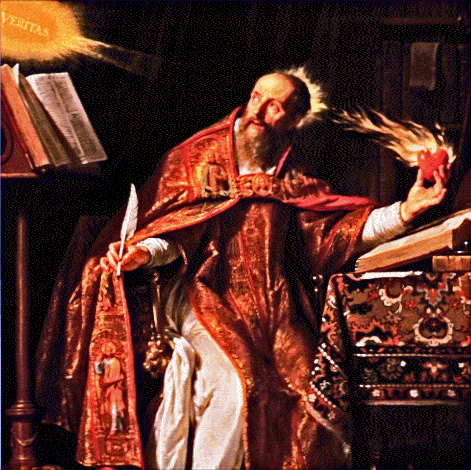
Feast of St. Augustine 28 August 2008

Today we celebrate the fest of St. Augustine. I like St. Augustine, because as a saint he shows the mercy and goodness of God. St. Augustine before his conversion was a very worldly man. He has an illegitimate son, was an intellectual giant and was generally having what we 20th century moderns call a good time.
If one reads the Confessions one will realize that despite having a mighty good time deep inside he was seeking the truth. Most of us go through this. I like At Augustine because he seems so human and yet after his conversion we see the greatness of his transformation all because of the mercy and love of God.
At times of despair one need only think of what St. Augustine was pre conversion to what he became post conversion and realize what God is capable of if only we let him and this is enough to lift one out of the despair.
Let us now consider the words of Dr. Plinio.


Comments of Prof. Plinio:

Reading the works of St. Augustine is one of the greatest pleasures a man can have. The Confessions is a wonderful and highly edifying book from many points of view. In it, St. Augustine describes the moral abysses of pride and sensuality into which he had fallen and narrates how he turned away from his innumerable sins. Then he relates his first contacts with St. Ambrose and how the light of the Catholic Religion began to enter his soul through the presence of St. Ambrose.

He expresses his enthusiasm for the Bishop of Milan and his visits to him. St. Augustine could not speak often with St. Ambrose since the Bishop was usually busy writing and studying, but he would remain there just to watch St. Ambrose at his work. The latter knew that his presence was making a better apostolate with St. Augustine than his words would do.

You can imagine the scene. St. Ambrose, the great Doctor of the Church, writing in an infolio, his features those of a venerable old man, placid, enlightened by the grace of God, wise, recollected, sublime in his judgments. Once in a while, he would stop to make a short interior prayer, then he would return to his thinking until he reached the final conclusion. Observing him was St. Augustine, whose face still reflected the turbulence of the crisis through which he was passing. But the grace of God was entering the soul of St. Augustine and transforming his personality through his admiration for St. Ambrose.

And so he goes on to narrate his interior crisis, the peace he experienced upon entering the church and hearing the sacred music, the psalms, the beauty of God’s worship. Then his strong movements of repentance and the voice he heard ordering him: Tolle et lege – take it and read. He took up Sacred Scriptures and the page opened to a verse that applied perfectly to his past life ["Not in riots and drunken parties, not in eroticisms and indecencies, not in strife and rivalry, but put on the Lord Jesus Christ and make no provision for the flesh in its lusts" (Romans 13:13-14)]. He received a decisive grace that completed his conversion.

Further on he describes the famous colloquium at Ostia with St. Monica, his mother. She was a very holy woman, while he had been a very bad son. When they were in Carthage preparing for a voyage to Rome, St. Monica went to a church and spent the night praying there. Augustine took advantage of the opportunity to flee from her and embarked for Rome by himself, leaving her alone.

Afterward she followed him, always weeping and praying for his conversion. Once she went to the Bishop of Milan, St. Ambrose, to ask him if her son would ever convert. He replied to her with those famous words: “Woman, the child of so many tears shall never perish." That is, she would see his rebirth through her intense and profound suffering.

You can imagine her joy when her son converted. St. Augustine and his mother spent some months together as he prepared for his Baptism. Then they planned to return to Africa. Before embarking on the voyage, they stayed at an inn in Ostia, a port city near Rome on the Mediterranean Sea. Standing at a window watching the sea, they began to converse about heavenly things.

One who reads this conversation between the saintly mother and son realizes they were experiencing a supernatural ecstasy. This gave him strength for the fights ahead he would have to face. For her it was a pre-taste of Heaven, because she would die there in Ostia, before the ship departed. He describes movingly how he assisted at her funeral. Then he went to Africa and became the Bishop of Hippo.

In Hippo, he wrote another of his great books The City of God. The theme of that extraordinary work is the perpetual and irreconcilable fight that takes place between the two cities in History – the city he speaks of comes from the Latin, civitas, and should be understood more as a state. These two cities are the City of God and the City of the Devil. He conceives all History as a battle between the Catholic Church and the power of darkness. The struggle results from two different loves. In the City of God there is the love of God to the oblivion of oneself; in the city of man, or City of the Devil, there is the love of oneself to the oblivion of God.

To live for self is to consider oneself the minuscule center of the universe, with everything turned toward one’s own pleasures and interests. This egotism is the starting point for every bad thing. On the contrary, to love God is to turn oneself entirely toward the transcendent realities we find in Revelation. It is to have a metaphysical spirit, a religious spirit turned toward the highest things. This is to live for God. With these two principles, he summarizes all of History.

An analogous philosophy of History is taught by St. Louis Grignion de Monfort. He argues that everything God does is good. Since the enmity between Our Lady and the serpent, and therefore between her spiritual descendents and those of the serpent, was decreed by God, this enmity is also good. It is the same thesis of St. Augustine, with more combativeness.

Because of this unequivocal presentation of good and evil, Progressivism attacks St. Augustine today by saying that he was Manichean. According to this stupid accusation everyone who admits that there is good and evil would be a Manichean. It is nonsensical because the Magisterium of the Catholic Church has always admitted the existence of good and evil, as have all of her Saints. If this were the only criterium, then they would all be Manichean. It is absurd!

In passing, let me say that Manichaeism was a Gnostic doctrine that appeared in the first centuries of the Church proposing that there would be two gods equal in origin and power, a good one and a bad one, in constant struggle against each other. Catholic doctrine says something completely different. It says that there is only one God, Eternal and Omnipotent, and that the Devil, a mere creature, revolted against Him and fights Him throughout History.

The heresy of Manichaeism supposes a different order of being than what Catholic doctrine teaches. For the former, the fight is on the ontological level; for the latter it is in the moral sphere. Also according to Manichaeism the fight will never end; in Catholic doctrine the fight ends at the Last Judgment when God will eternally triumph over his infinitely inferior enemy. Progressivism is aware of these differences, but still continues to spread that anyone who doesn’t support its ecumenism is a Manichaean. It is an absurd affirmation and a manifestation of bad faith.

There is a very beautiful point to consider about St. Augustine. He wrote his books as the Roman Empire of the West was falling, when everything pointed to the probability that the Catholic Religion would be swept from the earth after the barbarian invasions. In fact, Hippo and Carthage in North Africa were so devastated that almost nothing was left of these cities and the Catholic Religion did not re-establish itself in that area. Notwithstanding, St. Augustine serenely wrote his books for a future that was uncertain. He died as the Vandals were entering his city.

The world he knew fell; the Middle Ages came. And then it was the works of St. Augustine that inspired the medieval conception of State, Empire, and Christendom. Charlemagne used to listen to the reading of the City of God during his meals, and the Empire he founded was inspired directly by St. Augustine. The Middle Ages, in a certain way is a lily born from the works of St. Augustine. Centuries after his death, his confidence was rewarded.

There is a lesson for us in this. In our times when the new Vandals are destroying both the cultural values and material buildings of Christian Civilization, we should carry on our work with faith and confidence, knowing that it will serve to build the Reign of Mary when God so decides.