Evil triumphs when good men do nothing - Edmund Burke

Thursday, November 13, 2008

SAINT FRANCES XAVIER CABRINI - 13th November 2008


Mother Cabrini was the foundress of the Missionary Sisters of the Sacred Heart and pioneer worker for the welfare of dispersed Italian nationals, this diminutive nun was responsible for the establishment of nearly seventy orphanages, schools, and hospitals, scattered over eight countries in Europe, North, South, and Central America.

Francesca Cabrini was born on July 15, 1850, in the village of Sant' Angelo, on the outskirts of Lodi, about twenty miles from Milan, in the pleasant, fertile Lombardy plain. She was the thirteenth child of a farmer's family, her father Agostino being the proprietor of a modest estate. The home into which she was born was a comfortable, attractive place for children, with its flowering vines, its gardens, and animals; but its serenity and security was in strong contrast with the confusion of the times. Italy had succeeded in throwing off the Austrian yoke and was moving towards unity. Agostino and his wife Stella were conservative people who took no part in the political upheavals around them, although some of their relatives were deeply concerned in the struggle, and one, Agostino Depretis, later became prime minister. Sturdy and pious, the Cabrinis were devoted to their home, their children, and their Church. Signora Cabrini was fifty-two when Francesca was born, and the tiny baby seemed so fragile at birth that she was carried to the church for baptism at once. No one would have ventured to predict then that she would not only survive but live out sixty-seven extraordinarily active and productive years. Villagers and members of the family recalled later that just before her birth a flock of white doves circled around high above the house, and one of them dropped down to nestle in the vines that covered the walls.

The father took the bird, showed it to his children, then released it to fly away.

Since the mother had so many cares, the oldest daughter, Rosa, assumed charge of the newest arrival. She made the little Cecchina, for so the family called the baby, her companion, carried her on errands around the village, later taught her to knit and sew, and gave her religious instruction. In preparation for her future career as a teacher, Rosa was inclined to be severe. Her small sister's nature was quite the reverse; Cecchina was gay and smiling and teachable. Agostino was in the habit of reading aloud to his children, all gathered together in the big kitchen. He often read from a book of missionary stories, which fired little Cecchina's imagination. In her play, her dolls became holy nuns. When she went on a visit to her uncle, a priest who lived beside a swift canal, she made little boats of paper, dropped violets in them, called the flowers missionaries, and launched them to sail off to India and China. Once, playing thus, she tumbled into the water, but was quickly rescued and suffered only shock from the accident.

At thirteen Francesca was sent to a private school kept by the Daughters of the Sacred Heart. Here she remained for five years, taking the course that led to a teacher's certificate. Rosa had by this time been teaching for some years. At eighteen Francesca passed her examinations, , and then applied for admission into the convent, in the hope that she might some day be sent as a teacher to the Orient. When, on account of her health, her application was turned down, she resolved to devote herself to a life of lay service. At home she shared wholeheartedly in the domestic tasks. Within the next few years she had the sorrow of losing both her parents. An epidemic of smallpox later ran through the village, and she threw herself into nursing the stricken. Eventually she caught the disease herself, but Rosa, now grown much gentler, nursed her so skillfully that she recovered promptly, with no disfigurement. Her oval face, with its large expressive blue eyes, was beginning to show the beauty that in time became so striking.

Francesca was offered a temporary position as substitute teacher in a village school, a mile or so away. Thankful for this chance to practice her profession, she accepted, learning much from her brief experience. She then again applied for admission to the convent of the Daughters of the Sacred Heart, and might have been accepted, for her health was now much improved. However, the rector of the parish, Father Antonio Serrati, had been observing her ardent spirit of service and was making other plans for her future. He therefore advised the Mother Superior to turn her down once more.

Father Serrati, soon to be Monsignor Serrati, was to remain Francesca's lifelong friend and adviser. From the start he had great confidence in her abilities, and now he gave her a most difficult task. She was to go to a disorganized and badly run orphanage in the nearby town of Cadogno, called the House of Providence. It had been started by two wholly incompetent laywomen, one of whom had given the money for its endowment. Now Francesca was charged "to put things right," a large order in view of her youth-she was but twenty-four-and the complicated human factors in the situation. The next six years were a period of training in tact and diplomacy, as well as in the everyday, practical problems of running such an institution. She worked quietly and effectively, in the face of jealous opposition, devoting herself to the young girls under her supervision and winning their affection and cooperation. Francesca assumed the nun's habit, and in three years took her vows. By this time her ecclesiastical superiors were impressed by her performance and made her Mother Superior of the institution. For three years more she carried on, and then, as the foundress had grown more and more erratic, the House of Providence was dissolved. Francesca had under her at the time seven young nuns whom she had trained. Now they were all homeless.

At this juncture the bishop of Lodi sent for her and offered a suggestion that was to determine the nun's life work. He wished her to found a missionary order of women to serve in his diocese. She accepted the opportunity gratefully and soon discovered a house which she thought suitable, an abandoned Franciscan friary in Cadogno. The building was purchased, the sisters moved in and began to make the place habitable. Almost immediately it became a busy hive of activity. They received orphans and foundlings, opened a day school to help pay expenses, started classes in needlework and sold their fine embroidery to earn a little more money. Meanwhile, in the midst of superintending all these activities, Francesca, now Mother Cabrini, was drawing up a simple rule for the institute. As one patron, she chose St. Francis de Sales, and as another, her own name saint, St. Francis Xavier. The rule was simple, and the habit she devised for the hard-working nuns was correspondingly simple, without the luxury of elaborate linen or starched headdress. They even carried their rosaries in their pockets, to be less encumbered while going about their tasks. The name chosen for the order was the Missionary Sisters of the Sacred Heart.

With the success of the institute and the growing reputation of its young founder, many postulants came asking for admission, more than the limited quarters could accommodate. The nuns' resources were now, as always, at a low level; nevertheless, expansion seemed necessary. Unable to hire labor, they undertook to be their own builders. One nun was the daughter of a bricklayer, and she showed the others how to lay bricks. The new walls were actually going up under her direction, when the local authorities stepped in and insisted that the walls must be buttressed for safety. The nuns obeyed, and with some outside help went on with the job, knowing they were working to meet a real need. The townspeople could not, of course, remain indifferent in the face of such determination. After two years another mission was started by Mother Cabrini, at Cremona, and then a boarding school for girls at the provincial capital of Milan. The latter was the first of many such schools, which in time were to become a source of income and also of novices to carry on the ever-expanding work. Within seven years seven institutions of various kinds, each founded to meet some critical need, were in operation, all staffed by nuns trained under Mother Cabrini.

In September, 1887, came the nun's first trip to Rome, always a momentous event in the life of any religious. In her case it was to mark the opening of a much broader field of activity. Now, in her late thirties, Mother Cabrini was a woman of note in her own locality, and some rumors of her work had undoubtedly been carried to Rome. Accompanied by a sister, Serafina, she left Cadogno with the dual purpose of seeking papal approval for the order, which so far had functioned merely on the diocesan level, and of opening a house in Rome which might serve as headquarters for future enterprises. While she did not go as an absolute stranger, many another has arrived there with more backing and stayed longer with far less to show.

Within two weeks Mother Cabrini had made contacts in high places, and had several interviews with Cardinal Parocchi, who became her loyal supporter, with full confidence in her sincerity and ability. She was encouraged to continue her foundations elsewhere and charged to establish a free school and kindergarten in the environs of Rome. Pope Leo XIII received her and blessed the work. He was then an old man of seventy-eight, who had occupied the papal throne for ten years and done much to enhance the prestige of the office. Known as the "workingman's Pope" because of his sympathy for the poor and his series of famous encyclicals on social justice, he was also a man of scholarly attainments and cultural interests. He saw Mother Cabrini on many future occasions, always spoke of her with admiration and affection, and sent contributions from his own funds to aid her work.

A new and greater challenge awaited the intrepid nun, a chance to fulfill the old dream of being a missionary to a distant land. A burning question of the day in Italy was the plight of Italians in foreign countries. As a result of hard times at home, millions of them had emigrated to the United States and to South America in the hope of bettering themselves. In the New World they were faced with many cruel situations which they were often helpless to meet. Bishop Scalabrini had written a pamphlet describing their misery, and had been instrumental in establishing St. Raphael's Society for their material assistance, and also a mission of the Congregation of St. Charles Borromeo in New York. Talks with Bishop Scalabrini persuaded Mother Cabrini that this cause was henceforth to be hers.

In America the great tide of immigration had not yet reached its peak, but a steady stream of hopeful humanity from southern Europe, lured by promises and pictures, was flowing into our ports, with little or no provision made for the reception or assimilation of the individual components. Instead, the newcomers fell victim at once to the prejudices of both native-born Americans and the earlier immigrants, who had chiefly been of Irish and German stock. They were also exploited unmercifully by their own padroni, or bosses, after being drawn into the roughest and most dangerous jobs, digging and draining, and the almost equally hazardous indoor work in mills and sweatshops. They tended to cluster in the overcrowded, disease-breeding slums of our cities, areas which were becoming known as "Little Italies." They were in America, but not of it. Both church and family life were sacrificed to mere survival and the struggle to save enough money to return to their native land. Cut off from their accustomed ties, some drifted into the criminal underworld. For the most part, however, they lived forgotten, lonely and homesick, trying to cope with new ways of living without proper direction. "Here we live like animals," wrote one immigrant; "one lives and dies without a priest, without teachers, and without doctors." All in all, the problem was so vast and difficult that no one with a soul less dauntless than Mother Cabrini's would have dreamed of tackling it.

After seeing that the new establishments at Rome were running smoothly and visiting the old centers in Lombardy, Mother Cabrini wrote to Archbishop Corrigan in New York that she was coming to aid him. She was given to understand that a convent or hostel would be prepared, to accommodate the few nuns she would bring.

Unfortunately there was a misunderstanding as to the time of her arrival, and when she and the seven nuns landed in New York on March 31, 1889, they learned that there was no convent ready. They felt they could not afford a hotel, and asked to be taken to an inexpensive lodging house. This turned out to be so dismal and dirty that they avoided the beds and spent the night in prayer and quiet thought. But the nuns were young and full of courage; from this bleak beginning they emerged the next morning to attend Mass. Then they called on the apologetic archbishop and outlined a plan of action. They wished to begin work without delay. A wealthy Italian woman contributed money for the purchase of their first house, and before long an orphanage had opened its doors there. So quickly did they gather a house full of orphans that their funds ran low; to feed the ever-growing brood they must go out to beg. The nuns became familiar figures down on Mulberry Street, in the heart of the city's Little Italy. They trudged from door to door, from shop to shop, asking for anything that could be spared—food, clothing, or money.

With the scene surveyed and the work well begun, Mother Cabrini returned to Italy in July of the same year. She again visited the foundations, stirred up the ardor of the nuns, and had another audience with the Pope, to whom she gave a report of the situation in New York with respect to the Italian colony. Also, while in Rome, she made plans for opening a dormitory for normal-school students, securing the aid of several rich women for this enterprise. The following spring she sailed again for New York, with a fresh group of nuns chosen from the order. Soon after her arrival she concluded arrangements for the purchase from the Jesuits of a house and land, now known as West Park, on the west bank of the Hudson. This rural retreat was to become a veritable paradise for children from the city's slums. Then, with several nuns who had been trained as teachers, she embarked for Nicaragua, where she had been asked to open a school for girls of well-to-do families in the city of Granada. This was accomplished with the approbation of the Nicaraguan government, and Mother Cabrini, accompanied by one nun, started back north overland, curious to see more of the people of Central America. They traveled by rough and primitive means, but the journey was safely achieved. They stopped off for a time in New Orleans and did preparatory work looking to the establishment of a mission. The plight of Italian immigrants in Louisiana was almost as serious as in New York. On reaching New York she chose a little band of courageous nuns to begin work in the southern city. They literally begged their way to New Orleans, for there was no money for train fare. As soon as they had made a very small beginning, Mother Cabrini joined them. With the aid of contributions, they bought a tenement which became known as a place where any Italian in trouble or need could go for help and counsel. A school was established which rapidly became a center for the city's Italian population. The nuns made a practice too of visiting the outlying rural sections where Italians were employed on the great plantations.

The year that celebrated the four hundredth anniversary of Columbus' voyage of discovery, 1892, marked also the founding of Mother Cabrini's first hospital. At this time Italians were enjoying more esteem than usual and it was natural that this first hospital should be named for Columbus. Earlier Mother Cabrini had had some experience of hospital management in connection with the institution conducted by the Congregation of St. Charles Borromeo, but the new one was to be quite independent. With an initial capital of two hundred and fifty dollars, representing five contributions of fifty dollars each, Columbus Hospital began its existence on Twelfth Street in New York. Doctors offered it their services without charge, and the nuns tried to make up in zeal what they lacked in equipment. Gradually the place came to have a reputation that won for it adequate financial support. It moved to larger quarters on Twentieth Street, and continues to function to this day.

Mother Cabrini returned to Italy frequently to oversee the training of novices and to select the nuns best qualified for foreign service. She was in Rome to share in the Pope's Jubilee, celebrating his fifty years as a churchman. Back in New York in 1895, she accepted the invitation of the Archbishop of Buenos Aires to come down to Argentina and establish a school. The Nicaraguan school had been forced to close its doors as a result of a revolutionary overthrow of the government, and the nuns had moved to Panama and opened a school there. Mother Cabrini and her companion stopped to visit this new institution before proceeding by water down the Pacific Coast towards their destination. To avoid the stormy Straits of Magellan they had been advised to make the later stages of the journey by land, which meant a train trip from the coast to the mountains, across the Andes by mule-back, then another train trip to the capital. The nuns looked like Capuchin friars, for they wore brown fur-lined capes. On their unaccustomed mounts, guided by muleteers whose language they hardly understood, they followed the narrow trail over the backbone of the Andes, with frightening chasms below and icy winds whistling about their heads. The perilous crossing was made without serious mishap. On their arrival in Buenos Aires they learned that the archbishop who had invited them to come had died, and they were not sure of a welcome. It was not long, however, before Mother Cabrini's charm and sincerity had worked their usual spell, and she was entreated to open a school. She inspected dozens of sites before making a choice. When it came to the purchase of land she seemed to have excellent judgment as to what location would turn out to be good from all points of view. The school was for girls of wealthy families, for the Italians in Argentina were, on the average, more prosperous than those of North America. Another group of nuns came down from New York to serve as teachers. Here and in similar schools elsewhere, today's pupils became tomorrow's supporters of the foundations.

Not long afterward schools were opened in Paris, in England, and in Spain, where Mother Cabrini's work had the sponsorship of the queen. From the Latin countries in course of time came novice teachers for the South American schools. Another southern country, Brazil, was soon added to the lengthening roster, with establishments at Rio de Janeiro and Sao Paulo. Back in the United States Mother Cabrini started parochial schools in and around New York and an orphanage at Dobbs Ferry. In 1899 she founded the Sacred Heart Villa on Fort Washington Avenue, New York, as a school and training center for novices. In later years this place was her nearest approach to an American home. It is this section of their city that New Yorkers now associate with her, and here a handsome avenue bears her name.

Launching across the country, Mother Cabrini now extended her activities to the Pacific Coast. Newark, Scranton, Chicago, Denver, Seattle, Los Angeles, all became familiar territory. In Colorado she visited the mining camps, where the high rate of fatal accidents left an unusually large number of fatherless children to be cared for. Wherever she went men and women began to take constructive steps for the remedying of suffering and wrong, so powerful was the stimulus of her personality. Her warm desire to serve God by helping people, especially children, was a steady inspiration to others. Yet the founding of each little school or orphanage seemed touched by the miraculous, for the necessary funds generally materialized in some last-minute, unexpected fashion.

In Seattle, in 1909, Mother Cabrini took the oath of allegiance to the United States and became a citizen of the country. She was then fifty-nine years old, and was looking forward to a future of lessened activity, possibly even to semi-retirement in the mother house at Cadogno. But for some years the journeys to and fro across the Atlantic went on; like a bird, she never settled long in one place. When she was far away, her nuns felt her presence, felt she understood their cares and pains. Her modest nature had always kept her from assuming an attitude of authority; indeed she even deplored being referred to as "head" of her Order. During the last years Mother Cabrini undoubtedly pushed her flagging energies to the limit of endurance. Coming back from a trip to the Pacific Coast in the late fall of 1917, she stopped in Chicago. Much troubled now over the war and all the new problems it brought, she suffered a recurrence of the malaria contracted many years before. Then, while she and other nuns were making preparations for a children's Christmas party in the hospital, a sudden heart attack ended her life on earth in a few minutes. The date was December 22, and she was sixty-seven. The little nun had been the friend of three popes, a foster-mother to thousands of children, for whom she had found means to provide shelter and food; she had created a flourishing order, and established many institutions to serve human needs.

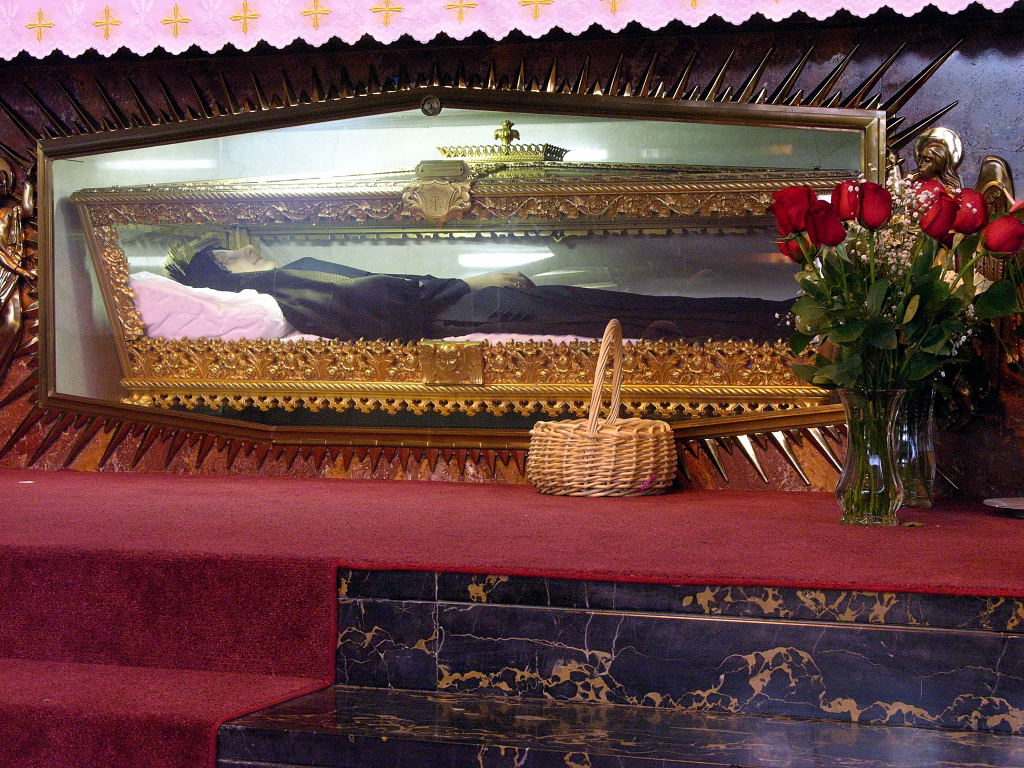
It was not surprising that almost at once Catholics in widely separated places began saying to each other, "Surely she was a saint." This ground swell of popular feeling culminated in 1929 in the first official steps towards beatification. Ten years later she became Blessed Mother Cabrini, and Cardinal Mundelein, who had officiated at her funeral in Chicago, now presided at the beatification. Heralded by a great pealing of the bells of St. Peter's and the four hundred other churches of Rome, the canonization ceremony took place on July 7, 1946. Hundreds of devout Catholics from the United States were in attendance, as well as the highest dignitaries of the Church and lay noblemen. Saint Frances Xavier Cabrini, the first American to be canonized, lies buried under the altar of the chapel of Mother Cabrini High School in New York City.

(Courtesy EWTN)
Wednesday, November 12, 2008

Saint Josaphat - 12th November 2008


In 1054, a formal split called a schism took place between the Eastern Church centered in Constantinople and the Western Church centered in Rome. Trouble between the two had been brewing for centuries because of cultural, political, and theological differences.

More than five centuries later, in what is now known as Belarus and Ukraine, but what was then controlled by Poland-Lithuania, the metropolitan of Kyiv and five other bishops decided to commit the millions of Christians under their pastoral care to reunion with Rome. Josaphat Kunsevich who was born in 1580 or 1584 was still a young boy when the Synod of Brest-Litovsk took place in 1595-96, but he was witness to the results both positive and negative.

Many of the faithful did not agree with the bishop’s decision to return to communion with Rome and both sides tried to resolve this disagreement not only with words but with violence. Martyrs died on both sides. Josaphat was a voice of Christian peace in this dissent.

After an apprenticeship to a merchant, Josaphat turned down a partnership in the business and entered the monastery of the Holy Trinity at Vilna in 1604. Within the monastery he found a soul mate in Joseph Benjamin Rutsky. Rutsky shared the young Josaphat's passion to work for reunion with Rome. Rutsky eventually became the metropolitan of Kyiv and Josaphat the abbot at Vilna.

Josaphat faced problems when he became first bishop of Vitebsk and then Polotsk in 1617. The church there was literally and figuratively in ruins with buildings falling apart, clergy marrying two or three times, and monks and clergy everywhere not really interested in pastoral care or model Christian living. Within three years, Josaphat rebuilt the church by holding synods, publishing a catechism to be used all over, and enforcing rules of conduct for clergy. But his most compelling argument was his own life which he spent preaching, instructing others in the faith, visiting the needy of the towns.

Despite all his work and the respect he had, dissenters found fertile ground with they set up their own bishops in the exact same area. Meletius Smotritsky was named his rival archbishop of Polotsk. Riots broke out when the King of Poland Sigismund III Vasa named Josaphat the only legitimate archbishop. His former diocese of Vitebsk turned completely against the reunion along with two other cities.

Another problem was that the very Catholics he looked to for communion opposed him as well. Catholics who should have been his support didn't like the way he insisted on the use of the Byzantine rite instead of the Roman rite. Out of fear or ignorance, Leo Sapiah, chancellor of Lithuania, chose to believe stories that Josaphat was inciting the people to violence and instead of coming to his aid, condemned him.

In October 1623, Josaphat decided to return to Vitebsk to try to calm the troubles himself. The dissenters saw their chance to get rid of Josaphat and discredit him if they could only stir Josaphat's party to strike the first blow. Then they would have an excuse to strike back. But Josaphat insisted that his party not react in anyway that did not show patience and forbearance. When the dissenters saw that they were not getting the violent response they had hoped for they decided to wear Josaphat and the others down as they plotted more direct action. A priest named Elias went to the house where Josaphat was staying and shouted insults and threats to everyone he saw, focusing on denouncing Josaphat and the Church of Rome. Josaphat knew of the plot against him and spent his day in prayer.

When Elias came back the next morning of November 12, the Josaphat’s servants were at their wits' ends and begged permission to do something. Before he went off to say his office he told them they could lock Elias away if he caused trouble again. When he returned to the house he found that the servants had done just that but Josaphat let Elias out of the room.

It was, however, too late. The mistake had been made. Elias had not been hurt in anyway but as soon as the mob saw that Elias had been locked up they rejoiced in the excuse they had been waiting for. Bells were rung and mobs descended on the house.

Josaphat came out in the courtyard to see the mob beating and trampling his friends and servants. He cried out, "My children what are you doing with my servants? If you have anything against me, here I am, but leave them alone!" With shouts of "Kill the papist" Josaphat was hit with a stick, then an axe, and finally shot through the head. His bloody body was dragged to the river and thrown in.

As usual violence had the opposite affect from that intended. Regret and horror at how far the violence had gone and the loss of their archbishop swung public opinion over toward the Catholics and unity. Eventually even Archbishop Meletius Smotritsky, Josaphat's rival, was reconciled with Rome. In 1867 Josaphat became the first saint of the Eastern Church to be formally canonized by Rome.

http://www.stjosaphat.ab.ca/Feasts_Holy_Days/st._Josaphat1.htm

Tuesday, November 11, 2008

Remembrance Day - We have forgotten


Today in Canada is Remembrance day. This day commemorate the sacrifices of members of the armed forces and of civilians in times of war, specifically since the First World War . It is observed on 11 November to recall the end of World War I on that date in 1918. It also Commemorates the men and women who bravely fought in World War II.

Now what did these brave men and women from different countries fight against? They fought against an evil ideology which threatened the destruction of civilization and existence itself. Despite the fact that we Won both world wars, the very ideology that we fought against, we have willingly accepted and enshrined as law in Canada and in many other countries.

In Canada, babies can be aborted right upto the ninth month (this was seen in NAZI Germany), using amniocentesis mothers can screen the unborn child and get rid of the child if it has even the smallest of defects. The elderly are hidden away in old age homes so that we do not have to put up with them and it is only a matter of time when we have laws providing euthanasia and assisted suicide in Canada. All these evil ideas were what those brave men and women died to protect their countries from. Yet we elect governments which support these very same evil ideas all under the name of 'Freedom of Choice'.

Yes, today we should stand siliently for 2 minutes to respect these men and women who died for us. And after that we should put onh our armour and fight the good fight against these evils. We need to fight against socialism so prevalent in our countries and against relativism as well. If we really want to show our respect for the veterans, it is time we adopted thier actions and stop doing lip service to thier sacrifices.

We need to stop voting for pro-choice politicans and municipal council members who want to promote abortions and such evil. We need to fight against our relatives who think that financial rescue matters and nationalized health care is more important that the life of the unborn. [Jesus said that we must not fear things that destroy the body (hunger, poverty etc) but rather fear those that destroy the soul (abortion, gay marriage etc) ]. Abortion and acts of violence against the unborn, the handicapped, and the elderly destroy the moral fabric of society and lead to the death and destrcution of society.

Statistic: in World war II the death toll was 48,231,700 and in World war I was 15,000,000. which totals 63,231,700 lives lost in war (civilin and military).

http://warchronicle.com/numbers/WWII/deaths.htm

In USA alone there till 2008 there have been 50,212,754 abortions of innocent babies which is just 13 million less than those who died in both world wars. I am not counting in Canada, UK, Australia and other countries becasue it is obvisous that the number of abortions will exceed the number of people who died in both world wars.

http://www.johnstonsarchive.net/policy/abortion/wrjp339.html

St. Martin of Tours - 11th November 2008

Today we celebrate the feast of St. Martin of Tours. Let us contemplate what Dr. Plinio Correa has to teach us about this saint.


"St. Martin’s mission was to complete the destruction of paganism, which had been driven from the towns by the martyrs but remained up to his time master of vast territories removed from the influence of the cities. All of Gaul heard from him.

"In all its provinces he overthrew the idols one after another, reduced the statues to powder, burnt or demolished all the temples, destroyed the sacred groves and all the haunts of idolatry. Martin, consumed with zeal for the House of God, was obeying none but the Spirit of God.

"Against the fury of the pagan population Martin’s only arms were the miracles he wrought, the visible assistance of the Angels sometimes granted to him, and, above all the prayers and tears he poured out before God, when the hard-heartedness of the people resisted the means by which Martin changed the face of the country.

"Where he found scarcely a Christian on his arrival, he left scarcely an infidel at his departure. The temples of the idols were immediately replaced by temples of the true God. For, says Sulpicius Severus, as soon as he had destroyed the houses of superstition, he built churches and monasteries. It is thus that all Europe is covered with sanctuaries bearing the name of St. Martin."

Comments of Prof. Plinio:

Dom Guéranger presented a first rate history of St. Martin of Tours. He went to the very heart of his mission, expounded it and analyzed it. It seems to me that its sociological aspect is the following:

In the Roman Empire the Catholic Religion conquered the cities more rapidly because of the vaster concentration of people in the urban centers. The evangelization was more successful and rapid because all the people were congregated together. Then the cities became the great focus of irradiation spreading the Catholic Religion. The cities were also the focus of the greater persecutions, and most of the martyrdoms took place in them.

Since the roads to the countryside were poor, people outside the cities lived isolated, far from each other, and the Catholic Religion did not reach them so easily. This was the reason why, even after the Christian Empire had been established in Rome and the great cities, paganism was still strong in the countryside. And this was the reason why St. Martin received the mission to destroy that paganism.

Pagus in Latin means village. From this came the name paganism, as synonymous with a village life, in the sense of a “hillbilly” backwoods life. The pagan was the primitive who still worshiped stones and groves instead of realizing that there is only one God, spiritual, immortal, King of all ages, and only one Jesus Christ, His Son, Our Lord the Savior, etc.

Therefore, St. Martin set out on a mission in which he was both the preacher who spread the Word of God, but also the warrior who destroyed the idols and the temples dedicated to the false gods. It is interesting to note that St. Augustine of Canterbury used to recommend that the pagan temples should not be destroyed. But here St. Martin did exactly the opposite, he destroyed the pagan temples. Naturally, the Saints had their different reasons. Most probably one reason was because the people in Britain could be attracted to the Catholic Church in those temples, which would then be purified for the practice of the true Faith. However, in France the temples were symbols that would invite the people to remain pagan. So, the great St. Martin spent a considerable part of his life preaching and destroying pagan temples.

If you look at the normal biographies of St. Martin, you will see that they generally don’t present this aspect shown by Dom GuĂ©ranger. They recount the famous case of St. Martin on horseback, stopping before a poor, cold beggar, and then tearing his mantle in half to share it with him. For a sentimental Catholic this episode summarizes the entire life of St. Martin.


I agree that it was good and noble to do that, but to take this as his whole life is to present a reality different from what actually happened. If it only demanded this kind of charity toward the poor to be a saint, we could leave aside every other concern and concentrate only on dividing mantles to give to the poor. It would be very easy. But this is not all that sanctity calls for. To present it as such is to distort the picture for persons and close them to the full reality of the lives of the saints. It is a poison, a kind of idolatry of sentimentality where there is no place for Catholic militancy. St. Martin, who was so saintly and had so many merits, including a great hatred for the pagan idols, certainly would likewise abhor this modern idol of sentimentality.

We might ask St. Martin to give us his zeal for the House of God, the Holy Catholic Church, and his efficiency in destroying idols. We should ask him to help us apply this spirit in fighting the idol of sentimental religiosity in our souls, so that we might truly understand the lives of the saints, follow their example, and become saints ourselves.


(Blog Owners Note: At this month of the Holy Souls, It is good to also pray for the Church Militant, that we might be ready to put on our faith into action to defend the Truth of God )

Monday, November 10, 2008

Pope St Leo the Great - 10th November 2008

Today we celebrate the feast of Pope St. Leo the Great. Let us read what Dr. Plinio has to say about this great Pope.


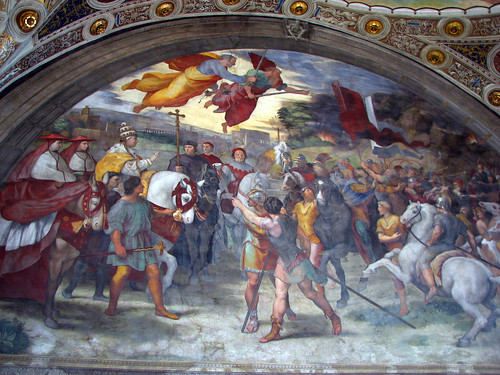
(The encounter between Leo the Great and Attila is the last fresco painted in this room. It was completed after the death of Julius II (pontiff from 1503 to 1513), during the pontificate of his successor Leo X (pontiff from 1513 to 1521). In fact the latter appears twice in the same scene, portrayed in the guise of Pope Leo the Great and as cardinal. According to legend, the miraculous apparition of Saints Peter and Paul armed with swords during the meeting between Pope Leo the Great and Attila (452 A.D.) caused the king of the Huns to desist from invading Italy and marching on Rome. Raphael situates the scene at the gates of Rome, identified by the Colosseum, by an aqueduct, an obelisk and other buildings, even if in fact the historical event took place in the north of Italy, near Mantua.)


St. Leo the Great, who reigned as Pope from 440 to 461, was one of the greatest Popes of History. He fought against numerous heresies that agitated the Church, principally against the Manicheans and Pelagians. In 452 he faced Attila and convinced the scourge of God and his Huns not to attack Rome and to leave Italy. He was also able to thwart the destruction of Rome by Genseric three years later.

Many Africans who had been driven away by the Vandals had settled in Rome and established a secret Manichean community there. When St. Leo discovered them, he denounced them to priests and religious, and warned the people to be on their guard against this reprehensible heresy.

In Spain the heresy of Priscillianism still survived and was attracting new adherents, provoking countless riots and general agitation. St. Leo was informed of this situation by St. Turibius, Bishop of Astorga in Spain. The Pope wrote him a long letter in which he refuted the errors of the Priscillian heresy and qualified it as the “sewer of all the prior heresies.” In particular he condemned its denial of free will and the influence of astrology, considered infallible. St. Leo also showed the connection between the Priscillians and the Manicheans, and sent St. Turibius the conclusions of the juridical processes that he had made against the latter in Rome.

In these processes one can see the seed of the future Inquisition. They were presided over by the Pope, who was assisted by Bishops, clergy, senators and other illustrious personages. During them, he would declare to the faithful their obligation to denounce the heretics; question those under suspicion; try to make them retract from their errors; give penances to those who returned to the Church; and deliver to the civil authorities those who were obstinate in their positions so they might be adequately punished.

Comments of Prof. Plinio:

This selection is very beautiful because you can see how St. Leo the Great acted with the authority of a Pope and at the same time as a saint, that is, a person whom the Catholic Church declared infallibly to be one who heroically practiced all the virtues
.

His sanctity, by the way, was confirmed by a colossal miracle. When he went out to meet Attila, as he approached him, St. Peter appeared over the Pope and made the barbarian retreat. This was one of the great miracles in the History of the Church. This man who was so holy was a persecutor of heretics. Manicheans who had fled from Africa to Italy because of the persecution of the Vandals received a severe reception from St. Leo. He gave sermons warning the people against them and exhorted the people to denounce them to the Church.

When the heresy of the Priscillians re-emerged in Spain, he supported the fight of St. Turibius, Bishop of Astorga, to suppress it. Further, he established a kind of Inquisition in Rome, and he was the one who presided over its sessions, assisted by Bishops and illustrious persons. He carried out the role of Inquisitor - he questioned them to see if there were heresies, tried to convert those who were in error, and ordered punishment for those who refused the Catholic doctrine. You can see, therefore, that he was practicing a holy violence against the heretics. And this in no way was opposed to his sanctity. It was a virtue, a virtue that today is poorly appreciated, because it is the opposite of the bad ecumenism.

What would St. Leo the Great say and do if he would rise up from his grave and see the Catholic Church in the sad situation she is in today where all heresies are unopposed? He would immediately order the re-installation of an Inquisition. Therefore, let us pray to St. Leo, asking him to re-ignite in the Church the spirit of the Inquisition, the spirit of discernment, of holy vigilance, of balanced intransigence, of militancy and the fight. If this were established in the Church, perhaps the world could avoid the terrible chastisement through which it needs to pass. Let us pray to him asking that we might be enflamed with this spirit and that it be maintained in the Holy Church until the end times.

(Blog Owners Note - Indeed let us pray that Our Pope Benedict XVI defends our Catholic Faith from the tide of Relativism and Socialism which is sweeping across the world today)

Sunday, November 9, 2008

India Prelates Say They're Proud of Their Flocks

BALASORE, India, NOV. 6, 2008 (Zenit.org).- Six Indian prelates are expressing their admiration and pride for the faithful of their communities, who have persevered in faith despite a wave of anti-Christian violence.


In a statement last week, the prelates said they wanted to "pay homage to those brothers and sisters who have laid down their lives for the sake of their faith, to comfort those who have been injured, to be with those who have been traumatized by the violence and mayhem […], to do everything in our ability to ensure rehabilitation of those who have lost their houses, property, churches, institutions etc, to stand by those whose rights have been violated, and to assure that justice will be done."

The pastoral letter comes after months of violence against Christians at the hands of Hindu extremists. Several Christians, including a priest, have been killed and thousands have fled their homes.

The statement is signed by Bishop Thomas Thiruthalil of Balasore; Archbishop Raphael Cheenath of Cuttack-Bhubaneswar; Bishop Alphonse Bilung of Rourkela; Bishop Lucas Kerketta of Sambalpur; Bishop Sarat Chandra Nayak of Berhampur; and Coadjutor Bishop John Barwa of Rourkela.

Root cause

Though Hindu-Christian tension in India is nothing new, the current wave was sparked in late August when a Hindu leader was killed and Christians were successively blamed.

The bishops, however, emphatically deny any Christian involvement in the slaying, and contend that the real cause of anti-Christian violence is a hunger for power.

"We understand the factors and forces behind violence against Christians," the prelates wrote. "The Church has been standing by the side of the poor and the marginalized. Through education, health, housing and employment programs, the Church has been bringing in awareness and awakening among the vulnerable communities. They in turn are demanding their rights. This is not liked by the powers that are, since they fear their position being challenged by the poor people. Hence, they have taken to violence. But we condemn this and restate our resolve to continue the services of the Church."

The bishops lauded the faithful for their strength in the face of the violence.

"We are humbled by your strong adherence to your faith and by your trust in Jesus Christ as the Saviour and Lord," they said. "We are humbled by your willingness to go through all kinds of humiliations, trials and even persecutions for the sake of your belief. We are proud of you for your ability to withstand all forms of intimidations and threats. We pray with you for the continued strength from Jesus our Saviour and Lord so that we all may continue to carry forward his mission of compassion, love, unity, justice and peace."

They also expressed appreciation for the interreligious support offered to the Christians of India.

They affirmed their "gratitude to people of all religions of Orissa and India, who in spite of the efforts by the fundamentalist forces and some political parties to divide them and create conflict between them, upheld the Indian traditions of communal harmony and national integrity. As always, we promise to continue our tradition of communal harmony and collective destiny."

Miserable failure

The six prelates had harsh words, though, for the state and federal government, and the "tardy manner" in which officials have responded to the violence.

"We are sorry to state that both these governments have failed miserably in discharging their constitutional obligations," they said. "Hence, we call upon them to use all the powers bestowed on them by the Constitution of the country and ensure that peace and harmony prevail in the area and that the guilty be punished and the affected people be protected and adequately compensated."

Finally, the prelates said that like Christ, they "pray for the perpetrators of crime. We pray with you that the Holy Spirit may give his wisdom and courage to the officials, government machinery and the governments to act immediately and to act in a non-partisan manner and bring life to normalcy for all in Orissa. We also pray with you that the life, passion, death and resurrection of Jesus may strengthen us in this time of crisis so that we may continue to live our Christian life in this country without any hesitation."

(From Zenit)

Revelation Chapter 13

When I read this, I can only wonder if we are in this time yet. The end which I have marked in bold might be a possible solution to the economic credit crisis. Please fellow Catholics and Christians lets us fast and pray for perseverance at such a time.

1 And I stood upon the sand of the sea, and saw a beast rise up out of the sea, having seven heads and ten horns, and upon his horns ten crowns, and upon his heads the name of blasphemy. 2 And the beast which I saw was like unto a leopard, and his feet were as the feet of a bear, and his mouth as the mouth of a lion: and the dragon gave him his power, and his seat, and great authority. 3 And I saw one of his heads as it were wounded to death; and his deadly wound was healed: and all the world wondered after the beast. 4 And they worshiped the dragon which gave power unto the beast: and they worshiped the beast, saying, Who is like unto the beast? who is able to make war with him? 5 And there was given unto him a mouth speaking great things and blasphemies; and power was given unto him to continue forty and two months. 6 And he opened his mouth in blasphemy against God, to blaspheme his name, and his tabernacle, and them that dwell in heaven.

7 And it was given unto him to make war with the saints, and to overcome them: and power was given him over all kindreds, and tongues, and nations. 8 And all that dwell upon the earth shall worship him, whose names are not written in the book of life of the Lamb slain from the foundation of the world. 9 If any man have an ear, let him hear. 10 He that leadeth into captivity shall go into captivity: he that killeth with the sword must be killed with the sword. Here is the patience and the faith of the saints.

11 And I beheld another beast coming up out of the earth; and he had two horns like a lamb, and he spake as a dragon. 12 And he exerciseth all the power of the first beast before him, and causeth the earth and them which dwell therein to worship the first beast, whose deadly wound was healed. 13 And he doeth great wonders, so that he maketh fire come down from heaven on the earth in the sight of men, 14 And deceiveth them that dwell on the earth by the means of those miracles which he had power to do in the sight of the beast; saying to them that dwell on the earth, that they should make an image to the beast, which had the wound by a sword, and did live. 15 And he had power to give life unto the image of the beast, that the image of the beast should both speak, and cause that as many as would not worship the image of the beast should be killed. 16 And he causeth all, both small and great, rich and poor, free and bond, to receive a mark in their right hand, or in their foreheads: 17 And that no man might buy or sell, save he that had the mark, or the name of the beast, or the number of his name. 18 Here is wisdom. Let him that hath understanding count the number of the beast: for it is the number of a man; and his number is Six hundred threescore and six.

Saturday, November 8, 2008

DEDICATION of the LATERAN BASILICA - 9th November 2008


Most Catholics think of St. Peter’s as the pope’s main church, but they are wrong. St. John Lateran is the pope’s church, the cathedral of the Diocese of Rome where the Bishop of Rome presides.

The residence of the Popes which was named the Lateran Palace was built by Lateranus Palutius, whom Nero put to death to seize his goods. It was given in the year 313 by Constantine the Great to Saint Miltiades, Pope, and was inhabited by his successors until 1308, when they moved to Avignon. The Lateran Basilica built by Constantine near the palace of the same name, is the first Basilica of the West. Twelve councils, four of which were ecumenical, have assembled there, the first in 649, the last in 1512.

If for several centuries the Popes have no longer dwelt in the Palace, the primacy of the Basilica is not thereby altered; it remains the head of all churches. Saint Peter Damian wrote that “just as the Saviour is the Head of the elect, the church which bears His name is the head of all the churches. Those of Saints Peter and Paul, to its left and its right, are the two arms by which this sovereign and universal Church embraces the entire earth, saving all who desire salvation, warming them, protecting them in its maternal womb.”

The Divine Office narrates the dedication of the Church by the Pope of Peace, Saint Sylvester:

“It was the Blessed Pope Sylvester who established the rites observed by the Roman Church for the consecration of churches and altars. From the time of the Apostles there had been certain places dedicated to God, which some called oratories, and others, churches. There, on the first day of the week, the assembly was held, and there the Christian people were accustomed to pray, to hear the Word of God, and to receive the Eucharist. But never had these places been consecrated so solemnly; nor had a fixed altar been placed there which, anointed with sacred chrism, was the symbol of Our Lord Jesus Christ, who for us is altar, victim and Pontiff. But when the Emperor Constantine through the sacrament of Baptism had obtained health of body and salvation of soul, a law was issued by him which for the first time permitted that everywhere in the world Christians might build churches. Not satisfied to establish this edict, the prince wanted to give an example and inaugurate the holy labors. Thus in his own Lateran palace, he dedicated a church to the Saviour, and founded the attached baptistry under the name of Saint John the Baptist, in the place where he himself, baptized by Saint Sylvester, had been cured of leprosy. It is this church which the Pontiff consecrated in the fifth of the ides of November; and we celebrate the commemoration on that day, when for the first time in Rome a church was thus publicly consecrated, and where a painting of the Saviour was visible on the wall before the eyes of the Roman people.”

When the Lateran Church was partially ruined by fires, enemy invasions, and earthquakes, it was always rebuilt with great zeal by the Sovereign Pontiffs. In 1726, after one such restoration, Pope Benedict XIII consecrated it anew and assigned the commemoration of that event to the present day. The church was afterwards enlarged and beautified by Popes Pius IX and Leo XIII.

Pope Innocent X commissioned the present structure in 1646. One of Rome’s most imposing churches, the Lateran’s towering facade is crowned with 15 colossal statues of Christ, John the Baptist, John the Evangelist and 12 doctors of the Church. Beneath its high altar rest the remains of the small wooden table on which tradition holds St. Peter himself celebrated Mass.

Unlike the commemorations of other Roman churches (St. Mary Major, Sts. Peter and Paul), this anniversary is a feast. The dedication of a church is a feast for all its parishioners. St. John Lateran is, in a sense, the parish church of all Catholics, for it is the pope's parish, the cathedral church of the Bishop of Rome. This church is the spiritual home of the people who are the Church.

"What was done here, as these walls were rising, is reproduced when we bring together those who believe in Christ. For, by believing they are hewn out, as it were, from mountains and forests, like stones and timber; but by catechizing, baptism and instruction they are, as it were, shaped, squared and planed by the hands of the workers and artisans. Nevertheless, they do not make a house for the Lord until they are fitted together through love" (St. Augustine, Sermon 36>).

Wednesday, November 5, 2008

Terrible accident - Please pray

Four people have been taken to hospital after a tractor-trailer loaded with copper tubing tipped over from one major Toronto-area highway onto a second busy commuter expressway.

"The tractor-trailer was travelling southbound on Highway 427 and the trailer portion dislodged from the truck," said OPP Sgt. Dave Woodford. "The trailer with its load went over onto the Queen Elizabeth Way. When the trailer went over it landed on four vehicles. Those are the people who have been transported to hospital."

He said two people were airlifted to hospital with life-threatening injuries. Two others suffered minor injuries.


I take the QEW to work we left 5 minutes late today...My Guardian angle must have been doing a lot of interceeding with God.

Please pray for the victims and their families. Im still a bit shaken up.

Tuesday, November 4, 2008

St. Charles Borromeo – 4th November 2008


Today the US goes to elections, today more importantly is the feast of St Charles Borromeo. Let us read the commentary of Dr. Plinio. Today when the USA is about to vote for a president which will determin its future, let us pray to this great saint so that he can obtain for us the grace to fight against the evil that has crept up upon us.


St. Charles Borromeo (1538-1584), Bishop and Confessor, was called by God to execute a true reform in the Church. The happy conclusion of the Council of Trent is in great part due to his prudence. Cardinal at age 23, he was given the archbishopric of Milan. He presided over synods and councils, established colleges and congregations, and renewed the spirit of his clergy and the religious Orders. He was the founder of the diocesan seminaries.

St. Charles Borromeo put into practice the decisions taken at the Council of Trent. He had both the natural and supernatural gifts necessary to be a holy Bishop. His sole aim was to realize the model of the perfect Bishop. All his life was ordained to this ideal. In him, the man disappeared and only the Prelate appeared, manifesting splendorous sanctity.

Comments of Prof. Plinio:

Something that can be noticed in History is that when a people reach an apogee, great men start to appear. And many of these great men are so closely bound to the post that they occupy that the person almost seems to disappear and only the position shines. Let us consider some examples.

There is one man who until today is the Emperor of Emperors, the perfect and definitive pattern for all Emperors. This is so true that when one thinks about an Emperor, one thinks foremost of him. He is Charlemagne. After Charlemagne died, the invasions that he had stopped, began again; the Empire that he had built, broke up; the Europe that he wanted to unite, fragmented into many kingdoms and smaller political units; the dynasty he founded, was extinguished. Everything would lead to the conclusion that his memory would disappear. But Charlemagne remained forever in the memory of all men as the prototype of the Catholic Emperor, and, therefore, the Emperor par excellence. The memory of Charlemagne endured with all the imperial dignity, plenitude of personality, and elevation of spirit proper to an Emperor sent by God to do His work on earth.

Louis XIV is the French King par excellence, the Sun King; Philip II of Spain was par excellence the King who defended the Faith. In the same way, you can find other personages who personified all the facets of the roles they exercised.

The same rule applies inside the Holy Church of God. St. Gregory VII was the Pope par excellence, St. John Baptist Vianney was the model for all parish priests, and St. Charles Borromeo was the prototype of a Bishop.

As a true Pastor who watches over his flock, he was alert to the way error was being presented at his time and took a strong position against it. Like many other preeminent figures of the Counter-Reformation, he helped Catholic doctrine progress by developing the doctrine that Protestantism denied. In his written works, he deduced new developments from truths already known. His position was always militant, as a Bishop should be. He was not an ecumenical Prelate who accepts little parts of truth that the error might have in order to appease the heretic. He would analyze the ensemble of the heresy he was dealing with and discern its ultimate bad intentions. Then he would refute the error in these malicious points and develop the opposite doctrine of the Church.

St. Charles Borromeo was not only a great Bishop of the Counter-Reformation, but in a certain sense he was the Bishop of the Counter-Reformation. This title is his not just because he was a very learned man, but rather because he became the very archetype of a Bishop. He was not satisfied with writing books against the errors of the time, which he did. But he did even more, he personified the truths he defended in his books. He became the very symbol of what he wrote.

I could describe various facets of St. Borromeo that made him a model Bishop if I had more time. But this would make me late for the meeting that follows this one. So let me summarize his life in an example I find very significant.

A Cardinal, as you know, is supposed to dress with pomp, grandeur, and solemnity to glorify Our Lord Jesus Christ before men. In addition to being a Prince of the Church, St. Charles Borromeo was a temporal Lord in Milan, born into a great and noble Italian family. In his 20s, he was entrusted with the responsible post of Papal Secretary of State. Therefore, he used to dress and appear in great style.

Once his carriage was on its way to one of his appointments when a simple friar, who was walking on the road, approached it. St. Charles Borromeo ordered the driver to stop the vehicle. The friar greeted him and said:

“Your Eminence, how nice it must be to live the life of a Cardinal, to wear such splendid clothes and travel in a magnificent carriage! Surely it is much more agreeable than to be a simple friar like me, and walk by foot.”

Cardinal Borromeo kindly invited the friar to accompany him. The friar seated himself next to the Cardinal and the journey re-commenced. Shortly the friar began to cry out in pain, because the beautiful cushions of the benches were placed over a board of sharp iron nails of penance that the Cardinal normally used to mortify himself. The pain became more acute with every movement of the vehicle. The friar could not support such mortification, and begged that the carriage stop for him to get out. Relieved, he returned to his "walk by foot."

That is to say, the silks and crystals of the luxurious carriage were meant to be seen by the people to glorify God and the dignity of his post. Underneath the splendid appearance of a Cardinal, the Saint continued to practice penance for his sins and those of his flock.

We can ask St. Charles Borromeo to intercede with Our Lord and Our Lady for several things on his feast day:

• for the reform of today’s Bishops who so often are very different from the model he represented,


• for the restoration of the seminaries, so immersed in bad morals and false doctrine,

• and finally, for the restoration of the entire Holy Catholic Church today as he helped to restore her in his times.

For ourselves personally, we might ask him to give us his vigilance against heresy and his heroic sense of sacrifice.

Monday, November 3, 2008

St. Martin de Porres - 3rd November 2008


"Father unknown" is the cold legal phrase sometimes used on baptismal records. "Half-breed" or "war souvenir" is the cruel name inflicted by those of "pure" blood. Like many others, Martin might have grown to be a bitter man, but he did not. It was said that even as a child he gave his heart and his goods to the poor and despised.

He was the illegitimate son of a freed woman of Panama, probably black but also possibly of Native American stock, and a Spanish grandee of Lima, Peru. He inherited the features and dark complexion of his mother. That irked his father, who finally acknowledged his son after eight years. After the birth of a sister, the father abandoned the family. Martin was reared in poverty, locked into a low level of Lima’s society.

At 12 his mother apprenticed him to a barber-surgeon. He learned how to cut hair and also how to draw blood (a standard medical treatment then), care for wounds and prepare and administer medicines.

He asked for admission to the Dominican Convent of the Rosary in Lima and was received first as a tertiary. When he was 24, he was given the habit of a Coadjutor Brother and assigned to the infirmary of that convent, where he would remain in service until his death at the age of sixty. His superiors saw in him the virtues necessary to exercise unfailing patience in this difficult role, and he never disappointed them. On the contrary, it was not long before miracles began to happen, and Saint Martin was working also with the sick outside his convent, often bringing them healing with only a simple glass of water. He begged for alms to procure for them necessities the Convent could not provide, and Providence always supplied what he sought.

One day an aged beggar, covered with ulcers and almost naked, stretched out his hand, and Saint Martin, seeing the Divine Mendicant in him, took him to his own bed, paying no heed to the fact that he was not perfectly neat and clean. One of his brethren, considering he had gone too far in his charity, reproved him. Saint Martin replied: “Compassion, my dear Brother, is preferable to cleanliness. Reflect that with a little soap I can easily clean my bed covers, but even with a torrent of tears I would never wash from my soul the stain that my harshness toward the unfortunate would create.”

When an epidemic struck Lima, there were in this single convent of the Rosary sixty religious who were sick, many of them novices in a distant and locked section of the convent, separated from the professed. Saint Martin is known to have passed through the locked doors to care for them, a phenomenon which was observed in the residence more than once. The professed, too, saw him suddenly beside them without the doors having been opened; and these facts were duly verified by the surprised Superiors. Martin continued to transport the sick to the convent until the provincial Superior, alarmed by the contagion threatening the religious, forbid him to continue to do so. His sister, who lived in the country, offered her house to lodge those whom the residence of the religious could not hold. One day he found on the street a poor Indian, bleeding to death from a dagger wound, and took him to his own room until he could transport him to his sister’s hospice. The Superior, when he heard of this, reprimanded his subject for disobedience. He was extremely edified by his reply: “Forgive my error, and please instruct me, for I did not know that the precept of obedience took precedence over that of charity.” In effect, there are situations where charity must prevail; and instruction is very necessary. The Superior gave him liberty thereafter to follow his inspirations in the exercise of mercy.

In normal times Saint Martin succeeded with his alms to feed 160 poor persons every day, and distributed a remarkable sum of money every week to the indigent — the latter phenomenon hard to explain by ordinary calculations. To Saint Martin the city of Lima owed a famous residence founded for orphans and abandoned children, where they were formed in piety for a creative Christian life. This lay Brother had always wanted to be a missionary, but never left his native city; yet even during his lifetime he was seen elsewhere, in regions as far distant as Africa, China, Algeria, Japan. An African slave who had been in irons said he had known Martin when he came to relieve and console many like himself, telling them of heaven. When later the same slave saw him in Peru, he was very happy to meet him again and asked him if he had had a good voyage; only later did he learn that Saint Martin had never left Lima. A merchant from Lima was in Mexico and fell ill; he said aloud: “Oh, Brother Martin, if only you were here to care for me..!” and immediately saw him enter his room. And again, this man did not know until later that he had never been in Mexico.


Comment:

Racism is a sin almost nobody confesses. Like pollution, it is a "sin of the world" that is everybody's responsibility but apparently nobody's fault. One could hardly imagine a more fitting patron of Christian forgiveness (on the part of those discriminated against) and Christian justice (on the part of reformed racists) than Martin de Porres.

Quote:

Pope John XXIII remarked at the canonization of Martin (May 6, 1962), "He excused the faults of others. He forgave the bitterest injuries, convinced that he deserved much severer punishments on account of his own sins. He tried with all his might to redeem the guilty; lovingly he comforted the sick; he provided food, clothing and medicine for the poor; he helped, as best he could, farm laborers and Negroes, as well as mulattoes, who were looked upon at that time as akin to slaves: thus he deserved to be called by the name the people gave him: 'Martin of Charity.'"

Sunday, November 2, 2008

All Saints Day – 1 Novenber 2008

Today is all Saints day. Let us read the commentary about this feast day from Dr. Plinio Correa.

Dr. Plinio Comments:

What is the object of the All Saints Day? It is the veneration of all souls that are in Heaven, even if they are not officially canonized or beatified. Anyone who is in Heaven is a holy person. He or she is in the presence of God, sees God face-to-face, and is entirely pleasing to God.

Since it is impossible to know all these persons, whose number is uncountable, the Catholic Church cannot properly honor each one of these Saints by offering them a formal homage as she does with the canonized Saints. So, she instituted the feast of All Saints, a day on which she venerates them all.

It is good to pray to all these souls and ask their protection. There are, however, some of them – whose names we do not know – who have a special relation to our counter-revolutionary fight. Who are these souls? I will give you a sample list that you can add to as you will.

How many crusaders died unknown fighting for the liberation of the Holy Land from the Muslim domination and went to Heaven? How many Catholics died fighting in Spain and Portugal during the war of the Reconquista? How many crusaders died fighting to conquer the pagan peoples of Northern Europe? All these were souls who understood in a special way the splendor of placing their force of arms at the service of the Faith, of sacrificing everything, including their own lives, for the victory of the Catholic Church.

There were souls like these who died in the Vendée in France and in the Carlista uprising in Spain. Also the SanCredistas who fought against the Revolution in South Naples; the Pontifical Zouaves who heroically fought and died to keep the Papal States from falling into the hands of the partisans of Garibaldi; the Cristeros in Mexico, and so on. They are our brother souls who are in Heaven praying for those who continue their fight against the Revolution on earth.

Then there were those glorious ecclesiastics who fought against Freemasonry. I remember with special admiration Dom Vital Maria Gonçalves de Oliveira, Archbishop of Olinda and Recife in Northeast Brazil, who forcefully combated Masonry, one of the most diabolic and dynamic agents of the Revolution. Also Msgr. Henri Delassus who wrote his famous La conjuration anti-chrétienne against Judaism and Masonry. They and many others spent their lives fighting against Masonry, and were persecuted, oppressed, and some of them even murdered. They also are our brother souls.

We cannot forget the cherished members of our families who preceded us in signum Fidei, in the sign of the Faith, and gained their eternal salvation. They are our special intercessors who love us and want to bring us ever closer to God to save our souls and be with them in Heaven. St. Therese of Lisieux had a beautiful veneration for her brothers who had died before the use of reason. She used to say that they were the saints of their family. Her family soon would produce a much greater saint, St. Therese herself.

We should pray specially to all these Saints on this feast day of theirs, since they are particularly open to hear us. We should ask them to help us accomplish on earth the vocation God gave us, and after that, to be with Him, Our Lady, and them in eternal glory.

Friday, October 31, 2008

Catholic Priest matryed in India

as my readers are aware there is a well and proper persecution of Catholics in India. Today I found this article in Zenit. I urge you all the intercede with God that the blood of these Martyrs brings about a rebirth of Christianity in India.

Father Bernard Digal, 45, died in a hospital Wednesday from wounds he sustained in late August, when he was beaten by Hindu extremists.

The priest served in the Archdiocese of Cuttack-Bhubaneswar, in the state of Orissa, the hotbed for a large portion of the anti-Christian violence that has plagued India since the August death of a Hindu leader.

Father Mrutyunjay Digal, secretary of Archbishop Raphael Cheenath of that archdiocese, announced the priest's death to the Fides news agency. He said the community was in "a moment of mourning, of silence and of prayer for the entire local Church."

"During his life, Father Bernard showed determination and courage to give testimony and die for Christ," the secretary added. "He has died as an authentic Christian; immediately after the attack he suffered, he pardoned his enemies and persecutors."

The Fides agency cited Indian Christian organizations in reporting that some 100 Christians have died as a result of the wave of persecution, while thousands have been wounded. Some 15,000 Christians are living in refugee camps and perhaps as many as 40,000 more have fled to the jungle to hide from the extremists.

Wednesday, October 29, 2008

Article 2272 of the Cathecism of the Catholic Church

2272 Formal cooperation in an abortion constitutes a grave offense. The Church attaches the canonical penalty of excommunication to this crime against human life. "A person who procures a completed abortion incurs excommunication latae sententiae," "by the very commission of the offense," and subject to the conditions provided by Canon Law. The Church does not thereby intend to restrict the scope of mercy. Rather, she makes clear the gravity of the crime committed, the irreparable harm done to the innocent who is put to death, as well as to the parents and the whole of society.

The Article above is from the Catechism of the Catholic Church. It says formal co-operation. Maybe I am interpreting this incorrectly but to me this not only means doctors, nurses, politicians, it also means any Catholic who knowing that a politician is pro-abotion knowingly and willingly votes for such a politician. By voting in such a manner the Catholic is formally co-perating in the perpetuation of abortion.

I would like if some one in authority from the Catholic Church could please explain this article to me. The way I understand it is that any Catholic who willfully supports legalized abortion gets an automatic excommunication.

Tuesday, October 28, 2008

St. Narcissus of Jerusalem - 29 October 2008

Life in second- and third-century Jerusalem couldn’t have been easy, but St. Narcissus managed to live well beyond 100. Some even speculate he lived to 160. He was rge thirtieth bishop of Jerusalem. In 195, he and Theophilus, bishop of Caesarea in Palestine, presided in a council of the bishops of Palestine held at Caesarea, about the time of celebrating Easter; in which it was decreed that this feast is to be kept always on a Sunday, and not with the Jewish passover.

Eusebius assures us, that the Christians of Jerusalem preserved in his time the remembrance of several miracles which God had wrought by this holy bishop; one of which he relates as follows. One year on Easter-eve the deacons were unprovided with oil for the lamps in the church, necessary at the solemn divine office that day. Narcissus ordered those who had care of the lamps to bring him some water from the neighboring wells. This being done, he pronounced a devout prayer over the water; then bade them pour it into the lamps; which they did, and it was immediately converted into oil, to the great surprise of the faithful. Some of this miraculous oil was kept there as a memorial at the time when Eusebius wrote his history.

We do know that Narcissus became bishop of Jerusalem in the late second century. He was known for his holiness, but there are hints that many people found him harsh and rigid in his efforts to impose church discipline. One of his many detractors accused Narcissus of a serious crime at one point. Though the charges against him did not hold up, he used the occasion to retire from his role as bishop and live in solitude. His disappearance was so sudden and convincing that many people assumed he had actually died.

Several successors were appointed during his years in isolation. Finally, Narcissus reappeared in Jerusalem and was persuaded to resume his duties. Bending under the weight of extreme old age, made St. Alexander his coadjutor. This primitive example authorizes the practice of coadjutorships; which, nevertheless, are not allowable by the canons except in cases of the perpetual inability of a bishop through age, incurable infirmity, or other impediment as Marianus Victorius observes in his notes upon St. Jerome. St. Narcissus continued to serve his flock, and even other churches, by his assiduous prayers and his earnest exhortations to unity and concord, as St. Alexander testifies in his letter to the Arsinoites in Egypt, where he says that Narcisus was at that time about one hundred and sixteen years old.

Monday, October 27, 2008

A reading for today

For all the liberals, abortionists, relativists, fremasons and all those who oppose God and his people this reading from the Book of Wisdom hopefully shall open your eyes

Wisdom 1:16 - 2:24

The godless call with deed and word for Death,
counting him friend, they wear themselves out for him,
with him they make a pact,
and are fit to be his partners.

‘As for the virtuous man who is poor, let us oppress him;
let us not spare the widow,
nor respect old age, white-haired with many years.
Let our strength be the yardstick of virtue,
since weakness argues its own futility.
Let us lie in wait for the virtuous man, since he annoys us
and opposes our way of life,
reproaches us for our breaches of the law
and accuses us of playing false to our upbringing.
He claims to have knowledge of God,
and calls himself a son of the Lord.
Before us he stands, a reproof to our way of thinking,
the very sight of him weighs our spirits down;
his way of life is not like other men’s,
the paths he treads are unfamiliar.
In his opinion we are counterfeit;
he holds aloof from our doings as though from filth;
he proclaims the final end of the virtuous as happy
and boasts of having God for his father.
Let us see if what he says is true,
let us observe what kind of end he himself will have.
If the virtuous man is God’s son, God will take his part
and rescue him from the clutches of his enemies.
Let us test him with cruelty and with torture,
and thus explore this gentleness of his
and put his endurance to the proof.
Let us condemn him to a shameful death
since he will be looked after – we have his word for it.’

This is the way they reason, but they are misled,
their malice makes them blind.
They do not know the hidden things of God,
they have no hope that holiness will be rewarded,
they can see no reward for blameless souls.
Yet God did make man imperishable,
he made him in the image of his own nature;
it was the devil’s envy that brought death into the world,
as those who are his partners will discover.

St Jude and St Simon - 28 October 2008


St. Jude is so named by Luke and Acts. Matthew and Mark call him Thaddeus. He is not mentioned elsewhere in the Gospels, except, of course, where all the apostles are referred to. Scholars hold that he is not the author of the Letter of Jude. Actually, Jude had the same name as Judas Iscariot. Evidently because of the disgrace of that name, it was shortened to "Jude" in English.

St. Simon is mentioned on all four lists of the apostles. On two of them he is called "the Zealot." The Zealots were a Jewish sect that represented an extreme of Jewish nationalism. For them, the messianic promise of the Old Testament meant that the Jews were to be a free and independent nation. God alone was their king, and any payment of taxes to the Romans—the very domination of the Romans—was a blasphemy against God. No doubt some of the Zealots were the spiritual heirs of the Maccabees, carrying on their ideals of religion and independence. But many were the counterparts of modern terrorists. They raided and killed, attacking both foreigners and "collaborating" Jews. They were chiefly responsible for the rebellion against Rome which ended in the destruction of Jerusalem in A.D. 70.

As in the case of all the apostles except for St Peter, St James and St John, we are faced with men who are really unknown, and we are struck by the fact that their holiness is simply taken to be a gift of Christ. He chose some unlikely people: a former Zealot, a former (crooked) tax collector, an impetuous fisherman, two "sons of thunder" and a man named Judas Iscariot.

It is a reminder that we cannot receive too often. Holiness does not depend on human merit, culture, personality, effort or achievement. It is entirely God's creation and gift. God needs no Zealots to bring about the kingdom by force. Jude, like all the saints, is the saint of the impossible: only God can create his divine life in human beings. And God wills to do so, for all of us.

It is also a reminder that no matter our current spiritual condition and our long shopping list of sins, if we co-operate with God's grace, frequently avail of the sacraments especially the Eucharist and confession and lastly love Mother Mary we will be lead down the path of sanctity and one day we will share in the banquet in the Father's house.

Saturday, October 25, 2008

St Edmund Campion - 25th October 2008


Edmund Campion was born on January 25, 1540 in England. Protestantism had usurped the Catholic Church as the spiritual authority; the dissolution of monasteries and the suppression of Catholic beliefs and believers intensified as land-hungry nobles and men of power continued, in the name of the young, sickly Edward VI, the transformation begun by Henry VIII.

Campion was 13 and the most promising scholar at Christ's Hospital school in London when he was chosen to read an address to Mary Tudor upon her arrival in London as queen in 1553. Campion received a scholarship to Oxford at age 15, and, by the time Elizabeth rose to power ("restoring" Protestantism as the national religion) upon Mary's death in 1558, he was already a junior fellow.

At Oxford Campion's erudition, charisma, and charm gained him noteriety; his students even imitated his mannerisms and style of dress. Queen Elizabeth visited in 1566 and for her entertainment was treated to academic displays. Campion, the star of the show, single-handedly debated four other scholars and so impressed the queen that she promised the patronage of her advisor (and one of the principal architects of the Reformation in England) William Cecil, who referred to Campion as the "diamond of England."

It was the hope of the crown that Campion would become a defender of the new faith (protestanism) which, though favored by the temporal power, lacked learned apologists. Yet even as he was ordained to the Anglican diaconate, he was being swayed toward Rome, influenced in great part by older friends with Catholic sympathies. In 1569 he journeyed to Dublin, where he composed his 'History of Ireland'. At this point Campion was at the summit of his powers. He could have risen to the highest levels of fame had he stayed his course. But this was not to be. By the time Campion left Ireland, he knew he could not remain a Protestant.

Campion's Catholic leanings were well-publicized, and he found the atmosphere hostile upon his return to England in 1571. He went abroad to Douay in France, where he was reconciled with the Church and decided to enter the Society of Jesus. He made a pilgrimmage to Rome and journeyed to Prague, where he lived and taught for six years and in 1578 was ordained a Jesuit priest.

In 1580 he was called by superiors to join fellow Jesuit Robert Parsons in leading a mission to England. He accepted the assignment joyfully, but everyone was aware of the dangers. The night before his departure from Prague, one of the Jesuit fathers wrote over Campion's door, ""

Campion crossed the English Channel as "Mr. Edmunds," a jewel dealer. His mission was nearly a short one: At Dover a search was underway for Gabriel Allen, another English Catholic expatriate who was rumored to be returning to England to visit family. Apparently Allen's description fit Campion also, and he was detained by the mayor of Dover, who planned to send Campion to London. Inexplicably, while waiting for horses for the journey, the mayor changed his mind, and sent "Mr. Edmunds" on his way.

Upon reaching London, Campion composed his "Challenge to the Privy Council," a statement of his mission and an invitation to engage in theological debate. Copies spread quickly, and several replies to the "Challenge" were published by Protestant writers, who attached to it a derogatory title, "Campion's Brag," by which it is best known today.

The power and sincerity of the "Brag" is accompanied by a degree of naivete: Campion's statement of purpose was of no value during his later trial for treason, and the challenge to debate, repeated later in his apologetic work 'Decem Rationes', was as much an invitation to capture. And his capture seemed almost inevitable: Elizabeth had spies everywhere searching for priests, the most sought after of whom being her former "diamond of England."

Campion and his companions traveled stealthily through the English countryside in the early summer of 1581, relying on old, landed Catholic families as hosts. They said Mass, heard confession, performed baptisms and marriages, and preached words of encouragement to a people who represented the last generation to confess the faith of a Catholic England.

There were close calls. Many homes had hiding places for priests—some even had secret chapels and confessionals—and the Jesuits had to rely on these more than once. Campion took extraordinary risks, never able to turn down a request to preach or administer the sacraments, and more than once he escaped detection while in a public setting.

His fortune changed while visiting the home of Francis Yate in Lyford Grange, which was west of London. Yate was a Catholic imprisoned for his faith who had repeatedly asked for one of the Jesuit fathers to tend to the spiritual needs of his household. Though it was out of the way and the queen's searchers were reportedly in hot pursuit, Campion was unable to resist the request.

He traveled to Lyford, heard confessions, preached well into the night, and departed without difficulty after saying Mass at dawn. Some nuns visiting the home shortly thereafter were upset to hear they had just missed Campion, and so riders were dispatched to pursuade him to return, which he did. Word of his return reached George Eliot, born and regarded as Catholic but in fact a turncoat in the pay of the queen; he had a general commission to hunt down and arrest priests. Eliot arrived at Lyford with David Jenkins, another searcher, and attended a Mass. He was greatly outnumbered by the Catholics, and, fearing resistance, made no move to arrest Campion. He departed abruptly to fetch the local magistrate and a small militia and returned to the Yate property during dinner. News of the approaching party reached the house, and Campion and his two priestly companions were safely squirreled away in a narrow cell prepared especially for that purpose, with food and drink for three days.

Later Eliot and Jenkins both claimed to have discovered the priests, offering the same story: A strip of light breaking through a gap in the wall leading to the hiding place was the giveaway—both men took credit for noticing it, and each reported being the one to break through the wall. No doubt each sought the credit for capturing the infamous Campion, for no priest was more beloved by the Catholics nor more despised by the crown.

Campion was taken to the Tower and tortured. Several times he was forced to engage in debates, without benefit of notes or references and still weak and disoriented from his rackings and beatings. He acquited himself admirably, all things considered: a testament to his unparalled rhetorical skills.

His trial was a farce. Witnesses were bribed, false evidence produced; in truth, the outcome had been determined since his arrival. Campion was eloquent and persuasive to the last, dominating the entire procedure with the force of his logic and his knowledge of the Scripture and law, but in vain. He and his priestly and lay companions were convicted of treason on November 14 and were sentenced to death. His address to the court upon sentencing invoked the Catholic England for which he had fought, the Catholic England which was about to die: "In condemning us, you condemn all your own ancestors—all the ancient priests, bishops and kings—all that was once the glory of England."

On December 1,1581 the prophecy hanging over his door in Prague was fulfilled: Campion was hanged, drawn, and quartered. The poet Henry Walpole was there, and during the quartering some blood from Campion's entrails splashed on his coat. Walpole was profoundly changed. He went overseas, took orders, and 13 years later met his own martyrdom on English soil. Campion was beatified by Leo XIII in 1886.

The Ottaviani Intervention

I love the holy sacrifice of the mass both ins the Usus Aquitior format as well as the Novus ordo format. Today let us read a letter sent from Cardinals Ottaviani and Bacci to His Holiness Pope Paul VI September 25th, 1969 regarding the change in the mass format to the Novus Ordo format.

Letter from Cardinals Ottaviani and Bacci to His Holiness Pope Paul VI
September 25th, 1969

Most Holy Father, Having carefully examined, and presented for the scrutiny of others, the Novus Ordo Missae prepared by the experts of the Consilium ad exequendam Constitutionem de Sacra Liturgia, and after lengthy prayer and reflection, we feel it to be our bounden duty in the sight of God and towards Your Holiness, to put before you the following considerations:

1. The accompanying critical study of the Novus Ordo Missae, the work of a group of theologians, liturgists and pastors of souls, shows quite clearly in spite of its brevity that if we consider the innovations implied or taken for granted which may of course be evaluated in different ways, the Novus Ordo represents, both as a whole and in its details, a striking departure from the Catholic theology of the Mass as it was formulated in Session XXII of the Council of Trent. The "canons" of the rite definitively fixed at that time provided an insurmountable barrier to any heresy directed against the integrity of the Mystery.

2. The pastoral reasons adduced to support such a grave break with tradition, even if such reasons could be regarded as holding good in the face of doctrinal considerations, do not seem to us sufficient. The innovations in the Novus Ordo and the fact that all that is of perennial value finds only a minor place, if it subsists at all, could well turn into a certainty the suspicions already prevalent, alas, in many circles, that truths which have always been believed by the Christian people, can be changed or ignored without infidelity to that sacred deposit of doctrine to which the Catholic faith is bound for ever. Recent reforms have amply demonstrated that fresh changes in the liturgy could lead to nothing but complete bewilderment on the part of the faithful who are already showing signs of restiveness and of an indubitable lessening of faith.

Amongst the best of the clergy the practical result is an agonising crisis of conscience of which innumerable instances come tour notice daily.

3. We are certain that these considerations, which can only reach Your Holiness by the living voice of both shepherds and flock, cannot but find an echo in Your paternal heart, always so profoundly solicitous for the spiritual needs of the children of the Church. It has always been the case that when a law meant for the good of subjects proves to be on the contrary harmful, those subjects have the right, nay the duty of asking with filial trust for the abrogation of that law.

Therefore we most earnestly beseech Your Holiness, at a time of such painful divisions and ever-increasing perils for the purity of the Faith and the unity of the church, lamented by You our common Father, not to deprive us of the possibility of continuing to have recourse to the fruitful integrity of that Missale Romanum of St. Pius V, so highly praised by Your Holiness and so deeply loved and venerated by the whole Catholic world.

A. Card. Ottaviani
A. Card. Bacci

For the rest of the article please refer to this link

http://www.fisheaters.com/ottavianiintervention.html

Friday, October 24, 2008

St Anthony Mary Claret - 24th October 2008

Today we celebrate the feast of St. Anthony Mary Claret. Let us contemplate what Dr. Plinio Correa has to say about this saint.


Biographical selection:

Anthony Mary Claret (1807-1870), Bishop and Confessor. From 1850 to 1857, he was Archbishop of Cuba and he predicted its chastisement. He returned to the court of Queen Isabella II as confessor, and went into exile with her in 1868.

He was a champion of papal infallibility and the fight against Freemasonry. A great devotee of Our Lady, he founded the Missionary Sons of the Immaculate Heart of Mary, known today as the Claretians. In 1869 and 1870, St. Anthony Mary Claret participated in the First Vatican Council. He died in the Cistercian monastery of Fontfroide in southern France on October 24, 1870.

Comments of Prof. Plinio:

A long time ago the Claretian Priests of the city of Rio Claro [in the State of Sao Paulo, Brazil] invited me to give a talk on their founder. I bought a small biography of him and read it on the trip. Many things can be said about this great Saint. He was one of these men who, aside from having founded a religious congregation, dominated his epoch by the mere fact of his existence.

He was a short, energetic Spaniard, a peppery Catalonian. At age 17 he traveled to the lively trade center of Barcelona to further himself in the weaving profession of his father. He became so involved in the technology and business that he could think of almost nothing else.

During this period of his life, he was a mediocre Catholic even though he maintained a devotion to Our Lady. One hot day in the summer of 1826, Anthony was wading in the sea when a huge wave engulfed him and carried him out into the deep. He could not swim, but called out to the Blessed Virgin for help, and found himself carried back to the shore, half drowned and semi-conscious. When he came to himself he realized how close he had come to dying. He began to consider the mediocrity of his life and he converted.

He was ordained a priest and became a missionary. He revealed himself an orator with eminent qualities who appealed to the simple people. He had a very powerful voice that could be heard in the far corners of the public squares where he used to preach to the multitudes that gathered to hear him. The churches could not contain all those people, and at times even the squares overflowed. He used to go from city to city preaching, and many times the inhabitants of one city followed him along the road to the halfway point, where he was met by inhabitants of the next city who had come to welcome him and accompany him to their city.

The preaching of St. Anthony Mary Claret attracted and held the people. His words were zealous, rich with learning and natural eloquence, and filled with extraordinary charismas. Very often he would move his audience to tears. At times he would prophesize, interrupting a sermon, for example, to tell a lady: “You think that you still have a long time to live, but you are mistaken. You will die in six months.” At other times he would exorcise demons, saying, for instance, “I will expel the Devil that hovers over this audience.” As he pronounced the words of the exorcism, strange noises, lightning, and other phenomena were heard and seen by the multitude. Of course, these charismas impressed and attracted the people.

He realized that he was called to preach the truths of the Faith to the simple people. Doing this, he gave an edifying example to other religious Orders that were influenced by Liberalism and rejecting the Church’s traditional preaching methods in order to adapt themselves to the modern world. St. Anthony Mary Claret achieved a fabulous result using the traditional methods. His implicit reply to those who attacked the traditional methods was simple: the people don’t come to you because of the old methods, but because you are liberals.

He also understood that he was called to increase the zeal of the people, not to organize or direct it. He would pass through the provinces planting the seed of the love of God, leaving the job of watering that seed and making it grow to others.

Only weeks after founding his missionary congregation of the Sons of the Immaculate Heart of Mary, notice arrived from Rome that he had been nominated to become Archbishop of Santiago, the primatial see of Cuba. He was consecrated Bishop, made an Archbishop, and sent to Cuba. As soon as he arrived, he started to correct the bad customs and indifferent morals of the people and began a real conversion of the Island.

The Freemasonry that was deeply entrenched in Cuba could not tolerate this, and intensely attacked St. Anthony Mary Claret. He suffered all kinds of persecutions, including several attempts on his life. The opposition of the enemies of the Church was so strong that finally the Queen of Spain decided it would be more prudent to remove him from the Island and return him to Spain. At her request, he was offered the appointment of Patriarch of India, which would make him confessor and spiritual director of the Royal Court of Madrid.

As his ship left the shore of Cuba, St. Anthony Mary Claret cursed the Island whose inhabitants had refused God. It was not long before this curse took effect. With its independence, Cuba rejected the life-giving spiritual sap it had received from Spain, and quickly became a center of corruption and immorality, a tourist site for Americans seeking dissolute vacations. This was the case until Communism took over the Cuban government and implanted its regime. You can see that the curse launched by St. Anthony Mary Claret was realized quite impressively.

The chaplain of the Spanish Court had the title of Patriarch of India, but it was just an honorific title with nothing to do with India. Queen Isabella II was supporting the liberal side of the Spanish Royal House that was fighting against the good Carlist movement. As so often happens with liberals, they play the game of Freemasonry, and if they stop, Masonry takes them out of the game. Even though she was liberal, the Queen began to be influenced by St. Anthony Claret and gradually took a different position. When her policies started to become anti-liberal, the Masons removed her from power and sent her out of Spain in exile. It was St. Anthony Claret who provoked this political earthquake.

It was also during that time in Spain he exercised a very successful missionary apostolate and more firmly established the Congregation of the Sons of the Immaculate Heart of Mary.

The deposing of Isabella II was in part a victory for the good cause. The Masonry knew that Spain was not yet ready to accept a Republic, and wanted to establish a Constitutional Monarchy first in order to prepare the way for a stable Republic. Because it was forced to depose the Queen, it was obliged to make the Republic prematurely. This caused a deep crystallization in public opinion against the Republic, which led to the restoration of the Monarchy some time later. The Republic would have triumphed earlier in Spain without the action of St. Anthony Mary Claret.

Even as he grew old and suffered sicknesses, his incredible energy and gifts to move the people with his words continued. He was also granted many special graces, in particular, the grace of conserving the Sacramental Species within his heart. From one Communion to another, the Eucharistic Species were preserved incorrupt in his body so that he always had the Blessed Sacrament in his heart.

In his last days, he participated in Vatican Council I, which the Pope had convened at the Vatican in December of 1869. Seeing many liberal Bishops opposing the matter of Papal Infallibility that was being discussed, he became indignant and strongly censured them in a speech. Hearing the errors being spoken on this topic, he was so overcome with indignation that the blood rushed to his head and he suffered a stroke from which he never recovered. He died some months later.

St. Anthony Mary Claret is our patron Saint under many different titles:
• the patron of those who are leading mediocre lives and need to convert to serve the Catholic cause;
• the patron of the faithful who promote devotion to Our Lady;
• the patron of counter-revolutionaries because of his action in Cuba and Spain;
•the patron of the those who follow the traditional methods of Catholic apostolate with the simple people and spurn the liberal novelties;
• the patron of those who fight for the Papacy against liberal Bishops.

Since it was this same current of Bishops that endured and took power in the Catholic Church at Vatican Council II, St. Anthony Mary Claret is also a great protector and intercessor of those who are called to fight the errors of Vatican II and its consequences.

We should call on St. Anthony Mary Claret for his help under these different titles.

Tuesday, October 21, 2008

Saint Louis Martin and Marie-Zélie Guérin


An exciting day for us married folks, we have a new beatified couple to look up to, none other than the parents of St Theresa of Lisieux.

Here are some excerpts from the article on Zenit to contemplate.

"The first married couple to be beatified together -- Italians Luigi and Maria Beltrame Quattrocchi, who died in 1951 and 1965, respectively -- were beatified in 2001 by Pope John Paul II.

Martin (1823-1894) and Guérin (1831-1877) were the parents of nine children, four of whom died as children. After concluding the beatification rite, Cardinal Saraiva Martins gave "thanks to God for this exemplary testimony of conjugal love."

Their example, the prelate assured, can "motivate Christian families in the integral practice of Christian virtues, just as it stimulated in Thérèse the desire for sanctity."

Cardinal Saraiva Martins said that in the moment of the beatification, "I thought of my father and my mother, and in this moment, I would like you to also think in your fathers and mothers, and that together, we give thanks to God for having created us and made us Christians, thanks to the conjugal love of our parents."

The cardinal presented the Martins as "a gift for spouses of all ages because of the esteem, respect and harmony with which they loved each other for 19 years."

He said the couple is also "a gift for parents" and "for all those who have lost their husband or wife."

"Widowhood is always a difficult condition to accept," the cardinal said. "Louis lived the loss of his wife with faith and generosity, preferring the good of his children over his personal preferences."

And, Cardinal Saraiva Martins said, this couples is "a gift for those who face sickness and death. In our world, which tries to hide death, they teach us to look at it face to face, abandoning ourselves in God."

The Pontiff also approved the beatification of four Servants of God:

* Vincenza Poloni Mary - virgin and founder of the Institute of the Sisters of Mercy, on Sunday, September 21 in Verona Italy.
* Miguel Sopocko – priest and founder of the Congregation of the Sisters of Merciful Jesus, on Sunday, Septmber 20, in Bialystok, Poland.
* Francesco Pianzola, - priest and founder of the Missionary Sister of the Immaculate Queen of Peace, on Saturday, October 4, in Vigevano, Italy.
* Giovanni Francesco Bonifacio - priest and martyr, also on Saturday, October 4 in Trieste, Italy.

Monday, October 20, 2008

Love and Fear and Christian Piety

These days it is hard to find a biography for the saints of the day. In addition to this making plans to travel out for Christmas so South America is taking up a fair amount of my time. This being the case, I am posting an article by Dr. Plinio Correa called 'Love and Fear and Christian Piety'


According to Church teaching, love and fear of God are virtues. Since neither antagonism nor contradiction can exist among the virtues, love does not exclude fear and fear does not exclude love.

Furthermore, both of these virtues are essential for salvation. If we cannot envision a saint without love of God, like wise we cannot envision a saint without fear.

One could affirm that love is the higher virtue and that these virtues influence each soul in different degrees, according to its individuality and the economies of grace. But, disregarding one virtue under the pretext of stimulating another-that is, maintaining silence regarding fear to develop love, or vice versa-usually inflicts irremediable damage on souls.

Now, there was a time when the profoundly balanced piety of the faithful held love and fear in proper perspective, whence both virtues were proportionately reflected in sermons, art, and religious literature. Later, however, Jansenism stressed the role of fear to the point of exaggeration and delirium. In reaction, saints, theologians and preachers pertinaciously stressed the role of love. As a result, many treasures of grace, of theological and pastoral wisdom, and of artistic beauty blossomed in the Holy Church because of Her most characteristic and best elements which we need not mention.

In this way, a wise and strategic maxim was applied: whenever one side of something is exaggerated, one must accentuate the other side.

Let us bring this principle into focus and see how to apply it today. Which one is being exaggerated? Love or fear? It seems modern man sins neither by excessive love nor fear. Much to the contrary, having forgotten God and having been impregnated with secularism, naturalism and indifferentism, he takes no account of God, neither loving Him nor fearing Him.

Consequently, the solution to this complete lack of love and fear is to call men to God by attracting them to one and the other virtue. For fear also brings men to God: the fear of the Lord is the beginning of wisdom.

In this regard, religious art can be of much help. It is a marvelous means of demonstrating how Our Lord Jesus Christ should be loved and feared.

In the famous Arena Chapel at Padua, the immortal brush of Giotto left us this mocked Christ, an admirable representation of the patience of the Divine Master. His adorable face is barbarously wounded; sacrilegious hands pull His hair and beard; a crown of thorns, a derisive symbol of His royalty, is set upon His venerable forehead. But Jesus, with eyes lowered, seems neither to see His enemies nor to feel the enormity of the outrage, but rather feels a fathomless sadness. This is truly the gentle Savior Who suffers everything for our redemption with a meek and humble Heart.


"Judas, dost thou betray the Son of Man with a kiss?" Both faces were close to each other at the memorable moment of this infamous kiss and terrifying question. Giotto depicts this scene in another painting in the same chapel. With his low forehead, flabby flesh, grim look, vulgar nose, loathsomely soft and drooping lips, Judas reveals an inexpressible infamy in his whole being. Jesus-noble, infinitely superior, and possessing an ineffable moral loftiness-looks upon him with a gaze wherein a sparkle of love, rebuke, severity, and total repulsion can be found. Poor, miserable Judas, who did not want to open his soul to the love or fear which this gaze elicited and to which this doleful and pungent question invited him.

And, because his soul resisted every invitation to love and to fear, it sank from theft to deicide and from deicide to despair.