Wednesday, March 18, 2009
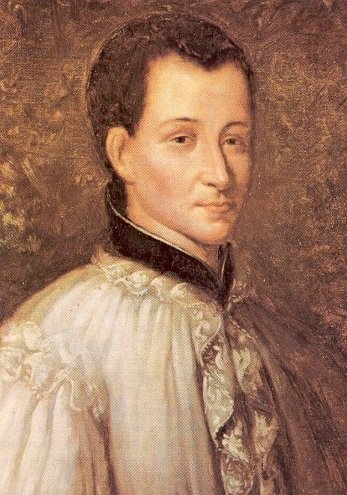
St. Cyril of Jerusalem - 18th March 2009
Biographical selection:
Cyril was born in Jerusalem in 315. From his youth he dedicated himself to the study of the Holy Scriptures and acquired a great knowledge of Church doctrine by reading the Fathers who came before him. When St. Maximus died, Cyril succeeded him in the See of Jerusalem in 349.
At the beginning of his episcopacy, he became famous for a dispute with Acacius, Archbishop of Caesarea, an ardent follower of Arianism who abhorred Cyril and his orthodoxy. Because of the plots of Acacius, he was exiled twice from Jerusalem. But after Julian the Apostate was raised to the throne of the Empire, a general amnesty was granted for Prelates who had been exiled; therefore, he entered the city and re-assumed his see.
From there, he witnessed the miraculous obstacles sent by God that made it impossible to rebuild the Temple of Jerusalem. Julian, who took the side of the Jews against the Catholics, tried to rebuild the Temple two times. The first time the recently laid foundation was destroyed by an earthquake; the second time the groundwork was destroyed by flames of fire that burst forth from the ground. During these attempts of reconstruction, St. Cyril calmly affirmed that the prophecy of Christ would remain true, and that not one stone of the Temple would be left standing upon another.
He was exiled for a third time when Emperor Valens, a follower of Arianism, decreed the expulsion of all Prelates recalled by Julian. Under Theodosius, he returned from this exile to find his flock torn by heresies and schisms. He made great efforts to achieve doctrinal unity and peace.
In 381 he took part in the Council of Constantinople and signed the condemnation of semi-Arianism. He died in 386. His great work, The Catecheses, or Catechetical Lectures, is turned toward the preparation of catechumens and neophytes.
Comments of Prof. Plinio:
Parallel to Bishops who were founders of nations, like St. Patrick, whose life we have already commented on, there were also Bishops whom we can call pillars of the Church. They existed primarily in the East, and St. Cyril of Jerusalem was one of them.
When the Church left the Catacombs, many of her members were contaminated by a spirit of tepidness and spiritual decadence that propitiated the infiltration of paganism into Catholic milieus. It was a subtle penetration that stimulated them to accept diverse heresies. It was an attempt of the Devil to make them shake off the easy yoke of Our Lord placed by Constantine over the entire Empire.
In the West heresies popped up, one more harmful than the other, until the fall of the Roman Empire. In the East those heresies would continue. Such heresies, however, gave rise to numerous heroic and saintly Bishops who fought like lions against them. These heroes often ended by being defeated, but they filled the Church with splendor. They wrote works; they took positions that later would be admired and serve as a base to build the magnificent edifice of the Middle Ages.
Considering the example of St. Cyril of Jerusalem and so many other Saints, we understand what the fight for the Church should be. One must fight expending all his strength and resources. At times, he will die in the battle without fully realizing the effect of his effort, for often only the immediate defeat is apparent. But afterwards, that effort is remembered and treasured by others as a precious legacy, and it gives great fruits.
The Fathers and the Doctors of the Church – St. Cyril is one of them – played an enormous role in setting the foundations for Scholasticism and establishing the Catholic State in the Middle Ages. They were received with ingratitude by their contemporaries, but they formed the basis for the great triumph of Catholic Civilization.
From such examples, we can understand that we should fight for the cause of the Church by assuming a similar state of spirit that can appear paradoxical:
First, we must fight with the certainty that we are defeating the Revolution, which will fall under the blows we are giving it. We feel an appeal of Divine Providence calling us to do this and a promise that Our Lady wants to use us to accomplish this work.
Second, we must have such a great dedication to this fight that, even if we were to die without having defeated the Revolution and seeing the Reign of Mary, we would close our eyes in peace knowing that our effort will have an effect.
Third, even if this effort were not to have any effect in the future and would never be known to future generations, even if it would be lost in anonymity, we should be at peace because we will know that in the Book of Life, our fight was written for the Day of Judgment. It will be recognized that at the moment in History when Our Lady was prisoner there were some few who came to fight for her. In a world where truth was no longer welcome, there were some who proclaimed it. In this epoch of darkness, there were some who glorified God.
Therefore, our fight - which is motivated by these three certainties - is always a work that gives fruit. And if it is an incessant, indomitable fight in which we use every legitimate means, it will be an invincible one.
Let us pray to the great St. Cyril of Jerusalem to obtain for us the spirit of Faith he showed and left as an example so that we might destroy the Revolution in our days.
Tuesday, March 17, 2009
St. Patrick - 17th March 2009
Biographical selection:
Patrick was the Apostle of a people, the light of Ireland, the father of this nation whose martyrdom will endure for ages. In him the gift of the apostolate shone. Christ put this gift in His Church and it will remain in her to the end times.
Some apostles were given the mission of working with a small part of the Gentiles and planting a seed among a certain group of people. It germinates to a greater or lesser degree according to the maliciousness or docility of men. But other apostles have the mission of making rapid conquests and submitting entire nations to the Gospel. Patrick belongs to this latter type of apostles. We should honor him as one of the most outstanding monuments of Divine Mercy toward men. His work was admirably solid.
In the 5th century, Great Britain was unaware that the Messiah had come. All the northern nations slept in the darkness of faithlessness. Before the successive awaking of many of those peoples, Ireland received the news of salvation. The word of God brought by the Apostle Patrick grew on that emerald Island, more fertile in fruits of grace than of nature. Its saints were abundant and spread throughout Europe.
The Irish missionaries spread the evangelization they received from their Founding Saint to other countries. When the hour of the great apostasy of the 16th century sounded, Germany, England, Scotland and the Scandinavian nations fell to Protestantism. But Ireland remained faithful. No persecution, subtle or atrocious as it might be, was able to take it from the Catholic Faith as taught by St. Patrick.
Comments of Prof. Plinio:
These beautiful words of Dom Guéranger bring before our eyes one of those figures of evangelizers of entire peoples. Dom Guéranger makes a distinction that is very true and shows us what we often call a man of the right hand of God.
There are certain men chosen by God to make limited, small apostolates. For this work they are efficient and powerful. God gives them the graces for those efforts, but their works do not spread further. In Europe there are many Saints who are famous in their Dioceses, in the places they professed their vows or made various foundations. They sowed the seeds of Christendom in those specific places, where they are venerated. They are chosen as Patron Saints of a region, and local pilgrimages are made to their tombs. They constitute part of the rich multitude of facets that regional life brings to the ensemble of the Church and society.
There are other men, however, who play roles in the life of the Church on an international scale. Such apostles can be called men of the right hand of God in a more marked way. Obstacles are insignificant before them. They realize things no one would imagine possible to do. In this way they rapidly accelerate the march of History and the progress of the Church. We can say that St. Patrick was one of those men.
What is said about St. Patrick could also be said regarding Ireland. We normally stress the influence of Cluny in the Middle Ages. It is a correct point. But it is also important to stress the role played by the Irish people. Ireland was a true starting point for the irradiation of the Catholic Faith into nations that gave much glory to God, although centuries later they would become Protestant.
As the Catholic Faith established itself in Ireland, monasteries were founded throughout the country. By means of these monasteries, the Irish participated in the missionary action of the Carolingian Empire. In this sense they played a role in evangelizing England, Scotland, France, Germany, Switzerland, Austria, Italy, and the nations of the Northern Sea. In that time Ireland played a role similar to that which the Iberian Peninsula would play in the 16th century, when Spain and Portugal were the point of evangelization of Latin America, as well as parts of Africa and Asia. Analogously, after a period of irradiation, the glory of Ireland - like the glory of Spain and Portugal - faded.
The Revolution and the Secret Forces employed every effort to make Spain and Portugal apostatize from the Catholic Faith. The world glory of those countries faded, and in many points they denied the Catholic position, although some of the old fidelity still remains. Ireland, however, never apostatized. It received this prize because it was the apostolic nation of the North. Ireland remains firm, very firm for the glory of God.
This fact is very beautiful and should raise our hearts to God in thanksgiving. But it is also true that Ireland was infiltrated by Socialism and other forms of the Revolution. Irish Catholicism became in large measure liberal and progressivist. As a result the Irish immigration to the United States was largely made up of leftists and liberal Catholics. That is to say, that magnificent Catholic Ireland became rotten in great part through the maneuvers of the Revolution even though it remained inside the Church.
Let us pray to St. Patrick to obtain from Our Lady an end to this situation so that everything will not be corrupted. If things continue the way they are going, this is what will happen in a short time. It is why it is necessary that God intervene soon.
Monday, March 16, 2009
St. Clement Mary Hofbauer - 16th March 2009
Let us read what Dr. Plino has to comment about the life of St. Clement Mary Hofbauer
Biographical selection:
Apostle of Vienna, born in Tasswitz, Austria on December 26, 1751, died on March 15, 1821.
After his course in theology, Clement entered the University of Vienna for seminary training. It was not long before he realized that some of his teachers were not rejecting the Rationalism of the 18th century. They were looking for a strange reconciliation between Catholic doctrine and Enlightenment thinking.
From the time he was very young, Clement had been gifted with a secure Catholic sense that permitted him to distinguish with certainty what was true Catholic doctrine. He was anguished, therefore, to hear these falsified doctrines.
One day after class, he went to the teacher to present objections to the adaptation to Enlightenment thinking that the professor had made in his lecture. The teacher tried to explain to him that it would be very difficult in the climate of the epoch to follow the traditional doctrine of the Church, since only the language of reason was accepted, either from the pulpit or the university chairs. He concluded: “We have to swim with the tide if we don’t want to be left behind.”
The simple son of a laborer responded: “To swim with the tide in this case is cowardice, since we have to fight and swim against the tide of this ocean. Whosoever wants to shine the light upon the road for this century must ignite his torch in the light of Revelation.”
The professor replied: “Hofbauer, you will preach to empty pews. Our epoch no longer supports that kind of talk.”
Clement made this reply: “If what you say is true, then we are already in the end times announced by St. Paul, who said that times would come that would no longer tolerate sound doctrine. What would St. Paul say about your thinking, professor?”
On another occasion a professor stated in class that the Immaculate Conception of the Holy Virgin was just a pious legend, and that it should no longer be spoken of in public. Clement stood up indignantly and said: “Professor, this doctrine is not Catholic!” And he left the room.
“Perhaps one day a little more light will enter the mind of this peasant!” the professor shouted to his retreating back. But he was obliged to end the class then, since the room had emptied. All the students had followed Hofbauer.
Comments of Prof. Plinio:
It is interesting to note and identify here the methods of the Revolution. The 18th century seems very remote to us. It was the time of litters, hoop skirts and tricorne hats. The 19th century also seems far away to us today. Perhaps some of you would not distinguish the century of Ramses II from the century of Queen Victoria. Almost everything from the past seems immersed in the same cloudy historical background.
Well, in that time that seems so ancient to us, men already imagined themselves to be very modern. They already defended the idea that one has to cede a little in face of the Revolution in order not to give up everything. This motto was already being adopted: “Cede to not lose.” The same modernist current that we see today was already using the same methods and assuming the same type of cowardice.
Notice, for example, the threat the professor made to St. Clement Marie Hofbauer: “When you leave here, you will preach to empty pews.” It is the same thing they say to us: The doctrine you defend is no longer able to attract men today.
But in reality what happened was that St. Clement spoke out, and the whole class followed him. Therefore, the situation was not so lost as they presented it. It is a fact that the Enlightenment exerted great influence on the leadership and some among the grassroots. But there were still persons who were disposed to follow one who would courageously act and take up the complete Catholic position. Yesterday – as well as today – the right thing to do is to speak the whole truth.
It is also interesting to see how counter-revolutionary the position of St. Clement Marie Hofbauer was. He fought against the motto: “Cede to not lose.” He did not cede an inch in face of the threat that he would be preaching to empty pews. If this, in fact, would happen, his conclusion was that the end times had arrived. His professor didn’t want to think about such a thing. Like almost all the progressivists today, the liberals of that time didn’t want to consider that possibility – for them there is no end of time. On the contrary, what they want is more time to enjoy life. The same spirit that opposed St. Clement Hofbauer in the 18th and 19th centuries is combating us today.
In the similarities you find in this episode from the life of St. Clement Hofbauer and in what happens in our fight today, you can see one of the principle laws of History. That is, that there is a continuity in the same good spirit and the same bad spirit fighting one another through the centuries.
For this reason we should not consider ourselves as a small group that is separated from everyone in the past and the future, like something that suddenly appeared out of nowhere separated from everything, like a cork floating on the ocean. No, we are not alone, we are those who are united with a whole current of Catholics, those who continue and maintain a state of spirit that has existed since the beginning of History and will last until the end. We are a link in the most magnificent and majestic of chains, the chain of the slaves of Our Lady who will crush the head of the serpent.
From the example of St. Clement Marie Hofbauer, we can see that the enemies he combated are the same as the enemies we combat. Our fight did not start today. It is a fight that began long ago and will last much longer. It is part of a golden chain that started in the Old Testament and will continue until the final days of tribulation when the last Catholics will still be fighting even if they consider everything to be lost.
At that moment the Son of the Man, Our Lord Jesus Christ, will come in great pomp and majesty to conquer, to judge and to close History. And then, this chain will be complete and all of its member will join together, by the favor of Our Lady, in Heaven.
Sunday, March 15, 2009
St. Louise de Marillac - 15 March 2009
Louise, born near Meux, France, lost her mother when she was still a child, her beloved father when she was but 15. Her desire to become a nun was discouraged by her confessor, and a marriage was arranged. One son was born of this union. But she soon found herself nursing her beloved husband through a long illness that finally led to his death.
Louise was fortunate to have a wise and sympathetic counselor, St. Francis de Sales, and then his friend, the Bishop of Belley, France. Both of these men were available to her only periodically. But from an interior illumination she understood that she was to undertake a great work under the guidance of another person she had not yet met. This was the holy priest M. Vincent, later to be known as St. Vincent de Paul.
At first he was reluctant to be her confessor, busy as he was with his "Confraternities of Charity." Members were aristocratic ladies of charity who were helping him nurse the poor and look after neglected children, a real need of the day. But the ladies were busy with many of their own concerns and duties. His work needed many more helpers, especially ones who were peasants themselves and therefore close to the poor and could win their hearts. He also needed someone who could teach them and organize them.
Only over a long period of time, as Vincent de Paul became more acquainted with Louise, did he come to realize that she was the answer to his prayers. She was intelligent, self-effacing and had physical strength and endurance that belied her continuing feeble health. The missions he sent her on eventually led to four simple young women joining her. Her rented home in Paris became the training center for those accepted for the service of the sick and poor. Growth was rapid and soon there was need of a so-called rule of life, which Louise herself, under the guidance of Vincent, drew up for the Sisters of Charity of St. Vincent de Paul (though he preferred "Daughters" of Charity).
He had always been slow and prudent in his dealings with Louise and the new group. He said that he had never had any idea of starting a new community, that it was God who did everything. "Your convent," he said, "will be the house of the sick; your cell, a hired room; your chapel, the parish church; your cloister, the streets of the city or the wards of the hospital." Their dress was to be that of the peasant women. It was not until years later that Vincent de Paul would finally permit four of the women to take annual vows of poverty, chastity and obedience. It was still more years before the company would be formally approved by Rome and placed under the direction of Vincent's own congregation of priests.
Many of the young women were illiterate and it was with reluctance that the new community undertook the care of neglected children. Louise was busy helping wherever needed despite her poor health. She traveled throughout France, establishing her community members in hospitals, orphanages and other institutions. At her death on March 15, 1660, the congregation had more than 40 houses in France. Six months later St. Vincent de Paul followed her in death.
Louise de Marillac was canonized in 1934 and declared patroness of social workers in 1960.Saturday, March 14, 2009
St. Maximilian - 14th March 2009
Brought before the proconsul Dion, Maximilian refused enlistment in the Roman army saying, "I cannot serve, I cannot do evil. I am a Christian."
Dion replied: "You must serve or die."
Maximilian: "I will never serve. You can cut off my head, but I will not be a soldier of this world, for I am a soldier of Christ. My army is the army of God, and I cannot fight for this world. I tell you I am a Christian."
Dion: "There are Christian soldiers serving our rulers Diocletian and Maximian, Constantius and Galerius."
Maximilian: "That is their business. I also am a Christian, and I cannot serve."
Dion: "But what harm do soldiers do?"
Maximilian: "You know well enough."
Dion: "If you will not do your service I shall condemn you to death for contempt of the army."
Maximilian: "I shall not die. If I go from this earth my soul will live with Christ my Lord."
Maximilian was 21 years old when he gladly offered his life to God. His father went home from the execution site joyful, thanking God that he had been able to offer heaven such a gift.Friday, March 13, 2009
St. Leander of Seville - 13 March 2009
Biographical selection:
St. Leander, a close friend of St. Gregory the Great, was born in Carthagena to a family of high nobility. He was the eldest brother of several saints. His brother, St. Isidore, succeeded him as Bishop of Seville. Another brother, St. Fulgentius, became Bishop of Carthagena, and his sister, St. Florentina, became an Abbess in Carthagena.
When he was still young, Leander retired to a Benedictine monastery where he became a model of learning and piety. In 579 he was raised to the episcopal see of Seville, where he continued to practice his customary austerities and penances.
At that time, a part of the territory of Spain was dominated by the Visigoths. Those barbarians were Arians and had spread their errors in the cities they had conquered. The Iberian Peninsula had been infected by that heresy for 170 years when St. Leander was chosen Bishop of Seville. He began to combat it immediately. With the help of God, to Whom he had recourse, his efforts were successful and the heresy began to lose hold on its followers. He also played an important role in the conversion of Hermenegild, the eldest son of the Visigoth King.
King Leovigild, however, became angry over his son’s conversion and St. Leander’s activity. He exiled the Saint, and condemned his son to death. Later, he repented, recalled the Saint to Spain and asked him to educate and form his other son and successor, Reccared, who became a Catholic and helped the Saint to convert the rest of his subjects.
St. Leander played a central role at two councils, the Council of Seville and the Third Council of Toledo, where Visigothic Spain abjured Arianism in all its forms. He also wrote an influential Rule for his sister with instructions on prayer and renunciation of the world. He reformed the liturgy in Spain, adding the Nicene Creed to the Mass in order to make an express profession of the Faith against Arianism. Later, this practice passed to other Catholic countries. He died in 596.
Comments of Prof. Plinio:
This is a very rich selection that allows many comments.
First, one’s attention is caught by the extraordinary blossoming of saints in that period. In a family of high nobility, there were at the same time St. Isidore of Seville, who was one of the greatest saints of Spanish history, St. Fulgentius, Bishop of Carthagena, St. Florentina, an Abbess, and St. Leander. That is, four saints from the same house, coming from a single noble family of that time. You can see how beautiful it is that all were from the same lineage. It is a way God shows how a family line is useful for His plans.
Second, the vitality of sanctity in that epoch is also remarkable. That puissance of sanctity did not come from this or that religious order, but straight from the Holy Ghost. There was no apparent connection between St. Gregory the Great in Italy, these saintly brothers and sister in Spain, and other holy figures in Gaul, Germany, England, etc. These were Saints who often did not even know each other. It does not seem that they were the fruit of a particular movement, but rather, issued from a general and universal action of the Holy Ghost.
This blossoming of saints which inaugurated the Kingdom of Our Lord Jesus Christ in the Middle Ages is one of the most beautiful phenomena in History. That such a marvelous harvest of saints took place in the past leads us to think that there will be another similar blooming of saints that will inaugurate the Reign of Mary.
Third, St. Leander had to face a difficult problem: the heretical barbarians had dominated Spain for 170 years. Those barbarians were not pagans, as many people think. Before the barbarians invaded the Western Roman Empire, a reprobate bishop named Ulfilas had taught among the Germanic tribes in various lands and perverted them to Arianism. So when these tribes invaded Europe, they spread Arianism everywhere. This is what had happened in Spain.
The Catholics in Spain were the descendents of the old citizens of the Roman Empire. They had been defeated and submitted to the Visigoths, who represented the new people full of energy ready to replace the old Romans. The Catholics were oppressed under the yoke of those Arian Visigoths. From a historic perspective, 170 years can appear a short time, but in reality it is not. It represented almost two centuries of consolidated Arian dominion in Spain.
St. Leander was called to overthrow that dominion. How did he carry out his mission? In an admirable way. First of all, by praying to God through the mediation of Our Lady, asking for the necessary supernatural help, aware that without grace, no man relying on only his own means can be successful in his apostolate. Assisted by special graces, he began to preach against Arianism, and the conversions came in colossal numbers. The power of Arianism began to weaken.
The King, furious over such an attack, exiled St. Leander and killed his own son, who became a martyr. Then the King repented, brought back St. Leander and asked him to educate his other son. When Reccared rose to the throne, he helped consolidate the work of St. Leander. It is an admirable example of collaboration between Church and State. The Church, by the voice of a Saint, prepared the situation; the State entered to fully resolve the problem with the cooperation of a faithful King. With this, Arianism disappeared from Spain forever.
These are several aspects of the historic reality that we can discern reading the life of St. Leander of Seville, one of the greatest figures of Spanish history.
Let us ask him to give us his unrelenting spirit to fight against the heresy that resides in Progressivism, a synthesis of all the heresies, which is oppressing Catholics everywhere today.
Thursday, March 12, 2009
Blessed Angela Salawa - 12 March 2009
Born in Siepraw, near Kraków, Poland, she was the 11th child of Bartlomiej and Ewa Salawa. In 1897, she moved to Kraków where her older sister Therese lived. Angela immediately began to gather together and instruct young women domestic workers. During World War I, she helped prisoners of war without regard for their nationality or religion. The writings of Teresa of Avila and John of the Cross were a great comfort to her.
Angela gave great service in caring for soldiers wounded in World War I. After 1918 her health did not permit her to exercise her customary apostolate. Addressing herself to Christ, she wrote in her diary, "I want you to be adored as much as you were destroyed." In another place, she wrote, "Lord, I live by your will. I shall die when you desire; save me because you can."
At her 1991 beatification in Kraków, Pope John Paul II said: "It is in this city that she worked, that she suffered and that her holiness came to maturity. While connected to the spirituality of St. Francis, she showed an extraordinary responsiveness to the action of the Holy Spirit" (L'Osservatore Romano, volume 34, number 4, 1991).Wednesday, March 11, 2009
St. John Ogilvie - 11 March 2009
Slowly, John came to see that the Catholic Church could embrace all kinds of people. Among these, he noted, were many martyrs. He decided to become Catholic and was received into the Church at Louvain, Belgium, in 1596 at the age of 17.
John continued his studies, first with the Benedictines, then as a student at the Jesuit College at Olmutz. He joined the Jesuits and for the next 10 years underwent their rigorous intellectual and spiritual training. Ordained a priest in France in 1610, he met two Jesuits who had just returned from Scotland after suffering arrest and imprisonment. They saw little hope for any successful work there in view of the tightening of the penal laws. But a fire had been lit within John. For the next two and a half years he pleaded to be missioned there.
Sent by his superiors, he secretly entered Scotland posing as a horse trader or a soldier returning from the wars in Europe. Unable to do significant work among the relatively few Catholics in Scotland, John made his way back to Paris to consult his superiors. Rebuked for having left his assignment in Scotland, he was sent back. He warmed to the task before him and had some success in making converts and in secretly serving Scottish Catholics. But he was soon betrayed, arrested and brought before the court. His trial dragged on until he had been without food for 26 hours. He was imprisoned and deprived of sleep. For eight days and nights he was dragged around, prodded with sharp sticks, his hair pulled out. Still, he refused to reveal the names of Catholics or to acknowledge the jurisdiction of the king in spiritual affairs. He underwent a second and third trial but held firm. At his final trial he assured his judges: "In all that concerns the king, I will be slavishly obedient; if any attack his temporal power, I will shed my last drop of blood for him. But in the things of spiritual jurisdiction which a king unjustly seizes I cannot and must not obey."
Condemned to death as a traitor, he was faithful to the end, even when on the scaffold he was offered his freedom and a fine living if he would deny his faith. His courage in prison and in his martyrdom was reported throughout Scotland.
John Ogilvie was canonized in 1976, becoming the first Scottish saint since 1250.Tuesday, March 10, 2009
St. Dominic Savio - 10 March 2009
Born into a peasant family at Riva, Italy, young Dominic joined St. John Bosco as a student at the Oratory in Turin at the age of 12. He impressed John with his desire to be a priest and to help him in his work with neglected boys. A peacemaker and an organizer, young Dominic founded a group he called the Company of the Immaculate Conception which, besides being devotional, aided John Bosco with the boys and with manual work. All the members save one, Dominic, would in 1859 join John in the beginnings of his Salesian congregation. By that time, Dominic had been called home to heaven.
For all that, Dominic was a normal, high-spirited boy who sometimes got into trouble with his teachers because he would often break out laughing. However, he was generally well disciplined and gradually gained the respect of the tougher boys in Don Bosco's school.
In other circumstances, Dominic might have become a little self-righteous snob, but Don Bosco showed him the heroism of the ordinary and the sanctity of common sense. "Religion must be about us as the air we breathe," Don Bosco would say, and Dominic Savio wore holiness like the clothes on his back.
He called his long hours of prayer "his distractions." In 1857, at the age of fifteen, he caught tuberculosis and was sent home to recover. On the evening of March 9, he asked his father to say the prayers for the dying. His face lit up with an intense joy and he said to his father: "I am seeing most wonderful things!" These were his last words.
Thought for the Day: "I can't do big things," St. Dominic Savio once said, "but I want everything to be for the glory of God." His was the way of the ordinary: cheerfulness, fidelity in little things, helping others, playing games, obeying his superiors. This heroism in little things is the stuff of holiness.
Dominic's health, always frail, led to lung problems and he was sent home to recuperate. As was the custom of the day, he was bled in the thought that this would help, but it only worsened his condition. He died on March 9, 1857, after receiving the Last Sacraments. St. John Bosco himself wrote the account of his life.
Some thought that Dominic was too young to be considered a saint. St. Pius X declared that just the opposite was true, and went ahead with his cause. Dominic was canonized in 1954.Monday, March 9, 2009
St. Frances of Rome - 9 March 2009
Biographical selection:
Born 1384 in Rome, died 1440 in Rome. St. Frances of Rome received a supernatural gift of visions from God. She is famous for her visions about Hell. Perhaps throughout the History of the Church no other mystic has had so many descriptive visions of Hell as St. Frances.
The following text is taken from Rohrbaher, Universal History of the Catholic Church. The author reproduces words of the Saint regarding one of her visions on Hell:
While one-third of the angels sinned, the other two-thirds persevered in grace. One-third of the fallen angels is in Hell tormenting the condemned souls. These devils are the ones who freely followed Lucifer and deliberately revolted against God. They cannot leave the abyss except with the special acquiescence of God, when He decides to punish the sins of men with a great calamity. These are the worst among the devils.
The other two-thirds of the fallen angels inhabit the air and the earth. They are the ones who did not take a side in the battle between Lucifer and God, but remained silent.
The devils of the air often instigate storms, winds and thunders to frighten souls, causing their wills to weaken and cede to inconstancy, thus preparing them to falter in the Faith and to doubt Divine Providence. The devils who live on earth among men to tempt us are the fallen angels of the lowest choir. The faithful angels of this choir are our guardian angels.
The prince and chief of all devils is Lucifer, who is confined at the bottom of the abyss, where he punishes the other devils and the condemned men and women. Since he fell from the highest place among the angels, the Seraphic choir, he became the worst devil. His characteristic vice is pride.
Below him and under his power are three other princes: First, Asmodeu, who represents the vice of impurity and was the head of the Cherubim; second, Mammon, who represents the vice of avarice and was the first among the Thrones; third, Belzebuth, who represents idolatry, sorcery and spells and was the chief of the Dominations. He is over everything that is dark and that diffuses darkness over rational creatures.
Comments of Prof. Plinio:
St. Frances of Rome describes Lucifer as the highest Seraphim, and for this reason his sin was very grave. You know that the Seraphim constitute the highest of the nine choirs of angels. Since he was the highest angel in Heaven who revolted, he was thrown into the deepest part of Hell.
There were angels who made the decision to follow Lucifer with a special malice and by their own initiative. These went to Hell with him and are being tormented by him since he is more powerful than they, and because Divine Justice delegated him the task of punishing for all eternity those whom he had convinced to follow him in the rebellion.
After that, St. Frances tells us, there are three principal demons who follow Lucifer’s commands. The first is Asmodeu, who represents the vice of the flesh; the second is Mammon, head of the vice of avarice, and then Belzebuth, chief of all idolatries and dark works.
You are seeing that the two principal rebellious angels – Lucifer and Asmodeu – are the angels of pride and sensuality. According to our conception of History, pride and sensuality are the two driving forces of the Revolution. In a certain sense, this description of St. Frances confirms it. These angels are in Hell and only rarely does God permit them to leave the abyss to punish humanity. I have the impression that in our times Hell was opened and these worst of devils are on earth trying to accomplish the special task of destroying the Church, just as they were also on earth to kill Our Lord Jesus Christ. I know that the Catholic Church is immortal, but I think that in our days they are here to try to destroy her.
Then there are the other fallen angels. In the first battle they did not want to choose between God and Lucifer. They did not revolt outright against God nor did they clearly support His cause. At the same time, they did not give straightforward support to the cause of Lucifer. They remained in the middle of the road, in a neutral position, which at depth meant they had sympathy for Satan. It was for this reason that God condemned them. But Divine Justice made their chastisement less terrible than that of the other angels. Instead of being hurled into Hell, they are in the air and on the earth. After the Final Judgment they will go to Hell for all eternity. Therefore, during this time between their sin and the Final Judgment, they escape the suffering of Hell.
These “middle-of-the-road” angels are divided into two kinds. First, there are the angels who inhabit the air and produce climatic turmoil to frighten men on earth. Second, there are the angels on earth who belong to the same choir as our guardian angels. They normally do the opposite of the guardian angels, that is, instead of protecting persons, they try to lead them into the danger of sin. There is a constant battle between these two kinds of angels.
From this, we can learn an important lesson. It is to realize how small man is. How minute we are compared to the magnitude of the angelical nature. There was a Saint who often saw her guardian angel, that is, an angel from the lowest choir in the celestial hierarchy. Well, the first time she saw him she was so impressed with the appearance of the angel that she thought he was God Himself. She fell prostrate to the ground to adore him. He had to stop her and explain who he was. This shows us the splendor of a simple guardian angel. Can you imagine, then, the splendor of an Archangel, and even more, of a Cherubim or a Seraphim?
How small we are in face of this battle among the angels that is taking place around us everywhere and all the time! There are angels who come down from Heaven with this or that mission. There are devils who come out of Hell to cause a great damage. There are demons who infest the air, demons who are working among men. Really we are very small in face of this angelic struggle.
What is our defense against all the plots and evil instigated by these devils? We need to apply the warning of Our Lord: be vigilant and pray in order not to fall into temptation. And the beginning of this vigilance is to believe in the angelical presence, its power, and its continual action.
A Bishop once taught me a principle that is currently admitted among theologians. It is that in any natural temptation a man has, the devil adds his action to the natural cause to make the temptation more intense. For instance, suppose that one of you feels irritated by someone who is bothering you in this crowded meeting. This small temptation toward irritation receives a new impulse from the devil, who tries to increase the natural irritation and induce one to sin.
The devil is always acting against us; the guardian angels are always protecting us. We should try to discern the action of the devils and ask the protection of our guardian angels more often. We should also pray to Our Lady more often. This is to be vigilant against the action of the devils.
This is the lesson I suggest to you from this revelation of St. Frances of Rome.
Saturday, March 7, 2009
Sts. Perpetua and Felicity - 7th March 2009
The record of the
"While I was still with my companions, and my father in his affection for me was trying to turn me from my purpose by arguments and so weaken my faith, 'Father,' said I, 'do you see this vessel—water pot or whatever it may be? . . . Can it be called by any other name than what it is?" No,' he replied. 'So also I cannot call myself by any other name than what I am—a Christian.' Then my father, provoked by the word 'Christian,' threw himself on me as if he would pluck out my eyes, but he only shook me, and in fact was vanquished.... Then I thanked God for the relief of being, for a few days, parted from my father . . . and during those few days we were baptized. The Holy Spirit bade me after the holy rite to pray for nothing but bodily endurance.
"A few days later we were lodged in the prison, and I was much frightened, because I had never known such darkness. What a day of horror! Terrible heat, owing to the crowds! Rough treatment by the soldiers! To crown all I was tormented with anxiety for my baby. But Tertius and Pomponius, those blessed deacons who ministered to us, paid for us to be moved for a few hours to a better part of the prison and we obtained some relief. All went out of the prison and we were left to ourselves. My baby was brought and I nursed him, for already he was faint for want of food. I spoke anxiously to my mother on his behalf and encouraged my brother and commended my son to their care. For I was concerned when I saw their concern for me. For many days I suffered such anxieties, but I obtained leave for my child to remain in the prison with me, and when relieved of my trouble and distress for him, I quickly recovered my health. My prison suddenly became a palace to me and I would rather have been there than anywhere else.
"My brother then said to me: 'Lady sister, you are now greatly honored, so greatly that you may well pray for a vision to show you whether suffering or release is in store for you.' And I, knowing myself to have speech of the Lord for whose sake I was suffering, promised him confidently, 'Tomorrow I will bring you word.' And I prayed and this was shown me. I saw a golden ladder of wonderful length reaching up to heaven, but so narrow that only one at a time could ascend; and to the sides of the ladder were fastened all kinds of iron weapons. There were swords, lances, hooks, daggers, so that if anyone climbed up carelessly or without looking upwards, he was mangled and his flesh caught on the weapons. And at the foot of the ladder was a huge dragon which lay in wait for those going up and sought to frighten them from the ascent. The first to go up was Saturus, who of his own accord had given himself up for our sakes, because our faith was of his building and he was not with us when we were arrested. He reached the top of the ladder and, turning, said to me: 'Perpetua, I wait for you, but take care that the dragon does not bite you.' And I said: 'In the name of Jesus Christ, he will not hurt me.' And the dragon put out his head gently, as if afraid of me, just at the foot of the ladder; and as though I were treading on the first step, I trod on his head. And I went up and saw a vast garden, and sitting in the midst a tall man with white hair in the dress of a shepherd, milking sheep; and round about were many thousands clad in white. He raised his head and looked at me and said: 'Thou art well come, my child.' And he called me and gave me some curds of the milk he was milking, and I received them in my joined hands and ate, and all that were round about said 'Amen.' At the sound of the word I awoke, still tasting something sweet. I at once told my brother and we understood that we must suffer, and henceforth began to have no hope in this world.
"After a few days there was a report that we were to be examined. My father arrived from the city, worn with anxiety, and came up the hill hoping still to weaken my resolution. 'Daughter,' he said, 'pity my white hairs! Pity your father, if I deserve you should call me father, if I have brought you up to this your prime of life, if I have loved you more than your brothers! Make me not a reproach to mankind! Look on your mother and your mother's sister, look on your son who cannot live after you are gone. Forget your pride; do not make us all wretched! None of us will ever speak freely again if calamity strikes you.' So spoke my father in his love for me, kissing my hands and casting himself at my feet, and with tears calling me by the title not of 'daughter' but of 'lady.' And I grieved for my father's sake, because he alone of all my kindred would not have joy at my martyrdom. And I tried to comfort him, saying, 'What takes place on that platform will be as God shall choose, for assuredly we are not in our own power but in the power of God.' But he departed full of grief.
"The following day, while we were at our dinner, we were suddenly summoned to be examined and went to the forum. The news of the trial spread fast and brought a huge crowd together in the forum. We were placed on a sort of platform before the judge, who was Hilarion, procurator of the province, since the proconsul had lately died. The others were questioned before me and confessed their faith. But when it came to my turn, my father appeared with my child, and drawing me down the steps besought me, 'Have pity on the child.' The judge Hilarion joined with my father and said: 'Spare your father's white hairs. Spare the tender years of your child. Offer sacrifice for the prosperity of the emperors.' I replied, 'No." Are you a Christian?' asked Hilarion, and I answered, 'Yes, I am.' My father then attempted to drag me down from the platform, at which Hilarion commanded that he should be beaten off, and he was struck with a rod. I felt this as much as if I myself had been struck, so deeply did I grieve to see my father treated thus in his old age. The judge then passed sentence on us all and condemned us to the wild beasts, and in great joy we returned to our prison. Then, as my baby was accustomed to the breast, I sent Pomponius the deacon to ask him of my father, who, however, refused to send him. And God so ordered it that the child no longer needed to nurse, nor did my milk incommode me."
Secundulus seems to have died in prison before the examination. Before pronouncing sentence, Hilarion had Saturus, Saturninus, and Revocatus scourged and Perpetua and Felicitas beaten on the face. They were then kept for the gladiatorial shows which were to be given for the soldiers on the festival of Geta, the young prince whom his father Severus had made Caesar four years previously.
While in prison both Perpetua and Saturus had visions which they described in writing in great detail.
The remainder of the story was added by another hand, apparently that of an eyewitness. Felicitas had feared that she might not be allowed to suffer with the rest because pregnant women were not sent into the arena. However, she gave birth in the prison to a daughter whom one of their fellow Christians at once adopted. Pudens, their jailer, was by this time a convert, and did all he could for them. The day before the games they were given the usual last meal, which was called "the free banquet." The martyrs strove to make it an
On the day of their martyrdom they set forth from the prison. Behind the men walked the young noblewoman Perpetua, "abashing the gaze of all with the high spirit in her eyes," and beside her the slave Felicitas. At the gates of the amphitheater the attendants tried to force the men to put on the robes of the priests of Saturn and the women the dress symbolic of the goddess Ceres, but they all resisted and the officer allowed them to enter the arena clad as they were. Perpetua was singing, while Revocatus, Saturninus, and Saturus were calling out warnings to the bystanders and even to Hilarion himself, as they walked beneath his balcony, of the coming vengeance of God. The mob cried out that they should be scourged for their boldness. Accordingly, as the martyrs passed in front of the
To each one God granted the form of martyrdom he desired. Saturus had hoped to be exposed to several sorts of beasts, that his sufferings might be intensified. He and Revocatus were first attacked half-heartedly by a leopard. Saturus was next exposed to a wild boar which turned on his keeper instead. He was then tied up on the bridge in front of a bear, but the animal refused to stir out of his den, and Saturus was reserved for one more encounter. The delay gave him an opportunity to turn and speak to the converted jailer Pudens: "You see that what I desired and foretold has come to pass. Not a beast has touched me! So believe steadfastly in Christ. And see now, I go forth yonder and with one bite from a leopard all will be over." As he had foretold, a leopard was now let out, sprang upon him, and in a moment he was fatally wounded. Seeing the flow of blood, the cruel mob cried out, "He is well baptized now!" Dying, Saturus said to Pudens, "Farewell; remember my faith and me, and let these things not daunt but strengthen you." He then asked for a ring from Pudens' finger, and dipping it in his own blood, returned it to the jailer as a keepsake. Then he expired.
Perpetua and Felicitas were exposed to a mad heifer. Perpetua was tossed first and fell on her back, but raised herself and gathered her torn tunic modestly about her; then, after fastening up her hair, lest she look as if she were in mourning, she rose and went to help Felicitas, who had been badly hurt by the animal. Side by side they stood, expecting another assault, but the sated audience cried out that it was enough. They were therefore led to the gate Sanevivaria, where victims who had not been killed in the arena were dispatched by gladiators. Here Perpetua seemed to arouse herself from an ecstasy and could not believe that she had already been exposed to a mad heifer until she saw the marks of her injuries. She then called out to her brother and to the catechumen: "Stand fast in the faith, and love one another. Do not let our sufferings be a stumbling block to you." By this time the fickle populace was clamoring for the women to come back into the open. This they did willingly, and after giving each other the kiss of peace, they were killed by the gladiators. Perpetua had to guide the sword of the nervous executioner to her throat. The story of these martyrs has been given in detail for it is typical of so many others. No saints were more universally honored in all the early Church calendars and martyrologies. Their names appear not only in the Philocalian Calendar of Rome, but also in the Syriac Calendar. The names of Felicitas and Perpetua occur in the prayer "Nobis quoque peccatoribus" in the Canon of the Mass. In the fourth century their
(Courtesy EWTN LIbrary)
Thursday, March 5, 2009
St. John Joseph of the Cross - 5th March 2009
John Joseph was very ascetic even as a young man. At 16 he joined the Franciscans in Naples; he was the first Italian to follow the reform movement of Saint Peter Alcantara. John’s reputation for holiness prompted his superiors to put him in charge of establishing a new friary even before he was ordained.
Obedience moved John to accept appointments as novice master, guardian and, finally, provincial. His years of mortification enabled him to offer these services to the friars with great charity. As guardian he was not above working in the kitchen or carrying the wood and water needed by the friars.
When his term as provincial expired, John Joseph dedicated himself to hearing confessions and practicing mortification, two concerns contrary to the spirit of the dawning Age of Enlightenment. John Joseph was canonized in 1839.Wednesday, March 4, 2009
St. Casimir - 4th March 2009
Today we celebrate the feast of St. Casimir. Let us contemplate what Dr. Plinio has to say about this great saint.
Biographical section
St. Casimir, prince of Poland, was born in the royal palace at Krakow on October 3, 1458.
When the King went to Lithuania to arrange affairs there, Casimir was placed in charge of Poland and from 1481 to 1483. He administered the State with great prudence and justice. About this time his father tried to arrange a marriage for him with the daughter of Frederick III, but Casimir preferred to remain single. Shortly afterward he fell sick, and died at the court of Grodno on March 3, 1484. He is the patron saint of Poland and Lithuania.
Comments of Prof. Plinio:
I would like to emphasize that St. Casimir lived in the royal court of his parents, Casimir IV the Great and Queen Elizabeth of Habsburg, to point out that he lived his life at court and became a saint there.
Sometimes, because of a certain erroneous vision of sanctity, one is led to think that only persons in the religious life – priests, monks and nuns – can become saints. According to this mentality, it is so rare for a layperson to become a saint that one who does so should be considered an exception to the rule, a kind of miracle. However a lay saint is not an exception to the rule; it is the normal accomplishment of the plan of Divine Providence for lay persons.
The fact that St. Casimir became a saint living in a royal court shows that the court was a place where one can live and be a saint. In this sense, it constitutes a kind of eulogy to the ambience in which he lived. This fact refutes the revolutionary propaganda that says that the courts were necessarily corrupt. Frequently, as we can verify on our calendar, there were saints who were kings and queens, saints who were princes and princesses, and saints who were nobles. Very often sanctity perfumed the courts. Therefore, those courts, instead of being seats of moral corruption and perdition, were often places where sanctity throve, flourished, and exerted a considerable influence.
In this sense, the ambience of court in many ways realized the ideal of Christian Civilization. What should an ideal court be in a Christian Civilization? The king is an earthly image of God, and his court should be an image of the heavenly court. In an ideal Catholic court, the saintly king would be surrounded by courtesans who should be images of the angels and saints before God thrice holy. Now, the fact that this ideal has been partially realized at certain times in History is something that should fill us with joy. These examples show that the Catholic courts were good, and they also demonstrate how the revolutionary propaganda lies when it talks about the courts.
Someone could object and say that in one thousand years of History, anyone can find anything to prove a thesis. Therefore, just because many saints can be found in the courts, this does not prove what I said
I can answer this objection. First, the argument is not true. If it were true, we should have a proportional number of saints in the governments and representative houses of the liberal republican system. This system has been established almost everywhere since the American and French Revolutions – for more than 200 years. We do not find saints, however, flourishing in these political ambiences, but quite the opposite.
Second, according to the laws of History, normally great virtue or great vice does not appear isolated. It appears, to use a metaphor, like a mountain peak on a whole chain of mountains. That means that if you have a saint in one place, surrounding him you normally have a number of people who are very good Catholics even though they are not saints, a greater number of upright people, and a multitude of just decent people. Sanctity is the greatest fruit of a whole social group that aspires to follow Our Lord Jesus Christ. Therefore, by showing that many saints existed in the Catholic courts of times past, we demonstrate that those ambiences were compatible with sanctity and good on many levels. So, the saints who lived in those courts were not just exceptional cases, but reflections of the whole.
I think that St. Casimir is pleased that we are remembering these points about him. I hope and pray that from his heavenly throne he will protect us in our counter-revolutionary fight.
Tuesday, March 3, 2009
St. Katharine Drexel - 3rd March 2009
Born in Philadelphia, Pennsylvania, U.S.A. on 26 November 1858, Katharine was the second daughter of Francis Anthony Drexel, a wealthy banker, and his wife, Hannah Jane. The latter died a month after Katharine's birth, and two years later her father married Emma Bouvier, who was a devoted mother, not only to her own daughter Louisa (born 1862), but also to her two step-daughters. Both parents instilled into the children by word and example that their wealth was simply loaned to them and was to be shared with others.
Katharine was educated privately at home; she travelled widely in the United States and in Europe. Early in life she became aware of the plight of the Native Americans and the Blacks; when she inherited a vast fortune from her father and step-mother, she resolved to devote her wealth to helping these disadvantaged people. In 1885 she established a school for Native Americans at Santa Fe, New Mexico.
Later, during an audience with Pope Leo XIII, she asked him to recommend a religious congregation to staff the institutions which she was financing. The Pope suggested that she herself become a missionary, so in 1889 she began her training in religious life with the Sisters of Mercy at Pittsburgh.
In 1891, with a few companions, Mother Katharine founded the Sisters of the Blessed Sacrament for Indians and Colored People. The title of the community summed up the two great driving forces in her life—devotion to the Blessed Sacrament and love for the most deprived people in her country.
Requests for help reached Mother Katharine from various parts of the United States. During her lifetime, approximately 60 schools were opened by her congregation. The most famous foundation was made in 1915; it was Xavier University, New Orleans, the first such institution for Black people in the United States.
In 1935 Mother Katharine suffered a heart attack, and in 1937 she relinquished the office of superior general. Though gradually becoming more infirm, she was able to devote her last years to Eucharistic adoration, and so fulfil her life’s desire. She died at the age of 96 at Cornwell Heights, Pennsylvania, on 3 March 1955. Her cause for beatification was introduced in 1966; she was declared Venerable by Pope John Paul II on 26 January 1987, by whom she was also beatified on 20 November 1988.
(Courtesy EWTN Library )
Monday, March 2, 2009
Fetal Stem Cells Do not work
Boy Who Received Fetal Stem Cell Treatment Develops Tumors
Rome, Italy, Feb 25, 2009 (CNA).- The scientific magazine PLoS Medicine" reported in its latest edition that an Israeli boy who suffers from a rare genetic disease has developed tumors in his brain and spine after being injected with fetal stem cells, thus raising more doubts among scientists about the usefulness of such therapies.
Scientists from the Sheba Medical Center in Israel explained to the Associated Press that the boy, who suffers from ataxia telangiectasia, had traveled to Russia at age 9, when he was injected with fetal neural stem cells in his brain and spinal cord.
However, in 2005, he began to suffer from headaches. Tests revealed the growth of abnormal cells in the brain and spinal cord fluid. The following year, doctors removed the cancerous cells from the spinal cord fluid, and after analysis it was determined that the origin of the tumors was the fetal stem cells.St. Agnes of Bohemia - 2nd March 2009
After declining marriages to King Henry VII of Germany and Henry III of England, Agnes was faced with a proposal from Frederick II, the Holy Roman Emperor. She appealed to Pope Gregory IX for help. The pope was persuasive.
On learning that St. Agnes had left him to become the spouse of Christ, Frederick II is said to have remarked: "If she had left me for a mortal man, I would have taken vengeance with the sword, but I cannot take offence because in preference to me she has chosen the King of Heaven."
After Agnes built a hospital for the poor and a residence for the friars, she financed the construction of a Poor Clare monastery in Prague. In 1236, she and seven other noblewomen entered this monastery. Saint Clare sent five sisters from San Damiano to join them, and wrote Agnes four letters advising her on the beauty of her vocation and her duties as abbess.
Agnes became known for prayer, obedience and mortification. Papal pressure forced her to accept her election as abbess; nevertheless, the title she preferred was "senior sister." Her position did not prevent her from cooking for the other sisters and mending the clothes of lepers. The sisters found her kind but very strict regarding the observance of poverty; she declined her royal brother’s offer to set up an endowment for the monastery.
Devotion to Agnes arose soon after her death on March 6, 1282. She was canonized in 1989 by Pope John Paul II
Sunday, March 1, 2009
St. David of Wales - 1st March 2009

St David of Wales or Dewi Sant, was a saint of the Celtic Church. He was the son of Sandde, Prince of Powys,and Non, daughter of a Chieftain of Menevia whose lands included the peninsula on which the little cathedral town of St David's now stands. St David is thought to have been born near the present town of St David's. The ruins of a small chapel dedicated to his mother, Non, may be seen near St. David's Cathedral
David became the Abbot of St David's and died on 1st March 589. A.D. An account of his life was written towards the end of the 11th century by Rhygyfarch, a monk at Llanbadarn Fawr near Aberystwyth. Many miracles were attributed to him. One miracle often recounted is that once when Dewi was preaching to a crowd at Llandewi Brefi those on the outer edges could not hear, so he spread a handkerchief on the ground, and stood on it to preach, whereupon the ground rose upbeneath him, and all could hear.
He was buried in what is today St David's Cathedral in Pembrokeshire. His holiness was such that medieval pilgrims equated two pilgrimages to St David's were worth one pilgrimage to Rome - a great saving in journeying at that time! Fifty churches in South Wales alone bear his name.
March 1st , St David's Day, is now the traditional day of the Welsh. March 1 is the date given by Rhygyfarch for the death of Dewi Sant, was celebrated as a religious festival up until the Protestant Reformation of the 16th century. In the 18th century it
became a national festival among the Welsh, and continues as such to this day.
The celebration usually means singing and eating. St. David's Day meetings in Wales are not the boisterous celebrations of that accompany say St Patrick's Day in Ireland, but that may be because Welsh nationalism is kept in check.The singing of traditional songs followed by a Te Bach, tea with teisen bach and bara brith. Y Ddraig Goch, the Red Dragon, is flown as a flag or worn as a pin or pendant, and leeks are worn, and sometimes eaten. St David's Day is now celebrated by Welsh people all over the world.
St. David is pictured standing on a mound with a dove on his shoulder. The legend is that once while he was preaching a dove descended to his shoulder and the earth rose to lift him high above the people so that he could be heard. Over 50 churches in South Wales were dedicated to him in pre-Reformation days.
Saturday, February 28, 2009
Scranton's Bishop Instructs Ministers: No Communion for Public Sinners
Feb. 27, 2009 (CWNews.com) - Bishop Joseph Martino-- who has emerged during the past year as the American bishop most determined to call pro-abortion politicians to account-- has now issued an order that in his Scranton, Pennsylvania diocese, "Those whose unworthiness to receive Holy Communion is known publicly to the Church must be refused Holy Communion in order to prevent sacrilege and to prevent the Catholic in question from committing further grave sin through unworthy reception."
Bishop Martino's directive was conveyed by the diocesan chancellor, James Earley, in an official notice dated February 26. The crucial concluding portion of notice reads:
Therefore, His Excellency, the Most Reverend Joseph F. Martino, Bishop of Scranton, reminds all ministers of Holy Communion, ordinary and extraordinary, that:
1. To administer the Sacred Body and Blood of the Lord is a serious duty which they have received from the Church, and no one having accepted this responsibility has the right to ignore the Church’s law in this regard;
2. Those whose unworthiness to receive Holy Communion is known publicly to the Church must be refused Holy Communion in order to prevent sacrilege and to prevent the Catholic in question from committing further grave sin through unworthy reception.
PLEASE KEEP THIS BISHOP IN YOUR PRAYERS
Blessed Daniel Brottier - 28th February 2009
Born in France in 1876, Daniel was ordained in 1899 and began a teaching career. That didn’t satisfy him long. He wanted to use his zeal for the gospel far beyond the classroom. He joined the missionary Congregation of the Holy Spirit, which sent him to Senegal, West Africa.
The name “Holy Ghost Fada” is a household name in Sierra Leone. Spiritans, as they are known today, were founded by a young French man Francis Claude Poullart des Place on Pentecost Sunday in 1703. Later in 1848, a Jewish-French man, Francis Mary Paul Libermann, merged his congregation – Society of the Holy Heart of Mary – to Poullart des Places’ Holy Spirit Congregation thus taking a new name – Congregation of the Holy Ghost under the Protection of the Holy Heart of Mary. They have been in Sierra Leone since 1864 and their contribution to primary and secondary school and the overall evangelization task of the Church can never be over estimated. Spiritans work in over 50 countries in all five continents.
After eight years in Senegal, his health was suffering. He was forced to return to France, where he helped raise funds for the construction of a new cathedral in Senegal. He was the builder of the great cathedral of Our Lady of Victories. Dakar, Senegal.
At the outbreak of World War I Daniel became a volunteer chaplain and spent four years at the front. He did not shrink from his duties. Indeed, he risked his life time and again in ministering to the suffering and dying. It was miraculous that he did not suffer a single wound during his 52 months in the heart of battle.
After the war he was invited to help establish a project for orphaned and abandoned children in a Paris suburb. He spent the final 13 years of his life there. He died in 1936 and was beatified by Pope John Paul II in Paris only 48 years later.
(I do love his long beard)
Tuesday, February 24, 2009
Blessed Luke Belludi - 24th February 2009
Luke, then only 20, was to be Anthony's companion in his travels and in his preaching, tending to him in his last days and taking Anthony's place upon his death. He was appointed guardian of the Friars Minor in the city of Padua. In 1239 the city fell into the hands of its enemies. Nobles were put to death, the mayor and council were banished, the great university of Padua gradually closed and the church dedicated to St. Anthony was left unfinished. Luke himself was expelled from the city but secretly returned. At night he and the new guardian would visit the tomb of St. Anthony in the unfinished shrine to pray for his help. One night a voice came from the tomb assuring them that the city would soon be delivered from its evil tyrant.
After the fulfillment of the prophetic message, Luke was elected provincial minister and furthered the completion of the great basilica in honor of Anthony, his teacher. He founded many convents of the order and had, as Anthony, the gift of miracles. Upon his death he was laid to rest in the basilica that he had helped finish and has had a continual veneration up to the present time.Thursday, February 19, 2009
St. Conrad of Piacenza - 19th February 2009
Born of a noble family in northern Italy, Conrad as a young man married Euphrosyne, daughter of a nobleman.
Saint Conrad was living peacefully as a nobleman of Piacenza. He had married when quite young and led a virtuous and God-fearing life. One day, when engaged in his usual pastime of hunting, he ordered his attendants to set fire to some brushwood where game had taken refuge. The prevailing wind caused the flames to spread rapidly, and the surrounding fields and forest were soon in a state of conflagration. A mendicant who happened to be found near the place where the fire had originated was accused of being the author; he was imprisoned, tried and condemned to death. As the poor man was being led to execution, Conrad, stricken with remorse, declared the man innocent and confessed his own guilt openly. In order to repair the damage of which he had been the cause, as he then volunteered to do, he was obliged to sell all his possessions. He repaid his neighbors for all the losses they had suffered, then retired to a distant region where he took the Third Order habit of Saint Francis, while his wife entered the Order of Poor Clares.
After visiting the holy places in Rome, he went to Sicily and dwelt for forty years in strict penance, sleeping on the bare ground with a stone for pillow, and with dry bread and raw herbs for food. God rewarded his great virtue by the gift of prophecy and the grace of miracles. He died while praying on his knees in 1351, surrounded by a bright light, in the presence of his confessor, who was unaware for some time of his death because of his position. He is invoked especially for the cure of hernias.
Wednesday, February 18, 2009
Blessed John of Fiesole - 18th February 2009
Fra Benedetto was superior at San Dominico at Fiesole for some years before his death in 1448. Fra Angelico, who during a residence at Foligno had come under the influence of Giotto whose work at Assisi was within easy reach, soon graduated from the illumination of missals and choir books into a remarkably naive and inspiring maker of religious paintings, who glorified the quaint naturalness of his types with a peculiarly pious mysticism. He was convinced that to picture Christ perfectly one must need be Christlike, and Vasari says that he prefaced his paintings by prayer. His technical equipment was somewhat slender, as was natural for an artist with his beginnings, his work being rather thin dry and hard. His spirit, however, glorified his paintings. His noble holy figures, his beautiful angels, human but in form, robed with the hues of the sunrise and sunset, and his supremely earnest saints and martyrs are permeated with the sincerest of religious feeling. His early training in miniature and illumination had its influence in his more important works, with their robes of golden embroidery, their decorative arrangements and details, and pure, brilliant colours. As for the early studies in art of Fra Angelico, nothing is known. His painting shows the influence of the Siennese school, and it is thought he may have studied under Gherardo, Starnina, or Lorenzo Monaco.
On account of the struggle for the pontifical throne between Gregory XII, Benedict XIII, and Alexander V, Fra Giovanni and his brother, being adherents of the first named, had in 1409 to leave Fiesole, taking refuge in the convent of their order established at Foligno in Umbria. The pest devastating that place in 1414, the brothers went to Cortona, where they spent four years and then returned to Fiesole. There Fra Angelico remained for sixteen years. He was then invited to Florence to decorate the new Convent of San Marco which had just been allotted to his order, and of which Cosmo de' Medici was a munificent patron. At Cortona are found some of his best pictures.
It was at Florence, however, where he spent nine years, that he painted his most important works. In 1445, Pope Eugenius IV invited Fra Angelico to Rome and gave him work to do in the Vatican, where he painted for him and for his successor, Pope Nicholas V, the frescoes of two chapels. That of the cappella del Sacramento, in the Vatican, was destroyed later by Paul III. Eugenius IV than asked him to go to Orvieto to work in the chapel of the Madonna di San Brizio in the cathedral. This work he began in 1447, but did not finish, returning to Rome in the autumn of that year. Much later the chapel was finished by Luca Signorelli. Pope Eugenius is said to have offered the painter the place of Archbishop of Florence, which through modesty and devotion to his art he declined. At Rome, besides his great paintings in the chapels of the Vatican, he executed some beautiful miniatures for choral books. He is buried in Rome in the church of Santa Maria sopra Minerva.
Among the thirty works of Fra Angelico in the cloisters and chapter house of the convent of San Marco in Florence (which has been converted into a national museum) is notable the famous "Crucifixion", with the Saviour between the two thieves surrounded by a group of twenty saints, and with bust portraits of seventeen Dominican fathers below. Here is shown to the full the mastery of the painter in depicting in the faces of the monks the emotions evoked by the contemplation of heavenly mysteries. In the Uffizi Gallery are "The Coronation of the Virgin", "The Virgin and Child with Saints", "Naming of John the Baptist", "The Preaching of St. Peter", "The Martyrdom of St. Mark", and "The Adoration of the Magi", while among the examples at the Florence Academy are "The Last Judgement", "Paradise", "TheDeposition from the Cross", "The Entombment", scenes from the lives of St. Cosmas and St. Damian, and various subjects from the life of Christ. At Fiesole are a "Madonna and Saints" and a "Crucifixion". The predella in London is in five compartments and shows Christ with the Banner of the Resurrection surrounded by a choir of angels and a great throng of the blessed. There is also there an "Adoration of the Magi". At Cortona appear at the Convent of San Domenico the fresco "The Virgin and Child with four Evangelists" and the altar-piece "Virgin and Child with Saints", and at the baptistry an "Annunciation" with scenes from the life of the Virgin and a "Life of St. Dominic". In the Turin Gallery "Two Angels kneeling on Clouds", and at Rome, in the Corsini Palace, "The Ascension", "The Last Judgment", and "Pentecost". At the Louvre in Paris are "The Coronation of the Virgin", "The Crucifixion", and "The Martyrdom of St. Cosmas and St. Damian". Berlin has, at the Museum, a "Last Judgment", and Dublin, at the National Gallery, "The Martyrdom of St. Cosmas and St. Damian". At Madrid is "The Annunciation", in Munich "Scenes from the Lives of St. Cosmas and St. Damian", and in St. Petersburg a "Madonna and Saints". Mrs. John L. Gardner has in the art gallery of her Boston residence an "Assumption" and a "Dormition of the Virgin". There are other works at Parma, Perugia, and Pisa. At San Marco, Florence, in addition to the works already mentioned are "Madonna della Stella", "Coronation of the Virgin", "Adoration of the Magi", and "St. Peter Martyr". The Chapel of St. Nicholas in the Vatican at Rome contains frescoes of the "Lives of St. Lawrence and St. Stephen", "The Four Evangelists", and "The Teachers of the Church". In the gallery of the Vatican are "St. Nicholas of Bari", and "Madonna and Angels". The work at Orvieto finished by Signorelli shows Christ in "a glory of angels with sixteen saints and prophets".
(Courtesy Catholic Encyclopedia)
Tuesday, February 17, 2009
Seven Holy Founders of the Servites - 17th February 2009
On the feast of the Assumption, 1233 the Blessed Virgin appeared to seven noble Florentines exhorting them to leave the world and retire to live in solitude and prayer.
The seven retired to La Camarzia. After a time they returned to Florence and the inhabitants came outside the city to receive them in great joy. Newborn infants from the arms of their mothers called out on seeing them: “These are the Servants of Mary!”
The seven adopted that name and dedicated their lives to propagate the devotion to the Passion of Our Lord and the Sorrows of Mary. Later, on the Feast of the Assumption in 1240 Our Lady appeared to them carrying a black habit, and a nearby angel bore a scroll reading Servants of Mary. She told them:
“You will found a new Order, and you will be my witnesses throughout the world. This is your name: Servants of Mary. This is your rule: that of Saint Augustine. And here is your distinctive sign: the black scapular, in memory of my sufferings at the foot of the Cross.”
The Order developed rapidly not only in Italy but also in France and Germany, where the Holy Founders spread devotion to the Seven Sorrows of Mary. Their Order was duly approved by the Pope in 1259. They were canonized by Pope Leo XIII in 1888.
Comments of Prof. Plinio:
This is one of the oldest Orders specially dedicated to spread devotion to Our Lady. It is a very beautiful title, The Servants of Mary, which was miraculously inspired when infants still unable to speak began to shout it in praise of the, Seven Holy Founders who were retuning to Florence. This title designates a special devotion to Our Lady that would reach its full form centuries later with the explications of St. Louis Grignion de Montfort in his Treatise of True Devotion to Mary.
Essentially to be a servant of Our Lady is the same thing as to be her slave. It represents the renunciation of one’s past, present, and future merits and goods – both spiritual and material. It is an excellent designation that marks the distinction between the true Catholic position and the revolutionary one.
Today many people, including progressivist theologians, think that it is shameful for the modern man to be a servant or a slave of Our Lady. It would be acceptable in the past, but since the abolition of slavery, there should no longer be servants or slaves, even for Our Lady. So, regarding our relations with Our Lady, we should call ourselves her children but not her servants or slaves, because it is not in accordance with human dignity. This is obviously an egalitarian and revolutionary affirmation.
In reality, it is an honor to be the servant of Our Lady, who is the Queen of Heaven and Earth. The principal desire of our lives is to be her true slaves. Because as her servants we are also her children, a special kind of children who desire her glory above all and renounce everything for this end.
The name of the Order of the Servants of Mary, or Servites, was clearly a name desired not only by the Seven Saints who founded it, but also by Our Lady, who affirmed their choice. This name was also endorsed when the Pope approved the Order, and when the Church canonized the Founders in the 19th century. Therefore, it is an excellent name.
It is a work of the Devil, the inspirer of the Revolution, to strive to destroy every kind of superiority, not only on this earth, but even in the supernatural order. The Revolution cannot abide acknowledging the immense inequality God put between His Mother and all other creatures – Angels, Saints and the rest of mankind. Between Our Lady and all creatures there is a veritable abyss. It is irrational to deny this or even raise a doubt about it.
Notwithstanding, this is what the Revolution does. Denial of every hierarchy is a characteristic of its spirit. It also is the root of Atheism, which in effect is hatred for the fact that there is a Lord in Heaven Who reigns over all of us. The revolutionary spirit rejects every form of lordship.
Karl Marx formulated this hatred of any superiority: he said that the goal of Marxism was to do away with every kind of alienation. This word originates from the Latin: alienatio, which is the transfer of the right of ownership from one person to another. For Marx, no one should ever cede dominion over himself to any other person. Any form of superiority and authority would be evil because it would cause an unjustifiable alienation of the inferior person, which would be to usurp his right and will, and to exploit his labor.
So, it causes alienation when the father commands his children; the husband, his wife; the teacher, his pupil, employer, his employees; the noble, his plebeians; etc. Any sort of authority would cause alienation. The worst alienation for Marx, however, is the one produced by God. According to him, God does not exist; God is a myth. Therefore, in addition to being hateful, the alienation toward God would be something empty and idiotic.
Therefore, man should be absolutely independent, complete master of himself, and never obey anyone. This is the ideal of Marxism, which coincides with the ideal of the Revolution.
It is the opposite of the true Catholic spirit. I do not think that I need to offer proof of this here.
What should we ask the Seven Holy Founders of the Servites? If these 13th century men were to resurrect and see what is going on in the Church and the world today, what would they say? What kind of indignation and censures would they make?
We should ask them to intervene for the Catholic Church and re-enkindle true devotion to Our Lady among the faithful, along with its correlated hierarchical sense and counter- revolutionary spirit.
Monday, February 16, 2009
St. Gilbert of Sempringham - 16th February 2009
After studying in France, he returned home and established a local school, to which he was to return as household secretary to the Bishop of Lincoln, who ordained him priest. When Gilbert's father died he was thus both parish priest and squire of the family domain. Gilbert formed a small village community of seven women, who lived in a local house under his spiritual direction and under an adaptation of the Rule of St. Benedict. This was to develop into an Order, with both lay sisters and lay brothers, and several other houses were to, follow, principally in Lincolnshire and Yorkshire. In all there were 13 Gilbertine houses, four for canons, who followed the Rule of St. Augustine, and nine double monasteries, of both men and women.
Over the years a special custom grew up in the houses of the order called "the plate of the Lord Jesus." The best portions of the dinner were put on a special plate and shared with the poor, reflecting Gilbert's lifelong concern for less fortunate people.
The Order was out of, favour for some time because Gilbert was in sympathy with Thomas Becket. In his later years, too, there was a revolt led by the law brothers who complained of being over-worked and under-fed. Nevertheless, the Gilbertines were amply supported by Rome; Gilbert himself died in 1189, aged 105 and was canonised as early as 1202. All the Gilbertine houses were destroyed at the Reformation and never re- constituted, thus bringing to an end a branch of monasticism which happily harmonised the male and female religious vocations with social concern (leper-hospitals, orphanages were founded by the Gilbertines).
Sunday, February 15, 2009
St. Claude la Colombiere - 15th Febraury 2009
This is a special day for the Jesuits, who claim today’s saint as one of their own. It’s also a special day for people who have a special devotion to the Sacred Heart of Jesus—a devotion Claude la Colombière promoted, along with his friend and spiritual companion, St. Margaret Mary Alacoque. The emphasis on God’s love for all was an antidote to the rigorous moralism of the Jansenists, who were popular at the time.
He was the third child of the notary Bertrand La Colombière and Margaret Coindat, was born on 2nd February 1641 at St. Symphorien d'Ozon in the Dauphine, southeastern France. After the family moved to Vienne Claude began his early education there, completing his studies in rhetoric and philosophy in Lyon.
It was during this period that Claude first sensed his vocation to the religious life in the Society of Jesus. We know nothing of the motives which led to this decision. We do know, however, from one of his early notations, that he "had a terrible aversion for the life embraced". This affirmation is not hard to understand by any who are familiar with the life of Claude, for he was very close to his family and friends and much inclined to the arts and literature and an active social life. On the other hand, he was not a person to be led primarily by his sentiments.
At 17 he entered the Jesuit Novitiate at Avignon. In 1660 he moved from the Novitiate to the College, also in Avignon, where he pronounced his first vows and completed his studies in philosophy. Afterwards he was professor of grammar and literature in the same school for another five years.
In 1666 he went to the College of Clermont in Paris for his studies in theology. Already noted for his tact, poise and dedication to the humanities, Claude was assigned by superiors in Paris the additional responsibility of tutoring the children of Louis XIV's Munster of Finance, Jean Baptiste Colbert.
His theological studies concluded and now a priest, Claude returned to Lyon. For a time he was teacher in the College, then full-time preacher and moderator of several Marian congregations.
Claude became noted for solid and serious sermons. They were ably directed at specific audiences and, faithful to their inspiration from the gospel, communicated to his listeners serenity and confidence in God. His published sermons produced and still produce significant spiritual fruits. Given the place and the short duration of his ministry, his sermons are surprisingly fresh in comparison with those of better-known orators.
The year 1674 was a decisive one for Claude, the year of his Third Probation at Maison Saint-Joseph in Lyon. During the customary month of the Exercises the Lord prepared him for the mission for which he had been chosen. His spiritual notes from this period allow one to follow step-by-step the battles and triumphs of the spirit, so extraordinarily attracted to everything human, yet so generous with God.
He took a vow to observe all the constitutions and rules of the Society of Jesus, a vow whose scope was not so much to bind him to a series of minute observances as to reproduce the sharp ideal of an apostle so richly described by St. Ignatius. So magnificent did this ideal seem to Claude that he adopted it as his program of sanctity. That it was indeed an invitation from Christ himself is evidenced by the subsequent feeling of interior liberation Claude experienced, along with the broadened horizons of the apostolate he witnesses to in his spiritual diary.
On 2nd February 1675 he pronounced his solemn profession and was named rector of the College at Paray-le-Monial. Not a few people wondered at this assignment of a talented young Jesuit to such an out-of the-way place as Paray. The explanation seems to be in the superiors' knowledge that there was in Paray an unpretentious religious of the Monastery of the Visitation, Margaret Mary Alacoque, to whom the Lord was revealing the treasures of his Heart, but who was overcome by anguish and uncertainty. She was waiting for the Lord to fulfill his promise and send her "my faithful servant and perfect friend" to help her realize the mission for which he had destined her: that of revealing to the world the unfathomable riches of his love.
After Father Colombière's arrival and her first conversations with him, Margaret Mary opened her spirit to him and told him of the many communications she believed she had received from the Lord. He assured her he accepted their authenticity and urged her to put in writing everything in their regard, and did all he could to orient and support her in carrying out the mission received. When, thanks to prayer and discernment, he became convinced that Christ wanted the spread of the devotion to his Heart, it is clear from Claude's spiritual notes that he pledged himself to this cause without reserve. In these notes it is also clear that, even before he became Margaret Mary's confessor, Claude's fidelity to the directives of St. Ignatius in the Exercises had brought him to the contemplation of the Heart of Christ as symbol of his love.
After a year and half in Paray, in 1676 Father La Colombière left for London. He had been appointed preacher to the Duchess of York - a very difficult and delicate assignment because of the conditions prevailing in England at the time. He took up residence in St. James Palace in October.
In addition to sermons in the palace chapel and unremitting spiritual direction both oral and written, Claude dedicated his time to giving thorough instruction to the many who sought reconciliation with the Church they had abandoned. And even if there were great dangers, he had the consolation of seeing many reconciled to it, so that after a year he said: "I could write a book about the mercy of God I've seen Him exercise since I arrived here!"
The intense pace of his work and the poor climate combined to undermine his health, and evidence of a serious pulmonary disease began to appear. Claude, however, made no changes in his work or life style.
Of a sudden, at the end of 1678, he was calumniously accused and arrested in connection with the Titus Oates "papist plot". After two days he was transferred to the severe King's Bench Prison where he remained for three weeks in extremely poor conditions until his expulsion from England by royal decree. This suffering further weakened Claude's health which, with ups and downs, deteriorated rapidly on his return to France.
During the summer of 1681 he returned to Paray, in very poor condition. On 15th February 1682, the first Sunday of Lent, towards evening Claude suffered the severe hemorrhage which ended his life.
On the 16th of June 1929 Pope Pius XI beatified Claude La Colombière, whose charism, according to St. Margaret Mary Alacoque, was that of bringing souls to God along the gospel way of love and mercy which Christ revealed to us.