Evil triumphs when good men do nothing - Edmund Burke

Tuesday, April 28, 2009

The Fiery Prayer

The Fiery Prayer
for the Apostles of the Latter Times

St. Louis Marie Grignion de Montfort

St. Louis composed this prayer asking for apostles of the latter times. These fiery words are certainly applicable to our days, when the need for these apostles is so urgent in face of the universal and profound affliction of Holy Mother Church.

The division into days and subtitles has been added to make it easier to pray.

First Day: To Raise Up Men of Thy Right Hand

Remember, O Lord, remember Thy congregation which Thou did possess from the beginning and think of from all eternity. It was held in Thy Almighty hand when, by a word, Thou didst create the world out of nothing. It was hidden in Thy heart when Thy Divine Son, dying on the Cross, consecrated it by His death and confided it, as a precious treasure, to the care of His most dear Mother: Remember Thy congregation, which Thou hast possessed from the beginning (Ps. 73:2).

Accomplish, O Lord, Thy merciful designs; raise up the men of Thy right hand, such men as Thou hast shown in prophetic vision to some of Thy greatest servants - to St. Francis of Paola, to St. Vincent Ferrer, to St. Catherine of Siena, and to many other noble souls during the last two centuries.

Angel
Remember, O Lord: O Almighty God, remember this Company, applying to it all the might of Thy arm, which has no limits, to create, to produce and to bring it to perfection.

Great God, Thou Who out of the very stones can raise up children to Abraham, in the might of Thy Godhead say but one word to provide good laborers for Thy harvest and missionaries for Thy Church.

Remember, O Lord: God of infinite goodness, remember Thy mercies of old and, through this mercy, remember this congregation. Remember Thy repeated promises that Thou has made to us by Thy Prophets and by Thine Own Son to grant us all our lawful requests. Remember the prayers that have been offered To Thee by Thy servants for this end for so many centuries. Let their wishes, their sighs, their tears, and the blood that they have shed for Thee come into Thy presence and earnestly implore Thy mercy. But, above all, remember Thy Dear Son: Look on the face of Thy Christ (Ps. 83:10). Contemplate His agony, His shame and confusion, His loving complaint in the Gar- den of Olives, when He said: What profit is there in My Blood? (Ps. 29:10).

His cruel death, His Blood that poured forth cries out for mercy so that, by means of this congregation, His Kingdom may be established upon the ruins of that of His enemies.

Remember, O Lord: Remember, O Lord, this community in the effects of Thy justice. It is time, O Lord, to do: they have dissipated Thy law (Ps. 118:126). It is time to do what Thou has promised: Thy Divine Law is transgressed. Thy Gospel is ignored, Thy religion abandoned. Torrents of iniquity overwhelm the world, carrying away even Thy servants; the whole earth has become desolate; impiety is enthroned; Thy sanctuary is profaned, and abomination has reached even into the holy place.

Will Thou suffer this any longer, just Lord, God of vengeance? Will the end of all be like that of Sodom and Gomorrah? Will Thou be forever silent? Must not Thy will be done on earth as it is in heaven? Must not Thy Kingdom come? Hast Thou not given to some of Thy friends a prophetic glimpse of the future renovation of Thy Church? Are not the Jews to be converted to the Truth? Is not this what Thy Church is awaiting? Do not all the Saints in heaven cry out to Thee: Avenge Thyself? Do not all the just on earth say to Thee: Amen. Come, O Lord, for the time is at hand (Apoc. 22:20). Do not all creatures, even the most insensible, moan under the weight of the numberless sins of Babylon and call for Thy coming to reestablish all things? For we know that every creature groaneth (Rom. 8:22).

Second Day: Detachment from all Earthly Things

Lord Jesus, Remember Thy congregation. Remember to give to Thy Mother a new company who, through Her, will renew all things and thus, through Mary, complete the years of grace just as, through Her, Thou did begin them.

Give me children, otherwise I shall die (Gen. 30:1): Give to Thy Mother children, servants, or let me die. Give Thy Mother children. It is for Thy Mother’s sake that I pray to Thee. Remember that Thou did dwell within her womb, were nourished at Her breasts, and reject me not. Remember whose Son Thou art and hear me. Remember what She is to Thee and what Thou art to Her, and grant my request. What is it I am asking from Thee? Nothing for myself, all for Thy glory. What am I asking of Thee? What Thou can, and even, I dare say, what Thou should grant me, being as Thou art the true God to Whom all power has been given in heaven and on earth and the best of all children, for Thou loved Thy Mother with an infinite love.

What am I asking of Thee?

Children: Priests, free with Thy freedom, detached from all things, without father or mother, or brothers or sisters, without relations according to the world, without means, without worry, without cares, and even without any will of their own.

Children: Slaves of Thy love and of Thy will: men according to Thy heart, who, without self-will to stain and hold them back, accomplish all Thy designs and crush all Thy enemies; other Davids, with the staff of the Cross and the sling of the holy Rosary in their hands.

Children: souls raised above this earth like heavenly dew who, without impediment, fly hither and thither in accordance with the breath of the Holy Spirit. It was they, in part, Thy Prophets spoke of when they asked: Who are these that fly as clouds? (Is. 60:8). Wither the impulse of the Spirit was to go, there they went (Ez. 1:12).

Children: Men ever at Thy hand, ever ready to obey Thee, like Samuel, at the voice of their Superiors: Presto sum: I am ready, every ready to run and suffer everything with Thee and for Thee, like the Apostles: Let us also go ,that we may die with Him (John 11:16).

Children: True Children of Mary, Thy Holy Mother, who are begotten and concealed by Her charity, carried in Her bosom, fastened to Her breasts, nourished with Her milk, reared under Her care, upheld by Her arms, and enriched with Her graces.

Children: True servants of the Blessed Virgin, who, like other Saint Dominics, would go everywhere carrying the bright and burning torch of the Holy Gospel in their mouths and the holy Rosary in their hands; barking, like faithful watchdogs, at the wolves who would fain tear to pieces the flock of Jesus Christ; burning like fires and lighting up the darkness of the World like other suns. Men who would, by means of a true devotion to Mary, that is to say, interior, not hypocritical; exterior, not critical; prudent, not ignorant; tender, not indifferent; constant, not unsteady; and holy, without presumption, crush wherever they go the head of the old serpent, in order that the curse Thou placed on him might be entirely fulfilled: I will put enmities between thee and the Woman and thy seed and Her seed: She shall crush thy head (Gen. 3:15).

Third Day: In Combat with the Devil

It is true, great God, that as Thou has predicted, the world will lay mighty snares to entrap the heel of this mysterious woman, that is to say, the little company of her children who will emerge toward the end of the world, and that there will be a mighty enmity between this blessed posterity of Mary and the cursed race of Satan. But it is a divine enmity, and the only one of which Thou art the author: I will put enmities. But these combats and persecutions that the children of the race of Belial will inflict on Thy Blessed Mother’s race will only serve to show to greater advantage the power of Thy grace and the courage of their virtue and the authority of Thy Mother, since Thou hast given to Her, from the beginning of the world, the commission to curse this proud spirit by the humility of Her Heart: She shall crush thy head.

If not this, then I shall die: Is it not better that I should die rather than see my God cruelly offended every day and myself in constant danger of being carried away by the unopposed and ever-increasing torrents of iniquity? Ah, death would be to me a thousand times preferable. Either send me help from heaven or take away my soul. Yes, if I did not hope that sooner or later Thou would, in the interest of Thy glory, hear his poor sinner as Thou has already heard so many others: This poor man cried, and the Lord heard him (Ps. 33:7), then I would pray to Thee just as the Prophet did: Take away my soul! (Kings 19:4)

But the confidence that I have in Thy mercy makes me say with another Prophet: I shall not die, but live; and shall declare the works of the Lord (Ps. 117:17) until I can say with Simeon: Now Thou dost dismiss Thy servant, O Lord, in peace, because my eyes have seen Thy salvation (Luke 2:29).

Fourth Day: Formed by the Holy Spirit in Mary

Remember, O Lord, O Holy Spirit, remember to produce and to form children of God with Thy divine and faithful Spouse, Mary. Thou did form Jesus Christ, the Chief of the predestined, with Her and in Her. It is with Her and in Her that Thou should form all His members; Thou did beget no divine person in the Divinity; but it is Thou alone Who forms all holy persons out of the Divinity; and all the saints that have been or shall be until the end of the world are so many works of Thy love united with Mary. The special reign of God the Father lasted until the Deluge, and was concluded by a deluge of water. The reign of Jesus Christ was concluded by a deluge of Blood. But Thy reign, Spirit of the Father and of the Son, continues at the present time and will be concluded by deluge of fire, of love, of justice.

Angel
When shall it come, this deluge of fire and pure love, which Thou art to enkindle in all the earth with so much strength and sweetness that all nations, Turks, idolaters, even the Jews, will burn with it and be converted? And there is no one who can hide himself from his heat (Ps. 18:7).

May it be enkindled: May this divine fire, which Jesus Christ came to bring the world be enkindled before that of Thy anger, which will reduce everything to ashes. Send forth Thy spirit and they shall be created; and Thou shalt renew the face of the earth (Ps. 103:30). Send forth the spirit of fire upon the earth to create priests all aflame, by whose ministry the face of the earth may be renewed and the Church reformed.

Remember Thy congregation, O Lord: It is a congregation, an assembly, a choice selection of predestined souls, which Thou must make in the world and of the world: I have chosen you out of the world (John 15:19). It is a flock of peaceful sheep which Thou must collect from among the wolves; a company of chaste doves and royal eagles from among so many ravens; a swarm of honey bees from among so many wasps; a herd of fleet deer from among so many tortoises; a battalion of courageous lions from among so many timid hares. Ah! Lord: Gather us from among the nations (Ps. 105:47). Call us together, unite us, that we may render all glory to Thy holy and powerful name.

Fifth Day: Complete trust in Providence

Thou did predict this illustrious company to Thy Prophets who spoke of it in inspired, although in very obscure and very secret, terms:

Thou shall set aside for Thy inheritance a free rain, O God; and it was weakened, but Thou hast made it perfect. In it shall Thy animals dwell: in Thy sweetness, O God, Thou hast provided for the poor. The Lord shall give the word to them that preach good tidings with great power. The king of powers is of the beloved, of the beloved; and the beauty of the house shall divide spoils. If you sleep among the midst of lots, you shall be as the wings of a dove covered with silver, and the hinder parts of her back with the paleness of gold. When He that is in heaven appointed kings over her, they shall be white with snow in Selmon. The mountain of God is a fat mountain. A curdled mountain, a fat mountain. Why suspect, ye curdled mountains? A mountain in which God is well pleased to swell: for there the Lord shall dwell unto the end (Ps. 67: 10-17).

What is this voluntary rain which Thou has separated and chosen for Thy weakened heritage if not these missionaries, these children of Mary, Thy Spouse, whom Thou art to assemble and to separate from the world for the good of Thy Church so afflicted and so weakened by the crimes of her children?

What are these animals and these poor who will dwell in Thy heritage, to be there nourished with the heavenly sweetness that Thou has prepared for them, if not these poor missionaries trusting in Providence, who will be satiated with Thy divine joys; if not those mysterious animals of Ezekiel, having the humanity of man by their disinterest and beneficent charity toward their neighbor; the courage of the lion by their holy anger and their ardent, prudent zeal against the demons and the children of Babylon; and the strength of the ox by their apostolic labors and their mortification of the flesh, and finally, the swiftness of the eagle by their contemplation in God?

These are the missionaries whom Thou wish to send to Thy Church. They shall have the eye of a man for their neighbor, the eye of a lion for Thy enemies, the eye of an ox for themselves, and the eye of an eagle for Thee. These imitators of the Apostles shall preach with a strength and a virtue so great and so striking that they will stir up all minds and all hearts, wheresover they will preach. It is to them that Thou wilt give Thy word: even Thy mouth and Thy wisdom: For I will give you a mouth and wisdom, which all your adversaries shall not be able to resist or gainsay (Luke 21: 15), which none of Thy enemies will be able to resist.

It is among these well-beloved that Thou, Holy Spirit, as King of the virtues of Jesus Christ, the Well-Beloved, will take Thy delight. For in all their missions, they shall have no other end in view than that of giving to Thee all the glory of the spoils taken from Thy enemies: The king of powers is of the beloved, of the beloved, and the beauty of the house shall divide the spoils.

By their trust in Providence and their devotion to Mary, they shall have the silvery wings of the dove: that is to say, a perfect charity toward their neighbors to bear with their defects, and a great love for Jesus Christ to carry His Cross.

Thou alone, as King of heaven and King of kings, shall set apart from the world these missionaries like so many kings, in order to make them whiter than the snow on the top of Mount Selmon, the mountain of God, the strong and fertile mountain in which God takes wonderful delight and in which He dwells and shall dwell until the end.

Lord God of Truth, Who is this mysterious mountain of which Thou speakest such wonderful things if not Mary, Thy dear Spouse, whose foundation Thou has placed upon the tops of the highest mountains? The foundations thereof are in the holy mountains ... the mountain of the house of the Lord shall be prepared in the top of mountains (Ps. 86:1; Mich. 4:1).

Happy, a thousand times happy, are the priests whom Thou has chosen and predestined to dwell with Thee upon this abundant and divine mountain, there to become the kings of eternity by their contempt of the world and their elevation in God; there to be made whiter than snow by their union with Mary, Thy spouse, all beautiful, all pure, all immaculate; there to be enriched with the dew of heaven and the riches of the land, with all the temporal and eternal blessings with which Mary is filled.

It is from the top of this mountain that, like other Moses’, they shall direct the arrows of their ardent prayers against their enemies to crush or to convert them. It is upon this mountain that they shall learn, even from the lips of Jesus Christ, Who always dwells there, the meaning of His Eight Beatitudes. It is upon this mountain of God that they shall be transfigured with Him as upon Tabor, die with Him as upon Calvary, and ascend to heaven with Him as upon Mount Olivet.

Sixth Day: That they may extinguish the fire in the House of God

Remember, O Lord, Thy congregation: It is Thy Grace alone that must form this company. If man touches it first, nothing will be done. If he interferes with Thy work, he will spoil all, overturn all. Thy congregation: It is Thy work, great God. Do Thy work: do Thy all-divine work; collect, call, gather together Thy elect from all places over which Thou has domination and make of them a strong army to defend Thy heritage against Thy enemies.


Seest Thou, Lord, God of battles, seest Thou the captains who are forming full battalions, the potentates who are assembling whole fleets, the merchants gathering in large numbers at the markets and the fairs? Crowds of robbers, drunkards, libertines, impious men are uniting against Thee every day - and so easily and promptly. The sound of a whistle, the beat of a drum, the sight of a blunt sword-tip, the promise of a withered laurel wreath, the offer of a bit of gold or silver; in a word, a breath of fame and earthly interest, a vile pleasure for which they long can, in a moment, unite robbers as one, call forward soldiers, assemble battalions, bring together merchants, fill houses and market places and cover the earth and the sea with an innumerable multitude of the reprobate, who, although divided among themselves by the places whence they come, by the differences in their dispositions or by their personal interests, are nevertheless united as one man, until death, to fight against Thee under the banner and the leadership of the demon.

And we, great God! Although there is so much glory and profit, so much sweetness and so many advantages to be gained by serving Thee, shall there be so few to take up Thy cause? Hardly any soldiers under Thy banner! Nary a St. Michael to proclaim among Thy brethren in zeal for Thy glory: Who is like unto God?

Ah, let me cry out everywhere: Fire! Fire! Fire! Help! Help! Help! Fire even within the sanctuary! Help for our brother who is being murdered! Help for our children whose throats are being cut! Help for our Father Who is being stabbed! If any man be on the Lord’s side, let him join with me (Ex. 32:26).

Let all good priests who are spread over the Christianworld, and those who are actually on the battlefield and those who have withdrawn from the combat to bury themselves in deserts and solitude, let them all come forward and unite with us — in unity there is strength — so that we may form, under the banner of the Cross, a well-regulated army in battle array, and together attack the enemies of God who have already sounded the alarm. They have shouted; they have raged; they have swelled their ranks. Let us break their bonds asunder; let us cast away their yoke from us. He that dwelleth in heaven shall laugh at them (Ps. 2:3-4). Let the Lord arise, and let His enemies be dispersed.

Arise, O Lord, why sleepest Thou? Arise: Arise, O Lord, why feignest Thou to sleep? Arise in Thy might, Thy mercy, and Thy justice, to form Thyself a chosen bodyguard to keep Thy house, to defend Thy glory, and to save the souls bought at the price of Thy Precious Blood, so that there may be but one fold and one shepherd, and that all may glorify Thee in Thy holy temple: And in His temple all shall proclaim His glory. Amen.

Monday, April 27, 2009

St Louis Grignion De Montfort - 28th April 2009

Let us read wht Dr. Plio has to teach us about this great saint.

When St. Louis Grignion (1673-1716) was in Poitiers preaching spiritual exercises to the Sisters of St. Catherine, the Bishop, influenced by Jansenism, sent him an order to immediately leave the Diocese. The saint obeyed. At his leave-taking, since he could no longer speak to the inhabitants of Montbernage, he directed to them a letter worthy of the zeal of St. Paul.
“Remember, then, my dear children, my joy, my glory, and my crown, to have an ardent love for Jesus Christ and to love Him through Mary. Let true devotion to our loving Mother be manifest everywhere and to everyone, so that you may spread everywhere the good fragrance of Jesus Christ. Carrying your cross with constancy following the steps of this good Master, thus gain the crown and the kingdom that await you. Do not fail to faithfully fulfill your baptismal promises and all that they entail, pray your Rosary every day either in private or in public, and receive the Sacraments at least once a month.

“I beg my cherished friends of Montbernage, who possess the statue of Our Lady, my good Mother, and my heart, to continue praying even more fervently, and not to tolerate in their company those who swear and blaspheme, sing immoral songs, and become drunk…

“I stand in face of many enemies. All those who love and esteem transitory and perishable things of this world treat me with contempt, mock and persecute me, and the powers of evil have conspired together to incite against me everywhere all those powerful ones in authority. Surrounded by all this I am very weak, even weakness itself. I am ignorant, even ignorance itself, and even worse that I do not dare to speak of. Being so alone and poor, I would certainly perish were I not supported by Our Lady and the prayers of good people, especially your own. These are obtaining for me from God the gift of speech or Divine Wisdom, which will be the remedy for all my ills and a powerful weapon against all my enemies.

“With Mary everything is easy. I place all my confidence in her, despite the snarls of the world and thunders of hell. I say with St. Bernard: ‘In her I have placed unbounded confidence; she is the whole reason for my hope.’ …. Through Mary I will seek and find Jesus; I will crush the serpent’s head and overcome all my enemies as well as myself for the greater glory of God.

“Farewell then but not goodbye, for if God spares me, I will pass this way again.”

Comments of Prof. Plinio:

These words of St. Louis Grignion are magnificent because they show us some facets that deeply correspond to our counter-revolutionary vocation.

First, almost superfluous to mention, is his devotion to Our Lady which perfumes the whole of his letter, as everything he writes, which is his great glory.

Second, he had the gift to attract many enmities, to inspire the hatred of so many who joined forces against him. The powerful ones of this earth - the ones who should be the most interested in his preaching - by an aberration and a paradox were the ones who combated him the most. For he said that it was these powerful ones who joined together to conspire against him. Those powerful men represented the royalty, the aristocracy, the ecclesiastical Hierarchy and the Clergy. That is, they were persons who thus showed their hatred for the very principles of the institutions that supported them.

Because St. Louis Grignion defended those principles, because he expounded them in their most profound points combating pride and sensuality, because he preached and presented true devotion to Our Lady, the powerful of this earth hated him. You know the result. The places where the preaching of St. Louis Grignion was well received - the Vendée and Bretagne – were the only two places that rose up to defend the altar and the throne some generations later in the French Revolution. The only defenders of the altar and throne were the spiritual sons of that man whom the altar and the throne had so cruelly persecuted. You can see how a nation can run madly toward its own destruction. That is what happened with France.

The most profound explanation for the French Revolution is not the strength of its partisans, but the weakness of those who should have combated it. That weakness resulted from not having listened to St. Louis Grignion de Monfort; from not having listened to the message of the Sacred Heart transmitted by St. Margaret Mary Alacoque who asked that the Heart of Jesus be placed on the French flag, and that the King Louis XIV consecrate France to the Sacred Heart of Jesus. The result was the French Revolution. It was the internal infidelity of the good that led to it.

Third, you can understand the mission of St. Louis as a rejected prophet. He raised high the standard of the fight, but at the same time he was rejected, hatred, and persecuted - just as the true counter-revolutionaries are today. The bad people laughed at him and despised him just as they laughed and despised Our Lord Jesus Christ. He received an order to stop preaching and leave the district, and he obeyed. He did not become discouraged. He was forbidden to speak publicly, and he obeyed.

However he wrote. And what did he recommend? He recommended the fight: to not accept passively those who blaspheme and curse, those who sing immoral songs and become drunk. He instructed his disciples to react, to protest and stand up to those bad people. You can see, therefore, that he was a fighter.

Let us ask St. Louis Grignion de Monfort to increase our devotion to Our Lady, to make us fighters against the evil, and to give us the strength of soul to follow in his footsteps, to take the counter-revolutionary course, and to never be defeated by sarcasm, hatred or persecution.

Saturday, April 25, 2009

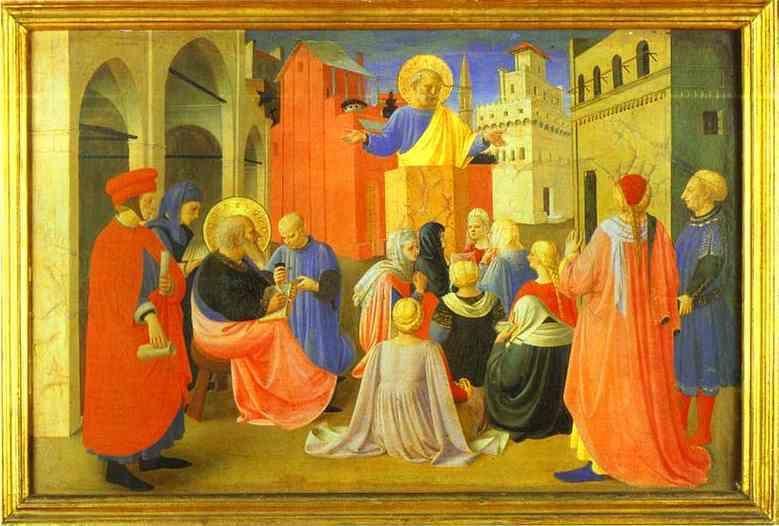
Fra Angelico - Linaiuoli Tabernacle: Peter Preaching with Mark


As today is the feast of St Mark let us enjoy this painting by Fra Angelico. The details of the image is Fra Angelico. Linaiuoli Tabernacle: Peter Preaching with Mark. Predella. 1433. Tempera on panel. 39 x 56 cm. Museo di San Marco, Florence, Italy.


St. Mark - 25th April 2009

Today we celebrate the feast of the evangelist of St. Mark. Let us read what Dr. Plinio has to say about this great saint. 

Biographical selection: 

The Evangelist St. Mark was from the tribe of Levi. He was baptized by St. Peter and instructed by him in the Christian Faith. He followed Peter to Rome and would preach the Gospel in this city with him. The faithful asked St. Mark to write the life of Our Lord according to the accounts of St. Peter. So Mark wrote the narrative based on what he had heard from Peter. The latter, after examining Mark’s work, testified that it was perfectly exact and approved it to be read by all the faithful. 

Later St. Peter sent St. Mark to Alexandria, where he was the first to preach the Word of God. According to Simon, an old Jew who witnessed the labors of Mark in that city, an enormous multitude converted there as a consequence of the apostolate of St. Mark. 

St. Peter Damian wrote that God gave St. Mark a special grace by which all the people he converted in Alexandria took up monastic customs. He inspired them to this by his miracles and the example of his virtues. After his death, his relics were sent back to Italy, so the land where he wrote his Gospel had the honor of preserving his body. 

St. Peter consecrated him Bishop of Alexandria. In this city the zeal of St. Mark attracted the hatred of the priests of the false gods. On Easter in the year 68 AD, they seized him while he said Mass, and tied a rope around his neck. Then they dragged him through the city like an animal to slaughter. His body was lacerated by the rough rocky surface and his blood stained the roads.

In the prison where they threw him, he was consoled by an Angel. Then Our Lord deigned to visit him and told him: “Peace be with you, o Mark, My Disciple and My Evangelist. Fear nothing because I am near you.” 

The next day the pagan priests again placed a rope around his neck and dragged him through the streets of the city. This time his strength gave out and he died, saying: “Into Thy hands I commend my spirit.” 

The air became turbulent, and lighting and thunder broke through the sky. His assailants, who had planned to burn his body, all fled. Thus Mark’s disciples were able to collect and piously bury his remains. 

Comments of Prof. Plinio: 

You know that Alexandria was one of the largest cities of Antiquity. It was a city famous for its culture, wealth, and political importance, as well as for the pomp and luxury of its inhabitants. At that time Paganism was different from modern Paganism, which is noted for its vulgarity, banality, and equalitarianism. Paganism then was set in fabulous richness and luxury. It used to make a similar show of an elaborated culture. This pagan display of splendor brought great importance to many of the cities of that time and made them shine before the world. 

These important cities were also the most difficult to convert. St. Mark, however, was able to convert many people of Alexandria. Soon after he arrived, many people changed their lives and took up monastic habits. You can easily imagine the sharp contrast this dignified, serious, chaste and austere life made with the dissolute and exorbitant way of life of the local social elites. 

The life of those elites was quite censurable. It seems useful to give you an idea of how it was. The Romans had conquered all the countries around the Mediterranean Sea, which they called mare nostrum [our sea]. For this reason those countries had the tendency to adopt Roman customs. 

For example, the elites used to have evening banquets and parties in palaces with garden courtyards. With the agreeable evening air of the sea, the doors of the palaces would be open. Such parties frequently lasted all night, ending at dawn with the family members and guests spread throughout the gardens, drunk and unconscious, lying here and there alone or entwined with others in dishonorable postures to be picked up by the servants and taken to their own beds. 

At those bacchanals, they used to eat and drink until they were satiated. They would recline in a kind of chaise longue called a triclinium that could accommodate two or three persons. The ambience was what I imagine would be the boîte [night club] of our days. There were performances of music, poetry, songs, sometimes even gladiators for the amusement and enjoyment of the guests. Throughout the party all were eating and drinking. 

When someone had gorged himself on food and drink and could take no more, there were places like our restrooms where slaves would tickle their throats with a feather so they could vomit everything. Then they would clean themselves with water and perfumes, dry their hands in the long hair of women slaves who were there for that purpose, and return to the banquet rooms to eat and drink again. 

The moral ambience of the lower levels of society was also repugnant. The slaves were very numerous, since almost every free man of the elites or middle classes had more than one slave. But they were not treated as human beings. They were considered the objects of their owners. The slave had no rights to marry or have a family, no rights of parents over children. A child belonged to the owner of his parents like a fruit belongs to the proprietor of the tree. The owner used to take what he wanted from the family of the slaves. He could even kill the slave, which was not considered a crime. 

This was the bestial and decadent world of Paganism. The world of the Alexandria when St. Mark came to preach in it.

You have to imagine this opulent city of Alexandria when St. Mark first arrives with his great dignity. He is there for the first time walking through its streets, let’s suppose, at 4 p.m. with the sun still shining. A Jew, with his beard, his stately bearing, his sanctity, his spirit of recollection, he approaches a first group of people, finds them open to him, and begins to preach. Some of the wayfarers laugh of him, others are indifferent, but one here, another there, come to joint the small group that is already listening to him. In a short time he has a circle of people around him. He finishes, bids farewell to his audience, and goes to a modest inn. 

People start to talk about the things they heard, about Our Lord Jesus Christ, His cross, the need to follow a way of austerity, chastity, and sanctity. Grace accompanies the words of St. Mark, and those people for the first time contemplate a completely different life. Here is a wife who was abandoned by her husband, there is a young man whose eyes begin to open to the gross immorality of this society, further along is a drunk who stops to see what was going on. 

The words of St. Mark open a new perspective of eternal live. He speaks about a spirit that is not material, he speaks of the resurrection of the body, of Heaven and eternal happiness, and also of Hell and Purgatory. He explains that there is a God who is Goodness, Justice and Wisdom Itself to whom we should pray and ask for help. He speaks about Our Lady and the Sacraments, the Holy Eucharist, Confession and the great privilege it is to have our sins forgiven. To a man accustomed to the orgies of Alexandria, these topics cause contradictory reactions. One feels an irresistible attraction, and another a complete repulsion. 

This illustrates how the action of grace over the words of St. Mark could have converted many people. It also makes us understand how his words and his presence constituted a problem for the entire city of Alexandria. He gained so many followers that from that time onward the Catholic Faith was established in the city. But he also generated an immense hatred against him, and these people decided to kill him. 

It is clear that he came to divide, to separate. He created an unsustainable situation for those who did not want to follow him. The result was that they began to plot to kill him. This explains, until the end of time, what happens to all those who follow the model of Our Lord Jesus Christ. 

There is a similarity between the great mission of St. Mark and our more modest mission, we who fight against the modern world. In many ways, the present day world is much worse than the Alexandria of that time. Today’s immorality, I could sustain, is much worse than it was at that time. But I would focus on another point: the indifference of the modern world. In that time St. Mark was able to convert multitudes, in modern times you can consider the apathy of the world in face of the miracles of Lourdes, the great miracle of the sun at Fatima. The normal modern man doesn’t care about them and doesn’t change.

Another point, St. Mark suffered martyrdom and his body was received with veneration by the Italian people who dedicated a city to him: he became the patron of Venice. Today, the Monophysitist Coptic sect is trying to have the body of St. Mark returned to Alexandria. In 1968 Paul VI already gave the precious relic of the head of St. Mark to that sect. The reaction among the Catholic public was very weak, almost complete indifference. 
From this we can see that, worse than the times of St. Mark, today we have doctrinal corruption that has penetrated the Holy Church. She should be the sun of sanctity, and today she is infiltrated by enemies who disfigure her. The Progressivism that controls the Catholic Church today is an expression of the modern world. It is worse than the world of St. Mark. 

Just as St. Mark had the obligation to fight against the corrupt world of his time, we have the duty to fight against the enemies who brought this corruption inside the Church. And because we are convinced that we are incomparably less than St. Mark, we should ask him to help us to conquer ourselves, to overcome our own miseries, so that we might be able to defend the Church against her enemies. 

- Dr. Plinio Corea

Friday, April 24, 2009

St. Fidelis of Sigmaringen - 24th April 2009


FIDELIS was born at Sigmaringen in 1577, of noble parents. In his youth he frequently approached the sacraments, visited the sick and the poor, and spent moreover many hours before the altar. For a time he followed the legal profession, and was remarkable for his advocacy of the poor and his respectful language towards his opponents. Finding it difficult to become both a rich lawyer and a good Christian, Fidelis entered the Capuchin. Order, and embraced a life of austerity and prayer. Hair shirts, iron-pointed girdles, and disciplines were penances too light for his fervor; and being filled with a desire of martyrdom, he rejoiced at being sent to Switzerland by the newly-founded Congregation of Propaganda, and braved every peril to rescue souls from the diabolical heresy of Calvin. When preaching at Sevis he was fired at by a Calvinist, but the fear of death could not deter him from proclaiming divine truth. After his sermon he was waylaid by a body of Protestants headed by a minister, who attacked him and tried to force him to embrace their so-called. reform. But he said, "I came to refute your errors, not to embrace them; I will never renounce Catholic doctrine, which is the truth of all ages, and I fear not death." On this they fell upon him with their poignards, and the first martyr of Propaganda went to receive his palm.

Thursday, April 23, 2009

Montreal Cardinal: "I am against abortion, but I can understand that in certain cases, there is almost no other choice than to practice it."

This is a snippet from LifeSite News

"In the interview Cardinal Turcotte, as quoted by Le Devoir, compared abortion to killing in self-defense, effectively equating the unborn child with a violent aggressor. "Personally, I am against murder," he said, "but can understand that sometimes, when someone is being attacked, they need to kill someone in self-defense. I am against abortion, but I can understand that in certain cases, there is almost no other choice than to practice it."

No respected Cardinal there are no cases in which abortion can be practiced, not even if the life of the mother is at risk. If you dobt this respected Cardinal, please refer to Saint Gianna Molla  

A few days before the child was due, although trusting as always in Providence, she was ready to give her life in order to save that of her child: “If you must decided between me and the child, do not hesitate: choose the child - I insist on it. Save him”. On the morning of April 21, 1962, Gianna Emanuela was born. Despite all efforts and treatments to save both of them, on the morning of April 28, amid unspeakable pain and after repeated exclamations of “Jesus, I love you. Jesus, I love you», the mother died. She was 39 years old. Her funeral was an occasion of profound grief, faith and prayer. The Servant of God lies in the cemetery of Mesero (4 km from Magenta).

Wednesday, April 22, 2009

What church father are you

I Don't normally put up such things on my blog. However this is an oppurtunity to learn about a church father so here goes...


You’re St. Melito of Sardis!


You have a great love of history and liturgy. You’re attached to the traditions of the ancients, yet you recognize that the old world — great as it was — is passing away. You are loyal to the customs of your family, though you do not hesitate to call family members to account for their sins.


Find out which Church Father you are at The Way of the Fathers!


St. Adalbert of Prague - 22nd April 2009


Today is the feast of St. Adalbert of Prague. Let us understand what Dr. Plino has to teach us about this Saint.

Adalbert was born in 956 into an illustrious family of Bohemia. In childhood he was taken by a fatal illness and his parents made a vow to the Holy Virgin to offer him to the priesthood if he would be cured. Their prayers were answered, and the boy recovered his health. They sent their son to Magdeburg to the saintly Archbishop of Magdeburg, who oversaw his education in religion and science.

In 973 he received holy orders from the Bishop of Prague. Later, this Bishop died a bad death, screaming in despair on his deathbed that he would be condemned for his negligence to his duties and ardent pursuit of honors, wealth and pleasures. A witness to this sad end, Adalbert never forgot it, taking it as a lesson for the rest of his life. The next year he was chosen as Bishop of Prague.

He entered Prague barefoot and was joyfully received by the people. The Diocese was in a deplorable situation. Some of its inhabitants were still idolaters, and many Catholics were well entrenched in shameful vices. In vain St. Adalbert tried to correct them and to bring them to religion and piety. When his efforts proved fruitless, he obtained papal permission to leave the Episcopate and enter a monastery in Rome. After five years, Pope John XV sent him back to Prague with the provision that he could again leave the Episcopate if the people did not correspond.

A second time he was received joyfully, and the people promised to correct themselves and leave their heathen practices. These hasty promises were soon forgotten, however, and the Saint determined to abandon them forever and return to his monastery. On his way back to Rome, he met with a great success in Hungary, where he converted many to Catholicism. With this, the Pope ordered him to not come to Rome, but to return to Prague. At this news, the elites of Prague became enraged and killed many relatives of the Saint, stole his belongings, and burned the family castles.

Adalbert went to Boleslaus, his friend, son of the Duke of Poland. In this country he again converted many idolaters. On a missionary trip to Prussia he converted some of the inhabitants of Danzig. It was there that he met his death when a group of pagans attacked him. When he received the first blow, he thanked God for giving him the opportunity to suffer for Him. Then the pagan priest leading the idolaters pierced his body with a two-headed lance, saying: “Be joyous, then, since you want nothing more than to suffer with your Christ.” It was April 23, 997.

Comments of Prof. Plinio: This life is so dense in teachings that we could analyze it point by point. Let us take only some of them.

First, we can consider the situation in the Middle Ages. It is erroneous to imagine that in that time the Church was crowned with glory sleeping in a bed of flowers for 1000 years. The fact is that during those 1000 years the life of the Church was a hard fight. The reality is that the Church won that fight because many generous souls, called by God to make the sacrifice of their lives, said “yes.” In other times the Church has to face the same fight, but instead of saying “yes,” persons called by God say “no,” or “perhaps” – which is the more detestable way to say “no.” So, the Church is badly served and as a consequence, civilization slides downhill. This applies to the facts we just heard regarding the Middle Ages.

Second, Prague was an important city of that time. It was situated in an area newly evangelized by the Church, still lacking a Catholic civilization. Great attention was being paid to it, just as today people pay special attention to new areas that are just starting to develop and be civilized. In Prague there was a Bishop who had the responsibility to further the Reign of Our Lord and Our Lady in that region. His mission was to confirm the Catholics in their faith and to convert those who were not Catholics. But he was bad and died in despair.

Third, even in this death we can see some medieval characteristics that almost no longer exist. Today almost no one dies in dramas of despair. Sinners like this Bishop and even worse die listening to music and such, completely indifferent to their responsibilities. They do so cynically, calmly, saying good bye to everyone and pretending they have nothing to fear. There is no longer shame felt for the sins committed and the evil done. It is a complete indifference, and a general insensibility. The worse thing is that this moral insensibility reflects the person’s loss of the sense of good and evil, the sense of what comes from God and what comes from the Devil.

Such insensibility was much rarer in the Middle Ages. Certainly the Church had to fight against all kind of enemies, as we heard in this selection. But it rarely happened that a man would have the kind of indifferent death we see today. Persons could die blaspheming, or in despair; others would convert in extremis [at the last moment]. But almost no one died in the cynicism and indifference so common today.

Fourth, so we see that the Bishop of Prague died with signs of horror, with signs of his condemnation. One good result was the healthy shock this caused in the life of a future saint. Remembering this sight, St. Adalbert decided to humbly enter Prague barefoot when he was chosen to be the successor of that man. Doing this, he was showing that he was a penitent Bishop, and not a dissolute Bishop. It was his way of saying that he would not follow in the steps of his predecessor, that he would lead the Diocese in a way completely different from his predecessor. It was a strong statement that showed his disapproval not only of the bad Bishop, but also of the bad faction of Catholics of that city.

Fifth, a curious fact that contradicts later events is that twice the people received him very well. Nonetheless, that people was incorrigible. They resisted the efforts of the Saint during his whole lifetime. They became, in effect, his great cross. He preached to this people, and they didn’t convert. Afterwards, he preached to the Hungarians and the Prussians and they converted, but his own people did not. They remained bad to the end.

Nothing is automatic in the life of the Church. Some persons think that if a city or an area has a saint, it will automatically convert. It doesn’t work this way. While it is true that often a saint is enough to convert a region, at other times a bad people can resist the action of the greatest saints, just as the Jews resisted the action of Our Lord Jesus Christ, who was the Man-God Himself.

Sixth, the result of this rejection of St. Adalbert by Bohemia – it is interesting to see the consequences of the rejection of a saint – is that it continued to be a bad region for a long time. With John Hus, Bohemia took an early lead in the Protestant revolution, and after it, Bohemia was one of the strongholds of Protestantism.

Although Bohemia was subject to the House of Austria, it always constituted a problem. Later it became a socialist republic. Furthermore, this people did not rise up with any particular reaction against Communism when it took over Czechoslovakia. That is to say, that rejection of old, that bad character from its past, generated a bad people until our days. There were, of course, exceptions. There were many good people there, many saints. But a bad current always continued.

We should imitate St. Adalbert in bringing the truth and the traditional Catholic position to our countries. If we do so in the right way, fearlessly and humbly, as St. Adalbert did, we invite our countries to adhere to the right path.

We should pray to St. Adalbert and especially to Our Lady to help convert our countries and our American continent. We should ask that we are generous enough to answer “yes,” and never “perhaps” to the invitation God makes to us to help Him.

Tuesday, April 21, 2009

St. Anslem - 21 April 2009

St. Anselm was born in 1033 near Aosta, in those days a Burgundian town on the frontier with Lombardy. Little is known of his early life. He left home at twenty-three, and after three years of apparently aimless travelling through Burgundy and France, he came to Normandy in 1059. Once he was in Normandy, Anselm's interest was captured by the Benedictine abbey at Bec, whose famous school was under the direction of Lanfranc, the abbey's prior.

Lanfranc was a scholar and teacher of wide reputation, and under his leadership the school at Bec had become an important center of learning, especially in dialectic. In 1060 Anselm entered the abbey as a novice. His intellectual and spiritual gifts brought him rapid advancement, and when Lanfranc was appointed abbot of Caen in 1063, Anselm was elected to succeed him as prior. He was elected abbot in 1078 upon the death of Herluin, the founder and first abbot of Bec.

Under Anselm's leadership the reputation of Bec as an intellectual center grew, and Anselm managed to write a good deal of philosophy and theology in addition to his teaching, administrative duties, and extensive correspondence as an adviser and counsellor to rulers and nobles all over Europe and beyond. His works while at Bec include the Monologion (1075-76), the Proslogion (1077-78), and his four philosophical dialogues: De grammatico (1059-60), De veritate, and De libertate arbitrii, and De casu diaboli (1080-86).

In 1093 Anselm was enthroned as Archbishop of Canterbury. The previous Archbishop, Anselm's old master Lanfranc, had died four years earlier, but the King, William Rufus, had left the see vacant in order to plunder the archiepiscopal revenues. Anselm was understandably reluctant to undertake the primacy of the Church of England under a ruler as ruthless and venal as William, and his tenure as Archbishop proved to be as turbulent and vexatious as he must have feared. William was intent on maintaining royal authority over ecclesiastical affairs and would not be dictated to by Archbishop or Pope or anyone else.

So, for example, when Anselm went to Rome in 1097 without the King's permission, William would not allow him to return. When William was killed in 1100, his successor, Henry I, invited Anselm to return to his see. But Henry was as intent as William had been on maintaining royal jurisdiction over the Church, and Anselm found himself in exile again from 1103 to 1107. Despite these distractions and troubles, Anselm continued to write. His works as Archbishop of Canterbury include the Epistola de Incarnatione Verbi (1094), Cur Deus Homo (1095-98), De conceptu virginali (1099), De processione Spiritus Sancti (1102), the Epistola de sacrificio azymi et fermentati (1106-7), De sacramentis ecclesiae (1106-7), and De concordia (1107-8). Anselm died on 21 April 1109. He was canonized in 1494 and named a Doctor of the Church in 1720.

Monday, April 20, 2009

St. Conrad of Parzham - 20th April 2009


St. Conrad was not a founder of an order, a priest or a doctor yet his love of God and his devotion to Mary made him a hero of Christ. St. Conrad excelled in the virtue of Charity, showing itself in love of God and neighbour, devotion to the Holy Eucharist and a childlike confidence in Mary, the Mother of God.

St Conrad received a good training in Catholicism from his parents whom he helped on the farm. We are told that he spent many hours in prayer while going about his work, so it may not be surprising that this holy youth sought entry to the Capuchins after attending a mission in his town. He entered as a humble lay brother. In his notes we find written, "The Cross is my book". Because Christ had given all to us, Conrad decided to give all he could possibly give for Christ and souls. He held the office of Porter at Altoetting for over forty years. As the monastery was a place of pilgrimage, it was besieged by thousand calls a day. To young and old alike, to polite and impolite, the saint was kind and gentle. By living in union with God he was able to let Christ act through him. In answering questions and discussing God he led many souls to the Divine Redeem. Conrad ate little, slept less and worked hard, but always in communion with Christ, the God of his heart. He had a great longing for the Eucharist and served Mass with great devotion. The Mass was the greatest joy of Conrad's long and hard life. Whatever extra time he had from his work, the Saint spent before the Blessed Sacrament.

To the strong devotion to the Eucharist and the Crucified Lord, Conrad added a special devotion to Mary. She was his Queen and Advocate in all his trials and above all his guide to Christ. He prayed before the statue of Our Lady of Sorrows and the Crucifix in the Porter's Office and was always ready to spread devotion to Mary by the distribution of Rosary Beads. Finally crippled, Conrad served his last Mass on April 18th, 1894; three days later, while the children who he had taught the Rosary, recited it outside his window, Conrad died. His heroic virtues and the miracles he performed won for him the distinction to be ranked among the Blessed by Pope Pius XI in the year 1930. Four years later, the same Pope approving additional miracles which had been performed, solemnly inscribed his name in the list of Saints. The feast of St. Conrad is celebrated on April 21st.

Friday, April 17, 2009

Bl. Kateri Tekakwitha - 17th April 2009

Kateri Tekakwitha, known as “the Lily of the Mohawk”, was born in 1656 of a captive Algonquin mother and an Iroquois chieftain. Her mother was a Christian but dared not baptize Kateri or her younger brother. When an epidemic of smallpox broke out in 1660, the little girl lost her mother and brother, perhaps also her father at that time; she herself nearly succumbed to the malady.

Her uncle, who adopted her, later wanted her to marry a young Iroquois her own age, but she refused, having already experienced the horror of the Iroquois brutalities. When in 1675 Father Jacques de Lamberville, Jesuit missionary, discovered on the banks of the Mohawk River this “beautiful lily”, he transplanted her to the mission of St. Francis Xavier near Montreal, which had been founded a few years before. She received her first Communion there on Christmas day of 1676.

In 1679, on the feast of the Annunciation, with the authorization of one of the Fathers at the mission, Kateri privately pronounced a vow of perpetual chastity and consecrated herself to the Blessed Virgin. From that time on, she and her rosary were inseparable. Her health had never been strong, and her penances contributed to weakening it further. It was during Holy Week of 1680 that this young Indian maiden quietly expired, invoking the names of Jesus and Mary. Miracles and favors were attributed to her soon after her death.

In 1943, Pope Pius XII admitted the cause of beatification, approving the decree on the heroism of her virtues. Saint Kateri had appeared to some Polish prisoners during World War II, telling them she was named a patron of their country and brought about their release. They described to the Jesuits of their own country, the young Indian girl whom they had all seen in their vision, and learned who she was — Kateri, Lily of the Mohawk, the Canadian Indian girl who had attained sanctity very young and died at the age of 24 years. She was beatified in 1980, canonized in 1991.


The oldest portrait of Kateri Tekakwitha is an oil painting on canvas 41"x37" painted by Father Chauchetière between 1682-1693. It hangs in the sacristy of St. Francis Xavier Church on the Kanawaké Mohawk Reservation on the south bank of the St. Lawrence River, near Montréal, Québec.


For more about this saint please refer to the following link

Thursday, April 16, 2009

St. Benedict Joseph Labre - 16th April 2009


Benedict Joseph Labre was born 26 March 1748 at Amettes, near Boulogne, the son and eldest child of a shopkeeper. After a private education with an uncle, the parish priest at Erin (who died heroically, ministering to, and himself infected by the victims of a cholera epidemic), he tried his vocation unsuccessfully with a number of strict monastic communities: Carthusians (Val-Sainte-Aldegonde, Neuville), Trappists (La Trappe, twice), and Cistercians (Sept-Fonts). His modern namesake, the Capuchin Father Benedict Groeschel, counts eleven attempts at monastic life!

By 1770, when he was twenty-two, it was clear that Benedict Joseph had no vocation to any religious community, and thenceforth he lived as a destitute pilgrim -- walking to shrines all over Europe. His only possessions, besides the single set of clothes he wore, were two rosaries, and three books: a New Testament, a Breviary, and The Imitation of Christ.

He settled permanently in Rome in 1774 (except for an annual pilgrimage to the Shrine of the Holy House at Loreto), sleeping at night in the Colosseum, and spending his days in the churches of Rome, especially those where the Forty Hours' Devotion was being observed. Santa Maria dei Monti became his favorite Roman church, where he was devoted to a fresco of the Madonna and Child with Saints Stephen, Lawrence, Augustine and Francis. Toward the end of his life, when he had grown severely ill, he did accept shelter sometimes at a hospice for poor men.

By Holy Week of 1783 he was near death, and on Wednesday he collapsed just outside Santa Maria dei Monti after attending Mass. A passerby, a local butcher, picked him up off the street and carried Benedict Joseph to his own nearby home, where, that evening at about eight o'clock, 16 April 1783, Benedict Joseph died after receiving Extreme Unction, aged thirty-five. So great was the crowd thronging his funeral that troops had to be called in to maintain public order.

Within a few months of his death, more than 130 miracles ascribed to the Saint had been carefully recorded. That year, G. L. Marconi, a priest who had been his confessor, published a biography. Benedict Joseph Labre was canonized by Pope Leo XIII, 8 December 1881.

Part of the butcher's house where he died (near Santa Maria dei Monti) was converted into a chapel with an altar, two cupboards containing the scanty relics he left, and a life-size recumbent statue of the Saint, marking the spot where he died, over which hangs a painting of the Madonna. He was buried beneath an altar in a chapel of Santa Maria dei Monti, where there is another life-size marble effigy. The death mask that was made before his burial is extant. Also preserved is one portrait made during his life. While the saint was in an ecstasy before an image of our Lady, he was painted by Antonio Cavallucci, and this portrait hangs in the National Gallery, Rome (Galleria Nazionale d'Arte Antica).

For More about this saint and his writing refer to this link

Wednesday, April 15, 2009

St. Maro - 15th April 2009

St. Maro chose a solitary abode not far from the city of Cyrrhus in Syria, and there in a spirit of mortification, he lived mainly in the open air. He had indeed a little hut covered with goatskins to shelter him in case of need, but he very seldom made use of it. Finding the ruins of the heathen temple, he dedicated it to the true God, and made it his house of prayer. St. John Chrysostom, who had a great regard for him, wrote to him from Cucusus, the place of his banishment, and, recommending himself to his prayers, begged to hear from him as often as possible. Maro was a disciple of St. Zebinus. He drew great crowds by his spiritual wisdom. He trained many hermits and monks and founded three monasteries. It is believed the Maronites take their name from Bait-Marun monastery near the source of the Orantes river, where a church was erected over his tomb. His feast day is April 15th.

Tuesday, April 14, 2009

Saint Lidwina - 14th April 2009

Saint Lidwina (Lydwine) lived in Schiedam (Holland). We know a lot about her thanks to many books, including a book about her written by J.K. Huysmans (translated by Agnes Hastings. into English) and reprinted by Tan Books and Publishers of Rockford, IL., in 1979).

The original work is dated 1923 and was published in French.The preface of this work reveals that Jan Gerlac, the sacristan of the Augustinian Monastery of Windesem, was a relation of
hers and he lived a number of years near Lidwina (later in the same house as Lidwina) and thus writes from personal observation and was quoted by Huysmans.

Two other gentlemen are quoted his book. One of these is Thomas à Kempis who was subprior of the Augustinians of Mount Agnes near Zwolle. We know à Kempis as the author of the Imitation of Christ. Lidwina lived in Holland at the time of the Great Schism when the Church was split due to two anti-popes.

At the age of 15 Lidwina broke a rib while ice skating and remained bedridden for the rest of her life. She put her illness to a supernatural purpose. She was suffering voluntarily for the welfare of the Church. She fasted during this entire time when she was bedridden and was found often in ecstacy. She is one of the most heroic victim-souls of all time.

During her lifetime, there was a school of ascetics in Deventer that followed the teachings of Blessed Jan van Ruysbroeck, who preached at Campen, Zwolle, Amsterdam, Leiden, Zutphen, Utrecht, Gouda, Haarlem and Delft. He and his pupil, Florent Radewyns, a Deventer priest, founded the aforementioned Institute of Brothers and Sisters of Communal Life. This order, although it never bore that name, were really oblates of Saint Augustine.

It is interesting to note that the name Lidwina a formalization of Lidie comes from the Dutch word "lijden" which means to suffer. The aid of physicians were enlisted by Lidwina's parents to seek a cure for her disease. She was in intense pain, sobbed on her bed in a state of terrible abandonment, was given to constant vomiting, suffered burning fevers and could not hold down food of any kind. This situation lasted for three years.

Then followed a relatively blissful period but she was still confined to bed and could not get up. In the following years she still suffered greatly from abscesses, inflamed sores, and
it was said she was near death twenty-two times. At the age of 28, the coldest winter ever experienced in Holland set in, when even the fish froze in the rivers, the tears she shed at night froze to her face.

From the Third Order of Saint Francis in Schiedam she received a woolen shirt to wear, however she was not a member of that lay order. Historically, at that time William VI, a duke, was the Count of Holland. As he traveled with his wife, the Countess Marguerite through Schiedam, he granted Lidwina's father, who had fallen on bad times free rent on the premises they occupied. In the 13th and 14th Century, Holland began to see some economic development and William was proclaimed German king in 1247.

There was yet another war, the 100-Year War, but also during that time a number of cities obtained municipal rights, as Hecht already mentioned but also Middelburg, Dortrecht, Delft, Leiden, Haarlem, Arnhem, Nijmegen, Zutphen, Deventer and Kampen obtained municipal privileges. According the Encyclopediae Britannica: "The rise of the towns was accompanied by their struggle for political influence in their respective territories, in which they co-operated with the nobility and the clergy. This led to the growth of representative assemblies which were to become essential political institutions."

Returning to the story of Saint Lidwina, she continued to suffer and the more she suffered, apparently, the more she was given God's Gift of contemplation and bilocation. She was given to be in two places at once, when Jesus asked her to be with him at Golgotha. In answer to His request, Lidwina replied: "O Saviour, I am ready to accompany you to that mountain and to suffer and die there with you!" (Huysmans, 1923)

"He took her with Him, and when she returned to her bed, which corporeally she had never left, they saw ulcers on her lips, wounds on her arms, the marks of thorns on her forehead and splinters on her limbs, which exhaled a very pronounced perfume of spices." A number of miraculous healings were reported. For example, Lidwina prayed for a woman, a friend of hers, who had a frightful toothache. The woman's pain ceased immediately. Also, another woman came to her to ask for her intercession for her child who was screaming with pain. When the child was placed on Lidwina's bed his troubles disappeared. When the child grew up, he became a priest in memory of Lidwina.

Additional miracles continued after her death and she is not forgotten. Her feast day occurs on April 14th.

Monday, April 13, 2009

St. Martin I - 13th April 2009

Today is the feast of St Martin I, let us read what Dr. Plinio has to say about this great Pope and saint.

Biographical selection:

St. Martin was named successor of Pope Theodore I in the year 649. The soul of the new Pope had to be great to face the great difficulties of the times. To save the Church in the East, he condemned Monothelism, which claimed Christ had only one will.

Shortly after, Emperor Constans II, who was a Monothelist, ordered his agents to kidnap the Pope. They took Pope Martin and brought him by ship to stand before the Emperor at Constantinople. The Pope suffered enormously during the voyage and arrived in Constantinople very weak. There he was held in a filthy, freezing cell in a prison for three months. Finally, in handcuffs, he was dragged before a tribunal, and under the depositions of false witnesses he was condemned to death as a traitor and heretic. After the sentence was read, he was taken to a terrace of the palace near the imperial stables where a multitude was gathered.

The judge who had presided at the tribunal approached St. Martin and mocked him: “You see how God delivered you into our hands. You were against the Emperor, and thus has God abandoned you.”

Then the soldiers slashed his clothing and took away his shoes. He was delivered to the prefect of the city with the order of execution. The judge tried to incite the populace to anathematize St. Martin, but the mob remained silent gazing at the ground, with the exception of some 20 people who followed the order. After a while, the crowd dispersed.

The soldiers stripped the Pope of his shredded clothes and dressed him in a grotesque tunic, open on both sides, to humiliate him. They put an iron ring around his neck with a rope attached to it, and dragged him to a prison of common criminals. In the freezing cold, St. Martin trembled and awaited death. But at the last moment his death was commuted to life imprisonment.

In Crimea, where he was exiled, his suffering increased daily until the Creator called his soul in 655. Pope Martin left praiseworthy letters, full of wisdom, as well as his answers to the tribunal, written in a noble and sublime style, worthy of the majesty of the Apostolic See.


Comments of Prof. Plinio:

There are various aspects of this martyrdom that are very instructive to us.

First, the extreme respectability of Pope St. Martin and the special form of torment to which he was subjected. He was a saint and, therefore, aware of the supreme dignity of the Pontifical Throne. He knew it was the highest dignity on earth. The dignity of any King or Emperor cannot be compared to the dignity of the Vicar of Christ, to whom Our Lord gave the keys of Heaven and Earth.

Further St. Martin was a man of noble spirit. The selection allows us to see that he was very intelligent and highly educated. His letters reflected a noble and elevated spirit. He loved what is high and sublime.

Second, he was exposed to one of the worst humiliations a Pope had to suffer since the beginning of the Church. We know that St. Peter was crucified, but few Popes suffered a martyrdom as terrible as that of St. Martin. The Roman Pontiff who knew he was the legitimate representative of Our Lord was badly treated during his trip; when he arrived in Constantinople, he was kept in cruel confinement for three months before he was dragged before a court of Monothelist heretics. The tribunal was already prepared to condemn him.

After the condemnation, he was dressed in ridiculous apparel with an iron ring placed on his neck, as if he were an animal to be pulled here and there by a rope at their pleasure. He was mocked by the judge, who far from being an impartial man, instigated the multitude to laugh at and condemn the Sovereign Pontiff. Next, he was dragged barefoot to a prison of common criminals.

We can see the humiliation this represented for a man who respected himself. Further, it was intensely cold and he was trembling. Some bystanders could possibly interpret his trembling as a symptom of fear and have laughed at him. Finally, he was condemned to exile in the Crimea. He died there as a consequence of such bad treatment. For this reason the Church considers him a martyr.

He faced the worst public ordeals, such as the questioning before the Emperor and the judge, with panache and gave the answers that should be given. To the end he did not compromise. It is a noble example of fortitude.

Third, the cruelty of Emperor Constans II and the Monothelist heretics who surrounded him is notable. The Emperor committed an unspeakable crime practiced in the presence of all the people. An Emperor who exposes the Pope to public humiliation commits a sacrilege and brings the curse of God over the Empire. He and his sycophant, the judge, had planned that the people should laugh at the Pope and anathematize him. Even though they were a bad people, they did not do this.

The people remained silent and walked away. If they had been faithful, they would have risen in indignation and liberated the Pope from that outrage. The fact that they did not do this reveals the stage of decadence into which they had fallen.

Fourth, this episode also points to the centuries of rivalry that existed between Constantinople and Rome, the two largest cities in the world. This rivalry would lead to the Schism in the 11th century and the establishment of the Schismatic Church, which is called schismatic by a kind of historical condescendence, since it had always been heretical.

I read the report of a witness present in Constantinople when it was taken by the Turks in the 15th century. This man observed that the heretical people of Constantinople were literally terrified by the bloody invasion of the Turks. He noted, however, that if that people were to be given the alternative of returning to the Catholic Faith in order to stop the invasion, they would prefer to continue in the heresy and be destroyed by the Turks. That is, among them there was such a blind hatred toward the truth that nothing else mattered.

We see the fanaticism that the enemies of the Church can have.

How can we explain it? I remember a phrase of Donoso Cortes, a great Spanish thinker. He said that, without the grace of God, men normally like only partial truths; they do not like the whole truth, the universal truth. Normally men hate the whole truth more than anything else.

The Catholic Church offers the total truth. This is why she is hatred by so many people. They prefer any error to the whole truth. This explains why those schismatics and heretics of the 15th century hatred the Church; this also explains why Modernists, Progressivists, Communists and others hate the universal truth. For this they will be punished by the justice of God.

These are the comments that the edifying martyrdom of Pope St. Martin suggests. Let us ask him to give us his fortitute and the love for the whole truth.

Wednesday, April 8, 2009

St. Julie Billiart - 8th April 2009

Born in Cuvilly, France, into a family of well-to-do farmers, young Marie Rose Julia Billiart showed an early interest in religion and in helping the sick and poor. Though the first years of her life were relatively peaceful and uncomplicated, Julie had to take up manual work as a young teen when her family lost its money. However, she spent her spare time teaching catechism to young people and to the farm laborers.

A mysterious illness overtook her when she was about 30. Witnessing an attempt to wound or even kill her father, Julie was paralyzed and became a complete invalid. For the next two decades she continued to teach catechism lessons from her bed, offered spiritual advice and attracted visitors who had heard of her holiness.

When the French Revolution broke out in 1789, revolutionary forces became aware of her allegiance to fugitive priests. With the help of friends she was smuggled out of Cuvilly in a haycart; she spent several years hiding in Compiegne, being moved from house to house despite her growing physical pain. She even lost the power of speech for a time.

But this period also proved to be a fruitful spiritual time for Julie. It was at this time she had a vision in which she saw Calvary surrounded by women in religious habits and heard a voice saying, "Behold these spiritual daughters whom I give you in an Institute marked by the cross." As time passed and Julie continued her mobile life, she made the acquaintance of an aristocratic woman, Francoise Blin de Bourdon, who shared Julie's interest in teaching the faith. In 1803 the two women began the Institute of Notre Dame, which was dedicated to the education of the poor as well as young Christian girls and the training of catechists. The following year the first Sisters of Notre Dame made their vows. That was the same year that Julie recovered from the illness: She was able to walk for the first time in 22 years.

Though Julie had always been attentive to the special needs of the poor and that always remained her priority, she also became aware that other classes in society needed Christian instruction. From the founding of the Sisters of Notre Dame until her death, Julie was on the road, opening a variety of schools in France and Belgium that served the poor and the wealthy, vocational groups, teachers. Ultimately, Julie and Francoise moved the motherhouse to Namur, Belgium.

Julie died there in 1816. She was canonized in 1969.

Sunday, April 5, 2009

St Isidore of Seville - 4th April 2009

Today is the feast of St Isidore of Seville. Let us read what Dr. Plinio has to say about this great saint.

Biographical selection:

Bishop and Doctor of the Church, illustrious for his doctrine and sanctity, St. Isidore of Seville (c. 560-636) illuminated Spain with his zeal, Catholic Faith, and observance of ecclesiastical discipline. Born in Cartegena, Spain, he was considered the most learned man of his times. He was a prolific writer, and fought tenaciously against the Arians.

His name shines in a family of saints: His elder brother St. Leander was his immediate predecessor in the See of Seville; while a younger brother St. Fulgentius presided over the Bishopric of Astigi. His sister Florentina was a nun, and ruled over forty convents and one thousand religious.

In his Chosen Works, there is a text titled “Lamentations of a Sinner.” In it, St. Isidore advises:

“In all your acts, in all your works, in all your behavior, imitate the good; be a competitor of the saints, keep your eye on the heroism of the martyrs, follow the example of the just. It is my wish that the life and teachings of the saints be for you an encouragement to virtue.

“Have a good spirit, maintain your good reputation and do not diminish it with any bad action; do not let it fall into dishonor.

“Demonstrate what you think by your bearing and your walk. Have simplicity in the way you present yourself, purity in your walk, gravity in your gestures, honesty in your step. Do not display lasciviousness, arrogance, and superficiality. The stance of the body is the indicator of the mind. Your walk, therefore, should not represent superficiality; your step should not affront yourself or your neighbor.

“Do not permit yourself to be a spectacle for the gossip of others; do not allow your honor to be degraded. Do not associate with vain people. Avoid the bad; rebuff the indolent. Flee overmuch association with men, especially those who are more inclined to vice.

“Seek the good, desire their company. Look for the company of the saints. If you will share their way of acting, you will share their virtue. If you walk with wise men, you will be wise; if you walk with idiots, you will be an idiot, for persons seek those of similar stripe.

“It is dangerous to live among bad persons; it is harmful to be surrounded by those with perverse wills. You will feed yourself on their infamy if you associate with the undignified. It is better to suffer the hatred of evil persons than their company. Analogously, just as much good comes from the lives of the saints, much evil comes from the lives of bad persons, for those who touch what is filthy become contaminated.”


Comments of Prof. Plinio:

To comment on this beautiful excerpt of St. Isidore, let me highlight two points.

First, he establishes a profound link between the moral conduct of a man and his exterior behavior, that is, how the man presents himself and the way he appears before others. The basic idea is that everyone should appear before others in accordance with a Catholic moral ideal. In other words, no one should be entirely spontaneous and follow his first uncontrolled instincts. That is revolutionary. By his external way of being, his bearing, his gaze, his walking, his behavior, every man should symbolize the moral ideal he follows.

The presupposition of St. Isidore is that, since we have original sin, it is not true that our virtue will always appear when we deal with others. Many times virtue is not apparent, but rather our bad side shows. So, we should be careful to express what is good and repress what is bad. We have the obligation to suppress our bad side in our external behavior. This is not hypocrisy or vanity. It is an obligation of respect to others and principally to God. It is an implicit affirmation that the vice that lives in us has no right to appear in the light of day.

Hence, we have to discipline ourselves and follow an exterior way of conduct that will reflect the best of that we are interiorly. If man were free of original sin, this would not be necessary. But since original sin exists, we must discipline ourselves and control our bad impulses.

This is why in any civilization that achieves a certain degree of perfection, parents teach their children to have good posture and fine manners in order to reflect their ideal.

Second, when St. Isidore speaks of how one should seek out the good and avoid bad company, he implicitly refutes the progressivist mentality that affirms that the good should mix with the bad in order to “do apostolate.” This is an error. If we start to associate with those who are bad, we will become bad also.

These words of St. Isidore frontally oppose the progressivist method of “apostolate of conquest,” which preaches that Catholics should “bring Christ to the world.” This was the mentality of the student and worker social movements that have inundated the Church since the 1930s. Their partisans preach that Catholics should seek out worldly men and women in their own circles – in factories, football stadiums, or nightclubs. The practical result of such experiences was that the worker-priests who went to the factories became communists; those who went to nightclubs became morally relaxed and increasingly compromised in their Catholic principles. Large sectors of the Church became infected with this permissive mentality.

An analogous thing is happening with Vatican II’s aggiornamento, that is, the adaptation of the Catholic Church to the modern world. Instead of changing the world and converting it to Catholicism, what is happening is precisely the opposite: The world is conquering the Church. Everywhere we see priests and Bishops abandoning their respectable habits and cassocks and wearing worldly clothes; we see churches built in the modern art styles and imitating theaters, the Mass becoming a show for the public, popular music invading the sanctuaries, and revolutionary customs and clothes being admitted everywhere to accomodate the youth.

St. Isidore of Seville thinks otherwise. He advises us to contain our bad spontaneity, to always be dignified. His words of advice also explain the failure of the aggiornamento: “Analogously, just as much good comes from the lives of the saints, much evil comes from the lives of bad persons, for those who touch what is filthy become contaminated.”

Let us ask the great St. Isidore of Seville to give us both the self-discipline to present only the dignified aspects of our souls in our external behavior and the discernment to know what is good and bad. Then we should foster in ourselves an admiration for the good and the desire to follow it, and a rejection for the evil and the resolve to resist it.

Friday, April 3, 2009

St. Benedict the African - 3rd April 2009

Benedict held important posts in the Franciscan Order and gracefully adjusted to other work when his terms of office were up.

His parents were slaves brought from Africa to Messina, Sicily. Freed at 18, Benedict did farm work for a wage and soon saved enough to buy a pair of oxen. He was very proud of those animals. In time he joined a group of hermits around Palermo and was eventually recognized as their leader. Because these hermits followed the Rule of St. Francis, Pope Pius IV ordered them to join the First Order.

Benedict was eventually novice master and then guardian of the friars in Palermo— positions rarely held in those days by a brother. In fact, Benedict was forced to accept his election as guardian. And when his term ended he happily returned to his work in the friary kitchen.

Benedict corrected the friars with humility and charity. Once he corrected a novice and assigned him a penance only to learn that the novice was not the guilty party. Benedict immediately knelt down before the novice and asked his pardon.

In later life Benedict was not possessive of the few things he used. He never referred to them as "mine" but always called them "ours." His gifts for prayer and the guidance of souls earned him throughout Sicily a reputation for holiness. Following the example of St. Francis, Benedict kept seven 40-day fasts throughout the year; he also slept only a few hours each night.

After Benedict’s death, King Philip III of Spain paid for a special tomb for this holy friar. Canonized in 1807, he is honored as a patron saint by African-Americans.

Thursday, April 2, 2009

St. Francis Of Paula - 2ns April 2009

Saint Francis Of Paula, founder of the order of Minims, born at Paula or Paola, Calabria, in 1416, died at Plessis-les-Tours, France, April 2, 1507. His family name has been variously given as Martorello, Martotillo, and Re-tortillo. Commines, who gives all the details of his stay in France, constantly calls him Frere Robert. This may have been his first name, to which that of Francis was added at a later date. He was devoted by his parents to St. Francis of Assisi, to whose intercession they ascribed his birth, after their marriage had been long childless.

He was early placed in an unreformed convent of Franciscans in Calabria, where he surpassed all the monks in the strict observance of the rule. In 1428 he returned to Paula, resigned his right of inheritance, and retired to a grotto to lead the life of a hermit. He was hardly 20 years old when he found many followers, who built themselves cells near his grotto. He received from the archbishop of Cosenza permission to build a church and convent, which were completed in 1436. From this year dates the establishment of the order of Minims, which adopted the name of hermits of St. Francis. To the usual three monastic vows (poverty, chastity, obedience) St. Francis added as a fourth perpetual abstinence, not only from meat, but also from eggs and milk, except in sickness.

He himself was still more ascetic. He slept on the bare ground, took no food before sunset, often contented himself with bread and water, and sometimes ate only every other day. The fame of miracles reported of him induced Pope Paul II. in 1469 to send his chamberlain to investigate the facts. The report was very favorable. Pope Sixtus IV. confirmed the new order, appointed the founder superior general, and permitted him to establish as many convents as he could. King Louis XL of France, attacked by a fatal disease, sent for him in the hope of being cured; but Francis waited until, in 1482, the pope ordered him to go. He met the sick king in Tours, and exhorted him to leave the issue of his sickness to the will of God, and to prepare himself for death. The successor of Louis, Charles VIII, retained the saint in France, and consulted him in cases of conscience as well as in state affairs, and built for him two convents in France and one in Rome. Francis was canonized by Pope Leo X. in 1519.

Wednesday, April 1, 2009

St. Hugh of Grenoble - 1st April 2009

St. Hugh was born on in 1052, at Châteauneuf, France near Valence in the Dauphiné. St. Hugh was born to a pious family. His father, Odilo, was a soldier and he had been married twice. Odilo later became a Carthusian; as a religious order of great austerity dedicated exclusively to the contemplative life, the Carthusians were founded by St. Bruno in 1084 in the Chartreuse Mountains, a lonely branch of the French Alps.

Odilo died at the age of 100, receiving viaticum from his son in whose arms he passed away. After education begun in Valence and completed with distinction in foreign centres of learning, Hugh was presented to a canonry (the office of a canon) in the cathedral of Valence through still a layman - such benefices at that period being often conferred on young students without orders. At the time when Hugh was very young, good-looking, and extremely bashful, he won all hearts by his courtesy and by the modesty which led him to conceal and underrate his talents and learning.

The bishop of Die, another Hugh, was so charmed by his namesake when he came to Valence that he insisted upon attaching him to his household. The prelate soon proved the young canon's worth by entrusting him with some difficult negotiations in the campaign then directed against simony; and in 1080 he took him to a synod at Avignon, called to consider, amongst other matters, the disorders which had crept into the vacant see of Grenoble. The council and the delegates from Grenoble severally and collectively appear to have looked on Canon Hugh as the one man who was capable of dealing with the disorders complained of; but through unanimously elected it was with the greatest reluctance that he consented to accept the office. The legate himself conferred on him holy orders up to the priesthood, and took him to Rome that he might receive consecration as bishop from the pope. Immediately after consecration, St. Hugh hurried off to his diocese, but he was appalled by the state of his flock. St. Hugh had the ability in dealing with both the immorality and wickedness that were predominant and common in Grenoble. St. Hugh was elected bishop at the age of twenty-five.

For two years, Hugh laboured unremittingly. The excellent results he was obtaining were clear to all but to himself: he only saw his failures and blamed his own incompetence. It had been two years of preaching, denunciations, rigorous fasts and continuous praying. Because Hugh was discouraged, he quietly withdrew to the Cluniac Abbey of Chaise-Dieu, where he received the Benedictine habit. He did not remain there long, for Pope Gregory commanded him to resume his pastoral charge and return to Grenoble.

It was to St. Hugh of Grenoble that St. Bruno and his companions addressed themselves when they decided to forsake the world, and it was he who granted to them the desert called the Chartreuse, that gave its name to their order. The bishop became greatly attached to the monks; it was his delight to visit them in their solitude, joining in their exercises and performing the most menial offices. Sometimes he would linger so long in these congenial surroundings that St. Bruno was constrained to remind him of his flock and of his episcopal duties. St. Hugh's preaching with greater intensity and passion than earlier times at Grenoble, drove several people into the state of sadness and sorrow; St. Hugh was so effective that some would make confessions in the public. Despite his achievements, St. Hugh would frequently ask one Pope after another to be transferred; however, the Popes of his time felt he was needed in Grenoble.

A generous almsgiver, St. Hugh in a time of famine sold a gold chalice as well as rings and precious stones from his church treasury; and rich men were stirred by his example to give liberally to feed the hungry and supply the needs of the diocese. His actions were perfect examples in helping the needy, avoiding unimportant money and belongings, and living a true Christian life. St. Hugh's charitable actions and way of living helped influence, teach and persuade other rich people into giving generously to the hungry and needy.

Although at the end of life his soul was further purified by a lingering illness of a very painful character, Hugh never uttered a word of complaint, nor would he speak of what he endured. St. Hugh had suffered drastic health problems in the last forty years of his life. A short time before his death he lost his memory for everything but prayer, and he would recite the psalter or the Lord's Prayer without intermission. St. Hugh died on 1 April 1132, having been a bishop for fifty-two years. Pope Innocent II canonized him two years later.

Tuesday, March 31, 2009

St. Stephen of Mar Saba - 31st March 2009

I do apologize for not updating sooner. I have been busy writing up some articles for a magazine and taking care of some other personal issues.

Stephen of Mar Saba was the nephew of St. John Damascene, who introduced the young boy to monastic life beginning at age 10. When he reached 24, Stephen served the community in a variety of ways, including guest master. After some time he asked permission to live a hermit's life. The answer from the abbot was yes and no: Stephen could follow his preferred lifestyle during the week, but on weekends he was to offer his skills as a counselor. Stephen placed a note on the door of his cell: "Forgive me, Fathers, in the name of the Lord, but please do not disturb me except on Saturdays and Sundays."

Despite his calling to prayer and quiet, Stephen displayed uncanny skills with people and was a valued spiritual guide.

His biographer and disciple wrote about Stephen: "Whatever help, spiritual or material, he was asked to give, he gave. He received and honored all with the same kindness. He possessed nothing and lacked nothing. In total poverty he possessed all things."

Stephen died in 794.