Evil triumphs when good men do nothing - Edmund Burke

Tuesday, August 25, 2009

St. Louis IX, King of France - 25th August 2009


The following text from the Book of Wisdom is habitually applied to St. Louis:

“Hear, therefore, ye kings, and understand; learn, ye that are judges of the ends of the earth. Give ear, you that rule the people, and that please yourself in the multitude of nations: For power is given you by the Lord, and strength by the Most High, who will examine your works, and search out your thoughts ...

“To you, therefore, O kings, these are my words, that you may learn wisdom, and not fall from it. For they that have kept just things justly, shall be justified: and they that have learned these things, shall find what to answer.

"Covet ye, therefore, my words, and love them, and you shall have instruction. Wisdom is glorious, and never fadeth away, and is easily seen by them that love her, and is found by them that seek her” (6:2-4; 10-12).

Comments of Prof. Plinio:

St. Louis was a wise King in the full sense of the word, because the truly wise one is not the scientist who knows many facts, but the saint.

What is wisdom? It is the fundamental virtue by which man knows the most profound aspect of things, the ultimate reality of things. It is the virtue that allows one to penetrate and understand not only this or that subject, but the whole universe, the cosmos. It is wisdom that permits one to understand the meaning of one’s own existence, the meaning of human life in general, and the meaning of the ensemble of other created things.

How does one understand the ultimate reality of things? It is to know what the things are, what they represent, what they exist for. But wisdom is not just to understand. It is to understand in order to lead one’s life and order one’s actions in accordance with the answer one finds to these questions.

There is, then, an opposition between the wise and the foolish spirits. The foolish man is the one who is not concerned about these things. He only wants to enjoy himself. He doesn’t want to know the ultimate reason of things, the reality that is behind appearances. He doesn’t want to adapt his life to principles. He just wants to enjoy a good life. Not necessarily an immoral life, but a life where he doesn’t have to think about anything profound. To live a life like this is a complete absence of wisdom.

How many good ladies do you know who take reasonable care of their family duties, assist at Mass, go to confession, receive Holy Communion, but do not have wisdom? Certainly there are many. They do all these good things, but afterwards they are immersed in their little mediocre lives without any deep thought.

In his Treatise on Eternal Wisdom St. Louis de Montfort explains that wisdom is a presupposition for the Faith. Without wisdom the Faith can exist, but it lacks a foundation. Our Lady was the Seat of the Wisdom and was always seeking to increase her knowledge, love and service of God.

This virtue is demanded of kings, governors, and anyone who exercises some form of power. A king without wisdom loses his people. When he has wisdom, he saves his people, and is the glory of his people. For a man without wisdom, power becomes an instrument of his perdition.

Hence, we can understand the magnificent eulogy Scriptures made of the wise king. He leads peoples and things to their last end, which is God. This is the ultimate meaning of his kingship.

What we admire in St. Louis, King of France, is the model of a wise man placed on the throne to govern his kingdom.

We should ask him to give us the precious virtue of wisdom.

Monday, August 24, 2009

St. Bartholomew - 24th August 2009

Saint Bartholomew, Bar-Tolmai or son of Tolmai, was one of the twelve Apostles called to the apostolate by our Blessed Lord Himself. His name is more adequately rendered by his given name, Nathanael. If one wonders why the synoptic Gospels always call him Bartholomew, it would be because the name Nathanael in Hebrew is equivalent to that of Matthew, since both in Hebrew signify gift of God; in this way the Evangelists avoided all confusion between the two Apostles. He was a native of Cana in Galilee, a doctor of the Jewish law, and a friend of Philip.

Philip, advised by Peter and Andrew, hastened to communicate to his friend the good news of his discovery of Christ: “We have found Him whom Moses in the Law, and the Prophets, wrote! Come and see.” Jesus saw Nathanael coming to Him, and said of him, “Behold a true Israelite, in whom there is no guile.” (Cf. John 1:45-49) His innocence and simplicity of heart deserved to be celebrated with this high praise in the divine mouth of Our Redeemer. And Nathanael, when Jesus told him He had already seen him in a certain place, confessed his faith at once: “Rabbi, Thou art the Son of God, Thou art the King of Israel!”

Being eminently qualified by divine grace to discharge the functions of an Apostle, he carried the Gospel through the most barbarous countries of the East, penetrating into the remoter Indies, baptizing neophytes and casting out demons. A copy of the Gospel of Saint Matthew was found in India by Saint Pantænus in the third century, taken there, according to local tradition, by Saint Bartholomew. Saint John Chrysostom said the Apostle also preached in Asia Minor and, with Saint Philip, suffered there, though not mortally, for the faith. Saint Bartholomew’s last mission was in Greater Armenia, where, preaching in a place obstinately addicted to the worship of idols, he was crowned with a glorious martyrdom. The modern Greek historians say that he was condemned by the governor of Albanopolis to be crucified. Others affirm that he was flayed alive, which treatment might well have accompanied his crucifixion, this double punishment being in use not only in Egypt, but also among the Persians.

Saturday, August 22, 2009

Founder of the Heralds of the Gospel is decorated by Pope Benedict XVI

Founder of the Heralds of the Gospel is decorated by Pope Benedict XVI

8/19/2009 - PST

Founder of the Heralds of the Gospel is decorated by Pope Benedict XVI

São Paulo, Brazil (August 19, 2009, Gaudium Press) The "Pro Ecclesia et Pontifice" medal, one of the highest distinctions granted by the Pope to persons outstanding in their service to the Church and to the Roman Pontiff, was bestowed by His Eminence Franc Cardinal Rodé to Msgr. João Scognamiglio Clá Dias, in a solemn celebration of the Eucharist on August 15, in the Church of Our Lady of the Rosary, at the seminary of the Heralds of the Gospel, located in Greater São Paulo.

Msgr. João S. Clá Dias is founder of Heralds of the Gospel and of two societies of apostolic life, one clerical and the other feminine, Virgo Flos Carmeli and Regina Virginum, respectively.

In the act of bestowing the medal, on the occasion of the 70th birthday of Msgr. João Clá, the Prefect of the Congregation for Institutes of Consecrated Life and Societies of Apostolic Life drew attention to the merits of the recipient, recalling the words of Saint Bernard of Clairvaux:

"At the moment of bestowing upon you this decoration with which the Holy Father wished to reward your merits, the words of Saint Bernard of Clairvaux at the beginning of his treatise De Laude Novae Militiae come to mind: ‘The news has been spreading for some time that a new type of chivalry has appeared in the world.' These words could be applied to the present moment. In effect, a new chivalry has been born thanks to Your Excellency, not secular but religious, with a new ideal of sanctity and of heroic service to the Church. In this endeavor, born of your noble heart, we cannot fail to see a particular grace given to the Church; an act of Divine Providence in view of the needs of the world today."

Upon expressing his gratitude for the prestigious decoration with which the Holy Father had honored him, Msgr. João S. Clá Dias emphasized the brilliant role of Cardinal Franc Rodé in directing the roman dicastery confided to his care and the valued guidance that led to the pontifical approval of the two societies of apostolic life: Regina Virginum and Virgo Flos Carmeli. But, above all, he wished to express the sentiments of filial adhesion to the Holy Father that pulses in the hearts of all the members of the movement of the Heralds of the Gospel, using the words of the eminent Brazilian Catholic leader of the Twentieth Century, Professor Plinio Corrêa de Oliveira:

"Everything there is within the Catholic Church of sanctity, of authority, of supernatural virtue, all of this, but absolutely everything without exception, or conditions, or restrictions, is subordinated, conditioned, and dependant upon union with the Chair of Saint Peter. (...) Because of this, it is a sign of a condition of spiritual vigor, an extreme sensitivity, a delicate and lively feeling of the faithful for all that touches upon the security, glory and tranquility of the Roman Pontiff. After the love of God, this is the highest of loves that Religion teaches us. One and the other love are even interchangeable. (...) And we can say: 'for us, between the Pope and Jesus Christ, there is no difference.' Everything that involves the Pope, directly, intimately and indissolubly involves Jesus Christ."

On the previous day, August 14, the illustrious visitor inaugurated the Church of Our Lady of Carmel at the motherhouse of the feminine society of apostolic life Regina Virginum, with a solemn celebration of the Eucharist.

Thursday, August 13, 2009

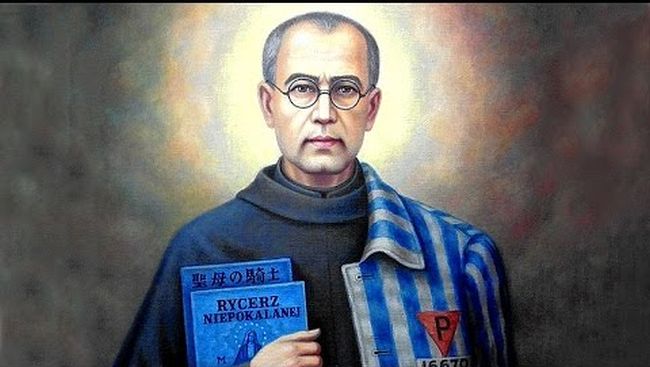
St. Maximilian Mary Kolbe - 14 August 2009


St. Maximilian Mary Kolbe (1894-1941) was born at Pabiance, in Russian Occupied Poland. He was baptized Raymond at the Parish Church. Already proficient in virtue, the Blessed Virgin Mary appeared to him in 1906 A. D., about the time of his first communion.

She offered him the graces of virginity and martyrdom and asked him which he wanted. Filled with zeal, he begged for both, and was filled thereafter with the most ardent desire to love and serve this Immaculate Queen.

He joined the Order of Friars Minor Conventual at Lvov in Austrian Occupied Poland, where he took the name Maximilian, and after finishing preliminary studies he was sent to the International Seraphic College in Rome to pursue doctorates in philosophy and theology.

In 1917 on the occasion of the 75th anniversary of the conversion of Alphonse Ratisbon, renowned anti-Catholic and agnostic of Jewish lineage, St. Maximilian was moved by divine grace to found a pious association of the faithful known as the Militia of the Immaculate .

The Militia was to be a loosely organized tool in the hands of the Immaculate Mediatrix for the conversion and sanctification of non-Catholics, especially those inimical to the Church. Its members consecrated themselves to the Blessed Virgin Mary, invoked Her daily for the conversion of sinners, and strove by every licit means to build up the Kingdom of the Sacred Heart throughout the world.

Ordained to the priesthood in 1918, St. Maximilian returned to Poland to teach Church History in Cracow, where he organized the first group of the Militia outside of Italy. Because of ill health he was freed to devote his time exclusively to the promotion of the Militia, whereupon he founded the "Knight of the Immaculate," a monthly Roman Catholic Magazine promoting the knowledge, love and service of the Immaculate Virgin, in the conversion of all souls to Christ Our Lord.

The phenomenal growth of this apostolate led to the foundation of the first city of the Immaculate, Niepokalanow in 1929. This was a friary of Franciscan priests and brothers engaged in the use of all kinds of modern equipment so as to promote via the mass media the Militia through all parts of Poland.

Two years later St. Maximilian, heeding the call of the Holy Father to all religious, to come to the aid of the missionary efforts of the universal Church, volunteered to go to the Orient to found another city of the Immaculate, Mugenzai No Sono .

St. Maximilian returned to Niepokalanow, as it spiritual father, in 1936 and under his able direction the number of the friars there grew above 900 in the months preceding World War II. Publishing apostolate was producing 1,000,000 magazines monthly as well all 125,000 copies of a daily paper for the 1,000,000 members of the Militia worldwide.

After the invasion of Poland by the German Wermacht in September of 1939, the friars dispersed and Niepokalanow was ransacked. St. Maximilian and about 40 others were taken to holding camps, first in Germany, and later in Poland. By the mercy of the Immaculate they were released and allow to return home on the Solemnity of the Immaculate Conception of the same year.

During the war the friars turned to caring for about 5,000 Jewish refugees of the Poznan district as well as providing a repair shop for the farming machinery of the locale.

To incriminate St. Maximilian, the Gestapo permitted one final printing of the "Knight of the Immaculte" in December of 1940. In February of 1941, they came to Niepokalanow and arrested St. Maximlian. He was taken to Pawiak Prision in German Occupied Warsaw, Poland, and later was transferred to Auschwitz.

Over the entrance gate of this concentration camp was a sign in German, "Work makes free!". In reality, upon entering the prisoners were told that all Jews had the right to live only two weeks, Roman Catholic priests 1 month.

At Auschwitz several million Roman Catholics were put to death along with another several million persons of Jewish lineage. The objective of Hitler, in his hatred for Jesus Christ, was both to remove all witness to the truth of the original revelation of the God of Israel (the Jewish nation), as well as all who came to believe in Him in His Incarnation by Mary (Roman Catholics).

Thus, St. Maximilian, Knight of the Immaculate Virgin, was placed by Divine Providence at the very center of the ideologic and spiritual conflict of the century, and was destined by God to be the sign of contradiction to a nation given over to diabolic hatred of God and His people.

St. Maximilian, in response to the vicious hatred and brutality of the prison guards, was ever obedient, meek, and forgiving. He gave counsel to all his fellow prisoners "Trust in the Immaculate!" "Forgive!" "Love your enemies and pray for your persecutors!" He was noted for his generosity in surrendering his food despite the ravages of starvation that he suffered, for always going to the end of the line of the infirmary, despite the acute tuberculosis afflicting him.

In the end, by the maternal mediation of the Virgin Mary, he received the grace to be intimately conformed to Christ in death. For on the night of August 3, 1941 a prisoner successfully escaped from the same section of the came in which St. Maximilian was detained. In reprisal, the commandant ordered death by starvation for 10 men chosen at random from the same section.

One of the condemned, Seargent Franciszek Gajowniczek, shouted out, lamenting that he would never see his wife and children again. In his stead, St. Maximilian Mary, who had remained standing all night long during the selection of the condemned, stepped forward and offered his own life in exchange for this man. Ten days later, having led the other 9 in prayers and hymns, St. Maximilian was given a lethal injection of carbolic acid, and passed into eternal glory.

Pope Paul VI beatified St. Maximilian in 1973 and Pope John Paul II canonized him in 1982 as a martyr of charity.

St. Maximilian Mary Kolbe's life and work continues today in the religious institutes of the Franciscan Friars of the Immaculate, the Franciscan Sisters of the Immaculate, at the Academy of the Immaculate, and in the movement known as the Mission of the Immaculate Mediatrix.


(Courtesy - EWTN)

St. Hippolytus - 13 August 2009

As a presbyter in Rome, Hippolytus (the name means “a horse turned loose”) was at first “holier than the Church.” He censured the pope for not coming down hard enough on a certain heresy—calling him a tool in the hands of one Callistus, a deacon—and coming close to advocating the opposite heresy himself. When Callistus was elected pope, Hippolytus accused him of being too lenient with penitents, and had himself elected antipope by a group of followers. He felt that the Church must be composed of pure souls uncompromisingly separated from the world, and evidently thought that his group fitted the description. He remained in schism through the reigns of three popes. In 235 he was also banished to the island of Sardinia. Shortly before or after this event, he was reconciled to the Church, and died with Pope Pontian in exile.

Saint Hippolytus was a priest in the Church of Rome in the late second and early third centuries. Known for his extensive and profound teaching, he is undoubtedly the most important Roman theologian of the third century, in a time when the liturgy and all teaching of the Church in Rome was done in Greek. When Callistus, whom he considered to be a liberal, was elected to the Papacy, St. Hippolytus contested the election, apparently setting himself up as an anti-pope. His separation from full communion with the Church lasted for several years. Yet ultimately he and Pope Callistus' lawful successor, Pontianus, found themselves suffering side by side during a wave of persecution. They reconciled and died together for their faith in the mines of Sardinia in 235 AD.


St. Hippolytus' great work "The Apostolic Tradition" was only rediscovered in the 20th century, providing an elightening and extensive glimpse into the liturgical and devotional life of Roman Christians around the year 200 AD.

Easter Prayer of St. Hippolytus

Christ is Risen: The world below lies desolate
Christ is Risen: The spirits of evil are fallen
Christ is Risen: The angels of God are rejoicing
Christ is Risen: The tombs of the dead are empty
Christ is Risen indeed from the dead,
the first of the sleepers,
Glory and power are his forever and ever

St. Hippolytus of Rome (AD 190-236)

Wednesday, August 12, 2009

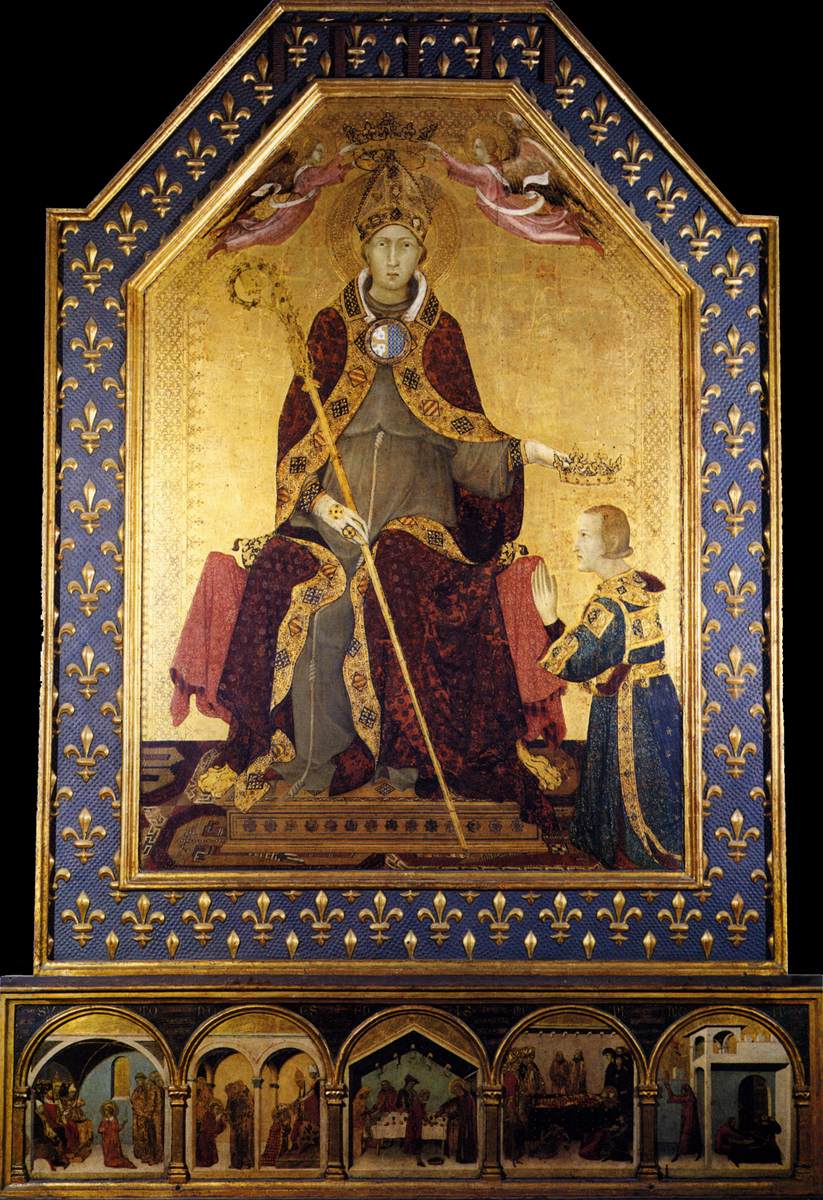
St. Louis of Toulouse - 12th August 2009


The life of the future saint Louis of Toulouse (1274- August 19, 1297) is a good example of how family expectations mingled with royal power politics in the service of religion. Louis was the second son of Angevin Charles II "the Lame" of Naples. As a child, he served with two of his brothers as a hostage for his father, who had been defeated in a naval battle with the Sicilians and Aragonians. For these seven years (1288-1295) he was educated by Franciscan friars, among them Peter Olivi, and impressed them with his holiness and learning. During an illness, he made a vow to become a Friar Minor. Even when he was still in captivity (1294), he was named Archbishop of Lyons. When his older brother died in 1295, Louis also became heir to his father's secular titles.

When Louis was released in 1295, at age twenty-one, he went to Naples where he renounced his rights of succession to his brother Robert. He then fairly quickly ascended through the priestly orders, becoming Bishop of Toulouse in 1296. Although Louis was a pious person-attested by his teachers who were renowned spiritual leaders-he was an untried administrator, whose appointment was suggested by his superb connections. He finally got to Toulouse in February of 1297, where his mildness and care for the poor were admired. However, he fell sick and died after only a few short months in office.

On what basis was Louis made a saint? The scenes depicted on the predella emphasize the Franciscan virtue of humility above all else. But whatever his virtues, it was undoubtedly his connection to the royal house of Naples, among other saintly relations (nephew to Louis IX of France, and descendent of saint Elizabeth of Hungary.) His case was promoted by Pope Clement V in 1307, and he was canonized by John XXII on April 7, 1317.

As a saint, Louis of Toulouse was not widely venerated, although his day was kept by the Franciscan order, and he became the patron saint of Valencia, where his relics were taken in 1423. He was also held in great honor in Naples by his brother Robert, who commissioned an extraordinarly sumptuous and beautiful altar to him from Simone Martini not long after the canonization.

In this altar, Louis of Toulouse gazes directly at us from his throne, dressed in episcopal garments whose looseness hints that he barely had time to grow into them. Although he sits against a glowing gold background highly reminiscent of Byzantine icons, the throne is positioned firmly on an inlaid floor, suggesting three-dimensional space in the progressive manner of International Gothic style. Robert of Anjou kneels to his left, and receives a crown from his brother's hand. Robert receives earthly glory, as Louis' abdication left him with a clear claim to the Kingdom of Naples. Presumably Robert is also the recipient of heavenly favors, as well, for his brother will surely intercede in heaven for this anointed king, and all of the Angevin dynasty. The panel emphasizes heraldic imagery, notably the French fleurs-de-lis in the frame.

The French ruling house was particularly honored in the Church. The canonization of Louis IX of France had only occurred ten years before, in 1297. The French nobility's intimate access to divinity is evident in a grouping of saints in the Francisan Church at Assisi. Around 1317, Simoni Martini decorated a chapel in honor of French patron Saint Martin. Here also St. Louis of Toulouse is pictured, in the company of other members of his order and family (St Louis and St Elizabeth).

(St Louis of France and St. Louis of Toulouse)

Tuesday, August 11, 2009

St. Clare of Assisi - 11th August 2009

Biographical selection:

When Francis of Assisi was preaching at St. George Church, a young lady from a noble family was listening to him with her mother and sister. Claire listened to those words and understood that St. Francis should be the guide of her soul. She confided this desire to her aunt, who went with her to St. Mary of the Angels to speak with St. Francis. Who can say what happened in the soul of the Seraphic Father during that first interview with the woman who would be his assistant in the task Heaven had designed for him to accomplish?

Francis revealed to Clare the beauties of the Celestial Spouse and the excellence of virginity. Then he described to her what he cherished the most in his heart: the power and the charm of poverty and the need for penance. Clare listened, astounded and enthused, and the divine appeal touched her heart. In a short time her decision was made. She would break all the bounds that linked her to earth and consecrate herself to God.

On the evening of Palm Sunday, March 17, 1212, she secretly left her father’s house and with some companions headed toward St. Mary of the Angels, the Church of the Portiuncula. St. Francis and his brothers met them along their way with torches and led them into the church. On that night the spiritual marriage of St. Clare took place. Francis asked her what she wanted, and she answered: “I want the God of the Manger and of Calvary. I desire no other treasure or inheritance.”

While Francis was cutting her hair, she delivered over all her precious jewelry and ornaments, and received the rude habit, cord, and humble veil and consecrated herself entirely to God.


Comments of Prof. Plinio:

One can admire the beauty of the scene. In the small medieval town of Assisi, a cortege of young ladies flees the home of their families, who want to impede their sacrifice. Silently and cautiously they walk through the winding streets of Assisi so as not to raise any attention. They leave the town and in the fields that separate Assisi from the Monastery of St. Mary of the Angels they meet another cortege. This second cortege is even more heavenly than the first. It is St. Francis of Assisi, who was another Christ on earth, who was even similar physically to Our Lord Jesus Christ.

Carrying torches, St. Francis and some of those saints who helped him found the Franciscan Order walk to receive those virgins. The corteges unite and enter together into the Church of Our Lady. The group gathers inside it in a circle. St. Claire renounces everything.

Then St. Francis cuts her hair as she takes the definitive step from which the Order of Poor Clares would be born. Upon that step depended the entire Second Order of Franciscans, which gave so many saints for the Catholic Church and glory to God through the centuries.

St. Claire left everything to enter a convent at a time when, in many respects, the Church was in her apogee. Today, we are witnessing the House of God cracked, the dignity of the ministers of God dragged into the mud, the veil of religious women gone, religious life disintegrated. Does this tragic spectacle leave us indifferent? Are we more concerned about our job, making money, buying a new car and new clothes, or acquiring more comforts for our home? If so, where is our faith? What do we believe in? What do we take seriously?

Only when a Catholic completely lacks seriousness can he place his personal life on the same level with the extreme sorrow this religious situation represents to the Catholic Church. Actually, it represents another Passion of Our Lord Jesus Christ. Today the Church is crucified. She does not die because she cannot die; otherwise she would have already expired.

So, on this day of St. Clare, let us imitate her dedication and confirm our commitment to offer our lives to fight against Progressivism in the Church, which is the worst enemy she has ever had throughout time. Never has a cause had so few persons to fight for it. This is enough to characterize it as the most glorious fight in History.

Speaking about those pilots who fought the Battle of London and saved the city from the Nazi bombardments, Churchill said: “Never was so much owed by so many to so few.” On the Final Judgment, Our Lady will certainly say something similar about those who fight for her now.

Let us ask Our Lady and St. Clare to imbue our souls with this spirit of dedication to the cause of Holy Mother Church.

Monday, August 10, 2009

St. Laurence - 10th August 2009

Biographical selection:

St. Laurence was chief of the seven Roman deacons of Pope Sixtus II. In 258 Emperor Valerian increased his persecutions of the Christians. One day when Pope Sixtus II was in the cemetery of St. Calistus celebrating the Holy Mysteries accompanied by some members of his clergy, he was arrested.

As the soldiers took the Pontiff to be put to death, Laurence followed him in anguish saying: “Where are you going, my father, without your son? Where are you going, Holy Pontiff, without your deacon? Isn’t it the custom to offer the sacrifice with an assistant? Let me prove I am worthy of the choice you made when you entrusted me with the distribution of the Blood of Our Lord.”

Sixtus replied: “I am not leaving you, my son. They are lenient on old men, not the youth. A greater combat is reserved for you. You will follow me in three days.”

Thinking that the Christians had hidden great treasures, the prefect of Rome called for Laurence, who as first deacon was the custodian of the Church’s goods. The prefect ordered Laurence to hand over all the Church’s treasures. Laurence answered that he would do so but first he needed to assemble them. So he went out and gathered all the poor and sick people of Rome, then returned and showed them to the prefect, telling him that these were the sole and greatest treasure of the Church. The poor people were the gold, the virgins and widows were the pearls and other precious stones. Furious, the prefect condemned Laurence to die a slow and cruel death.

The saint was undressed and laid on a grill with burning coals beneath it. Witnesses of the scene saw a radiant joy on the martyr’s face. After a certain time had passed, he addressed his torturers saying: “Turn me around, because this side is already well cooked.” They turned him, and after a time he said: “It is done and ready to eat.” Then turning his eyes to Heaven he prayed to God for the conversion of Rome and expired. His body was carried away by converted Roman Senators who buried him in a grotto in the Verano field, near Tivoli.

Comments of Prof. Plinio:

There are numerous precious data in this selection.

The first is the dialogue between St. Laurence and St. Sixtus. You know that the holy Sacrifice of the Mass is the bloodless reenacting of the holy sacrifice of the Cross. Now, when a martyr offers his holocaust he imitates Our Lord Jesus Christ who immolated Himself. It is not the reenactment of the sacrifice of the Mass, but it is analogous to it.

Therefore, one finds two correlations with the Sacrifice of Calvary in the admirable dialogue between St. Sixtus and his Deacon. St. Laurence said to the Pontiff: “Often have you offered the Holy Sacrifice of the Mass with me as assistant. Now at the moment you go to offer you life, would you have no more need of my assistance? Are you putting me aside at this moment? Don’t you want my help? Let me go with you to be killed with you. Since I have served you at the foot of the altar during my life, let me serve you now at the feet of death.”

After hearing this marvelous proposal, St. Sixtus prophesized: “I will have an easy death compared to yours. You, young man, will be spared much less than the old man I am. In three days you also will be killed.”

Second, the fidelity of St. Laurence to St. Sixtus shows us a first spark of the Middle Ages. Theirs was a relationship that was primordially ecclesiastic, but it was already a feudal fidelity. This union between lord and vassel in which the person who serves unites himself to the one he serves is much more than a work contract; it is a link of veneration and dedication, it is to offer one’s life. The person who serves realizes that he loses his reason to exist without his superior. In this splendid bond of fidelity of St. Laurence to St. Sixtus, we see a beginning of feudalism. In his turn, the superior esteems and protects the inferior. This kind of relationship represented one of the glories of the Middle Ages. Its remnants survived in Christendom even after the French Revolution. In its depth, what the Progressivist Church does is struggle to extinguish the last vestiges of this.

Third, another admirable point to consider is the episode with the prefect. St. Laurence brought him all the treasures of the Church: the poor people. You have to consider that for the pagan mentality, the poor were despicable. The Roman of that time had an extreme repulsion for the poor. But St. Laurence presented the poor to the prefect as the Church’s treasure. He gave the prefect an extraordinary lesson of the supernatural spirit.

Why is the poor a treasure?

There are some titles that make any baptized Catholic a treasure: he is a man who is a son of the Catholic Church; he was saved by the infinitely precious Blood of Our Lord Jesus Christ; he was worthy of the supremely valuable tears of Our Lady in the Passion.

But, there are other titles that specifically apply to the condition of one who is poor. God loves those who suffer deprivation with resignation and in union with Him. When poverty is involuntary, it should be loved by both the one who is poor and by the one who is not. The latter should help the former to leave the state of poverty, but both should realize that there is a real merit in accepting such poverty with resignation. The same applies to sickness. The Church does more than anyone to alleviate illnesses, but she also loves the sick and praises the afflicted man when he bears the suffering with resignation to the will of God. Therefore, one can say that the poor, like the widow and orphan, is a treasure. They are truly treasures within the Holy Church. St. Laurence gave an admirable lesson of the supernatural spirit to the prefect of Rome.

Fourth, the last lesson St. Laurence gave us was his martyrdom. Without a miracle – and a first class miracle – one cannot understand how a man suffered what he did. He was slowly roasted on a grill with live coals beneath it. You can imagine how painful this would be. Consider how a live animal put to such torment would react: it would roar and jump trying to escape the pain. In a man this torture would raise even stronger reactions, because the animal doesn’t have intelligence and can’t understand what is happening. Understanding makes the suffering still greater.

St. Laurence, however, was extremely tranquil before such suffering, with his face radiating joy. When he realized that a part of his body was dead, he asked to be turned over to the other side. He was turned, and then he died. You can see that there were successive miracles that permitted him to remain calm and joyful, and then to live longer even after he was entirely roasted on one side. When his hour finally came, he asked for the conversion of Rome. And God heard his prayer at that very moment he expired. For several Roman Senators who were assisting at his martyrdom converted and carried his body to the grave. That is, he, a simple deacon, poor himself and living in the catacombs, had his body carried by members of the highest legislative and political organ on earth at that time, the Roman Senate.

In the Magnificat Our Lady entoned this rule: Deposuit potentes de sede et exaltavit humiles – God puts down the mighty from their seats and exalts the humble. Today no one knows the name of the prefect of Rome, almost no one knows anything about the Emperor Valerian. Regarding the latter, people either forgot him or consider him with horror. On the contrary, a great many people know about the humble St. Laurence and love him. One of the most famous palaces of the world, the Escorial, was built in Spain by the great King Philip II in honor of St. Laurence.

Philip II had a difficult time fighting the French Protestants. On the feast day of St. Laurence in the place called St. Quentin he engaged in a hard and decisive battle against the Protestants. He made God a promise to build a magnificent basilica in honor of St. Laurence if he won the battle. He crushed the heretics, and to commemorate the occasion he erected the greatest work of art of his reign, the Escorial. This palace was built in the shape of a grill to celebrate the martyrdom of St. Laurence. In this way Philip II perpetuated the glory of St. Laurence. This is just one example. The Catholic Church has honored him in many other ways, celebrating his virtues and venerating him.

You have, then, a realization of what Our Lady entoned: the powerful were put down and erased from the memory of the people and the humble were glorified.

Let us ask St. Laurence to give us that same supernatural spirit he displayed before the prefect, and his panache in face of his sufferings and death.

Sunday, August 9, 2009

St. Teresa Benedict of the Cross (Edith Stein) - 9 August 2009

"We bow down before the testimony of the life and death of Edith Stein, an outstanding daughter of Israel and at the same time a daughter of the Carmelite Order, Sister Teresa Benedicta of the Cross, a personality who united within her rich life a dramatic synthesis of our century. It was the synthesis of a history full of deep wounds that are still hurting ... and also the synthesis of the full truth about man. All this came together in a single heart that remained restless and unfulfilled until it finally found rest in God." These were the words of Pope John Paul II when he beatified Edith Stein in Cologne on 1 May 1987.

Who was this woman?

Edith Stein was born in Breslau on 12 October 1891, the youngest of 11, as her family were celebrating Yom Kippur, that most important Jewish festival, the Feast of Atonement. "More than anything else, this helped make the youngest child very precious to her mother." Being born on this day was like a foreshadowing to Edith, a future Carmelite nun.

Edith's father, who ran a timber business, died when she had only just turned two. Her mother, a very devout, hard-working, strong-willed and truly wonderful woman, now had to fend for herself and to look after the family and their large business. However, she did not succeed in keeping up a living faith in her children. Edith lost her faith in God. "I consciously decided, of my own volition, to give up praying," she said.

In 1911 she passed her school-leaving exam with flying colours and enrolled at the University of Breslau to study German and history, though this was a mere "bread-and-butter" choice. Her real interest was in philosophy and in women's issues. She became a member of the Prussian Society for Women's Franchise. "When I was at school and during my first years at university," she wrote later, "I was a radical suffragette. Then I lost interest in the whole issue. Now I am looking for purely pragmatic solutions."

In 1913, Edith Stein transferred to G6ttingen University, to study under the mentorship of Edmund Husserl. She became his pupil and teaching assistant, and he later tutored her for a doctorate. At the time, anyone who was interested in philosophy was fascinated by Husserl's new view of reality, whereby the world as we perceive it does not merely exist in a Kantian way, in our subjective perception. His pupils saw his philosophy as a return to objects: "back to things". Husserl's phenomenology unwittingly led many of his pupils to the Christian faith. In G6ttingen Edith Stein also met the philosopher Max Scheler, who directed her attention to Roman Catholicism. Nevertheless, she did not neglect her "bread-and-butter" studies and passed her degree with distinction in January 1915, though she did not follow it up with teacher training.

"I no longer have a life of my own," she wrote at the beginning of the First World War, having done a nursing course and gone to serve in an Austrian field hospital. This was a hard time for her, during which she looked after the sick in the typhus ward, worked in an operating theatre, and saw young people die. When the hospital was dissolved, in 1916, she followed Husserl as his assistant to the German city of Freiburg, where she passed her doctorate summa cum laude (with the utmost distinction) in 1917, after writing a thesis on "The Problem of Empathy."

During this period she went to Frankfurt Cathedral and saw a woman with a shopping basket going in to kneel for a brief prayer. "This was something totally new to me. In the synagogues and Protestant churches I had visited people simply went to the services. Here, however, I saw someone coming straight from the busy marketplace into this empty church, as if she was going to have an intimate conversation. It was something I never forgot. "Towards the end of her dissertation she wrote: "There have been people who believed that a sudden change had occurred within them and that this was a result of God's grace." How could she come to such a conclusion?
Edith Stein had been good friends with Husserl's Göttingen assistant, Adolf Reinach, and his wife.

When Reinach fell in Flanders in November 1917, Edith went to Göttingen to visit his widow. The Reinachs had converted to Protestantism. Edith felt uneasy about meeting the young widow at first, but was surprised when she actually met with a woman of faith. "This was my first encounter with the Cross and the divine power it imparts to those who bear it ... it was the moment when my unbelief collapsed and Christ began to shine his light on me - Christ in the mystery of the Cross."

Later, she wrote: "Things were in God's plan which I had not planned at all. I am coming to the living faith and conviction that - from God's point of view - there is no chance and that the whole of my life, down to every detail, has been mapped out in God's divine providence and makes complete and perfect sense in God's all-seeing eyes."

In Autumn 1918 Edith Stein gave up her job as Husserl's teaching assistant. She wanted to work independently. It was not until 1930 that she saw Husserl again after her conversion, and she shared with him about her faith, as she would have liked him to become a Christian, too. Then she wrote down the amazing words: "Every time I feel my powerlessness and inability to influence people directly, I become more keenly aware of the necessity of my own holocaust."

Edith Stein wanted to obtain a professorship, a goal that was impossible for a woman at the time. Husserl wrote the following reference: "Should academic careers be opened up to ladies, then I can recommend her whole-heartedly and as my first choice for admission to a professorship." Later, she was refused a professorship on account of her Jewishness.

Back in Breslau, Edith Stein began to write articles about the philosophical foundation of psychology. However, she also read the New Testament, Kierkegaard and Ignatius of Loyola's Spiritual Exercises. She felt that one could not just read a book like that, but had to put it into practice.

In the summer of 1921. she spent several weeks in Bergzabern (in the Palatinate) on the country estate of Hedwig Conrad-Martius, another pupil of Husserl's. Hedwig had converted to Protestantism with her husband. One evening Edith picked up an autobiography of St. Teresa of Avila and read this book all night. "When I had finished the book, I said to myself: This is the truth." Later, looking back on her life, she wrote: "My longing for truth was a single prayer."

On 1 January 1922 Edith Stein was baptized. It was the Feast of the Circumcision of Jesus, when Jesus entered into the covenant of Abraham. Edith Stein stood by the baptismal font, wearing Hedwig Conrad-Martius' white wedding cloak. Hedwig washer godmother. "I had given up practising my Jewish religion when I was a 14-year-old girl and did not begin to feel Jewish again until I had returned to God." From this moment on she was continually aware that she belonged to Christ not only spiritually, but also through her blood. At the Feast of the Purification of Mary - another day with an Old Testament reference - she was confirmed by the Bishop of Speyer in his private chapel.

After her conversion she went straight to Breslau: "Mother," she said, "I am a Catholic." The two women cried. Hedwig Conrad Martius wrote: "Behold, two Israelites indeed, in whom is no deceit!" (cf. John 1:47).

Immediately after her conversion she wanted to join a Carmelite convent. However, her spiritual mentors, Vicar-General Schwind of Speyer, and Erich Przywara SJ, stopped her from doing so. Until Easter 1931 she held a position teaching German and history at the Dominican Sisters' school and teacher training college of St. Magdalen's Convent in Speyer. At the same time she was encouraged by Arch-Abbot Raphael Walzer of Beuron Abbey to accept extensive speaking engagements, mainly on women's issues. "During the time immediately before and quite some time after my conversion I ... thought that leading a religious life meant giving up all earthly things and having one's mind fixed on divine things only. Gradually, however, I learnt that other things are expected of us in this world... I even believe that the deeper someone is drawn to God, the more he has to `get beyond himself' in this sense, that is, go into the world and carry divine life into it."

She worked enormously hard, translating the letters and diaries of Cardinal Newman from his pre-Catholic period as well as Thomas Aquinas' Quaestiones Disputatae de Veritate. The latter was a very free translation, for the sake of dialogue with modern philosophy. Erich Przywara also encouraged her to write her own philosophical works. She learnt that it was possible to "pursue scholarship as a service to God... It was not until I had understood this that I seriously began to approach academic work again." To gain strength for her life and work, she frequently went to the Benedictine Monastery of Beuron, to celebrate the great festivals of the Church year.

In 1931 Edith Stein left the convent school in Speyer and devoted herself to working for a professorship again, this time in Breslau and Freiburg, though her endeavours were in vain. It was then that she wrote Potency and Act, a study of the central concepts developed by Thomas Aquinas. Later, at the Carmelite Convent in Cologne, she rewrote this study to produce her main philosophical and theological oeuvre, Finite and Eternal Being. By then, however, it was no longer possible to print the book.

In 1932 she accepted a lectureship position at the Roman Catholic division of the German Institute for Educational Studies at the University of Munster, where she developed her anthropology. She successfully combined scholarship and faith in her work and her teaching, seeking to be a "tool of the Lord" in everything she taught. "If anyone comes to me, I want to lead them to Him."

In 1933 darkness broke out over Germany. "I had heard of severe measures against Jews before. But now it dawned on me that God had laid his hand heavily on His people, and that the destiny of these people would also be mine." The Aryan Law of the Nazis made it impossible for Edith Stein to continue teaching. "If I can't go on here, then there are no longer any opportunities for me in Germany," she wrote; "I had become a stranger in the world."

The Arch-Abbot of Beuron, Walzer, now no longer stopped her from entering a Carmelite convent. While in Speyer, she had already taken a vow of poverty, chastity and obedience. In 1933 she met with the prioress of the Carmelite Convent in Cologne. "Human activities cannot help us, but only the suffering of Christ. It is my desire to share in it."

Edith Stein went to Breslau for the last time, to say good-bye to her mother and her family. Her last day at home was her birthday, 12 October, which was also the last day of the Feast of Tabernacles. Edith went to the synagogue with her mother. It was a hard day for the two women. "Why did you get to know it [Christianity]?" her mother asked, "I don't want to say anything against him. He may have been a very good person. But why did he make himself God?" Edith's mother cried. The following day Edith was on the train to Cologne. "I did not feel any passionate joy. What I had just experienced was too terrible. But I felt a profound peace - in the safe haven of God's will." From now on she wrote to her mother every week, though she never received any replies. Instead, her sister Rosa sent her news from Breslau.

Edith joined the Carmelite Convent of Cologne on 14 October, and her investiture took place on 15 April, 1934. The mass was celebrated by the Arch-Abbot of Beuron. Edith Stein was now known as Sister Teresia Benedicta a Cruce - Teresa, Blessed of the Cross. In 1938 she wrote: "I understood the cross as the destiny of God's people, which was beginning to be apparent at the time (1933). I felt that those who understood the Cross of Christ should take it upon themselves on everybody's behalf. Of course, I know better now what it means to be wedded to the Lord in the sign of the cross. However, one can never comprehend it, because it is a mystery." On 21 April 1935 she took her temporary vows. On 14 September 1936, the renewal of her vows coincided with her mother's death in Breslau. "My mother held on to her faith to the last moment. But as her faith and her firm trust in her God ... were the last thing that was still alive in the throes of her death, I am confident that she will have met a very merciful judge and that she is now my most faithful helper, so that I can reach the goal as well."

When she made her eternal profession on 21 April 1938, she had the words of St. John of the Cross printed on her devotional picture: "Henceforth my only vocation is to love." Her final work was to be devoted to this author.

Edith Stein's entry into the Carmelite Order was not escapism. "Those who join the Carmelite Order are not lost to their near and dear ones, but have been won for them, because it is our vocation to intercede to God for everyone." In particular, she interceded to God for her people: "I keep thinking of Queen Esther who was taken away from her people precisely because God wanted her to plead with the king on behalf of her nation. I am a very poor and powerless little Esther, but the King who has chosen me is infinitely great and merciful. This is great comfort." (31 October 1938)

On 9 November 1938 the anti-Semitism of the Nazis became apparent to the whole world.

Synagogues were burnt, and the Jewish people were subjected to terror. The prioress of the Carmelite Convent in Cologne did her utmost to take Sister Teresia Benedicta a Cruce abroad. On New Year's Eve 1938 she was smuggled across the border into the Netherlands, to the Carmelite Convent in Echt in the Province of Limburg. This is where she wrote her will on 9 June 1939: "Even now I accept the death that God has prepared for me in complete submission and with joy as being his most holy will for me. I ask the Lord to accept my life and my death ... so that the Lord will be accepted by His people and that His Kingdom may come in glory, for the salvation of Germany and the peace of the world."

While in the Cologne convent, Edith Stein had been given permission to start her academic studies again. Among other things, she wrote about "The Life of a Jewish Family" (that is, her own family): "I simply want to report what I experienced as part of Jewish humanity," she said, pointing out that "we who grew up in Judaism have a duty to bear witness ... to the young generation who are brought up in racial hatred from early childhood."

In Echt, Edith Stein hurriedly completed her study of "The Church's Teacher of Mysticism and the Father of the Carmelites, John of the Cross, on the Occasion of the 400th Anniversary of His Birth, 1542-1942." In 1941 she wrote to a friend, who was also a member of her order: "One can only gain a scientia crucis (knowledge of the cross) if one has thoroughly experienced the cross. I have been convinced of this from the first moment onwards and have said with all my heart: 'Ave, Crux, Spes unica' (I welcome you, Cross, our only hope)." Her study on St. John of the Cross is entitled: "Kreuzeswissenschaft" (The Science of the Cross).

Edith Stein was arrested by the Gestapo on 2 August 1942, while she was in the chapel with the other sisters. She was to report within five minutes, together with her sister Rosa, who had also converted and was serving at the Echt Convent. Her last words to be heard in Echt were addressed to Rosa: "Come, we are going for our people."

Together with many other Jewish Christians, the two women were taken to a transit camp in Amersfoort and then to Westerbork. This was an act of retaliation against the letter of protest written by the Dutch Roman Catholic Bishops against the pogroms and deportations of Jews. Edith commented, "I never knew that people could be like this, neither did I know that my brothers and sisters would have to suffer like this. ... I pray for them every hour. Will God hear my prayers? He will certainly hear them in their distress." Prof. Jan Nota, who was greatly attached to her, wrote later: "She is a witness to God's presence in a world where God is absent."

On 7 August, early in the morning, 987 Jews were deported to Auschwitz. It was probably on 9 August that Sister Teresia Benedicta a Cruce, her sister and many other of her people were gassed.
When Edith Stein was beatified in Cologne on 1 May 1987, the Church honoured "a daughter of Israel", as Pope John Paul II put it, who, as a Catholic during Nazi persecution, remained faithful to the crucified Lord Jesus Christ and, as a Jew, to her people in loving faithfulness."

Wednesday, August 5, 2009

Dedication of St. Mary Major Basilica - 5th August 2009

This is the history of Our Lady of the Snows. The time was the year 352, so soon after the birth of Jesus that many did not know about Him, and many "dared" not know, for fear of persecution.

The city of Rome, Italy, was fast becoming a Catholic center, and there resided Pope Liberius, the Holy Father, Successor of the Holy Apostle, St. Peter. Among his loyal subjects were a noble patrician, John, and his wife. This couple was very holy and devout.

They were not blessed with children, so it was their desire that their worldly goods should be given to the Mother of God. They discussed this with Pope Liberius and he counseled them to commend this holy intention to the Blessed Virgin Mary. Fervently, they besought her to show them her desire by some sign.

During the night of August 5th, the Virgin Mary appeared to John and his wife, and also to Pope Liberius, telling them to construct a church in her honor on the crest of the Esquiline Hill. As a sign of her will, she told them, they would find it covered with snow.

Snow is rare in Rome. When it falls, it is a day of rejoicing, and the populace delights in the beautiful sight of trees and shrubs blanketed with a soft mantle of white. Many winters pass without the least trace of a snowfall.

Imagine the great excitement of a snowfall during the first days of the hot month of August. That is exactly what happened on the night of August 5th, 352. In the morning, almost all of Rome thronged to the Esquiline Hill as the news spread that snow had fallen there during the sultry night, outlining the precise shape of the church requested by Our Lady. John, his wife, and Pope Liberius, told the crowd the snow was a favor from the Immaculate Queen of Heaven. When the people learned this, they shouted over and over again, "Our Lady of the Snows!"

The crest of the Esquiline hill, therefore, became the site of a church dedicated to the Mother of God, just as she wished. This was ancient Rome, early in Christianity, only 352 a.d. - almost sixteen hundred and fifty years ago! This was the origin of the title: Our Lady of the Snows.

The church built in her honor is known today as the Basilica of Saint Mary Major (Santa Maria Maggiore), because it is the Mother of all churches throughout the world dedicated to our Heavenly Queen. This church in Rome is the original Shrine of Our Lady of the Snows. In honor of Pope St. Liberius (who suffered exile during the Arian heresy), it is also called the "Liberian Basilica."

The altar of Our Lady's Basilica contains the relics of the manger crib of Our Divine Lord, which St. Helena brought back from Jerusalem with the True Cross. The image honored as Our Lady of the Snows is a venerable painting of the Madonna and Child in Greek style, attributed to the physician-Evangelist, St. Luke. Relics of many apostles and saints, as well as the body of St. Matthew and the head of St. Luke rest in this favored sanctuary.

The Greatest Marian Church throughout History. Down through the sixteen centuries since the first construction of the Basilica, pilgrims from all regions of Christendom have made Saint Mary Major one of the most popular churches in the world. Our Lady of the Snows has found pleasure in showering down countless blessings upon her children who invoke her under this particular title.

Throughout the annals of Church History, we find many a Saint greatly devoted to this magnificent Church of Our Lady.

The Popes of the past have had a tender devotion towards the Madonna of the Esquiline, and have tried to outdo one another in enriching this Mother Church dedicated to her honor. The present magnificent edifice was constructed in the fifth century by Pope Sixtus III. The compartments of the intricate ceiling were gilded with the first gold brought from America by the devout Catholic explorer, Christopher Columbus. St. Gregory the Great turned to Our Lady during the devastating black plague in Rome in 597, and had her miraculous image carried in procession from St. Mary Major to St. Peter's Basilica; and St. Michael appeared in the sky to indicate the end of the pestilence. The tomb of Pope St. Pius V lay for centuries in the Chapel of the Blessed Sacrament, where St. Ignatius Loyola said his first Mass (until, tragically, this shrine was torn out of the Basilica by John Paul II). Eugenio Pacelli (the future Pope Pius XII), also said his first Mass at the altar of Our Lady of the Snows in 1899. It is obvious why She is frequently referred to as the "Madonna of the Popes." Many other examples can be taken from the lives of the Popes and Saints who lived in Rome, manifesting their tender devotion to St. Mary Major, the "Shrine of Our Lady of the Snows." St. Stanislaus Kostka even used to turn in his cell to pray facing St. Mary Major.

Thus, has this beautiful title come down from Christian antiquity.

One lovely custom of olden times has come down even to our era. During Mass and Vespers each year on the Feast of Our Lady of the Snows (Aug. 5), the glorious anniversary of the origin of the Basilica is celebrated with pomp and splendor. Recalling the miraculous fall of snow that indicated the site of this Mother Church of Mary, a shower of rose petals, jasmine, and other white flowers are let to fall from the ceiling at the words: "He sendeth His snow like wool..."

The white jasmine symbolizes the purity and innocence of the Blessed Virgin Mary. The way the flowers are scattered from above suggests the manner in which Our Lady showers her graces on all souls, but in a particular manner upon those who honor her under the title of Our Lady of the Snows.

Throughout the thirty-some years of our apostolate, Our Lady has manifested herself under this special title in ways especially dear to those who cherish the providential significance of this wonderful title of the Immaculate Queen of Heaven; and we look forward to her continued protection and guidance, safe beneath the white flowing mantle of her heavenly grace.

Prayer

Our Lady of the Snows, Immaculate Queen of the Universe, from this privileged sanctuary, Thou has bestowed so many countless graces and pledges of love upon the hearts and souls of millions. O Mother, from this cradle of Christianity, this Mother Church of all churches, deign to shower forth the graces of thine Immaculate Heart upon the remnant Faithful throughout the world, wherever they may be, and grant them the graces of a childlike love and unwavering fidelity to the holy truths of our Faith. Grant, good Mother, to the faithful Bishops of the Church the grace to defend Her Sacred Teachings, and to persevere courageously against all the enemies of the Holy Church. Amen.

Tuesday, August 4, 2009

Pope Benedict to Catholics: Kneel and Receive on the Tongue Only

Whosoever shall eat this bread, or drink the chalice of the Lord unworthily, shall be guilty of the Body and of the Blood of the Lord... For he that eateth and drinketh unworthily, eateth and drinketh judgment to himself, not discerning the Body of the Lord" - 1 Corinthians 11:27,28


Pope Benedict XVI does not want the faithful receiving Communion in their hand nor does he want them standing to receive Christ in the Blessed Sacrament. According to Vatican liturgist, Monsignor Guido Marini, the pope is trying to set the stage for the whole church as to the proper norm for receiving Communion for which reason communicants at his papal Masses are now asked to kneel and receive on the tongue.

The Holy Father's reasoning is simple: "We Christians kneel before the Blessed Sacrament because, therein, we know and believe to be the presence of the One True God." (May 22, 2008)

According to the pope the entire Church should kneel in adoration before God in the Eucharist. "Kneeling in adoration before the Eucharist is the most valid and radical remedy against the idolatries of yesterday and today" (May 22, 2008)

The pope's action is in accord with the Church's 2000 year tradition and is being done in order to foster a renewed love and respect for the Eucharist which presently is being mocked and treated with contempt. The various trends and innovations of our time (guitar liturgy, altar girls, lay ministers, Communion in the hand) have worked together to destroy our regard for the Eucharist, thus advancing the spiritual death of the church. After all, the Eucharist is the very life and heartbeat of the Mystical Body around which the entire Church must revolve.

Kneeling also coincides with the Church's centuries old ordinance that only the consecrated hands of a priest touch the Body of Christ in Holy Communion. "To priests alone has been given power to consecrate and administer to the faithful, the Holy Eucharist." (Council of Trent) This teaching is beautifully expressed by St. Thomas Aquinas in his Summa Theologica: "Because out of reverence towards this sacrament, nothing touches it, but what is consecrated; hence the corporal and the chalice are consecrated, and likewise the priest's hands, for touching this sacrament."

It is for reason that Pope Paul VI in his May 1969 pastoral letter to the world's bishops reaffirmed the Church's teaching on the reception of Communion, stating that: "This method on the tongue must be retained." (Memoriale Domini) This came in response to the bishops of Holland who started Communion in the hand in defiance of the centuries old decree from the Council of Rouen (650 A.D.) where this practice was condemned as sacrilegious. "Do not put the Eucharist in the hands of any layperson, but only in their mouths." To date this prohibition has never been overturned legally.

Today Communion in the hand is carried on illegally and has become a major tool of the enemy to destory the Faith throughout the world. For this practice serves no other purpose than to warp our conception of Jesus Christ and nourish a contempt for the sacred mysteries. It's no wonder St. Basil referred to Communion in the hand as "a grave fault."

That is to say, Communion in the hand is not tied with Catholic tradition. This practice was first introduced to the Church by the heretical Arians of the 4th century as a means of expressing their belief that Christ was not divine. Unfortunately, it has served to express the same in our time and has been at the very heart of the present heresy and desecration that is rampant throughout the universal Church. If we have 'abuse' problems today it is because we're abusing the Sacrament - it's backfiring on us!

Thanks to Communion in the hand, members of satanic cults are now given easy access to come into the Church and take the Host so that they bring it back to their covens where it is abused and brutalized in the ritualistic Black Mass to Satan. They crush the Host under their shoes as a mockery to the living God, and we assist it with our casual practice? Amongst themselves the satanists declare that Communion in the hand is the greatest thing that ever happened to them, and we do nothing to stop it?


Hence, the Holy Father is doing his part to try to purge the Church of abuse and we as members of Christ are called upon to assist him. For your encouragement we include the following quotation from Cardinal Llovera, the new prefect for the Vatican's Congregation for Divine Worship and Discipline of the Sacraments speaking to Life Site News on July 22, 2009: "It is the mission of the Congregation for Divine Worship and Sacraments to work to promote Pope Benedict's emphasis on the traditional practices of liturgy, such as reception of Communion on the tongue while kneeling."

Also worth considering is the recent decree from Cardinal Caffarra, the Archbishop of Bologna Italy, forbidding the practice of Communion in the hand: "Many cases of profanation of the Eucharist have occurred, profiting by the possibility to receive the consecrated Bread on one’s palm of the hand... Considering the frequency in which cases of irreverent behavior in the act of receiving the Eucharist have been reported, we dispose that starting from today in the Metropolitan Church of St. Peter, in the Basilica of St. Petronius and in the Shrine of the Holy Virgin of St. Luke in Bologna the faithful are to receive the consecrated Bread only from the hands of the Minister directly on the tongue." (from his decree on the reception of the Eucharist, issued April 27, 2009)

Technically all bishops and clergy are bound to follow the Holy Father's directive on this issue, but in the meantime the faithful are not obliged to wait for the approval of their bishop in order to kneel for God. The directives of the Holy Father are not subject to the veto or scrutiny of the bishops and therefore all pastors and laity have a right and duty to put these directives into practice for the edification of their communities.


(Courtesy http://newsblaze.com/story/20090801065749zzzz.nb/topstory.html)

St. John Baptist Vianney - 4th August 2009

Biographical selection:

Today is the feast day of the Curé of Ars, confessor, intercessor for the Clergy’s sanctification and model for those entrusted with the care of souls. He lived in the 19th century (1786-1859).

Comments of Prof. Plinio:

There is always a word to say about St. John Baptist Vianney because he was one of the greatest saints of the 19th century. His life presents so many different facets that one always can take new lessons from it.

In the first decades of the 19th century, he was a poor seminarian. Not only was he poor but he had a small intelligence, remarkably small. He had to make an extraordinary effort to follow his studies at the seminary, and twice failed the examinations required before ordination. His intellectual insufficiency gave much cause for concern about his priestly vocation. Finally at age 30 he barely managed to complete the course and was ordained.

The Bishop sent this dull priest to a tiny village in the south of France, the village of Ars. There he began his sacerdotal life, which would permeate all of Europe with its light, and, from there, spread throughout the world. He was canonized a saint by Pius XI in 1925 and proclaimed patron of parish priests.

What was it that distinguished this Saint? Even though he didn’t have any natural qualities to make him an exceptional priest, he became a magnificent priest, an extraordinary apostle, a confessor with rare discernment, and a preacher who exercised a profound influence over souls.

What was the reason for such efficiency? St. Therese of Lisieux used to say, “For love, nothing is impossible.” What this means is that one who truly loves God, Our Lord and Our Lady will obtain the means to do what Divine Providence calls him to do. This applies perfectly to St. John Vianney. For example, let us look at his preaching. He became an extraordinary preacher. He prepared his sermons the best he could, then he studied them. They were not sermons touching on the highest topics of theology; they were common catechetical instructions for the people. But when he taught, he spoke with such conviction, with such a great love of God, with words so blessed that the graces of those sermons were communicative and touched all who heard them.

A defect I still didn’t mention: he had a weak voice, and in those happy times when microphones didn’t exist, the multitudes that gathered to listen his preaching – filling the church of Ars and its environs – often could not hear him. Even though persons at a distance could only hear a few loose phrases of his sermons, many of them still converted. Others could not hear him at all, but they also converted, only from the effect of seeing him.

In his Soul of the Apostolate, Dom Chautard relates this telling fact. An impious lawyer went to Ars to mock its unlearned Curé. But he returned converted. Someone asked him: What did you see there? He answered: “I saw God in a man.” That is, the presence of God was in St. John Vianney. One could note that God was with him and in him. I consider the witness of this impious lawyer about the Curé of Ars – “I saw God in a man” – one of the most glorious homages a man can receive.

The blessings from his sermons and charisma of his words extended far and wide, and all over Europe pilgrimages started to be made to Ars. This was one of the reasons for the countless conversions St. John Vianney made.

He was also a martyr of the confessionary. He used to spend hours and hours there hearing confessions and giving counsels. We don’t realize the tremendous penance it represents to spend long hours hearing the foul moral things people do. In the confessionary he applied the advice of St. Alphonse of Ligouri to not hurry through the confession, to be patient, to consider each penitent as if he were the only person to be heard and to help him conquer each one of his sins. So he entered battle against each sin, insisted on the practice of virtue, advised good behavior, and often he denied absolution. Yes, if he could not note a serious intent of amendment, he denied absolution to that person.

He was an enemy of dancing. You should note that the dances of that time were far different from the immoral and outrageous dances of today. The young ladies were completely covered and had skirts that reached to the floor. If he condemned those dances, what would he say about ours? His condemnation went so far as to deny absolution to those who would not promise to stop going to such dances.. Many persons would go to other churches to receive absolution. Hearing this, he simply commented: If other priests want to send them to Hell, it is up to them.

This extraordinary Saint spent all his time in the church: at the pulpit, confessionary or altar. At night when he returned to his house, one might think he would at least get a deserved rest. But no, a new fight started, this time against the devil. For decades he fought a nightly battle with the devil – whom he called Grapin – in which the devil physically assaulted him and tormented him with deafening noises and insulting words. On the night before a person particularly dominated by the devil would come to confess to St. John Vianney, the devil would inflict stronger torments on the Saint. Once he set fire to the Curé’s bed. In response St. John Vianney used to increase his special penances, flagellations, and prayers to win the graces for his words to effect the needed conversions.

It is beautiful to consider that Divine Providence, in order to further increase his apostolate, gave him the gift of the miracles. In fact he worked many miracles. But he did not attribute them to himself. In his church he built a shrine to St. Philomena, a virgin martyr that Paul VI removed from the list of the saints. St. John Vianney did not think the same way, and attributed all his miracles to her.

I will mention just one extraordinary fact that reveals his gift of reading souls – the discernment of spirits – that he had. This fact was reported by one of his penitents, a young lady who was a Daughter of Mary. She went to confession to the Curé of Ars. After she knelt, he began to tell her events from her past life.

- Do you remember that you went to a ball on such-and-such occasion?
- Yes, I remember.
- Do you remember that at a certain moment a handsome young man entered the ballroom. He was quite elegant, appeared very upright and danced with several young ladies?
- Yes, I do.
- Do you recall that you had a great desire to dance with him?
- I recall that.
- Do you recollect that you became sad because he didn’t ask you to dance?
- Yes, I do.
- Do you remember that by chance you looked down at his feet and saw a strange blue light coming from them?
- Yes. I remember.

Until now, everything he described to the young lady came from his gift of discernment, because naturally he knew nothing of her past. Then, he made the astonishing revelation:

- That young man was none other than the devil who had taken that shape to tempt several of the young women there. He was unable to approach you because you are a Daughter of Mary protected by her, and you were wearing the Miraculous Medal.

The fact is rich in lessons. It also explains the extraordinary fame that spread because of episodes like this – for he used to read the souls of many such penitents who came to him for confession – throughout the environs of the small village of Ars, then all of France, Europe and the whole world.

There would be many other extraordinary facts that could be told about his life, but I leave them for another opportunity.

In these sad and decadent post-Vatican II times in which we live, let us pray to St. John Baptist Vianney and ask him to heal the Catholic clergy of whom he is the patron. And let us ask him to give us the necessary discernment and strength of will to be free of any liberalism in customs.

Monday, August 3, 2009

Wound on Christ's side

I have a question?

Is the wound on Christs side of the right or the left?

I am massively confused


-----
The devine Mercy Picture shows the Wound on the Left side of Jesus, some crucifixes (early church art) shows it on the right.

Is there any theological implications or is this just an art issue.

St. Peter Julian Eymard - 3rd August 2009

St. Peter Julian Eymard is known for his love for the Holy Eucharist. Instead of reading a biography on his life, it is better to read and understand his writings and benefit richly from it.
___________

THE object of Eucharistic adoration is the Divine Person of our Lord Jesus Christ present in the Most Blessed Sacrament.

He is living there. He wants us to speak to Him, and He will speak to us. Anybody may speak to our Lord. Is He not there for everybody? Does He not tell us, "Come ye all to Me"?

This conversation between the soul and our Lord is the true Eucharistic meditation, i. e., adoration.

The grace of it is given to everybody. In order, however, to succeed in it and avoid routine or dryness of mind and heart, adorers must seek inspiration in the grace of their vocation, in the various mysteries of the life of our Lord and of the Blessed Virgin, or in the virtues of the Saints. In this way they will honor and glorify the God of the Eucharist through the virtues of His mortal life as through those of all the Saints, of whose holiness He was the grace and end as He is now its crown of glory.

Look upon the hour of adoration assigned to you as an hour in Paradise. Go to your adoration as one would to Heaven, to the Divine banquet. You will then long for that hour and hail it with joy. Take delight in fostering a longing for it in your heart. Tell yourself, "In four hours, in two hours, in one hour, our Lord will give me an audience of grace and love. He has invited me; He is waiting! for me; He is longing for me."

When your hour is particularly difficult, rejoice all the more; your love will be greater for its suffering more. It is a privileged hour that will count for two.

When on account of illness, infirmity, or some other reason, you cannot make your hour, let your heart be saddened for a moment. Then in spirit imagine yourself at adoration in union with those who are actually adoring. On a bed of sickness, or on a journey, or at a task that detains you, be more recollected, and you will derive the same fruit as if you had been able to kneel at the feet of the good Master. That hour will be written down to your credit and perhaps even counted for two.

Go to our Lord just as you are. Be natural in your meditation. Use up your own stock of piety and love before resorting to books. Cherish the inexhaustible book of a humble love. It is all very well to take a pious book with you to regain control of yourself in case the mind wanders or the senses grow drowsy; but remember that our good Master prefers the poverty of our heart to the most sublime thoughts and affections borrowed from others.

You can be sure that our Lord wants our bean and not that of someone else. He wants the thought and prayer of that heart as the genuine expression of its love for Him.

It may be that we do not want to go to our Lord because we are ashamed of our misery and wretchedness: that is the fruit of subtle self-love, impatience, or cowardice. Our Lord prefers our helplessness to everything else; He is pleased with it and blesses it.

You are suffering from spiritual dryness? You can at least give glory to God's grace without which you can do nothing. Open your soul toward heaven just as a flower opens its petals at sunrise to receive the refreshing dew.

You are stricken with utter powerlessness; your mind is lost in darkness; your heart is crushed with the weight of its nothingness; your body is ailing. Offer Him the adoration He should expect from one so destitute; forget your poverty and abide in our Lord. Or again, present your poverty to Him that He may make it rich; that is a masterpiece worthy of His glory.

But you are in a state of temptation and of sadness; everything rebels in you; everything induces you to leave your adoration under the pretext that you are offending God, and that you are dishonoring rather than serving Him. Do not listen to that insidious temptation; you adore Him by resisting, by being loyal to Him against yourself. No, no, you are not displeasing Him. You are bringing joy to our Master Who is looking on and Who permitted Satan to upset you. He expects you to honor Him by remaining with Him to the last minute of the time you were to devote to Him. May confidence and simplicity and love bring you to adoration.

II
DO YOU wish to find happiness in love? Live continually under the influence of the goodness of Jesus Christ, a goodness ever renewed for you. Observe in Jesus the workings of His love on you. Contemplate the beauty of His virtues and the light of His love rather than the intensity of it. With us the fire of love soon burns out, but the truth of it remains.

Begin every one of your adoration hours with an act of love; bringing your soul under the influence of God will be a delight. If you begin with yourself, you will stop halfway; or if you begin with any virtue other than love, you are taking the wrong road. Does not a child kiss its mother before obeying her? The only door to the heart is love.

But do you want to be generous in your love? Speak to Love of itself; speak to Jesus of His Heavenly Father Whom He loves so much; speak to Him of the task He has undertaken for His Father's glory, and you will gladden His Heart, and He will love you all the more.

Speak to Jesus of His love for all men; that will make His Heart and yours expand with happiness and joy.

Speak to Jesus of His Blessed Mother whom He loved so much, and you will make Him experience anew the happiness of a good son. Speak to Him of His Saints in order to glorify His grace in them.

The real secret of love is, therefore, to forget oneself like Saint John Baptist in order to exalt and glorify the Lord Jesus.

True love looks not at what it gives but at what its Beloved deserves.

Jesus will thus be pleased with you and will speak to you of yourself. He will tell you His love for you, and your heart will open under the rays of this Sun just as a flower, dampened and chilled by the night air, opens under the rays of the sun. His gentle voice will penetrate your soul just as fire eats into combustible material. With the Spouse in the Canticle of Canticles you will say: "My soul melted with bliss when my Beloved spoke." Then, you will listen to Him in silence, or rather in love's most gentle and powerful action: you will become one with Him.

For what stands in strongest opposition to the growth of the grace of love in us if not that we are no sooner at the feet of our good Master than we straightway speak to Him of ourselves, of our sins, of our defects, and of our spiritual wretchedness? In other words, we tire our mind with the sight of our misery, we sadden our heart with the thought of our ingratitude and unfaithfulness. Sadness gives rise to distress, and distress to discouragement; and it is only after much humiliation, affliction, and suffering that we finally get out of this maze and recover our freedom before God. Do not therefore go about it that way any more. But since the first movement of the soul ordinarily determines what the whole action will be, direct this first movement to God and say to Him: "O my good Jesus, how happy and pleased I am to come to see Thee, to spend this hour with Thee and tell Thee my love! How kind of Thee to have invited me! How lovable Thou art to love such a poor creature as I am! Oh! yes, I really want to love Thee!"

Love has then opened the door to the Heart of Jesus; go in, love, and adore.

III

IN ORDER to adore well we must keep in mind that Jesus, present in the Eucharist, glorifies and continues therein all the mysteries and virtues of His mortal life.

We must keep in mind that the Holy Eucharist is Jesus Christ past, present, and future; that the Eucharist is the last development of the Incarnation and mortal life of our Savior; that in the Eucharist Jesus Christ gives us every grace; that all truths tend to and end in the Eucharist; and that there is nothing more to be added when we have said, "The Eucharist," since it is Jesus Christ.

Let the Most Holy Eucharist therefore be the starting point of our meditations on the mysteries, virtues, and truths of our religion. The Eucharist is the focal point; the truths of religion are the rays. Let us start from the focus to go to the rays.

It is not difficult to find a relation between the birth of Jesus in the stable and His sacramental birth on the altar and in our hearts.

Who does not see that the hidden life of Nazareth is continued in the Divine Host of the tabernacle, and that the passion of the Man-God on Calvary is renewed in the Holy Sacrifice at every moment of the day and night, and all over the world?

Is not our Lord as meek and humble in His Sacrament as during His mortal life? Is He not always the Good Shepherd, the Divine Consoler, our bosom Friend?

Happy is the soul that knows how to find Jesus in the Eucharist, and in the Eucharist all things!


-------------

For more writings of St Peter Julian Eymard, refer to the following link

Sunday, August 2, 2009

St. Alphonsus Maria de Ligouri - 1 August 2009

Biographical selection:

Alphonsus was born in Naples in southern Italy in 1696. Of a noble family, his father was a Captain of a Neapolitan Royal Galley. Alphonsus was a brilliant student, and made great progress in all types of learning. He could paint beautifully and was a master of the harpsichord at age 13. His first work was a book of poetry.

At age 16 he received his doctorate in law from the University of Bologna. At the ceremony, he was so small that he was buried in his doctor’s gown, and all the spectators laughed.

He then embarked on the practice of law, and at age 19 he practiced his first case in the courts. He was extraordinarily able and successful, and by age 26 was one of the leaders of the Neapolitan Bar.

Given his fame, Alphonsus was chosen by the Grand Duke of Gravina in 1723 to represent him in a lawsuit against the Grand Duke of Tuscany in a case where a property valued at 2 million marks was at stake. On the court day, Alphonsus made a brilliant opening speech and sat down confident of victory.

But the opposing counsel immediately responded in chilling tones: “Your arguments are wasted breath. You have overlooked a document which destroys your whole case.” He was presented with a document that he had reviewed many times and interpreted according to the laws of Naples. However, the opposing counsel correctly argued that the case had to be judged according to the laws of Lombardy, where Tuscany was located. This reversed the process, and crushed the young lawyer. He left the court saying: “World, I know you now. Courts, you shall see me no more.”

His pride deeply wounded by the strong blow to his career, he shut himself away for three days and refused food. Then he began to see that this humiliation was sent by God to detach him from his career and achievements, which had led him to neglect the prayer and practices of piety that had been an integral part of his life.

In this situation Alphonsus felt a divine appeal. He abandoned his career as a lawyer and dedicated himself to pious exercises and charitable works. On August 28, 1723, as he left a hospital, he found himself surrounded by a mysterious light. He felt the earth shake under his feet, and an interior voice said: “Why do you wait to leave the world and give yourself to Me?” This occurred twice.

Alphonse left the hospital and went to the Church of the Redemption of Captives. He laid his sword at the feet of a statue of Our Lady of Mercy and made a solemn resolution to enter the ecclesiastical state. He prevailed over the strong opposition of his father, renounced his right of primogeniture and started to study theology from his home. He was ordained in December 21, 1726 at age 30, and for six years he developed an intense apostolate giving missions and preaching to the people, especially the poor classes in rural areas. Later, following the counsel of a Bishop, he founded the Congregation of the Most Holy Redeemer, or the Redemptorist Order.

For the next 25 years he traveled through all the provinces of the Kingdom of Naples on continuous missions, achieving great success.

In the second part of his life, when fatigue and infirmities prevented him from continuing the missionary work, he concentrated his efforts on writing, through which he would continue his pastoral activity. He based his writings on his actual experience in confessing thousands of souls and intended that they offer his Congregation practical orientation for the Sacrament of Penance. This was the beginning of his work on Moral Theology.

In 1747, King Charles of Naples wished to make Alphonsus Archbishop of Palermo, but he refused it. In 1762, he was constrained by formal obedience to the Pope to accept the Bishopric of St. Agatha of the Goths, a small Neapolitan Diocese close to Naples. He reformed the lax Diocese, more than once facing assassination attempts. Finally, his poor health made it impossible for him to continue. A terrible attack of gout left him paralyzed to the end of his days, with the result that his head was bent so acutely that the pressure of his chin produced a wound in the chest. He was only able to say Mass supported by a chair. Despite these infirmities, the Holy See did not allow him to leave his flock until 1775 at the age of 79.

He retired to the Monastery of his Order to prepare for death, but he would have to wait 11 more years. Blind and deaf, but still lucid, he lived his last years in a wheelchair. He was dangerously ill so often that he received the last rites nine times. He was tormented both physically and morally, because he was assaulted for some years by concerns and anguish over the future of his Order, as well as by strong temptations against purity.

He died peacefully in the Mother House of the Redemptorists near Naples on August 1787, the 90th year of his life.

Comments of Prof. Plinio:

This long and interesting selection offers many points for commentary.

First, it is curious to notice how the progressivists abhor St. Alphonsus Ligouri because he is very precise in his demands in Morals. Since Progressivism wants a permissive spirit for moral wrongdoings, they do whatever they can to boycott St. Alphonsus. This is one reason for us to give him special veneration.

Second, it is also interesting to note the apparent contrast between the careers of him and his father. His father was a Captain of a Royal Galley, a man accustomed to command both the soldiers and the prisoners condemned to row, linked by chains to the floor of the ship. Those men – criminals whose sentences were commuted to rowing in the galleys – were often looking for an opportunity to deliver the crew of the ship to an enemy and escape. So, such a position of command demanded an iron fist. This was the father of St. Alphonsus.

Apparently the son was much different. Playing the harpsichord, painting pictures, and writing poetry could make him appear more fragile and delicate, but actually what he had to bear later in life would be much more than what his father had shouldered.

Third, the legal case that caused that profound disappointment in the young Alphonsus and worked his conversion was a dispute caught up in two different feudal law codes. The feudal laws were very different from place to place. Such problems can still be found today in disputes that involve different nations, in which the process is governed by the laws of the country where the disputed property lies. Most probably the case of Alphonsus involved a land disputed both by Naples and Tuscany, with both parties claiming right to it. So, the opposition lawyer, realizing that he would lose the case based on the laws of Naples, claimed that the whole process must be re-examined based on the laws of Tuscany. This argument turned Alphonsus’ defense upside down. With this maneuver, St. Alphonse saw the fragility of human justice. He was still a young man, and until then had illusions about justice in tribunals.

Fourth, he was a noble youth, and a brilliant one. His successes made him become attached to earthly things and diminished his piety. Often a successful career causes a person to lose his love for the things of God. Seeing such tepidity, God chooses to shake a man’s career in order to convert him. This is what happened to Alphonsus. He realized that many of his friends had flattered him because of his high status and talent in law. Thus, he resolved to renounce all earthly things. How often we also need similar corrections of God to enter the counter-revolutionary life or to remain in it! Happy are those who do not need these chastisements!

Fifth, it is beautiful to see that the first thing he did after his resolution to offer his life to God was to enter a church and place his sword at the feet of Our Lady. He was a noble, and when a noble relinquished his sword, it was symbolic of his renouncement of the world, because a noble would never present himself in the world without his sword.

Sixth, he also renounced his right of primogeniture. It was a wise custom for the families everywhere before the French Revolution to give the greater part of their fortune to the firstborn son. He would inherit the fortune and the title of nobility. This was a way to prevent the enormous effort of many generations from being dispersed by dividing the properties among all the brothers and sisters. It allowed the family to continue its own history.

The firstborn received this mission, but also the responsibility to help his brothers and sisters, as well as their children, to progress. It was another factor that kept the family united around the firstborn and gave stability to the family. Needless to say, as soon as it could, the Revolution strove to abolish the right of primogeniture.

Seventh, it was not by chance that St. Alphonse chose to spend more than 25 years of his life preaching to the humble people. During his time, the clergy was experiencing an enormous relaxation in zeal and customs. The Church had many assets and goods, and it was possible for priests to get by with doing very little. Therefore, a large number of them went to the cities to mix in society. The people of those rural mountain areas were almost abandoned by the clergy. Various kinds of pre-figures of the Mafia infested such areas, the people were very primitive and ignorant, the life was hard and disagreeable. The clergy fled from them. The little people still had good customs and good will, but were ignorant of almost everything regarding religion and ran the serious risk of losing their souls.

St. Alphonsus, called by God to abandon all the brilliant worldly things, took up an opposite kind of work. He went to preach and care for the most humble and poor, the smallest peasants, the most ignorant people in the Kingdom of the Two Sicilies. It teaches us that God normally calls a person to do the opposite of what he was attached to.

Eighth, the Order of the Redemptorists he founded was born from his concern that all those simple people would be abandoned again after he died. Even if he converted one, two, or several villages, many others were still waiting to be converted. It would be better to found an Order of priests who would continue his work. His Order is turned to continuously preach the word of Our Lord to the common people.

The life of the Redemptorist priest is very beautiful. He travels about preaching, remaining no longer than two months in one city. Then, from time to time, he retires to a monastery of the Congregation and stays there for a time - perhaps 10 to 15 days – in complete silence, making severe penances and receiving flagellations. This is to balance his successful preaching. After this retreat, he is sent to other cities and continues his work. He is a perpetually itinerant priest, without the possibility of attaching himself to worldly things, continuously preaching the word of God.

Ninth, St. Alphonse was called to be an intellectual, a great moralist and a Doctor of the Church. During those first 25 years of his work, he was unaware of this. His only concern was doing good for the people. That contact, however, would provide him with a great familiarity with the concrete everyday moral problems of people. This invaluable experience would give him the elements to deal objectively with Catholic Morals.

His previous study of law also prepared him to be a great moralist, because as everyone knows, Law demands Morals in its more profound explanation. We should note that the first aim of St. Alphonsus was not to write a treatise, but to give a practical orientation to the priests of his Congregation in resolving the problems of the common people.

So, his life had several different phases that prepared the moralist to come. It is a marvelous thing to see in the lives of many saints how Divine Providence masterly carved their souls to propitiate the fulfillment of their missions. Often the saint does not realize this, and only in Heaven will he understand why things happened as they did. This is the case of St. Alphonsus.

Tenth, there is the tremendous suffering of St. Alphonse at the end of his life. The effects of gout obliged him to be folded over, with his chin setting so sharply on his chest that it caused a painful wound. Then, 11 years in a wheelchair with all the inconvenience this represents.

He was a great Saint, a Bishop, a Doctor of the Church, a great moralist, a founder of a religious Order. With a life so replete, he was nonetheless still tormented by all kinds of spiritual temptations at the end of his life. He did not succumb to them, but God asked him to fight against them to the very end. Only by the time of his death had peace returned to his soul.

I offer one final small fact from his life for your edification. In the last years of his life, when he was in a wheelchair, every day a brother used to take him out to the cloister gardens for a little air. One day, he asked the brother: “Have we already finished the three terços of the Rosary?”

The brother answered: “I don’t remember if we finished them all, but I am sure that we got as far as such-and-such mystery.”

Then, St. Alphonsus began to pray the mysteries he was not sure he had said.

The brother protested: “But, my Father, you are dispensed from saying it because of your age and state of health.”

He replied: “If I did not pray my full Rosary for even one day, I would fear for my salvation.”

It is a golden note to end a commentary on a golden life. Let us ask St. Alphonsus de Ligouri to protect us and all the people today who are ignorant and abandoned because of so many bad progressivist priests, Bishops and higher Prelates.

Peterborough bishop faces human rights complaint

Peterborough Bishop Nicola De Angelis and 12 parishioners at St. Michael’s parish in Cobourg, Ont., face an Ontario Human Rights Tribunal (not the 'Commission', as previously reported) complaint that could cost the parishioners $20,000 each and the diocese of Peterborough $25,000 plus legal fees.

Jim Corcoran brought the complaint after he was asked to give up his position as an altar server at Sunday Masses. Corcoran was dismissed from all duties on the altar after 12 parishioners wrote a letter to De Angelis questioning the presence of a gay man serving at the altar of St. Michael’s.

For More Details refer to this link