Saturday, November 8, 2008
DEDICATION of the LATERAN BASILICA - 9th November 2008
The residence of the Popes which was named the Lateran Palace was built by Lateranus Palutius, whom Nero put to death to seize his goods. It was given in the year 313 by Constantine the Great to Saint Miltiades, Pope, and was inhabited by his successors until 1308, when they moved to Avignon. The Lateran Basilica built by Constantine near the palace of the same name, is the first Basilica of the West. Twelve councils, four of which were ecumenical, have assembled there, the first in 649, the last in 1512.
If for several centuries the Popes have no longer dwelt in the Palace, the primacy of the Basilica is not thereby altered; it remains the head of all churches. Saint Peter Damian wrote that “just as the Saviour is the Head of the elect, the church which bears His name is the head of all the churches. Those of Saints Peter and Paul, to its left and its right, are the two arms by which this sovereign and universal Church embraces the entire earth, saving all who desire salvation, warming them, protecting them in its maternal womb.”
The Divine Office narrates the dedication of the Church by the Pope of Peace, Saint Sylvester:
“It was the Blessed Pope Sylvester who established the rites observed by the Roman Church for the consecration of churches and altars. From the time of the Apostles there had been certain places dedicated to God, which some called oratories, and others, churches. There, on the first day of the week, the assembly was held, and there the Christian people were accustomed to pray, to hear the Word of God, and to receive the Eucharist. But never had these places been consecrated so solemnly; nor had a fixed altar been placed there which, anointed with sacred chrism, was the symbol of Our Lord Jesus Christ, who for us is altar, victim and Pontiff. But when the Emperor Constantine through the sacrament of Baptism had obtained health of body and salvation of soul, a law was issued by him which for the first time permitted that everywhere in the world Christians might build churches. Not satisfied to establish this edict, the prince wanted to give an example and inaugurate the holy labors. Thus in his own Lateran palace, he dedicated a church to the Saviour, and founded the attached baptistry under the name of Saint John the Baptist, in the place where he himself, baptized by Saint Sylvester, had been cured of leprosy. It is this church which the Pontiff consecrated in the fifth of the ides of November; and we celebrate the commemoration on that day, when for the first time in Rome a church was thus publicly consecrated, and where a painting of the Saviour was visible on the wall before the eyes of the Roman people.”
When the Lateran Church was partially ruined by fires, enemy invasions, and earthquakes, it was always rebuilt with great zeal by the Sovereign Pontiffs. In 1726, after one such restoration, Pope Benedict XIII consecrated it anew and assigned the commemoration of that event to the present day. The church was afterwards enlarged and beautified by Popes Pius IX and Leo XIII.
Pope Innocent X commissioned the present structure in 1646. One of Rome’s most imposing churches, the Lateran’s towering facade is crowned with 15 colossal statues of Christ, John the Baptist, John the Evangelist and 12 doctors of the Church. Beneath its high altar rest the remains of the small wooden table on which tradition holds St. Peter himself celebrated Mass.
Unlike the commemorations of other Roman churches (St. Mary Major, Sts. Peter and Paul), this anniversary is a feast. The dedication of a church is a feast for all its parishioners. St. John Lateran is, in a sense, the parish church of all Catholics, for it is the pope's parish, the cathedral church of the Bishop of Rome. This church is the spiritual home of the people who are the Church.
"What was done here, as these walls were rising, is reproduced when we bring together those who believe in Christ. For, by believing they are hewn out, as it were, from mountains and forests, like stones and timber; but by catechizing, baptism and instruction they are, as it were, shaped, squared and planed by the hands of the workers and artisans. Nevertheless, they do not make a house for the Lord until they are fitted together through love" (St. Augustine, Sermon 36>).
Wednesday, November 5, 2008
Terrible accident - Please pray
"The tractor-trailer was travelling southbound on Highway 427 and the trailer portion dislodged from the truck," said OPP Sgt. Dave Woodford. "The trailer with its load went over onto the Queen Elizabeth Way. When the trailer went over it landed on four vehicles. Those are the people who have been transported to hospital."
He said two people were airlifted to hospital with life-threatening injuries. Two others suffered minor injuries.
I take the QEW to work we left 5 minutes late today...My Guardian angle must have been doing a lot of interceeding with God.
Please pray for the victims and their families. Im still a bit shaken up.
Tuesday, November 4, 2008
St. Charles Borromeo – 4th November 2008
Today the US goes to elections, today more importantly is the feast of St Charles Borromeo. Let us read the commentary of Dr. Plinio. Today when the USA is about to vote for a president which will determin its future, let us pray to this great saint so that he can obtain for us the grace to fight against the evil that has crept up upon us.
St. Charles Borromeo (1538-1584), Bishop and Confessor, was called by God to execute a true reform in the Church. The happy conclusion of the Council of Trent is in great part due to his prudence. Cardinal at age 23, he was given the archbishopric of Milan. He presided over synods and councils, established colleges and congregations, and renewed the spirit of his clergy and the religious Orders. He was the founder of the diocesan seminaries.
St. Charles Borromeo put into practice the decisions taken at the Council of Trent. He had both the natural and supernatural gifts necessary to be a holy Bishop. His sole aim was to realize the model of the perfect Bishop. All his life was ordained to this ideal. In him, the man disappeared and only the Prelate appeared, manifesting splendorous sanctity.
Comments of Prof. Plinio:
Something that can be noticed in History is that when a people reach an apogee, great men start to appear. And many of these great men are so closely bound to the post that they occupy that the person almost seems to disappear and only the position shines. Let us consider some examples.
There is one man who until today is the Emperor of Emperors, the perfect and definitive pattern for all Emperors. This is so true that when one thinks about an Emperor, one thinks foremost of him. He is Charlemagne. After Charlemagne died, the invasions that he had stopped, began again; the Empire that he had built, broke up; the Europe that he wanted to unite, fragmented into many kingdoms and smaller political units; the dynasty he founded, was extinguished. Everything would lead to the conclusion that his memory would disappear. But Charlemagne remained forever in the memory of all men as the prototype of the Catholic Emperor, and, therefore, the Emperor par excellence. The memory of Charlemagne endured with all the imperial dignity, plenitude of personality, and elevation of spirit proper to an Emperor sent by God to do His work on earth.
Louis XIV is the French King par excellence, the Sun King; Philip II of Spain was par excellence the King who defended the Faith. In the same way, you can find other personages who personified all the facets of the roles they exercised.
The same rule applies inside the Holy Church of God. St. Gregory VII was the Pope par excellence, St. John Baptist Vianney was the model for all parish priests, and St. Charles Borromeo was the prototype of a Bishop.
As a true Pastor who watches over his flock, he was alert to the way error was being presented at his time and took a strong position against it. Like many other preeminent figures of the Counter-Reformation, he helped Catholic doctrine progress by developing the doctrine that Protestantism denied. In his written works, he deduced new developments from truths already known. His position was always militant, as a Bishop should be. He was not an ecumenical Prelate who accepts little parts of truth that the error might have in order to appease the heretic. He would analyze the ensemble of the heresy he was dealing with and discern its ultimate bad intentions. Then he would refute the error in these malicious points and develop the opposite doctrine of the Church.
St. Charles Borromeo was not only a great Bishop of the Counter-Reformation, but in a certain sense he was the Bishop of the Counter-Reformation. This title is his not just because he was a very learned man, but rather because he became the very archetype of a Bishop. He was not satisfied with writing books against the errors of the time, which he did. But he did even more, he personified the truths he defended in his books. He became the very symbol of what he wrote.
I could describe various facets of St. Borromeo that made him a model Bishop if I had more time. But this would make me late for the meeting that follows this one. So let me summarize his life in an example I find very significant.
A Cardinal, as you know, is supposed to dress with pomp, grandeur, and solemnity to glorify Our Lord Jesus Christ before men. In addition to being a Prince of the Church, St. Charles Borromeo was a temporal Lord in Milan, born into a great and noble Italian family. In his 20s, he was entrusted with the responsible post of Papal Secretary of State. Therefore, he used to dress and appear in great style.
Once his carriage was on its way to one of his appointments when a simple friar, who was walking on the road, approached it. St. Charles Borromeo ordered the driver to stop the vehicle. The friar greeted him and said:
“Your Eminence, how nice it must be to live the life of a Cardinal, to wear such splendid clothes and travel in a magnificent carriage! Surely it is much more agreeable than to be a simple friar like me, and walk by foot.”
Cardinal Borromeo kindly invited the friar to accompany him. The friar seated himself next to the Cardinal and the journey re-commenced. Shortly the friar began to cry out in pain, because the beautiful cushions of the benches were placed over a board of sharp iron nails of penance that the Cardinal normally used to mortify himself. The pain became more acute with every movement of the vehicle. The friar could not support such mortification, and begged that the carriage stop for him to get out. Relieved, he returned to his "walk by foot."
That is to say, the silks and crystals of the luxurious carriage were meant to be seen by the people to glorify God and the dignity of his post. Underneath the splendid appearance of a Cardinal, the Saint continued to practice penance for his sins and those of his flock.
We can ask St. Charles Borromeo to intercede with Our Lord and Our Lady for several things on his feast day:
• for the reform of today’s Bishops who so often are very different from the model he represented,
• for the restoration of the seminaries, so immersed in bad morals and false doctrine,
• and finally, for the restoration of the entire Holy Catholic Church today as he helped to restore her in his times.
For ourselves personally, we might ask him to give us his vigilance against heresy and his heroic sense of sacrifice.
Monday, November 3, 2008
St. Martin de Porres - 3rd November 2008
"Father unknown" is the cold legal phrase sometimes used on baptismal records. "Half-breed" or "war souvenir" is the cruel name inflicted by those of "pure" blood. Like many others, Martin might have grown to be a bitter man, but he did not. It was said that even as a child he gave his heart and his goods to the poor and despised.
He was the illegitimate son of a freed woman of Panama, probably black but also possibly of Native American stock, and a Spanish grandee of Lima, Peru. He inherited the features and dark complexion of his mother. That irked his father, who finally acknowledged his son after eight years. After the birth of a sister, the father abandoned the family. Martin was reared in poverty, locked into a low level of Lima’s society.
At 12 his mother apprenticed him to a barber-surgeon. He learned how to cut hair and also how to draw blood (a standard medical treatment then), care for wounds and prepare and administer medicines.
He asked for admission to the Dominican Convent of the Rosary in Lima and was received first as a tertiary. When he was 24, he was given the habit of a Coadjutor Brother and assigned to the infirmary of that convent, where he would remain in service until his death at the age of sixty. His superiors saw in him the virtues necessary to exercise unfailing patience in this difficult role, and he never disappointed them. On the contrary, it was not long before miracles began to happen, and Saint Martin was working also with the sick outside his convent, often bringing them healing with only a simple glass of water. He begged for alms to procure for them necessities the Convent could not provide, and Providence always supplied what he sought.
One day an aged beggar, covered with ulcers and almost naked, stretched out his hand, and Saint Martin, seeing the Divine Mendicant in him, took him to his own bed, paying no heed to the fact that he was not perfectly neat and clean. One of his brethren, considering he had gone too far in his charity, reproved him. Saint Martin replied: “Compassion, my dear Brother, is preferable to cleanliness. Reflect that with a little soap I can easily clean my bed covers, but even with a torrent of tears I would never wash from my soul the stain that my harshness toward the unfortunate would create.”
When an epidemic struck Lima, there were in this single convent of the Rosary sixty religious who were sick, many of them novices in a distant and locked section of the convent, separated from the professed. Saint Martin is known to have passed through the locked doors to care for them, a phenomenon which was observed in the residence more than once. The professed, too, saw him suddenly beside them without the doors having been opened; and these facts were duly verified by the surprised Superiors. Martin continued to transport the sick to the convent until the provincial Superior, alarmed by the contagion threatening the religious, forbid him to continue to do so. His sister, who lived in the country, offered her house to lodge those whom the residence of the religious could not hold. One day he found on the street a poor Indian, bleeding to death from a dagger wound, and took him to his own room until he could transport him to his sister’s hospice. The Superior, when he heard of this, reprimanded his subject for disobedience. He was extremely edified by his reply: “Forgive my error, and please instruct me, for I did not know that the precept of obedience took precedence over that of charity.” In effect, there are situations where charity must prevail; and instruction is very necessary. The Superior gave him liberty thereafter to follow his inspirations in the exercise of mercy.
In normal times Saint Martin succeeded with his alms to feed 160 poor persons every day, and distributed a remarkable sum of money every week to the indigent — the latter phenomenon hard to explain by ordinary calculations. To Saint Martin the city of Lima owed a famous residence founded for orphans and abandoned children, where they were formed in piety for a creative Christian life. This lay Brother had always wanted to be a missionary, but never left his native city; yet even during his lifetime he was seen elsewhere, in regions as far distant as Africa, China, Algeria, Japan. An African slave who had been in irons said he had known Martin when he came to relieve and console many like himself, telling them of heaven. When later the same slave saw him in Peru, he was very happy to meet him again and asked him if he had had a good voyage; only later did he learn that Saint Martin had never left Lima. A merchant from Lima was in Mexico and fell ill; he said aloud: “Oh, Brother Martin, if only you were here to care for me..!” and immediately saw him enter his room. And again, this man did not know until later that he had never been in Mexico.
Comment:
Quote:Racism is a sin almost nobody confesses. Like pollution, it is a "sin of the world" that is everybody's responsibility but apparently nobody's fault. One could hardly imagine a more fitting patron of Christian forgiveness (on the part of those discriminated against) and Christian justice (on the part of reformed racists) than Martin de Porres.
Pope John XXIII remarked at the canonization of Martin (May 6, 1962), "He excused the faults of others. He forgave the bitterest injuries, convinced that he deserved much severer punishments on account of his own sins. He tried with all his might to redeem the guilty; lovingly he comforted the sick; he provided food, clothing and medicine for the poor; he helped, as best he could, farm laborers and Negroes, as well as mulattoes, who were looked upon at that time as akin to slaves: thus he deserved to be called by the name the people gave him: 'Martin of Charity.'"
Sunday, November 2, 2008
All Saints Day – 1 Novenber 2008
Dr. Plinio Comments:
What is the object of the All Saints Day? It is the veneration of all souls that are in Heaven, even if they are not officially canonized or beatified. Anyone who is in Heaven is a holy person. He or she is in the presence of God, sees God face-to-face, and is entirely pleasing to God.
Since it is impossible to know all these persons, whose number is uncountable, the Catholic Church cannot properly honor each one of these Saints by offering them a formal homage as she does with the canonized Saints. So, she instituted the feast of All Saints, a day on which she venerates them all.
It is good to pray to all these souls and ask their protection. There are, however, some of them – whose names we do not know – who have a special relation to our counter-revolutionary fight. Who are these souls? I will give you a sample list that you can add to as you will.
How many crusaders died unknown fighting for the liberation of the Holy Land from the Muslim domination and went to Heaven? How many Catholics died fighting in Spain and Portugal during the war of the Reconquista? How many crusaders died fighting to conquer the pagan peoples of Northern Europe? All these were souls who understood in a special way the splendor of placing their force of arms at the service of the Faith, of sacrificing everything, including their own lives, for the victory of the Catholic Church.
There were souls like these who died in the Vendée in France and in the Carlista uprising in Spain. Also the SanCredistas who fought against the Revolution in South Naples; the Pontifical Zouaves who heroically fought and died to keep the Papal States from falling into the hands of the partisans of Garibaldi; the Cristeros in Mexico, and so on. They are our brother souls who are in Heaven praying for those who continue their fight against the Revolution on earth.
Then there were those glorious ecclesiastics who fought against Freemasonry. I remember with special admiration Dom Vital Maria Gonçalves de Oliveira, Archbishop of Olinda and Recife in Northeast Brazil, who forcefully combated Masonry, one of the most diabolic and dynamic agents of the Revolution. Also Msgr. Henri Delassus who wrote his famous La conjuration anti-chrétienne against Judaism and Masonry. They and many others spent their lives fighting against Masonry, and were persecuted, oppressed, and some of them even murdered. They also are our brother souls.
We cannot forget the cherished members of our families who preceded us in signum Fidei, in the sign of the Faith, and gained their eternal salvation. They are our special intercessors who love us and want to bring us ever closer to God to save our souls and be with them in Heaven. St. Therese of Lisieux had a beautiful veneration for her brothers who had died before the use of reason. She used to say that they were the saints of their family. Her family soon would produce a much greater saint, St. Therese herself.
We should pray specially to all these Saints on this feast day of theirs, since they are particularly open to hear us. We should ask them to help us accomplish on earth the vocation God gave us, and after that, to be with Him, Our Lady, and them in eternal glory.
Friday, October 31, 2008
Catholic Priest matryed in India
Father Bernard Digal, 45, died in a hospital Wednesday from wounds he sustained in late August, when he was beaten by Hindu extremists.
The priest served in the Archdiocese of Cuttack-Bhubaneswar, in the state of Orissa, the hotbed for a large portion of the anti-Christian violence that has plagued India since the August death of a Hindu leader.
Father Mrutyunjay Digal, secretary of Archbishop Raphael Cheenath of that archdiocese, announced the priest's death to the Fides news agency. He said the community was in "a moment of mourning, of silence and of prayer for the entire local Church."
"During his life, Father Bernard showed determination and courage to give testimony and die for Christ," the secretary added. "He has died as an authentic Christian; immediately after the attack he suffered, he pardoned his enemies and persecutors."
The Fides agency cited Indian Christian organizations in reporting that some 100 Christians have died as a result of the wave of persecution, while thousands have been wounded. Some 15,000 Christians are living in refugee camps and perhaps as many as 40,000 more have fled to the jungle to hide from the extremists.
Wednesday, October 29, 2008
Article 2272 of the Cathecism of the Catholic Church
The Article above is from the Catechism of the Catholic Church. It says formal co-operation. Maybe I am interpreting this incorrectly but to me this not only means doctors, nurses, politicians, it also means any Catholic who knowing that a politician is pro-abotion knowingly and willingly votes for such a politician. By voting in such a manner the Catholic is formally co-perating in the perpetuation of abortion.
I would like if some one in authority from the Catholic Church could please explain this article to me. The way I understand it is that any Catholic who willfully supports legalized abortion gets an automatic excommunication.
Tuesday, October 28, 2008
St. Narcissus of Jerusalem - 29 October 2008
Eusebius assures us, that the Christians of Jerusalem preserved in his time the remembrance of several miracles which God had wrought by this holy bishop; one of which he relates as follows. One year on Easter-eve the deacons were unprovided with oil for the lamps in the church, necessary at the solemn divine office that day. Narcissus ordered those who had care of the lamps to bring him some water from the neighboring wells. This being done, he pronounced a devout prayer over the water; then bade them pour it into the lamps; which they did, and it was immediately converted into oil, to the great surprise of the faithful. Some of this miraculous oil was kept there as a memorial at the time when Eusebius wrote his history.
We do know that Narcissus became bishop of Jerusalem in the late second century. He was known for his holiness, but there are hints that many people found him harsh and rigid in his efforts to impose church discipline. One of his many detractors accused Narcissus of a serious crime at one point. Though the charges against him did not hold up, he used the occasion to retire from his role as bishop and live in solitude. His disappearance was so sudden and convincing that many people assumed he had actually died.
Several successors were appointed during his years in isolation. Finally, Narcissus reappeared in Jerusalem and was persuaded to resume his duties. Bending under the weight of extreme old age, made St. Alexander his coadjutor. This primitive example authorizes the practice of coadjutorships; which, nevertheless, are not allowable by the canons except in cases of the perpetual inability of a bishop through age, incurable infirmity, or other impediment as Marianus Victorius observes in his notes upon St. Jerome. St. Narcissus continued to serve his flock, and even other churches, by his assiduous prayers and his earnest exhortations to unity and concord, as St. Alexander testifies in his letter to the Arsinoites in Egypt, where he says that Narcisus was at that time about one hundred and sixteen years old.Monday, October 27, 2008
A reading for today
Wisdom 1:16 - 2:24
The godless call with deed and word for Death,
counting him friend, they wear themselves out for him,
with him they make a pact,
and are fit to be his partners.
‘As for the virtuous man who is poor, let us oppress him;
let us not spare the widow,
nor respect old age, white-haired with many years.
Let our strength be the yardstick of virtue,
since weakness argues its own futility.
Let us lie in wait for the virtuous man, since he annoys us
and opposes our way of life,
reproaches us for our breaches of the law
and accuses us of playing false to our upbringing.
He claims to have knowledge of God,
and calls himself a son of the Lord.
Before us he stands, a reproof to our way of thinking,
the very sight of him weighs our spirits down;
his way of life is not like other men’s,
the paths he treads are unfamiliar.
In his opinion we are counterfeit;
he holds aloof from our doings as though from filth;
he proclaims the final end of the virtuous as happy
and boasts of having God for his father.
Let us see if what he says is true,
let us observe what kind of end he himself will have.
If the virtuous man is God’s son, God will take his part
and rescue him from the clutches of his enemies.
Let us test him with cruelty and with torture,
and thus explore this gentleness of his
and put his endurance to the proof.
Let us condemn him to a shameful death
since he will be looked after – we have his word for it.’
This is the way they reason, but they are misled,
their malice makes them blind.
They do not know the hidden things of God,
they have no hope that holiness will be rewarded,
they can see no reward for blameless souls.
Yet God did make man imperishable,
he made him in the image of his own nature;
it was the devil’s envy that brought death into the world,
as those who are his partners will discover.
St Jude and St Simon - 28 October 2008
St. Jude is so named by Luke and Acts. Matthew and Mark call him Thaddeus. He is not mentioned elsewhere in the Gospels, except, of course, where all the apostles are referred to. Scholars hold that he is not the author of the Letter of Jude. Actually, Jude had the same name as Judas Iscariot. Evidently because of the disgrace of that name, it was shortened to "Jude" in English.
St. Simon is mentioned on all four lists of the apostles. On two of them he is called "the Zealot." The Zealots were a Jewish sect that represented an extreme of Jewish nationalism. For them, the messianic promise of the Old Testament meant that the Jews were to be a free and independent nation. God alone was their king, and any payment of taxes to the Romans—the very domination of the Romans—was a blasphemy against God. No doubt some of the Zealots were the spiritual heirs of the Maccabees, carrying on their ideals of religion and independence. But many were the counterparts of modern terrorists. They raided and killed, attacking both foreigners and "collaborating" Jews. They were chiefly responsible for the rebellion against Rome which ended in the destruction of Jerusalem in A.D. 70.
As in the case of all the apostles except for St Peter, St James and St John, we are faced with men who are really unknown, and we are struck by the fact that their holiness is simply taken to be a gift of Christ. He chose some unlikely people: a former Zealot, a former (crooked) tax collector, an impetuous fisherman, two "sons of thunder" and a man named Judas Iscariot.
It is a reminder that we cannot receive too often. Holiness does not depend on human merit, culture, personality, effort or achievement. It is entirely God's creation and gift. God needs no Zealots to bring about the kingdom by force. Jude, like all the saints, is the saint of the impossible: only God can create his divine life in human beings. And God wills to do so, for all of us.
It is also a reminder that no matter our current spiritual condition and our long shopping list of sins, if we co-operate with God's grace, frequently avail of the sacraments especially the Eucharist and confession and lastly love Mother Mary we will be lead down the path of sanctity and one day we will share in the banquet in the Father's house.
Saturday, October 25, 2008
St Edmund Campion - 25th October 2008
Edmund Campion was born on January 25, 1540 in England. Protestantism had usurped the Catholic Church as the spiritual authority; the dissolution of monasteries and the suppression of Catholic beliefs and believers intensified as land-hungry nobles and men of power continued, in the name of the young, sickly Edward VI, the transformation begun by Henry VIII.
Campion was 13 and the most promising scholar at Christ's Hospital school in London when he was chosen to read an address to Mary Tudor upon her arrival in London as queen in 1553. Campion received a scholarship to Oxford at age 15, and, by the time Elizabeth rose to power ("restoring" Protestantism as the national religion) upon Mary's death in 1558, he was already a junior fellow.
At Oxford Campion's erudition, charisma, and charm gained him noteriety; his students even imitated his mannerisms and style of dress. Queen Elizabeth visited in 1566 and for her entertainment was treated to academic displays. Campion, the star of the show, single-handedly debated four other scholars and so impressed the queen that she promised the patronage of her advisor (and one of the principal architects of the Reformation in England) William Cecil, who referred to Campion as the "diamond of England."
It was the hope of the crown that Campion would become a defender of the new faith (protestanism) which, though favored by the temporal power, lacked learned apologists. Yet even as he was ordained to the Anglican diaconate, he was being swayed toward Rome, influenced in great part by older friends with Catholic sympathies. In 1569 he journeyed to Dublin, where he composed his 'History of Ireland'. At this point Campion was at the summit of his powers. He could have risen to the highest levels of fame had he stayed his course. But this was not to be. By the time Campion left Ireland, he knew he could not remain a Protestant.
Campion's Catholic leanings were well-publicized, and he found the atmosphere hostile upon his return to England in 1571. He went abroad to Douay in France, where he was reconciled with the Church and decided to enter the Society of Jesus. He made a pilgrimmage to Rome and journeyed to Prague, where he lived and taught for six years and in 1578 was ordained a Jesuit priest.
In 1580 he was called by superiors to join fellow Jesuit Robert Parsons in leading a mission to England. He accepted the assignment joyfully, but everyone was aware of the dangers. The night before his departure from Prague, one of the Jesuit fathers wrote over Campion's door, "
Campion crossed the English Channel as "Mr. Edmunds," a jewel dealer. His mission was nearly a short one: At Dover a search was underway for Gabriel Allen, another English Catholic expatriate who was rumored to be returning to England to visit family. Apparently Allen's description fit Campion also, and he was detained by the mayor of Dover, who planned to send Campion to London. Inexplicably, while waiting for horses for the journey, the mayor changed his mind, and sent "Mr. Edmunds" on his way.
Upon reaching London, Campion composed his "Challenge to the Privy Council," a statement of his mission and an invitation to engage in theological debate. Copies spread quickly, and several replies to the "Challenge" were published by Protestant writers, who attached to it a derogatory title, "Campion's Brag," by which it is best known today.
The power and sincerity of the "Brag" is accompanied by a degree of naivete: Campion's statement of purpose was of no value during his later trial for treason, and the challenge to debate, repeated later in his apologetic work 'Decem Rationes', was as much an invitation to capture. And his capture seemed almost inevitable: Elizabeth had spies everywhere searching for priests, the most sought after of whom being her former "diamond of England."
Campion and his companions traveled stealthily through the English countryside in the early summer of 1581, relying on old, landed Catholic families as hosts. They said Mass, heard confession, performed baptisms and marriages, and preached words of encouragement to a people who represented the last generation to confess the faith of a Catholic England.
There were close calls. Many homes had hiding places for priests—some even had secret chapels and confessionals—and the Jesuits had to rely on these more than once. Campion took extraordinary risks, never able to turn down a request to preach or administer the sacraments, and more than once he escaped detection while in a public setting.
His fortune changed while visiting the home of Francis Yate in Lyford Grange, which was west of London. Yate was a Catholic imprisoned for his faith who had repeatedly asked for one of the Jesuit fathers to tend to the spiritual needs of his household. Though it was out of the way and the queen's searchers were reportedly in hot pursuit, Campion was unable to resist the request.
He traveled to Lyford, heard confessions, preached well into the night, and departed without difficulty after saying Mass at dawn. Some nuns visiting the home shortly thereafter were upset to hear they had just missed Campion, and so riders were dispatched to pursuade him to return, which he did. Word of his return reached George Eliot, born and regarded as Catholic but in fact a turncoat in the pay of the queen; he had a general commission to hunt down and arrest priests. Eliot arrived at Lyford with David Jenkins, another searcher, and attended a Mass. He was greatly outnumbered by the Catholics, and, fearing resistance, made no move to arrest Campion. He departed abruptly to fetch the local magistrate and a small militia and returned to the Yate property during dinner. News of the approaching party reached the house, and Campion and his two priestly companions were safely squirreled away in a narrow cell prepared especially for that purpose, with food and drink for three days.
Later Eliot and Jenkins both claimed to have discovered the priests, offering the same story: A strip of light breaking through a gap in the wall leading to the hiding place was the giveaway—both men took credit for noticing it, and each reported being the one to break through the wall. No doubt each sought the credit for capturing the infamous Campion, for no priest was more beloved by the Catholics nor more despised by the crown.
Campion was taken to the Tower and tortured. Several times he was forced to engage in debates, without benefit of notes or references and still weak and disoriented from his rackings and beatings. He acquited himself admirably, all things considered: a testament to his unparalled rhetorical skills.
His trial was a farce. Witnesses were bribed, false evidence produced; in truth, the outcome had been determined since his arrival. Campion was eloquent and persuasive to the last, dominating the entire procedure with the force of his logic and his knowledge of the Scripture and law, but in vain. He and his priestly and lay companions were convicted of treason on November 14 and were sentenced to death. His address to the court upon sentencing invoked the Catholic England for which he had fought, the Catholic England which was about to die: "In condemning us, you condemn all your own ancestors—all the ancient priests, bishops and kings—all that was once the glory of England."
On December 1,1581 the prophecy hanging over his door in Prague was fulfilled: Campion was hanged, drawn, and quartered. The poet Henry Walpole was there, and during the quartering some blood from Campion's entrails splashed on his coat. Walpole was profoundly changed. He went overseas, took orders, and 13 years later met his own martyrdom on English soil. Campion was beatified by Leo XIII in 1886.
The Ottaviani Intervention
Letter from Cardinals Ottaviani and Bacci to His Holiness Pope Paul VI
September 25th, 1969
Most Holy Father, Having carefully examined, and presented for the scrutiny of others, the Novus Ordo Missae prepared by the experts of the Consilium ad exequendam Constitutionem de Sacra Liturgia, and after lengthy prayer and reflection, we feel it to be our bounden duty in the sight of God and towards Your Holiness, to put before you the following considerations:
1. The accompanying critical study of the Novus Ordo Missae, the work of a group of theologians, liturgists and pastors of souls, shows quite clearly in spite of its brevity that if we consider the innovations implied or taken for granted which may of course be evaluated in different ways, the Novus Ordo represents, both as a whole and in its details, a striking departure from the Catholic theology of the Mass as it was formulated in Session XXII of the Council of Trent. The "canons" of the rite definitively fixed at that time provided an insurmountable barrier to any heresy directed against the integrity of the Mystery.
2. The pastoral reasons adduced to support such a grave break with tradition, even if such reasons could be regarded as holding good in the face of doctrinal considerations, do not seem to us sufficient. The innovations in the Novus Ordo and the fact that all that is of perennial value finds only a minor place, if it subsists at all, could well turn into a certainty the suspicions already prevalent, alas, in many circles, that truths which have always been believed by the Christian people, can be changed or ignored without infidelity to that sacred deposit of doctrine to which the Catholic faith is bound for ever. Recent reforms have amply demonstrated that fresh changes in the liturgy could lead to nothing but complete bewilderment on the part of the faithful who are already showing signs of restiveness and of an indubitable lessening of faith.
Amongst the best of the clergy the practical result is an agonising crisis of conscience of which innumerable instances come tour notice daily.
3. We are certain that these considerations, which can only reach Your Holiness by the living voice of both shepherds and flock, cannot but find an echo in Your paternal heart, always so profoundly solicitous for the spiritual needs of the children of the Church. It has always been the case that when a law meant for the good of subjects proves to be on the contrary harmful, those subjects have the right, nay the duty of asking with filial trust for the abrogation of that law.
Therefore we most earnestly beseech Your Holiness, at a time of such painful divisions and ever-increasing perils for the purity of the Faith and the unity of the church, lamented by You our common Father, not to deprive us of the possibility of continuing to have recourse to the fruitful integrity of that Missale Romanum of St. Pius V, so highly praised by Your Holiness and so deeply loved and venerated by the whole Catholic world.
A. Card. Ottaviani
A. Card. Bacci
For the rest of the article please refer to this link
http://www.fisheaters.com/ottavianiintervention.html
Friday, October 24, 2008
St Anthony Mary Claret - 24th October 2008
Biographical selection:
Anthony Mary Claret (1807-1870), Bishop and Confessor. From 1850 to 1857, he was Archbishop of Cuba and he predicted its chastisement. He returned to the court of Queen Isabella II as confessor, and went into exile with her in 1868.
He was a champion of papal infallibility and the fight against Freemasonry. A great devotee of Our Lady, he founded the Missionary Sons of the Immaculate Heart of Mary, known today as the Claretians. In 1869 and 1870, St. Anthony Mary Claret participated in the First Vatican Council. He died in the Cistercian monastery of Fontfroide in southern France on October 24, 1870.
Comments of Prof. Plinio:
A long time ago the Claretian Priests of the city of Rio Claro [in the State of Sao Paulo, Brazil] invited me to give a talk on their founder. I bought a small biography of him and read it on the trip. Many things can be said about this great Saint. He was one of these men who, aside from having founded a religious congregation, dominated his epoch by the mere fact of his existence.
He was a short, energetic Spaniard, a peppery Catalonian. At age 17 he traveled to the lively trade center of Barcelona to further himself in the weaving profession of his father. He became so involved in the technology and business that he could think of almost nothing else.
During this period of his life, he was a mediocre Catholic even though he maintained a devotion to Our Lady. One hot day in the summer of 1826, Anthony was wading in the sea when a huge wave engulfed him and carried him out into the deep. He could not swim, but called out to the Blessed Virgin for help, and found himself carried back to the shore, half drowned and semi-conscious. When he came to himself he realized how close he had come to dying. He began to consider the mediocrity of his life and he converted.
He was ordained a priest and became a missionary. He revealed himself an orator with eminent qualities who appealed to the simple people. He had a very powerful voice that could be heard in the far corners of the public squares where he used to preach to the multitudes that gathered to hear him. The churches could not contain all those people, and at times even the squares overflowed. He used to go from city to city preaching, and many times the inhabitants of one city followed him along the road to the halfway point, where he was met by inhabitants of the next city who had come to welcome him and accompany him to their city.
The preaching of St. Anthony Mary Claret attracted and held the people. His words were zealous, rich with learning and natural eloquence, and filled with extraordinary charismas. Very often he would move his audience to tears. At times he would prophesize, interrupting a sermon, for example, to tell a lady: “You think that you still have a long time to live, but you are mistaken. You will die in six months.” At other times he would exorcise demons, saying, for instance, “I will expel the Devil that hovers over this audience.” As he pronounced the words of the exorcism, strange noises, lightning, and other phenomena were heard and seen by the multitude. Of course, these charismas impressed and attracted the people.
He realized that he was called to preach the truths of the Faith to the simple people. Doing this, he gave an edifying example to other religious Orders that were influenced by Liberalism and rejecting the Church’s traditional preaching methods in order to adapt themselves to the modern world. St. Anthony Mary Claret achieved a fabulous result using the traditional methods. His implicit reply to those who attacked the traditional methods was simple: the people don’t come to you because of the old methods, but because you are liberals.
He also understood that he was called to increase the zeal of the people, not to organize or direct it. He would pass through the provinces planting the seed of the love of God, leaving the job of watering that seed and making it grow to others.
Only weeks after founding his missionary congregation of the Sons of the Immaculate Heart of Mary, notice arrived from Rome that he had been nominated to become Archbishop of Santiago, the primatial see of Cuba. He was consecrated Bishop, made an Archbishop, and sent to Cuba. As soon as he arrived, he started to correct the bad customs and indifferent morals of the people and began a real conversion of the Island.
The Freemasonry that was deeply entrenched in Cuba could not tolerate this, and intensely attacked St. Anthony Mary Claret. He suffered all kinds of persecutions, including several attempts on his life. The opposition of the enemies of the Church was so strong that finally the Queen of Spain decided it would be more prudent to remove him from the Island and return him to Spain. At her request, he was offered the appointment of Patriarch of India, which would make him confessor and spiritual director of the Royal Court of Madrid.
As his ship left the shore of Cuba, St. Anthony Mary Claret cursed the Island whose inhabitants had refused God. It was not long before this curse took effect. With its independence, Cuba rejected the life-giving spiritual sap it had received from Spain, and quickly became a center of corruption and immorality, a tourist site for Americans seeking dissolute vacations. This was the case until Communism took over the Cuban government and implanted its regime. You can see that the curse launched by St. Anthony Mary Claret was realized quite impressively.
The chaplain of the Spanish Court had the title of Patriarch of India, but it was just an honorific title with nothing to do with India. Queen Isabella II was supporting the liberal side of the Spanish Royal House that was fighting against the good Carlist movement. As so often happens with liberals, they play the game of Freemasonry, and if they stop, Masonry takes them out of the game. Even though she was liberal, the Queen began to be influenced by St. Anthony Claret and gradually took a different position. When her policies started to become anti-liberal, the Masons removed her from power and sent her out of Spain in exile. It was St. Anthony Claret who provoked this political earthquake.
It was also during that time in Spain he exercised a very successful missionary apostolate and more firmly established the Congregation of the Sons of the Immaculate Heart of Mary.
The deposing of Isabella II was in part a victory for the good cause. The Masonry knew that Spain was not yet ready to accept a Republic, and wanted to establish a Constitutional Monarchy first in order to prepare the way for a stable Republic. Because it was forced to depose the Queen, it was obliged to make the Republic prematurely. This caused a deep crystallization in public opinion against the Republic, which led to the restoration of the Monarchy some time later. The Republic would have triumphed earlier in Spain without the action of St. Anthony Mary Claret.
Even as he grew old and suffered sicknesses, his incredible energy and gifts to move the people with his words continued. He was also granted many special graces, in particular, the grace of conserving the Sacramental Species within his heart. From one Communion to another, the Eucharistic Species were preserved incorrupt in his body so that he always had the Blessed Sacrament in his heart.
In his last days, he participated in Vatican Council I, which the Pope had convened at the Vatican in December of 1869. Seeing many liberal Bishops opposing the matter of Papal Infallibility that was being discussed, he became indignant and strongly censured them in a speech. Hearing the errors being spoken on this topic, he was so overcome with indignation that the blood rushed to his head and he suffered a stroke from which he never recovered. He died some months later.
St. Anthony Mary Claret is our patron Saint under many different titles:
• the patron of those who are leading mediocre lives and need to convert to serve the Catholic cause;
• the patron of the faithful who promote devotion to Our Lady;
• the patron of counter-revolutionaries because of his action in Cuba and Spain;
•the patron of the those who follow the traditional methods of Catholic apostolate with the simple people and spurn the liberal novelties;
• the patron of those who fight for the Papacy against liberal Bishops.
Since it was this same current of Bishops that endured and took power in the Catholic Church at Vatican Council II, St. Anthony Mary Claret is also a great protector and intercessor of those who are called to fight the errors of Vatican II and its consequences.
We should call on St. Anthony Mary Claret for his help under these different titles.
Tuesday, October 21, 2008
Saint Louis Martin and Marie-Zélie Guérin


An exciting day for us married folks, we have a new beatified couple to look up to, none other than the parents of St Theresa of Lisieux.
Here are some excerpts from the article on Zenit to contemplate.
"The first married couple to be beatified together -- Italians Luigi and Maria Beltrame Quattrocchi, who died in 1951 and 1965, respectively -- were beatified in 2001 by Pope John Paul II.
Martin (1823-1894) and Guérin (1831-1877) were the parents of nine children, four of whom died as children. After concluding the beatification rite, Cardinal Saraiva Martins gave "thanks to God for this exemplary testimony of conjugal love."
Their example, the prelate assured, can "motivate Christian families in the integral practice of Christian virtues, just as it stimulated in Thérèse the desire for sanctity."
Cardinal Saraiva Martins said that in the moment of the beatification, "I thought of my father and my mother, and in this moment, I would like you to also think in your fathers and mothers, and that together, we give thanks to God for having created us and made us Christians, thanks to the conjugal love of our parents."
The cardinal presented the Martins as "a gift for spouses of all ages because of the esteem, respect and harmony with which they loved each other for 19 years."
He said the couple is also "a gift for parents" and "for all those who have lost their husband or wife."
"Widowhood is always a difficult condition to accept," the cardinal said. "Louis lived the loss of his wife with faith and generosity, preferring the good of his children over his personal preferences."
And, Cardinal Saraiva Martins said, this couples is "a gift for those who face sickness and death. In our world, which tries to hide death, they teach us to look at it face to face, abandoning ourselves in God."
The Pontiff also approved the beatification of four Servants of God:
* Vincenza Poloni Mary - virgin and founder of the Institute of the Sisters of Mercy, on Sunday, September 21 in Verona Italy.
* Miguel Sopocko – priest and founder of the Congregation of the Sisters of Merciful Jesus, on Sunday, Septmber 20, in Bialystok, Poland.
* Francesco Pianzola, - priest and founder of the Missionary Sister of the Immaculate Queen of Peace, on Saturday, October 4, in Vigevano, Italy.
* Giovanni Francesco Bonifacio - priest and martyr, also on Saturday, October 4 in Trieste, Italy.
Monday, October 20, 2008
Love and Fear and Christian Piety
According to Church teaching, love and fear of God are virtues. Since neither antagonism nor contradiction can exist among the virtues, love does not exclude fear and fear does not exclude love.
Furthermore, both of these virtues are essential for salvation. If we cannot envision a saint without love of God, like wise we cannot envision a saint without fear.
One could affirm that love is the higher virtue and that these virtues influence each soul in different degrees, according to its individuality and the economies of grace. But, disregarding one virtue under the pretext of stimulating another-that is, maintaining silence regarding fear to develop love, or vice versa-usually inflicts irremediable damage on souls.
Now, there was a time when the profoundly balanced piety of the faithful held love and fear in proper perspective, whence both virtues were proportionately reflected in sermons, art, and religious literature. Later, however, Jansenism stressed the role of fear to the point of exaggeration and delirium. In reaction, saints, theologians and preachers pertinaciously stressed the role of love. As a result, many treasures of grace, of theological and pastoral wisdom, and of artistic beauty blossomed in the Holy Church because of Her most characteristic and best elements which we need not mention.
In this way, a wise and strategic maxim was applied: whenever one side of something is exaggerated, one must accentuate the other side.
Let us bring this principle into focus and see how to apply it today. Which one is being exaggerated? Love or fear? It seems modern man sins neither by excessive love nor fear. Much to the contrary, having forgotten God and having been impregnated with secularism, naturalism and indifferentism, he takes no account of God, neither loving Him nor fearing Him.
Consequently, the solution to this complete lack of love and fear is to call men to God by attracting them to one and the other virtue. For fear also brings men to God: the fear of the Lord is the beginning of wisdom.
In this regard, religious art can be of much help. It is a marvelous means of demonstrating how Our Lord Jesus Christ should be loved and feared.
In the famous Arena Chapel at Padua, the immortal brush of Giotto left us this mocked Christ, an admirable representation of the patience of the Divine Master. His adorable face is barbarously wounded; sacrilegious hands pull His hair and beard; a crown of thorns, a derisive symbol of His royalty, is set upon His venerable forehead. But Jesus, with eyes lowered, seems neither to see His enemies nor to feel the enormity of the outrage, but rather feels a fathomless sadness. This is truly the gentle Savior Who suffers everything for our redemption with a meek and humble Heart.
"Judas, dost thou betray the Son of Man with a kiss?" Both faces were close to each other at the memorable moment of this infamous kiss and terrifying question. Giotto depicts this scene in another painting in the same chapel. With his low forehead, flabby flesh, grim look, vulgar nose, loathsomely soft and drooping lips, Judas reveals an inexpressible infamy in his whole being. Jesus-noble, infinitely superior, and possessing an ineffable moral loftiness-looks upon him with a gaze wherein a sparkle of love, rebuke, severity, and total repulsion can be found. Poor, miserable Judas, who did not want to open his soul to the love or fear which this gaze elicited and to which this doleful and pungent question invited him.
And, because his soul resisted every invitation to love and to fear, it sank from theft to deicide and from deicide to despair.
Friday, October 17, 2008
St. Margaret Mary Alacoque – 17 October 2008
The devotion to the Sacred Heart of Jesus comes to us from St Margaret Mary Alcoque. Let us read what Dr. Plinio Correa has to say about this great saint.
St. Margaret Mary Alacoque (1647-1690) received revelations of the Sacred Heart of Jesus and spread this devotion.
Comments of Prof. Plinio:
There is a post-history to report about the revelations of the Sacred Heart to St. Margaret Mary that concerns our times.
You know that the Sacred Heart of Jesus appeared to St. Margaret Mary in an epoch when the revolutionary process was already well advanced. From a certain point of view, it was an irreversible process. The Middle Ages had ended, even though some remnants of the old medieval social body were still present and going forward. It was also true that the corruption of customs had entered on all fronts, and with it, the revolution in the ideas. You can get a notion of the situation by studying the life of St. Louis Grignion de Montfort and some of his writings where he describes the apostasy of his times. It was a tragic picture,a precursor to the French Revolution.
At that historic moment, the Sacred Heart of Jesus intervened, manifesting Himself to a religious woman of the Visitation Order, who was St. Margaret-Mary Alacoque. He told her that He was opening a new source of graces for souls, devotion to His Sacred Heart. Whoever practiced this devotion would have more abundant and generous graces than in the past. It was a way to attract souls to conversion. This devotion took root and expanded within the Church, reaching its apex in the 19th century until 1925, that is, the early pontificate of Pius XI.
This devotion has been very well studied by various theologians and great doctors, among them St. John Eudes, who promoted it vigorously. It was well-received by Popes – Leo XIII made the consecration of the world to the Sacred Heart of Jesus. Churches built in cities everywhere in the 19th and early 20th centuries were dedicated to the Sacred Heart of Jesus. It was a splendid devotion that did a great deal of good for souls.
This devotion began to be opposed on two fronts in the first years of the pontificate of Pius XI. This Modernism condemned by St. Pius X did not die, but entered a period of lethargy. Around 1924 or 1925 the same modernist heresy started to rear its head under the titles of Catholic Action and the liturgical movement. Many members of these movements started to combat devotion to the Sacred Heart in two different ways.
The first way, venomous but not the most efficient, was that in Catholic Action and liturgical milieus it began to be whispered that this devotion was sentimental and somehow effeminate, lacking theological content and acceptable only to poorly formed Catholics. If a person argued that the devotion had been approved by the Church, that St. Margaret Mary and St. John Eudes had been canonized, he would be put out of these movements. There was, therefore, a kind of defamatory campaign made against the devotion of the Sacred Heart.
Second, there was a more dangerous maneuver, which was to bury this devotion in a dense layer of silence. The devotion stopped being promoted and fell into oblivion. Churches were no longer built in honor of the Sacred Heart. The special devotions made in June, the month dedicated to the Sacred Heart, ceased to be promoted in many parishes. New devotions with suspicious theological content began to circulate.
Today, devotion to the Sacred Heart has almost completely disappeared in the Church. Like so many others, it was put aside, another treasure that almost no one pays attention to. It is a source of graces that Divine Providence opened to save the world, and it is abandoned.
When I was in France in the late ‘50s, I went to visit Paray-le-Monial, which is where the Sacred Heart appeared to St. Margaret-Mary. In times past, it was a very popular pilgrimage site. I found it empty and abandoned; almost no one was in the church, even though it was a good season.
In the front of the church was a Catholic bookstore that should have been spreading that devotion. I went there to buy a souvenir for my mother, who was a great devotee of the Sacred Heart, and didn’t find anything worthwhile. Instead I found some very beautiful souvenir cards with phrases of Rousseau and Voltaire. The great enemies of the Church were being promoted instead of the Sacred Heart. I was profoundly shocked to find such impious things in a place established by Our Lord for the salvation of the souls. To think that ingratitude had reached such a point.
The fact reminded me of the invocation from the Litany of the Sacred Heart, Cor Jesu, lancea perforatum – Miserere nobis; Sacred Heart of Jesus, pierced by the lance, have mercy on us. The Heart so filled with goodness, mercy, and forgiveness, the Vessel of all possible perfections that opened Itself to men, is perforated by mankind with a lance.
This rejection of the devotion to the Sacred Heart is more blameworthy than that of the centurion who perforated the Heart of the crucified Christ, from which blood and water poured out. The centurion was partially blind and when he pierced the Heart of Our Lord with his lance, some of that water and blood fell on him and cured him, and he converted.
Today an analogous sin is being committed by the Catholic world, but there is no blood and water that cures its blindness. The blind are leading the blind, and each day they are walking further into the abyss that you know.
Let us implore the Sacred Heart of Jesus through St. Margaret Mary Alacoque that this situation end, and that both a new Christendom and a restored Holy Mother Church be reinstalled on this earth.
Wednesday, October 15, 2008
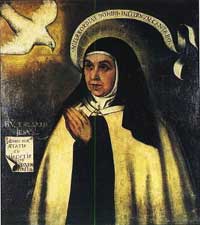
St. Teresa of Avila, 15 October 2008
Biographical selection:
Teresa was at the Carmel of Toledo when the King of Portugal, Dom Sebastian, was killed and his army defeated at the great battle against the Moors at Alcacer-Quibir in Morocco in 1578. The saint had a revelation regarding the defeat. She was deeply saddened and wept, since she greatly desired Christendom’s advance and its enemies conquered.
She complained to Our Lord: “My God, why did Thou permit the defeat of Thy people and the victory of Thy enemies?” Our Lord answered her: “If I found them prepared to be brought into My presence, why are you afflicted?”
Her feeling of sorrow dissipated as she considered the glory the soldiers killed in battle were already enjoying. She admired those warriors whom God had found prepared for eternal happiness, especially considering the normally lax habits of soldiers. Immediately she desired to extend her Carmelite reform to Portugal.
She ardently prayed to know the divine will, and on the Feast of the Assumption, an answer came. Our Lord told her:
“My daughter, you will not go to Portugal to found the houses of your reform. Your daughters and sons will do this in the future when I will end the chastisement inflicted on Portugal, and employ My mercy with this country. The increase in numbers of good religious will give me cause to raise Portugal from the misery into which it will have fallen, restore to it the happiness it enjoyed of old, and be the promise of future glories.”
Comments of Prof. Plinio:
The excerpt deals with two inter-related subjects: the defeat of Alcacer-Quibir in 1578, and the foundation of Carmelite convents in Portugal.
First, St. Therese was praying when God revealed to her that the King Dom Sebastian of Portugal [who reigned from 1557-78] suffered the great defeat of Alcacer-Quibir. This battle proved to be decisive on several points.
(King Dom Sebastian of Portugal)
* If King Dom Sebastian – a very pious and virgin King, the last flower of old Portugal – would have been victorious, he would have broken the power of the Moors. Portugal could have founded a prosperous colony in North Africa, which could have been the bridgehead for a Catholic Africa. This would have shaken the Muslim power all around the world.
The Mohammedans occupied the Balkan Peninsula, Turkey, all of Asia Minor, and parts of Africa, Egypt, Tunis, Tripolitania, Algeria and Morocco. At that time the most dynamic part of the Muslim power was in North Africa. Therefore, if the Portuguese army would have conquered North Africa, this would have made it easier for other Catholic kingdoms such as Spain and France to follow after it. Portugal already had a bridgehead in Fez; at Alcacer-Quibir it was trying to extend its military position. For this reason, Alcacer-Quibir was a decisive battle.
For that overseas battle, King Dom Sebastian had assembled a large fleet at Lagos with a numerous army of Portuguese nobles and soldiers. It is said that he made an imprudent military maneuver against the Moors. He was killed in the battle, and the Portuguese power was broken. On the other hand, the Islamic power consolidated itself and gained force.
* This was not only very bad for the conversion of the Islamic nations, but was also favorable to Protestantism. For, freed from the Catholic threat in Africa, the Muslims were better able to concentrate on their attacks against Austria and Hungary. For that purpose they favored the Protestants there and in other countries that were also enemies of Catholic Austria and Hungary.
* This catastrophe also spelled a disaster for the independence of Portugal. Dom Sebastian left only one heir, his uncle Cardinal Dom Henrique, who became King. He was dispensed by the Holy See from his vow of chastity so that he might continue the Avis dynasty. But he only reigned two years [1578-1580] and never had children. The Portuguese crown passed by right of succession to King Philip II of Spain. The Portuguese dynasty disappeared. Therefore, the death of Dom Sebastian at Alcacer-Quibir represented very heavy damages for Portugal.
* Realizing all this, St. Teresa became sad and wept. She asked Our Lord why he had allowed this defeat. His answer to her was that the army was spiritually so well prepared that He took most of them to Heaven. You can see that this answer of Our Lord was a little evasive. The full answer came when He said that the defeat had been a punishment, and that the good religious to come would be one means to defer the chastisement.
You can see that the topic of this episode between St. Teresa and Our Lord is essentially a political and military concern about Portugal. This stands in opposition to a certain sentimental sweet mentality about the lives of saints, which almost never considers such facets. Everything has to be spiritual. This sham pious spirit abhors dealing with Catholic politics and military interests; it falsely assumes that the spiritual is so high nothing else matters. The true saint, it insinuates, doesn’t care about political and military affairs. In the episode recounted above between Our Lord and St. Therese, you can witness the opposite.
Our Lord showed the military defeat of King Sebastian in a mystical revelation to the great St. Teresa because He wanted to talk about it with her. God had a great interest in that battle. When the Catholic cause loses, saintly persons are supposed to be afflicted, as St. Teresa was. The two conversed, and Our Lord revealed to History His divine reason for the defeat.
* It is interesting to consider how beautiful the designs of God are. How Divine Wisdom has an infinity of facets that the human intelligence can never completely encompass. He responded to St. Teresa’s question by telling her that most of the Portuguese troops had been prepared for death, and so He had taken them. You can see that even at the moment that God was chastising that nation, His goodness was taking into consideration the spiritual state of those combatants. Perhaps He would have changed the moment of chastisement had the soldiers not been so well prepared for a good death. You can see His care, His goodness, His mercy.
Second, let me say only a word about the Carmelite Order. St. Teresa had the special mission of spreading the reform of Carmel. The mission of the Carmelites was, by means of prayer and penance, to attract the graces of God to those countries where the Carmelite Convents existed. A second dimension of their mission was to win those graces for all Christendom, and, in a third dimension, for the whole world, to convert everyone to the Catholic Religion.
When St. Teresa saw that the Portuguese nation was so fervent, she desired to found a convent there. Her wish was excellent and pleased God, but He postponed the founding. Why? Only Divine Wisdom knows.
But one consideration is that the Portuguese people would need a certain time to accept Spanish supremacy once the crown of Portugal had been incorporated to Spain – I just mentioned that King Philip II received the crown as the legitimate heir after the death of the Cardinal Dom Henrique. If the Spanish Carmelites would have gone to Portugal then, at the time St. Teresa desired, bringing another novelty, they could well have been poorly received. A period for adaptation seemed to be necessary. Perhaps this was one of the reasons why Our Lord delayed in sending the Spanish Carmelites to Portugal. After the union of the two kingdoms, the presence of the Spanish Carmelites in Portugal followed naturally and produced immense spiritual fruits.
As a conclusion, we can see how important it is to follow the events and news of our times to the measure that they are related to the salvation of souls, the Catholic cause, the defeat of the Revolution, and the glory and exaltation of the Holy Church. This should be for us an act of love of God characteristic of our counter-revolutionary vocation, since it is to act in present day events.
Let us ask St. Teresa to give us this invaluable grace.
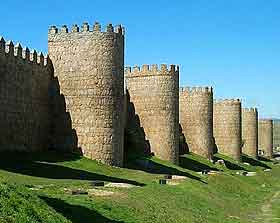
(Walled city of Avila)
Tuesday, October 14, 2008
St. Callistus of Huesca – 14 October 2008
(Catholic Knights)
Biographical selection:
St. Callistus of Huesca was a valorous Spanish officer who became famous for his fight against the Moors in Aragon. He lived in the 10th century and died in 1003.
To assist the inhabitants of Aure valley in France against the enemies of Christianity, he and his companion in arms St. Mercurialis went there to defend them. Both died in combat. The Diocese of Tarbes, France, celebrates his feast day on October 15.
Comments of Prof. Plinio:
At that time, the fight against the Saracens was still in its epic period when they were a great power that had not been virtually defeated. The Spanish Reconquista was just starting to give its great fruits, but at that time the future was uncertain.
In this period we see two military saints who fought side by side against the Moors. Because of their combativeness these two heroes were screened out of certain Books of Saints and hidden by that Sulpician sentimental school of piety that adulterates the lives of the saints by presenting only their soft and delicate facets. This is why almost no one knows about them. I am glad to comment on them to repair this flaw and fill the vacuum.
We can imagine the marvelous scene. On the top of a mountain the two saints are fighting together outnumbered by a large horde of Saracens. The sun is beginning to set and the last rays of its light shine on their metal armors and swords. A golden dusk covers the battle that ensues amidst a great clamor of weapons and shouts.
With strength and temperance, St. Callistus and St. Mercurialis fight side by side, giving and receiving tremendous blows, surrounded by enemies. They struggle as long as they can, but the final moment of their lives arrives. They say a last prayer and strike a last blow as a symbol of the rights of Our Lord Jesus Christ and Our Lady over the lands of France and Spain. Then their souls fly to the presence of God, where they receive their eternal reward, and the blood they shed makes the soil of France where it spilled sacred.
After their deaths, one can imagine the clamor of victory from the Saracens over the appearance that the Catholic Faith was smashed and the Cross was defeated by the Crescent.
But here we should consider that their sacrifice was known to other Catholics of the Reconquista and their fight until death was taken as a model. What they did strengthened those Catholics in their convictions and encouraged them to expel the enemies of the Faith from Catholic soil. Here we can understand how the adage “The blood of martyrs is the seed of Christians” is so true. The repercussions from their fight and deaths gave a new élan for the good cause over all Christendom. It was primordially a supernatural phenomenon, but it also produced a natural psychological reaction. In this sense, their defeat produced elements for the future victory.
I am stressing that the two Saints were defeated to oppose a certain triumphalist mentality that is not rare among Catholics and counter-revolutionaries. According to this mentality, we should never suffer defeats. Our fight should go from victory to victory until the complete triumph and installation of the Reign of Mary. This is a wrong mentality. Many times we are defeated. Since we are in a war against the Revolution and the enemies of the Church, it is normal that at times we win and, at other times, we be defeated. This is the rule of all wars.
When a Catholic understands this rule, he can transform the defeat into a spiritual victory, because martyrdom is a victory in the eyes of God. Our Lord said that there is no higher proof of friendship than a person who gives his life for another. These two warriors died for Our Lord, having the name of Our Lady on their lips. Even though St. Callistus of Huesca and St. Mercurialis died fighting and not enduring sufferings like typical martyrs, they are considered as such because several Popes gave a special privilege to those who died in the Reconquista against the Moors, as well as in the Crusades, to receive honors similar to the martyrs.
Monday, October 13, 2008
Prayer of Thanksgiving to the Sacred Heart of Jesus
O Word of God,
dear Jesus our Redeemer,
we adore Thee and with hearts over-flowing
we thank Thee for having taken human flesh upon Thee
and become for our redemption both Priest and Victim
in the sacrifice of the Cross,
a sacrifice which,
through the exceeding love of Thy Sacred Heart,
Thou dost renew upon our altars at every moment.
O High Priest,
O Divine Victim,
give us the grace to honour Thy holy sacrifice
in the most adorable Eucharist
with the homage of Mary most holy
and of all Thy holy Church,
triumphant, suffering and militant.
We offer ourselves wholly to Thee;
of Thine infinite goodness and mercy
do Thou accept our offering,
unite it to Thine own
and grant us Thy blessing.
Glory be to the Father,
and to the Son,
and to the Holy Ghost.
As it was in the beginning,
is now,
and ever shall be,
world without end.
Sunday, October 12, 2008
St. Alfonsa - India's first Woman saint.
The baptismal name of St. Alfonsa is Anna Muttathupadam; she was born on August 19, 1919, in Kudamaloor, in Kerala. Her mother died when she was a baby. At the age of 17 she entered the Congregation of the Immaculate Conception.
Her delicate health was held to be an obstacle in religious life and her superiors wanted her to return to her home; but Sister Alfonsa persevered in her vocation and made her perpetual vows in 1936. She died 10 years later at age 35.
In 1936, she took perpetual vows at the monastery of the Claretians of Malabar in Bharananganam.
Her work was teaching, but she soon had to leave it for health reasons. She bravely endured her illness until her death, on July 28, 1946. The bishop of Palai began the diocesan process of beatification in 1955, and on November 9, 1984, she was declared venerable. On February 8, 1986, Pope John Paul II beatified her in Kottayam, in India, together with another Indian blessed, Kuriakose Elias Chavara.
“This is a great moment for the Indian Church," says Cardinal Varkey Vithayathil, head of the Indian bishops' conference, "God has raised up to the highest honour a person who the world considered useless and sickly. Today Blessed Alfonsa will be a living catechesis that the Catholic Church produces children who are holy bearing fruit, and in a twist of irony curing the sick, the humble one who understands the intimacy of union with Christ through suffering.”
The cardinal compares the life of the blessed with the experience of St. Teresa of Lisieux, in which the brevity of life marked by "physical suffering" is exalted by the "salvific dimension" that is present in faith in Christ, at a particular moment of the Indian Church, marked by the martyrdom and violence against Christians in many areas of the country.
"We live in a time," continues the president of the Indian bishops, "where the world wants to deny suffering and the cross, even the tremendous scientific and technological progress unfortunately are used to get rid to the suffering through any means there are other sinister developments. Some cast doubt on the right to life of the newborn disabled baby, and of others who are incurably sick and old, and of those whose lives - they judge - are no longer useful to society or meaningful to themselves. Due to this we see termination of pregnancy when the foetus is abnormal, and even euthanasia are all the result of the inability to accept this suffering."
The life of Blessed Alfonsa is taking on an even greater value in India, a society where there is still a rigid separation among the castes, and the underprivileged are kept at the margins of society. "The canonization of Blessed Alfonsa," Cardinal Vithayathil concludes, "should force us to confront the grim reality upon which our success and world dominance depend - all money, power and other attractions end with death, but a live lived in holiness, in faith and lived communion with Christ, lives and continues to bear fruit even after the passing away of our mortal life."