Evil triumphs when good men do nothing - Edmund Burke

Tuesday, May 26, 2009

Summa Theologica Ascension Article 3

Article 3. Whether Christ ascended by His own power?

Objection 1. It would seem that Christ did not ascend by His own power, because it is written (Mark 16:19) that "the Lord Jesus, after He had spoken to them, was taken up to heaven"; and (Acts 1:9) that, "while they looked on, He was raised up, and a cloud received Him out of their sight." But what is taken up, and lifted up, appears to be moved by another. Consequently, it was not by His own power, but by another's that Christ was taken up into heaven.

Objection 2. Further, Christ's was an earthly body, like to ours. But it is contrary to the nature of an earthly body to be borne upwards. Moreover, what is moved contrary to its nature is nowise moved by its own power. Therefore Christ did not ascend to heaven by His own power.

Objection 3. Further, Christ's own power is Divine. But this motion does not seem to have been Divine, because, whereas the Divine power is infinite, such motion would be instantaneous; consequently, He would not have been uplifted to heaven "while" the disciples "looked on," as is stated in Acts 1:9. Therefore, it seems that Christ did not ascend to heaven by His own power.

On the contrary, It is written (Isaiah 63:1): "This beautiful one in his robe, walking in the greatness of his strength." Also Gregory says in a Homily on the Ascension (xxix): "It is to be noted that we read of Elias having ascended in a chariot, that it might be shown that one who was mere man needed another's help. But we do not read of our Saviour being lifted up either in a chariot or by angels, because He who had made all things was taken up above all things by His own power."

I answer that, There is a twofold nature in Christ, to wit, the Divine and the human. Hence His own power can be accepted according to both. Likewise a twofold power can be accepted regarding His human nature: one is natural, flowing from the principles of nature; and it is quite evident that Christ did not ascend into heaven by such power as this. The other is the power of glory, which is in Christ's human nature; and it was according to this that He ascended to heaven.

Now there are some who endeavor to assign the cause of this power to the nature of the fifth essence. This, as they say, is light, which they make out to be of the composition of the human body, and by which they contend that contrary elements are reconciled; so that in the state of this mortality, elemental nature is predominant in human bodies: so that, according to the nature of this predominating element the human body is borne downwards by its own power: but in the condition of glory the heavenly nature will predominate, by whose tendency and power Christ's body and the bodies of the saints are lifted up to heaven. But we have already treated of this opinion in I, 76, 7, and shall deal with it more fully in treating of the general resurrection (XP, 84, 1).

Setting this opinion aside, others assign as the cause of this power the glorified soul itself, from whose overflow the body will be glorified, as Augustine writes to Dioscorus (Ep. cxviii). For the glorified body will be so submissive to the glorified soul, that, as Augustine says (De Civ. Dei xxii), "wheresoever the spirit listeth, thither the body will be on the instant; nor will the spirit desire anything unbecoming to the soul or the body." Now it is befitting the glorified and immortal body for it to be in a heavenly place, as stated above (Article 1). Consequently, Christ's body ascended into heaven by the power of His soul willing it. But as the body is made glorious by participation with the soul, even so, as Augustine says (Tract. xxiii in Joan.), "the soul is beatified by participating in God." Consequently, the Divine power is the first source of the ascent into heaven. Therefore Christ ascended into heaven by His own power, first of all by His Divine power, and secondly by the power of His glorified soul moving His body at will.

Reply to Objection 1. As Christ is said to have risen by His own power, though He was raised to life by the power of the Father, since the Father's power is the same as the Son's; so also Christ ascended into heaven by His own power, and yet was raised up and taken up to heaven by the Father.

Reply to Objection 2. This argument proves that Christ did not ascend into heaven by His own power, i.e. that which is natural to human nature: yet He did ascend by His own power, i.e. His Divine power, as well as by His own power, i.e. the power of His beatified soul. And although to mount upwards is contrary to the nature of a human body in its present condition, in which the body is not entirely dominated by the soul, still it will not be unnatural or forced in a glorified body, whose entire nature is utterly under the control of the spirit.

Reply to Objection 3. Although the Divine power be infinite, and operate infinitely, so far as the worker is concerned, still the effect thereof is received in things according to their capacity, and as God disposes. Now a body is incapable of being moved locally in an instant, because it must be commensurate with space, according to the division of whichtime is reckoned, as is proved in Physics vi. Consequently, it is not necessary for a body moved by God to be moved instantaneously, but with such speed as God disposes.

Monday, May 25, 2009

The Investirue Issue - Church History


The monk Hildebrand, who had already become a great power in the Church was elected as pope. He chose the name of Gregory VII, and under that name he became even more powerful than he had been as Hildebrand. Between him and Henry IV a bitter struggle for supremacy began.

Two years after his inauguration Gregory issued a decree declaring that henceforth bishops should not be chosen by the emperor nor by any lay person, but that the investiture should be entirely in the hands of the Church. Now emperor after emperor had tried to strengthen the clergy in order to curb the power of the nobles. And to do this emperor after emperor had given them lands to hold in fief, until at length a great part of the soil of Germany was in their hands. If, then, the pope alone had power to appoint bishops, all these lands would pass into his control, and the imperial authority would be seriously lessened.

Henry was at this time only twenty-five. He was passionate and ill-balanced, and little calculated to cope with a pope of overweening pride and terrible severity. He was in no mood to yield up any of his authority, and he deposed the pope. For had not his father elected and deposed popes as he would. But Gregory was no German pope, ready to bow to the commands of a German king. Instead of being cowed by this show of imperial power, he replied to it by excommunicating Henry and threatening to depose him if he remained impenitent.

Never before had a pope dared to use such arrogance towards an emperor, and had Henry been surrounded by faithful vassals, had he ruled over a united people, the thunders of the pope might have fallen harmless upon him; but because of that dream of world dominion Germany was not united. There was little German loyalty to a ruler who claimed the world as his dominion. Every prince of the Empire was constantly seeking an opportunity to become an independent ruler. Now many saw their opportunity, for the pope had set them free from their allegiance, and Henry found his empire filled with rebellion and his authority vanishing into thin air.

Henry soon saw that only by submitting to the pope could he regain his authority over his rebellious subjects, and he made up his mind to submit at once. It was no repentance for his deed which urged him to this, but merely political necessity. In midwinter he crossed the Alps, and after incredible hardships reached Canossa, where the haughty pope awaited him. There, one bitter winter morning, while the snow lay on the ground, the proud emperor appeared before the castle gates of the still prouder pope. Clad in the garb of a penitent, with head and feet bare, he humbly knocked, begging admission. But the door remained closed. A second and a third day passed, and still Henry stood without the gates, waiting the pleasure of the stern old man within.

At length Gregory relented. The penitent king was admitted to his presence, and received absolution. Thus did the inexorable priest uphold before the eyes of all Christendom the papal right to judge kings. Thus did he make good his claim to loose and to bind in earthly as in heavenly Matters, "to give and to take away empires, kingdoms, princedoms, and the possessions of all men." Without striking a blow, without even having an army behind him, this little, grey-haired priest had conquered "the lord of the world."

But the pope, had made an implacable enemy of Henry, and as soon as he felt himself strong enough he defied the pope anew. Again he was excommunicated, and again he replied by deposing the pope. This time he set up an anti-pope and marching to Rome beseiged Gregory there.

After a siege of three years Henry entered the city and received the imperial crown at the hands of his own pope, Clement III. Gregory's day was over, and he fled to Salerno. There he died, but even in death he did not forgive the recreant emperor, and he died leaving his enemy still under the ban of the Church.

Rebellion and civil war filled Henry's last days, and at length, deposed, betrayed, and beggared, he died. But the pope's curse followed him even beyond the grave, and not until five years later was the ban removed and the bones of Henry IV laid to rest in consecrated ground.

Concordat of Worms

Gregory VII was dead, Henry IV was dead, but the struggle over the investiture continued. For succeeding popes clung to the great powers Gregory had claimed, succeeding emperors resisted them. Henry V succeeded his father, Henry IV. He had rebelled against his father during his lifetime, and now the new pope, Paschal II, hoped to find in him an obedient servant; but he was mistaken, and the struggle continued. At length, however, at the Concordat of Worms, Calixtus II being now pope, an agreement was come to. It was agreed that the pope should have the right to investiture with ring and crozier, but that bishops should be chosen with the consent of the emperor, and that they should do homage to him for their fiefs in the same way as laymen.

Thus the struggle of fifty years ended. The pope was, in the main, victorious, for although he had not been able to make good all his claims, he had won much prestige, whereas the emperor had lost much. But although the question of investiture might be settled, the rivalry between pope and emperor, each claiming to rule the world, continued as before. More and more the popes strove to make good their claim to be not only the chief priests but the chief princes of Christendom. But it is not uninteresting to note the difference in the treatment meted out by them to Henry of Germany and William of England.

In England the king was supreme in Church and state. There the people alone could give or take away the crown, there the king made and unmade bishops without reference to the pope. But in the hope of making England a fief of the Church the pope, Alexander II, blessed the enterprise of William of Normandy when he set forth to conquer the kingdom from Harold the Saxon. William, however, pious Churchman as he was, having conquered England, meant to rule there as sole master. Gregory VII also meant to rule there as elsewhere, and after some preliminary skirmishes in which William yielded nothing, he sent a messenger to demand from the king of England an oath probably of fealty, together with the assurance that Peter's Pence should be more punctually paid.

William's reply was very short, very decisive. Bluntly he refused to own himself the pope's man. The kings of England who had gone before him had never sworn fealty to the pope; neither would he. As to Peter's Pence, from ancient times it had been paid, and he would continue to pay it. What was lawfully due to the pope the pope should have. The respect due to the chief priest of Christendom he should also have, and nothing more. The right of investiture, over which pope and emperor quarrelled so fiercely, was never even mentioned, and whatever wrath Gregory may have felt at William's refusal of fealty, no thunders of the Church were launched at the recreant king. This was partly, doubtless, because Gregory was otherwise [100] occupied. His arch-enemy the emperor was again defiant, and had enthroned an anti-pope, and Gregory, gathering his forces to combat him, had little leisure to fight the king of England.

But if the popes were unsuccessful in pressing their claims in England, in Germany they were more successful. During the reign of Lothaire the Saxon, who followed Henry V as ruler of Germany, their power increased. For Lothaire was weakly fearful of arousing the pope's wrath, and he even went so far as to acknowledge the pope as his overlord, in respect of some Italian lands, of which he might have claimed possession outright.

The Dictatus Papae - Pope St. Gregory VII

The Dictatus Papae was included in Pope's register in the year 1075. Some argue that it was written by Pope Gregory VII (r. 1073-1085) himself, others argues that it had a much later different origin. In 1087 Cardinal Deusdedit published a collection of the laws of the Church which he drew from any sources. The Dictatus agrees so clearly and closely with this collection that some have argued the Dictatus must have been based on it; and so must be of a later date of compilation than 1087. There is little doubt that the principals below do express the pope's principals.

The Dictates of the Pope

1. That the Roman church was founded by God alone.
2. That the Roman pontiff alone can with right be called universal.
3. That he alone can depose or reinstate bishops.
4. That, in a council his legate, even if a lower grade, is above all bishops, and can pass sentence of deposition against them.
5. That the pope may depose the absent.
6. That, among other things, we ought not to remain in the same house with those excommunicated by him.
7. That for him alone is it lawful, according to the needs of the time, to make new laws, to assemble together new congregations, to make an abbey of a canonry; and, on the other hand, to divide a rich bishopric and unite the poor ones.
8. That he alone may use the imperial insignia.
9. That of the pope alone all princes shall kiss the feet.
10. That his name alone shall be spoken in the churches.
11. That this is the only name in the world.
12. That it may be permitted to him to depose emperors.
13. That he may be permitted to transfer bishops if need be.
14. That he has power to ordain a clerk of any church he may wish.
15. That he who is ordained by him may preside over another church, but may not hold a subordinate position; and that such a one may not receive a higher grade from any bishop.
16. That no synod shall be called a general one without his order.
17. That no chapter and no book shall be considered canonical without his authority.
18. That a sentence passed by him may be retracted by no one; and that he himself, alone of all, may retract it.
19. That he himself may be judged by no one.
20. That no one shall dare to condemn one who appeals to the apostolic chair.
21. That to the latter should be referred the more important cases of every church.
22. That the Roman church has never erred; nor will it err to all eternity, the Scripture bearing witness.
23. That the Roman pontiff, if he have been canonically ordained, is undoubtedly made a saint by the merits of St. Peter; St. Ennodius, bishop of Pavia, bearing witness, and many holy fathers agreeing with him. As is contained in the decrees of St. Symmachus the pope.
24. That, by his command and consent, it may be lawful for subordinates to bring accusations.
25. That he may depose and reinstate bishops without assembling a synod.
26. That he who is not at peace with the Roman church shall not be considered catholic.
27. That he may absolve subjects from their fealty to wicked men.

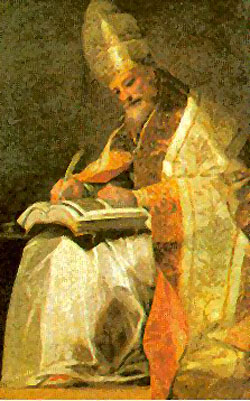
Pope St. Gregory VII - 25th May 2009


Today is the feast of pope St Gregory the VII, let us read what Dr. Plino has to teach us about this Pope.

Biographical selection:

St. Gregory VII, Pope and Confessor. By his teachings and action he affirmed and defended the rights of the Pope over the Church, and of the spiritual over the temporal sphere. He was an example of intransigence, courage, and confidence in the supernatural.

Comments of Prof. Plinio:

It’s a pity that I didn’t remember to bring here a document attributed to St. Gregory VII that is attacked by all the progressivist theologians. It is called Dictatus Papae (1090), which means the The Dictates of the Pope. It is a kind of summary he dictated of the theses he wanted to uphold. Among those theses, one of the most beautiful and habitually shunned regards the relation between the Pope and the Emperor as head of the temporal sphere.

The Emperor at the time, Henry IV, was intervening in Church matters in order to direct her through the control of the election of the Bishops. St. Gregory VII fought against this. He wanted to smash this pretension of the imperial government and humiliate it, and in fact he did so.

The Dictatus Papae shows his thinking on the relations that should exist between the Holy Roman Empire and the Papacy. He affirmed that the Papal Monarchy is a universal monarchy in spiritual matters. In temporal matters the Papal Monarchy should decisively influence the Empire, even without governing it directly. The temporal power should be the sword of the Pope, at his service to protect the Holy Catholic Church, defend the Faith, and persecute its enemies. The temporal power should govern its subjects independently according to natural law, but the Papacy should watch over how this is done. There would be two different and independent powers.

Which one would be the highest power? At the top is the Pope, and at his left, one step down is the Emperor, and below the Emperor, all the Kings and sovereigns of the temporal sphere. Also below the Pope and to his right is the entire Catholic Hierarchy in the spiritual sphere. In synthesis, everything relies upon the Pope. This was St. Gregory VII’s conception of the two powers.

We might ask St. Gregory VII on his feast day to intercede for the world so we might again have this conception of the spiritual and temporal orders. On the day when this again becomes the general view, it will be the dawn of the Reign of Mary. The reverse is also true: on the day that the dawn of the Reign of Mary will arrive, this vision will be born with it.

Let us pray to St. Gregory VII to move God to bring back his sublime vision on earth, because without it nothing can find the right path.

Summa Theologica - Ascension Article 2

Article 2. Whether Christ's Ascension into heaven belonged to Him according to His Divine Nature?

Objection 1. It would seem that Christ's Ascension into heaven belonged to Him according to His Divine Nature. For, it is written (Psalm 46:6): "God is ascended with jubilee": and (Deuteronomy 33:26): "He that is mounted upon the heaven is thy helper." But these words were spoken of God even before Christ's Incarnation. Therefore it belongs to Christ to ascend into heaven as God.

Objection 2. Further, it belongs to the same person to ascend into heaven as to descend from heaven, according to John 3:13: "No man hath ascended into heaven, but He that descended from heaven": and Ephesians 4:10: "He that descended is the same also that ascended." But Christ came down from heaven not as man, but as God: because previously His Nature in heaven was not human, but Divine. Therefore it seems that Christ ascended into heaven as God.

Objection 3. Further, by His Ascension Christ ascended to the Father. But it was not as man that He rose to equality with the Father; for in this respect He says: "He is greater than I," as is said in John 14:28. Therefore it seems that Christ ascended as God.

On the contrary, on Ephesians 4:10: "That He ascended, what is it, but because He also descended," a gloss says: "It is clear that He descended and ascended according to His humanity."

I answer that, The expression "according to" can denote two things; the condition of the one who ascends, and the cause of his ascension. When taken to express the condition of the one ascending, the Ascension in no wise belongs to Christ according to the condition of His Divine Nature; both because there is nothing higher than the Divine Nature to which He can ascend; and because ascension is local motion, a thing not in keeping with the Divine Nature, which is immovable and outside all place. Yet the Ascension is in keeping with Christ according to His human nature, which is limited by place, and can be the subject of motion. In this sense, then, we can say that Christ ascended into heaven as man, but not as God.

But if the phrase "according to" denote the cause of the Ascension, since Christ ascended into heaven in virtue of His Godhead, and not in virtue of His human nature, then it must be said that Christ ascended into heaven not as man, but as God. Hence Augustine says in a sermon on the Ascension: "It was our doing that the Son of man hung upon the cross; but it was His own doing that He ascended."

Reply to Objection 1. These utterances were spoken prophetically of God who was one day to become incarnate. Still it can be said that although to ascend does not belong to the Divine Nature properly, yet it can metaphorically; as, for instance, it is said "to ascend in the heart of man" (cf. Psalm 83:6), when his heart submits and humbles itself before God: and in the same way God is said to ascend metaphorically with regard to every creature, since He subjects it to Himself.

Reply to Objection 2. He who ascended is the same as He who descended. For Augustine says (De Symb. iv): "Who is it that descends? The God-Man. Who is it that ascends? The self-same God-Man." Nevertheless a twofold descent is attributed to Christ; one, whereby He is said to have descended from heaven, which is attributed to the God-Man according as He is God: for He is not to be understood as having descended by any local movement, but as having "emptied Himself," since "when He was in theform of God He took the form of a servant." For just as He is said to be emptied, not by losing His fulness, but because He took our littleness upon Himself, so likewise He is said to have descended from heaven, not that He deserted heaven, but because He assumed human nature in unity of person.

And there is another descent whereby He descended "into the lower regions of the earth," as is written Ephesians 4:9; and this is local descent: hence this belongs to Christ according to the condition of human nature.

Reply to Objection 3. Christ is said to ascend to the Father, inasmuch as He ascends to sit on the right hand of the Father; and this is befitting Christ in a measure according to His Divine Nature, and in a measure according to His human nature, as will be said later (58, 3)

Sunday, May 24, 2009

Ascension of Our Lord - Summa Theologica


Article 1. Whether it was fitting for Christ to ascend into heaven?

Objection 1. It would seem that it was not fitting for Christ to ascend into heaven. For the Philosopher says (De Coelo ii) that "things which are in a state of perfection possess their good without movement." But Christ was in a state of perfection, since He is the Sovereign Good in respect of His Divine Nature, and sovereignly glorified in respect of His human nature. Consequently, He has His good without movement. But ascension is movement. Therefore it was not fitting for Christ to ascend.

Objection 2. Further, whatever is moved, is moved on account of something better. But it was no better thing for Christ to be in heaven than upon earth, because He gained nothing either in soul or in body by being in heaven. Therefore it seems that Christ should not have ascended into heaven.

Objection 3. Further, the Son of God took human flesh for our salvation. But it would have been more beneficial for men if He had tarried always with us upon earth; thus He said to His disciples (Luke 17:22): "The days will come when you shall desire to see one day of the Son of man; and you shall not see it." Therefore it seems unfitting for Christ to have ascended into heaven.

Objection 4. Further, as Gregory says (Moral. xiv), Christ's body was in no way changed after the Resurrection. But He did not ascend into heaven immediately after rising again, for He said after the Resurrection (John 20:17): "I am not yet ascended to My Father." Therefore it seems that neither should He have ascended after forty days.

On the contrary, Are the words of our Lord (John 20:17): "I ascend to My Father and to your Father."

I answer that, The place ought to be in keeping with what is contained therein. Now by His Resurrection Christ entered upon an immortal and incorruptible life. But whereas our dwelling-place is one of generation and corruption, the heavenly place is one of incorruption. And consequently it was not fitting that Christ should remain upon earth after the Resurrection; but it was fitting that He should ascend to heaven.

Reply to Objection 1. That which is best and possesses its good without movement is God Himself, because He is utterly unchangeable, according to Malachi 3:6: "I am the Lord, and I change not." But every creature is changeable in some respect, as is evident from Augustine (Gen. ad lit. viii). And since the nature assumed by the Son of God remained a creature, as is clear from what was said above (2, 7; 16, 8,10; 20, 1), it is not unbecoming if some movement be attributed to it.

Reply to Objection 2. By ascending into heaven Christ acquired no addition to His essential glory either in body or in soul: nevertheless He did acquire something as to the fittingness of place, which pertains to the well-being of glory: not that His body acquired anything from a heavenly body by way of perfection or preservation; but merely out of a certain fittingness. Now this in a measure belonged to His glory; and He had a certain kind of joy from such fittingness, not indeed that He then began to derive joy from it when He ascended into heaven, but that He rejoiced thereat in a new way, as at a thing completed. Hence, on Psalm 15:11: "At Thy right hand are delights even unto the end," the gloss says: "I shall delight in sitting nigh to Thee, when I shall be taken away from the sight of men."

Reply to Objection 3. Although Christ's bodily presence was withdrawn from the faithful by the Ascension, still the presence of His Godhead is ever with the faithful, as He Himself says (Matthew 28:20): "Behold, I am with you all days, even to the consummation of the world." For, "by ascending into heaven He did not abandon those whom He adopted," as Pope Leo says (De Resurrec., Serm. ii). But Christ's Ascension into heaven, whereby He withdrew His bodily presence from us, was more profitable for us than His bodily presence would have been.

First of all, in order to increase our faith, which is of things unseen. Hence our Lord said (John 16) that the Holy Ghost shall come and "convince the world . . . of justice," that is, of the justice "of those that believe," as Augustine says (Tract. xcv super Joan.): "For even to put the faithful beside the unbeliever is to put the unbeliever to shame"; wherefore he goes on to say (10): "'Because I go to the Father; and you shall see Me no longer'"--"For 'blessed are they that see not, yet believe.' Hence it is of our justice that the world is reproved: because 'you will believe in Me whom you shall not see.'"

Secondly, to uplift our hope: hence He says (John 14:3): "If I shall go, and prepare a place for you, I will come again, and will take you to Myself; that where I am, you also may be." For by placing in heaven the human nature which He assumed, Christ gave us the hope of going thither; since "wheresoever the body shall be, there shall the eagles also be gathered together," as is written in Matthew 24:28. Hence it is written likewise (Micah 2:13): "He shall go up that shall open the way before them."

Thirdly, in order to direct the fervor of our charity to heavenly things. Hence the Apostle says (Colossians 3:1-2): "Seek the things that are above, where Christ is sitting at the right hand of God. Mind the things that are above, not the things that are upon the earth": for as is said (Matthew 6:21): "Where thy treasure is, there is thy heart also." And since the Holy Ghost is love drawing us up to heavenly things, therefore our Lord said to His disciples (John 16:7): "It is expedient to you that I go; for if I go not, the Paraclete will not come to you; but if I go, I will send Him to you." On which words Augustine says (Tract. xciv super Joan.): "Ye cannot receive the Spirit, so long as ye persist in knowing Christ according to the flesh. But when Christ withdrew in body, not only the Holy Ghost, but both Father and Son were present with them spiritually."

Reply to Objection 4. Although a heavenly place befitted Christ when He rose to immortal life, nevertheless He delayed the Ascension in order to confirm the truth of His Resurrection. Hence it is written (Acts 1:3), that "He showed Himself alive after His Passion, by many proofs, for forty days appearing to them": upon which the gloss says that "because He was dead for forty hours, during forty days He established the fact of His being alive again. Or the forty days may be understood as a figure of this world, wherein Christ dwells in His Church: inasmuch as man is made out of the four elements, and is cautioned not to transgress the Decalogue."

Ascension - From The Baltimore Catechism

101. When did Christ ascend into heaven?

Christ ascended, body and soul, into heaven on Ascension Day, forty days after His Resurrection.

102. Why did Christ remain on earth forty days after His Resurrection?

Christ remained on earth forty days after His Resurrection to prove that He had truly risen from the dead and to complete the instruction of the apostles.

(a) Saint Paul tells us that Christ, after His Resurrection, appeared frequently to the apostles and to many others.

(b) Christ ascended into heaven from Mount Olivet, a hill outside Jerusalem.

103. What do we mean when we say that Christ sits at the right hand of God, the Father Almighty?

When we say that Christ sits at the right hand of God, the Father Almighty, we mean that Our Lord as God is equal to the Father, and that as man He shares above all the saints in the glory of His Father and exercises for all eternity the supreme authority of a king over all creatures.

(a) Even as man, Christ of Himself has dominion over all creation. His Kingship rests on the fact that His human nature is immediately united to the divine Person of the Son of God, and on the fact that He redeemed all men with His precious blood.

(b) On earth Christ exercises His kingly authority in spiritual matters through His Church. His Kingship extends also over temporal and civil matters.

Saturday, May 23, 2009

Catholic Art - The Ascension of Our Lord Jesus Chirst

Obama Messiah Video

I have a very bad cold. And could hardly sleep at night. So while tossing and turning this song came to my mind and i had to make a video like this. Enjoy.


Original Video - More videos at TinyPic


If anyone knows how to modify this song so that I can put it in Youtube without the copyright nonsense, I wll be most greatful

St. Felix of Cantalice - 23 May 2009

It was in a small village at the foot of Mount Appenine named Cantalice, that Saint Felix was born in 1513 of pious but poor parents, whose names were Saint and Sainte. It was not long before the little boy, when he approached the other children, was hailed by them: “Here comes Felix, the Saint!” He showed a predilection for solitary prayer from his earliest youth, and as a little shepherd used to retire to a quiet place to kneel there and meditate on the Passion of Jesus.

When he was a little older, he resolved to take the habit of the Capuchin Friars. The rigor of their rule could not deter him, but his obligations could; he was employed as a laborer. When his life was spared in an accident, during which two runaway bulls and a trailing plow should have killed him, the man for whom he was working saw the hand of God in his preservation and permitted him to leave, to enter religion. He was at that time nearly thirty years old, but the Superiors, observing his fervor, placed no obstacles.

In 1545 he pronounced his vows and was sent to Rome, where for forty years he begged for the community. His characteristic words to his companion were: “Let us go, my Brother, with rosary in hand, our eyes to the ground and our spirit in heaven.” He was of an exquisite politeness, extreme gentleness and great simplicity. The sick persons he visited at night became attached to him, and for his part, he sought them out everywhere in Rome, insofar as obedience permitted.

One day on the street he met two duelists with sword in hand. He begged them to repeat after him, “Deo gratias!” which finally they did, and after taking him as arbiter of their quarrel, they separated as good friends. Saint Felix met Saint Philip Neri in Rome, and they became friends who wished one another all possible torments for the love of Jesus Christ. They sometimes remained together without speaking for considerable periods, seemingly transported with joy.

Saint Felix had a great devotion to the most Blessed Virgin, reciting Her rosary with such tenderness that he could not continue at times. He loved the Holy Name of Jesus, and invited the children he would meet to say it with him. He slept only for about two hours, going afterwards to the church and remaining there in prayer until the office of Prime; then he would serve the first Mass and receive Communion every day.

When he was sick and was given the last Sacraments, he saw the Blessed Virgin and a beautiful troop of Angels coming to fortify him in this last journey. He cried out in joy, and gave up his soul peacefully to his Creator in 1587. He was canonized by Pope Clement XI in 1712. His body is in the Capuchin Church of Rome; a plenary indulgence is granted to those who, fulfilling the ordinary conditions, visit a church of his Order on his feast day.

(The Church of Santa Maria della Concezione on Via Veneto in Rome where the remains of St. Felix are kept)


Friday, May 22, 2009

Painting of the Crucifixion, Resurrection and Ascension of our Lord


Today as part of our look into Catholic Art let us admire this painting on the Crucifixion, Resurrection and Ascension of Our Lord

St. Rita of Cascia - 22nd May 2009


Daughter of Antonio and Amata Lotti, a couple known as the Peacemakers of Jesus; they had Rita late in life. From her early youth, Rita visited the Augustinian nuns at Cascia, Italy, and showed interest in a religious life. However, when she was twelve, her parents betrothed her to Paolo Mancini, an ill-tempered, abusive individual who worked as town watchman, and who was dragged into the political disputes of the Guelphs and Ghibellines. Disappointed but obedient, Rita married him when she was 18, and was the mother of twin sons. She put up with Paolo’s abuses for eighteen years before he was ambushed and stabbed to death. Her sons swore vengeance on the killers of their father, but through the prayers and interventions of Rita, they forgave the offenders.

Upon the deaths of her sons, Rita again felt the call to religious life. However, some of the sisters at the Augustinian monastery were relatives of her husband’s murderers, and she was denied entry for fear of causing dissension. Asking for the intervention of Saint John the Baptist, Saint Augustine of Hippo, and Saint Nicholas of Tolentino, she managed to bring the warring factions together, not completely, but sufficiently that there was peace, and she was admitted to the monastery of Saint Mary Magdalen at age 36.

Rita lived 40 years in the convent, spending her time in prayer and charity, and working for peace in the region. She was devoted to the Passion, and in response to a prayer to suffer as Christ, she received a chronic head wound that appeared to have been caused by a crown of thorns, and which bled for 15 years.

Confined to her bed the last four years of her life, eating little more than the Eucharist, teaching and directing the younger sisters. Near the end she had a visitor from her home town who asked if she’d like anything; Rita’s only request was a rose from her family’s estate. The visitor went to the home, but it being January, knew there was no hope of finding a flower; there, sprouted on an otherwise bare bush, was a single rose blossom.

Among the other areas, Rita is well-known as a patron of desperate, seemingly impossible causes and situations. This is because she has been involved in so many stages of life - wife, mother, widow, and nun, she buried her family, helped bring peace to her city, saw her dreams denied and fulfilled - and never lost her faith in God, or her desire to be with Him.

Thursday, May 21, 2009

Ascension painting by Giotto

In some diocese and in some countries today is the Feast of the Ascension of Our Lord. Not so in Canada where this feat is celebrated on Sunday.

Let us today admire this fresco by Giotto di Bondone as we prepare our hearts for this Feast.

St. Cristóbal Magallanes and Companions - 21st May 2009

Pope John Paul II beatified Toribio (among the martyrs who were collectively called Cristóbal Magallanes and his Companions, Martyrs of the Catholic Action Movement in Mexico) on November 22, 1992; the pontiff canonized the martyrs on May 21, 2000. In his homily, the Holy Father spoke of the martyrs, saying:

Most of them belonged to the secular clergy and three were laymen seriously committed to helping priests. They did not stop courageously exercising their ministry when religious persecution intensified in the beloved land of Mexico, unleashing hatred of the Catholic religion. They all freely and calmly accepted martyrdom as a witness to their faith, explicitly forgiving their persecutors. Faithful to God and to the Catholic faith so deeply rooted in the ecclesial communities which they served by also promoting their material well-being, today they are an example to the whole Church and to Mexican society in particular. After the harsh trials that the Church endured in Mexico during those turbulent years, today Mexican Christians, encouraged by the witness of these witnesses to the faith, can live in peace and harmony, contributing the wealth of Gospel values to society. The Church grows and advances, since she is the crucible in which many priestly and religious vocations are born, where families are formed according to God's plan, and where young people, a substantial part of the Mexican population, can grow up with the hope of a better future. May the shining example of Cristóbal Magallanes and his companion martyrs help you to make a renewed commitment of fidelity to God, which can continue to transform Mexican society so that justice, fraternity and harmony will prevail among all.

During his homily at the canonization Mass on May 21, 2000, Pope John Paul II addressed the Mexican men, women and children present in Rome and said: “After the harsh trials that the Church endured in Mexico during those turbulent years, today Mexican Christians, encouraged by the witness of these witnesses to the faith, can live in peace and harmony, contribute the wealth of gospel values to society. The Church grows and advances, since she is the crucible in which many priestly and religious vocations are born, where families are formed according to God's plan, and where young people, a substantial part of the Mexican population, can grow with the hope of a better future. May the shining example of Cristóbal Magallanes and his companion martyrs help you to make a renewed commitment of fidelity to God, which can continue to transform Mexican society so that justice, fraternity and harmony will prevail among all.”

Wednesday, May 20, 2009

Stupid "Catholic " Politicians wife

French First Lady Carla Bruni-Sarkozy accuses Pope Benedict of "damaging" countries in Africa with his stance on birth control.

"I find that the controversy coming from the Pope's message – albeit distorted by the media – is very damaging," she said. "In Africa it's often church people who look after sick people. It's astonishing to see the difference between the theory and the reality.

"I think the church should evolve on this issue. It presents the condom as a contraceptive which, incidentally, it forbids, although it is the only existing protection."

Bruni-Sarkozy added: "I was born Catholic, I was baptized, but in my life I feel profoundly secular."

Sorry Carla, firstly by marring a divorced man you are living in a state of sin, the sin is called fornication. *

Second secularism is condemned as a heretical error in the Syllabus of Errors by Pope Pius IX

Why then did Moses command to give a bill of divorce, and to put away? 8 He saith to them: Because Moses by reason of the hardness of your heart permitted you to put away your wives: but from the beginning it was not so. 9 And I say to you, that whosoever shall put away his wife, except it be for fornication, and shall marry another, committeth adultery: and he that shall marry her that is put away, committeth adultery.

St. Paul in the Square - Youth pray to their Mother


It was heart warming to see the little ones and the teens pray the Rosary.


The Archbishop after the Rosary went walking amidst the crowd and blessed the children and their parents as well. (My camera got soft so all the pictures are a bit out of focus)


This little lad was fascinated by the big cross that the Archbishop had on.

St. Bernardine of Siena - 20th May 2009


One day in the year 1408 the great apostle Saint Vincent Ferrer suddenly interrupted his sermon, to declare that there was among his hearers a young Franciscan who would be one day a greater preacher than himself, and who would be placed in honor by the Church before himself. This unknown friar, who would be canonized only six years after his death, was Bernardine, then 28 years old. Of noble birth, he had spent his youth in works of mercy, caring for the sick before he entered religion at the age of 24.

Owing to a speech defect, Bernardine’s success as a preacher at first seemed doubtful, but by the prayers of Our Lady, this obstacle was miraculously removed in 1417, and the Franciscan friar began an apostolate which lasted until he died. One day, preaching in praise of the Blessed Virgin, he applied to Her the verse of the Apocalypse: “A great sign appeared in heaven, a Woman clothed with the sun...” At once a brilliant star appeared over his head. He was understood, when he spoke in Italian, by listeners of the Greek language who knew only their maternal tongue. He obtained miraculous conversions and reformed the greater part of Italy by his burning words and by the power of the Holy Name of Jesus. He preached that devotion, displaying at the end of his sermons, the Holy Name written on a tablet. He was also a zealous apostle of the cult of Saint Joseph. It is said that during sixteen years, and some say eighteen, he did not pass a single day without preaching.

Especially known for his devotion to the Holy Name of Jesus, Bernardine devised a symbol—IHS, the first three letters of the name of Jesus in Greek, in Gothic letters on a blazing sun. This was to displace the superstitious symbols of the day, as well as the insignia of factions (for example, Guelphs and Ghibellines). The devotion spread, and the symbol began to appear in churches, homes and public buildings. Opposition arose from those who thought it a dangerous innovation. Three attempts were made to have the pope take action against him, but Bernardine’s holiness, orthodoxy and intelligence were evidence of his faithfulness.

But his success had to be purified by the cross. The Saint was denounced as a heretic, and his devotion as idolatrous. After many trials he lived to see his innocence proved. In 1427 he refused the bishopric of Siena, and a few years later two others, in order to continue his preaching. He miraculously cured lepers and other sick persons, and raised to life several deceased persons. The Feast of the Holy Name of Jesus, established in 1530, was extended to the entire Church in 1721 by Pope Innocent XIII.

Saint Bernardine was appointed Vicar General of his Order in 1438, which office he held for five years, then preached again for a time until his last illness forced his retreat in 1444. He died on Ascension Eve of that year, while his brethren were chanting the antiphon, “Father, I have manifested Thy Name to men.” Already in 1450, a Jubilee year, he was canonized.

Tuesday, May 19, 2009

St. Paul in the Square - Rosary

The St. Paul in the Square event began at 3:00 pm in Dundas Square in Toronto with the recitation of the Rosary and the Litany to St. Paul.

(This priest in black with nifty sunglasses led the Rosary and Litany to St Paul)

Some sat and prayed the rosary.

Some stood


Actually quite a few stood

Some faced the sun, no only she faced the sun. It was a windy day indeed.


The little ones prayed too when I wasn't running about being a source of distraction.

Those with strong knees kneeled on the stone floor.


His Grace too said the rosary which made me so happy. It is great indeed to see such a strong devotion to The Rosary.

St. Theophilus of Corte - 19th May 2009

Theophilus was born in Corsica of rich and noble parents. As a young man he entered the Franciscans and soon showed his love for solitude and prayer. After admirably completing his studies, he was ordained and assigned to a retreat house near Subiaco. Inspired by the austere life of the Franciscans there, he founded other such houses in Corsica and Tuscany. Over the years, he became famous for his preaching as well as his missionary efforts.

Though he was always somewhat sickly, Theophilus generously served the needs of God's people in the confessional, in the sickroom and at the graveside. Worn out by his labors, he died on June 17, 1740. He was canonized in 1930.

Monday, May 18, 2009

St. Paul in the Square


(Click on image for panoramic view)


On the 17th May 2009, the Archdiocese of Toronto organized St. Paul in the Square to mark the end of the year of St. Paul. This event was at Dundas Square which is in the heart of the city of Toronto.
The program began at 3:00pm with the rosary and the litany to St. Paul. This was followed by some praise and worship music by Susan Hookong Taylor and Ana DaCosta who is the composer of 'Song of the Cross' which was the theme song of World Youth Day Toronto 2002.


After short break, Archbishop Thomas Collins of Toronto did Lectio Divina which is reading from the bible with meditation. This was very beautiful and dealt with the life of St. Paul, Reflection on Acts 17:16-34
. I shall go into this in detail in posts over the week ahead.

The program ended with Music by Matt Maher.

For pictures of this event, please scroll down to the bottom of this page for a slide show at the bottom.