Evil triumphs when good men do nothing - Edmund Burke

Saturday, September 20, 2008

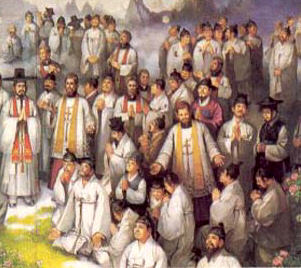
Sts. Andrew Kim Taegon, Paul Chong Hasang, and Companions - 20th September 2008


I have been a bit tardy updating this blog, must be giving into the sin of sloth. It is one of the seven deadly ones. Today let us read the lives of Sts. Andrew Kim Taegon, Paul Chong Hasang, and Companions. These saints were newly canonized by Pope John Paul II.

I suspect that a similar persecution may take place in my native land of India. I hope that the Catholic population there gives a strong witness to Our Lord Jesus Christ and the river of blood of the martyrs gives birth to a new harvest of Catholic Souls in a land of one billion people.


Born to Korean nobility; his parents were converts. His father, Ignatius Kim, was martyred during the persecution of 1839 and was beatified in 1925. Andrew was baptized at age 15, then travelled 1,300 miles to the nearest seminary in Macao. He became Korea's first native priest, and the first priest to die for the faith in Korea. Leader of the Martyrs of Korea.

After baptism at the age of fifteen, Andrew traveled thirteen hundred miles to the seminary in Macao, China. After six years he managed to return to his country through Manchuria. That same year he crossed the Yellow Sea to Shanghai and was ordained a priest. Back home again, he was assigned to arrange for more missionaries to enter by a water route that would elude the border patrol. He was arrested, tortured and finally beheaded at the Han River near Seoul, the capital.

Paul Chong Hasang was a lay apostle and a married man, aged forty-five. Christianity came to Korea during the Japanese invasion in 1592 when some Koreans were baptized, probably by Christian Japanese soldiers. Evangelization was difficult because Korea refused all contact with the outside world except for an annual journey to Beijing to pay taxes. On one of these occasions, around 1777, Christian literature obtained from Jesuits in China led educated Korean Christians to study. A home church began. When a Chinese priest managed to enter secretly a dozen years later, he found four thousand Catholics, none of whom had ever seen a priest. Seven years later there were ten thousand Catholics. Religious freedom came in 1883.

When Pope John Paul II visited Korea in 1984, he canonized Andrew, Paul, ninety-eight Koreans and three French missionaries who had been martyred between 1839 and 1867. Among them were bishops and priests, but for the most part they were laypersons: forty-seven women, forty-five men.

Among the martyrs in 1839 was Columba Kim, an unmarried woman of twenty-six. She was put in prison, pierced with hot awls and seared with burning coals. She and her sister Agnes were disrobed and kept for two days in a cell with condemned criminals, but were not molested. After Columba complained about the indignity, no more women were subjected to it. The two were beheaded. A boy of thirteen, Peter Ryou, had his flesh so badly torn that he could pull off pieces and throw them at the judges. He was killed by strangulation. Protase Chong, a forty-one-year-old noble, apostatized under torture and was freed. Later he came back, confessed his faith and was tortured to death.

Today there are approximately four million Catholics in Korea.

The Korean Church is unique because it was founded entirely by laypeople. This fledgling Church, so young and yet so strong in faith, withstood wave after wave of fierce persecution. Thus, in less than a century, it could boast of 10,000 martyrs. The death of these many martyrs became the leaven of the Church and led to today's splendid flowering of the Church in Korea. Even today their undying spirit sustains the Christians of the Church of Silence in the north of this tragically divided land.

Friday, September 19, 2008

Archbishop of delhi speaks about violence against Christians in India

The "violence and terror" underway in Orissa and in other states in India are not only a problem of "respect for the minorities", but also involve the future of "India's democracy". This is affirmed by the archbishop of the capital, Vincent Concessao, in an interview with AsiaNews. "India, the world’s largest democracy, was recognised as a vibrant multi-ethnic, multi-religious, and multi-lingual democracy. Sadly, today the image of ‘democratic India’ is at stake".

In addition to the violence taking place in Orissa, Karnataka, Madya Pradesh, and Kerala, Archbishop Concessao also cites abuses by Hindu fundamentalists in Delhi. Just yesterday, a Hindutva group occupied the property in front of the church of Prabhu Prakash Girija, in Trilokpuri, in the eastern part of Delhi. The property is used as a garden by the Catholics, and the city authorities have placed limitations on construction on the spot. The church has been maintaining the garden since 1991. But the extremist group has threatened to build a temple there. Last week, they placed statues of Hindu divinities in a niche set up against the wall of the church.

In the past, there have been many clashes between Hindus and Muslims because of attempts by radical Hindus to take possession of Islamic places of worship.

"This is another incident of the growing anti-Christian wave that is spreading its evil tentacles all over our beloved country and sadly, it will have long-term disastrous consequences on secular democracy. These misguided extremists are indoctrinated with the Hinduvta ideology and their methodology and strategy is ‘muscle power’, they do not respond to either reason or dialogue. It is very much like Nazism, they are brainwashed into believing that India should be exclusively Hindu, they do not believe in secular democracy".

"This is very unfortunate, on the one hand on the global stage, India is emerging as a world power in the 21st century, while in our own country, there is growing religious intolerance and human rights and freedom of faith are blatantly violated. The international community and the world leaders who believe in secular democracy must oppose and condemn this gross violation of constitutional rights in India. It is much larger than ‘minority rights’, it is a question of the future of democracy in India".

(Courtesy http://www.asianews.it)

Wednesday, September 17, 2008

Carmelite Convent Attacked in Madya Pradesh India - 17 September 2008

The guard at the Carmelite convent in Banduha (Ujjain, Madya Pradesh) has been wounded while trying to protect the sisters. In Karnataka, the Syro-Catholic church of St George in Ujire was devastated and burned; a statue of Our Lady of Lourdes was destroyed in Kolar. This is some of the new violence against Christians recorded today. All of these attacks took place overnight, or in the early morning. The wave of violence, which began in Orissa three weeks ago, has so far killed at least 45, and wounded more than 18,000.

At 1:30 this morning, a group of five people with air guns came to the Carmel Convent in Banduha and wounded the guard, Amar Singh, shooting him three times. He is in the hospital, and is not in serious condition. Amar Says that "the culprits asked me to call the sisters but I told them that they were not available. They beat me and asked me to cry loudly so that sisters would come out. They shot me with air guns when I disobeyed, and went away".

One of the sisters, Sr Dhanya, says that four days earlier, a group had surrounded the convent making noise and shouting slogans, but the guard chased them away. The police have opened an investigation on the incident. Last week a church was burned in Ratlam. But the police attributed the responsibility to the guards.

Fr Anand Muttungal, spokesman for the bishops of Madya Pradesh, affirms that these incidents are not random: "in Madhya Pradesh, there is a series of attacks taking place here. It is always done with different methods; we are in touch with the higher officials and leaders from different socio-political organizations. We are peace-loving people, so violence is not our way of living".

In Ujire, at 5 o'clock this morning, a group of unidentified persons entered the Syro-Catholic church of St George. They burned bibles, missals, prayer books, desecrated the tabernacle, destroyed the crucifix, the statues and icons. They also poured kerosene on the curtains to burn the building, but fortunately it did not catch fire.

Fr Joseph Valiaparambil, spokesman for the diocese of Belthangady, says "We are peace-loving people. We, the Catholic community, with all like-minded people forgive the culprits and pray for them as our Lord Jesus Christ taught us to do. Ours is a democratic country and all the citizens enjoy equal rights and privileges . . . The violence and brutality against Christians in Karnataka is perpetrated on the basis of false ideologies and distorted notions that violate the very fabric of democracy and the spirit of the constitution of India".

Early this morning, a replica of the grotto of Lourdes was also attacked, near the church of St Mary, in Kolar. The culprits broke the statue of the Virgin Mary and the panels protecting it. Christians, Muslims, and Hindus all venerate the statue of the Virgin Mary. The custodian and cleaning person at the grotto is a Hindu woman.

On September 14, 20 churches were attacked in Karnataka. The police are accused of not preventing the attacks, even though they knew about them. Catholics have organized demonstrations to criticize the attitude of the security forces. In many cases, police savagely beat the faithful.

The new wave of attacks against Christians and their institutions began in Orissa, after Maoists ordered the killing of radical Hindu leader Swami Laxmanananda Saraswati on August 23. Hindu fundamentalist organizations accuse the Christians of being the authors of the assassination, and for this reason launched a pogrom, killing and wounding the faithful, destroying and burning churches, schools, social centers, homes. From Orissa, the violence is spreading to Madya Pradesh, Karnataka, and Kerala.

According to the All India Catholic Union, so far the violence in the state of Orissa alone has killed 45 and wounded 18,000; 5 are missing. 56 churches, 11 schools, and 4 NGO offices have been destroyed; 300 villages have been attacked; more than 4,000 homes have been burned or destroyed, forcing more than 50,000 people to flee. Of these, 40,000 are still hiding in the forest; 12,000 are sheltered in the refugee camps provided by the government.

(Courtesy http://www.asianews.it/)

Feast of Saint Robert Bellarmine - 17 September 2008

We live in an age of liberalism and relativism. Today we celebrate the feast of St. Robert Bellarmine who fought these very issues. Let us read about this saint through the explanations of Dr. Plinio Correa


Since the founding of the Church until our days, Divine Providence has always called illustrious men, who by their knowledge and sanctity have conserved and defended the truths of Catholic Faith against the attacks of heretics.

Among these men shines St. Robert Bellarmine (1542-1621), who was celebrated for his teachings and polemic works as well as for his virtue and zeal for the Church. In truth, it would seem that the holy Cardinal had received from God the threefold gift of teaching the people, guiding the faithful, and confounding the Protestant heretics of the 16th century, a time when Protestantism was growing and spreading.

He was great as a preacher, professor and polemicist, receiving the title of 'hammer of heresies' from Benedict XV. He wrote prodigiously, and to understand the worth of his books one need only read what St. Francis of Sales, his contemporary and friend, said about them: 'I preached five years in Chablais with no other books than the Bible and the works of the great Bellarmine.'

His most famous work is The Controversies, a collection of the lectures he delivered at the Roman College. In it he set out the teaching of the Fathers, the Councils and the Church Law to victoriously defend the dogmas attacked by the Protestants. Clear, balanced, and forceful, this work is so well done that many considered it insuperable. When it was published, it raised as much joy among Catholics as hatred among the Church's enemies. Theodore of Baise, a Protestant leader, used to say: 'This is the work that defeated us.' Given the number of conversions for which it was responsible, reading it was forbidden under penalty of death in England by Queen Elizabeth. Only doctors of theology were permitted to read
it.

Comments of Prof. Plinio:

Permit me to provide another fact from his life: St. Robert Bellarmine was the spiritual director of St. Louis Gonzaga. This alone would be honor enough in the life of a man.

What can be said about St. Robert Bellarmine? He was praised as 'the hammer of heresies.' There was a time, before Vatican II, when this was a great eulogy. Pope Benedict XV granted him this title. Various other great saints who worked considerable damage on the heresies received similar epithets. He wrote many books demonstrating the Catholic truth and attacking the heretics. His arguments were forceful and hard, but they converted many of them.

Theodore of Blaise, an important Protestant leader who succeeded Calvin, was fearful of St. Robert Bellarmine's work. This man had a famous debate with St. Francis of Sales. Elizabeth I, the Queen of England, was also in panic over his works, given the number of conversions they had occasioned. She was so fearful that she decreed that whosoever was not a doctor in theology was forbidden to read his works.

St. Robert Bellarmine understood that one cannot do away with a heresy only by preaching the truth. It is also necessary to attack and smash the error. Using this method he converted heretics, bringing them back into union with the Church. When the Catholic Church canonized him, she approved this method. She said that St. Bellarmine had practiced all the virtues in a heroic degree. Therefore, he acted according to charity, since it is one of the three theological virtues, faith, hope, and charity. He also acted according to justice and prudence since they are included in the four cardinal virtues: justice, prudence, temperance, and fortitude. If his method was wrong, the Church would not have canonized him.

This is an important point to remember, since from the time of Vatican Council II, we have been taught that to attack heresy and heretics is harmful to the union of the churches. According to this conciliar mentality, every work of apostolate should praise and applaud the heretics, and never forthrightly combat their errors. The life of St. Robert Bellarmine proves precisely the opposite.

It is also interesting to note the presence of harmonic contrasts in the life of St. Robert Bellarmine. He was a champion of orthodoxy and a great fighter, but at the same time he was a man able to direct the sensitive soul of St. Louis of Gonzaga, and guide him to sanctity. St. Louis Gonzaga was very pure and so concerned about guarding his chastity that some bad persons close to him spread that he was unbalanced. St. Robert Bellarmine was the one who understood that difficult-to-understand soul, knew how to deal with him and to guide him to become a masterpiece of sanctity.

Therefore, at the same time that he was a very busy polemicist, St. Robert Bellarmine made the time to direct souls and to write profound spiritual treatises that earned him the title of Doctor of the Church. This capacity to revert back and forth from the middle of a fight and the direction of souls, along with maintaining a spirit of meditation to write his books, is only possible when a man has a great calmness of spirit. This calm is, in a certain sense, one of the most profound notes of the soul of St. Robert Bellarmine.

Let us admire such a great saint and ask him to do with each one of us what he did with St. Louis Gonzaga, that is, to lead us on the road of sanctity.

Tuesday, September 16, 2008

Update on Mangalore situation


Mangalore Sept 14, 2008: In an incident that has shocked the peace loving Christians of Mangalore, a group of persons claiming to be from the RSS group have entered the Adoration Monastery Chapel at Milagres and desecrated the blessed sacrament and broken everything they could get their hands on. Fr. Prakash Monteiro from the Bishop's house speaking to Mangaloreancom informed that the incident occurred at 10:15 am today. He said the miscreants entered the chapel by breaking two windows. The chapel is being run by the cloistered carmel sisters, where Sr. Mary Carmel is the Mother Superior. Speaking to Mangalorean.com, the nuns of the Cloistered Carmel said that a group of youth about eight in number barged into the chapel around 10:15 am and started attacking everything in sight. The cloistered nuns were inside the enclosure and heard the sounds. There were about three lay people praying in the chapel. One of the persons who was praying caught hold of the youth who was climbing the altar and tried to stop him from breaking the sacrament but he did not succeed. The nuns said the sacrament fell on the floor and broke. The miscreants then went on a rampage and broke the crucifix, the oil lamps, the vases on the altar and then proceeded to destroy the statues.

Eye witnesses in the chapel said they were armed with big stones and heavy sticks. The nuns said though they tried to break the statue of Mother Mary by beating it with the stones, it did not break and not a scratch is seen on it. However, they did manage to break the statues of St. Joseph and St. Francis Xavier. People who have gathered around this area are shocked and in tears. The whole attack took about four to five minutes. The person who tried to stop them from desecrating the sacrament was also beaten up and is hospitalised. The police are on the premises now. Similar attacks have taken place in Belthangady, Kodaikal, Chikmangalore and Udupi Koloor, Chickmangalore, Kundapur, Karkal, Koppa, Balehanoor and Moodbidri.

Monday, September 15, 2008

Christian schools targetted in Raigad Maharashtra

This is really close to where I am from originally. Please find below an article from the Bombay Catholic Sabah. he following below is from the Bombay Catholic Sabah web site

Christian Schools in Raigad District targeted by the local Education Department as they were closed on August 29 in solidarity and support of the Orissa victims.

This ridiculous circular issued by the Block Education Officer Raigad District questioning the patriotism and nationalism [ copy of the circular below] and summoning the school principals for a meeting on September 16 to discuss questions which are as follows:

1. Is the national anthem sung in your school? (Authors note - This is a practice done in all Christian schools)

2. Are the lessons on Saints taught in the school? (Authors note - I am sure they do not mean Catholic saints. Why should Christian schools teach about non-Christian 'saints')

3. Is Religion taught in your school? (Authors note - This is the sneaky one. If Christianity is taught in the schools then the local government will deliberately say that Christians are trying to forcibly convert the students. )

4. Are the pictures of the National Leaders displayed in your school and where? (Authors note - In my School National Leaders were framed on the wall along with the the Pope at the time)

We are equally shocked that this circular was issued under the pressure and direction of the local Zilla President of the BJP.

We need to know the following from the Chief Minister / Education Minster of Maharashtra:

1. Is this Circular issued under the direction of the Education Minister?

2. Is this Circular being issued selectively to the Christian Schools?

We need to respectfully advise the concerned Government Authorities that the Christian Institutions are protected under the Constition under Article 30 which stipulates the rights of the minorities to establish, administer and run the Institutions of their choice.

We do not have to put the badge of patriotism on our shoulders as the work of the Institutions and Personnel is committed and involved in nation building by educating the children of all communities.

We therefore demand the following:

1. Immediate withdrawal of the said Circular.

2. Suspension of the concerned education official

3. We fear for the safety of the Institutions and the Personnel. Adequate police protection for all the Institutions in Maharashtra.

Needless to say, if our requests are not complied with, than the The Bombay Catholic Sabha will have no options but to launch a public agitation to protect our rights guaranteed under the Constitution.

Best Regards,

Dolphy D'souza

President
THE BOMBAY CATHOLIC SABHA
St Michael's Church,
Mahim, Mumbai 400 016.
Tel: 24463853 / 9820226227
Email: president@bcsabha.org
www.bcsabha.org

(The Author hopes that all protests and public agitations taken by the Bombay Catholic Sabah are peaceful following the teaching of Our Lord Jesus Christ)

Police inaction in Mangalore - 15th September 2008

MANGALORE Sept 15: The failure of the police to protect the Christian prayer halls despite prior information about the attacks, and the subsequent brutality on Christian protesters, were the two prominent features of the chaos that erupted in the city. Superintendent of Police (Dakshina Kannada) N. Sateesh Kumar admitted that the police had information that some pro-Hindu organisations were planning to attack Christian places of worship in the district.

He said this before a group of Christian leaders during a meeting at the Adoration Monastery, near Milagres, one of the eight payer halls to have been attacked on Sunday. "We had warned some institutions," he said and added that pickets were posted at strategic places in the city. Reacting to the statement made by Mr. Kumar, the Chancellor of the diocese of Mangalore Fr. Henry Sequeira said: "If the police knew about this in advance and still could not prevent the attacks, then we have no hope."

In an attempt to allay the fears of leaders Mr. Kumar said: "I will take this up as a challenge."


(Courtesy Mangalore.com)

Update on Religious Riots in Kasargod Kerela

Kasargod (Kerala), Sep 15 (IANS) A missionary school, which was also used as a temporary church, was attacked in the Kasargod district in Kerala, the police said Monday.

The incident follows attacks on churches by suspected Bajrang Dal activists in Dakshina Kannada and Udupi districts in Karnataka, which neighbour Kasargod, the northernmost district of Kerala.

"The attack must have taken place Sunday night or early Monday morning," the vicar of St. Joseph's Catholic Church Punnoor Antony told IANS.

The church authorities found the window panes of the school smashed apart from some other damage.

As the church was under renovation, regular mass was being offered at Jayamatha School nearby.

"We closed the school after prayers Sunday evening. It was this morning we noticed the damage," Antony said.

Police said they had not made any arrests so far in connection with the incident.

"It could be the act of some mischief mongers, who wanted to create panic here," said Ramdas Pothan, Kasargod district superintendent of police.

"The police here are alert following attack on churches in Karnataka," Pothan said.

"We have already provided protection to churches located near the state border with Karnataka," he added.


(Article courtesy of Mangalore.com)

Religious Riots in Karnataka India

As tensions continued in the eastern state of Orissa, Hindu nationalist groups intensified attacks on churches and Christian institutions in the southern state of Karnataka. Hindu extremists leveled false charges of “forcible” conversions against Christian workers as the Karnataka government, ruled by the Hindu nationalist Bharatiya Janata Party, prepared to close down churches. Sajan K. George of the Global Council of Indian Christians told Compass that more than 200 people attacked the Mission Action Prayer Fellowship church in Bada village, Davangere district on Sunday (September 7), accusing the Christians of “forcible” conversions. George said the commissioner of Davangere City had issued notices to demolish three churches – Eternal Life Church, Divine Healing Ministry church and Jesus Prayer Hall – in the city, claiming that their buildings were illegal. The three churches have been sealed. The Indian Express newspaper reported that the Davangere deputy commissioner labeled the churches “unauthorized,” and a representative of the Christian Legal Association (CLA) told Compass that the official had also sent notices to 13 other churches asking them to obtain a “license” for holding worship services. “This is a violation of the religious freedom enshrined in the Indian Constitution,” said the CLA source. “There is neither any such requirement anywhere in the country, nor is there any provision for such license in any government authority.”

The Seven Sorrows of Our Lady - 15th September 2008


Today let us contemplate the Seven Sorrows of Our Lady by reading the commentary By Dr. Plinio Correa.

As the octave of the Nativity of Our Lady ends, the consideration of her suffering would not normally come to the mind of the faithful. But if someone would ask about the future of this child, we would recall that before being proclaimed blessed by all nations, Mary would suffer with her Son for the salvation of the world.

The voice of the liturgy invites us to consider her sorrow: “Ó all ye who pass by the way, attend,and see if there be any sorrow like to my sorrow.” This applies to her.

The sorrow of Our Lady is a work of God. He was the One who destined her to be the Mother of His Son. Therefore, He indissolubly united her to the Person, life, mysteries and sufferings of Jesus in order to make her His faithful companion in the work of Redemption. Suffering has to be a great gift, because God gave it to His Son and to the creature He loves more than any other after Him, Our Lady. He gave it as a most precious gift.

For Mary the suffering did not start at Calvary, but with Jesus, “that incommodious child,” as Bossuet called Him, because wherever He went, he entered with His Cross and with His thorns which He distributes to those He loves.

The prophecy of the aged Simeon, the flight into Egypt, the loss of the Divine Child in Jerusalem, the carrying of the Cross, the Crucifixion, the taking down from the Cross, and the burial of Jesus: these are the seven mysteries into which are grouped the well-nigh infinite sufferings which made Our Lady the Queen of Martyrs, the first and loveliest rose in the garden of the Spouse.

Above all, this solemn day shows us Mary on Calvary, and reminds us of that supreme sorrow among all the sorrows that ran through the life of Our Lady. The Church gave this feast the title of Seven Sorrows because this number expresses the idea of totality and universality.

To understand the extent and intensity of the suffering of Our Lady, we need to understand the extent and intensity of her love for Jesus, because her love increased her suffering. Nature and grace concurred to produce in Mary’s heart profound impressions. Nothing is stronger by nature than the love a mother has for her son, and by grace the love one has for God.

There are so many excellent thoughts in this selection by D. Guéranger that I could be tempted to prolong these comments. I will not do so, but will just select some ideas that he offers us.

The first is that since God loved His Son, Our Lord Jesus Christ, with an infinite love and loved Our Lady with a lesser love, but still greater than His love for any other creature, He reserved for them His highest love. For this reason He gave them that vastness of crosses represented by the number seven. Seven sorrows is understood as all sorrows. Our Lady could be called the Lady of all sorrows because she suffered everything.

All generations call her blessed, but all generations also could call her sorrowful.

If this is so, we should understand better that when sorrow enters our lives it is a proof of the love God has for us. We should also realize that if sorrow does not enter our lives, we do not have this proof of His love for us. Therefore, we should not complain when sufferings come to us – nervous problems, difficulties in our apostolate, misunderstandings with our friends, problems at home, poor health, business troubles. We should accept these things as normal, as a proof of the love of Divine Providence for us.

When I see a person without maturity, stability, rationality, elevation of spirit, I think that what he is lacking is suffering. These qualities only come with suffering - much suffering.

If we receive such trials, certainly we should pray for them to end. But to the measure that they remain, we should thank God and Our Lady.

I would also like to stress those extraordinary words of Bossuet who called Our Lord: “that incommodious child.” All those who follow Our Lord are incommodious. When you give a good counsel, offer a good example, ask for a sacrifice, the face of the person you are addressing will let you know that he considers you bothersome. It would be easier and more pleasant to tell a joke, to tease a bit, and close the matter with a pat on the back, dispensing the person from his duties.

Sometimes we have to command. How easy it would be to command if we did not have to ask a subordinate to take things seriously, to see reality at its most profound depths and in its most elevated aspect. How simple it would be if we did not have to ask him to face his own spiritual life without cowardice and keep careful watch over his defects. All this causes bother. The burden of being incommodious is one of the heaviest weights we have to carry.

Maintaining joyful resignation in face of the annoyance we cause because we represent Catholic duty, and having the courage to be incommodious in every circumstance is the path we are called to take in order to follow Our Lord.

These are the virtues that on the day of the Seven Sorrows of Our Lady we should ask her to give us.


Sunday, September 14, 2008

Feast of the Exaltation of the Holy Cross - 14th September 2008


Today is the Exaltation of the Holy Cross. Let us contemplate the comments of Dr. Plinio.

You know that in ancient times the cross was an instrument of torment. It was ignominious for any person to be crucified. It was a dishonor for the person as well as for his family. Aware of this, St. Paul asked not to be crucified because he was a Roman citizen, and Roman citizens were not subject to crucifixion. He was beheaded with a sword because this was a privilege of the Romans.

When Our Lord Jesus Christ was crucified, therefore, he suffered a terrible humiliation. That shame was meant to signify that He was a bandit, an outlaw of the same genre of the two thieves with whom He was crucified. In this sense the crucifixion was not only a humiliation, but the highest possible humiliation for any honest man.

You know that the Jews inflicted every humiliation they could upon Our Lord during His life. This corresponded to their increasing hatred for the good He represented. Finally they served to Him the supreme humiliation, which was the sacrifice of the Cross. With this they became the 'Deicide' people.

Their desire to humiliate Our Lord as much as they could became evident in the Passion. For example, the crown of thorns, the tunic of the fool, the cane they placed in His hands as a scepter, the persons who ridiculed Him and spit at Him, etc, express the desire to torment Him not only in His Most Sacred Body, but also in His Most Holy Soul.

The Cross of Our Lord became the starting point of all the humiliations that all Catholics would have to bear until the end times for the cause of Our Lord Jesus Christ.

The forces of impiety never set aside their weapons against the good. They are always seeking to humiliate and break the morals of the good. None of you have been free from these humiliations because of your fidelity to Our Lord. It is an honor for us. To be persecuted for the love of Jesus Christ is one of the beatitudes. All of us had suffered these humiliations and will suffer them to the end of History because of the continuous outrages the impious ones make against God.

But, in parallel, the honor of God, the honor of Our Lord Jesus Christ, is vindicated by the Church. Catholics take the Cross as a symbol of honor, as the most sacred and holy thing we have, as the symbol of our redemption. Because of this sentiment, on the top of every Catholic church a Cross is placed; on the top of the most majestic crowns, the Cross is planted.

Many of the greatest families have the Cross on their coat-of-arms. Catholic decorations that reward the heroic deeds of a military man or the generosity of a great benefactor have the shape of the Cross.

These are manifestations of the Catholic spirit which vindicate that humiliation; they vindicate it with chivalric panache, with supernatural panache. With this special manifestation of love, that is, a reaction against the outrage of the enemies, the Catholic Church celebrates the feast of the Exaltation of the Holy Cross.

To exalt the Holy Cross is to glorify it. The word ex-altare in Latin means to elevate, to raise to a high place, which is to glorify.

The first sign of this was the apparition of the Cross in the sky to Constantine before the battle of Milvia Bridge. Above that Cross was written these words In Hoc Signo Vinces – Under the sign of the Cross you will conquer. That Cross which appeared in the sky for the first time then would remain on the horizon of all mankind throughout History, humiliating the evil ones and the devils.

The Cross would also be the sign of our honor. Our honor does not lie in avoiding humiliations, but in receiving them with panache and a spirit of challenge. To those who humiliate us, we should respond as knights and we should glorify the Cross of Our Lord even more proudly.

This is what exaltation means. It is to proclaim the glory of God in face of the attempt of His enemies to humiliate Him. Our attitude should smash the enemy's attempts to humiliate Our Lord.

There is an ejaculation in the litany of the rogations, which is this: Ut inimicus Sanctae Matris Ecclesiae humiliare digneris, Te rogamus audi nos– That Thou wouldst deign to humiliate the enemies of the Holy Mother Church, we beseech Thee, hear us. So, the Church teaches us to pray for the humiliation of our enemies. Therefore, the best way to respond to the enemies who attempt to humiliate the Cross of Our Lord and His followers is to humiliate those enemies; it is to humiliate those who inflict humiliations.

Doing this, we rescue the Cross that lays in the dust of the despised, and raise it to the highest place. We glorify what had been humiliated. This is the essence of the exaltation of the Holy Cross.

False and sentimental piety takes an opposite position regarding the Cross. It never thinks of the counter-attack Catholics should make to exalt the Cross. The man with this sentimental mentality only cultivates syrupy sentiments regarding the Cross and if he ever considers its enemies, it is to flee from them under the pretext that he is forgiving them. With this mentality the Church will never have the true exaltation of the Holy Cross.

To the contrary, when someone tries to humiliate the Cross, we must respond with an even stronger counter-attack. Not in defense of our honor, but in defense of the honor of Our Lord Jesus Christ.


Saturday, September 13, 2008

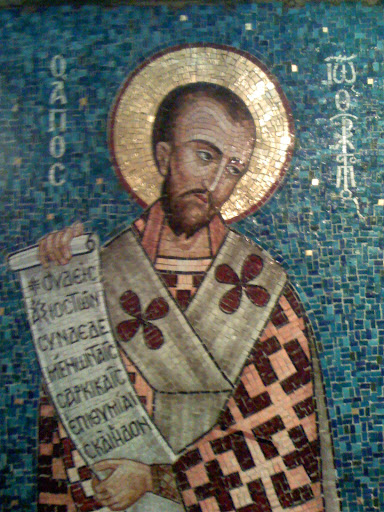
Feast of St John Chrysotom - 13 September 08


Today we celebrate the feast of the life of St. John Chrysotom. Chrysotom actually means 'Golden Mouth'.

He is on of the four great doctors of the Church, and born in 347 in Antioch, Syria. He was prepared for a career in law under the renowned Libanius, who marveled at his pupil's eloquence and foresaw a brilliant career for his pupil as statesman and lawgiver. But John decided, after he had been baptised at the age of 23, to abandon the law in favour of service to the Saviour. He entered a monastery which served to educate him in preparation for his ordination as a priest in 386 AD. From the pulpit there emerged John, a preacher whose oratorical excellence gained him a reputation throughout the Christian world, a recognition which spurred him to even greater expression that found favour with everyone but the Empress Eudoxia, whom he saw fit to examine in some of his sermons.

When St. John was forty-nine years old, his immense popularity earned him election to the Patriarchate of Constantinople, a prestigious post from which he launched a crusade against the excessiveness and extreme wealth which the Empress construed as a personal affront to her and her royal court. This also gave rise to sinister forces that envied his tremendous influence. His enemies found an instrument for his indictment when they discovered that he had harboured some pious monks who had been excommunicated by his arch rival Theophilos, Bishop of Alexandria, who falsely accused John of treason and surreptitiously plotted his exile.

When it was discovered that the great St. John had been exiled by the puppets of the state, there arose such a clamour of protest, promising a real threat of civil disobedience, that not even the royal court dared to confront the angry multitudes and St John was restored to his post. At about this time he put a stop to a practice which was offensive to him, although none of his predecessors outwardly considered it disrespectful; this practice was applauding in church, which would be considered extremely vulgar today, and the absence of which has added to the solemnity of Church services.

St. John delivered a sermon in which he deplored the adulation of a frenzied crowd at the unveiling of a public statue of the Empress Eudoxia. His sermon was grossly exaggerated by his enemies, and by the time it reached the ears of the Empress it resulted in his permanent exile from his beloved city of Constantinople. The humiliation of banishment did not deter the gallant, golden-mouthed St. John, who continued to communicate with the Church and wrote his precious prose until he died in the lonely reaches of Pontus in 407.

Fore more details about the life of St John Chrysotom refer to http://www.chrysostom.org/life.html

For the writings of St John Chrysotom refer to http://www.chrysostom.org/writings.html

Friday, September 12, 2008

Feast of the Holy Name of Mary - 12th September 2008

On the feast of the Holy Name of Mary let us read the words of the Doctor of the faith St. Alphonsus Ligouri

The following is a text for the book by St. Alphonsus Ligouri called the Glories of Mary.

THE great name of Mary, which was given to the divine mother, was not found on earth, neither was it invented by the mind or will of men, as were all other names that are in use among them;but it came from heaven, and was given to the Virgin by divine ordinance, as St. Jerome, St. Epiphanius f St. Antoninus, and others attest.

The name of Mary was drawn from the treasury of the divinity, as Richard of St. Laurence says: From the treasury of the divinity, oh Mary, came forth thy excellent and admirable name; for the Most Holy Trinity, the same author goes on to say, gave to thee this name, next
to the name of thy Son, so superior to every name, and attached to it such majesty and power, that when it is uttered, all in heaven, earth, and hell must fall prostrate and venerate it.Among the other privileges which the Lord has attached to the name of Mary, let us see how sweet he has made it to the servants of this most holy Lady in life as well as in death.

To begin with life, the holy anchorite, Honorius,says, that the name of Mary is full of all divine sweetness.And the glorious St. Anthony of Padua attributes to the name of Mary the same sweetness as St. Bernard attributed to the name of Jesus. The name of Jesus, said the latter,
the name of Mary, said the former, is joy to the heart, honey to the mouth, melody to the ear of their devoted servants.

We read in the holy Canticles, that at the Assumption of the Virgin, the angels three times asked her name: 'Who is she that goeth up by the desert as a pillar of smoke?' 'Who is she that cometh forth as the morning rising?' And in another: 'Who is this that cometh up from the desert, flowing with delights?'; Richard of St. Laurence in quires why the angels so often asked the name of this queen, and answers: The sound of the name of Mary was so sweet to the angels, and they repeated the question that they might hear it repeated also.

The enamored St. Bernard, too, addressing his good mother with tenderness, says to her: Oh great, oh merciful Mary, most holy Virgin, worthy of all praise, thy name is so sweet and lovely that it cannot be spoken without enkind ling love to thee and to God in the heart of him
who pronounces it; the thought of it alone is enough to console thy lovers, and inflame them a consolation to the poor, because by them they are relieved of their miseries, oh how much more, says Richard of St. Laurence, does thy name console us sinners, oh Mary; far more than the riches of earth it relieves us in the troubles of the present life.

For more about the Holy Name of Mary refer to Chapter X of The Glories of Mary.

Thursday, September 11, 2008

Feast of St. Cyprian - 11th September 2008


St. Cyprian is important in the development of Christian thought and practice in the third century, especially in northern Africa.

Highly educated, a famous orator, he was converted to Christianity as an adult. He distributed his goods to the poor, and amazed his fellow citizens by making a vow of chastity before his Baptism. Within two years he had been ordained a priest and was chosen, against his will, as Bishop of Carthage (near modern Tunis).

Cyprian's first Christian writing is "Ad Donatum", a monologue spoken to a friend, sitting under a vine-clad pergola. He tells how, until the grace of God illuminated and strengthened the convert, it had seemed impossible to conquer vice; the decay of Roman society is pictured, the gladiatorial shows, the theatre, the unjust law-courts, the hollowness of political success; the only refuge is the temperate, studious, and prayerful life of the Christian.

Cyprian complained that the peace the Church had enjoyed had weakened the spirit of many Christians and had opened the door to converts who did not have the true spirit of faith. When the Decian persecution began, many Christians easily abandoned the Church. It was their reinstatement that caused the great controversies of the third century, and helped the Church progress in its understanding of the Sacrament of Penance. Novatus, a priest who had opposed Cyprian's election, set himself up in Cyprian's absence (he had fled to a hiding place from which to direct the Church—bringing criticism on himself) and received back all apostates without imposing any canonical penance. Ultimately he was condemned. Cyprian held a middle course, holding that those who had actually sacrificed to idols could receive Communion only at death, whereas those who had only bought certificates saying they had sacrificed could be admitted after a more or less lengthy period of penance. Even this was relaxed during a new persecution.

During a plague in Carthage, he urged Christians to help everyone, including their enemies and persecutors.

A friend of Pope Cornelius, St. Cyprian opposed the following pope, Stephen. He and the other African bishops would not recognize the validity of Baptism conferred by heretics and schismatics. This was not the universal view of the Church, but Cyprian was not intimidated even by Stephen's threat of excommunication.

He was exiled by the emperor and then recalled for trial. He refused to leave the city, insisting that his people should have the witness of his martyrdom.

Cyprian was a mixture of kindness and courage, vigor and steadiness. He was cheerful and serious, so that people did not know whether to love or respect him more. He waxed warm during the baptismal controversy; his feelings must have concerned him, for it was at this time that he wrote his treatise on patience. St. Augustine remarks that St. Cyprian atoned for his anger by his glorious martyrdom.

In August, 258, Cyprian learned that Pope Sixtus had been put to death in the catacombs on the 6th of that month, together with four of his deacons, in consequence of a new edict that bishops, priests, and deacons should be at once put to death; senators, knights, and others of rank are to lose their goods, and if they still persist, to die; matrons to be exiled; Caesarians (officers of the fiscus) to become slaves. This edict was put forward by Emperor Valerian.

Galerius Maximus, the successor of Paternus, sent for Cyprian back to Carthage, and in his own gardens the bishop awaited the final sentence. Many great personages urged him to fly, but he had now no vision to recommend this course, and he desired above all to remain to exhort others. Yet he hid himself rather than obey the proconsul's summons to Utica, for he declared it was right for a bishop to die in his own city. On the return of Galerius to Carthage, Cyprian was brought from his gardens by two principes in a chariot, but the proconsul was ill, and Cyprian passed the night in the house of the first princeps in the company of his friends. Of the rest we have a vague description by Pontius and a detailed report in the proconsular Acts. On the morning of the 14th a crowd gathered "at the villa of Sextus", by order of the authorities. Cyprian was tried there. He refused to sacrifice, and added that in such a matter there was no room for thought of the consequences to himself. The proconsul read his condemnation and the multitude cried, "Let us be beheaded with him!" He was taken into the grounds, to a hollow surrounded by trees, into which many of the people climbed.Cyprian took off his cloak, and knelt down and prayed. Then he took off his dalmatic and gave it to his deacons, and stood in his linen tunic in silence awaiting the executioner, to whom he ordered twenty-five gold pieces to be given. The brethren cast cloths and handkerchiefs before him to catch his blood. He bandaged his own eyes with the help of a priest and a deacon, both called Julius. So he suffered. For the rest of the day his body was exposed to satisfy the curiosity of the pagans. But at night the brethren bore him with candles and torches, with prayer and great triumph, to the cemetery of Macrobius Candidianus in the suburb of Mapalia. He was the first Bishop of Carthage to obtain the crown of martyrdom.
“You cannot have God for your Father if you do not have the Church for your mother.... God is one and Christ is one, and his Church is one; one is the faith, and one is the people cemented together by harmony into the strong unity of a body.... If we are the heirs of Christ, let us abide in the peace of Christ; if we are the sons of God, let us be lovers of peace” (St. Cyprian, The Unity of the Catholic Church).

Solemn Mass in Toronto

I cannot believe it. This is a Solemn mass in Toronto. I hope all my blog readers who are in Toronto and the vicinity will be able to attend this. Please drop me a line if you can we can meet before or after the mass. This mass commemorates Our Lady of the Rosary, remember the Battle of Lepanto.

Wednesday, September 10, 2008

Understanding forms of Government

With both the USA and Canada going to election. It is a good time to look at governments.
In the USA issues in the upcoming elections include the right to life for unborn babies, homosexual unions etc. While in Canada abortions right up to the 9th month are legal and homosexual unions have been dubiously dubbed as marriages.

Let us see what Dr. Plinio Correa has to say about the forms of government

When speaking of the various forms of government, Pope Leo XIII made it quite clear that "each of them is good, as long as it moves honestly toward its end, namely, the common good, for which social authority is constituted,"

We do label as revolutionary the hostility professed against monarchy and aristocracy on the principle that they arc essentially incompatible with human dignity and the normal order of things. This error was condemned by Saint Pius X in the apostolic letter 'Notre charge apostolique', of August 25, 1910. In this letter, the great and holy Pontiff censures the thesis of Le Sillon, that "only democracy will inaugurate the reign of perfect justice," and he says: "Is this not an injury to the other forms of government, which are thus reduced to the category of impotent governments, acceptable only for lack of something better?" (If democracy is the best form of government, how then can it aloow for abortions on demand and legal sanction of homosexual unions? - note by blog author)

If one fails to consider this error, which is deeply rooted in the process under study, one cannot completely explain how it is that monarchy, classified by Pope Pius VI as the best form of government in thesis ("praestantioris monorchici regiminis forma"), has been the object in the nineteenth and twentieth centuries of a hostile worldwide movement that has overthrown the most venerable thrones and dynasties. From our perspective, the mass production of republics all over the world is a typical fruit of the Revolution and a capital aspect of it.

A person cannot be termed a revolutionary for preferring, in view of concrete and local reasons, that his country be a democracy instead of an aristocracy or a monarchy, provided the rights of legitimate authority be respected. But, yes, he can be termed a revolutionary if, led by the Revolution's egalitarian spirit, he hates monarchy or aristocracy in principle and classifies them as essentially unjust or inhuman.

From this antimonarchical and antiaristocratic hatred are born the demagogic democracies, which combat tradition, persecute the elites, degrade the general tone of life, and create an ambience of vulgarity that constitutes, as it were, the dominant note of the culture and civilization--supposing the concepts of civilization and culture can be realized in such conditions.

How different from this revolutionary democracy is the democracy described by Pius XII:


History bears witness to the fact that, wherever true democracy reigns, the life of the people is as it were permeated with sound traditions, which it is illicit to destroy. The primary representatives of these traditions are first of all the leading classes, that is, the groups of men and women or the associations that set the tone, as we say, for the village or the city, for the region or the entire country. Whence the existence and influence, among all civilized peoples, of aristocratic institutions, aristocratic in the highest sense of the word, like certain academies of widespread and well?deserved fame. And the nobility is also in that number.


As can be seen, the spirit of revolutionary democracy is quite different from the spirit that must animate a democracy according to the doctrine of the Church.


(This is an exceprt from Dr. Plinio's book Revolution and Counterrevolution)

St. Thomas ov Villanova - Commentary by Dr. Plinio Correaf

Let us read the commentary of Dr. Plinio Correa about St. Thomas of Villanova.


Comments of Prof. Plinio:

This is not a very easy selection to comment on since it primarily reports facts about St. Thomas of Villanova that are characteristic of many saints. They are admirable and praiseworthy, but a little too generic and repeat what we hear about the others. I limit myself, therefore, to comment on some more distinctive points here and there for our meditation.

First, it is remarkable the fact that Charles V chose St. Thomas of Villanova as a preacher and councilor. He was a person who in many ways directed the conscience of the Emperor. You see the finger of Divine Providence directing this great statesman.

Charles V, Emperor of the Holy Roman German Empire, a man over whose domains the sun never set, was an extraordinarily important man. He continued the vocation of the Hapsburgs of the House of Austria. There is a text by Mary de Agreda describing the designs of Providence for the House of Austria and all the graces God gave the Hapsburgs to fulfill them. It is very beautiful to see how Divine Providence assisted the realization of those designs by sending St. Thomas of Villanova to be the court preacher and councilor to Charles V.

Charles V, we must add with sadness, did not entirely correspond to those plans of God. He had a saint as a councilor, but he was a man whose softness and spirit of tolerance permitted Protestantism to expand in his lands. It is true that he had many different enemies to fight. One of them was the league formed by Muslim Turkey and Catholic France, which also became indirectly responsible for the expansion of Protestantism.

But Charles V had long periods of peace when he could have opposed the expansion of Protestantism. His famous temporizations have made him the subject of strong, objective critiques by Church historians.

But he ended his life well. He left aside all his possessions and goods and retired to a monastery as a penitent. He spent his last years there living a life that edified all Christendom. Did the good counsels of St. Thomas of Villanova finally move his heart? He used to say that St. Thomas had the gift of moving hearts. Did St. Thomas also bend his own heart of iron? It is a point to consider.

Someone could object: Why do you say that he had an iron heart? A man who makes concessions is a soft man and cannot be consider a man with an iron heart.

I would answer that long experience of life has shown me that nothing is harder to change than the heart of a soft man and make him an energetic man. It is harder to make a soft man energetic than to make an energetic man become soft. I think that a saint who could have made Louis XVI lose his softness would have performed a supernatural exploit greater than one who would convince Louis XIV to refrain from using force. So, the change of Charles V, who went to a monastery to make penance, may have been due to a good counsel of St. Thomas of Villanova.

Second, it is interesting to see that St. Thomas had so many ecstasies that he used to speak about them in his sermons. It is admirable to see how he reported, sincerely and nobly, without vanity, the manifestations of grace in his soul from the pulpit. Only a truly superior soul can do this because he understands that grace does not rely on his personal merit but only on the largesse of God.

This attitude is the opposite of a certain Calvinist way of understanding humility that has infiltrated many Catholic milieus. According to it, an individual is proud if he ever praises himself or lets someone else know of his qualities or gifts, because humility would always demand that he hide such things. This is not always true. It is a simplified picture.

I know, of course, that it can be dangerous to tell a person he can praise his own qualities. Often it happens that the person does not have an objective view of himself, but exaggerates his qualities and becomes proud. I know this, and I agree that we must be careful about encouraging this kind of pride.

But this is different from obliging everyone to hide his qualities in the name of humility. You can see in the life of St. Thomas of Villanova how he made a beautiful and natural manifestation of the graces he received and the marvelous things God did in his soul. He could talk about them even in a sermon because he was detached from them and was glorifying God alone, and not himself.

In the richness of the Catholic Church, we can find the models for both the rule, which is to be silent about one’s qualities, and also for the exception, which is to praise one’s own graces and qualities in order to honor God.

This is another beautiful facet of the life of St. Thomas of Villanova.

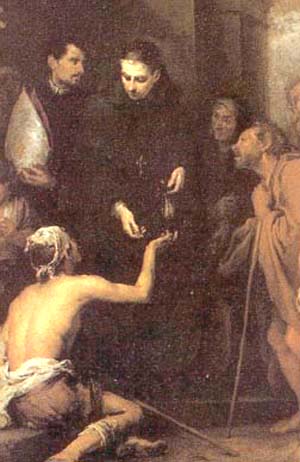
St. Thomas of Villanova - 10th September 2008

Thomas García Martínez was born in 1486 in Fuenllana, Ciudad Real, Spain. He spent his childhood in the family home in Villanova de los Infantes.

A gifted student, Thomas entered the University of Alcalá at the age of 15. He earned a degree in Theology in a very short time, and was asked to join the faculty of this famous university.

His reputation as an excellent teacher spread, and the prestigious University of Salamanca offered Thomas a professorship in 1516. He refused the position, instead seeking admission into the Order of Saint Augustine.

He professed his vows as an Augustinian in 1517 and was ordained a Priest in 1518. Recognizing his leadership ability, his fellow Augustinians chose him to serve as Prior (local superior) and later as Provincial (regional superior). In this position, Thomas encouraged a more faithful adherence to the principles of Augustinian life. He also promoted missionary activity by Augustinians in the New World.

Thomas grew into a deeply spiritual life. He lived simply, giving away the small fortune that he inherited from his parents.

Asked to become Bishop of Granada, Thomas refused, preferring the simple life to a life of power and prestige. Several years later, Thomas was asked to become Bishop of Valencia. When he refused again, the authorities persuaded Thomas' religious superiors to order him under his vow of obedience to accept.

He reluctantly accepted, and became Archbishop of Valencia in 1545. There he found an archdiocese in spiritual chaos. He began his episcopacy by visiting every parish in the Archdiocese to discover what were the needs of the people. He then set up programs in which funds provided by the wealthy would help to provide for the poor.

The money his cathedral chapter gave him to furnish his house was given to a hospital instead. His explanation to them was that "our Lord will be better served by your money being spent on the poor in the hospital. What does a poor friar like myself want with furniture?"

He wore the same habit that he had received in the novitiate, mending it himself. The canons and domestics were ashamed of him, but they could not convince him to change. Several hundred poor came to Thomas's door each morning and received a meal, wine and money. When criticized because he was at times being taken advantage of, he replied, "If there are people who refuse to work, that is for the governor and the police to deal with. My duty is to assist and relieve those who come to my door." He took in orphans and paid his servants for every deserted child they brought to him. He encouraged the wealthy to imitate his example and be richer in mercy and charity than they were in earthly possessions.

In order to have a well-formed clergy, Thomas started Presentation Seminary in 1550. He established schools where the young would have access to a quality education. He turned his own home into a sort of soup kitchen and shelter, giving to the poor and the homeless food to eat and a place to sleep. For that reason he was known as Beggar Bishop and Father of the Poor.

Criticized because he refused to be harsh or swift in correcting sinners, he said, "Let him (the complainer) inquire whether St. Augustine and St. John Chrysostom used anathemas and excommunication to stop the drunkenness and blasphemy which were so common among the people under their care."

Thomas became ill in 1551. As his illness progressed and he grew weaker, he gave away all of his remaining possessions. As he lay dying, Thomas commanded that all the money he possessed be distributed to the poor. His material goods were to be given to the rector of his college. Mass was being said in his presence when after Communion he breathed his last, reciting the words: "Into your hands, O Lord, I commend my spirit."He died September 8, 1555 in Valencia. His remains are preserved at the Cathedral there. He was canonized in 1658.

Tuesday, September 9, 2008

Sacremental Wine the Precious Blood of Our Lord

I had an email from a reader who wanted to know what is Sacramental Wine and is it different from regular wine. I am publishing this article courtesy EWTN


Wine is one of the two elements absolutely necessary for the
sacrifice of the Eucharist. For valid and licit consecration vinum
de vite, i.e. the pure juice of the grape naturally and properly
fermented, is to be used. Wine made out of raisins, provided that
from its colour and taste it may be judged to be pure, may be used
(Collect. S. C. de Prop. Fide, n. 705). It may be white or red,
weak or strong, sweet or dry. Since the validity of the Holy
Sacrifice, and the lawfulness of its celebration, require
absolutely genuine wine, it becomes the serious obligation of the
celebrant to procure only pure wines. And since wines are
frequently so adulterated as to escape minute chemical analysis,
it may be taken for granted that the safest way of procuring pure
wine is to buy it not at second hand, but directly from a
manufacturer who understands and conscientiously respects the
great responsibility involved in the celebration of the Holy
Sacrifice. If the wine is changed into vinegar, or is become
putrid or corrupted, if it was pressed from grapes that were not
fully ripe, or if it is mixed with such a quality of water that it
can hardly be called wine, its use is forbidden (Missale Rom., De
Defectibus, tit. iv, 1). If the wine begins to turn into vinegar,
or to become putrid, or is the unfermented juice is pressed from
the grape, it would be a grievous offence to use it, but it is
considered valid matter (ibid., 2). To conserve weak and feeble
wines, and in order to keep them from souring or spoiling during
transportation, a small quantity of spirits of mine (grape brandy
or alcohol) may be added, provided the following conditions are
observed (1) The added spirit (alcohol) must have been distilled
from the grape (ex genimime vitis); (2) the quantity of alcohol
added, together with that which the wine contained naturally after
fermentation, must not exceed eighteen per cent of the whole; (3)
the addition must be made during the process of fermentation (S.
Romana et Univ. Inquis., 5 August, 1896).

A.J. SCHULTE
Transcribed by Michael C. Tinkler

From the Catholic Encyclopedia, copyright © 1913 by the
Encyclopedia Press, Inc. Electronic version copyright © 1996 by
New Advent, Inc., P.O. Box 281096, Denver, Colorado, USA, 80228.
(knight@knight.org) Taken from the New Advent Web Page
(www.knight.org/advent).

This article is part of the Catholic Encyclopedia Project, an
effort aimed at placing the entire Catholic Encyclopedia 1913
edition on the World Wide Web. The coordinator is Kevin Knight,
editor of the New Advent Catholic Website. If you would like to
contribute to this worthwhile project, you can contact him by e-
mail at (knight.org/advent). For more information please download
the file cathen.txt/.zip.

-------------------------------------------------------

Provided courtesy of:

Eternal Word Television Network
PO Box 3610
Manassas, VA 22110
Voice: 703-791-2576
Fax: 703-791-4250
Data: 703-791-4336
Web: http://www.ewtn.com
FTP: ewtn.com
Telnet: ewtn.com
Email address: sysop@ ewtn.com

EWTN provides a Catholic online
information and service system.

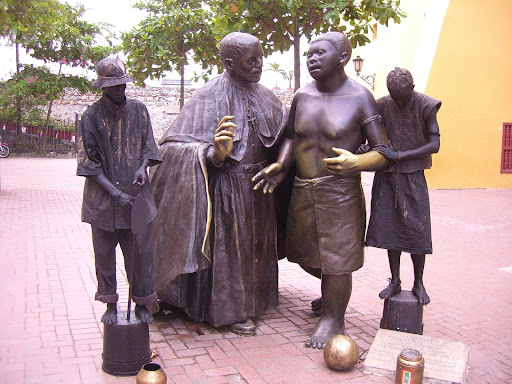
St. Peter Claver - 9th September 2008

Today we celebrate the feast if St. Peter Claver a Jesuit Missionary.


If anyone wonders what exactly it is that constitutes a Saint, he has only to read the life of Saint Peter Claver, in whom the superhuman life of grace acted so visibly as to create a person who seemed more than a man. This holy Jesuit, born in Spain in 1580, was during his novitiate a disciple of Saint Alphonsus Rodriguez, “the holy porter of Majorca”, a humble lay-brother endowed with the highest gifts of contemplation and prophecy. The two would eventually be canonized together by Pope Leo XIII in 1888, thus cementing the perfect union which began on earth and certainly continues in heaven.

Saint Alphonsus, when he saw the novice for the first time, was inspired to kiss his feet; and the novice embraced his spiritual father with a tenderness which would increase with time. A little later, the preceptor learned from a vision that this novice was destined to save a multitude of souls in the New World; he said to Peter: “How many peoples go astray for lack of ministers! The fatigue of going to seek them out is dreaded, but not the danger and crime which it is to abandon them!” Eventually Saint Alphonsus revealed his divinely revealed calling to him, to inspire in him an active desire to respond to the explicit Will of God.

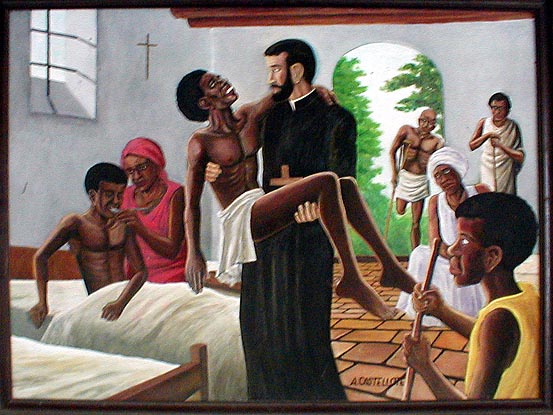
After eight years of study and apostolic preparation in Spain, Saint Peter asked to go to the Jesuit missions of the Western Indies, and was sent to Carthagena in Colombia, South America, when he was thirty years old. He was assigned to accompany an elderly priest who had undertaken a ministry of service to the poor Africans brought to be sold in the market of that city. These poor strangers spoke several languages but shared a common misery, which Saint Peter soon saw clearly. When the holds of the boats were opened, “all one beheld was a confused mass of men, women, children and old men, sick persons mingled with healthy ones, and often, alas! living beings next to cadavers, for the crossing made victims.” The elderly forerunner of Peter, when about to retire, asked that the objects of his care be definitively confided to Peter Claver, a petition willingly granted.

Thus began forty-four years of unceasing dedication to their spiritual and material betterment by Saint Peter. He watched for the arrival of the slave ships, which brought from ten to twelve thousand souls each year, and never failed to be the first to go aboard, accompanied by his interpreters and carrying the provisions he had been able to beg. He greeted the living, arranged for the burial of the dead and the transport of the sick to hospitals. Having won their sympathy, he went to them regularly with his interpreters and taught them, during several hours’ time, the elements of doctrine, aided by pictures. Before he died, he had baptized 400,000. He put around the necks of each newly baptized child of God, a medal which would thereafter distinguish the Christians from the yet untaught.


Though this was his principal industry, he also spent many days in the nearby lazaretto — a refuge for lepers — and in the hospitals of the region. No infirmity repelled him; the Brother who accompanied him had several times a day to clean his cloak, on which he would lay the sick while he arranged their poor beds. It never ceased to emit a heavenly fragrance. He slept only two or three hours at night, and ate almost nothing. The poor were his beloved children and he their beloved father, whose visits were anxiously awaited and were always too short. Those who resisted him did not do so indefinitely; one man insulted him for twenty-two years, but at the end of that time fell on his knees and begged his pardon. The vision of his charity is certainly reserved for heaven; his biographers scarcely find words adequate to describe his heroic life. Pope Pius IX, who beatified Saint Peter in 1851, commented that never had he read a life of a Saint which so moved him.

After Saint Peter contracted the plague in his declining years, he was left infirm and partially paralyzed. He then had himself tied to a donkey and in that way went about begging and distributing provisions. He had a rude servant who often neglected him and mistreated him, but when his brethren offered him another, asked to be allowed to keep that one, who treated him far better than he deserved. Two years after his death at the age of seventy-four, his body was found intact, despite the humidity of the burial site and the live caustic covering it. Miracles proliferated there and elsewhere by the invocation of his name. A large church was built in Carthagena in his honor, and he became the second patron of his adopted land, Colombia.

Peter Claver understood that concrete service like the distributing of medicine, food or brandy to his black brothers and sisters could be as effective a communication of the word of God as mere verbal preaching. As Peter Claver often said, "We must speak to them with our hands before we try to speak to them with our lips."