Evil triumphs when good men do nothing - Edmund Burke

Friday, October 10, 2008

Papal Texts regarding Abortion

It seems that our American brothers and sisters have a big election coming up and abortion is one of the major issues. Let us read and understand what the Popes (magisterial teachings) have to say about this grave sin. In the following passages the Popes talk about abortion leading to a weakening of the social fabric and eventually its destruction.

Papal texts:

* "Those who hold the reins of government should not forget that it is the duty of public authority by appropriate laws and sanctions to defend the lives of the innocent, and this all the more so since those whose lives are endangered and assailed cannot defend themselves. Among whom we must mention in the first place infants hidden in the mother's womb. And if the public magistrates not only do not defend them, but by their laws and ordinances betray them to death at the hands of doctors or of others, let them remember that God is the Judge and Avenger of innocent blood which cries from earth to Heaven.”(1) Pius XI

* "But another very grave crime is to be noted, Vener­able Brethren, which regards the taking of the life of the offspring hidden in the mother's womb. Some wish it to be allowed and left to the will of the father or the mother; others say it is unlawful unless there are weighty reasons which they call by the name of medical, social, or eugenic `indications.' . . . There are those, moreover, who ask that the public authorities provide aid for these death-dealing operations, a thing, which, sad to say, everyone knows is of very frequent occurrence in some places... What could ever be a sufficient reason for excusing in any way the di­rect murder of the innocent? This is precisely what we are dealing with here. Whether inflicted upon the mother or upon the child, it is against the precept of God and the law of nature: 'Thou shall not kill.' The life of each is equally sacred, and no one has the power, not even the public authority, to destroy it." (2) Pius XI

* "Moreover, every human being, even the child in its mother's womb, receives its right to life directly from God, not from his parents, nor from any human society or authority. Therefore there is no man, no human authori­ty, no science, no 'indication' whether medical, eugenical, social, economic or moral, that can show or give a valid juridical title for a deliberate and direct disposing of an in­nocent human life, that is to say, for an action which aims at its destruction, whether such destruction be intended as an end or as a means towards some other end which may itself be in no way illicit. So, for example, to save the life of the mother is a most noble end, but the direct killing of the child as a means to that end is not lawful. The direct killing of the so-called 'valueless life,' whether born or un­born, which was practiced a few years ago in numerous in­stances, can in no way be justified." (3) Pius XII

* "Indeed, all must regard the life of man as sacred, since from its inception, it requires the action of God the Creator. Those who depart from this plan of God not only offend His divine majesty and dishonor themselves and the human race, but they also weaken the inner fiber of the commonwealth." (4) John XXIII

* "Vatican II reiterated the point: 'Abortion and in­fanticide are abominable crimes.' . . . The first and most fundamental right of man is the right to life, that is, to the protection of his life. And no one can have a con­trary right where an innocent person is concerned. The weaker the subject is, the more he needs protection, and the more all have a duty to protect him. The mother is particularly accountable as long as she has the baby in her womb." (5) Paul VI

* "I do not hesitate to proclaim before you and before the world that all human life—from the moment of con­ception and through all subsequent stages—is sacred, be­cause human life is created in the image and likeness of God. . . . Let me repeat what I told the people during my recent pilgrimage to my homeland: "If a person's right to life is violated at the moment in which he is first conceived in his mother's womb, an indirect blow is struck also at the whole of the moral order, which serves to ensure the inviolable goods of man. Among those goods, life occupies the first place. The Church defends the right to life not only in regard to the majesty of the Creator, who is the first giver of life, but also in respect to the essential good of the human person." (6) John Paul II

* "I wish to recall emphatically to your memory to­day only the following: the killing of unborn life is not a legitimate means of family planning. I repeat what I said on May 31st of this year to workers in the Parisian suburb of Saint-Denis: 'The first right of man is the right to life. We must defend this right and this value. In the contrary case, the whole logic of faith in man, the whole program of really human progress, would be shaken and collapse.' " (7) John Paul II

* "On my part I owe it to my apostolic office to reaf­firm as clearly and as strongly as possible what the Church of Christ teaches in this respect, and to reiterate vigorously her condemnation of artificial contraception and abortion. Yes, from the moment of conception and through all sub­sequent stages, all human life is sacred, for it is created in the image and likeness of God." (8) John Paul II

* "Dear brothers and sisters: on this evening when we celebrate life, we are also mindful of the many threats to life which exist in our technological society. Of incalcula­ble danger to all humanity is the rate of abortion in society today. This unspeakable crime against human life which rejects and kills life at its beginning sets the stage for despis­ing, negating and eliminating the life of adults, and for at­tacking the life of society." (9) John Paul II

* "Over the last twenty years, many states have re­nounced their dignity as defenders of innocent human life, enacting laws permitting abortion. A real slaughter of the innocents is being carried out every day throughout the world ." (10) John Paul II

________________________
1. On Christian Marriage, St. Paul Editions, Boston, pp. 33-34.
2. Ibid., pp. 31-32.
3. Address of Pope Pius XII to the Italian Catholic Union of Midwives, The Clergy Review, vol. 36, no. 6, pp. 382-383.
4. Mater et Magistra, St. Paul Editions, Boston, p. 55.
5. The Pope Speaks, vol. 17, no. 1, pp. 334-335.
6. Homily at the Mass on the Capitol Mall, Washington, D.C., October 7, 1979, Sacred in All Its Forms, St. Paul Edi­tions, Boston, pp. 160-161.
7. Homily at the Mass for families, in Cologne, Germany, November 15, 1980, Sacred in All Its Forms, St. Paul Editions, Boston, p. 196.
8. Homily at the Mass for families, in Cebu City, the Philip­pines, February 19, 1981, Sacred in All Its Forms, St. Paul Editions, Boston, p. 204.
9. Address to the youth, to the aging, and the disabled in Van­couver, B.C., L'Osservatore Romano, English edition, October 8, 1984, p. 17.
10. L'Osservatore Romano, English edition, April 11, 1988, p. 6.

St. Francis Borgia - 10th October 2008

Today we celebrate the feast of St. Francis Borgia. Lets us contemplate the life of this saint through the words of Dr. Plinio Correa.


(The adoration of the Eucharist in the hands of St. Francis Borgia is the subject of one of the quadrants of the dome of the Gesù.)

Biographical selection:

For the Church, the 16th century was a dolorous epoch. The rebirth of Paganism, the spread of Protestantism and then Jansenism devastated Catholic Europe, while Islamism became an arrogant and menacing danger. In Golkun, Holland, 40 Catholics were martyred; in England St. John Fisher and St. Thomas More were beheaded, and Blessed Ignatius of Azevedo along with his 39 blessed companions were massacred by the Calvinists on their way to Brazil.

To remedy so many evils, Divine Providence raised up saints all over Europe. In Spain, St. Ignatius of Loyola, St. Francis Xavier, St. John of the Cross, St. Therese of Ávila, St. Peter of Alcantara, St. Paschal Baylon, and St. Thomas of Villanova carried out spiritual reforms that encompassed all Christendom. Others, such as St. Charles Borromeo, St. Felipe Neri, St. Peter Canisius, St. Francis of Paula, St. Jerome Emilianus and the great St. Pius V spread light over Christendom in their fight against the darkness of heresy.

During that stormy century, St. Francis Borgia shone for his nobility, virtue, and combativeness in Catholic Spain. He was born in Valencia into a family of royal blood that was related to the principal reigning houses of Europe, including that of Emperor Charles V. When Francis Borgia entered his service and came to court at age 17, the Emperor was so impressed by his noble and modest behavior that he determined to keep Francis always at his side. Charles V maintained this admiring friendship all his life.

After he became a widower, however, Francis Borgia made the decision to enter the Society of Jesus. St. Ignatius advised him to ask the Emperor’s permission. Since Charles V was in the Netherlands, Francis addressed a letter to him there. The Emperor replied with these words:

“I am very sorry to lose the company of a man of your merit, a shining light of counsel, a model in the exercise of the highest offices of State, and, because of your virtue and piety, a factor of edification for all my court. But I recognize that it would be unreasonable to dispute over you with the Master you have chosen to serve. It is, therefore, with sorrow that I grant you the permission you are requesting. I authorize you to renounce your fiefs and titles in favor of your firstborn son.

“The number of those who will envy you will be greater than those who will imitate you, since it is easy to admire beautiful examples, but difficult to follow them. I recommend myself to your prayers and I count upon you to attract divine blessings over me, my States, and all Christendom.”

After holding the office of Superior of the Society of Jesus in Spain, Portugal and the West Indies, St Francis Borgia was elected the third General of the Order when Fr. Laynes died in 1560.

One of the first tasks he faced was that of refuting and fighting the calumnies that the Lutherans and other enemies of the Church were spreading about the Society of Jesus in attempts to bring it to ruin. They were trying to stimulate dissension between the Dominican Order and the Society of Jesus. When Cardinal Alessandrini, a Dominican, was elected Pope, a member of the College of Cardinals tried to influence him to suppress the Jesuits. St. Pius V answered:

“God preserve me from so great a sin. The Lord wants to use these priests for His glory. Their Society is called to produce great fruits for the Church.”

The next day St. Pius V was to be crowned Supreme Pontiff at the solemn ceremony in the Basilica of St. John Lateran. He was carried in the gestatory chair followed by all the dignitaries of the Roman Court. An enormous multitude filled the streets. When the cortege arrived in front of the House of the Society of Jesus, the Pope ordered it to stop. St. Pius V called for St. Francis Borgia, who respectfully approached. The Pope embraced him and offered his friendship and support for whatever he would need. He also thanked him for the service the Order had already given to the Church and expressed his warmest wishes to see their members work for the glory of God and the salvation of souls. The cortege then continued on its way.


Comments of Prof. Plinio:

This selection has two distinct parts. The first is a brief description of the life of St. Francis Borgia when he was a layman, and the second presents an episode from his government as General of the Society of Jesus.

To evaluate the biographical data in this selection, one needs to consider the general panorama of the times. His Sovereign was Charles V, Emperor of the Holy Roman and German Empire. He was Emperor, and also King of Hungary, King of Bohemia, Lord of numerous Italian territories, and King of Spain, and, therefore, of the Spanish colonies spread all over the world. It was at this time that it became common to say that the sun never set on his Empire. That is, when the sun was rising in one part of his Empire, night had not yet fallen in another. There was always daylight within the domains of his Empire.

He was one of the most powerful Monarchs in History. The 16th century was certainly already a decadent century in comparison with the Middle Ages, but it was not that distant from those blessed centuries, and many of its values were still alive at that time. One of these values was that people still appreciated justice more than power. It was generally recognized that Charles V, as Emperor, deserved the most honor and reverence. The Emperor of the Holy Roman Empire was considered the natural head of all Christendom, superior to all Kings. Above him was only the Pope.

St. Francis Borgia was a man of high lineage who descended from a royal family that had reigned over Valencia. The different kingdoms of Spain had united to face the Moorish invasion, and even though many of those royal families no longer had thrones, they were still very highly considered. St. Francis Borgia was a descendent of one of those families, which still had fiefs. His situation was similar to that of a prince.

As a youth he was sent to Charles V’s court. Since it was the highest court in the world, it attracted countless men of value: nobles, personages, famous artists, financial magnates, reputed diplomats, and brilliant military officers. It was a gathering point for the best of Europe. Over all them was the Emperor, who successfully ruled over his numerous Kingdoms. Into this extraordinary scenario an adolescent of 17-years entered. He was so remarkable that he attracted the attention of the Emperor. That is to say, he stood out among those countless princes and outstanding men who were there vying for the Emperor’s attention.

The selection tells us that he was very noble and modest, which means he possessed a great superiority and dignity in manners. We should not think of modest in the modern sense of the term, as describing a man who is trying to flee social life. Rather, the word would retain its old-fashioned meaning, coming from modus – that is, someone who had distinguished and reserved manners in his way of being.

The sanctity of St. Francis Borgia attracted the Emperor so much that he wanted him always near to give him counsel. St. Francis was Duke of Gandia, which he governed. He married and founded a large family with many descendants. That is, he had many temporal matters to deal with on a daily basis.

In 1539 the wife of Charles V, Empress Isabel, was struck with fever and died. As the Marquis of Lombay, Francis Borgia was required to head the funeral cortege to Granada, where a Requiem Mass was sung and official identification of the body made before burial. When Francis opened the coffin and lifted the cloth from the face of the dead Empress, the cadaver had already beginning to deteriorate. This sight made a strong impression on St. Francis Borgia, who realized the futility of all the glories of the world. He resolved to abandon them and ask St. Ignatius to enter the Society of Jesus.

One condition that St. Ignatius made was that he must obtain the Emperor’s permission. Then Charles V wrote him the beautiful letter we just read. It is a high eulogy of St. Francis Borgia, which ended with the line that expresses well the spirit of the time: Many people will admire you, but only a few will follow you.

This explains the difference between that time and the Middle Ages. In the Middle Ages, many admired the good examples, and many followed them. In the time of Charles V, many admired the good examples, and just a few followed them. Today the good examples are neither admired nor followed. You have here the different steps of the Revolution.


St. Francis Borgia entered the Society of Jesus and became its General. There was a rivalry between the two Orders: the Dominicans and the Jesuits. The enemies of the Church were interested in destroying the Society of Jesus because of its more zealous combativeness against the Protestants. So they stimulated rumors and calumnies that were spread against the Jesuits. When St. Pius V, a Dominican, was elected Pope, those same enemies found ways to influence Vatican ecclesiastics, who immediately tried to maneuver the new Pope to close the Jesuits. Instead, St. Pius V planned a way to do the opposite, to confer added prestige to their Order.

You know that until Paul VI, the Popes used the gestatory chair, which was a portable throne for the Pope carried on the shoulders of a dozen men so that the Pontiff could be seen by all the public. That custom, which began in the early days of the Church, was enriched as time passed with a ceremonial cortege and trumpets.

St. Pius V resolved to break the long established protocol of the cortege of coronation. He did so, stopping its progression in front of the House of the Jesuits and calling for St. Francis Borgia, who most probably was standing outside with the other directors of the Society of Jesus waiting for the Pope to pass.

You can imagine the scene: St. Pius V a man who had been Inquisitor, tall, thin, with a great sharp nose like an eagle, already advanced in years, sublime, approaching the highest phase of his life where he would shine brilliantly as the militant Pope who broke the Muslim power at the Battle of Lepanto. St. Francis Borgia, General of the Society of Jesus, with the air of a grand-seigneur beneath his Jesuit cassock. St. Francis Borgia approached the Pontiff with respect and admiration, venerating the Saint whom God had sent the world to be the Pope of the Church. He knelt before him, and St. Pius V bent to embrace him. Then they exchanged some words.

St. Pius V said that he loved the Society of Jesus with all his heart, that he wished every good for its priests, and that he considered himself its protector. His only desire was that the Society of Jesus fight for the glory of God. St. Francis Borgia thanked the Pope and promised the complete fidelity of the Order to St. Pius V and the Papacy.

Then the cortege continued on. St. Francis Borgia and his Jesuits entered the Church of Gesù, next to the Jesuit house in Rome, to make an act of thanksgiving before the Blessed Sacrament. What splendor, what an exquisite perfume emanates from the encounter of those two saints!

I think it is legitimate for us to turn our eyes from the contemporary epoch – filled with corruption and treason – to end the day admiring the encounter of those two saints. That encounter, the words they exchanged, and their mutual admiration for one another express something of the supreme happiness we will have in Heaven.

Let us ask St. Francis Borgia to give us his Catholic spirit, which impressed everyone in his life, including Emperor Charles V, and his dedication to the Papacy, which was the main characteristic of the Society of Jesus in its first times.


(God, Francis Xavier, Francis Borgia, and Ignatius Loyola are the subjects of the quadrants of the dome. Note the railing below and high up a part of the name of Alessandro Farnese, a cardinal and Pope Paul III's nephew, whose financial patronage made the Gesù possible.)

Thursday, October 9, 2008

St. Denis and Companions - 9th October 2008

Today we celebrate the feast of St. Denis and his companions.


This martyr and patron of France is traditionally held to have been the first bishop of Paris. His popularity is due to a series of legends, especially those connecting him with the great abbey church of St. Denis in Paris. He was for a time confused with the writer now called Pseudo-Dionysius.

The best hypothesis contends that Denis was sent to Gaul from Rome in the third century and beheaded in the persecution under Valerius in 258.

While still very young he was distinguished for his virtuous life, knowledge of sacred things, and firm faith, is proved by the fact that Pope Fabian (236-250) sent him with some other missionary bishops to Gaul on a difficult mission. The Church of Gaul had suffered terribly under the persecution of the Emperor Decius and the new messengers of Faith were to endeavour to restore it to its former flourishing condition. Denis with his inseparable companions, the priest Rusticus and the deacon Eleutherius, arrived in the neighbourhood of the present city of Paris and settled on the island in the Seine. The earliest document giving an account of his labours and of his martyrdom (Passio SS. Dionsyii, Rustici et Eleutherii), dating from the end of the sixth or the beginning of the seventh century and wrongly attributed to the poet Venantius Fortunatus, is interwoven with much legend, from which, however, the following facts can be gleaned.

On the island in the Seine, Denis built a church and provided for a regular solemnization of the Divine service. His fearless and indefatigable preaching of the Gospel led to countless conversions. This aroused the envy, anger and hatred of the heathen priests. They incited the populace against the strangers and importuned the governor Fescenninus Sisinnius to put a stop by force to the new teaching. Denis with his two companions were seized and as they persevered in their faith were beheaded (about 275) after many tortures. Later accounts give a detailed description of the confessors' sufferings. They were scourged, imprisoned, racked, thrown to wild beasts, burnt at the stake, and finally beheaded.

According to one of the legends, after he was martyred on Montmartre (literally, "mountain of martyrs") in Paris, he carried his head to a village northeast of the city. St. Genevieve built a basilica over his tomb at the beginning of the sixth century.

Wednesday, October 8, 2008

" Well ! Well....! Mr. Advani ! "

What follows below is a letter from Fr. Cedric Prakash in response to LK Advani dealing with the recent religious violence against Christians in India

" Well ! Well....! Mr. Advani ! "

- Fr. Cedric Prakash sj *


Well....! Well....! Mr. Advani ! Well "spoken" indeed !


You have called for "inter-religious dialogue" and in no uncertain terms you say (there are media reports quoting you) "I strongly condemn these acts of violence and vandalism which cannot be condoned or justified. The law must take its course and the culprits must be brought to justice..."

Well, Mr. Advani.... I, for one, would like to believe this statement. Unfortunately, your track record exposes your double speak and well, your insincerity.

As somebody aspiring to be a future Prime Minister of the country, (and the fact that you are the icon of the BJP), you will have to first rein in all the fascist forces that support your ideology and your agenda. How about booking the many from the Bajrang Dal, the RSS and the VHP who have systematically been attacking Churches and killing innocent Christians in different parts of the country ? (Orissa and Karnataka are just current examples of this reality.) How about disassociating yourself from them completely ? and perhaps, joining vast sections of the country who call for their ban ?

When you call for "inter-religious dialogue", I don't suppose you mean that men and women of faith should talk or dialogue with terrorist organizations ? Or do you ?

You say you have a "soft corner" for Christians but then, how is it that you have never raised your voice when the Christians of Gujarat were attacked in 1998/99 by these same fascist forces and when they continue to be attacked in several other parts of the country ? You thought it prudent enough not to make a statement on Sunday 14th September when Christians and Churches were being attacked in Karnataka - just as the National BJP meeting was concluding in the State. It amuses me that you had to go to Shillong and make a statement several days after thousands of Christians have been hounded from their homes and property in Orissa. Do you think such hollow statements can actually give the BJP votes there ? In your wisdom, did you not think it would have been more appropriate, if in Bangalore, your party passed a resolution condemning the attacks on Christians and other minorities in this country ? So why go to Shillong to make your statement ....? Do you think that the "Aaam aadmi" (ordinary person) – cannot see through your ploy.... ?

However, can we start from the very beginning....?

What about 1990 when you began the Rath Yatra with much fanfare ? In an attempt to destroy the secular fabric of our Constitution, your "Rath of Death" polarized Gujarat and several parts of the country as never before. Yes, it definitely garnered you votes and perhaps put your party in power (for which they are eternally grateful ! ). But any one with conventional wisdom will tell you that narrow short-term gains normally negate long-term acceptance and solutions. Hitler and his Nazi party is a classic example.

As of now, you represent my Constituency in Parliament. When hundreds of innocent Muslims were burnt alive and gang-raped in our streets, you declared that it was the ISI that was responsible for setting the S6 coach on fire ! Have you ever condemned the brutality and the inhumanity taking place in your own Constituency ? When you speak of "justice", can you echo and re-echo the words of your mentor (the former PM), to your protégé here (the Chief Minister (Narendra Modi) of this land dedicated to Satyagraha and Ahimsa) that he should be following "Rajdharma" ? How about raising your voice for victims of the Gujarat Carnage ?

Today in your Constituency, if one is a Muslim, one cannot buy or own a shop. Besides, in many areas, Christians too are treated as second-class citizens.

Some housing societies have very clearly stated in their byelaws that Muslims would not be allowed to stay in that society. The irony is, we have the byelaws of one society which clearly state that "Muslims and Sindhis" will not be permitted to live in that housing society. So why don't you try buying a house in that society ?

Well....Well....Mr. Advani, this is your Constituency ! Your goons came for the Muslims first, then for the Christians....It is only a matter of time before they come for the "Sindhis" (caste group that Mr Advani belongs to) !

It is definitely not too late Mr. Advani....you can still show India and the world that you still cherish the values that were imparted to you through a Christian education : of tolerance, compassion, sense of justice and fair play, of equality, of respect for all religious, of not allowing people to take law and order into their own hands....and hopefully show your secular face.

You have a little over five years to prove it. And if the fascists of the country allow you or me to still be around in 2014, you may still have a chance to then aspire to be Prime Minister. Until then, just forget it .....

Well ! Well....! Mr. Advani !


(* Fr. Cedric Prakash sj is the Director of "Prashant", the Ahmedabad-based Jesuit Centre for Human Rights, Justice and Peace)


' PRASHANT '
(A Centre for Human Rights, Justice and Peace)
Near Kamdhenu Hall
Drive-in Road, Ahmedabad 380 052
Gujarat, India
Tel: 91 79 66522333 /27455913
Fax: 91 79 27489018
Email: sjprashant@gmail.com
www.humanrightsindia.in


2nd October 2008

Tuesday, October 7, 2008

Our Lady of the Rosary – 7 October 2008

Today is the feast of Our Lady of the Rosary. Let us read the commentary of Dr. Plinio Correa.

The feast day of Our Lady of the Rosary was instituted by St. Pius V in commemoration of the victory of the Battle of Lepanto on October 7, 1571 against the Turks who were threatening Europe. In 1716, the feast was extended to the entire Church in thanksgiving for the defeat of the Muslim Crescent in Hungary.

The devotion of the rosary was revealed to St. Dominic by Our Lady. It was born, therefore, in a private revelation. And we know that such revelations are abhorred by the enemies of the Church – internal and external. Although it came from a private revelation, the praying of the Rosary was extended to the entire Catholic Church, and was considered by St. Louis Grignion de Montfort as the characteristic devotion of predestined souls.

Before Vatican II, the habits of many religious Orders had rosaries that hung on their cinctures, and good Catholics used to carry the rosary with them all day. It was considered not only an item for counting the Hail-Mary’s, but a blessed object, the seal of a special liaison of the person with Our Lady. Many times, the mere physical presence of the rosary would repel the Devil and attract special graces. It became the classic religious object to fight against the Devil.

What is the rosary? The rosary is a series of mediations on the mysteries from the lives of Our Lord and Our Lady. These mysteries are simultaneously prayers that one says vocally and meditations that one makes mentally. This mixture of vocal prayer and meditation is a splendid thing, because while the lips pronounce a plea, the mind concentrates on a point of the mystery. It is a dual activity that intimately unites one with God.

The practice of praying the rosary to beg a grace from God supposes the theological truth that Our Lady is the Universal Mediatrix of all graces. It is, therefore, a small masterpiece of spirituality and Catholic doctrine as they should be understood. The rosary is not a religious custom relying on emotions, but rather a serious, solid, and meditative pious practice, which explains why the rosary has obtained so many graces.

It is very beautiful and valuable to meditate on the mysteries of the rosary, because for each decade, one contemplates a different thing with its special graces: There are particular graces for the mystery of the Annunciation, others for the Agony in the Garden, yet others associated with the Ascension of Our Lord. Each one of the decades has its special graces, and the person who meditates on all of them attracts to his soul the ensemble of graces from the lives of Our Lord and Our Lady. It is a complete circumnavigation that brings a supernatural plenitude to the soul of the person, which helps us to better understand the salutary influence of the rosary.

A Catholic, thinking and reflecting on things of the Faith, should draw conclusions that build upon each other and constitute a kind of architectural construct. This should be the spiritual life of a Catholic. It follows in accordance with the way God governs the universe. He wisely judges the weight and measure of everything. This is another reason why the rosary is an excellent devotion.

We know that the victory of the Battle of Lepanto was achieved when St. Pius V interrupted a meeting with Cardinals at the Vatican and went to a window and started to pray the rosary. He was deeply concerned about the future of the Church and Christendom that was being decided in those Mediterranean waters. After the Pontiff finishing praying the rosary, he returned to the meeting and told the Cardinals that the Catholic fleet had been victorious. That is, he had a revelation while he was praying the rosary. It was the way Our Lady showed him that she linked that victory to his praying of the rosary. Understanding this, St. Pius V instituted the feast of Our Lady of the Rosary, which was extended to the whole Church in commemoration for another great victory over the Mohammedans in 1716.

The fact that this devotion is specially linked to victories over the enemies of the Church and Christendom induces us to think that it will protect all those who fight against the enemies of the Catholic cause. It is a devotion that most probably will endure until the end time, when the enemies of the Church will be more dangerous than ever.

Therefore, also during the chastisement predicted at Fatima, the assiduous recitation of the holy rosary should be a decisive factor of victory for those who would be defending the Catholic cause. The historical antecedents of the value of the rosary are a pledge of analogous future victories.

When St. Alphonsus of Liguori was already old, sick, and in a wheelchair, a lay brother used to wheel him around the cloister of his monastery in the evening so he could take some fresh air. Engaging the brother in conversation, St. Alphonsus asked him:

“Did you pray your rosary today?”
“I don’t remember,” the brother answered,
“Then, let us pray it now,” the Saint said.
“But you are already so tired. What difference does it make if we don’t pray the rosary for one day?” protested the brother.
St. Alphonsus answered: “If I did not pray my rosary for even one day, I would fear for my eternal salvation.”


This is what a Saint said. I like this episode because it teaches us that we should do precisely the same. The daily rosary is a great guarantee of final perseverance and fidelity for the times ahead when the prophecies of Fatima will be fulfilled. The victory in our everyday Lepanto is linked to the recitation of the rosary.

Let us ask Our Lady of the Rosary to bless this intention of saying the Rosary daily and give us the grace to carry it out.

Monday, October 6, 2008

Consecration at a Solemn High Mass (Usus Antiquior) held at the Toronto Oratory on 4 October 2008


This is a video of the consecration at the Solemn High Mass (Usus Antiquior) held at the Toronto Oratory on 4 October 2008

Usus Antiquior mass in Toronto on 4th October 2008


I had the opportunity to attend this mass at the Toronto Oratory Church. It was a very solemn mass and very beautiful.

Sunday, October 5, 2008

Statue of Christ in Slovak Catholic Church in Michigan


Here are some lovely pictures of Christ at the Slovak Catholic Church in Michigan

Saturday, October 4, 2008

St. Francis of Assisi - 4th Ocotber 2008

Today is the feast of St. Francis of Assisi, let us read and contemplate what Dr. Plinio Correa has to say about the founder of the Franciscan Order.

Biographical Section

In the summer of 1215 St. Francis with a small group of friars were in Rome seeking approbation for his Rule. One night during his stay while Francis was praying, he saw Our Lord prepared to unleash most terrible chastisements upon the world. His Most Holy Mother was making an effort to placate Him, asking His mercy and forgiveness. For this purpose, she presented two men who would labor for the conversion of the world and return a countless number of lost sheep to the fold. Francis recognized himself as one of these apostles. He did not recognize the other one, however.

The following day, he was in one of the churches of Rome when suddenly an unknown person came up to him, embraced him, and said: “You are my companion, we will work together, supporting one another toward the same end, and no one will prevail against us.” Francis recognized him as the other man in the vision. It was St. Dominic, who had also received a similar vision. When he saw Francis in that church, he immediately went to greet him, inspired by the Holy Ghost.

Sometime after this encounter, Francis and Dominic assisted at a service at St. John the Lateran Basilica where a famous preacher was giving a sermon. It was Fr. Angelo who later would die a martyr in Sicily. As he preached, Fr. Angelo saw Francis and Dominic in the audience. Moved by a grace, he stopped, looked at them, and announced with prophetic words that the two would be strong columns of the Church.

At the end of the ceremony, St. Angelo waited for them, embraced them, and told them the favors God had reserved for them. The two founders, in turn enlightened by a supernatural grace, revealed the principal events of the life of St. Angelo. As the trio left the church, they came upon a leper begging there. The three gave a simultaneous blessing to the poor man, which restored him to health.


(St Francis receiving the Stigmata by Giotto)


Comments of Prof. Plinio:

This narration is so beautiful that I feel embarrassed to comment on it. But since I have the obligation to say some words to you regarding it, I will do so.

You see the splendor of the scene. St. Francis and St. Dominic both received visions that allowed them to recognize one another. So when St. Dominic saw St. Francis in one of the churches of Rome, he went to him and embraced him. They both expressed their enthusiasm for the mission each had received and for the fact that they would support one another. This was the embrace of two souls, each one with every reason to hold the other in the highest esteem: on one hand, because their missions were very similar; on the other hand, because they were very different.

According to Catholic criteria, a great similarity leads to friendship, but so also does a great dissimilarity when it is not the dissimilarity of opposition, but rather one that is complementary. One had something that the other was lacking. Together they constituted a harmonic ensemble. For this reason, they admired one another.

Both saints had a profound Marian devotion. St. Francis was a great palatine of the Immaculate Conception centuries before it was defined as dogma. The Franciscans would spread that truth throughout the world. St. Dominic was the great apostle of the Rosary. Through the devotion of the Rosary the Dominicans would effect immediate and spectacular conversions. The Dominican is the Order of the Rosary par excellence. So, from the Marian perspective, there is a great similarity in the Orders.

However, even with this similarity of mission, there are also differences. The two Marian devotions represent in the minds of the faithful two different floods of light. Still, they are convergent lights, because it is not unusual for the person who believes in the Immaculate Conception to pray the Rosary, and vice-versa.

This balance between similarity and dissimilarity can also be noted in another point. The Dominican Order was called to convert persons by speaking to their will through their intelligence. It is clear that part of the Dominican mission is an intellectual work – the study and teaching of philosophy, theology, and apologetics. On the contrary, the dominant note of the Franciscan Order is to move the will through a manifestation of zeal. The great conversions of the Franciscans came about through the consideration of the Wounds of Our Lord, His Passion, His poverty and spirit of sacrifice. Once again, they are harmonic differences that merge in the spirit of the faithful. A Catholic instructed in the arguments of apologetics by the Dominicans should also be touched by the fervor of the Franciscans.

That embrace in a church of Rome, therefore, was not just the embrace of two saints, but something more. It was the missions of the two Orders that embraced in that moment. The two Founders were like the two hands of God uniting their efforts to work on this earth, to bring holiness and happiness to men and glory to the Catholic Church.

This was further completed by the presence of a third saint. The saint who preached from the pulpit was so famous that both Francis and Dominic came to hear him. In the middle of his sermon, St. Angelo sees what it is not given to human eyes to see: he sees the future of St. Francis and St. Dominic and how they would become strong columns of the Church and Catholic Civilization, which was threatening to crack and break.

Finally, the three men met and embraced at the end of the office. What did the Carmelite preacher St. Angelo bring to that embrace? He brought what was missing: martyrdom. He brought his acceptance of the holocaust and immolation of his very life in honor of Our Lord Jesus Christ and as a witness to the truth of the Catholic Faith.

Simplifying the picture, then, we have wisdom, charity and martyrdom that merge in that encounter and work a miracle. A leper was at the door of the church begging. Leprosy was the worst and most incurable illness of the time. The three Saints made a joint blessing over the leper, and the man was cured. This symbolized a Christendom that was becoming leprous and which, by the action of those saints, was restored to health.

This is how we can understand the first part of the selection. The Revolution was installed in Christendom and Our Lord was ready to release His punishments. But Our Lady intervened, pointing to the mission of those two men, and she obtained the postponement of that chastisement, because the action of the Revolution would be deferred by the action of those two saints.

In the 15th century the Revolution entered again with new force. Why did this happen? Did God call another man to halt it? In this case, we would be facing the possibility that a new St. Francis was called and did not correspond to his vocation. Or perhaps the man corresponded and became a saint – St. Vincent Ferrer, for example – but the people did not correspond to his appeal. We do not know. What is certain is that from the 15th century on, the collapse of Christendom has been continuous.

We can see the preventive counter-revolutionary action of St. Francis of Assisi. By means of humility, purity and austerity, he put a brake on the pride and sensuality of his times.

We should ask St. Francis, through the grand union he has with Our Lady, to obtain for us a great spirit of humility and mortification so that we stop thinking about ourselves and think only on the Catholic cause, without the desire to appear, shine, or have fun. It should suffice for us only to know, love, serve and glorify Our Lady through our whole life. We should also ask him to help us fight with all our forces to destroy the Revolution, which he helped to counter-attack in his times.


(Tomb of St. Francis of Assisi)

Friday, October 3, 2008

Thursday, October 2, 2008

Feast of the Guardian Angel - 2nd October 2008

Today is the feast of the guardian angel. Let us read what Dr. Plinio Correa says about guardian angels.

Is the Guardian Angel Less Intelligent than the Demon?

The Church teaches that God created angels vastly superior to man. Pure spirits possessing a most lucid intelligence and great power, they surpass by nature even the most gifted of men. As a consequence of their revolt, the fallen angels lost their virtue, but not their intelligence or power. In accord with His Divine Providence, God restrains their activity. However, they remain far superior to man, by nature.

Accordingly, the Church always approved artists’ depictions of the demon as an intelligent, shrewd, astute and powerful being, although full of malice in all his designs. She even sanctions his portrayal as a creature with captivating charms, reflecting the qualities that the spirit of darkness exploits to disguise himself so that he may seduce men.


Our first picture is an example are such presentation of the demon. Diabolical and shrewd, astute with a penetrating psychology and full of guile, the demon suggests, in a beguiling manner, thoughts of perdition to slumbering Dr. Faust. This is the classical depiction of the devil. We can hardly imagine him otherwise.

However, how are faithful angels portrayed today?

They are shown as well-intentioned, happy and innocent beings. This is in conformance with their eminent sanctity, blessedness, and purity.

Nevertheless, such depictions lack proper balance by emphasizing the goodness and purity of the faithful angels, while failing to convey their admirable intelligence, strength and majesty. Instead, they are often painted as weak creatures with no hint of courage.

Our second picture shows a child crossing a wobbly bridge. A guardian angel is protecting her.


Naturally, the idea of a child continuing her carefree walk lovingly guarded by a celestial Prince is quite touching. Still, if we pay closer attention to this prince, especially his countenance, does he not lack the strength, intelligence, acuteness, and agility proper to angelic nature, as present in every portrayal of the Prince of Darkness?

Examine the body of the good angel in the painting. Observe the soft, unintelligent and slackened attitude. Compare it to the lithe agility and alertness of the demon.

Could the contrast be any sharper?

Does it make sense?

By insistently representing the demon as intelligent, lively and capable; and the good angel as soft, expressionless and almost foolish, what impression is conveyed to the public?

One impression is that the practice of virtue results in creatures lacking in backbone and sense, while, on the contrary, vice is the practice of powerful and intelligent beings.

Thus we see yet another example of the deception which romanticism continues to exercise profoundly over many religious ambiences.

Wednesday, October 1, 2008

St. Therese of the Child Jesus - 1st October 2008

Today we celebrate the feast of St. Therese of the Child Jesus.

On September 30, 1897, a 24-year-old nun lay dying in the Carmelite Convent in Lisieux, France. She had done so little in her life that one of sisters remarked that while she was charming, what would Mother Superior write about her at her death in the report she would make for the community?

The question is amusing to us now. For the fame of this young nun would spread beyond the Convent and throughout the Church with remarkable speed. One year after her death, her autobiography, The Story of a Soul, was published. Her devotees multiplied as miracles were worked and favors granted through her intercession. During World War I French pilots carried a photo of her in their aircrafts to protect them.

In less than 30 years, in April of 1923, Pope Benedict XV declared her Blessed, and in 1925 Pius XI canonized her and named her feast day October 3. St. Pius X called St. Therese of the Child Jesus one of the greatest saints of modern times. In less than a century, she had become one of the most popular saints throughout the world.

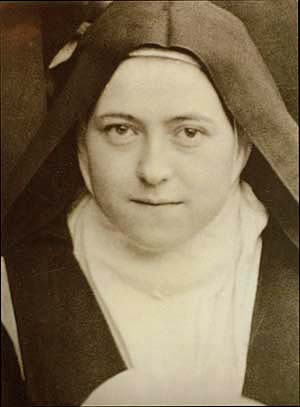
A visage that reveals a great self-mastery

There is a popular iconography that represents St. Therese in statues and pictures with ruby lips, rosy cheeks, and an expression of sentimental piety and sanguine sweetness on her face. I am not a fan of this school of art that represents the saints like fairy tale figures stripped of character. To know St. Therese, it is best to contemplate her real face, since we are fortunate to have many pictures of her.

When her sister Celine entered the Lisieux Carmel in 1894, she brought her camera and photography equipment. Although the camera was banned in many Convents of the time as frivolous, Celine was permitted to pursue the hobby, and so today we have the 41 pictures in which St. Therese figured, either alone or in a group.


What does the face of the real Therese reveal? It is a physiognomy that is delicate but strong, sweetly serene but intensely reflective, a face stamped with the tranquil acceptance of suffering and the life of the Cross. There is the strong chin, the firmly set lips with a hint of smile, a gaze that has lost nothing of its childhood innocence and, at the same time, reveals a person who views the world without superficiality or optimism. In the real face of St. Therese, one sees a soul of character and the self-mastery of a saint.

Self-mortification – the means to self-mastery

Looking at her sweet smile, it is hard to believe that it was a hard-earned smile that only a great self-mastery maintained through both the small irritations and great sufferings she endured in her short life. It is worth pausing a moment here because this kind of self-mastery, earned by mortification of one’s will, is the exact opposite of what the modern world advocates. In various ways, we are led to believe that the strong and successful woman is the one who gets her own way, who makes a stunning career, who controls every situation.

St. Therese teaches something different. “To write books of devotion, to compose the most sublime poetry is of less worth than the least act of renunciation,” she wrote. That she had learned the value of small acts of self-mortification from the time she was young is evident throughout her biography.

For example, when she was ten-years-old, her father offered Celine painting lessons, and then turned to Therese to ask her if she would like them also. Before she could answer yes, her sister Marie remarked that Therese did not have the same gift for it as Celine. She held herself back and remained silent, offering her great desire for lessons as a sacrifice. Later, in her autobiography, she remarked, “I still wonder how I had the fortitude to remain silent.”

She maintained this spirit in her years at Carmel. In the convent laundry of Lisieux, for example, she worked opposite a Sister who would splash her with dirty water while washing the handkerchiefs. She refrained from her inclination to draw back and wipe her face to show the Sister how much this annoyed her. This may seem very small, but the self will is as well denied and curbed in small things as in great things, and sometimes more so when they go against the grain.

St. Therese explained this “Little Way” (2) with simplicity and candor:

“Far from being like to those great souls who from their childhood practice all sorts of macerations, I made my mortification consist solely in the breaking of my will, restraining a hasty word, rendering little services to those around me without making anything of it, and a thousand other things of this kind.”

The exterior demeanor influences the interior

In the face of St. Therese, her lips are set in the way of one who is accustomed to keep watch over herself, of smiling when she “feels” irritable or sad, of not allowing herself to be the slave of passing moods or fancies. From her, we learn an important lesson often ignored today by parents or teachers – the importance of the exterior demeanor as a means for controlling the interior.

She used to tell the novices that out of respect for the Angels we should always carry ourselves with dignity. She could not bear to see the least contraction on their faces, such as frowning. She told them: “The face reflects the soul. So it must always be calm and serene. That holds good even when you are alone, because you are always in the sight of God and his Angels.”

In her Story of a Soul, St. Therese explained how she formed the habit of conquering her moods:

“When things that are irritable or disagreeable befall me, instead of assuming an air of sadness, I respond by a smile. At first I was not always successful, but now it is a habit which I am very happy to have acquired.”

It was this habit that made her able to maintain a peaceful demeanor even during the horrible physical sufferings and terrible temptations against the Faith at the end of her life. Her expression then was so serene that one Sister doubted her suffering during her sickness and confronted her, asking her how she could keep the expression of joy on her countenance if she was suffering so much.

“It is because of the very acute pain I am feeling,” replied Therese. “I have always striven to love suffering, both small and great, and to give it a cordial welcome.”

Confidence, the weapon to fight discouragement

Someone might wonder: Didn’t St. Therese ever become discouraged over her small failings and inability to do the great things she desired for the love of God?

In fact, Therese had by her temperament a natural tendency toward discouragement. That she recognized this disposition is evident from the first of the three resolutions she made on her First Communion day: “I shall not be discouraged.”

The second resolution was “I shall say the Memorare to the Blessed Virgin every day;” the third was “I shall blot out my pride with humility.”

In Carmel, she wrote a beautiful prayer for a novice about humility. In it she said that she would wake in the morning with a strong resolve to conquer her pride; in the evening she would be discouraged knowing she had failed. Then she realized that this discouragement itself was but itself a form of pride, and this would make her more discouraged. It is the vicious circle many of us have experienced. St. Therese explains how the dilemma was resolved:

“Since it has been given to me to understand the love of the Heart of Jesus, I own that it has chased all discouragement from mine. The remembrance of my faults humiliates me, and urges me never to depend on my own strength, which is nothing but weakness. Still more does this remembrance speak to me of mercy and of love. When, with all filial confidence we cast our faults into the devouring furnace of love, how should they not be totally consumed?”

It was only confidence that could conquer discouragement and melancholy. “What offends Jesus, what wounds Him to the Heart,” she insisted to her novices, “is lack of confidence.”

She did not permit this reliance on divine mercy and confidence in the goodness of God to allow any kind of passivity in the daily battle. Once a novice was bewailing her lack of courage. St. Therese chastised her for the spirit that relies on the “feeling” of the moment:

“Where would your merit be if you fought only when you felt courage? What does matter if you have none, provided that you act as if you had! If you feel too lazy to pick up a bit of thread, and you nonetheless do it for the love of Jesus, you have more merit than some great accomplishment made in a moment of fervor.”

Confidence in the mercy and goodness of God does not release us from the obligation to fight the daily battles against our faults. But in fighting those battles, St. Therese found her support in it: “It is confidence, and confidence alone, that must lead us to love.”

She used to say that it was not because she had been preserved from mortal sin that she had so much confidence. Even if she had “committed every possible crime,” she said, she would have the same confidence. She would feel that this whole mass of sins would be like a drop of water thrown into a burning furnace. For if we know how to lay siege to His Heart, she insisted, we render Him blind to our lamentable deficiencies.

St. Therese composed this prayer, An Act of Holocaust as Victim of God’s Merciful Love on June 9, 1895, as an expression of her desire to be consumed by Divine Love.

If we do all that we can, she said, and offer this to the good God, in his justice and love He will supply the rest. “My way is all confidence and love,” affirmed St. Therese, telling us something we need to hear again and again, that we can never have too much confidence in the goodness of God.

Like St. Therese, we should not fear in these difficult days to ask Our Lady for everything: that she permit us to serve her in the defense of the Catholic Cause, that we might be saints, that the Church might be restored, that Her Reign might come, that Her Immaculate Heart be victorious.

Tuesday, September 30, 2008

St. Jerome - 30th September 2008

It is the end of the month and today we celebrate the feast of St. Jerome. Let us read the commentary about this saint from Dr. Plinio Correa

(Under the Altar of St. Jerome is the resting site for the body of Bl. John XXIII.)


St. Jerome, Confessor and Doctor of the Church (c. 341-420) is considered the Church’s greatest Doctor of Scriptures.

He conferred this praise upon St. Augustine: “As I have done, you applied all your energy to make the enemies of the Church your personal enemies.” This eulogy is consistent with the counsel of St. Augustine: “You must hate the evil, but love the one who errs.”

Regarding St. Jerome the Roman Breviary says: “He pummeled the heretics with his most harsh writings.”

Comments of Prof. Plinio:

In the Catholic Church, St. Jerome is the representative par excellence of the polemical spirit, and in this sense he is a symbol against progressivist ecumenical dialogue. His writings are so straightforward, energetic, and intransigent that some people imagine that a saint could not write as he did. Almost everyone of his time trembled before him.

Once St. Augustine, with whom he had an ongoing correspondence, amiably told him that with half the energy St. Jerome used in one of his letters, he would already be convinced of his argument. I also remember that once I read that a pious lady sent St. Jerome a gift: some young doves and a basket of cherries. He wrote back asking her what she was thinking when she sent those delicate things to him. He was suspicious that she might want to corrupt the austerity of his penitent life. He immediately gave the presents to the poor.

One of my first encounters with Progressivism was with the reformist liturgical mentality that was being accepted by many monks in the Benedictine Monastery in Sao Paulo. I was talking with the Abbot and he told me that some works of St. Jerome were being read in the refectory of the monastery during the midday meal. He commented that the monks had become furious over the readings. In my naiveté, I thought that their hatred was directed toward the heretics St. Jerome combated, but I soon realized that I was wrong. Their hatred was against St. Jerome himself, because they had sympathy for the heretics.

The combativity of St. Jerome was an expression of his consuming zeal for the House of God. This kind of militancy is one of the most legitimate and saintly expressions of that zeal. Since his energy was inspired by love for God and not by personal resentments, it was a very holy thing. If force is exerted because of personal resentments, it is a completely different thing.

That saintly militancy made him a living sword of God. I know of no higher praise than to say that a man is the living sword of God, cutting, piercing, wounding, and destroying His enemies. St. Jerome represents the pinnacle of the polemic spirit, and as such he is the Patron Saint of the counter-revolutionary fight

His eulogy of St. Augustine about how he made the Church’s enemies his personal enemies is remarkable. It is one saint praising another one, and for this reason it can be said that the eulogy reflects the sanctity of the Church. The selection points out well that this aspect harmonizes perfectly with another apparently contrary one that can be seen in other words of St. Augustine: “We must hate evil, but love those who err.”

Today it is important that we have a clear understanding of what it means to love those who err. It is a liberal and ecumenical simplification to say that if one vigorously attacks those who err, he is harming these persons or showing a lack of charity. There are three reasons why this is not the case:

First, when a person is in grave danger of falling into an abyss, the right thing to do is to shout at him and say, “Be careful, you are at the edge of the cliff and if you fall, you will crack your head and die.” It would not be sensible to speak mildly, saying: “Hello there, I am standing in a much better place than you. Why don’t you come join me?”

This would be a foolish way to keep the man from falling into the abyss. The right way to rescue a man from danger is not to show the positive side of your position, but to expose the danger of his position and the imprudence of remaining in it.

Which one of you, seeing a man imprudently playing with a loaded gun and having his finger on the trigger, would gently suggest he play chess with you instead? It is a foolish attitude. The right thing is to address him sternly: “Look, stop playing with that gun or you might hurt yourself or me.” A man who is tempted to do something wrong needs to be addressed with words that inspire fear.

This is true above all when we deal with Catholic doctrine. Men are more easily moved by fear of bad consequences they can experience than a possible good they may enjoy. They are more easily moved by fear of Hell than by love of Heaven. Therefore, in order to convert a man, it is more charitable and expedient for us to first point out his error and its bad consequences, and then speak about the beauty and goodness of the truth. St. Jerome was a model of this way of acting.

I know that some rare souls may be touched by sweetness rather than combativity, but this is not the rule. It is the exception to the rule. God gives His Church saints who have special charismas to attract with amiability, such as St. Francis of Sales, who drew souls by his sweetness. However, the rule is to attack the evil to convert the person, as St. Jerome did.

Second, another simplification that the liberal and ecumenical spirit does not consider is that when we debate a heretic, a Protestant pastor for example, our primary goal is not to convert him, but to confirm in their Faith the Catholics who are following the debate and help them to not be contaminated by the Protestant errors. To this end, it is extremely advantageous to defeat the heretic.

The secondary goal of the debate is to convert the Protestants who are also following the debate and are not as obstinate in error as the pastor. The third and last aim is the conversion of the Protestant pastor, which should also be seriously considered. This is the correct hierarchy of aims in a debate of a Catholic with a Protestant. The progressivists simplify the topic enormously by saying that it is just a debate between A and B, and that the most efficient way to convert B is to smile and make concessions. It is not like that. By ignoring the two most important goals of the debate, a trap is set to lead people into a more progressivist and ecumenical mentality

Third, Our Lord, the divine model of sanctity, did not act with conciliation when he debated with the Pharisees. Instead, he called them as a generation of vipers, sons of Satan, whited sepulchers, etc. Also, when He came upon the money-changers in the Temple, He became indignant and used a whip to physically drive them out. That is, He used not only energy in the polemic against evil people, but He also used physical violence to punish the profaners.

The militant and polemic spirit of the great St. Jerome gives us the opportunity to see how Progressivism and the ecumenical spirit are sabotaging Catholic militancy everywhere. Today almost no one hears this Catholic doctrine taught in its entirety.

The progressivist Church avoids this teaching because it wants to push its agenda of ecumenism tending toward a spurious Pan-Religion.

We should certainly ask St. Jerome to help us in our counter-revolutionary polemics, but we should also and primarily ask him to help us destroy this liberal mentality that opens the door for the evil that is assaulting and taking over the entire Church.

Monday, September 29, 2008

An open letter from Fr. Cedric Prakash regarding the situation in Mangalore

Prashant . The Province Office for Integral Social Development of the Gujarat Jesuits . A Centre for Human Rights, Justice and Peace
Post Box No. 4050,
Navrangpura,
Ahmedabad 380 009,
Gujarat, India
Tel. : +91 (079) 66522333, 2745 5913 .
Fax : +91 (079) 2748 9018
Mobile : 9824034536 .
e-mail : sjprashant@gmail.com .
www.humanrightsindia.in

AN OPEN LETTER

TO THE CATHOLICS OF MANGALORE
- Fr. Cedric Prakash sj *


Dear Sisters and Brothers,

Greetings of Peace and Love to each one of you !

I have just returned from Mangalore, after spending five hectic days there, during which I met with, listened to and spoke to hundreds of youth, men and women; religious and clergy.

The days beginning Sunday, 14th September (the Feast of the Exaltation of the Cross) have been very traumatic and painful for many across the board. "We never expected this to happen to us" is what several of you have been saying. Many others added "and we were totally unprepared".

During the days there, I experienced the pain and suffering of several of the victims: those who were in the midst of teargas, those who were beaten up and brutalized by the brute force and insensitivity of the police, and even of those who spent some days in jail / police custody. The underlying feeling throughout was, "this violence was just too terrible for words".

It was also heartwarming to know how several of you literally stood firm to protect the Church and Church property. I have been tremendously edified by the heroics of many women (very specially Religious Sisters) who boldly faced the onslaught of violence. I was touched by the fact that several youth went to jail for no wrongdoing whatsoever, but only because their names were handed over to the police officers, who demanded that this be done.

I salute each one of you who have exemplified faith, courage and dignity to preserve the diversity and the secular fabric of our country.

Having said this, I need to share with you some of my reflections on the current happenings in Mangalore and other parts of Karnataka. What I write here is essentially based on the sharing of many and in no way should be misconstrued as "final words". I also share them because as a citizen of India, I feel I have a responsibility to do so :


¨ The attacks on Churches and Christians is NOT a "one off" affair. It is part of a systematic long term project of the Sangh Parivar, who have an insidious, divisive agenda based on a fascist ideology.

¨ During these attacks, the fascists have effectively used age old tactics like "hit-and-run", "divide- and-rule" (it's not "you" but "they"), "diverting-from-the-real-issue" (illegal conversion, foreign funds, etc.)

¨ It is blatantly obvious that they have trapped us in their subterfuge. We have fallen prey to their evil designs.

¨ What perhaps went awry in their plans, was the groundswell of response, from the Catholic Laity - very specially the youth. This spontaneous response, both, on September 14th and 15th, certainly put them on the back foot.

¨ The ringing (pealing / tolling) of Church bells was a terrific strategy used on the part of the Catholics on both days. In doing so, we were reminded that God is with us and that we need to come together / remain united in the face of crisis. (At times during the Nazi regime, the Resistance Movements in parts of France also used to ring the Church bells in times of danger).

¨ The Police had no business to enter Church property, and very specially the Sacred Precincts of our Churches. There is enough of documentary evidence to show how police have beaten up and brutalized people even inside Churches and severely damaged Church property.

¨ No acts of violence can and should be justified. However, it is anyone's guess as to who threw "the first stone" and to what extent were the Catholic youth actually involved in stone throwing.

¨ In some Parishes, the police asked for a list of names of youth who they could arrest, and unfortunately, these were given, even when the youth were just sitting silently in the Church compound.

¨ On the very first day, members of the Sangh Parivar took responsibility for the attacks. This would not have been possible if they did not have the full patronage of the State Government and the support of BJP higher-ups. Government Officials and Police, clearly acted as footstools for the whims and fancies of their political masters.

¨ A few days before these attacks, a highly inflammatory and defamatory booklet was printed and distributed outside the gates of several educational institutions in Mangalore. The booklet held the Christians responsible for the killing of the Swami in Orissa. The police did nothing to stop those responsible for the publishing and distribution of this booklet.

¨ The Sangh Parivar with all its affiliates, is a fascist organization. They are out to destroy the secular fabric of the country. They DO NOT represent the vast majority of the Hindus of the country. It is DANGEROUS and ABSOLUTELY IMMORAL, to enter into any negotiations or deals or agreements with them. When one does so, one provides them a legitimacy which they desperately hanker for. One is manipulated into a vulnerable position carefully designed by them ("you are also criminals like us"). Above all, it is a tremendous letdown to the wider community that looks up to us to take a stand which is based on "truth" and "justice".

¨ Large sections of Indian (Hindu) society, regard the Sangh Parivar as a terrorist group and would like that they be BANNED.

¨ The dharnas / demonstrations by the Catholics have proved that "Satyagraha" (the force of Truth) given to us by Mahatma Gandhi is a very effective weapon to counter hate, prejudice and violence in this country.


In the context of the above, I would like to make the following suggestions / remarks :


Ø The machinations of the Sangh Parivar are going to continue for a long time. Please don't be fooled if there are utterances that it's all over.

Ø It is important to document / study / analyze the way they work. This should be done through well established Resources Centres which can also serve as nodal points in times of crisis.

Ø We need to carefully study the various statements of the Chief Minister and Home Minister (check his blog) of Karnataka. There are several contradictions in them. Do remember that fascists always indulge in techniques which are Goebbelsian. "Tell a lie a thousand times and people tend to believe it"

Ø We need to be a Communicating Church with a very effective coordinating mechanism in which power and responsibility is shared at every possible level and specially among all sections of the laity.

Ø We need to SPEAK TRUTH TO POWER...(The bold statements made by Archbishop Bernard Moras of Bangalore, to the Chief Minister of Karnataka is an excellent example for all of us to emulate.).

Ø We need to formulate responses and strategies for the long term. We need to set OUR agenda, very specially to preserve and enhance the Constitutional Rights and Freedom of every single citizen (the Sangh Parivar tries to make us reactionaries to their devious agenda).

Ø We should not give up any of our routine programmes / functions / celebrations. Every effort has to be made to show the fascists that we are citizens of this country with the rights and freedoms guaranteed to every citizen.

Ø Our response has to be broad based. It should certainly include all ethnic groups within the Catholic Community. It should include all denominations of the Christian Faith (eg. at the National level, we do have the 'National United Christian Forum' and in Gujarat we have the 'Gujarat United Christian Forum for Human Rights').

Above all, it should include all men and women of goodwill. In this last category, we will have thousands of young men and women

belonging to every faith, who have passed through the portals of our Educational Institutions, and who even hold important positions in Society,

in Government and in Industry. They MUST be part of this broad based response.

Ø Those policemen responsible for these heinous acts should be brought to book immediately for dereliction of duty. There is an understandable fear among members of the community from doing so, fearing revenge, but unless some beginning is made by civil society, we will never be able to make the police accountable and in adhering to their sacred mandate that of protecting the life and property of every single citizen.

Ø All others responsible for the attacks on Christians and the Churches MUST be brought to book immediately and the Government must be held responsible for this. If not, they will be miserably failing in their prime duty.

Ø All Catholic youth who have been arrested should be released immediately and all charges against them should be dropped unconditionally.

Ø A totally empowered and equipped Nodal Agency (Coordinating / Monitoring Office) must be set up immediately. It should have four specific teams : i) Legal ii) Media iii) Investigation and Research iv) Training / Awareness generation. All these teams need to work in tandem with each other and also network with other likeminded individuals / groups, locally, nationally and internationally. The Nodal Agency and Teams, should consist of competent individuals who are fearless and willing to take strong stands for Human Rights, Justice and Peace, and against the fascist forces.

Ø The attacks on the Christians in Karnataka, together with those of Orissa and other parts of India must be internationalized. The Central and State Governments must get missives from countries who are friendly with India. Above all, the Chief Minister and the Home Minister must be blacklisted by Democracies all over the world and (as is currently done for Narendra Modi of Gujarat), they should be denied Visas for any travel abroad.

Ø A Citizens Tribunal consisting of eminent people from all walks of life (and preferably non-Christians), must be set up immediately. Mangalorean Catholics will have to provide the financial resources and logistical support for this Citizens Tribunal.

Above all, DO NOT PANIC....DO NOT FEAR. The Lord is with us and has told us over and over again that we should " FEAR NO ONE " on this earth....

Let us hold our heads high and cherish the eternal values given to us by Jesus. The Indian Constitution also guarantees many of them. We should not allow anyone to treat us as second class citizens ....Being an Indian Citizen is our BIRTHRIGHT !

With warm wishes and prayers,

In solidarity,
Fr. Cedric Prakash sj
Director

* (Fr. Cedric Prakash sj is the Director of PRASHANT, the Jesuit Centre for Human Rights, Justice and Peace, based in Ahmedabad, Gujarat. For his involvement in issues related to Human Rights, Justice, Communal Harmony and Peace, he has received several national and international awards which include the Legion d' Honneur from the Government of France and the Kabir Puraskar and Minorities Rights Award 2006 from the Government of India . He is also the Convenor of the Gujarat United Christian Forum for Human Rights apart from holding several other responsibilities.)

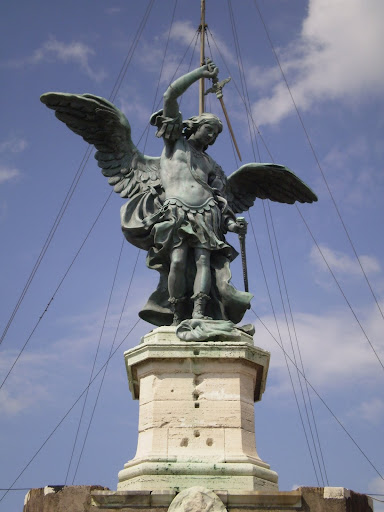
Feast of St Michael the Archangel - 29th September 2008

Let us read the commentary from Dr. Plinio Correa about St. Michael the Archangel.

The Church considers St. Michael, who stands between mankind and the Divinity, as the mediator of her liturgical prayer. God, who made the visible and invisible hierarchies with an admirable order, makes use of the ministry of the celestial spirits for his glory. The angelical choirs, who contemplate ceaselessly the face of the Father, know, better than men, how to adore and contemplate the beauty of His infinite perfections.

The Church on earth also invites the celestial spirits to praise and glorify the Lord, to worship and ceaselessly adore Him. This contemplative mission of the Angels is a model for us, as St. Leo reminds us in the beautiful preface of his Sacramental:

“It behooves us to render graces to Thee, who teaches us through Thy Apostle that our life is directed toward Heaven; that Thou dost benevolently desire that our spirits are transported to the heavenly region, the home of those whom we venerate, and that especially on this day, the feast day of St. Michael the Archangel, we ascend to these heights."


Comments of Prof. Plinio:

St. Michael is the chief of the Angels who fought against the Devil and the bad Angels and threw them into Hell. He is the chief of the Guardian Angels of individuals, and also of institutions. He himself is the Guardian Angel of the institution of all institutions, which is the Holy Roman Catholic and Apostolic Church. He has, therefore, a mission of tutelage. Regarding such mission, we can ask what relation exists between St. Michael’s first mission of defeating the revolted Angels and the protection he gives men in this valley of tears.

The two missions are linked. God wanted St. Michael to be His shield against the Devil in the first celestial fight. He also wants St. Michael to be the shield of men against the Devil, and the shield of the Holy Catholic Church as well. But St. Michael does not limit himself to be a shield of protection. He is also a sword to defeat and hurl the enemy into Hell. It is a double mission that is correlated.

For this reason, in the Middle Ages St. Michael was considered the first knight, the celestial knight: faithful, strong, and pure as a knight should be. He was also victorious, because he put all his trust in God, and after the birth of Our Lady, all his confidence in her.

It is this admirable figure of St. Michael whom we should consider our natural ally in the fights in which we are called to engage in defense of the honor of God, Our Lady, the Holy Church and Christian Civilization. With St. Michael as our model, we should defend them as a shield, and attack their enemies as a sword in order to destroy the Devil’s empire and establish the Reign of Mary on this earth. St. Michael should be our special patron.

The selection points to a particular aspect of devotion to the Angels that should be stressed. The Angels are inhabitants of the celestial court who continuously see God face-to-face. The apex of angelic and human happiness is to contemplate God, and this is the essence of life in Heaven; it is what makes Heaven the motherland of our souls. God continuously manifests new aspects of Himself that suffuse the Angels with happiness.

In epochs of true faith, something of this heavenly happiness filtrates to earth and is communicated to some pious souls, who, in their turn, express it to the entire Church and incorporate it into her spiritual treasure for us to share. Today we sorely lack this sense of heavenly happiness and, therefore, we have less appetite for Heaven. Many persons only have an appetite for earthly things. If they could understand for only one moment the consolation that comes from the consideration of heavenly things, they would understand how provisory earthly goods are, how worthless they are, how other values far transcend them. If they understood these things, they would be able to remove themselves from their attachment to earthly goods.

But, in our days, people are enthusiastic about money, petty politics, worldly things, the trivial life and its little news. They are no longer elevated souls who are enthused by great doctrinal problems and celestial things.

What we are so greatly lacking today is precisely what the holy Angels can obtain for us. They are inundated with a heavenly happiness, which they can communicate to us. So, let us ask them to give us the desire for celestial things. This is an excellent thing to ask on St. Michael the Archangel’s feast day, that we might model ourselves after him and become the perfect knights of Our Lady on this earth.

Sunday, September 28, 2008

St. Wenceslas - 28th September 2008

Today we celebrate the feast of St Wenceslas. Let us read the biographical account and the commentary about this saint from Dr. Plinio Correa


(Statue of St Wenceslas)

Duke, sovereign and patron saint of Bohemia, Wenceslas practiced the most beautiful virtues. He conserved intact all his life the treasure of virginity. His brother Boleslas, inspired by his own mother, murdered him as he prayed one night before the tabernacle in the palace chapel. Hungary, Poland and Bohemia all chose him as their patron saint.

St. Wenceslas is one of the most brilliant lights of the 10th century, called the iron century. Grandson of a saint and son of a fanatical pagan mother, he was the purest expression of the Christian royalty of his epoch. His royal birth ensured him the highest honors and made him the lieutenant of Christ and His authentic representative on earth.

As chief of the great Bohemian family, the king was the father of his people, and all - from greatest to smallest - had the right to appeal to his justice. King Wenceslas was known as the irrefutable arbiter of justice whose decisions were unmarked by personal interest. Indeed, having received everything from God, he gave no account for his actions to any save God. He became known as a great peacemaker in the many disputes of his people with the aim of uniting all in the common good. He ended his short term as King by receiving the crown of martyrdom.

The fame of the virtues St. Wenceslas spread everywhere. He was admired and beloved throughout Christendom. He was known as a friend of his people, dedicated to the service of his nation, austere and generous, protector of the poor, defender of the Faith, and a faithful subject of the Church. He was also a fearless and loyal warrior.

In 961 Emperor Otto I of Germany called Wenceslas to the Diet of Worms and conferred every attention on him. One day Wenceslas was at prayer in church and lost track of the time. When he finally arrived at the assembly, the Emperor and other Princes, irritated by his delay, had resolved to not rise at his entrance, as was the custom for sovereigns.

When the Duke appeared at the threshold of the hall, however, the nobles saw that he was flanked by two Angels. Overcome by admiration and respect, the Emperor stood to receive him and gave him the place of honor at his right. How could the nobles deny this honor to him when the Angels themselves paid him their respects? As a sign of his consideration, the Emperor gave him two precious relics: an arm of St. Vitus and the bones of another valiant warrior-sovereign, St. Sigismund, King of Burgundy.


(Altar of St. Wenceslas by Angelo Caroseli, 1627-30)


Comments of Prof. Plinio:


This last episode is so expressive that it surpasses anything else in the selection. So I will analyze it.

Let us recompose the scene. Wenceslas was the Duke and King of Bohemia, and he probably had some authority in Poland, since this nation also took him as their patron. Thus his government covered a large territory. The highest Princes in the Holy Roman German Empire were called together to meet at the Diet of Worms. Wenceslas was also invited to this Diet, since his territories were probably subject in some way to the Holy Empire. It was a very important meeting because it was not just a gathering of a King with his subjects, but a meeting where the Emperor met with Kings and Sovereigns. It was an assembly of sovereigns, manly and courteous.

There was a beautiful custom already established at that time. When a sovereign would enter, even if he had a lower standing than the Emperor, all the sovereigns present - including the Emperor - would rise. In this particular case, since Wenceslas was late, the other sovereigns decided to not pay him this tribute. He was late because he was praying in the church. But there is an infallible rule: those who do not pray much take a stern attitude toward those who do. Whenever they can, they take their revenge. So, those nobles, who probably knew that the Bohemian King had lost track of time in prayer, resolved to punish him. To teach him a lesson, they would remain seated when he entered.

How did Divine Providence respond to this decision? God sent two Angels to accompany him, so that when he entered the hall all the nobles gathered there saw them flanking St. Wenceslas. Thus, instead of meeting disgrace, the Saint was covered with glory and honor. The Emperor gave him two precious relics, one of a Warrrior King who, like St. Wenceslas, had defended the Faith. How many beautiful things there are in this episode!

Just one question remains to be answered: Why don’t things like this happen today? Why don’t we have manifestations of the supernatural that cover the good with glory and smash the evil?

It is because the sins of mankind have reached such an apex that men no longer deserve such apparitions. The Angels who accompanied St. Wenceslas were not there principally for him, who probably did not even see them, but for the public who witnessed the miracle. It was for the good of others that they appeared. Today the public do not deserve such marvels. If Angels were to appear, they would most probably raise hatred in the onlookers, who would not change their positions. The hearts of the public today are as hard as stones, a state that only a chastisement can change.

When miracles like these no longer happen, it is the sign that Divine Providence has abandoned a certain people, a particular cycle of civilization, an historic era. Instead, it becomes marked by the sign of punishment.

Let us pray to St. Wenceslas to be prepared for the chastisements predicted by Our Lady of Fatima so that mankind will enter another age where God will be honored and glorified and miracles will again take place.

Competition Winner

We have a winner of the competition for the picture of Padre Pio.

The winner is Shirley who has her own blog at http://wwwseekingjesus.blogspot.com/

Congrats to the winner, your picture will be in the post soon.

Thursday, September 25, 2008

A Video I really Like

This is a video I really like. What I specifically like about it is that it mentions that we fostered the scientific and investigative approach. Also we started the college (university) system. Just for my dear readers information these events happened in the middle ages (which the liberal media claims were a horrible time).

http://www.youtube.com/watch?v=Vs6qZd_xP1w

St Elzear - 25th September 2008

Today we celebrate the feast of St. Elzear. To be honest I have never heard of this saint and have enjoyed reading up about him from the commentary of Dr. Plinio Correa


Elzear of Sabran (1285-1325) was born in Saint-Jean de Robians in Provence, France. He was son of the Count of Ariano from the Kingdom of Naples, Italy. His mother consecrated him to God as soon as he was born and raised him with good customs. He was well educated in the eternal and human sciences, as well as in the exercise of weapons. He became an outstanding knight and a champion in the tournaments. He married Delphine of Glandèves. By common agreement, they lived a life of continence. Both belonged to the Third Order of St. Francis.

When his father died in 1309, he inherited the County of Ariano and went to Italy to assume the government. With John, the brother of the King of Naples, he commanded an army against Emperor Henry VII, who led the anti-papist Ghibelline party in Italy. After two battles, Elzear defeated the German sovereign, who died soon afterward in 1313. As reward for his victories, Count Elzear received many honors and prizes.

King Robert of Naples chose him to be head of the Counsel of the Kingdom of Naples. As a judge he acted with supreme severity against the guilty, be they corrupt nobles or the lawless bandits who infested the whole Kingdom, and often condemned them to death. But he always took great care of the souls of those men, providing them all spiritual assistance possible and asking the priests to remain with them from the moment of condemnation until the hour of death. He was also chosen to be tutor of Prince Charles, heir to the throne.

After four years of separation, Delphine joined him from France and found her husband among the brilliant courtiers wearing magnificent clothes. She feared that during this period of separation Elzear had forgotten his duties of religion and became worldly. He sensed her thoughts, and when the two were alone together, he opened his habit and revealed his hair-shirt underneath. He always remained faithful to the Franciscan spirit.

God granted Count Elzear the grace of an inalterable serenity. His face was always tranquil, communicating peace. Once he revealed to his wife that it was continuous meditation on Our Lord’s Passion that gave him this gift.

In addition to being a skillful warrior and politician, he was also an adept diplomat. He was sent to Paris as a representative of King Robert to ask the hand of the daughter of the Count of Valois for the Prince Heir of Naples. During this mission he became seriously ill and died on September 27, 1325.

He was buried in the Franciscan habit in the church of the Minor Conventuals at Apt. Many miracles were worked through his intercession. He was canonized 44 years later by Pope Urban V. His wife, Countess Delphine, was still alive.

Comments of Prof. Plinio:

We are given a picture of St. Elzear as a saint who was principally a warrior, a winner of battles and tournaments, a governor of his provinces, and a judge.

In that epoch war was preponderantly an ensemble of individual fights, knight against knight, and soldier against soldier. No one could be weak to fight. In today’s wars, a feeble man can be behind a machine gun and do a lot of damage. In that time, men of war had to be courageous, strong, and skillful in martial deeds. This was St. Elzear. He did not abandon the world with platitudes of hatred for war and love for peace. All his life he engaged in war or exercises preparing for it. Doing this, he became a saint. St. Elzear attained sanctity practicing the heroic virtues that shine in the life of a warrior.

Since he was from a very noble family, the Sabran family, he inherited the fief of his father and became Count d’Ariano in Naples. At that time, the Kingdom of Naples was governed by French Princes. So he also became a saint through the wise governance of his fief. Contrary to the images of saints normally put forth by a sentimental piety, which is also a little progressivist, St. Elzear lived the normal life of a noble at court, which at the time implied among other things, wearing magnificent clothes.

As a reward for his military conquests, the King of Naples made St. Elzear head of the Counsel of the Kingdom. To be charged with handing down Justice is a difficult mission. The fair-minded judge often has to rule against the great, powerful, and wealthy in favor of the small and poor. This kind of judge raises the scorn and anger of many important persons. St. Elzear was a judge who acted before God, making no compromises with men. He combated the corrupt nobles, but also the bandits.

You know that in Italy there is an organized drove of bandits – in Sicily and Calabria it is called the Mafia, and in Naples the Camorra. At that time similar groups of bandits were probably in existence and found in St. Elzear an implacable enemy. But as a perfect Catholic, his behavior was entirely balanced: he condemned the guilty to death for the necessity of the common good, but then he took an exquisite care of their souls, trying to save them by all possible means. Death for the body, yes; but life for the soul.

One would say that a man with such extraordinary qualities to direct a fief and distribute justice, a prince in the court and a lion in the war, would be a pretentious man, quick to anger, stern and arrogant. But he was not that at all. He was most affable and serene with a pacific physiognomy. Here we have a harmonic contrast characteristic of a soul that lives in sanctifying grace.

Another contrast in his life appears in another episode from the selection. St. Elzear held an important position at court; he was a noble in the fullest sense of the word who carried out with dignity his duties as courtier. Therefore, he dressed in magnificent clothes.

When his wife joined him in Naples after four years she was surprised by the magnificence of his clothes and company, and feared that he had become worldly. When they were by themselves, he opened his fine outer clothing a bit and showed her the discipline that he wore under it. That is to say, he remained the same penitent, detached person he had been before. He wore those magnificent garments to properly fulfill his noble duties and uphold the situation he occupied at court. It is another contrast that is the fruit of grace.

The life of St. Elzear is very rich in contrasts and examples for those who do not have a religious vocation, but are called to live in the world as laypeople.

Let us ask him for confidence in the power of grace, and balance to live our vocation with the needed dignity, brilliance and nobility while maintaining a detached spirit. Like him, we should do everything for the glory of God, and not for ourselves.