Evil triumphs when good men do nothing - Edmund Burke

Saturday, January 10, 2009

St Gregory of Nyssa - 10th January 2009


The son of two saints, Basil and Emmilia, young Gregory was raised by his older brother, St. Basil the Great, and his sister, Macrina, in modern-day Turkey. Gregory's success in his studies suggested great things were ahead for him. After becoming a professor of rhetoric, he was persuaded to devote his learning and efforts to the Church. By then married, Gregory went on to study for the priesthood and become ordained (this at a time when celibacy was not a matter of law for priests).

He was elected Bishop of Nyssa (in Lower Armenia) in 372, a period of great tension over the Arian heresy, which denied the divinity of Christ. Briefly arrested after being falsely accused of embezzling Church funds, Gregory was restored to his see in 378, an act met with great joy by his people.

It was after the death of his beloved brother, Basil, that Gregory really came into his own. He wrote with great effectiveness against Arianism and other questionable doctrines, gaining a reputation as a defender of orthodoxy. He was sent on missions to counter other heresies and held a position of prominence at the Council of Constantinople. His fine reputation stayed with him for the remainder of his life.

For the works of this saint please refer to the CCEL web site at the following link

http://www.ccel.org/ccel/schaff/npnf205.toc.html

Wednesday, January 7, 2009

St. Raymond of Penyafort - 7th January 2009

Today we celebrate the feast of St. Raymond of Penyafort. Let us contemplate about this saint through the insights of Dr. Plinio


Biographical selection:

Raymond (1175-1275) was born into a wealthy and noble family related to the royal family of Aragon. He was born at the Castle of Peñafort in Villafranca, near Barcelona, Spain, in 1175.

At age 20 he was already teaching philosophy at Barcelona. After 15 years, he resigned from that chair and went to Bologna to study civil and canon law. He received his doctorate in 1216 and occupied a first chair of canon law in the university for three years.

The city Senate, hoping to retain him in the city, presented him with special rewards for his work. However, he did not remain, because Pope Honorius III asked him to return to Spain to tutor King James I of Aragon.

He had been attracted to the Dominican Order by the preaching of Blessed Reginald, prior of Bologna, and also met St. Dominic of Gusman there. In Barcelona he received the Dominican habit in 1222. His example attracted many great personages to the Order.

During his novitiate, he asked a penance for his past vanities while teaching, and he was ordered to write a book on cases of conscience for the guidance of confessors and moralists. This work, entitled The Summa of Penitential Cases, or Summa Casuum, was the first guide of this kind to be compiled. His work was praised by Pope Clement VIII.

In 1229 Pope Gregory IX sent the Cardinal of Sabina, John of Abbeville, to Spain to convoke the princes of the region and stimulate them to continue the valiant fight against the Moors. The Cardinal invited St. Raymond, who had been his theologian and penitentiary, to be his first assistant. St. Raymond would enter a city, preach the crusade to the people, and hear confessions in order to prepare the public for the arrival of the Cardinal. Then the Cardinal of Sabina would come to bless the crusade and grant the Papal indulgences for it.

When the Cardinal of Sabina returned to Rome, he reported to the Pope the great merits of St. Raymond. Pope Gregory IX was impressed and summoned him to Rome to be his chaplain and confessor. One of the penances Raymond would give the Pope was to not delay in seeing to the needs of the poor.

Pope Gregory IX gave St. Raymond the job of ordering and codifying the canon laws of the Church. It was an immense work, since he had to rewrite and condense decrees that had been accumulating for centuries. Completed in 1234, the work remained the most authoritative compilation within the body of canon law until 1917, when a new code was published. Due to the excess of work, St. Raymond fell ill. Fearful that he would die if he remained in Rome, his physicians recommended that he return to his monastery in Barcelona.

At the request of various Bishops, he set out the ceremonial to be followed by Bishops when they visited diocesan churches. He also composed a treatise on fair price in commerce to keep merchants from stealing from the public.

One of the most brilliant rays of St. Raymond’s glory was to assist in founding the Order of Our Lady of the Mercy, or Mercedarians, for the redemption of the captives. The order was established because of a heavenly revelation made simultaneously to King James I of Aragon, St. Raymond, and St. Peter Nolasco.

To inaugurate the new Order, the King with his court and the Magistrates of the city of Barcelona assisted at solemn ceremony in the Cathedral of the Holy Cross. Bishop Berengarius said the Holy Mass, and St. Raymond delivered the sermon in which he described the triple heavenly revelation ordering the founding of the new order. At the Offertory the King and St. Raymond presented St. Peter Nolasco to the Bishop as its first superior and he received the new habit from the Bishop. In his turn, St. Peter received thirteen nobles as the first members of the newly-born Order. When the Mass ended, the Monarch processed out with St. Peter and his monks to his palace, where he had reserved a wing of it to be their first Monastery. St. Raymond never ceased his work in spreading the Order of the Mercedarians until the end of his life.

By another revelation from God, St. Raymond was given to know that God wanted the conversion of the Moors and Jews who were numerous in Spain. From then on, he made special efforts to achieve this aim. He founded institutes at Barcelona and Tunis for the study of Eastern languages in order to convert the Moors and Jews. By 1256, he was able to write to his Superior telling him that 2,000 Mohammedans had received Baptism.

Many Muslim clerics, however, were very proud and did not want to change their thinking. So St. Raymond asked St. Thomas Aquinas to write a work to convince them of their errors and help them convert to the truth of the Catholic Church. This is how the Summa contra gentiles, The Summa against the Gentiles, one of St. Thomas’ most famous works, was born. It occasioned many conversions of the Muslim clergy.

St. Raymond reached an extreme old age. He died peacefully on January 6, the Feast of the Epiphany, in 1275, at age 100. On the feast day when God was glorified by the Kings symbolizing all the peoples, this man who had fought so much for the conversion of the gentiles died. During his last moments, the Kings of Aragon and Castile were visiting him and had the privilege to receive his last blessing.


Comments of Prof. Plinio:

The life of St. Raymond, which is characteristic of the Middle Ages, suggests some considerations regarding the good acceptation of the Saints by society and its consequences for the glory of God.

According to Catholic doctrine, it is very difficult for anyone to be in the state of grace. Because of original sin, it is impossible, naturally speaking, for anyone to be in the state of grace, that is, to share the supernatural life of God. Even after Baptism, man cannot practice durably all the Commandments of God. He may practice all of them at times, or else habitually practice only this or that Commandment, but he cannot practice all the Commandments durably. He needs supernatural grace for that.

God gives sufficient grace to practice the Commandments to all Catholics. No one is excluded. As long as one prays for this, he will receive abundant graces that will reinforce the actual grace and help him to do what is right. With this, then, a man can be in the state of grace and durably maintain it.

Given man’s social nature, when many persons are in the state of grace it becomes easier for each individual to maintain it. Therefore, when you have a considerable number of persons in a city who live in the state of grace, you can say with a certain imprecision that this city is in the state of grace.

Properly speaking a city does not have a soul. It has something analogous to a soul which is the moral entity formed by the interaction among the individuals of the city and their mutual influence on one another. This moral entity has a certain unity that defines the city. Our Lord himself confirmed this reality when He cried over Jerusalem and lamented as if He were speaking to a person: “O Jerusalem, Jerusalem, thou that kills the prophets, and stoned them that are sent to thee, how often would I have gathered together thy children, even as a hen gathers her chickens under her wings, and thou would not?” (Mat. 23:37)

Therefore, one can say that God has determined plans for this or that city. One can also say that a city is or is not faithful to the grace, or even that a city is or is not in a state of grace.

Now then, how can one know when this or that city is in a state of grace and is corresponding to the plans God has for it?

Someone might immediately object: It is impossible to know when an ensemble of individuals is in a state of grace, because those persons can be pretending that they are in the state of grace when they really are not.

The objection presents a good point. Further, along those same lines, if someone were to ask an individual if he is in the state of grace, he would have the right to hide his interior state. He is only required to answer to his confessor, no one else. Therefore, it would seem impossible to know when an ensemble of persons is in a state of grace.

Notwithstanding, there is a test that we can apply to know when a city or an epoch is in a state of grace, and it works very well.

When persons in the state of mortal sin are together, there are three possible degrees of evil that can result. In the first degree, there are simply those who are in mortal sin, and nothing further. In the second degree, there are those who are glad to be in mortal sin; they have antipathy toward those who are in the state of grace. In the third and worse degree, there are those who promote mortal sin; they are openly hostile to those in the state of grace; they hate those who are good. Among those who represent these three degrees a curious psychological phenomenon takes place: they instinctively form a front against the good.

The consequence is that in a city where many people are in state of mortal sin, good persons are not well-received. On the contrary, in a city where many people are in the state of grace, the good are very well-received.

In epochs when saints are the object of general enthusiasm, one can say that most of the population is living in the grace of God. On the contrary, in epochs when saints are persecuted, it can be said that most of the population is not in the grace of God. The way an epoch treats a saint is the way it treats God. Most of the inhabitants of that epoch reveal their position before God in this way. The saint is an image of God; whoever loves the image, loves God, and whoever hates the image, hates God.

When we study the lives of the saints, we can analyze how the people of their times treated them. If they were treated well, this reveals an epoch in which most of the people were in the grace of God. The opposite is also true.

When an epoch is living in the grace of God, the seeds of a Catholic Civilization are planted and, from there will take root and grow. When this Civilization is established, it will influence more people to live in the grace of God.

The life of St. Raymond of Peñafort is a remarkable example of this. His brilliant career, the influence he exerted on Popes and Cardinals, Kings and Magistrates, the cities that he conquered by his wisdom and that sought to keep him and not let him go, the unremitting success of his sermons and exhortations, and the fruitful result of his initiatives show the general approval he received from the people of his epoch. That epoch must have been an epoch in which most of the people were in the grace of God.

From these considerations about the life of St. Raymond of Peñafort, we see that to build a Catholic Civilization is not an impossible dream. To work for the Reign of Mary is not a chimera. It is a promise of Our Lady of Fatima that will be realized. She foretold: “In the end my Immaculate Heart shall triumph.” Her heart symbolizes her spirit, her mentality. What will she triumph over? First, she will triumph over the errors of Russia – Communism – that she came to denounce, and then the entire Revolution of which Communism is just one step.

This promise points to an enormous chastisement that will come to open the doors of an epoch when saints with the mentality of Our Lady will govern humankind. She will govern through her saints. They will return to influence Popes and Kings, the great and small ones on earth, and bring all to her.

Let us ask Our Lady through the intercession of St. Raymond of Peñafort to make us worthy of be living stones of this new era.

Tuesday, January 6, 2009

St. Gregory Nazianzen - 6th January 2009

Today we celebrate the feast of St. Gregory Nazianzen. Let us read what Dr. Plinio has to say about this saint. I particularly like the section dealing with Temperance, a virtue which I need to practice more.


Biographical section

St. Gregory of Nazianzus, or St. Gregory Nazianzen, fourth century, was Patriarch of Constantinople and a close friend of St. Basil. A writer and orator, he fought against the Arians. He is a Father and a Doctor of the Church.

When he was already advanced in the practice of virtue and piety, Gregory was favored with a mystical vision that gave him a special esteem for chastity. He described it:
“I saw two young virgins dressed in white. They wore no superfluous ornaments, as is so common to women, but they were very beautiful. A veil covered each of their heads and also hid part of their faces. They kept their eyes modestly lowered and were silent. I felt a great joy penetrating my whole soul. I asked them who they were and whence they came.

"‘We are chastity and temperance,’ they replied. ‘We stand on either side of the throne of Christ. Join us, and we will bring you to contemplate the Eternal Trinity.’

“From that moment on, I sought out the company of those who were chaste, and renounced the pleasures of the flesh, even the legitimate bonds of matrimony. I bent myself to the yoke of temperance and frugality and dedicated myself to the reading of books about God. I also avidly read works against heretics. I continued to cultivate the arts with the sole purpose of helping me to acquire true knowledge, for I never preferred human science to the Divine Scriptures.”
Comments of Prof. Plinio:

This beautiful vision of St. Gregory of Nazianzus reflects elements of classical culture. You know that the time in which he lived was still influenced by the art and symbolism of classical Roman-Greek culture. One of the artistic customs was to symbolize virtues and qualities by abstract personages – men or women.

You can see that in this vision God Himself used the same artistic practice to make St. Gregory understand the worth of chastity and temperance. He presented them as two young ladies, equally beautiful, with a symmetric grace and charm that allowed them to stand at both sides of the throne of Our Lord Jesus Christ. That is, they are symmetric adornments for the King of glory and Redeemer of the human race.

St. Gregory described the young ladies as modest and recollected, with lowered gaze, to indicate that such virtues require one to be concerned about superior things and to avoid dissipation and superficiality. These two virtues are placed on either side of the throne of Christ to show that Our Lord has a special love for these virtues and wants to honor them in a singular way.

Why are chastity and temperance sister-virtues?

What is chastity? Chastity, you know, is abstention from the pleasures of the flesh. Even if the person is married, if both the husband and wife agree to the arrangement, perfect chastity can be practiced. It represents the complete triumph of the spirit over the flesh, a complete detachment from the flesh’s instincts to leave the spirit greater freedom to rise to higher spheres of thought, which are the proper habitation for the soul.

What is temperance? Temperance is a cardinal virtue, one of the four fundamental virtues of Catholic moral behavior. Temperance is the virtue by which the person regulates his actions following the norms of reason. Instead of conceding to the impetus of his instincts, he acts following the counsels of reason in all things. It is wise, because the first responses of the instincts are disordered; they need to be corrected and tamed. This means that there is a temperate way of speaking, eating, sleeping, studying, and doing everything else. The essence of temperance, therefore, is the submission of the instincts to the guidance of reason. Temperance is wisdom governing all human internal movements.

What is the relation between temperance and chastity? It is simple, chastity is temperance applied to the sexual instinct. It is an aspect of temperance. But it is such an important aspect that normally it is considered as a separate virtue. This affinity of chastity and temperance explains why they appear as twin virtues that stand near the throne of Christ in St. Gregory’s vision.

This subject matter raises a parallel question that seems opportune to address. As single lay people, should we strive to acquire such virtues? Should we be chaste and temperate? Of course we should. But let me answer an objection that says the opposite.

During the pontificate of Pius XII, some second-rate theologians came up with a bizarre thesis that proposed every lay person should either marry, or become priests or religious. According to their theory, anyone who wants to be single and chaste should become a priest; if not, he or she should marry. These theologians represented a small minority, and no one learned in Church History paid any attention to them. Soon, the theory was no longer even mentioned. However, this narrow mentality remained present in some traditionalist ambiences that suffered the influence of those theologians. For this reason, still today at times we face an accusation that stems from this false view: “You cannot be lay, single and chaste; you should either marry or enter the priesthood.”

The reality is much more subtle and diversified than the simplified alternative: “Marry or be a priest.” This sophism is based on a generalization that supposes there are only two kinds of people, those able to maintain complete chastity and those who cannot. The former should not marry and serve the Church as priests or consecrated religious; the latter should marry in order not to sin and to perpetuate the species.

Even though the rule is correct, and this is actually one of the reasons for marriage, the argument is wrong because it does not consider the many exceptions the rule supposes. According to this false presupposition, it would be not possible to marry and remain a virgin, as St. Joseph and the Blessed Virgin Mary did; as St. Henry, Emperor of the Holy Roman Empire, and his wife Empress St. Cunegundes did, as well as many other saints. Also it would be impossible for a lay man to be single and be chaste as was St. Casimir, King of Poland, or St. Rose of Lima, who never became a religious. The list of saints who represent exceptions to the rule is long. But this is not my point at the moment. I mention it to show that the simple existence of such saints destroys the narrow-minded sophism.

Here I will present two other arguments. First, St. Thomas Aquinas offers a picturesque metaphor to explain the rule of marriage and chastity. He says that marriage represents the feet of mankind, since it is by means of marriage that the human race perpetuates itself and therefore walks onward. Chastity represents the eyes of mankind, given that it is by means of chaste persons that humanity sees the far horizons. He stresses that one of the main characteristics of chastity is to give broad horizons.

It is a valid comparison, because to consider only the practical aspect, married persons normally are so taken up with raising their families, they usually have little time to think of other things. The single person can maintain himself with much less effort, and therefore has more time for higher studies or causes.

If we were to take this comparison of St. Thomas, however, and apply it to the simplified rule we are refuting, “Marry or be a religious,” then the lay man or woman would be excluded from viewing the broad horizons of Christendom and the Catholic Church, which is perfectly absurd, given the enormous number of single lay people who became great warriors, politicians, scientists, poets etc. exactly because they had such horizons.

Second, it was so common in History for persons to choose to be lay, single, and chaste that they formed movements that assisted the Church in fields where ecclesiastics cannot act. For instance, what would the Middle Ages be without the knights errant, most of them living single, chaste, and turned to the defense of widows and orphans? But a priest, who is forbidden to shed human blood, could not be a knight errant.

What about the many Orders of Chivalry dedicated to defending the Catholic possessions in the Holy Land? The same is true, since ecclesiastics could not perform this task. Until today, some of these orders have a special status for their single and chaste members. How many centers of studies and arts, diverse movements that brought great benefits for Christendom – in the past or present – were made up of single chaste lay men or women? We see that the sophism incurs an erroneous generalization.

These are some lessons we can learn from the beautiful vision described by St. Gregory of Nazianzus. Let us ask him to help us to more firmly maintain and constantly increase our understanding of the fight for Christendom and the Catholic Church, and for that, to be chaste and temperate as he was.


Saturday, January 3, 2009

The twin commandments of love

The Lord himself came, the Teacher of love, full of love, shortening the word upon the earth, as it was foretold that he would do. He showed that from the two precepts of love depend the whole of the Law and the prophets.

What are these two commandments? Join me, my brethren, in recollecting them. They ought to be thoroughly familiar to you and not just come into your mind when we recite them: they ought never to be blotted out from your hearts. Always and everywhere, bear in mind that you must love God and your neighbour, love God with all your heart, and with all your soul, and with all your mind; and love your neighbour as you would love yourself.
We must always ponder these words, meditate them, hold them in our minds, practise them and bring them to fruition. As far as teaching is concerned, the love of God comes first; but as far as doing is concerned, the love of our neighbour comes first. Whoever sets out to teach you these two commandments of love must not commend your neighbour to you first, and then God, but God first and then your neighbour. You, on the other hand, do not yet see God, but loving your neighbour will bring you that sight. By loving your neighbour you purify your eyes so that they are ready to see God, as John clearly says: If you do not love your brother, whom you see, how can you love God, whom you do not see?

You are told “Love God”. If you say to me “Show me whom I should love”, what can I say except what John says? No man has ever seen God. But you must not think yourself wholly unsuited to seeing God: God is love, says John, and whoever dwells in love dwells in God. So love whoever is nearest to you and look inside you to see where that love is coming from: thus, as far as you are capable, you will see God.

So start to love your neighbout. Share your bread with the hungry, bring the homeless pauper into your house. Clothe the naked, and do not despise the servants of your kin.
What will you get from doing all this? Your light will break forth like the dawn. Your light is your God, your dawn, because he will come to you to end the night of this world — he who, himself, neither rises nor sets but is eternal.

By loving your neighbour, by having care for your neighbour, you are travelling on a journey. Where are you journeying, except to the Lord God, whom we must love with all our heart and all our soul and all our mind? We have not yet reached the Lord, but our neighbour is with us already. So support your neighbour, who is travelling with you, so that you may reach him with whom you long to dwell.

Friday, January 2, 2009

St. Basil the Great - 2nd January 2009

Today we celebrate the feast of St. Basil the Great. Let us read the commentary of Dr. Plinio.

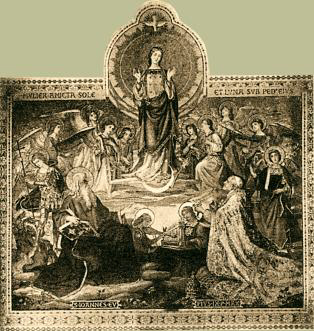
(The subject of the altarpiece is St. Basil Celebrating Mass in the presence of the Arian Emperor Valens.)

Biographical selection (from The Golden Legend):

Basil was a venerable Bishop and an eminent Doctor. His life was written by Amphilochius, Bishop of Iconium.

Basil’s great holiness was made manifest in a vision granted to a hermit named Ephrem, who, being rapt in ecstasy, saw a column of fire the tip of which touched heaven, and heard a voice from above saying: “Basil is as great as the immense column you see before you.”

Ephrem therefore went into the city on the feast of the Epiphany because he wanted to look upon this great man. When he saw the Bishop clothed in shining white vestments moving solemnly in procession with his clergy, he said to himself:

“I know now that I have gone to all this trouble for nothing! This man who lives surrounded by such honors certainly cannot be the great saint I expected to see! How could such a man in such glory be seen by Heaven as a column of fire in preference to us, who bear the burden of the open seasons in our hermitages.”

Basil knew in spirit what was going through Ephrem’s mind and had the hermit brought before him; and when he came to the Bishop’s presence, he saw a tongue of flame coming out of the Bishop’s mouth as the hermit spoke. “Truly Basil is great,” Ephrem exclaimed, “truly Basil is a column of fire, truly the Holy Spirit speaks through his mouth!” And to the Bishop, Ephrem said: “I beg of you, my lord, to obtain for me the ability to speak Greek.” Basil replied: “You have asked for something very strange.” Nevertheless he prayed for the hermit, who at once began to speak Greek.

There was another hermit who, seeing Basil somewhere in procession in his episcopal robes, despised him, thinking in his heart that the Bishop took much pleasure in such pomp. And a voice spoke to him, saying: “You there, you have more delight in stroking yuour cat's back in your hermitage than Basil takes in the apparel of his dignity!”

Emperor Valens, who was partial to the Arians, confiscated a church that belonged to the Catholics and gave it to the heretics. Basil went to the Emperor and said: “Your Majesty, it is written that the honor of the king loves judgment, and the judgment of the king loves justice. Why then has your heart ordered that the Catholics be excluded from their church and it be given to Arians?”

“So there you are, Basil,” the Emperor retorted, “shaming me again! This is unworthy of you!”

Basil replied: “What is worthy of me is to die, if I must, for justice!”

Then Demosthenes, who was in charge of the Emperor’s table and was also a partisan of the Arians, spoke in defense of the heretics and treated the Bishop insolently. “Your business is to cook chicken for the Emperor,” Basil answered, “and not to cook divine dogmas!” The steward, in confusion, had no more to say.

Valens now addressed the Bishop: “Basil, go and give judgment in this case, but do not be swayed by immoderate love of the people.” So Basil went before the Catholics and the Arians and proposed that the doors of the church be closed and sealed with the seal of each party, and that the church would belong to the party at whose prayer the doors opened. This satisfied everybody. The Arians then prayed for three days and three nights, but when they came to the church the next morning, the doors were not opened. Then Basil led a procession to the church, prayed, gave the doors a light blow with his pastoral crook, ordering them to open. The doors flew open at once, all the people went in, thanking God, and the church was returned to the Catholics.


Comments of Prof. Plinio:

These are beautiful stories, each one of which would deserve a special comment.

They are stories lacking historical rigor, since they are semi-legend. The Golden Legend is made up of semi-historical legends. Some of these things happened, others did not. And the true events are not necessarily narrated just as they happened. They were embellished by the imagination of the medieval people. Notwithstanding, they have a great spiritual value because they indicate how the piety of those people so filled with devotion painted the figures of the saints. This cannot simply be dismissed as a lie, because it is not.

St. Basil lived in a time of many heresies. He waged an enormous fight against the Arian heresy and also against the Emperor. In general the Emperors of Byzantium wanted to control the Church. Since the Catholic Church did not allow them to do this while the Arian bishops permitted it, the Emperors supported Arianism. According to Catholic doctrine, the Church is a perfect society, that is, in the spiritual sphere she is a sovereign society that can be governed only by herself, using her own authority. Following this doctrine the Catholic Church stood as a natural obstacle to the absolutism of the Byzantine Emperors, and they persecuted her.

The heresy of Arianism was devastating the East. The Greek Byzantium spirit was very arrogant and scorned Rome. This arrogant attitude toward Rome was one reason why the Eastern ecclesiastics invented so many sophisticated heresies in contrast with the holy simplicity of Catholic doctrine taught by Rome.

Notwithstanding, that time saw the blossoming in the East of a great grace, the grace of the eremitic state of life. This eremitic life was understood with much greater rigor than it is in modern times. The true hermit is not one who lives in a house with others. When many live together, each one is a cenobite, not a hermit. The hermit lives completely alone. He used to live in places without great beauty, like a cave or a desert, so as not to distract his imagination and senses. When a person lives isolated, entirely alone, conditions are created for his spirit to grow and fly. He is able to concern himself principally with superior things, and doing this he draws near to God.

This eremitic state appeals to the Eastern psychology. The Eastern man knows how to deal with solitude. His state of spirit abounds in imagination and fantasy, in the good sense of the word. He knows how to see the countless marvels of silence, the innumerable attractions of solitude. The Western man, especially if he is contaminated by the spirit of the Revolution, often is blind to these values.

In this East, replete with its bad and good aspects, we see the great figure of St. Basil, and also some hermits who opposed him.

It has always happened in the History of the Church that when the ideal of poverty is raised, some have exaggerated it and arrived at a bad consequence, which is to combat the pomp and richness of the institution of the Church. For example, after St. Francis of Assisi preached his ideal of poverty, some Franciscans initiated the Fraticelli heresy, which was communist, went against the right of private property, and was opposed to any notion of honor, pomp, and brilliance in the Church and Catholic Civilization.

The same thing happened at the time of St. Basil. Some hermits, accustomed to living in complete poverty and solitude, without servants or pomp, made this erroneous reasoning: “If I would live in pomp, I would lose my soul; therefore all those who live in pomp lose their souls.” The first part of this reasoning is true, the second is false. Each person saves his soul by following the road God chose for him. So the hermit saves his soul in the cave, but another can also save his soul serving God amid riches and pomp.

Because of this problem, two hermits saw St. Basil in his Episcopal grandeur and doubted his sanctity. The two episodes were described in the Golden Legend with a great psychological accuracy. The first one, the hermit Ephrem, was a man moved by impressions, not by principles as he should have been. He saw a column of fire, was impressed, and believed in the sanctity of St. Basil. He saw the saint in his ceremonial pomp, had a negative impression and doubted his sanctity. St. Basil had him brought before him to talk with him, and Ephrem immediately had a different impression. After that, to confirm in his mind the sanctity of Basil, he asked for a miracle – yet another impression. By giving the miracle, God was confirming the thesis that one can be a saint and live in Episcopal pomp. It was the right thing to do with a man moved by impressions. This type of psychology was very well pictured in the text.

The second hermit represents the sentimental man turned toward small comforts and affections. He was attached to his cat. One can imagine that for a certain type of person to live outside of life in society can be a relief – no one to bother you, no tragic temptations of sin, a life with all the practical problems resolved and a great deal of tranquility. Instead of striving foremost for a great union with God, he was turned toward enjoying his tranquility. All these bad tendencies were summarized in the enjoyment he took in petting his cat. The Golden Legend discerned the defect of the man and refuted his objection by saying that St. Basil was less attached to his Episcopal position than the hermit was to his cat. Again, it was a subtle way to resolve the problem for the reader and move him toward God.

These two cases are presented in a light and delicate manner that lets the reader understand the solution to a greater problem, the balance between poverty and riches in the Church. So, even if these incidents did not take place historically, the pictures they present give us a good fruit: the understanding that it is normal to have both riches and poverty in the Church.

The episode of St. Basil before Emperor Valens is also very well described. From the Emperor’s comment – “So here you are, Basil, shaming me again!” – you can see that St. Basil attacked the Emperor many times.

Then the kitchen chef enters and tries to defend the Arians and impress the Monarch with his knowledge of theology. St. Basil has this response that puts everything in its place: “Your business is to cook food. It’s my business to cook the dogmas. So stop talking about things you don’t understand.”

You can see that this episode follows the same style. One reads it, smiles, and understands. It is a lesson well given.

The last episode with the Arians is also piquant. The Emperor had given a Catholic church to the Arians and the Catholics were upset. He invites St. Basil to find a just solution. The saint proposes a judgment by God. The church doors are duly closed and sealed and both parties, Catholic and Arian, each one in its turn, are asked to approach to ask God to open the doors. The one whose cause is right will be heard by God. The Arians make their futile prayers and nothing happens. Then St. Basil approaches, followed by his clergy in a grandiose procession, and the doors of the church open. The Catholics are the ones in the right, God listens to them.

Even if these things did not happen exactly this way, there is a residual of truth in these stories. What is being affirmed here is that piety should feed the capacity for the marvelous in the human soul. This kind of piety existed in the Middle Ages and was objectively reported by Jacobus de Voragine. It is a type of piety open to the marvelous that exists in the supernatural life, which is a participation of the marvelous that exists in Heaven.

When we read these stories in the Golden Legend we experience a great relief. We feel removed from the monstrosities we are witnessing today that come from the Revolution and the progressivist Church. Reading these texts we are charmed and we marvel. They raise a hymn of admiration in our souls for that spirit which inspired them. When we finish reading and we have to return to normal life, we feel something like a soul who would have just seen Heaven and now had to return to Purgatory.

Let us pray to Our Lady to give us the spirit of admiration that inspired these texts. A disinterested and humble spirit that is able to be moved by this marvelous order of things, which is the most profound aspect of reality and gives us a pre-taste of Heaven. It is an order of things that exists in Heaven, which souls who know how to admire can already begin to appreciate in this life.

Wednesday, December 31, 2008

Ordination of a close family member

Dear Readers,

I have been away this Christmas to attend the ordination of a dear family member who was ordained a priest. He belongs to the order which is called the Heralds of the Gospel a link of which can be found at the link list of this blog.

Below I am embedding 2 videos of the ordination. It would be really nice if my readers could visit the TV website of the Heralds of the Gosple at TV Arautos


Friday, December 12, 2008

Our Lady of Guadalupe – 12 December 2008

Our Lady of Guadalupe is the Patroness of the Americas. Let us read what Dr. Plinio has to teach us about this feast day.


Biographical Section

These are some of the dialogues between Our Lady and Juan Diego, taken from written narrations inspired by the account of Indian scholar Antonio Valeriano around the middle of the 16th century.

In the first apparition, Our Lady addressed Juan Diego, speaking in the Mexican idiom: “Juanito, my son, the humblest of my children, where are you going?"

"Noble lady, I go to the church in Tlatelolco to listen to such divine matters as our priests teach us," he replied.

She said, “Know for certain, dearest of my sons, that I am the perfect and ever-Virgin Mary, Mother of the true God, the Lord of all things and Master of Heaven and Earth. I ardently desire a temple to be built here, where I will show and offer all my love, compassion, help, and protection to the people and those who look for me. I am your merciful Mother, the Mother of all who live in this land and of all mankind. I will hear the weeping and sorrows of those who love me, cry to me, and have confidence in me, and I will give them consolation and relief.

“Therefore, so that my designs might be fulfilled, go to the house of the Bishop of Mexico City and tell him that I sent you, and that it is my desire to have a temple built in this place. Tell him all that you have seen and heard. Be assured that I shall be grateful and will reward you for diligently carrying out what I have asked of you.”

Juan Diego bowed low and said, “My holy one, my Lady, I will go now and do all that you ask of me. Thy humble servant bids thee farewell.”

The second apparition: That same afternoon Juan Diego returned to the hilltop from the Bishop’s palace where he had delivered the message. The Holy Virgin was waiting for him. He told her:

“Noble lady and most loved Mistress, I did what you commanded. Even though it was difficult to be admitted to speak with the Bishop, I saw His Excellency and communicated to him your message. He received me kindly and listened with attention. But when he answered me, it seemed as if he did not believe me. …

“So I beg you, noble Lady, entrust this message to someone of importance, someone well-known and respected, so that they might believe in him. For I am a nobody, a piece of straw, a lowly peasant, and you, my Lady, have sent me to a place where I have no standing. Forgive me if my answer has caused you grief or displeasure, my Lady and my Mistress.”


The third apparition: The Holy Virgin insisted that she wanted Juan Diego to give her message to the Bishop. He did so, and this time the Indian returned to Our Lady saying that the Bishop had asked for a sign to prove that what he said was true.

Our Lady told him: “Very well, my dear little one, return here tomorrow and you will take to the Bishop the sign he has requested. With this he will believe you and no longer doubt you or be suspicious of you. Know, my beloved little one, that I will reward your solicitude, effort and fatigue spent on my behalf. Go now. I will await you here tomorrow.”

The fourth apparition: The next day, instead of going to the hilltop, Juan Diego took a different route that bypassed it to find a priest for his uncle who was gravely ill. Juan Diego was certain that Our Lady would not see him.

But she appeared to him along the road he had taken and asked him: “What is this, my little son? Where are you going?”

Juan Diego answered: “My loved Lady, God keep you! How are you this morning? Is your health good, my dearest Lady? It will grieve you to hear what I have to say. My uncle, your poor servant, is sick. He has taken the plague and is near death. I am hurrying to your house in Mexico City to call a priest to hear his confession and give him the last rites. When I have done this, I will return here immediately so I may deliver your message. Forgive me, I beg you, my Lady, be patient with me for now. I will not deceive you and tomorrow I will come in all haste.”

She answered: “Listen to what I am going to tell you, my son, and let not your heart be disturbed. Do not fear that plague or any other sickness or anguish. Am I not here, I, who am your mother? Are you not under my protection and care? Am I not your life and health? Are you not in the folds of my mantle and the embrace of my arms? What else do you need? Do not be grieved or disturbed by anything.”

She then told him that he should not worry about the sickness of his uncle, for he would not die at this time and that, in fact, he was already cured.

Calling herself Holy Mary of Guadalupe, she told Juan Diego to go up the nearby hilltop where he would find flowers aplenty, even though it was winter. He found Castilian roses and gathered many and placed them in his tilma, a long cloak used by Mexican Indians. He came back to the Virgin, who rearranged them and commanded him to go to the Bishop without opening it until he was in the Prelate’s presence.

After a long wait and much difficulty getting past the servants of the palace, Juan Diego finally stood before the Bishop. He unfolded his tilma, and the roses fell out. The Bishop and his attendants fell on his knees before him, for a life-size figure of the Holy Virgin was printed on the poor tilma of Juan Diego. It was December 12, 1531.

Comments of Prof. Plinio:

There are many aspects of these apparitions that have often been the subject of commentaries: that Our Lady chooses simple and pure souls to speak to mankind, that she is pleased to appear to humble peasants, that she challenges the human respect of her emissaries, etc. I think that these are good points, but they have already been stressed

An aspect that receives less attention that I believe is very interesting is the attitude of the Indian Juan Diego before Our Lady and the language he used to address her. His manner and language have an extraordinary tonus that corresponds to Our Lady’s attitude toward him from the beginning of the apparition. Our Lady treated him as a dearly loved son, with an extraordinary kindness, as if he were a child.

There is a marvelous contrast we can see in the general conduct of Our Lady. On one hand, there is the love she has for great souls, the heroic souls who accomplish great things in the lives of peoples and civilizations; on the other hand there is the love she has for small, simple souls entirely turned toward her and forgetful of their own virtue. It is marvelous to see how she speaks to these small souls with love and a particularly touching tenderness.

The attitude of Juan Diego is also interesting. He is a simple man, without any education, but in his simplicity he addresses Our Lady as a truly courteous man. He greets her, he inquires about her well being, he describes how he executed the mission he received as if he were a real diplomat, and he explains to Our Lady the practical cause for his failure.

He had presented himself in the Bishop’s palace to transmit the message of Our Lady and was treated disdainfully by the servants and valets of the palace. So he reasoned thus: If I were a noble and powerful man, I would be well received and my message would have more credibility.

He thought he was doing a good thing by giving this counsel to Our Lady: You should choose someone important to deliver your message; then the Bishop will receive him well and everything will go as you have asked. One sees in him the humble desire to not appear or shine and also, to a certain measure, his desire to avoid trouble. So in his charming simplicity he gave her that advice.

There are many qualities in this response, but here I want to stress his tact. He gives her a fine diplomatic counsel to resolve the situation. He also closes his suggestion in a courteous way: My Lady, I beg you not to be displeased with me. It was not my intention to anger or irritate you.

That is to say, he found a good way to excuse himself while presenting his suggestion. He is a simple peasant, but we can see a certain nobility in this attitude. One can also see that Our Lady liked the way he presented his idea. She probably smiled kindly at his diplomatic advice, but she did not accept it. On the contrary, she asked that he return to speak with the Bishop.

It seems that Juan Diego was willing, but found that he needed to postpone the task. His uncle was sick and seemed close to death, so he went to find a priest for him. He thought that Our Lady could wait until the next day. But she caught him on the different route he took to avoid her. Then she not only cured his uncle, but worked the miracle the Bishop had demanded. So finally, with that miracle, the apparition of Our Lady was approved by the Bishop.

There is a lesson for us in this episode: Wherever true virtue exists, courtesy and noble manners develop as a consequence of it. The opposite is also true: When virtue is no longer present, courtesy and nobility of manners disappear. Juan Diego was from a very simple social level; notwithstanding, he acted as a noble when he dealt with Our Lady.

The Catholic courtesy that bloomed in Europe was, at base, a daughter of the virtue that society practiced in the Middle Ages. When this virtue died away and the Revolution started to be accepted by society, courtesy lost its root and began to move toward the complete brutality of manners that exists in Communist countries or the blatant vulgarity that prevails in the Western countries that adhered to egalitarianism.

Tuesday, December 9, 2008

St. Juan Diego - 9th December 2008

Juan Diego was born in 1474, eighteen years before Columbus discovered America. He was born in the village of Cuautitlan, (Place of the Eagle) Mexico, located fourteen miles north of Tenochtitlan, now Mexico City. He was a Chichimeca of the Family of Texcoco. His Indian name was Cuauhtlatoatzin that means “He who speaks like an eagle”.

Juan received an early education according to the pre-Hispanic traditions, including the knowledge of “the one true God for whom one lives.” Later he married his wife, Malintzin, and they had children. He was a landowner, a small farmer and was involved in textile manufacturing. He had a good deal of property, some he inherited, and the rest came from his mat making business. He made mats from the reeds growing along the shores of Lake Texcoco.

Juan lived in Mexico before and after the Spanish Conquest of 1521 and before the establishment of Jamestown, Virginia, the first permanent English colony, in 1607. The Conquest was an apocalyptic event for the indigenous peoples. They lost their freedom, their land, their religion, their culture, their society and their great city of Tenochtitlan. Juan’s life bridged two cultures from the pre-Conquest worship of false gods and the human sacrifices made to appease them to the post-Conquest worship of the One True God and the end of human sacrifice.

After the Conquest, Juan converted to Christianity between 1524-25 and was baptized, together with his wife by the Franciscan missionary, Fray Toribio de Benavente whom the Indians called “Motolinia” or “the poor one”. He was baptized as Juan Diego (John) and she was baptized as Maria Lucia (Mary). In 1524 they celebrated the sacrament of Matrimony. Shortly later, they heard a sermon regarding how the virtue of chastity is pleasing to God. By mutual consent they decided to live their marriage thereafter as celibates, until Maria Lucia’s death in 1529. After that, Juan lived with his uncle, Juan Bernardino, in the village of Tolpetlac, located nine miles from Tlaltelolco where they attended Mass.

Ten years after the Conquest on Saturday, December 9, 1531, 57-year-old Juan, a recent widower, began his nine-mile walk from his home in Tolpetlac probably to Tlaltelolco near Mexico City “in pursuit of God and His commandments”, according to the Nican Mopohua, the earliest account of the apparitions written in 1545. Juan was walking to attend Mass and catechetical instructions.

Then, from the top of the hill, he heard a sweet feminine voice affectionately call him by name, “Juan, dearest Juan Diego.” He quickly climbed to the top of the hill to see who was there. He saw a beautiful young lady. Her dress shone like the sun and transformed the appearance of the rocks and plants on the barren cactus hill into glittering jewels. The ground glistened like the rays of a rainbow in a dense fog.

She identified herself to him as “the perfect and perpetual Virgin Mary, Mother of the one true God for whom one lives . . . .” She entrusted a mission to him to request Bishop Zumarraga to build a church on the hill so that she could manifest her Son to all of the people. She said, “I ardently desire that a little sacred house be built here for me where I will manifest Him, I will exalt Him, I will give Him to the people through my personal love, through my compassionate gaze, through my help and through my protection. Because I am, in truth, your merciful Mother and the mother of all who live united in this land and of all mankind, of all those who love me, of those who cry to me, of those who have confidence in me. Here I will hear their weeping and their sadness and will remedy and alleviate their troubles, their miseries and their suffering.”

(The rest of this Story will continue on the Feat of Our Lady Of Guadalupe on the 12th December 2008)

Juan Diego is a saint not because Our Lady appeared to him, but because he exercised heroic virtues. In his beatification address, Pope John Paul II praised Juan’s virtues, “his simple faith, nourished by catechesis and open to the mysteries; his hope and trust in God and in the Virgin; his love, his moral coherence, his unselfishness and evangelical poverty.

"Living the life of a hermit here near Tepeyac, he was a model of humility. The Virgin chose him from among the most humble as the one to receive that loving and gracious manifestation of hers which is the Guadalupe apparition. Her maternal face and her blessed image which she left us as a priceless gift is a permanent remembrance of this. In this manner she wanted to remain among you as a sign of the communion and unity of all those who were to live together in this land. . . .”

Juan exhibited the Marian virtues of humility, obedience, charity, trust, patience, poverty and chastity.

Like Mary, who saw herself as the lowly handmaid of the Lord, Juan saw himself as a nobody. Like Mary, who obeyed and accepted to be a mother to carry Christ, Juan obeyed and accepted to be carrier of the message of Mary. Like Mary, who in charity cared for her elderly pregnant cousin Elizabeth, Juan cared for his elderly dying uncle, Juan Bernardino. Like Mary, who “trusted that the Lord’s promise to her would be fulfilled” (Lk. 1:45), Juan trusted Our Lady’s promise that the Bishop would recognize her will and fulfill it through the sign of the roses. Like Mary, who patiently waited for nine months for the Lord’s promise to be fulfilled, Juan patiently waited for days for Our Lady’s promise to be fulfilled. Like Mary, who lived in poverty and chastity as a widow, Juan, the widower, gave up his possessions and lived in poverty and chastity until his death. Finally, like Mary, Juan didn’t argue with God’s will, he didn’t complain and he didn’t doubt. He simply did as he was asked, endured the derision of the Bishop’s servants and persevered in fortitude, as did Mary who endured the derision of her detractors who accused her of adultery.

At Juan’s canonization Mass, Pope John Paul II said, “With deep joy I have come on pilgrimage to this Basilica of Our Lady of Guadalupe, the Marian heart of Mexico and of America, to proclaim the holiness of Juan Diego Cuauhtlatoatzin, the simple, humble Indian who contemplated the sweet and serene face of Our Lady of Tepeyac, . . . . Blessed Juan Diego, a good, Christian Indian, whom simple people have always considered a saint! …

“In this new saint you have a marvelous example of a just and upright man, a loyal son of the Church, docile to his Pastors, who deeply loved the Virgin and was a faithful disciple of Jesus.”

Before his final blessing, the Holy Father said, “You have now in your new saint a remarkable example of holiness. . . . May he be a model for you and others that you may also be holy.”

Juan’s mission resulted in the largest mass evangelization in the history of the world. Nine million indigenous peoples of Mexico were converted to the one true God in nine years, the practice of human sacrifice ended in Mexico and the indigenous peoples were reconciled to their Spanish conquerors, intermarried with them and formed the new Mexican race.

During his homily at Juan’s canonization Mass, Pope John Paul II remarked on the formation of the Mexican people and said, “In accepting the Christian message without forgoing his indigenous identity, Juan Diego discovered the profound truth of the new humanity, in which all are called to be children of God. Thus he facilitated the fruitful meeting of two worlds and became the catalyst for the new Mexican identity, closely united to Our Lady of Guadalupe, whose mestizo face expresses her spiritual motherhood that embraces all Mexicans.”

Monday, December 8, 2008

The Immaculate Conception and the enemies of the Catholic Church

The following is a summary of a lecture given By Dr. Plinio about the Immaculate Conception of the Blessed Virgin Mary.


One of the truly Counter-Revolutionary acts of Pope Pius IX’s pontificate was the proclamation of the Immaculate Conception.

There are three reasons the definition of this dogma was especially Counter-Revolutionary and therefore hateful to the enemies of the Church.

First Reason:An Anti-Egalitarian Dogma
As you know, this dogma teaches that Our Lady was immaculate at her conception, meaning that, at no moment, did she have even the slightest stain of Original Sin. Both she, and naturally Our Lord Jesus Christ, were exempt from that rigid law that subjugates all other descendants of Adam and Eve.

Thus, Our Lady was not subject to the miseries of fallen man. She did not have bad influences, inclinations and tendencies. In her, everything moved harmonically towards truth, goodness and therefore God. In this sense, Our Lady is an example of perfect liberty, meaning that everything her reason, illuminated by Faith, determined as good, her will desired entirely. She had no interior obstacles to impede her practice of virtue.

Being “full of grace” increased these effects. Thus, her will advanced with an unimaginable impetus towards everything that was true and good.

Declaring that a mere human creature had this extraordinary privilege makes this dogma fundamentally anti-egalitarian, because it points out an enormous inequality in the work of God. It demonstrates the total superiority of Our Lady over all other beings. Thus, its proclamation made Revolutionary egalitarian spirits boil with hatred.

Second Reason:The Unsullied Purity of Our Lady
However, there is a more profound reason why the Revolution hates this dogma.

The Revolution loves evil and is in harmony with those who are bad, and thus tries to find evil in everything. On the contrary, those who are irreproachable are a cause of intense hatred. Therefore, the idea that a being could be utterly spotless from the first moment of her existence is abhorrent to Revolutionaries.

For example: Imagine a man who is consumed with impurity. When besieged by impure inclinations, he is ashamed of his consent to them. This leaves him depressed and utterly devastated.

Imagine this man considering Our Lady, who, being the personification of transcendental purity, did not have even the least appetite for lust. He feels hatred and scorn because her virtue smashes his pride.

Furthermore, by declaring Our Lady to be so free from pride, sensuality and the desire for anything Revolutionary, the proclamation of the Immaculate Conception affirmed that she was utterly Counter-Revolutionary. This only inflamed the Revolutionary hatred of the dogma all the more.

Disputing the Doctrine:A Counter-Revolutionary Struggle

For centuries, there were two opposing currents of thought about the Immaculate Conception in the Church. While it would be an exaggeration to suggest that everyone who fought against the doctrine was acting with Revolutionary intentions; it is a fact that all those who were acting with Revolutionary intentions fought against it. On the other hand, all those who favored its proclamation, at least on that point, expressed a Counter-Revolutionary attitude.

Thus, in some way the fight between the Revolution and Counter-Revolution was present in the fight between these two theological currents.

Third Reason:The Exercise of Papal Infallibility
There is still another reason this dogma is hateful to Revolutionaries: it was the first dogma proclaimed through Papal Infallibility.

At that time, the dogma of Papal Infallibility had not yet been defined and there was a current in the Church maintaining that the Pope was only infallible when presiding over a council. Nevertheless, Pius IX invoked Papal Infallibility when he defined the Immaculate Conception after merely consulting some theologians and bishops.

For liberal theologians, this seemed like circular reasoning. If his infallibility had not been defined, how could he use it? On the contrary, by using his infallibility, he affirmed that he had it.

This daring affirmation provoked an explosion of indignation among Revolutionaries, but enormous enthusiasm among Counter-Revolutionaries. In praise of the new dogma, children all over the world were baptized under the name: Conception, Concepcion or Concepta to consecrate them to the Immaculate Conception of Our Lady.

Pius IX:Bringing the Fight to the Enemy
It is not surprising that Pius IX so adamantly affirmed Papal Infallibility. Very different from those who succeeded him, he was ever ready to bring the fight to the enemy. He did this in Geneva, Switzerland, which then was the breeding ground of Calvinism, which is the most radical form of Protestantism.

When Swiss laws changed to allow a Catholic Cathedral in Geneva, Pius IX ordered that a statue of the Immaculate Conception be placed in the middle of the city, to proclaim this dogma in the place where Calvinists, Lutherans and other Protestants denied it more than anywhere else. This is an example of Pius IX’s leadership in the fight against the Revolution.

It is therefore entirely proper that all Catholics entertain a special affection for the dogma of the Immaculate Conception, which is so detested by the enemies of the Church today.

Wednesday, December 3, 2008

St. Francis Xaviers - 3rd December 2008


Today we celebrate the feast of St. Francis Xavier. He is the patron saint of our family. This is because we studied in St. Xavier's in Mumbai named after this great saint. Let us read the commentary that Dr. Plino has written about this Jesuit Saint.

Biographical selection:

St. Francis Xavier (1506-1552), born of a noble Spanish family, Jesuit missionary and confessor, Apostle to the Far East and special patron saint of the Missions.

The biography of St. Francis Xavier by Daurignac reprints a section of a letter he wrote to Dom John III, King of Portugal:

“My Lord, Your Highness should fear the moment when God will call you to stand before Him, which will happen without fail and perhaps when you least expect it. You should fear, great Prince, that an irate Judge will address you with these terrible words of accusation:

‘Why have you not proceeded with rigor against your ministers and subordinates who plotted against Me in India and did not fear to declare themselves in rebellion against Me? Why was your severity lax except when they failed to pay their taxes or were negligent in the administration of your finances?’

“My Lord, then you will answer God with the following excuse of little value:

‘For Thy glory I wrote to those countries every year recommending the greatest zeal in working for Thee and obeying Thy precepts.’

“Then the Lord will say to you:

‘Yes, you did so, but you did not punish all those who were indifferent to those orders.’”

Comments of Prof. Plinio:

It is a very beautiful text. You should consider that at that time the King of Portugal had important lands in India. In an annual letter to his subordinates, he recommended that they do everything possible to promote the Catholic Faith.

However, St. Francis Xavier, who was there making his apostolate, witnessed that those orders were not followed and that those officials even plotted to prevent the Catholic Faith from expanding. They were decadent men, probably linked to some sort of Masonry that was already secretly acting against the designs of the King of Portugal to sabotage the spread of the Catholic Faith.

St. Francis Xavier wrote to the King, giving him this warning: It is not enough to send orders; it is necessary to punish those who disobey you, because a command unaccompanied by punishment of those who flout it is a futile thing without value. It will not stand before God as the accomplishment of your duty.

He told him: You, the King, have the obligation to punish those who violate your orders to uphold and spread the Faith as strongly as you punished those who did not pay their taxes to the Crown. If you punished them for the taxes and not for religion, it means that you consider taxes more valuable than the Catholic Faith.

Then, the Saint warned the King: You should be aware that God may call you at any moment and then you will not be able to escape His judgment.

Indeed, at any moment he could have an accident, an attempt against his life could be made, he could become gravely ill, or some other such thing could bring him before the tribunal of God. Then, how would the King respond to God regarding the use of his power?

St. Francis Xavier reminded him of two principles: first, the temporal power’s principal concern should be to expand the Catholic Faith rather than increase the royal fortune; second, the exercise of his power should be accompanied with the threat of punishment for those who disobey his orders. The King will have to answer to God for that.

It is admirable to see the liberty with which St. Francis Xavier addressed one of the powerful men of the time. In times past, when someone used this kind of frankness, it was termed in ecclesiastical language “apostolic frankness.” It is a beautiful expression that reveals the courage an apostle must have. He is a representative of God and must use the language of God. Therefore he has the right to say the most unpleasant things to the most powerful men, and he has the right to be heard.

St. Francis Xavier spoke to the King, realizing the serious possibility that his words might change the King’s way of acting. In any circumstance, he fulfilled his duty and the warning was given. From that moment on, the King had to answer for his actions in that matter before God.

You see how this behavior is logical, noble, and beautiful. But you also see that today it seems outdated. Not because such behavior became obsolete in itself, but rather because men became so decadent and lax that they no longer want to hear such words. For this reason, today’s progressivist Catholics would accuse St. Francis Xavier of lacking charity for speaking in this way. They would say that this kind of admonition showed that he was lacking in the Catholic spirit.

People who say this are wrong, because here we have the words of one of the greatest saints of the Catholic Church, St. Francis Xavier, who spoke this way. The saints did not use the honeyed language of this false ecumenism that is everywhere in today’s Church.

This text of St. Francis Xavier is a confirmation that our anti-progressivist position is correct. The words of the true Catholic apostle should be like his. We should pray to him and to Our Lady that, until we die, we always have the courage to use this language.

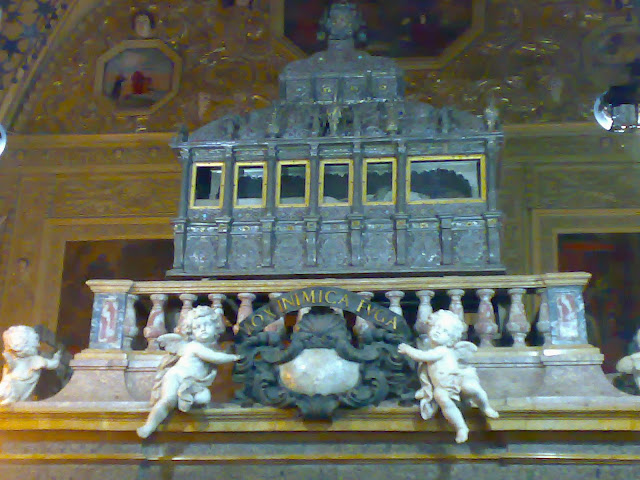
(The body of St Francis Xavier in Goa, India)

Tuesday, December 2, 2008

Been Busy

To my dear readers,

I have been busy. Busy preparing for a little spiritual holiday a retreat in a way. My only sibling is going to be ordained in a nice South American country. It will be the first time that my parents, my wife and my sibling will be in the same country at the same time, an occasion which has not happened for over at least 7 or 8 years.

We shall all attend his ordination and then spend Christmas together and then once he is ordained he will say a special mass for our wedding aniversary. All in all I am a happy about all of this.

And yet I worry, the recent terrorist attacks in Mumbai and the growing tension between India and Pakistan might spill into a war which might prevent my parents from traveling. So do keep us in your prayers that we all have a safe journey.

And I shall put up some pictures on my return.

Wednesday, November 26, 2008

St. Leonard of Port Maurice - 26 November 2008


Saint Leonard of Port Maurice was the Son of Domenico Casanova, a sea captain, and Anna Maria Benza. Placed at age thirteen with his uncle Agostino to study for a career as a physician, but the youth decided against medicine, and his uncle disowned him. Studied at the Jesuit College in Rome. Joined the Riformella, a branch of the Franciscans of the Strict Observance on 2 October 1697, taking the name Brother Leonard. Ordained in Rome in 1703. Taught for a while, and expected to become a missionary to China, but a bleeding ulcer kept him in his native lands for the several years it took to recover and regain his strength.

Sent to Florence in 1709 where he preached in the city are nearby region. A great preacher, he was often invited to other areas. Worked for devotion to the Blessed Sacrament, Sacred Heart, Immaculate Conception, and the Stations of the Cross. Established the Way of the Cross in over 500 places, including the Colosseum. Sent as a missionary by Pope Benedict XIV to Corsica in 1744. He restored discipline to the holy orders there, but local politics greatly limited his success in preaching. He returned exhausted to Rome where he spent the rest of his days.

It is very profitable for the soul that all Catholics read this sermon of the saint 'The little Number of Those who are saved'

Tuesday, November 25, 2008

Thoughts on family


Lately, I have been worried that my orthodox views will get me and my family in trouble. More particularly that i would be killed or jailed and that my family would suffer. While roaming around on the blogs i noticed that many Catholic men had this same worry. Then last night as I was stepping out of the bathtub and wiping myself dry something hit me. A scripture verse to be precise. 'If anyone puts family of friends before me he is not worth to enter the Kingdom of God' BANG like a bolt from the blue. All my worries about what would happen to my family vanished. I thought about it more, if I did not put God first then I would be really losing my family, but if I did put God first, it would appear that I would be losing my family for now but in the end when it mattered I would gain family. This corresponds with another bible verse ' He who loses his life for my sake gains it and He who tries to save his life will lose it'. My life to me is my family. Thus i think God is asking me to put Him first above even Family. After all he gave me the gift of life and family and He has the right to take it away if He so chooses.

St. Catherine of Alexandria – 25 November 2008

Today we celebrate the feast of St. Catherine of Alexandria. Let us contemplate what Dr. Plinio has to say about this saint.

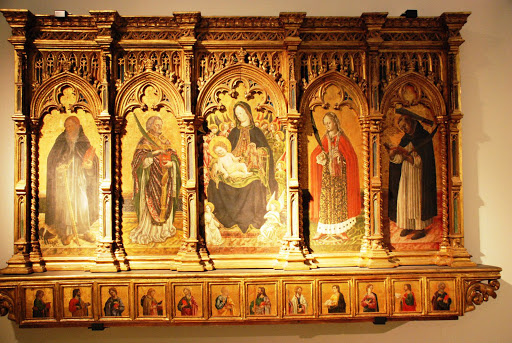
(Torchiara Polyptych. 1462 Madonna and Child and Angels, St. Nicodemus, St Catherine of Alexandria, and St. Peter. On the predella, the twelve Apostles.)

Biographical Section

After the unsuccessful attempt to kill St. Catherine on the wheel, Emperor Maxentius ordered her to be beheaded. She was conducted to the place of her martyrdom followed by a multitude, mainly ladies of high condition who wept at her fate. The virgin walked with a great calm. Before dying she said this prayer:

“Lord Jesus Christ, my God, I thank Thee for having firmly set my feet on the rock of the Faith and directed my steps on the pathway of salvation. Open now Thy arms wounded on the cross to receive my soul, which I offer in sacrifice to the glory of Thy Name.

“Forgive the faults I committed in ignorance and wash my soul in the blood I will shed for Thee. Do not leave my body, slaughtered by love for Thee, in the power of those who hate me. Kindly regard this people and give them the knowledge of the truth. Finally, O Lord, in Thy infinite mercy exalt those who will invoke Thee through me so that Thy name be always glorified.”

After saying these words, she told the soldiers to execute their orders, and she was beheaded with but one blow of the sword. It was November 25 (around the year 310).

Soon numerous miracles began to take place. Her body, as she had asked, was carried away by Angels and buried on Mount Sinai so that she might rest where God had written on stone His law, which she had so faithfully kept written on her heart.

Comments of Prof. Plinio:

This excerpt from the life of St. Catherine of Alexandria is so elevated that I lament commenting on it. It would be better to leave it shining alone on the horizon. But since I am asked to analyze it, I will say some words.

The first thing that occurs to me is the good position of the ladies of high society of those times. Today, such ladies often form a network that slanders and disparages the good cause. What a great potential there was in that country, where the ladies of high condition followed St. Catherine to the place of martyrdom, weeping for her, sympathetic for her, a martyr whose life would be snuffed out by the Emperor’s hatred. The Emperor was omnipotent; he could condemn any of them to death; notwithstanding they were there with St. Catherine.

It is beautiful to see the contrast of spirits in the picture and the different graces the Holy Ghost was giving. The ladies were weeping, probably touched by the gift of tears. But St. Catherine did not weep, she was calm, serene, and walked unswervingly toward death, inundated by another kind of grace of the Holy Ghost. She did not weep over her own situation, that martyrdom which grace moved the others to lament. One can imagine how impressive it was to see that cortège of ladies walking between aisles of soldiers and then to find that the only one who was serene, counseling the others to be tranquil, was St. Catherine, who was shortly to die.

Then, before her life ended, she said a prayer. It has the beauty of shining lights that fill the skies and emanate from many places. They do not come from just one source, from one central idea.

So, she began: “Lord Jesus Christ, my God.” Even as the Emperor tried to oblige her to adore the idols, she affirmed the divinity of Our Lord to show that she did not recognize any other god but Him.

The next thing she said, “I thank Thee for having firmly set my feet on the rock of the Faith and directed my steps on the pathway of salvation.” That is to say: I thank You for making me belong to You, the source of my salvation. You are the origin of every good that exists in me. I am good because You are good and gave me the solidity of the Catholic Faith; You made me love virtue and gave me the firmness to practice it. I recognize that everything that exists in me came from You.

She continued: “Open now Thy arms wounded on the cross to receive my soul, which I offer in sacrifice to the glory of Thy Name.” Nothing more beautiful can exist! She asked her Crucified Lord to open His bloodied arms to receive her soul as she left this life, which also saw its earth soaked with the blood of her martyrdom. What a marvelous intimacy! What an encounter: the Martyr of martyrs Our Lord Jesus Christ and this heroic and grandiose martyr St. Catherine of Alexandria! What a magnificent thought, that her blood should intermingle with the blood of Our Lord! What a profound idea of the communion of saints is expressed in such a desire! She had such a great certainty that she would be received into Heaven that she asked Our Lord to embrace her. How admirable such certainty is!
Then she said: “Forgive the faults I committed in ignorance and wash my soul in the blood I will shed for Thee.” She was afraid that she had committed some faults, and she asked to be washed clean by the merit of her martyrdom.

“Do not leave my body, slaughtered by love for Thee, in the power of those who hate me.” After having asked Our Lord to attend to her soul, she asked refuge for her body. You can see the respect she had for her own body, for the sanctity of the body that was her companion in the practice of virtue. And what a magnificent response to this request! Soon after she died, the Angels came and transported her body to the most majestic mountain that exists on earth after Mount Calvary, which is Mount Sinai, where God gave His Law to men.

“Kindly regard this people and give them the knowledge of the truth.” She was no longer thinking of herself, but of the ones she was leaving behind.

“Finally, O Lord, in Thy infinite mercy, exalt those who will invoke Thee through me, in order that Thy name be always glorified.” She was so certain that she would go to Heaven that she was already interceding for those who would pray to her.

Once this prayer was said, she calmly told the soldiers to carry out her sentence. No trembling, no desire to prolong her life a little more. Also, no precipitation, which sometimes is a reflection of fear. No. She said everything she wanted to say, and when she finished, she delivered herself into the hands of God. The soldiers beheaded her, and immediately afterward, her prayer started to be answered.

What grace should we ask of St. Catherine of Alexandria? We should ask her that when the chastisement predicted in Fatima will be realized and we face the enemies of the Church and Christendom, that we have the same serenity she had in face of death. It is a serenity that only grace can give. In face of death, there are two kinds of serenity: one is the serenity of the idiot, another is the serenity that comes from grace. Death, the separation of the body and soul, the apparent plunging into nothingness, is such a terrible thing that only two kinds of serenity are comprehensible: that of the idiot who never measures the consequences of anything, or the serenity of the man inundated by grace.

So then, let us ask St. Catherine to help us be calm in every situation in our lives, and especially in the risks and dangers of life, and even in the extreme sacrifice of death, if that should be the will of Our Lady for us.

Monday, November 24, 2008

St. Andrew Dung-Lac and Companions - 24th November 2008


St. Andrew was one of 117 martyrs who met death in Vietnam between 1820 and 1862. Members of this group were beatified on four different occasions between 1900 and 1951. Now all have been canonized by Pope John Paul II.
Christianity came to Vietnam (then three separate kingdoms) through the Portuguese. Jesuits opened the first permanent mission at Da Nang in 1615. They ministered to Japanese Catholics who had been driven from Japan.
The king of one of the kingdoms banned all foreign missionaries and tried to make all Vietnamese apostatize by trampling on a crucifix. Like the priest-holes in Ireland during English persecution, many hiding places were offered in homes of the faithful.
Severe persecutions were again launched three times in the 19th century. During the six decades after 1820, between 100,000 and 300,000 Catholics were killed or subjected to great hardship. Foreign missionaries martyred in the first wave included priests of the Paris Mission Society, and Spanish Dominican priests and tertiaries.
Persecution broke out again in 1847 when the emperor suspected foreign missionaries and Vietnamese Christians of sympathizing with the rebellion of one of his sons.
The last of the martyrs were 17 laypersons, one of them a 9-year-old, executed in 1862. That year a treaty with France guaranteed religious freedom to Catholics, but it did not stop all persecution.
By 1954 there were over a million and a half Catholics—about seven percent of the population—in the north. Buddhists represented about 60 percent. Persistent persecution forced some 670,000 Catholics to abandon lands, homes and possessions and flee to the south. In 1964, there were still 833,000 Catholics in the north, but many were in prison. In the south, Catholics were enjoying the first decade of religious freedom in centuries, their numbers swelled by refugees.
During the Vietnamese war, Catholics again suffered in the north, and again moved to the south in great numbers. Now the whole country is under Communist rule.

Sunday, November 23, 2008

Bl. Miguel Pro

Here is a comparatively rare event in the history of the Church: a camera is witness to a martyrdom. The whole affair was orchestrated in 1927 by a fierce enemy of the Church whose savage blows only served to strengthen and glorify both her and the individual victims of his wrath.

A sketch of Bl. Miguel Pro's life brings to mind the story of his spiritual forbears, the martyr-priests in post-Reformation England. Like them, he lived at a time when his nation's leaders turned against the Church. The young Jesuit novice went into exile during the Mexican revolution; like many seminarians during the English persecution, Miguel Pro had to study for the priesthood abroad; he was ordained in Belgium on August 31, 1925. Like his English forbears, Fr. Pro conducted his ministry on the sly, and frequently in disguise.

Fr. Pro was known not only for his devotion and prayerfulness, but also for his wit, his playfulness and his good cheer, especially in the face of a distressing stomach ailment. He was much loved; however, he was eventually betrayed to the authorities and ultimately condemned to death on a trumped-up charge of attempting to assassinate the vice-president.

On the day of Fr. Pro's execution by firing squad, the fiercely anti-Catholic president Plutarcho Calles brought the press out to photograph the event, secure in the belief that he would thereby prove that impending death reduced Catholics to sniveling cowards. In the first photograph above, we see Fr. Pro praying, the picture of serenity in the face of the violent death from which he is only moments away. The next photograph shows Fr. Pro confronting the firing squad, sans blindfold, his arms raised in the form of the cross, with a crucifix in one hand and a rosary in the other. Fr. Pro forgave his executioners; and as they took aim, he shouted his last words, "¡Viva Cristo Rey! (Long live Christ the King!)." The firing squad was so shaken by his courage that it succeeded only in wounding him; in the final photograph, a soldier dispatches the fallen priest at point-blank range.

Naturally, these photographs had the opposite effect to that intended; Plutarcho Calles ended up confiscating and outlawing them. And Calles obviously did not succeed in entirely destroying the camera's witness to Fr. Pro's courage, since they survive down to the present day.

(Courtesy[V for Victory!] blog )

Friday, November 21, 2008

The Presentation of the Blessed Virgin Mary - 21th November 2008

Today is the feast of The Presentation of the Blessed Virgin Mary which is a fixed Holy Day on the calendar. Let us contemplate on this feats by reading the commentary of Dr. Plinio.


Biographical selection:

The cult to Our Lady was born in the East; from there also we received the feast of the Presentation of Our Lady, where it was celebrated from the end of the seventh century. In the West, Pope Gregory XI adopted the feast day in 1372 at the pontifical court of Avignon.

A year later, King Charles V introduced the feast of the Presentation at the royal Chapel in Paris. In a letter dated November 10, 1374 to the masters and students of the College of Navarre, he expressed his desire that such a feast should be celebrated throughout the kingdom. The text of the letter reads:

'Charles, by the grace of God King of France, to our dearly beloved: health in Him Who ceases not to honor His Mother on earth. '

'Among other objects of our solicitude, daily occupation, and diligent meditation, that which rightly occupies our first thoughts is that the Most Blessed Virgin and Holy Empress be honored by us with very great love, and praised as it is due. For it is our duty to glorify her, and we, who raise the eyes of our soul to her on high, know what a incomparable protectress she is to all, how powerful a mediatrix she is with her Blessed Son for those who honor her with a pure heart .... This is why we wish to stimulate our faithful people to celebrate this feast, as we ourselves intend to do by God's assistance every year of our life. We send to you the liturgy of said feast to increase your joy.'
Such was the language of princes in those days. Then also at that very time, that wise and pious King, following up the work begun in Britigny by Our Lady of Chartres, rescued France from its fallen and dismembered condition.

Comments of Prof. Plinio:

In other words, the feast of the Presentation of Our Lady followed extraordinary historic circumstances. It was a Pope who introduced it in the West, and the King of France who spread it throughout his country. And from France it extended to the whole world. The King took up the feast to thank Our Lady of Chartres for her protection in the battle of Britigny, where the French army defeated its adversaries.

What does the feast of the Presentation celebrate? It celebrates the fact that the parents of Our Lady brought her to the Temple at the age of three and handed her over to live there for a long period as a virgin consecrated to the Temple, contemplating God exclusively.

What is the special beauty of this feast? Our Lady was the one chosen before time began, the Queen of Jesse from whom the Messiah would be born. The Temple was the only place in the Old Testament where sacrifices were offered to God. It represented, therefore, the only true religion. Our Lady being received at the Temple was the first step to the fulfillment of the promise that the Messiah would come to the true religion. It was the encounter of hope with reality.

When she was received at the Temple, Our Lady entered the service of God. That is, a soul incomparably holy entered the service of God. At that moment, notwithstanding the decadence of the nation of Israel, and even though the Temple had been transformed into a den of Pharisees, the Temple was filled with an incomparable light that was the sanctity of Our Lady.

It was in the Temple atmosphere that, without knowing it, she began to prepare herself to be the Mother of Our Lord Jesus Christ. It was there that she increased her love of God until she formed the ardent desire for the imminent coming of the Messiah. It was there that she asked God the honor to be the maidservant of His Mother. She did not know that she was the one chosen by God. This is so true that she wondered about the meaning of the salutation of the Archangel Gabriel when he greeted her to ask her permission for the Incarnation. That preparation for Our Lady to be the Mother of Jesus Christ began with the Presentation at the Temple, the feast the Church celebrates on November 21.

Is there a grace we should ask on this day? We should ask for spiritual help to be better prepared to serve God as Our Lady did. But the best way to serve God is to serve Our Lady herself. So, on this feast day we should re-present ourselves before Our Lady, asking her to receive our offer of service and to give us her assistance in the task of our sanctification, just as the Holy Ghost helped her at the Temple of Jerusalem.


Tuesday, November 18, 2008

DEDICATION OF THE CHURCHES OF ST PETER AND ST PAUL AT ROME - 18th November 2008

(Pope John Paul II prays at the tomb of St Peter)

The Vatican Church, dedicated in honour of St. Peter, is the second patriarchal church at Rome, and in it reposes one half of the precious remains of the bodies of SS. Peter and Paul. The tombs of the great conquerors and lords of the world have been long since destroyed and forgotten; but those of the martyrs are glorious by the veneration which the faithful pay to their memory.

The body of St. Peter is said to have been buried immediately after his martyrdom, upon this spot, on the Vatican hill, which was then without the walls and near the suburb inhabited by the Jews. The remains of this apostle were removed hence into the cemetery of Calixtus, but brought back to the Vatican. Those of St. Paul were deposited on the Ostian Way, where his church now stands. The tombs of the two princes of the apostles, from the beginning, were visited by Christians with extraordinary devotion above those of other martyrs. Caius, the learned and eloquent priest of Rome, in 210, in his dialogue with Proclus the Montanist, speaks thus of them: "I can show you the trophies of the apostles. For, whether you go to the Vatican hill, or to the Ostian road, you will meet with the monuments of them who by their preaching and miracles founded this church."

The Christians, even in the times of persecution, adorned the tombs of the martyrs and the oratories which they erected over them, where they frequently prayed. Constantine the Great, after founding the Lateran Church, built seven other churches at Rome and many more in other parts of Italy. The first of these were the churches of St. Peter on the Vatican hill (where a temple of Apollo and another of Idaea, mother of the gods, before stood) in honour of the place where the prince of the apostles had suffered martyrdom and was buried and that of St. Paul, at his tomb on the Ostian road. The yearly revenues which Constantine granted to all these churches, amounted to seventeen thousand seven hundred and seventy golden pence, which is above thirteen thousand pounds sterling, counting the prices, gold for gold; but, as the value of gold and silver was then much higher than at present, the sum in our money at this day would be much greater. These churches were built by Constantine in so stately and magnificent a manner as to vie with the finest structures in the empire, as appears from the description which Eusebius gives us of the Church of Tyre; for we find that the rest were erected upon the same model, which was consequently of great antiquity. St. Peter's Church on the Vatican, being fallen to decay, it was begun to be rebuilt under Julius II in 1506, and was dedicated by Urban VIII in 1626, on this day; the same on which the dedication of the old church was celebrated The precious remains of many popes, martyrs, and other saints, are deposited partly under the altars of this vast and beautiful church, and partly in a spacious subterraneous church under the other. But the richest treasure of this venerable place consists in the relics of SS. Peter and Paul, which lie in a sumptuous vault beyond the middle of the church, towards the upper end, under a magnificent altar at which only the pope says mass, unless he commissions another to officiate there. This sacred vault is called The confession of St. Peter, or The threshold of the Apostles (

Churches are dedicated only to God, though often under the patronage of some saint; that the faithful may be excited to implore, with united suffrages, the intercession of such a saint, and that churches may be distinguished by bearing different titles. "Neither do we," says St. Austin, "erect churches or appoint priesthoods, sacred rites, and sacrifices to the martyrs; because, not the martyrs, but the God of the martyrs is our God. Who, among the faithful, ever heard a priest standing at the altar which is erected over the body of a martyr to the honour and worship of God say, in praying, We offer up sacrifices to thee, O Peter, or Paul, or Cyprian; when at their memories (or titular altars) it is offered to God, who made them both men and martyrs, and has associated them to his angels in heavenly honour." And again, "We build not churches to martyrs as to gods, but memories as to men departed this life, whose souls live with God. Nor do we erect altars to sacrifice on them to the martyrs, but to the God of the martyrs and our God." Constantine the Great gave proofs of his piety and religion by the foundation of so many magnificent churches, in which he desired that the name of God should be glorified on earth to the end of time. Do we show ours by our awful deportment and devotion in holy places, and by our assiduity in frequenting them? God is everywhere present, and is to be honoured by the homages of our affections in all places. But in those which are sacred to him, in which our most holy mysteries are performed, and in which his faithful servants unite their suffrages, greater is the glory which redounds to him from them, and he is usually more ready to receive our requests—the prayers of many assembled together being a holy violence to his mercy.

(Pope Benedict at the tomb of St. Paul)