Evil triumphs when good men do nothing - Edmund Burke

Friday, July 24, 2009

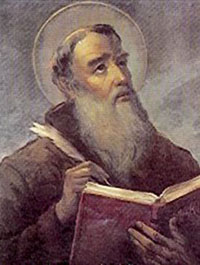
St. Sharbel Makhlouf - 24th July 2009

Today's saint is not of the Roman (Latin) Rite he is A Catholic of the Maronite rite.

Youssef Antoun Makhlouf was born in 1828, in Bekaa Kafra (North Lebanon). He had a true Christian upbringing, which had given him a passion for prayer. Then he followed his two hermit uncles in the hermitage of the St Antonious Kozhaya monastery and was converted to monastic and hermetical life.

In 1851, he left his family village and headed for the Our Lady of Maifouk monastery to spend his first monastic year, and then he went to the St Maron monastery in Annaya, where he entered the Maronite Order, carrying the name Charbel, a name of one of the Antioch church martyrs of the second century. On November 1st. 1853, he exposed his ceremonial vows in St Maron’s monastery - Annaya. Then he completed his theological studies in the St Kobrianous and Justina monastery in Kfifan, Batroun.

He was ordained a priest in Bkerky, the Maronite Patriarchate, on July 23rd, 1859. He lived 16 years in the St Maron's monastery – Annaya. From there, he entered, on February 15th, 1875, the St Peter & Paul hermitage, which belongs to the monastery. He was a typical saint and hermit, who spent his time praying and worshipping. Rarely had he left the hermitage where he followed the way of the saintly hermits in prayers, life and practice.

St Charbel lived in the hermitage for 23 years. On December 16th, 1898 he was struck with an illness while performing the holy mass. He died on Christmas' eve, December 24th, 1898, and was buried in the St Maron monastery cemetery in Annaya.

Few months later, dazzling lights were seen around the grave. From there, his corpse, which had been secreting sweat and blood, was transferred into a special coffin. Hordes of pilgrims started swarming the place to get his intercession. And through this intercession, God blessed many people with recovery and spiritual graces.

In 1925, his beatification and canonization were proposed for declaration by Pope Pious XI. In 1950, the grave was opened in the presence of an official committee which included doctors who verified the soundness of the body. After the grave had been opened and inspected, the variety of healing incidents amazingly multiplied. A multitude of pilgrims from different religious facets started flocking to the Annaya monastery to get the saint's intercession.

Prodigies reached beyond the Lebanese borders. This unique phenomenon caused a moral revolution, the return to faith and the reviving of the virtues of the soul.

Thursday, July 23, 2009

St. Bridget of Sweden - 23rd July 2009

The following is a commentary about St. Bridget by Dr. Plinio

Biographical selection:

St. Bridget (1303-1373) was a noble of royal blood from Sweden. In obedience to her father, she married Prince Ulfo of Nercia in 1316. She was the mother of eight children, including St. Catherine of Sweden. After Ulfo’s death in 1344, she dedicated her life to religion. In 1345 she founded the Order of the Most Holy Savior (the Bridgettines) at Vadstena.

Comments of Prof. Plinio:

I remember only one episode from the life of St. Bridget. Therefore, since we don’t have a biographical selection properly speaking, I will comment on it.

She was a person with a very bad temperament with a propensity to irritation and explosions. She married a bad-tempered man who was also difficult to deal with. In her relations with her husband, she had to learn to dominate herself. After a great deal of effort, she reached that point. Then she made pilgrimages, sanctified herself, had meetings with Popes to report the visions she had received from Our Lord and Our Lady. She also became a nun and founded a religious congregation.

Because St. Bridget had learned to control her impulsive temperament, she thought she had entirely dominated it. But toward the end of her life, that strong passion in her temperament returned completely, just as it was when she was very young. This was a great trial for her, because she thought that the great fight she had made throughout her life had been lost because of some infidelity to God, and that she would have to restart from the beginning again.

So with this sense that everything before had been in vain, she restarted the fight, tamed her temperament once again, and died at peace with God.

Her biographers tell us that this trial was not a punishment for any spiritual failing, but rather a design of Divine Providence to make her even more perfect. So, God let her think that the great spiritual progress she had achieved was futile in order to test her love for Him, to see if she would become impatient and revolt or humbly recommence her efforts from the very beginning in obedience to His will.

This trial was an invitation for her, without her knowledge, to reach the apex of her spiritual life. We should realize this and be prepared should something similar happen in our lives.

Divine Providence very often asks us – either in our spiritual lives or in our works of apostolate – to face analogous situations that seem to make no sense to us. We have to walk toward walls without doors; we have to dive into oceans without bottoms. But when we walk with the spirit of true obedience to the will of God, at the last moment the doors appear and we can touch the bottom of the ocean with our feet, so that we can continue with the work we are called to do.

Our Lady does this with souls that she is preparing for the highest ends. She asks the person to walk through what makes no sense as a proof of love for her. How is this a demonstration of love? It is blind faith in what Divine Providence has asked from one. After passing through that trial, Our Lady and Our Lord give great graces to that person.

Sara, the wife of Abraham, was unable to have children. Notwithstanding, Abraham trusted God’s promise that a great people would come from him. Finally, in their old age a son was born - Isaac, the son of the promise. Then, God asked Abraham to sacrifice Isaac. It made no sense. But Abraham prepared to carry out the will of God. You know the rest. God did not want the immolation of Isaac; what He wanted was to test Abraham’s love for Him. In the Old and New Covenants we find many other men of God who faced similar spiritual trials, even though they were men specially chosen by God.

Since ours is a great vocation to fight against the Revolution, especially the Revolution inside the Church, we should be prepared to face great tribulations in this specific point. All the efforts we made throughout our lives may at one point seem useless and futile. Our Lord and Our Lady - who called us to carry out this vocation - will be preparing us for greater things. We should not be surprised if this will happen.

Let us ask St. Bridget, who suffered this trial at the end of her life, to prepare us to accept such tests without revolt, protest or complaint. And may Our Lady find us worthy to receive similar tribulations.

Wednesday, July 22, 2009

St. Mary Magdalene - 22 July 2009

Biographical selection:

Commenting on St. Mary Magdalene, the Roman Martyrology says that after Our Lord expelled the devils from her, she became so perfect that she was worthy to be the first person to see Him resurrected.

Comments of Prof. Plinio:

The famous episode in a banquet where St. Mary Magdalene washed the feet of Our Lord Jesus Christ with perfume reveals some facets of her personality and her position in the Church.

We know that she was a sister of Lazarus. According to the traditions and documents of that time, he was a person of high society, because he had a rank of a prince and was very wealthy. He had been a prince of a small people who had been incorporated into the Jewish nation, and still had the title and honors of a prince even though he no longer played a political role. Therefore, he and his two sisters, Mary and Martha, were persons of a high social level.

However, Mary Magdalene strayed from the good path and became a public sinner. She repented profoundly and became a model of two different things: contemplation and penance.

Her contemplation was marked in contrast with the active life of Martha, who censured Mary for not caring about the needs of the house but only about staying close to Our Lord listening to Him and admiring Him. Our Lord told her: “Martha, Martha, Mary has chosen the better part, and it will not be taken from her.” She represents pure contemplation, unlinked to the active life.

Her repentance, her penance, and her perfect fidelity prepared her to stand with Our Lady and St. John at the foot of the Cross. Her penance was so perfect and the pardon she received so great that she achieved an extraordinary union with Our Lord. Studying her case, some serious theologians even raised the hypothesis that perhaps penance is more beautiful than innocence.

In the episode of the banquet, she represented penance, contemplation and complete detachment from worldly goods. To the contrary, Judas represented treason, hatred dissimulated under the pretext of charity, and attachment to material things. The opposition between Mary Magdalene and Judas could not be more flagrant.

After that episode, the opposition continued. She, the repentant sinner, was faithful and stood at the foot of the Cross. He, the damned Apostle, was the one who delivered Jesus Christ to be crucified. She was the first to witness the Resurrection of Our Lord and His ascension to Heaven to meet the Eternal Father; the impenitent Judas hanged himself in despair and hurled himself into Hell to meet the Devil. The antitheses are strong and expressive. On one hand, in Mary Magdalene, we see repentance, pure contemplation and detachment from worldly goods. On the other hand, in Judas, we find final impenitence, total attachment to money and cupidity for worldly goods.

St. Louis Grignion of Montfort distinguished two types of human psychology: those who are like Jacob and those like Esau. St. Mary Magdalene is characteristic of one with the spirit of Jacob: she had a superior soul turned toward heavenly things and indifferent to the things of this world. Judas, the opposite, was a type like Esau. He not only sold his birthrights for a plate of lentils, but much worse, he sold his Savior for thirty coins.


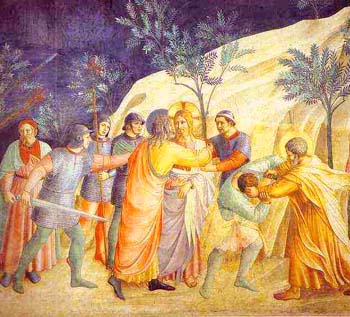
Fra Angelico painted the scene of the kiss of Judas delivering Our Lord to the Jewish soldiers. He painted Our Lord’s head surrounded with a golden halo, and Judas’ head with a black halo. He wanted to express that Judas was the son of iniquity, the damned Apostle whose spirit was one of sin and darkness, while Our Lord’s was filled with sanctity and light. We could apply this to the contrast between St. Mary Magdalene and Judas. One had a golden halo, the other a black halo.

When St. Mary Magdalene repented, she completely rejected all those things that had induced her to sin. In her case, this constituted the brilliant things of life. As penance she distanced herself totally from such things, she completely detached herself from them. To achieve such detachment she abandoned all links with the active life and became a pure contemplative. Her contemplation, therefore, was born from penance and detachment. It made her understand the excellence of heavenly things and how every created thing was made to serve and glorify heavenly things. So, nothing could be more consistent for her than to take a very valuable perfume and pour it on the divine feet of Our Lord Jesus Christ.

What had induced the despicable Judas to be attached to money, which led him to hate Our Lord? Yes, I say hate, because no one betrays the Man-God as he did only for a profit. What induced Judas to steal the alms collected for the poor? No one can know for sure, but one can raise a hypothesis.

When Our Lord was preaching His doctrine, Judas was probably thinking about other things, for instance, about the prestige of the Pharisees in Jerusalem and how he would like to do something to impress them. So, he wanted to become rich and have a parallel career in order to be considered an important man by the Pharisees. He started to think about these things of this world and fell into sin, he started to steal money. This habit made him more and more hostile to Our Lord. The process continued to the final extreme, where Judas handed over Our Lord to the ones he admired and wanted to impress, and also to make some money.

The processes of both, Mary Magdalene and Judas, are logical. One has the logic of the golden halo; the other, the logic of the black halo. The pathway of a woman who was in sin and became a saint crossed the pathway of an Apostle who was in grace and became a traitor.

What was the most profound reason why one repented and other fell into despair? In my opinion it is because of their different relations with Our Lady.

St. Mary Magdalene was always close to Our Lady, helping her and giving her support, above all at the supreme moment when her Son was crucified and died on Calvary. Judas, however, was cold toward Our Lady. Catharine Emmerick says that before the treason was consummated, Our Lady, who knew what he was planning, approached Judas and spoke with him for a long time, trying to convert him. He rejected everything, and the Gospel affirms that after the Last Supper, the Devil entered his soul.

The woman who had warm and close relations with Our Lady became one of the greatest saints of the Church, who in Heaven certainly is very close to the Sacred Hearts of Jesus and Mary. The Apostle who was cold toward her became the son of perdition, who was pictured by Dante inside the very mouth of Satan in the deepest place of Hell.

This contrast has many lessons. The principal one is for us to be as close as possible to Our Lady, no matter what our situations are, whether we be in the state of grace or in sin.

Tuesday, July 21, 2009

Saint Lawrence of Brindisi - 21 July 2009


Saint Lawrence of Brindisi is the Apostolic Doctor and the doctor of conversions and missions. He lost his parents at an early age and was educated by his uncle. Brindisi was first sent to the Conventual Franciscans for his early education. His parents named him Julius Caesar. In many respects, his presence was as a leading general as the famous Julius Caesar of Rome. As appointed chaplain-general, he led armies during European battles and skirmishes. The crushing defeat of the Turks was attributed to Lawrence. Emperors, kings, popes, dukes and heads of state requested his support. He gave advice to generals, rallied the troops and led many missions carrying the cross of Christ as his effective sign and weapon.

Our saint labored for the church, his Franciscan Religious Order-the Capuchins, his country, those who supported religion and all that Christ was sent to save. God would have sent the Savior of the world, according to St Lawrence, even if Adam had not sinned. That is how much God desires to share eternal love with us even before we possess it later in eternity. God is, in a sense, impatient, when it comes to love. He is an impetuous, impressive and impassionate Lover first and foremost. God's Savior role came after sin entered into the soul of humankind.

According to this champion doctor, the Father would have sent his Son if no original sin occurred. Perhaps his main goal in his lifetime was to provide, preach, and expose missions. It has been said that Lawrence was one of the greatest preachers in the history of Christianity. Lawrence realized fully that the Savior had been sent. His efforts were to talk, convert and help people to be saved. In addition, for Lawrence, the Son was sent to save all with no exceptions. We too, according to the degree of our faith, have the same mission as Lawrence. We are called and chosen to assist others as they need our help and according to our gifts.

Lawrence was gifted with remarkable talent, intelligence and, most of all, language ability. He spoke eight languages fluently. He served others through his preaching and missions. He led missions against other religions and anywhere Catholicism needed support. He performed reconciliation efforts against heretics all over Europe and always with empathy, sensitivity and compassion.

In times past, religions would have been exceedingly hostile against others. Persecutions, wars, and even brutual punishment among brothers, sisters and families within the same religion happened. Times have changed hopefully if we have learned anything about authentic love. Charity and love must supersede all other religions. Reverence not only for all religions but now we must have a whole new faternal attitude toward all people, nationalities, race, gender, and elimination of sordid bias, prejudice and discrimination must be the new Christian motif of all future generations.

Respect for Hinduism, Buddist, Jainist, Muslims, Sikh, Baha'i, Sinto, African Native, Zoroastrian, Native American, Jewish and Christianity, to name but a few major religions, must be the obligation for all decent human beings.

Saint Lawrence was a biblical scholar and the pope requested him to preach to the Jews. He spent much time in conversion attempts. His language abilities were flawless and wherever he spoke the people thought he was a native of that place. The rabbis felt he was a Jew who had become a Christian.

This amazing Franciscan wrote extensively filling many volumes including his sermons, which were always substantiated by scriptural quotations. His brilliance was matched with great human compassion and administrative skills. He was quickly elected to the highest office in his religious order, minister-general. He was responsible for the Capuchin's growth and geographical expansion.

St Lawrence was appointed papal emissary. He was a powerful peacemaker. His positions took him to many foreign countries. He was so influential that he was asked to settle royal quarrels, be a diplomat and work for pacification and healing among many nations.

Our saint burned himself out with goodwill for those whom he served. He realized how deeply God loved all creations in sending Jesus Christ. He felt we too should ask to be sent, as our Brother, to help others. This made sense to Lawrence’s way of thinking because humankind had sinned and committed original sin. His main goal was to give mission (talks and instructions about the faith) to change hearts and be drawn back to God. This is conversion. He decided early to be God's messenger and active minister.

For More about this doctor of the Church please refer to this web site

Thursday, July 16, 2009

Our lady of Mount Carmel - 16th July 2009


According to the most ancient Carmelite chronicles, the Order has its origins with the disciples of the prophets Elias and Eliseus. They lived in caves on Mount Carmel. They honored the Queen of Heaven as the Virgin who is to give birth to the Saviour. When the reality replaced the symbol, the pious ascetics of Carmel were converted to the Christian Faith. In the 12th century, many pilgrims from Europe who had followed the Crusaders came to join the solitaries. A rule was established and the Order began to spread to Europe.

Amid the many persecutions raised against the Order of Mount Carmel, newly arrived in Europe, Saint Simon Stock, General of the Order, turned with filial confidence to the Blessed Mother of God. As he knelt in prayer on July 16, 1251, in the White Friars’ convent at Cambridge, She appeared before him and presented him with the well-known brown scapular, a loose sleeveless garment destined for the Order of Carmel, reaching from the shoulders to the knees. It was given as an assurance, for all who died wearing it, of Her heavenly protection from eternal death. An extraordinary promise indeed, but one requiring a life of prayer and sacrifice.

Devotion to the blessed habit spread quickly throughout the Christian world. Pope after Pope enriched it with indulgences, and innumerable miracles put their seal upon its efficacy. The first of them was worked at Winchester on a man dying in despair, who when the scapular was laid upon him by Saint Simon Stock at once asked for the Sacraments.

In the year 1636, a certain gentleman, member of a cavalry regiment, was mortally wounded at the battle of Tehin, a bullet having lodged near his heart. He was then in a state of grievous sin, but he had time to make his confession. Afterwards a surgeon probed his wound, and the bullet was found to have driven his scapular into his heart. When it had been withdrawn he soon expired, making profound acts of gratitude to the Blessed Virgin who had prolonged his life miraculously, thereby preserving him from the irremediable death of his soul.

At Lourdes in 1858, the Virgin chose to make Her last apparition on July 16th, feast of Our Lady of Mount Carmel, the day the Church commemorates Her apparition to Saint Simon Stock. And at Fatima on October 13, 1917, it is as Our Lady of Mount Carmel that Mary appeared when She said farewell to the three children. Throughout the ages, the Queen of Carmel has always kept a faithful watch over the destinies of Her cherished children on earth.


Wednesday, July 15, 2009

St. Bonaventure - 15th July 2009

The illustrious founder of the Franciscan Friars, St Francis, cured Bonaventure of a serious illness as a boy in central Italy through his prayers, faith and God's favor. Later, he felt called by God to join the same religious order that he obviously knew. He devoted himself, as all can, according to God's will, to earnest study and prayer. God filled others with the fruits of his learning through his example, teaching and writings. The Order of Friar Minor (OFM), and the world, through Bonaventure, was renewed through his leadership and God's graces.

Our Italian Franciscan was a close friend of St Thomas Aquinas and received his doctorate with him as a Doctor of Theology in Paris. Thomas once asked him where he acquired his learning and Bonaventure pointed to his crucifix. Reflect and dwell on these spirited filled words of his: "whoever gazes upon Christ crucified with faith, hope and love will celebrate the Passover with Him". This master of theology and philosophy illuminates us, in this one sentence, with the secret and fulfillment of life, love and infinite happiness.

He held the leading role of his religious order and later was appointed a cardinal-bishop of Albano. He actually had declined an archbishopric position at Lyons. When the Pope offered Bonaventure one position, he humbly declined. Then the pope would offer him another. He got the message and Bonaventure humbly accepted.

Another reason he is referred to as the seraphic doctor is because of the warmth found in his writings and teaching. Both were always filled and inspired with God's burning charity. In biblical literature, a seraph is one of the six-winged angels of the highest rank believed in ancient Judaism to guard God's throne with sacred ardor. We can say that every creature of God, and not only the angels, who guard themselves from evil thoughts or actions, acts in a seraphic manner. We are temples of the Most High. We contain the throne of God within us. God has given us a guardian angel to protect, rule, guide and grace us. However, we have to be on our guard to acknowledge God's love responsibly. We need to show and demonstrate acts of kindness and goodness as Bonaventure even to unkind or mean people. This requires strength and virtue. When we do this, and we can only do it with God's grace, we, too, will reveal the fervor of God's fire as blessed Bonaventure.

Our doctor first taught at the University of Paris for about ten years. His teaching enkindled God's love in his subjects. His types of questions, his explanations, his answers - all, had divine warmth to them. He was a catalyst to anyone seeking the love and knowledge of God. Both in his Scripture and Theology courses, he made known to all that God was an exuberant Lover who cared and was solicitous for all creatures.

Many attacks were lodged against the Franciscan mendicants (beg for a living and take a vow of poverty) at this time largely because of jealousy and the success of their pastoral and academic endeavors. Bonaventure attempted to defend the friars by his good example and writings, some of which included: Concerning Perfection of Life, Soliloquy and Concerning the Threefold Way.

St Bonaventure's bent was to the ascetical rather than the philosophical approach. Ten thick volumes of writings testify to his inspired zeal. He is described as a "spiritual writer of great power and authority."

Our Franciscan doctor encouraged others in his lifetime and encourages us today to have a sincere spirit of humility, devotion and repentance. We need to practice these God-given qualities. Humility is a part of truth. Sound devotion is the earnest searching after God. Contrition, conversion and repentance means sorrow for past sins. We have committed egregious wrongs and have need of God's mercy. We are incapable and inadequate to have friendship with God without God's help and compassion. Our inadequacies are apparent in nearly all that we do despite our best intentions.

Read and listen to the following quote of St Bonaventure highlighting the futile effort of only human effort and not God's graces and support. Nothing can be gained supernaturally unless humility, devotion and repentance are practiced. Pray attentively as you think about Bonaventure's quote about our inadequacies:

"reading without repentance,
knowledge without devotion,
research without the impulse of wonder,
prudence without the ability to surrender to joy,
action divorced from religion,
learning sundered from love,
intelligence without humility,
study unsustained by divine grace,
thought without the wisdom inspired of God."

We often do all of the above in a natural manner when we could sanctify them with God's help and grace. We need grace! We can not follow our natural bent and inclination. That will not do it. Even if we achieved phenomenal results, is it pleasing to God? God does not measure the amount that we do but the quality of our love that we give. Bonaventure gave until it hurt and without complaining. He probably sensed that he was very ill and questioned to himself if he should have gone to the council at Rome. However, he was not thinking about himself but the church and her needs. Obedience and goodwill urged him onward.

During this period there were many reforms and renewals being encouraged by the church and Bonaventure attempted to pacify both the right and the left. He governed his Order for seventeen years and has been justly called its second founder. He also wrote about his Seraphic Founder's life, St Francis of Assisi.

This cordial and warm gentleman attended significant church councils, preached at sessions and gave his all to the church whenever the Holy Father requested his assistance. In fact, he died attending one of these sessions.

He attempted to unite holiness and theological knowledge. And he did just that! He was a very active preacher, writer and loved by all. It has been said that to know him was to love him. To read him is still for all, especially Franciscans today, to meet a true peacemaker and a gentleman. Many tears where shed by his sudden death just as he must have caused tears of conversion when he spoke about the joy of his life: Jesus Christ, the crucified Master. He was a person of eminent learning and eloquence and of outstanding holiness known for his kindness, approachableness, gentleness, compassion and virtue. What greater tribute could one possibly say than to be described as a very warm and charming saint, doctor, teacher, reformer and founder?

From one of his discourses: "The outcome or the fruit of reading holy scripture is by no means negligible: it is the fullness of eternal happiness. For these are the books which tell us of eternal life, which were written not only that we might believe but also that we might have everlasting life. When we do live that life we shall understand fully, we shall love completely, and our desires will be totally satisfied. Then, with all our needs fulfilled we shall truly know the love that surpasses all understanding and so be filled with the fullness of God. The purpose of scriptures, which comes to us from God, is to lead us to this fullness according to the truths contained in those sayings of the apostles to which I have referred. In order to achieve this, we must study holy scripture carefully, teach it and listen to it in the same way."

He explained Mary along a Franciscan theme of poverty and giving to the poor. He cited an unknown Franciscan who claims that Mary refused to accept the gifts given to Jesus by the Magi. She distributed them to the poor.

For more about St. Bonaventure please click here

Monday, July 13, 2009

St. Henry II, Emperor - 13th July 2009


Biographical selection:

St. Henry II (972-1024), Duke of Bavaria, became Emperor of the Holy Roman German Empire. He placed his army under the blessing of God and used to invoke the patron saints of his people, especially St. Adrian, a military martyr, whose sword was carefully conserved as a relic for a long time in Walbach.

With this protection he organized an army and defeated the barbarians from the East who were invading Western Europe. Before facing the pagan Slavs, who were much superior in strength, he called on his army to pray and receive Communion. When the troops entered combat, an unexpected panic took hold of the enemy soldiers, who broke ranks and fled en masse. An Angel and three martyrs led his troops, causing the enemy to take flight in despair. The Slavs submitted to his rule, and Bohemia, Moravia, and Poland were in turn annexed to the Holy Empire.

In 1006, he called a meeting of the Bishops in Frankfurt with the objective of regulating many points of discipline and enforcing a stricter observance of the ecclesiastical canons. Later, he would support the reform movement of Cluny.

Twice he defeated the Lombards, who resisted the consolidation of the Empire and threatened the Pontifical States. After his first victory in 1004, he was crowned King of Lombardy in Pavia with the famous Iron Crown of that Kingdom. The second time, he had to do more than pacify the Lombards, since grave problems were afflicting the Church. Henry drove out an antipope, and brought the legitimate Pope Benedict VIII back to Rome.

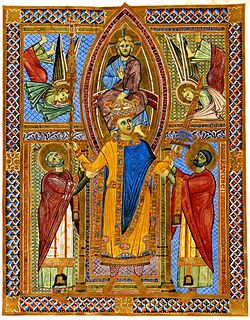
When he and Empress Cunigunde went to Rome to visit the Pope, they were crowned Emperor and Empress of the Romans. The Sovereign Pontiff gave St. Henry a golden orb, a symbol of the imperial dignity, inlaid with pearls and topped by a cross. St. Henry, dignified by the many honors, gave the orb to St. Odilon, Abbot of Cluny, who was present at the ceremony so that those symbols would be conserved at the Monastery of Cluny.

St. Henry approached Stephen, King of Hungary, who was still a pagan and had not been received into the bosom of the Church. St. Henry II made an alliance with him, offering him the hand of his sister, Gisele, as his wife. Soon afterward King Stephen was baptized and the whole nation was brought to the faith of Christ. With the marvelous conversion of Stephen, Henry won a great King for the Church and a Saint for Heaven.

After other military expeditions in Italy that resulted in the re-establishment of peace in the peninsula, he returned to Germany. On his way back, when he reached Luxembourg, he had a famous meeting with Robert, King of France, to resolve various political problems of Europe. The meeting was scheduled to take place on the banks of the Meuse River, which occasioned a problem of protocol. If one Sovereign crossed the river to enter the other’s domain, the former would be subject to the laws of the latter. To resolve the delicate situation, it was planned for the Sovereigns to meet in boats in the middle of the river – a neutral area. But St. Henry disregarded the protocol and crossed to the French side in consideration for the virtues of the French King.

Comments of Prof. Plinio:

This selection is somewhat wide-ranging because the life of St. Henry is full of memorable acts that should be reported. For us to have a good understanding of the ensemble of these facts, it is necessary to place them in their historical context.

We are in the Middle Age, in the early 1000s. As you know, the Middle Age began with the fall of the Roman Empire in the West. It was invaded by incalculable hordes of barbarians. Those barbarians established themselves inside the imperial territory and ended by subjecting the Romans to their control.

Gradually the Roman population also fell into barbarianism. The roads were abandoned with no one to care for them; the aqueducts that supplied the cities with water broke and no one repaired them; the palaces occupied by barbarians became dirty and disorganized; works of art in public places were ruined, and the cities fell into chaos. Everything that represented culture and civilization was miserably destroyed. In this situation Europe became illiterate and its level of customs sunk to unimaginably low levels. It took centuries to bring Europe to a state of civilization again.

While everything was being crushed, the Catholic Church remained as the one existing institution. Those barbarians began to convert under her influence. The work the Church did with the European peoples was not so different from the work she later undertook to convert and civilize the Indians in the New World. The missionaries arrived, preached the catechism, and through successive generations the Indians became civilized and acquired a certain culture. The same took place with those European tribes.

In the year 1000, civilization had already achieved much in relation to the original barbarian way of living, but Catholic Civilization was still far below the standards it would reach 200 or 300 years later. That is to say, at the time of St. Henry II, we are in a semi-barbarian situation.

Some peoples were more civilized than others. In Europe there were islands of an incipient Catholic civilization amid a sea of barbarian peoples who continued to go and come at will and attack the established kingdoms. Catholic life was very difficult with adversaries coming from all directions.

One of the earliest conversions took place with the Germanic peoples who occupied the territory of present-day Germany, Austria, Slovakia, the Czech Republic and Switzerland. Those peoples became civilized and constituted a political entity called the Holy Roman German Empire. It was called Empire because it encompassed different peoples as a federation. Those free peoples agreed to be led – not governed – by a single political chief, elected by the various heads of State. So, as a league including a large territory and different peoples, it was called an Empire. It was called Roman because its model was the old Roman Empire; it was called German because it had been founded by German peoples; and it was called Holy because its principal finality was to defend the Catholic Church against the aggression of the pagans.

In the person of St. Henry II, we see an Emperor who was also a Saint. That a great political leader and head of an army was a saint does not fit very well with the lives of the saints taught by a certain sentimental piety. Indeed, he held the highest office in the most important political organization of his time and was, therefore, the most powerful man in Europe. Simultaneously he was the greatest warrior of Europe and the first son of the Church. He was par excellence the son of the Church. He was the one who always protected the Church against the attacks of her enemies.

He also had to face the peoples of the East who continuously attacked the Empire. So he gathered together a large army and counter-attacked those barbarians. He waged many wars and acted as a Catholic hero who had the spirit of Faith, relying more on supernatural help than on his natural forces. He asked God for the might to win his battles. To show St. Henry how his prayers were pleasing to Him, God gave him a miraculous victory on one occasion. As the two armies came face to face, the enemy troops fled the battlefield in panic for apparently no reason. In fact, to terrify his enemies, God had sent an Angel and the holy martyrs to whom Henry II had prayed. God was so pleased with the prayers of the warriors that he gave them the victory even without the combat.

With this victory, the pagan forces from the East were broken and the claws of Paganism lost their strength.

But a danger still threatened Christendom: the presence of the Lombards in North Italy. Lombardy was not a land of pagans, but heretics who were enemies of the Catholic Faith. They used to attack the Pope and the Papal territories and opposed the Catholic Empire. So St. Henry, with the support of the Italian Bishops, entered Lombardy, defeated its army, and then went on to Rome to visit and pay homage to Pope Benedict VIII.

It was on this occasion that the Pope crowned him Emperor of the Holy Roman German Empire. In a ceremony realized with great splendor, he gave St. Henry a golden orb inlaid with pearls representing the power of the Emperor over the world. But St. Henry did not keep that treasure. To prove his love for the Church, he offered the precious gift to the Holy Abbot Odilon, the head of the largest religious order of Europe at that time.

After inflicting new defeats on the revolted Lombards, he returned to Germany. There he assisted the Bishops to exert their role of maintaining discipline in the Church. He also was instrumental in the conversion of a pagan King. He offered an alliance with Stephen, King of Hungary, together with the hand of his sister Gisela. She married Stephen and converted him. She did so good a job that he became a saint, St. Stephen, who afterward converted all of Hungary to the Catholic Faith.

Behind this conversion was the intelligent diplomatic maneuver of St. Henry. With this he won a precious ally close to those Slavic enemy peoples who had just been pacified. His diplomatic sense was also demonstrated in the episode at the Meuse River, in which he gave up his privileges in order to please the French King. Crossing over to the French banks, St. Henry was implicitly paying homage to the King. That is, he who was more – an Emperor – paid homage to the one who was less in order to maintain cordial relations and to resolve the complicated problems of Europe.

After all these services to the Church and Christendom, St. Henry died in 1024 in the peace of God as a great saint, warrior, diplomat and politician. This is the glorious story of St. Henry II, Emperor.

Let us pray to him to help us establish the foundation of a new Christendom that will be the Reign of Mary.

Saturday, July 11, 2009

St Benedict Abbot - 11th July 2009

Overrun by half-civilized pagan and Arian hordes during the fifth century, Italy and the entire Mediterranean world was falling back into barbarism. The Church was torn by conflict, city and country alike were made desolate by war and pillage, violence was rampant among Christians as well as heathen. During this anarchic time appeared one of the noblest of the Fathers of the Western Church—St. Benedict of Nursia, founder of the great order which bears his name. We know little of his background, save that he was born about the year 480 at Nursia, in the province of Umbria, in north central Italy, and that his family was probably of noble lineage. We also know that he had a sister called Scholastica, who from childhood vowed herself to God.

Sent to Rome to be educated, young Benedict was quickly revolted by the licentiousness of his fellow students. He was not yet twenty when he decided to go away from Rome to live in some remote spot. No one knew of his plan except an aged family servant, who loyally insisted on accompanying him to serve his wants. Benedict and this old woman made their way to a village called Enfide, in the Sabine Mountains, some thirty miles from Rome. In the , St. Gregory gives us a series of remarkable incidents associated with Benedict's life, one of them occurring at this time. While staying in the village, Benedict miraculously mended an earthen sieve which his servant had broken. Wishing to escape the notice and the talk which this brought upon him, he soon started out alone in search of complete solitude. Up among the hills he found a place known as Subiaco or Sublacum (beneath the lake), so named from an artificial lake created there some five centuries earlier. It was near the ruins of one of Nero's palaces. He made the acquaintance of a monk called Romanus, and to him Benedict revealed his desire to become a hermit. Romanus, who lived in a monastery not far away, gave the young man a monastic habit made of skins and led him up to an isolated cave, where he might live completely undisturbed. The roof of the cave was an overhanging rock over which descent was impossible, and it was approached from below with difficulty In this desolate cavern Benedict passed the next three years, unknown to all but his friend Romanus, who each day saved for him a part of his own portion of bread and let it down from above in a basket by a rope.

According to Pope Gregory, the first outsider to find his way to the cave was a priest, who while preparing a special dinner for himself on Easter Sunday heard a voice saying to him: "Thou art preparing thyself a savoury dish while my servant Benedict is afflicted with hunger." The priest immediately set out in search of Benedict, and finally discovered his hiding place. Benedict was astonished, but before he would enter into conversation with his visitor he asked that they might pray together. Then, after they had talked for a time on heavenly things, the priest invited Benedict to eat, telling him that it was Easter Day, on which it is not reasonable to fast. Later Benedict was seen by some shepherds, who at first glance took him for a wild animal because he was clothed in the skins of beasts. It did not occur to them that a human being could live among the barren rocks. From that time on, others made their way up the steep cliff, bringing such small offerings of food as the holy man would accept and receiving from him instruction and advice.

Even though he lived thus sequestered from the world, Benedict, like the Desert Fathers, had to struggle with temptations of the flesh and the devil. One of these struggles is described by Gregory. "On a certain day when he was alone the tempter presented himself. A small dark bird, commonly called a blackbird, began to fly around his face and came so near him that, if he had wished, he could have seized it with his hand. But on his making the sign of the cross, the bird flew away. Then followed a violent temptation of the flesh, such as he had never before experienced. The evil spirit brought before his imagination a woman whom he had formerly seen, and inflamed his heart with such vehement desire at the memory of her that he had very great difficulty in repressing it. He was almost overcome and thought of leaving his solitude. Suddenly, however, with the help of divine grace, he found the strength he needed. Seeing near at hand a thick growth of briars and nettles, he stripped off his habit and cast himself into the midst of them and plunged and tossed about until his whole body was lacerated. Thus, through those bodily wounds, he cured the wounds of his soul." Never again was he troubled in the same way.

Between Tivoli and Subiaco, at Vicovaro, on the summit of a fortified rock overlooking the Anio, there lived at that time a community of monks. Having lost their abbot by death, they now came in a body to ask Benedict to accept the office, no doubt with the idea that his growing fame would attract offerings to their community. He at first refused, assuring the monks that their ways and his would not agree. At length they persuaded him to return with them. It soon became evident that the severe monastic discipline he instituted did not suit their lax habits, and in order to get rid of him they finally poisoned his wine. When, as was his habit, he made the sign of the cross over the cup, it broke as if a stone had fallen on it. "God forgive you, brothers," Benedict said serenely. "Why have you plotted this wicked thing against me? Did I not tell you beforehand that my ways would not accord with yours? Go and find an abbot to your taste, for after what you have done you can no longer keep me with you." Then he bade them farewell and returned to Subiaco.

Disciples now began to gather around Benedict, attracted by his sanctity and by his miraculous powers. At last he found himself in a position to initiate the great work for which God had been preparing him. This was the idea that had slowly been germinating during his years of isolation: to bring together those who wished to share the monastic life, both men of the world who yearned to escape material concerns and the monks who had been living in solitude or in widely scattered communities, to make of them one flock, binding them by fraternal bonds, under one observance, in the permanent worship of God. In short, his scheme was for the establishment in the West of a single great religious order which would end the capricious rule of the various superiors and the vagaries of individual anchorites. Those who agreed to obey Benedict in this enterprise, he settled in twelve monasteries of twelve monks each. Although each monastery had its own prior, Benedict himself exercised general control over all of them from the monastery of St. Clement.

They had no written rule, although they may at first have been guided by the Eastern Rule of St. Basil. According to one old record, they simply followed the example of Benedict's deeds. Romans and barbarians, rich and poor, came to place themselves under a monk who made no distinction of rank or nation. Parents brought their young sons, for, in the prevailing chaos, the safest and happiest way of life seemed to be that of the monk. Gregory tells us of two noble Romans, Tertullus, a patrician, and Equitius, who came with their small sons, Placidus, a child of seven, and Maurus, a lad of twelve. They were the forerunners of the great hosts of boys, in succeeding centuries, who were to be educated in Benedictine schools. On these two aristocratic young Romans, especially on Maurus, who afterwards became his coadjutor, Benedict expended his utmost care.

Gregory tells also of a rough untutored Goth who came to Benedict, was gladly received, and clothed in the monastic habit. As he was working one day with a hedgehook to clear the underbrush from a sloping piece of ground above the lake, the head of the hook flew off and disappeared into the water. When Benedict heard of the accident, he led the man to the water's edge, took from him the shaft, and dipped it into the lake. Immediately from the bottom rose the iron head and fastened itself in the shaft, whereat Benedict returned it to the astonished Goth, saying in a kindly voice, "Take your tool; work and be comforted." One of Benedict's greatest accomplishments was to break down in his monasteries the ancient prejudice against manual work as something in itself degrading and servile. The Romans had for centuries made slaves of conquered peoples, who performed their menial tasks. Now times were changing. Benedict introduced the novel idea that labor was not only dignified and honorable but conducive to sanctity; it was therefore made compulsory for all who joined the order, nobles and plebeians alike. "He who works prays," became the maxim which expressed the Benedictine attitude.

We do not know how long Benedict remained in the neighborhood of Subiaco, but he stayed long enough certainly to establish his monasteries there on a firm and permanent basis. His departure seems to have been unpremeditated. There was living in the neighborhood an unworthy priest called Florentius, who was bitterly envious of the success of Benedict's organization and of the great concourse of people who were flocking to him. Florentius tried to ruin him by slander; then he sent him a poisoned loaf, which failed of its purpose. Finally he set out to corrupt Benedict's monks by introducing into their garden women of evil life. Benedict realized Florentius' malicious schemes were directed at him personally and he resolved to leave Subiaco, lest the souls of his spiritual sons should be further assailed. Having set all things in order, he summoned the monks, or their representatives, from the twelve monasteries, bade them farewell, and withdrew with a few disciples from Subiaco to the more southerly territory of Monte Cassino, a conspicuous elevation where land had been offered him by Placidus' father, the patrician Tertullus.

The town of Cassino, formerly an important place, had been destroyed by the Goths, and the remnant of its inhabitants, left without a priest, were relapsing into paganism; the once-fertile land had fallen out of cultivation. From time to time the inhabitants would climb up through the woods to offer sacrifices in an ancient temple dedicated to Apollo, which stood on the crest of Monte Cassino. Benedict's first work, after a preliminary forty-day fast, was to preach to the people and win them back to the faith. With the help of these converts, he proceeded to overthrow the pagan temple and cut down the sacred grove. He built two oratories or chapels on the site; one he dedicated to St. John the Baptist and the other to St. Martin. Round about these sanctuaries new buildings were erected and older ones remodeled, until there rose, little by little, the tremendous pile which was to become the most famous abbey the world has known. The foundation was laid by Benedict probably about the year 520.

Profiting no doubt by his earlier experience, Benedict did not distribute his monks in separate houses, but gathered them together in one great establishment, ruled over by a prior and deans under his own direction. Almost immediately it became necessary to build guest chambers, for Monte Cassino[1] was easily accessible from Rome, Capua, and other points. Among the early visitors were Placidus' father, who came to confirm his donation, and Maurus' father, who bestowed more lands and churches on Benedict. Another generous benefactor was Gregory's father, Gordianus, who in the name of his wife Sylvia gave Benedict the Villa Euchelia in the suburbs of Aquinum, not far away, and other valuable property. Not only laymen but dignitaries of the Church, bishops and abbots, came to consult with the founder, whose reputation for sanctity, wisdom, and miracles was spreading.

It was probably during this period that Benedict composed his famous Rule.[2] Gregory says that in it may be perceived "all his own manner of life and discipline, for the holy man could not possibly teach otherwise than as he lived." Although the Rule professes only to lay down a pattern of life for the monks at Monte Cassino, it served as a guide for the monks of the whole Western Empire. It is addressed to all who, renouncing their own will, take upon them "the strong and bright armor of obedience, to fight under our Lord Christ, our true king." It prescribes a diversified routine of liturgical prayer, study, and physical work, in a community under one father. It was written for laymen by one who was not a priest; only after some five hundred years were clerical orders required of Benedictines. Its asceticism was intended to be reasonable; the monks abstained from flesh meat and did not break fast until mid-day. Self-imposed and abnormal austerities damaging to health were not encouraged. When a hermit who lived in a cave near Monte Cassino chained his foot to a rock, Benedict, to whom he looked for direction, sent him the message, "If thou art truly a servant of God, chain thyself not with a chain of iron but with a chain of Christ."

Far from confining his attention to those who accepted his Rule, Benedict extended his solicitude to the people of the countryside. He cured the sick, relieved the distressed, distributed alms and food to the poor, and is said on more than one occasion to have raised the dead. When Campania suffered from a famine, he gave away all the provisions stored in the abbey, with the exception of five loaves. "You have not enough today," he said to his monks, noticing their dismay, "but tomorrow you will have too much." Benedict's faith had its reward. The next morning a large donation of flour was deposited by unknown hands at the monastery gate. Other stories were told of prophetic powers and of an ability to read men's thoughts. A nobleman he had converted once found him in tears and inquired the cause of his grief. Benedict astounded him by replying that the monastery and everything in it would be delivered to the pagans, and the monks would barely escape with their lives. This prophecy came true some forty years later, when the abbey was wrecked by a new wave of invaders, the pagan Lombards.

Meanwhile, Totila, King of the Goths, had defeated the Emperor Justinian's army at Faenza and in 542 was making a triumphal progress through central Italy towards Naples. On the way he wished to visit Benedict, of whom he had heard marvelous tales. He therefore sent word of his coming to the famous abbot, who replied that he would see him. To discover whether Benedict really possessed the supernatural insight attributed to him, Totila ordered Riggo, captain of the guard, to don his own purple robes, and sent him, with the three counts who usually attended him, up to Monte Cassino. The trick did not deceive Benedict, who greeted Riggo with the words, "My son, take off what thou art wearing; it is not thine." Confounded, Riggo threw himself at Benedict's feet and then withdrew in haste to report to his master.

Totila now came himself to the abbey and, we are told, was so awed by Benedict that he fell prostrate. Benedict, raising him from the ground, rebuked him sternly for his cruelties and foretold in a few words all that should befall him. "Much evil," he said, "dost thou do and much wickedness hast thou done. Now, at least, make an end of iniquity. Rome thou shalt enter; thou wilt cross the sea; nine years thou shalt reign, and die the tenth." Totila begged for his prayers and departed, and from that time on, people said, was less cruel. In course of time he advanced on Rome, sailed thence to Sicily, and in the tenth year, lost both his crown and his life.[3] Benedict did not live long enough to see the prophecy fulfilled.

He who had foretold so many things was forewarned of his own death, and six days before the end bade his disciples dig a grave. As soon as this was done, Benedict was stricken with a fever, and on the sixth day, while the brethren supported him, he murmured a few words of prayer and died, standing, with hands uplifted towards Heaven. He was buried beside his sister Scholastica,[4] on the site of the altar of Apollo which he had thrown down. In art Benedict is commonly represented with King Totila, or with his finger on his lips, holding the Rule, or with the opening words, "," ("Hearken, O son") proceeding from his mouth. His symbols are reminders of various incidents in his life: we see him with a blackbird, a broken sieve, a rose bush, a scourge, a dove, a globe of fire, or a luminous stairway up which he is proceeding to Heaven; occasionally he is depicted with King Totila at his feet. The order which Benedict founded has spread over the earth. It was mainly responsible for the conversion of the Teutonic races, and has left its mark on the education, art, and literature of Europe. Within its cloisters, always marked by an atmosphere of industry and peace, were copied and recopied the great writings of the past, to be cherished and passed on to succeeding generations.


1. . . service, in the organization of which we trust that we shall ordain nothing severe and nothing burdensome. Yet if, prompted by a desire to attain to righteousness, we prescribe something a little irksome for the correction of vice or the preservation of charity, do you not, therefore, in terror flee from the way of salvation, the entrance to which must needs be narrow. For by continuing in this mode of life and faith the heart is enlarged and in the unutterable sweetness of love, we run in the way of God's commandments. Thus never straying from His guidance but persevering in the monastery unto death in His teachings, through patience we become partakers of Christ's passion and worthy heirs of His kingdom. Amen....

2. . An abbot who is worthy to preside over a monastery should always remember what he is called and justify by his deeds his title as a superior. For in the monastery he is looked upon as the representative of Christ, since he is called by His name, and the Apostle says: "Ye have received the spirit of adoption, whereby we cry Abba, Father."[5] So an abbot ought not to teach, institute, or command anything contrary to the precepts of the Lord, but his orders and teachings should be sprinkled in the minds of his disciples with the leaven of divine justice.... He must show no favoritism in the monastery, nor love one more than another, unless it be one whom he finds excelling in good works and obedience. He must not place a man of gentle birth above one lately a serf, except for some other reasonable cause . . . for whether bond or free, we are all one in Christ....

48. . Idleness is the enemy of the soul. At set times, accordingly, the brethren should be occupied with manual work, and again, at set times, with spiritual reading. We believe therefore that the hours for each should be fixed as follows: that is, from Easter to the first of October they should go out early in the morning from Prime[6] and work at what has to be done until about the fourth hour, and from the fourth hour spend their time in reading until about the sixth hour. When they rise from eating, after the sixth hour, they should rest on their beds in complete silence, or if one happens to wish to read let him do so without disturbing anyone else. Let Nones be said in good time, about the middle of the eighth hour; and then let them work again at whatever needs to be done until vespers. And let them not be disturbed if poverty or the necessities of the place compel them to toil at harvesting the crops with their own hands, as did our fathers and the Apostles.... In Lent they shall each receive a book from the library and read it entirely through. These books shall be given out at the beginning of Lent. Above all, have one or two seniors appointed to go around the monastery during the hours for reading to see that no restless brother is by chance idle or chattering and not intent on his reading and so of no profit to himself and a distraction to others.... However, if there is anyone so dull or lazy that he either will not or cannot study or read, let him have some task assigned him which he can perform, so that he may not be idle....

64. . Let him who has been created abbot reflect always on the weighty burden he has assumed and remember to whom he shall give an account of his stewardship. Let him understand too that he is to help others rather than command them.... He must hate vice but love the brethren. Even in his corrections he should act wisely lest while he too vigorously scrubs off the rust the vessel itself is shattered. He shall always bear in mind his own frailty and remember that the bruised reed must not be broken.... And he shall aim at being loved rather than feared.... Wherefore, adopting these and like principles of discretion, mother of virtues, let him so temper all things that the strong man may find scope for action and the weak be not intimidated. And especially let him keep the present Rule in all respects, so that when he has well administered it, he may hear from our Lord what that good servant did who gave meat to his fellow servants in due season.[7] "Verily I say unto you, That he shall make him ruler over all his goods."

Notes:

1 The monastery of Monte Cassino was destroyed by the Lombards about seventy years later. It was rebuilt and again destroyed, this time by the Saracens in 884; after its second restoration, it enjoyed a period of tranquillity, and in the eleventh century attained its greatest influence. It suffered severely from aerial bombardment during the Allied advance northwards in World War II, but the rebuilding of damaged portions has already begun.

2 "A monument of legislative art, remarkable alike for its completeness, its Simplicitys and its adaptability," wrote H. F. Dudden. The French historian Michelet said that it "gave to a world worn out by slavery the first example of work done by the hands of free men."

3 Totila was killed in the battle of Tagina, fighting against the forces of the Emperor Justinian under Narses. With his death all hope of the Goths for a kingdom in Italy ended. For more background on this period, see , below.

4 St. Scholastica was abbess of a nunnery about five miles south of Monte Cassino. Once a year she visited her brother and they spent the day in song and prayer and conversation. On the day of her death it is said that Benedict, at prayer in his cell, had a vision of his sister's soul ascending to Heaven. Filled with joy at her happiness, he thanked God, and then went out to announce her passing to his brethren.

5 Roman viii, 15 (Father) was used by the early Jews as a title of honor, and by Jesus and his contemporaries of the Deity.

6 Historians differ as to the exact length of the periods of work, rest, and reading, but the office of Prime was said probably between five and six in the morning, and the first hour would be about six, the sixth about noon. In the winter months work did not begin until about an hour later in the morning.

7 See Matthew XXIV, 45-47.

Thursday, July 9, 2009

St. Augustine Zhao Rong - 9th July 2009

Saint Augustine Zhao Rong was a Chinese diocesan priest who was martyred with his 119 companions in 1815. Among their number was an eighteen year old boy, Chi Zhuzi, who cried out to those who had just cut off his right arm and were preparing to flay him alive: "Every piece of my flesh, every drop of my blood will tell you that I am Christian." This optional memorial is new to the USA liturgical calendar and will be inscribed on July 9.

Christianity arrived in China by way of Syria in the 600s. Depending on China's relations with the outside world, Christianity over the centuries was free to grow or was forced to operate secretly.

The 120 martyrs in this group died between 1648 and 1930. Most of them (eighty-seven) were born in China and were children, parents, catechists or laborers, ranging from nine years of age to seventy-two. This group includes four Chinese diocesan priests.

If you visit the Vatican website, there are details about the 120 people who are counted among those martyrs we remember tonight. Most of them died in the 19th century, persecuted during the Boxer Rebellion. Reading about them, you’re struck by several things.

First, are the ages. So many were children. Three, four years old. One was ten months old. Some were teenagers, like 14-year-old Wang Anna…who refused to renounce her faith. Moments before her death, she cried out: “The door of heaven is open to all,” then whispered, “Jesus, Jesus, Jesus.” Seconds later, she was beheaded.

So many of them were also lay people. Mothers and fathers, even entire families. They were people like 18-year-old Chi Zhuzi, who became a Catholic at 17, and was disowned by his family. He was eventually captured and ordered to publicly worship idols. When he refused, they cut off his right arm. He still refused, declaring: “Every piece of my flesh, every drop of my blood will tell you that I am Christian.” He died by mutilation.

And about a quarter of the martyrs weren’t from China. While 87 of them were native Chinese – the first ever to be canonized -- 33 of them were missionaries, from France, or Germany, or Italy, who went to China to proclaim the Kingdom of God…and met bloodshed

The thirty-three foreign-born martyrs were mostly priests or women religious, especially from the Order of Preachers, the Paris Foreign Mission Society, the Friars Minor, Jesuits, Salesians and Franciscan Missionaries of Mary.

Augustine Zhao Rong was a Chinese soldier who accompanied Bishop John Gabriel Taurin Dufresse (Paris Foreign Mission Society) to his martyrdom in Beijing. Augustine was baptized and not long after was ordained as a diocesan priest. He was martyred in 1815. Beatified in groups at various times, these 120 martyrs were canonized in Rome on October 1, 2000.

Wednesday, July 8, 2009

St. Priscilla - 8th July 2009

St. Priscilla and her husband, St. Aquila of the Seventy, were Jewish Christians. Originally from Pontus (in Egypt), they moved to Rome to work as tentmakers. After they were exiled from Rome during the expulsion of the Jews in 49 AD, however, they moved to Corinth and met St. Paul.

Ss. Priscilla and Aquila moved to Ephesus and established a church in their home. In Ephesus they discipled Apollo, a famous early evangelist in the Church. They moved back to Rome for a while, where their tireless work for God prompted St. Paul to praise them in Romans 3-4. In the end, they returned to Ephesus, where St. Aquila was a bishop with St. Timothy.


Tuesday, July 7, 2009

St. Benedict XI - 7th July 2009

Nicholas Boccasini born at Treviso, Italy, 1240; died at Perugia, 7 July, 1304. He entered the Dominican Order at the age of fourteen. After fourteen years of study, he became lector of theology, which office he filled for several years.

In 1296 he was elected Master General of the Order. As at this time hostility to Boniface VIII was becoming more pronounced, the new general issued an ordinance forbidding his subjects to favour in any way the opponents of the reigning pontiff; he also enjoined on them to defend in their sermons, when opportune, the legitimacy of the election of Boniface. This loyalty of Boccasini, which remained unshaken to the end, was recognized by Boniface, who showed him many marks of favour and confidence. Thus with the two cardinal-legates, the Dominican General formed the important embassy, the purpose of which was the concluding of an armistice between Edward I of England and Philip IV of France, then at war with each other.

In the year 1298 Boccasini was elevated to the cardinalate; he was afterwards appointed Bishop of Ostia and Dean of the Sacred College. As at that time Hungary was rent by civil war, the cardinal-bishop was sent thither by the Holy See as legate a latere to labour for the restoration of peace. At the time of the return of the legate to Rome, the famous contest of Boniface VIII with Philip the Fair had reached its height. When, in 1303, the enemies of the pope had made themselves masters of the sacred palace, of all the cardinals and prelates only the two Cardinal-Bishops of Ostia and Sabina remained at the side of the venerable Pontiff to defend him from the violence of William of Nogaret and Sciarra Colonna.

A month after this scene of violence, Boniface having died, Boccasini was unanimously elected Pope, 22 October, taking the name of Benedict XI. The principal event of his pontificate was the restoration of peace with the French court. He was Pope only for a year (1303-1304).

Benedict XI was beatified in the year 1773. His feast is celebrated at Rome and throughout the Dominican Order on the 7th of July. He is the author of a volume of sermons and commentaries on a part of the Gospel of St. Matthew, on the Psalms, the Book of Job, and the Apocalypse.

Monday, July 6, 2009

St. Maria Goretti - 6th July 2009

"By the loving providence of God, we have assisted this evening at the supreme exaltation of a humble daughter of the people, in a ceremony whose solemnity and dignity are unique in the history of the Church.

For tonight's canonization has been held in this vast and inviting place of mystery, made for the occasion into a sacred temple whose vault is the open heaven that proclaims the glories of Almighty God—a choice for which you first expressed the desire before We had decided to make the disposition.

The concourse of the faithful coming here for the occasion, exceeds anything that has ever been witnessed at any other occasion. You have been lured here, we might almost say, by the entrancing beauty and intoxicating fragrance of this lily mantled with crimson whom we, only a moment ago, had the intense pleasure of inscribing in the roll of the saints; the sweet little martyr of purity, Maria Goretti."

Assunta Goretti, Maria's mother, must have had many thoughts and mixed emotions as she listened to His Holiness, Pope Pius XII deliver this homily. More than 250,000 people had gathered in the piazza, St. Peter's Square on the evening, June 24, 1950 to participate in the Holy Sacrifice of the Mass, to pray, and to honor Assunta’s canonized daughter. Any mother would be transported back in time, the early days of marriage, young children, family, familiar surroundings...

...To the never-ending winter of 1897. The blustery Alpine cold whipped down along Italy's eastern edge. Italy's backbone, the Apennine Mountains, deflect all the warmth from the Mediterranean and the African Continent. Luigi Goretti, Assunta's hard working farmer husband, was discouraged. The pure mountain air, steep paths and craggy landscape were appealing. Even the beauty of the Adriatic could be seen from the church tower in their little village of Corinaldo. But it was not enticing now. Enduring the long winters of heavy snows and bitter cold wind while gathering precious fuel was no way to live. Luigi was a man of action. God helps those who help themselves. He wanted more for his family than the meager existence the mountains provided. Assunta felt a knot of fear and panic at the thought of leaving her ancestral home. But Luigi, in his youthful travels as a soldier, had seen what lay beyond the mountains. There was the milder Mediterranean climate, fertile plains, and a chance for a man to make a living for his family, rather than the constant battle against nature.

Luigi and Assunta packed what little they had, along with their four children, Angelo, nine, Maria, six, Marino, four and new born Allesandro. Across the Apennines they traveled, two hundred miles in two weeks, due westward on steep, treacherous mountain paths until at last the Roman Campagna spread before them.

Into the city they headed, overwhelmed by the size, the multitudes of people and a strange, noisy life. They found comfort inside the city's numerous churches, praying, lighting candles, imploring the saints for guidance that they would find fruit and not folly in their adventure.

By chance they learned of rich farm lands owned by Count Mazzoleni south west of the city near the coastal town of Nettuno. They were told to stop and inquire at Ferriere. The land could be rented reasonably, or perhaps worked on a profit-sharing basis. The family was eager to settle. The boys were becoming restless. Only Maria remained sweet and uncomplaining as the city pavement fell away to a landscape of vineyards, and fields of wheat and corn. But as they continued, the Mediterranean coastal plain was very different. The "fertile" farmland had to be wrestled away from marshes and swamps. The air was hot and always heavy and damp from the sea.

It was mid afternoon when they entered the village of Ferriere on the edge of the Pontine Marshes. Not a soul was on the street to greet them; no church, no shops.

The heat of the day was intense, the children thirsty and tired after the day's journey.

Luigi swallowed his disappointment as he knocked on a door. Looking around him he felt unwelcome, as if all the sidewalks had been pulled up and locked away.

Finally after several attempts to arouse someone, Luigi heard the slow shuffling of feet. An elderly woman unbolted the door and directed him in the direction of the Count's "estate": the "old cheese factory" at the end of town.

The Goretti's found the oblong two story building perched on a small rise surrounded by flat, swampy, treeless land. The outbuildings consisted of a shed, stable and hen house, abandoned, empty of all life. With minimal fuss and bother, the Goretti's became sharecroppers for Count Mazzoleni.

Assunta quickly took over the cares of the house and made it home for her family.

Luigi began to work immediately to make a success of his endeavor. His first project was to drain the neglected land. All summer he continued with tireless effort and by fall had tilled enough land to plant eight acres of wheat and barley. But the summer of backbreaking work, the change in climate and the proximity of the malarial-infested Pontine had put Luigi in grave danger. At first, he ignored a slight chill and fever. With so much to be done how could he rest? There was work at the quarry to patch the roadway, hedges to trim, firewood to secure, buildings and roofs to repair, lofts to clean, and task after task after task. A troublesome cough followed him day and night, but he never stopped.

Harvest time came and Count Mazzoleni came to inspect the yield. He found Goretti's grain half cut, limp in the fields. The Count angrily stormed into the house.

Luigi lay ill, prostrate with fever. He could only admit that he could not bring in the harvest by himself. Without waiting for further explanation, the Count said he would send Giovanni Serenelli and his son to complete the work for a share of the crop.

Luigi fought back bitter disappointment. Now he must share half his harvest and expect Assunta to care for two more people. How could he ask his lovely Assunta to do more? Already she was overburdened with his illness, the children, a new baby, and the cares of the farm. As Luigi and Assunta prayed together before retiring, Luigi knew he must tell Assunta, but first he must sleep.

Early the next morning, the Serenelli's arrived. Giovanni was a man about sixty and his youngest son, Alexander, was a strong and well-built young man of eighteen.

Giovanni hailed from Assunta's own country and spoke lovingly of the people and places that were dear to her heart. He also had a well-practiced and touching litany of his own miseries: his wife's death in the asylum and a son's confinement there, his other children following their own lives back home. He was now left with his youngest, destitute and alone, but willing to work with Luigi—for half of the profits and a communal life with the Goretti's.

As the Serenelli's diligently began to work to get the harvest under control, a bit of joy returned to the Goretti household. Assunta prepared her best meals. The children were happily amused with Alexander's prowess at catching birds and making reed whistles. But as autumn's labors turned to the rainy, idle days of winter, the Serenelli's dispositions soured.

Giovanni had taken a liking to the strong, local wines and became irritable and overbearing. Alexander began to act vile, hostile and sullen, the result of years of maternal neglect and a youthful, depraved apprenticeship among the stevedores. He now shunned the children and spent his time locked in his room brooding over seamy magazines. Assunta discovered his hoard of pornographic books as she cleaned his room one day. She worried about Alexander's influence on her oldest son, Angelo, but unwilling to start a quarrel, she swallowed her first impulse to burn every piece of trash she found. Their home did not need more trouble. Luigi regretted their move from the mountains and especially repented of taking these two strangers into his home.

The malaria was doing its subtle job through the winter. As spring beckoned with endless work, Luigi attempted to meet its rigors uncomplainingly. He came in from the fields pallid and exhausted. Each night the children knelt about the bed in prayer; Luigi looked at his beautiful little Maria, with her limpid eyes and rosy cheeks. Why had he not noticed her maturity and grace? Silently she prayed and wept for her family. As April 1902 ended, so did Luigi's earthly life. As he lay surrounded by family and neighbors, he whispered haltingly to Assunta: "Go back to Corinaldo..."

Giovanni Serenelli became master of the farm. He was harsh and ruthless. He allowed Assunta and the children to stay and work for him. She desperately longed to go back to home and family, back to the fresh mountain life. She could not fulfill Luigi's dying wish now. A woman traveling over two hundred miles alone with seven young children and no money was unthinkable. Giovanni insisted Maria, now twelve, assume all the household duties while Assunta worked in the fields.

Her father's illness and death, the Serenelli's sinister cruelty, the never-ending labors of the farm had made Maria far too serious for her age. Her devotion to Jesus and her obedience to her mother was extraordinary. Even the other village children noticed her piety as she walked to town to sell eggs. It was with admiration and a touch of envy that they referred to Maria as "The Little Old Lady."

It was now July 1902. Only a few months before, Maria, though illiterate, had completed her Catechism instructions in order to receive her First Holy Communion.

How she had longed to take Jesus into her heart often! Once a week on Sunday just did not seem like enough. Maria managed the rigors of life because she had her Jesus for strength. This serious little girl had matured spiritually beyond her years, too.

Assunta noticed her young daughter's character changing. There was no childish playfulness left in Maria. The cares of the world clouded her eyes with sadness. Her night prayers become longer. She examined her conscience repeatedly for occasions of sin, her small body trembled with fear and bitter sobs. Alexander Serenelli had been stalking her for months now, prowling about with evil in his heart, threatening to kill her if she told a soul. She did not take Assunta into her confidence for fear of burdening her mother with more cares and creating more trouble with the Serenelli's.

The intense summer sun burned down on the farm yard. Assunta watched her children playfully helping with the threshing. She gazed upon them with intense love. They were her last joy left in this life. Maria was up on the porch outside of the kitchen, fingers flying with needle and thread, baby Theresa asleep at her feet.

Maria was lost in thought, too. She was rejoicing in eager anticipation of going to Mass. Tomorrow was Sunday and the Feast of the Precious Blood of Jesus. How she longed to share herself with Him in Confession and Communion. Then suddenly, Maria was startled by the sound of footsteps behind her. It was Alexander. He demanded she come into the kitchen. She froze in terror. Maria's silence further inflamed his foul passions. He grabbed her arm, dragged her into the kitchen, pressed a dagger to her throat and bolted the door. She fought him fiercely and screamed, "No! No Alexander! It is a sin. God forbids it. You will go to hell, Alexander. You will go to hell if you do it!" All went unseen and unheard.

Maria awoke with the sun streaming through the kitchen window. She heard the children playing and the monotonous sound of the threshing. The baby Theresa was crying at the edge of the porch. Maria attempted to lift herself to the open kitchen door. Her call for help was more a submission to the searing pain. A napping Giovanni heard the infant crying, and in an instant of exasperation for what he thought was Maria's neglect, headed up the stairs. His shout brought Assunta and the neighbors running, hearts pounding. They found Maria, tortured with pain, badly bruised and lying in a pool of blood. Assunta, recovering from shock questioned her sweet Maria, who answered, "It was Alexander, Mama... Because he wanted me to commit an awful sin and I would not."

Maria was laid tenderly on a bed while a neighbor summoned the ambulance.

Assunta tried to soothe her daughter's agony as the ambulance wagon bumped along on that torturous trip to the hospital in Nettuno. The doctors attempted to repair the extensive damage, but could give Assunta no encouragement. Maria unconsciously cried as she resisted Alexander's demands over and over. When she opened her eyes, they were transfixed upon the Statue of Our Lady placed at the foot of her bed. Awake she seemed to remember nothing of the previous day's horrors and wished only to know of the well being of her family. The parish priest came in to offer her Viaticum, but first she took time to reflect on the good Father's reminder that Jesus had pardoned those who had crucified Him. As she gazed at the crucifix on the far wall, she said without anger or resentment, "I, too, pardon him. I, too, wish that he could come some day and join me in heaven." Assunta's tears flowed hot and heavy as she gave her sweet Maria her last mortal mother's kiss. As the bells throughout the city were proclaiming the vespers hour, Jesus came to gather sweet Maria into His eternal protection, her reward for strength and virtue beyond her tender years.

Back to the Present

"...Why does this story move you even to tears? Why has Maria Goretti so quickly conquered your hearts, and taken first place in your affections?

Assunta listened as the Holy Father's words continued, "The reason is because there is still in this world, apparently sunk and immersed in the worship of pleasure, not only a meager little band of chosen souls who thirst for heaven and its pure air—but a crowd, nay, an immense multitude on whom the supernatural fragrance of Christian purity exercise an irresistible and reassuring fascination." Assunta must have found great joy in knowing that her sweet, little Maria could be a guiding force of goodness in the souls of youth. But on that July day, so many years ago...

Assunta Goretti, now eighty-two years old listened with two of her children at her side as the Holy Father concluded.

"During the past fifty years, coupled with what was often a weak reaction on the part of decent people, there has been a conspiracy of evil practices, propagating themselves in books and illustrations, in theaters and radio programs, in styles and clubs and on the beaches, trying to work their way into the hearts of the family and society, and doing their worst damage among the youth, even among those of the tenderest years in whom the possession of virtue is a natural inheritance.

"Dearly beloved youth, young men and women, who are the special object of the love of Jesus and of us, tell me, are you resolved to resist firmly, with the help of divine grace, against every attempt made to violate your chastity?

"You fathers and mothers, tell me—in the presence of this vast multitude, and before the image of this young virgin who by her inviolate candor has stolen you hearts...in the presence of her mother who educated her to martyrdom and who, as much as she felt the bitterness of the outrage, is now moved with emotion as she invokes her tell me, are you ready to assume the solemn duty laid upon you to watch, as far as in you lies, over your sons and daughters, to preserve and defend them against so many dangers that surround them, and to keep them always far away from places where they might learn the practices of impiety and of moral perversion?

"Finally, all of you who are intently listening to our words, know that above the unhealthy marshes and filth of the world, stretches an immense heaven of beauty. It is the heaven which fascinated little Maria; the heaven to which she longed to ascend by the only road that leads there, which is, religion, the love of Christ, and the heroic observance of his Commandments.

"We greet you, O beautiful and lovable saint! Martyr on earth and angel in heaven, look down from your glory on this people, which loves you, which venerates, glorifies and exalts you. On your forehead you bear the full brilliant and victorious name of Christ. In your virginal countenance may be read the strength of your love and the constancy of your fidelity to your Divine Spouse. As his bride espoused in blood, you have traced in yourself His own image. To you, therefore, powerful intercessor with the Lamb of God, we entrust these our sons and daughters who are present here, and those countless others who are united with us in spirit. For while they admire our heroism, they are even more desirous of imitating your strength of faith and your inviolate purity of conduct. Fathers and mothers have recourse to you, asking you to help them in their task of education. In you, through our hand, the children and the young people will find a safe refuge, trusting that they shall be protected from every contamination, and be able to walk the highways of life with that serenity of spirit and deep joy which is the heritage of those who are pure of heart. Amen." (Homily of Pope Pius XII, June 24, 1950)

Epilogue

Assunta Goretti, unable to bear the weight of her daughter's murder alone, soon returned to her family in Corinaldo with her six remaining children.

Alexander Serenelli was quickly apprehended, tried and convicted of murder. He was sentenced to thirty years solitary confinement. His sour and uncooperative character changed approximately eight years after his incarceration. He claimed, under oath, that he had a dream of Maria gathering lilies. As she handed them to him, the lilies took on a heavenly radiance and he felt the peace of forgiveness. He became an exemplary prisoner and was freed from prison three years early. Maria and her mother had forgiven Alexander; however the community could not and he spent the rest of his days, an outcast, a gardener at local monasteries. He died at the age of 87, May 6, 1969 in a Capuchin Monastery.

Provided Courtesy of:
Eternal Word Television Network
5817 Old Leeds Road
Irondale, AL 35210

Friday, July 3, 2009

St. Thomas the Apostle - 3rd July 2009

Let us read the commentary of Dr Plinio about the Apostle St. Thomas who died in India.

St. Thomas was ordered by Our Lord to go to India, which he did in the company of Abbanes, a provost of one of the kings of India who had come to Caesarea looking for an architect. After dealing with this King and building a palace for him, not on earth, but in Heaven by giving his treasure to the poor, and after converting multitudes in India through his innumerable miracles, Thomas headed to Upper India.

There he converted Queen Migdonia and her sister to the Catholic Faith. From then on, they refused to lie with their pagan husbands. The King became furious and ordered that Thomas be brought before him, his hands and his feet bound. He was commanded to reconcile the wives to their husband. But Apostle answered the King saying that he could not do this so long as he professed a false faith.

Irate, the King commanded that pieces of burning iron be brought forth and that the Apostle should stand on them in his bare feet. And immediately, by the will of Our Lord, a spring of water sprang up and quenched the iron.

Next, the King, following the counsel of his brother-in-law Carisius, had him thrown into a fiery furnace, but miraculously it was made so cold that the next day he issued out all safe, without harm.

Then Carisius said to the King: “Command him to sacrifice to the god of the sun. That will bring down on him the wrath of his God, who so far has been protecting him.” They tried to force Thomas to do this, but the Apostle responded that the devil was in the idol, and that God would break it to pieces the moment he would approach it. And so it happened.

After that miracle, the high priest killed St. Thomas piercing him through with a sword. The King and Carisius did not convert, but fled away, for they saw that the people would avenge the Apostle.


Comments of Prof. Plinio:

Our Lord said that the Apostles would work more and even greater miracles than He Himself did: “Verily, verily, I say unto you, He that believeth on me, the works that I do shall he do also; and greater works than these shall he do; because I go unto my Father (John 14:12). Why did He say this? What principle is behind these words?

It is not easy to respond with precision to this question, but among many answers, there is one worthy of attention.

A person who saw Our Lord Jesus Christ and heard the words that issued from His divine mouth already experienced a kind of special miracle, which was to see with his own eyes the Incarnate God. Our Lord’s presence was so supernatural, so divine, so out of proportion to any human measure that for a man of faith, nothing else would be necessary to believe in His divinity. His presence was more than any miracle imaginable.

For this reason He censured those who were asking for miracles. He addressed them as a “faithless and perverse generation” who only believe when they see miracles. Thus, it is a blessing to believe without miracles. St. Thomas also received a similar criticism from Our Lord: “Because thou hast seen me, Thomas, thou hast believed. Blessed are they that have not seen, and have believed” (John 20:29).

This selection mentions some of St. Thomas’ astonishing miracles in India. He worked one miracle after another, but still the King did not convert. His mind was made up and he did not want to believe. In the end, he remained an unbeliever and allowed his high priest to kill St. Thomas. One miracle, two miracles, many miracles were not enough for him. When he was defeated by the evidence of the miracles, he became an accomplice to the murder of St. Thomas.

This mentality is shared by those who are not satisfied with normal graces, but are always asking for miracles. In appearance, they are thirsty for miracles, but at depth they are too lazy to open their souls to grace. If God would give a miracle, it would not satisfy them. They would become more hardened, and even reject the saint who worked the miracle. They share in some way the psychology of the pagan King.

This leads us to consider the depth of human wickedness. Man stained by original sin and excessively complacent with his actual sins has a strong tendency to close his soul to grace, even to miracles. Often nothing but very exceptional graces can touch a soul like this.

Another symptom of such hardness is when a person, like the King in India, is subject to superstitions. I knew a person with a great vocation who came to our fight for the Church but never had a true generosity toward Our Lady. He ended by going astray. He was a superstitious man, always carrying an amulet that he believed had occult powers. I don’t think his defection was caused by the malefic power of the amulet. I think that by relying on magical powers he rejected the grace and disregarded the rich supernatural help the Church places at our disposition.

A point also worthy of consideration is the attitude of St. Thomas regarding his previous infidelity. He was unfaithful when he doubted the Resurrection of Our Lord. He was chastised for that: he was the only Apostle who was not present at the death of Our Lady. He arrived late, when Our Lady was already starting her Assumption in the air. With a marvelous manifestation of her tenderness for him, she took off her girdle and let it fall for him. He was chastised, but at the same time she inundated him with her tenderness.

St. Thomas converted because of her sweetness as well as Our Lord’s severity and became a truly penitent soul. What is a truly penitent soul?

It is one who committed a bad action, but with shame and sadness repents of the evil he did and, when the occasion presents itself he takes advantage of it to admit his bad action. He is happy to humiliate himself in public and accuse himself of the evil that he committed. He hates his sin and wants others to hate it also. This is the profile of the truly penitent soul. Regarding sins of purity, this rule only applies for those sins that are public and notorious for obvious reasons.

Even after this person makes expiation for his fault and practices acts of virtue, he always has before him the sin he committed. This is what David sang in one of his penitential psalms: “Peccatum meum contra me est semper” – my sin is always before me. That is, I hate my sin, it will stand there facing me all my life, and only my death will annihilate it. Repentance is a swelling hatred for the evil that one has done. Insofar as a man comes to understand the consequences of his bad action, he is increasingly sorrowful. To be implacable toward ourselves is one of the starting points of the Catholic and counter-revolutionary spirit.

There is another way one can note this sense of penance in a man. A person who is convinced of the effects of original sin in himself likes to be reprimanded. He is grateful when someone shows him that he did something wrong. He feels relieved when he is reproved, because from then on he can avoid that error and improve.

St. Thomas went far and wide evangelizing and I am sure that, like St. Peter, he wept over his past infidelity. I am sure he repented publicly without fear of causing scandal or a bad impression. Penance, when it is sincere, only attracts and advances others on the path of virtue.

Here are some points for an examination of conscience: Are we really sorry for the sins we committed? Is our repentance as serious as it should be? Do we have a true severity toward the evil we committed? Do we always have our sins before us so that we might hate them and make reparation for them? Are we happy when others reprove us for our faults or do we flee from those who criticize us with rage in our heart?

If this examination reveals that we are not as penitent as we should be, we can direct our prayers to all the penitent saints who are in Heaven – especially St. Thomas – and ask them to have mercy on us, give us the grace of true repentance, penance, and the splendid sadness of contrition along with a hatred for the evil that is in our souls.

The soul with the true spirit of penance loves without self-interest the virtue opposed to the sin he committed. This soul attracts Our Lady. She comes to his soul, enters, and remains in it, bringing with her the Holy Ghost her Spouse, Our Lord Jesus Christ her Son, and God the Father. Let us beg her to make us worthy of this.

Thursday, July 2, 2009

St. Oliver Plunkett - 2nd July 2009

(Case holding head of St Oliver Plunkett)

Oliver Plunkett was born in Loughcrew, Co. Meath, Ireland in 1629 of well-to-do Anglo-Normal parentage. He was related by blood to a number of landowning families, such as the Earl of Fingall, Earl of Louth and Lord Dunsany. Until the age of 16, he was educated by his cousin, Patrick Plunkett, Abbot of St Mary’s in Dublin. Patrick was a brother of the first Earl of Fingall and later became bishop in turn of Ardagh and Meath.
In 1645 he set out for Rome under the care of Fr Scarampo of the Roman Oratory and stayed at the Irish College where he had a brilliant academic career. The Rector later said that Plunkett “devoted himself with such ardour to philosophy, theology, and mathematics, that in the Roman College of the Society of Jesus he was justly ranked amongst the foremost in talent, diligence, and progress in his studies… and was a model of gentleness, integrity, and piety". He was ordained a priest in 1654, and deputed by the Irish bishops to act as their representative in Rome. Meanwhile, the Cromwellian conquest of Ireland (1649-53) had defeated the Catholic cause in Ireland and, as a result, it was impossible for Plunkett to return to Ireland for many years. He asked to stay on in Rome and, in 1657, became a professor of theology at the College of Propaganda Fide. He also pleaded successfully the case of the Irish Church. On 9 July 1669, he was appointed Archbishop of Armagh, the Irish primatial see, and was consecrated on 30 November at Ghent by the Bishop of Ghent, assisted by the Bishop of Ferns and another bishop. He finally landed in Ireland in March 1670 just as the English Restoration of 1660 was becoming more tolerant.
On his return to Ireland, he began to rebuild a ravaged Church and to build schools and seminaries. The clergy he found very weak in moral theology and in their ability to deal with religious controversies. There were also drinking problems among them. As the Penal Laws had been relaxed in accordance with the Declaration of Breda in 1660, a Jesuit school was set up in Drogheda in 1670. Within a year it had 150 students. However, three years later when the Test Act which Plunkett refused to accept was enacted, the school was demolished.
Plunkett now had to travel in disguise and refused to register with the authorities for deportation. In 1678, the Titus Oates plot to blow up the Houses of Parliament led to further repression of Catholics. The Privy Council in London was also told that Plunkett was plotting a French invasion of Ireland. He had a price on his head but refused to abandon his flock.
He took refuge in a Clogherhead parish church, about 10 km outside Drogheda. He was finally arrested in Dublin in December 1679 and held in Dublin Castle, where he gave absolution to the dying Archbishop Peter Talbot of Dublin, who had also been arrested. He was tried at Dundalk for conspiring against the state by plotting to bring thousands of French soldiers into the country, and for levying a tax on the priests to support a local force for rebellion. This was not proved but there were fears that another rebellion was being planned. Because Lord Shaftesbury knew Plunkett would never be convicted in Ireland, he had him moved to Newgate prison in London. After two very dubious trials, Plunkett was found guilty of high treason “for promoting the Catholic faith” and condemned to death.
On 1 July 1681, Plunkett became the last Catholic martyr to die in England when he was hanged, drawn and quartered at Tyburn. His body was initially buried next to five Jesuits, who had died earlier, in the courtyard of St Giles. Two years later the remains were moved to the Benedictine monastery at Lamspringe, near Hildesheim in Germany. The head was brought to Rome, and from there to Armagh and eventually to Drogheda where, since 29 June 1921, it has rested in Saint Peter’s Church. Most of the other remains are now in Downside Abbey, England, with some still at Lamspringe. There are also other relics in different locations.
Oliver Plunkett was beatified in 1920 and canonised in 1975, the first new Irish saint for almost 700 years and the first Irish martyr to be beatified. He has since been followed by 17 other Irish martyrs who were beatified by Pope John Paul II in 1992. During his short and difficult ministry, Oliver Plunkett confirmed more than 48,000 people over a period of four years.