Tuesday, November 23, 2010
The hermeneutic of continuity: Pope praises "Heralds of the Gospel"
Monday, November 22, 2010
Jesus Is King at the Moment of His Crucifixion
"The Gospel of St. Luke", said Pope Benedict, "presents the regality of Jesus at the moment of the crucifixion. The leaders of the people and the soldiers deride 'the firstborn of all creation' and put Him to the test to see if He has the power to save Himself from death. Yet it is precisely on the cross that Jesus is 'at the height' of God, Who is Love. There He can be recognised".
"In fact, while the Lord seems indistinguishable between two criminals, one of them, aware of his sins, ... turns to the 'king of the Jews' saying 'Jesus, remember me when you come into your kingdom'. ... The so-called 'good thief' immediately receives forgiveness and the joy of entering the Kingdom of heaven. ... Jesus, from His throne of the cross, welcomes all men with infinite mercy".
"The path of love, which the Lord reveals to us and invites us to follow, may also be seen in Christian art. Indeed from earliest times, 'in the arrangement of Christian sacred buildings, ... it became customary to depict the Lord returning as a king - the symbol of hope - ... while the west wall normally portrayed the Last Judgement as a symbol of our responsibility for our lives'': hope in the infinite love of God and commitment to ordering our lives in accordance with the love of God", the Pope explained.
"When we contemplate the depictions of Jesus inspired by the New Testament", he concluded, "we are, as the Council of Trent taught, led 'to understand ... the sublime nature of the humiliation of the Word of God, and ... to remember His life in the flesh, His salvific passion and death, and the redemption of the world which arises therefrom".
Sunday, November 21, 2010
Feast of Christ the King
Pius hoped the institution of the feast would have various effects. They were:
1. That nations would see that the Church has the right to freedom, and immunity from the state (Quas Primas, 32).
2. That leaders and nations would see that they are bound to give respect to Christ (Quas Primas, 31).
3. That the faithful would gain strength and courage from the celebration of the feast, as we are reminded that Christ must reign in our hearts, minds, wills, and bodies (Quas Primas, 33).
Today, the same distrust of authority exists, although the problem has gotten worse. Individualism has been embraced to such an extreme, that for many, the only authority is the individual self. The idea of Christ as ruler is rejected in such a strongly individualistic system. Also, many balk at the idea of kings and queens, believing them to be oppressive. Some even reject the titles of "lord" and "king" for Christ because they believe that such titles are borrowed from oppressive systems of government. However true these statements might be (some kings have been oppressive), these individuals miss the point: Christ's kingship is one of humility and service. Jesus said:
You know that those who are recognized as rulers over the Gentiles lord it over them, and their great ones make their authority over them felt. But it shall not be so among you. Rather, whoever wishes to become great among you will be your servant; whoever wishes to be first among you will be the slave of all. For the Son of Man did not come to be served, but to serve, and to give his life as a ransom for many (Mark 10:42-45, NAB).
and
Pilate said to Jesus, "Are you the King of the Jews?"... Jesus answered, "My kingdom does not belong to this world. If my kingdom did belong to this world, my attendants would be fighting to keep me from being handed over to the Jews. But as it is, my kingdom is not here." So Pilate said to him, "Then you are a king?" Jesus answered, "You say I am a king. For this I was born and for this I came into the world,to testify to the truth (John 18:33b, 36-37).
Thus, Jesus knew the oppressive nature of secular kings, and in contrast to them, he connected his role as king to humble service, and commanded his followers to be servants as well. In other passages of Scripture, his kingdom is tied to his suffering and death. While Christ is coming to judge the nations, his teachings spell out a kingdom of justice and judgment balanced with radical love, mercy, peace, and forgiveness. When we celebrate Christ as King, we are not celebrating an oppressive ruler, but one willing to die for humanity and whose "loving-kindness endures forever." Christ is the king that gives us true freedom, freedom in Him. Thus we must never forget that Christ radically redefined and transformed the concept of kingship.
Christ the King Sunday used to be celebrated on the last Sunday of October, but since the calendar reforms of 1969, the feast falls on the last Sunday of Ordinary Time, which is the Sunday before Advent. It is fitting that the feast celebrating Christ's kingship is observed right before Advent, when we liturgically wait for the promised Messiah (King).
Saturday, November 20, 2010
False Pieties - Dr. Plinio
Our spiritual life is the life of grace within us; through it we become children of God.
Thursday, November 18, 2010
Modesty of Dress and the Love of God: An Effective Way to Defend the Family and Restore Christian Culture
| Two pacifist protesters. |
Indeed, fashions have increasingly tended toward vulgarity. It is a vulgarity that tramples upon not only good taste and decorum but which reflects a mentality opposed to all order and discipline and to every kind of restraint, be it esthetic, moral or social, and which ultimately suggests a completely “liberated” standard of behavior.
Are Comfort and Practicality Supreme Criteria?
The rationale for introducing ever shorter skirts was “to be practical and liberating, allowing women the ability to run for a bus.” The notion that comfort, practicality and freedom of movement must be the only criteria for dress has led to a breakdown in the general standard of sobriety and elegance, not to speak of the norms of modesty.
Thus, casual dress, being more comfortable and practical, increasingly becomes the norm regardless of people’s sex, age and circumstances. Jeans and the T-shirt (formerly a piece of underwear) became part of common attire.
Though one can wear less formal clothes at times of leisure, these clothes should not convey the impression that one is abandoning one’s dignity and seriousness. They should not give the idea that one is actually on vacation from one's principles.
In the past, even leisure dress, though more comfortable, maintained the dignity that one should never abandon.
It is curious to note that many companies require employees to wear business suits to convey an image of seriousness and responsibility. This is proof that clothes do transmit a message. They can express seriousness and responsibility or on the other hand, immaturity and a carelessness.
Unisex Garb
The premise that comfort and practicality must preside over the choice of clothes had yet another consequence: clothes no longer reflect one's identity. In other words, they no longer indicate a person’s social position, profession, or even more fundamental characteristics such as sex and age.
Thus, unisex garb has become widespread: jeans and shorts have come to be worn by people of both sexes and all generations. Young men and women, the youth and the aged, single and married, teachers and students, children and adults, all mix together and wear one and the same clothing which no longer expresses that which they are, think or desire.
The Habit Does Not Make the Monk but Identifies Him
| Saint Therese of Lisieux, a model of modesty. |
True, the habit does not make the monk. Nevertheless, it is a strong element that identifies him. Furthermore, it influences not only the way people look at the monk but the way he looks at himself. No one will deny that the loss of identity by many nuns and monks that took place over the last forty years was largely due to their shedding the traditional habits, which adequately expressed the spirit of poverty, chastity and obedience, as well as an ascetic lifestyle proper to consecrated persons.
The Need for Coherence Between Dress and Convictions
Given the unity that exists in our tendencies, principles, convictions and behavior, the way we dress cannot fail to influence our mentality.
Wearing a certain type of clothing constitutes a form of behavior; and when clothing no longer adequately reflect our tendencies, principles and convictions, one’s mentality begins to undergo an imperceptible change to remain ‘in sync’ with the way one presents oneself. This is because human reason, by the force of logic inherent in it, naturally seeks to establish consistency between thought and behavior.
This rule is magnificently summed up in the famous phrase of French writer Paul Bourget: "One must live as one thinks, under pain of sooner or later ending up thinking as one has lived."
The process of transformation or erosion of principles can be slowed down or impeded by a person’s religious fervor, deeply rooted tendencies or ideas, and other factors. However, if inconsistency between behavior - reflected in the way one dresses - and one’s principles and convictions is not eliminated, the process of erosion, no matter how slow, becomes inexorable.
Living Faith, Inadequate Clothing
This subtle erosion is often manifested by a loss of sensitivity regarding the fundamental points of one’s mentality. One example would be the respect one must have for the sacred.
In some way, concessions to the principle that comfort must be the only rule of dress have ended up by giving a casual note to more serious and holy activities. How can one explain, for example, that persons who have true faith in the Real Presence of Our Lord in the Blessed Sacrament, and who make admirable sacrifices to frequent perpetual adoration, nevertheless see no contradiction in presenting themselves before the Blessed Sacrament wearing shorts as if they were on a picnic?
The same person who shows up thus dressed for perpetual adoration would never don those clothes for an audience, say, with Queen Elizabeth II. This contradiction shows how, though the person has maintained his faith, to a certain degree the notion of the majesty of the Sacrament of the Altar -- the Real Presence -- has vanished from his soul.
Egalitarianism...
There is a general tendency in our times to establish a most radical egalitarianism at all levels of culture and social relations between the sexes, and even, in the tendency of egalitarianianism, between men and animals.
In dress, this egalitarianism is manifested by the growing proletarianization, the establishment of unisex fashions and the abolition of differences between generations. The same garb can be worn by anybody no matter his position, age or circumstance (e.g. in a trip, a religious or civil ceremony).
Chaos reigns in the domains of fashion today. It is often difficult to distinguish, by their clothes, men from women, parents from children, a religious ceremony from a picnic. Haircuts and hairstyles follow the same tendency to confound age and sex and to break down standards of elegance and good taste.
...That Leads to Infantilization
One of the aspects that stand out the most in the modern dictates of fashion is the desire to create an illusion of eternal youth, even perpetual adolescence with no responsibility, a phenomenon that has been called the “Peter Pan Syndrome."
Modern fashion shows a tendency to infantilize people. A Brazilian fashion critic thus expressed herself: “For a long time now, we have seen on catwalks, both international and domestic, fashions that should be displayed at the Children’s Expo, such is the level of infantilization they suggest. Stylists over 25 years old were designing (and wearing) clothes that could be worn by children in a day care center.”
Modesty is Essential to Chastity
In addition to the extravagant, egalitarian and infantilizing tendency of modern fashion, one needs to consider the attack on virtue and the complete lack of modesty.
The human body has its beauty, and this beauty attracts us. Due to the disorder which Original Sin left in man, the disorder of concupiscence, the delight in contemplating bodily beauty, and particularly of the feminine body can lead to temptation and sin.
That is not to say that some parts of the body are good and can be shown and others are bad and must be covered. Such a statement is absurd and was never part of Church doctrine. All parts of the body are good, for the body is good as a whole, having been created by God. However, not all body parts are equal, and some excite the sexual appetite more than others. Thus, exposing those parts through semi-nudity or risqué low cut dresses or wearing clothes so tight as to accentuate one’s anatomy poses a grave risk of causing excitation, particularly in men in relation to women.
Therefore, clothes must cover that which must be covered and make stand out that which can be emphasized. To cover a woman’s face, like Muslims do, shows well the lack of equilibrium of a religion that does not understand true human dignity. The face, the noblest part of the body because it more perfectly reflects the spiritual soul, is precisely the part that stands out the most in the traditional habits of nuns.
Just as masculine clothes should emphasize the manly aspect proper to man, feminine fashion should manifest grace and delicacy. And in this sense, having longer hair is a natural adornment to frame a woman’s face.
Immorality in Fashions and Destruction of the Family
Garb that does not show a person’s self-respect as an intelligent and free being (and, through baptism, as a son or daughter of God and a temple of the Holy Ghost), contributes to a large extent to the present destruction of the family. It does this by favoring temptations against purity. It also does this by its vulgarity and childishness that corrodes the notion of the seriousness of life and the need for ascesis (self-discipline), all of which are fundamental elements that maintain family cohesion and stability.
The struggle for the restoration of the family by opposing abortion, contraception, and homosexuality will be much more effective if done together with efforts to restore sobriety, modesty and elegance in dress.
Dress and the Love of God
The role of clothing is not only to protect the body from the elements but also to serve as adornment and symbolize someone’s functions, characteristics and mentality. Garb must be not only dignified and decent but also as beautiful and elegant as possible (which requires more good taste than money).
If the “way of beauty” leads us to God by seeing Him as the exemplary cause of Creation, the “way of ugliness” turns us away from the Creator and places us on the slippery slope of sin. That is why ugliness is the very symbol of sin and is so well expressed by the expression “ugly as sin.”
St. Juliana of Cornillon Helped to Institute Corpus Christi
Born in the Belgian city of Liege towards the end of the twelfth century, Juliana was orphaned at the age of five "and entrusted to the care of the Augustinian nuns of the convent-lazaretto of Mont-Cornillon". Later she also took the Augustinian habit and went on to became prioress of the convent.
The Pope explained how the Belgian saint "possessed great culture, ... and a profound sense of the presence of Christ, which she experienced particularly intensely in the Sacrament of the Eucharist".
At the age of sixteen she had a vision which convinced her of the need to establish a liturgical feast for Corpus Christi "in which believers would be able to adore the Eucharist so as to augment their faith, increase the practice of virtue and mend the wrongs done to the Blessed Sacrament", said the Holy Father.
Juliana "confided [her revelation] to two other fervent adorers of the Eucharist " and the three together "formed a kind of 'spiritual alliance' with the intention of glorifying the Blessed Sacrament".
"It was", Pope Benedict continued his catechesis, "Bishop Robert Thourotte of Liege who, following some initial hesitation, accepted the proposal made by Juliana and her two companions and instituted, for the first time, the Solemnity of Corpus Domini in his diocese. Other bishops later imitated him and established the same feast in the areas under their pastoral care".
Juliana, said the Pope, "had to suffer the harsh opposition of certain members of the clergy, including the superior upon whom her convent depended. She therefore chose to leave Mont-Cornillon with a number of companions and for ten years, between 1248 and 1258, was accommodated in various houses of Cistercian nuns". At the same time "she zealously continued to spread Eucharistic devotion. She died at Fosses-La-Ville in Belgium in 1258".
The Holy Father recalled how "in 1264 Urban IV chose to institute the Solemnity of Corpus Domini as a feast for the Universal Church on the Thursday following Pentecost" and, by way of personal example, "himself celebrated the Solemnity of Corpus Domini in Orvieto, the city in which he was then residing". And the cathedral of Orvieto still houses "the famous corporal with traces of the Eucharistic miracle which had befallen at Bolsena the preceding year, 1263".
"Urban IV asked one of the greats theologians in history, St. Thomas Aquinas who was with the Pope at that time in Orvieto, to write the texts for the liturgical office of this great feast, ... as an expression of praise and gratitude to the Blessed Sacrament".
"Although following the death of Urban IV the celebration of Corpus Domini was restricted to certain regions of France, Germany, Hungary and northern Italy, in 1317 Pope John XXII reintroduced it for the whole Church".
"Joyfully I wish to affirm that there is a 'Eucharistic springtime' in the Church today", said the Holy Father. "How many people remain in silence before the Tabernacle sustaining a dialogue of love with Jesus! It is consoling to know that many groups of young people have rediscovered the beauty of prayer and adoration before the Blessed Sacrament. I pray that this 'Eucharistic springtime' may become increasingly widespread in parishes, and especially in Belgium, homeland of St, Juliana".
"Recalling St. Juliana of Cornillon, let us too renew our faith in the real presence of Christ in the Eucharist. ... Faithfully encountering the Eucharistic Christ at Sunday Mass is essential for our journey of faith, but let us also seek to visit the Lord frequently, before His presence in the Tabernacle. ... By gazing at Him in adoration the Lord draws us to Him, to His mystery, in order to transform us as He transforms the bread and wine".
Tuesday, November 16, 2010
St Margaret of Scotland - 16th November 2010
Her father, Edward Atheling was the Saxon heir to the throne of England when the Danes took over the country for a time. This put Edward in danger, and so he was forced to find safety at the court of King Andrew in Hungary. At that time, the Hungarian court was a place that fostered Christianity and welcomed royal exiles. There, Edward Atheling found both refuge and a pious wife, Agatha, who was a German princess. There, too, Edward and Agatha started a family. Their first child was Margaret, born in 1045, followed by Christina and Edgar. In Hungary, Margaret was trained to be a princess by her parents and taught to be a devout Christian by Benedictine nuns. She absorbed the lessons well.
Back in England, the Saxons threw out the Danes and Edward the Confessor became king in 1042. He had no children, so in 1054 he asked his nephew Edward Atheling to return with his family to England and prepare to become king when the time came.
Edward Atheling, Agatha, and their children arrived in England around 1057. Before the end of the year, Edward Atheling was dead, never having met his uncle King Edward the Confessor. According to the writer of the Anglo-Saxon Chronicles, Edward Atheling's death made William the Conqueror's Norman Conquest at the Battle of Hastings, and thus the end of Anglo-Saxon England, inevitable. When Edward the Confessor died in 1066, no one of the Saxon royal house remained to become a strong king.
Once again, Margaret's family had to seek refuge. This time, they found it in Scotland, landing at a spot known since then as St. Margaret's Hope.
The Scottish nobles were an unruly bunch, staging frequent raids into the north of England and quarreling among themselves. The young prince Malcolm, who was to become Margaret's husband, was still a child when his father, King Duncan, was killed by Macbeth. It was not until 1054 that Macbeth was driven out and Malcolm established on the throne of Scotland, as readers of Shakespeare's Macbeth will remember.
When Margaret and her family arrived in his land in 1070, King Malcolm greeted them graciously. Margaret had hoped to become a nun and devote her life to the Church, but Malcolm had other plans. He courted her and she, aware of the power for good that the position of Queen of Scotland could give her, agreed to his proposal of marriage. They were married when Margaret was 24 and Malcolm almost 40. Her first act as Queen was to build a great church dedicated to the Holy Trinity at Dunfermline, the site of their wedding.
or 23 years, Malcolm and Margaret ruled Scotland. Margaret was deeply pious and taught Malcolm the ways of prayer and charity. His political preoccupation continued to be invading England, while she, with his consent built schools, established abbeys, and personally cared for pilgrims and the poor by distributing money for food with her own hands. The coins shown in her hand on our statue of St. Margaret symbolize her very great charity.
The book Margaret is holding on our statue represents one of her most treasured possessions -- a Gospel Book ornamented with gold and precious jewels. This book was said to have been dropped in a river and, when rediscovered much later, showed no damage. Its miraculous preservation was attributed to Margaret's holiness. Such a Gospel book that once belonged to Queen Margaret is now in the Bodleian Library at Oxford University.
Margaret saw that the Church in Scotland had fallen into lax ways. As Queen, she prompted the Scottish clergy to hold church councils to bring Scottish practices into line with disciplines of Rome. With her encouragement, abuses were curtailed, the proper ritual of the Mass reestablished, and the rules for Lenten fasting and Easter Communion restored. Her zeal inspired a return to the religious and ecclesiastical observances that were common practice in England and on the continent of Europe, both places where she had lived.
As a Christian wife and mother, Margaret trained her eight children in the ways of God. Her daughter Edith married Henry I and became known as Good Queen Maud of England for her holy ways. Her son Ethelred became an abbot. As kings of Scotland, her three youngest sons "carried on her policies, inaugurating a golden age for Scotland that lasted 200 years" (Joanne Turpin, Women in Church History). The youngest of these sons of Margaret and Malcolm, King David of Scotland, was also canonized as a saint.
It was during one of his invasions of England that Malcolm and his oldest son Edward were killed in battle in November of 1093. Margaret had been sick for some time, and she died just a few days after her husband and son. She was canonized as Saint Margaret in 1250, and her feast day is the date of her death, November 16.
Margaret's second daughter Mary asked Margaret's confessor and friend Turgot to prepare a biography of her mother, in which he wrote: "Queen Margaret was a virtuous woman, and in the sight of God she showed herself to be a pearl, precious in faith and works."
Monday, November 15, 2010
St. Albert the Great - 15th November 2010
St. Albert the Great was born in Lauingen on the Danube, near Ulm, Germany; his father was a military lord in the army of Emperor Frederick II. As a young man Albert studied at the University of Padua and there fell under the spell of Blessed Jordan of Saxony, the Dominican who made the rounds of the universities of Europe drawing the best young men of the universities into the Dominicans.
After several teaching assignments in his order, he came in 1241 to the University of Paris, where he lectured in theology. While teaching in Paris, he was assigned by his order in 1248 to set up a house of studies for the order in Cologne. In Paris, he had gathered around him a small band of budding theologians, the chief of whom was Thomas Aquinas, who accompanied him to Cologne and became his greatest pupil.
In 1260, he was appointed bishop of Regensberg; when he resigned after three years, he was called to be an adviser to the pope and was sent on several diplomatic missions. In his latter years, he resided in Cologne, took part in the Council of Lyons in 1274, and in his old age traveled to Paris to defend the teaching of his student Thomas Aquinas.
It was in Cologne that his reputation as a scientist grew. He carried on experiments in chemistry and physics in his makeshift laboratory and built up a collection of plants, insects, and chemical compounds that gave substance to his reputation. When Cologne decided to build a new cathedral, he was consulted about the design. He was friend and adviser to popes, bishops, kings, and statesmen and made his own unique contribution to the learning of his age.
He died a very old man in Cologne on November 15,1280, and is buried in St. Andrea's Church in that city. He was canonized and declared a Doctor of the Church in 1931 by Pope Pius XI. His writings are remarkable for their exact scientific knowledge, and for that reason he has been made the patron saint of scientists.
Thought for the Day: St. Albert the Great was convinced that all creation spoke of God and that the tiniest piece of scientific knowledge told us something about Him. Besides the Bible, God has given us the book of creation revealing something of His wisdom and power. In creation, Albert saw the hand of God.
Sunday, November 14, 2010
Litany of the Holy Souls
O Jesus, Thou suffered and died that all mankind might be saved and brought to eternal happiness. Hear our pleas for further mercy on the souls of:
My dear parents and grandparents,* (*My Jesus Mercy!)
My brothers and sisters and other near relatives,*
My godparents and sponsors of Confirmation,*
My spiritual and temporal benefactors,*
My friends and neighbours,*
All for whom love or duty bids me pray,*
Those who have suffered disadvantage or harm through me,*
Those who are especially beloved by Thee,*
Those whose release is near at hand,*
Those who desire most to be united with Thee,*
Those who endure the greatest sufferings’*
Those whose release is most remote,*
Those who are least remembered,*
Those whose are most deserving on account of their services to the Church,*
The rich, who are now the most destitute,*
The mighty, who are now powerless,*
The once spiritually blind, who now see their folly,*
The frivolous, who spent their time in idleness,*
The poor, who did not seek the treasures of heaven,*
The tepid, who devoted little time to prayer,*
The insolent, who neglected to perform good works,*
Those of little faith, who neglected the frequent reception of the Sacraments,*
The habitual sinners, who owe their salvation to a miracle of grace,*
Parents who failed to watch over their children,*
Superiors who were not solicitous for the salvation of those entrusted to them,*
Those who strove for worldly riches and pleasures,*
The worldly-minded, who failed to use their wealth and talents in the service of God,*
Those who witnessed the death of others, but would not think of their own*
Those who did not provide for the life hereafter,*
Those whose sentence is severe because of the great things entrusted to them,*
The popes, kings and rulers,*
The bishops and their counselors,*
My teachers and spiritual advisers,*
The deceased priests of this diocese,*
The priests and religious of the Catholic Church,*
The defenders of the holy faith,*
Those who died on the battlefield,*
Those who fought for their country,*
Those who were buried in the sea,*
Those who died of apoplexy,*
Those who died of heart attacks,*
Those who suffered and died of cancer,*
Those who died suddenly in accidents,*
Those who died without the last rites of the Church,*
Those who shall die within the next twenty-four hours,*
My own poor soul when I shall have to appear before Thy judgement seat.*
Sunday, November 7, 2010
Interview with the Holy Father on Flight Bound For Spain
his morning during his flight to the Spanish city of Santiago de Compostela the Holy Father responded to a number of questions prepared by the journalists accompanying him on the papal plane. The questions were put to the Pope by Holy See Press Office Director Fr. Federico Lombardi S.J.
The first question concerned a congress on shrines held recently in Santiago de Compostela. "You have said you are living your own pontificate 'as a pilgrim' and your coat-of-arms contains the scallop shell. Please can you tell us something of your views on pilgrimage, also in your personal life and spirituality, and on the feelings with which you are going to Santiago as a pilgrim".
"I could say that the fact of being 'on the road' is already part of my own biography", said the Pope in his reply. "But that perhaps is an exterior aspect. Nonetheless it has made me think of the instability of this life, of the fact of being on a journey. Of course, against the idea of the pilgrimage it could be said that God is everywhere, that there is no need to go anywhere else. But it is also true that faith, by its very essence, is a pilgrim. ... Sometimes it is necessary to escape from daily routine, from the world of practicality and utility, to undertake a journey towards transcendence, transcending self, transcending daily life and so discovering a new freedom, a time for interior thought and for identifying oneself, for seeing others, seeing God. This is what pilgrimage has always meant. ... It is clear that the routes of Santiago are an element in the formation of the spiritual unity of the European continent. By making pilgrimages here, people have discovered themselves, they have discovered a shared European identity; and this movement is re-emerging today, this need for spiritual and physical movement, finding one another and thus discovering silence, freedom, renewal, God".
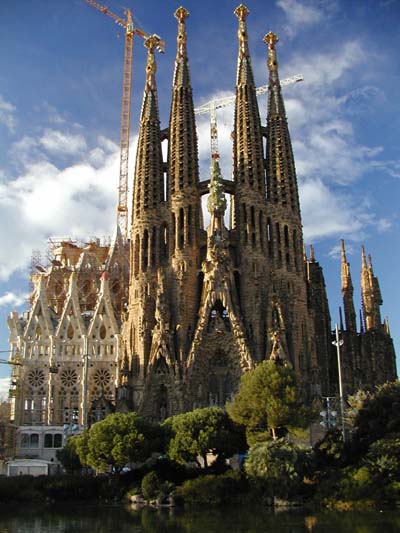
The second question was: "What significance can consecrating a church such as the Sagrada Familia have at the beginning of the twenty-first century? Is there some aspect of Gaudi's vision that has struck you in particular?"
"The truth is", said the Holy Father, "that this church is also an appropriate sign for our own times. In Gaudi's vision there are above all three elements that call my attention. The first is the blending of continuity and novelty, tradition and creativity. Gaudi had the courage to make himself part of the great tradition of the cathedrals. Using a completely new approach, he dared in his own time to make the cathedral a place for the solemn meeting between God and man. And this courage to remain within tradition, but with a creativity that renews tradition and shows the unity and progress of history, is a beautiful thing. Secondly, Gaudi chose the tripartite structure of the book of nature, the book of Scripture and the book of liturgy. This is of great importance. Scripture is made present in the liturgy, it becomes real today, it is no longer a Scripture of two thousand years ago but is celebrated, made real. In the celebration of Scripture creation speaks and finds its true response because, as St. Paul tells us, creation suffers and ... awaits the children of God; i.e., those who see it in the light of God. This fusion between meaning and creation, between Scripture and adoration, is a very important message for today. Finally, the third point is that this church was born of a typically nineteenth-century form of devotion: St. Joseph, the Holy Family of Nazareth, the mystery of Nazareth. But this devotion of the past could be said to have a great deal of importance today because the problem of the family, the renewal of the family as society's fundamental cell, is the great theme showing us the way to build society and to create a unity of faith and life, of religion and society. The main theme here is that of the family, for God Himself became a child in a family and He calls us to build and live in families".
"Gaudi and the Sagrada Familia are a very effective expression of the relationship between faith and art", said the third questioner. "How can faith today regain its place in the world of art and culture? I this an important theme for your pontificate?"
"It is indeed", said the Pope. "You know that I have given a lot of emphasis to the relationship between faith and reason; that faith, Christian faith, has its identity only in openness to reason, and that reason becomes authentic if it transcends itself towards faith. But the relationship between faith and art is equally important, because truth, which is the aim and goal of reason, finds expression and authenticity in beauty, where it reveals itself as truth. ... The relationship between truth and beauty is unbreakable, and this is why we need beauty. From earliest times the Church, even in the great modesty and poverty of the age of persecutions, used art and painting, expressions of God's salvation in the images of the world, singing, and later building. All this is and remains a constituent part of the Church. For this reason the Church has been mother to the arts for many centuries. The great treasures of Western art - music, architecture, painting - were born from the faith of the Church. Today there is some dissent, but this harms both art and faith. An art which loses its transcendent roots no longer tends towards God, it is a truncated art without a living root. A faith which only has the art of the past, is no longer faith in the present, and today it must again express itself as everlasting truth. And so the dialogue and meeting between art and faith is inscribed in the profound essence of the faith. We must do all we can so that today too faith is expressed in authentic art, as in the case of Gaudi, with continuity and novelty, so that art does not lose contact with faith".
The next question concerned the recent creation of a council for new evangelisation. "Many people have asked whether Spain, with the growth of secularisation and the fall in religious practice, is one of the countries you considered as the target of the new dicastery, even the principal target".
Benedict XVI replied: "In creating this new dicastery, my thoughts went per se to the whole world, because new schools of thought and difficulties in reflecting on the concepts of Scripture and theology are universal. Yet there is of course a centre, and that centre is the Western world with its secularism and the continuity of its faith, which must seek to renew itself in order to remain as faith today and to respond to the challenge of secularism. All the great countries of the West have their own experience of this problem. ... Spain has always been, on the one hand, a country of origin of the faith: we recall how the rebirth of Catholicism in the modern age came about above all thanks to Spain. St. Ignatius of Loyola, St, Teresa and St. John of the Cross were figures who truly renewed Catholicism and moulded its modern face. Yet it is equally true that Spain also saw the birth of laicism, of anticlericalism, a strong and aggressive secularism such as that of the 1930s. And this dispute, this clash between faith and modernity, both very lively, is coming about again in Spain today. Thus, the future of the faith and of the meeting (meeting not clash) between faith and secularism has its focal point in Spanish culture. In this sense I thought of all the great countries of the West but especially also of Spain".
The final question was: "With your trip next year for World Youth Day, you will have made three visits to Spain, more than to any other country. Why this privilege? Is it a sign of love or of particular concern?"
"Naturally it is a sign of love", the Holy Father explained. "It could be said that it is by chance that I will have made three trips to Spain. The first was for the great international gathering of families in Valencia. How could the Pope remain absent if the families of the world come together? Next year is World Youth Day, the meeting of young people from all over the world in Madrid. The Pope cannot be absent from such an occasion. Finally, we have the Compostela Holy Year and the consecration ... of the church of the Holy Family in Barcelona. How could the Pope not come? Of themselves, then, these occasions are challenges, almost a compulsion to attend. But precisely the fact that in Spain there are so many occasions shows how it truly is a country full of dynamism, full of the strength of faith. And the faith responds to challenges which are also present in Spain. Therefore, chance has brought me here, but this chance reveals a profound reality, the strength of the faith and the strength of the challenge to the faith".
Thursday, November 4, 2010
Fourth Centenary of Canonisation of St. Charles Borromeo
"The time in which Charles Borromeo lived was a very delicate one for Christianity", writes the Pope. "In a period obscured by many trials facing the Christian community, with divisions and doctrinal confusion, the clouding of the purity of faith and custom, and the bad example of many sacred ministers, Charles Borromeo did not limit himself to deploring and condemning, nor simply to expressing hope that others would change; rather, he began to reform his own life".
St. Charles "was aware that serious and credible reform had to begin with pastors". To this end he focused on "the centrality of the Eucharist, ... the spirituality of the cross, ... assiduous participation in the Sacraments, ... the Word of God, ... and love and devotion for the Supreme Pontiff, readily and filially obedient to his directives as a guarantee of true and complete ecclesial communion".
"May St. Charles encourage us always to begin with a serious commitment to personal conversion", writes the Holy Father, going on to encourage priests and deacons "to make of their lives a courageous path of sanctity" and expressing the hope that the Church in Milan may always find in her ministers "a clear faith and a sober and pure life, renewing that apostolic ardour which characterised St. Ambrose, St. Charles and so many of your holy pastors".
"St. Charles was recognised", Benedict XVI continues, "as a true loving father to the poor. ... He founded institutions for the assistance and recovery of those in need. ... During the plague of 1576, the saintly archbishop chose to remain among his people to encourage, serve and defend them with the weapons of prayer, penance and love".
The Pope highlights how "St. Charles Borromeo's charity cannot be understood without an understanding of his relationship of passionate love with the Lord Jesus". In this context the Holy Father refers to "the contemplation of the holy mystery of the altar and the Crucified Christ" which awakened the saint's "feelings of compassion for man's misery and aroused in his heart the apostolic longing to bring the evangelical message to everyone".
"Let us make the Eucharist the true centre of our communities, let us allow ourselves to be educated and moulded by that well of charity. Each apostolic and charitable action will draw strength and fruitfulness from that source".
The Holy Father concludes his Message with an appeal to young people: "Like St. Charles, you too are can make your youth an offering to Christ and your fellows. ... Dear young people, you are not only the hope of the Church, you are part of her present moment. And if you have the courage to believe in sanctity, you will become the greatest treasure of your Ambrosian Church, which is built upon saints".
The saints about The Sacrifice of The Mass
~revelation of Christ to St. Gertrude the Great~
Once, St. Teresa was overwhelmed with God's Goodness and asked Our Lord "How can I thank you?" Our Lord replied, "ATTEND ONE MASS."
The Blessed Virgin Mary once told Her faithful servant Alain: "My Son so loves those who assist at the Holy Sacrifice of the Mass that, if it were necessary He would die for them as many times as they've heard Masses."
"The Holy Mass would be of greater profit if people had it offered in their lifetime, rather than having it celebrated for the relief of their souls after death."
~Pope Benedict XV~
A great doctor of the Church, St. Anselm, declares that a single Mass offered for oneself during life may be worth more than a thousand celebrated for the same intention after death. St. Leonard of Port Maurice supports this statement by saying that one Mass before death may be more profitable than many after it.
"When we receive Holy Communion, we experience something extraordinary - a joy, a fragrance, a well being that thrills the whole body and causes it to exalt."
~ Saint Jean Vianney~
"The celebration of Holy Mass is as valuable as the death of Jesus on the cross."
~Saint Thomas Aquinas~
"If we really understood the Mass, we would die of joy."
~ Saint Jean Vianney~
"There is nothing so great as the Eucharist. If God had something more precious, He would have given it to us."
~ Saint Jean Vianney~
"It would be easier for the world to survive without the sun than to do without Holy Mass. "
~St. Pio of Pietrelcina (Padre Pio), stigmatic priest~
"When we have been to Holy Communion, the balm of love envelops the soul as the flower envelops the bee."
~ Saint Jean Vianney~
"The heavens open and multitudes of angels come to assist in the Holy Sacrifice of the Mass. "
~Saint Gregory~
"The angels surround and help the priest when he is celebrating Mass."
~ St. Augustine ~
"When Mass is being celebrated, the sanctuary is filled with countless angels who adore the Divine Victim immolated on the altar."
~ St. John Chrysostom~
Wednesday, October 27, 2010
St. Bridget of Sweden, Co-Patroness of Europe
St. Bridget of Sweden
St. Bridget of Sweden (1303-1373), whom John Paul II proclaimed as co-patroness of Europe, was the subject of Benedict XVI's catechesis during his general audience held this morning in St. Peter's Square.
The life of the saint, born in at Finister in Sweden, may be divided into two periods. During the first period she lived as a happily married woman and mother of eight children. She also began to study Sacred Scripture and, together with her husband, adopted the lifestyle of the Third Order of St. Francis. She also gave generously to the poor and founded a hospital.
This first period of Bridget's life, said the Pope, "helps us to appreciate what we could define today as authentic 'conjugal spirituality'. Christian couples can follow the path of sanctity together, upheld by the grace of the Sacrament of Marriage. ... May the Holy Spirit arouse the sanctity of Christian couples, so as to show the world the beauty of marriage lived according to the Gospel values of love, tenderness, mutual support, fruitfulness in the generation and education of children, openness and solidarity towards the world, and participation in the life of the Church".
With Bridget's widowhood began the second period of her life. She rejected a second marriage in order to concentrate on "union with the Lord through prayer, penitence and works of charity. ... Having distributed all her goods to the poor, and although she never underwent religious consecration, she moved to the Cistercian convent of Alvastra". There she began to receive the divine revelations which, differing greatly in content and style, would accompany her for the rest of her life.
"The value of St. Bridget's 'Revelations', which have been the subject of some doubt, was defined by the Venerable John Paul II in his Letter 'Spes aedificandi' where he wrote that the Church 'recognised Bridget's holiness without ever pronouncing on her individual revelations, [and] has accepted the overall authenticity of her interior experience'".
Pope Benedict went on: "Reading these Revelations we are challenged by many important questions. For example, she frequently describes ... the Passion of Christ, ... seeing therein the infinite love of God for mankind. ... Mary's painful maternity, which made her Mediator and Mother of Mercy, is another oft recurring theme of the Revelations".
St. Bridget was firmly convinced that "all charisms are destined to build the Church. It was for this reason that many of her revelations were addressed, in the form of sometimes severe admonitions, to the believers of her time including the political and religious authorities, to live their Christian lives coherently. But she always did this with an attitude of respect and complete faithfulness towards Church Magisterium, and especially towards the Successor of the Apostle Peter".
In 1349 Bridget left Sweden never to return, travelling to Rome to participate in the Jubilee Year 1350 and to ask the Pope to approve the rule of her religious order, which she intended should be made up of monks and nuns under the authority of an abbess, and dedicated to the Blessed Saviour.
"This must not surprise us", said the Holy Father. "During the Middle Ages there were religious orders in which a female branch and a male branch practiced the same monastic rule under the direction of an abbess. In the great Christian tradition the woman is recognised as having her own dignity and - following the example of Mary, Queen of the Apostles - her own place in the Church which, though not coinciding with the ordained priesthood, is equally important for the spiritual growth of the community".
Bridget also made pilgrimages to Assisi and the Holy Land. She died in 1373 and was canonised by Boniface IX in 1391. Her sanctity, characterised by the multiplicity of her gifts and experiences, "makes her an outstanding figure in the history of Europe", because she "bore witness to how deeply Christianity has permeated the life of all the peoples of this continent.
"By proclaiming her as co-patroness of Europe", Pope Benedict added in conclusion, "Pope John Paul II expressed the hope that St. Bridget - who lived in the fourteenth century when Western Christianity had still not been wounded by division - may intercede effectively with God to obtain the longed-for grace of full unity among all Christians, ... and to ensure that Europe may always nourish itself from its Christian roots".
Tuesday, October 26, 2010
Saturday, October 23, 2010
St. Elizabeth of Hungary - Teaching by Pope Benedict XVI
The Holy Father explained how St. Elizabeth was born in the year 1207. She lived the first four years of her life in the Hungarian royal court before being promised in marriage to Ludwig of Thuringia. "Although their match was decided for political reasons", said the Holy Father, "a sincere love arose between the two young people, animated by faith and by their desire to do the will of God".
Elizabeth, who "behaved before God as she behaved towards her subjects", is "a true example for everyone who holds positions of leadership", said Pope Benedict. "The exercise of authority at all levels must be practiced as a service to justice and charity, in the constant search for the common good".
Having highlighted the fact that the saint "assiduously practiced works of mercy", Benedict XVI spoke of the "profound happiness" of her marriage. "Elizabeth helped her spouse to elevate his human qualities to a supernatural level while he, for his part, protected his wife in her generosity towards the poor and in her religious observances. ... This is clear testimony of how faith and love for God and for others strengthen family life and make the marriage bond even more profound".
Elizabeth found support in the Friars Minor, something which helped her "become even more resolute in following the poor and crucified Christ, Who is present in the poor".
Following her husband's death in 1227, Elizabeth "had to face another trial: her brother-in-law usurped the government of Thuringia, declaring himself Ludwig's heir and accusing Elizabeth of being a pious woman, incompetent to rule. The young widow with her three children was driven from the castle of Wartburg and had to look for refuge elsewhere. ... During this ordeal, which she bore with great faith, patience and dedication to God, some relatives who had remained faithful and considered her brother-in-law's government illegitimate, re-established her good name. Thus, at the beginning of 1228, Elizabeth was given a pension and retired to the family castle at Marburg".
The Holy Father indicated that "Elizabeth spent her last three years in the hospital she founded, serving the sick and attending the dying. She always sought the most humble and repugnant tasks. She became what we could call a consecrated woman living in the world ('soror in saeculo') and formed a religious community with a number of grey-clad companions. It is no coincidence that she is patron of the Third Regular Order of St. Francis and of the Secular Franciscan Order".
In November 1231 she fell into a high fever and died a few days later. "The testimonies of her sanctity were so many that just four years later Pope Gregory IX proclaimed her a saint. In the same year a beautiful church was built in her honour at Marburg".
"In the figure of St. Elizabeth", Pope Benedict concluded his catechesis, "we see how faith and friendship with Christ, create a sense of justice, of universal equality, of the rights of others, and foment love and charity. From this charity comes hope, the certainty that we are loved by Christ, that the love of Christ awaits us, thus making us capable of imitating Christ and of seeing Him in others".
The priest and his ministry - Pope John Paul II
First and foremost, the priest must be seen as the 'man of faith', since by virtue of his mission he has to convey the Faith by proclaiming the word. He cannot preach the Gospel convincingly if he has not deeply assimilated its message. He bears witness to the Faith by his actions and his whole life. Through his pastoral contacts he does his best to sustain his brothers and sisters in the Faith, to respond to their doubts and to strengthen them in their convictions.
Every priest should be prepared for his role as teacher of the Faith within the Christian community. Hence, in our seminaries, revealed doctrine needs to be taught in such a way that young men may understand what the object of their faith is, and may respond to the call from the Lord with a free, interiorized adherence to the Gospel message, assimilated in prayer.
As well as being the man of faith, the priest is also the 'man of the sacred', the witness to the Invisible, the spokesman of God revealed in Jesus Christ. The priest must be known as a man of God, a man of prayer, who is seen to pray, who is felt to pray. When he celebrates the Eucharist, when he hears confessions, when he anoints the sick or when he conducts funerals, gives blessings or holds prayer meetings, let him do this in a dignified way, taking the proper time
and wearing the appropriate vestments. hence the priest must nourish within himself a spiritual life of high quality, inspired by the gift of his own ministerial priesthood. One may indeed speak of a 'spirituality of the diocesan priest'. His prayer life, his sharing, his efforts in life, are inspired by his apostolic activity, which is nourished by a life lived wholly with God. It has been observed that a time of intense pastoral activity often coincides with a period which is strong in spiritual life. The Second Vatican Council has reminded us, moreover, of 'that love of God and man, which is the soul of the apostolate' (Lumen gentium 33).
The priest is the man of faith, man of the sacred, and also the 'man of communion'. He it is who
assembles the People of God and strengthens their unity by means of the Eucharist; he is the leading spirit of brotherly love among all. The priest cannot venture on his own on the labour
awaiting him in the Lord's vineyard. He operates with his brothers in the priesthood. He collaborates with his own bishop. He does his best to forge brotherly links between members of the priestly college; in the presbyteral group especially, spiritual friendship is a great stimulus to ministry. The priest, furthermore, unites the members of the People of God who are entrusted to his pastoral care.
Friday, October 22, 2010
Visting the relics of St Don Bosco in Toronto
At 9:30pm after waiting in line for about 15 minutes I was let into the church to view the relics. Walking into the church was quite an experience. The Church was packed with barely a few seats at the back. On the left of the altar was the wax replica of St. John Bosco’s body containing the relics. Around the 3 walls of the church (excluding the altar wall) people were lined up to touch the relics. I sat down at the back of the church, while 2 youth cantors sang hymns of praise. A few moments later we were all asked to kneel down and the cantors sang ‘O Salutaris Hostia’ as youth of the Don Bosco Youth movement came in with candles to light the altar candles. The whole church, all of us, of different races, we were in one voice singing in the language of the Holy Roman church. It was as if for that moment the Tower of Babel never happened.
When all the candles on the altar were lit, a priest came in with the Monstrance containing the Most Blessed Sacrament. The Monstrance was placed on the altar and everyone silently venerated the Blessed Sacrament. A youth dressed up as St. Don Bosco, wearing black vestments and biretta, went to the microphone and read out one of the dreams of St. Don Bosco. The dream was the vision of the two pillars, where the battle ships are attacking a stately ship. The stately ship is commanded by the Holy Father and is surrounded by the flotilla of ships that protect it from the attacks of the warship. The Holy Father eventually gets wounded and dies and the enemy is rejoicing, but a new Holy Father is elected and he guides the ship safely and moors the ship to the two pillars, on top of one pillar is the Host and atop the other is the Blessed Virgin Mary. I was awestruck because in front of my eyes on the left was the relic of St. Don Bosco and on the right was the Blessed Sacrament. The a guide led St. Don Bosco down the broad road to hell, it was a sloping road with many traps. But in between the traps providence had placed knives to break the traps, the knives were the Holy Eucharist, the rosary, devotions to the saints, holy confession etc. Can you imagine, here was Our Lord in the Blessed Sacrament and the relics of St. Don Bosco, all ways provided by providence to avoid the snares of the evil one. While adoration of the Blessed Sacrament continued, various priests were available for the sacrament of Holy Confession.
Towards the end of the exposition of the Blessed Sacrament, we sung ‘Tantum Ergo’ and the divine praises as the Blessed Sacrament was reposed. People were invited to come up to the altar and light their candles as the lights in the church were turned down. Oh how symbolic this was, ‘You are the light of the world, no one puts a light under a basket, you are a city built on a hill.’ We had received the light, from all the lives and teachings saints (St Don Bosco), and from Christ himself. It was a dark rainy night in the city and in St. Benedict’s church we were the light: a light to carry out to the dark world, a light bolstered by the two pillars of the Holy Eucharist and devotion to Our Lady. After the final hymns of praise, I lined up to touch my rosary to the relic of St. Don Bosco. So that each time I say the holy rosary, I am reminded of the beautiful grace filled evening and that i never forget the two pillars.