Thomas García Martínez was born in 1486 in Fuenllana, Ciudad Real, Spain. He spent his childhood in the family home in Villanova de los Infantes.
A gifted student, Thomas entered the University of Alcalá at the age of 15. He earned a degree in Theology in a very short time, and was asked to join the faculty of this famous university.
His reputation as an excellent teacher spread, and the prestigious University of Salamanca offered Thomas a professorship in 1516. He refused the position, instead seeking admission into the Order of Saint Augustine.
He professed his vows as an Augustinian in 1517 and was ordained a Priest in 1518. Recognizing his leadership ability, his fellow Augustinians chose him to serve as Prior (local superior) and later as Provincial (regional superior). In this position, Thomas encouraged a more faithful adherence to the principles of Augustinian life. He also promoted missionary activity by Augustinians in the New World.
Thomas grew into a deeply spiritual life. He lived simply, giving away the small fortune that he inherited from his parents.
Asked to become Bishop of Granada, Thomas refused, preferring the simple life to a life of power and prestige. Several years later, Thomas was asked to become Bishop of Valencia. When he refused again, the authorities persuaded Thomas' religious superiors to order him under his vow of obedience to accept.
He reluctantly accepted, and became Archbishop of Valencia in 1545. There he found an archdiocese in spiritual chaos. He began his episcopacy by visiting every parish in the Archdiocese to discover what were the needs of the people. He then set up programs in which funds provided by the wealthy would help to provide for the poor.
The money his cathedral chapter gave him to furnish his house was given to a hospital instead. His explanation to them was that "our Lord will be better served by your money being spent on the poor in the hospital. What does a poor friar like myself want with furniture?"
He wore the same habit that he had received in the novitiate, mending it himself. The canons and domestics were ashamed of him, but they could not convince him to change. Several hundred poor came to Thomas's door each morning and received a meal, wine and money. When criticized because he was at times being taken advantage of, he replied, "If there are people who refuse to work, that is for the governor and the police to deal with. My duty is to assist and relieve those who come to my door." He took in orphans and paid his servants for every deserted child they brought to him. He encouraged the wealthy to imitate his example and be richer in mercy and charity than they were in earthly possessions.
In order to have a well-formed clergy, Thomas started Presentation Seminary in 1550. He established schools where the young would have access to a quality education. He turned his own home into a sort of soup kitchen and shelter, giving to the poor and the homeless food to eat and a place to sleep. For that reason he was known as Beggar Bishop and Father of the Poor.
Criticized because he refused to be harsh or swift in correcting sinners, he said, "Let him (the complainer) inquire whether St. Augustine and St. John Chrysostom used anathemas and excommunication to stop the drunkenness and blasphemy which were so common among the people under their care."
Thomas became ill in 1551. As his illness progressed and he grew weaker, he gave away all of his remaining possessions. As he lay dying, Thomas commanded that all the money he possessed be distributed to the poor. His material goods were to be given to the rector of his college. Mass was being said in his presence when after Communion he breathed his last, reciting the words: "Into your hands, O Lord, I commend my spirit."He died September 8, 1555 in Valencia. His remains are preserved at the Cathedral there. He was canonized in 1658.
Wednesday, September 10, 2008


Tuesday, September 9, 2008
Sacremental Wine the Precious Blood of Our Lord
I had an email from a reader who wanted to know what is Sacramental Wine and is it different from regular wine. I am publishing this article courtesy EWTN

Wine is one of the two elements absolutely necessary for the
sacrifice of the Eucharist. For valid and licit consecration vinum
de vite, i.e. the pure juice of the grape naturally and properly
fermented, is to be used. Wine made out of raisins, provided that
from its colour and taste it may be judged to be pure, may be used
(Collect. S. C. de Prop. Fide, n. 705). It may be white or red,
weak or strong, sweet or dry. Since the validity of the Holy
Sacrifice, and the lawfulness of its celebration, require
absolutely genuine wine, it becomes the serious obligation of the
celebrant to procure only pure wines. And since wines are
frequently so adulterated as to escape minute chemical analysis,
it may be taken for granted that the safest way of procuring pure
wine is to buy it not at second hand, but directly from a
manufacturer who understands and conscientiously respects the
great responsibility involved in the celebration of the Holy
Sacrifice. If the wine is changed into vinegar, or is become
putrid or corrupted, if it was pressed from grapes that were not
fully ripe, or if it is mixed with such a quality of water that it
can hardly be called wine, its use is forbidden (Missale Rom., De
Defectibus, tit. iv, 1). If the wine begins to turn into vinegar,
or to become putrid, or is the unfermented juice is pressed from
the grape, it would be a grievous offence to use it, but it is
considered valid matter (ibid., 2). To conserve weak and feeble
wines, and in order to keep them from souring or spoiling during
transportation, a small quantity of spirits of mine (grape brandy
or alcohol) may be added, provided the following conditions are
observed (1) The added spirit (alcohol) must have been distilled
from the grape (ex genimime vitis); (2) the quantity of alcohol
added, together with that which the wine contained naturally after
fermentation, must not exceed eighteen per cent of the whole; (3)
the addition must be made during the process of fermentation (S.
Romana et Univ. Inquis., 5 August, 1896).
A.J. SCHULTE
Transcribed by Michael C. Tinkler
From the Catholic Encyclopedia, copyright © 1913 by the
Encyclopedia Press, Inc. Electronic version copyright © 1996 by
New Advent, Inc., P.O. Box 281096, Denver, Colorado, USA, 80228.
(knight@knight.org) Taken from the New Advent Web Page
(www.knight.org/advent).
This article is part of the Catholic Encyclopedia Project, an
effort aimed at placing the entire Catholic Encyclopedia 1913
edition on the World Wide Web. The coordinator is Kevin Knight,
editor of the New Advent Catholic Website. If you would like to
contribute to this worthwhile project, you can contact him by e-
mail at (knight.org/advent). For more information please download
the file cathen.txt/.zip.
-------------------------------------------------------
Provided courtesy of:
Eternal Word Television Network
PO Box 3610
Manassas, VA 22110
Voice: 703-791-2576
Fax: 703-791-4250
Data: 703-791-4336
Web: http://www.ewtn.com
FTP: ewtn.com
Telnet: ewtn.com
Email address: sysop@ ewtn.com
EWTN provides a Catholic online
information and service system.

Wine is one of the two elements absolutely necessary for the
sacrifice of the Eucharist. For valid and licit consecration vinum
de vite, i.e. the pure juice of the grape naturally and properly
fermented, is to be used. Wine made out of raisins, provided that
from its colour and taste it may be judged to be pure, may be used
(Collect. S. C. de Prop. Fide, n. 705). It may be white or red,
weak or strong, sweet or dry. Since the validity of the Holy
Sacrifice, and the lawfulness of its celebration, require
absolutely genuine wine, it becomes the serious obligation of the
celebrant to procure only pure wines. And since wines are
frequently so adulterated as to escape minute chemical analysis,
it may be taken for granted that the safest way of procuring pure
wine is to buy it not at second hand, but directly from a
manufacturer who understands and conscientiously respects the
great responsibility involved in the celebration of the Holy
Sacrifice. If the wine is changed into vinegar, or is become
putrid or corrupted, if it was pressed from grapes that were not
fully ripe, or if it is mixed with such a quality of water that it
can hardly be called wine, its use is forbidden (Missale Rom., De
Defectibus, tit. iv, 1). If the wine begins to turn into vinegar,
or to become putrid, or is the unfermented juice is pressed from
the grape, it would be a grievous offence to use it, but it is
considered valid matter (ibid., 2). To conserve weak and feeble
wines, and in order to keep them from souring or spoiling during
transportation, a small quantity of spirits of mine (grape brandy
or alcohol) may be added, provided the following conditions are
observed (1) The added spirit (alcohol) must have been distilled
from the grape (ex genimime vitis); (2) the quantity of alcohol
added, together with that which the wine contained naturally after
fermentation, must not exceed eighteen per cent of the whole; (3)
the addition must be made during the process of fermentation (S.
Romana et Univ. Inquis., 5 August, 1896).
A.J. SCHULTE
Transcribed by Michael C. Tinkler
From the Catholic Encyclopedia, copyright © 1913 by the
Encyclopedia Press, Inc. Electronic version copyright © 1996 by
New Advent, Inc., P.O. Box 281096, Denver, Colorado, USA, 80228.
(knight@knight.org) Taken from the New Advent Web Page
(www.knight.org/advent).
This article is part of the Catholic Encyclopedia Project, an
effort aimed at placing the entire Catholic Encyclopedia 1913
edition on the World Wide Web. The coordinator is Kevin Knight,
editor of the New Advent Catholic Website. If you would like to
contribute to this worthwhile project, you can contact him by e-
mail at (knight.org/advent). For more information please download
the file cathen.txt/.zip.
-------------------------------------------------------
Provided courtesy of:
Eternal Word Television Network
PO Box 3610
Manassas, VA 22110
Voice: 703-791-2576
Fax: 703-791-4250
Data: 703-791-4336
Web: http://www.ewtn.com
FTP: ewtn.com
Telnet: ewtn.com
Email address: sysop@ ewtn.com
EWTN provides a Catholic online
information and service system.
St. Peter Claver - 9th September 2008
Today we celebrate the feast if St. Peter Claver a Jesuit Missionary.
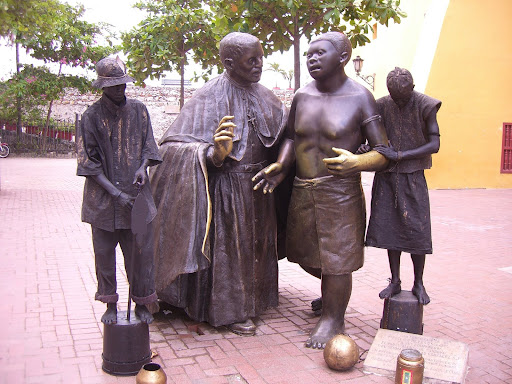
If anyone wonders what exactly it is that constitutes a Saint, he has only to read the life of Saint Peter Claver, in whom the superhuman life of grace acted so visibly as to create a person who seemed more than a man. This holy Jesuit, born in Spain in 1580, was during his novitiate a disciple of Saint Alphonsus Rodriguez, “the holy porter of Majorca”, a humble lay-brother endowed with the highest gifts of contemplation and prophecy. The two would eventually be canonized together by Pope Leo XIII in 1888, thus cementing the perfect union which began on earth and certainly continues in heaven.
Saint Alphonsus, when he saw the novice for the first time, was inspired to kiss his feet; and the novice embraced his spiritual father with a tenderness which would increase with time. A little later, the preceptor learned from a vision that this novice was destined to save a multitude of souls in the New World; he said to Peter: “How many peoples go astray for lack of ministers! The fatigue of going to seek them out is dreaded, but not the danger and crime which it is to abandon them!” Eventually Saint Alphonsus revealed his divinely revealed calling to him, to inspire in him an active desire to respond to the explicit Will of God.
After eight years of study and apostolic preparation in Spain, Saint Peter asked to go to the Jesuit missions of the Western Indies, and was sent to Carthagena in Colombia, South America, when he was thirty years old. He was assigned to accompany an elderly priest who had undertaken a ministry of service to the poor Africans brought to be sold in the market of that city. These poor strangers spoke several languages but shared a common misery, which Saint Peter soon saw clearly. When the holds of the boats were opened, “all one beheld was a confused mass of men, women, children and old men, sick persons mingled with healthy ones, and often, alas! living beings next to cadavers, for the crossing made victims.” The elderly forerunner of Peter, when about to retire, asked that the objects of his care be definitively confided to Peter Claver, a petition willingly granted.
Thus began forty-four years of unceasing dedication to their spiritual and material betterment by Saint Peter. He watched for the arrival of the slave ships, which brought from ten to twelve thousand souls each year, and never failed to be the first to go aboard, accompanied by his interpreters and carrying the provisions he had been able to beg. He greeted the living, arranged for the burial of the dead and the transport of the sick to hospitals. Having won their sympathy, he went to them regularly with his interpreters and taught them, during several hours’ time, the elements of doctrine, aided by pictures. Before he died, he had baptized 400,000. He put around the necks of each newly baptized child of God, a medal which would thereafter distinguish the Christians from the yet untaught.

Though this was his principal industry, he also spent many days in the nearby lazaretto — a refuge for lepers — and in the hospitals of the region. No infirmity repelled him; the Brother who accompanied him had several times a day to clean his cloak, on which he would lay the sick while he arranged their poor beds. It never ceased to emit a heavenly fragrance. He slept only two or three hours at night, and ate almost nothing. The poor were his beloved children and he their beloved father, whose visits were anxiously awaited and were always too short. Those who resisted him did not do so indefinitely; one man insulted him for twenty-two years, but at the end of that time fell on his knees and begged his pardon. The vision of his charity is certainly reserved for heaven; his biographers scarcely find words adequate to describe his heroic life. Pope Pius IX, who beatified Saint Peter in 1851, commented that never had he read a life of a Saint which so moved him.
After Saint Peter contracted the plague in his declining years, he was left infirm and partially paralyzed. He then had himself tied to a donkey and in that way went about begging and distributing provisions. He had a rude servant who often neglected him and mistreated him, but when his brethren offered him another, asked to be allowed to keep that one, who treated him far better than he deserved. Two years after his death at the age of seventy-four, his body was found intact, despite the humidity of the burial site and the live caustic covering it. Miracles proliferated there and elsewhere by the invocation of his name. A large church was built in Carthagena in his honor, and he became the second patron of his adopted land, Colombia.
Peter Claver understood that concrete service like the distributing of medicine, food or brandy to his black brothers and sisters could be as effective a communication of the word of God as mere verbal preaching. As Peter Claver often said, "We must speak to them with our hands before we try to speak to them with our lips."
If anyone wonders what exactly it is that constitutes a Saint, he has only to read the life of Saint Peter Claver, in whom the superhuman life of grace acted so visibly as to create a person who seemed more than a man. This holy Jesuit, born in Spain in 1580, was during his novitiate a disciple of Saint Alphonsus Rodriguez, “the holy porter of Majorca”, a humble lay-brother endowed with the highest gifts of contemplation and prophecy. The two would eventually be canonized together by Pope Leo XIII in 1888, thus cementing the perfect union which began on earth and certainly continues in heaven.
Saint Alphonsus, when he saw the novice for the first time, was inspired to kiss his feet; and the novice embraced his spiritual father with a tenderness which would increase with time. A little later, the preceptor learned from a vision that this novice was destined to save a multitude of souls in the New World; he said to Peter: “How many peoples go astray for lack of ministers! The fatigue of going to seek them out is dreaded, but not the danger and crime which it is to abandon them!” Eventually Saint Alphonsus revealed his divinely revealed calling to him, to inspire in him an active desire to respond to the explicit Will of God.
After eight years of study and apostolic preparation in Spain, Saint Peter asked to go to the Jesuit missions of the Western Indies, and was sent to Carthagena in Colombia, South America, when he was thirty years old. He was assigned to accompany an elderly priest who had undertaken a ministry of service to the poor Africans brought to be sold in the market of that city. These poor strangers spoke several languages but shared a common misery, which Saint Peter soon saw clearly. When the holds of the boats were opened, “all one beheld was a confused mass of men, women, children and old men, sick persons mingled with healthy ones, and often, alas! living beings next to cadavers, for the crossing made victims.” The elderly forerunner of Peter, when about to retire, asked that the objects of his care be definitively confided to Peter Claver, a petition willingly granted.
Thus began forty-four years of unceasing dedication to their spiritual and material betterment by Saint Peter. He watched for the arrival of the slave ships, which brought from ten to twelve thousand souls each year, and never failed to be the first to go aboard, accompanied by his interpreters and carrying the provisions he had been able to beg. He greeted the living, arranged for the burial of the dead and the transport of the sick to hospitals. Having won their sympathy, he went to them regularly with his interpreters and taught them, during several hours’ time, the elements of doctrine, aided by pictures. Before he died, he had baptized 400,000. He put around the necks of each newly baptized child of God, a medal which would thereafter distinguish the Christians from the yet untaught.
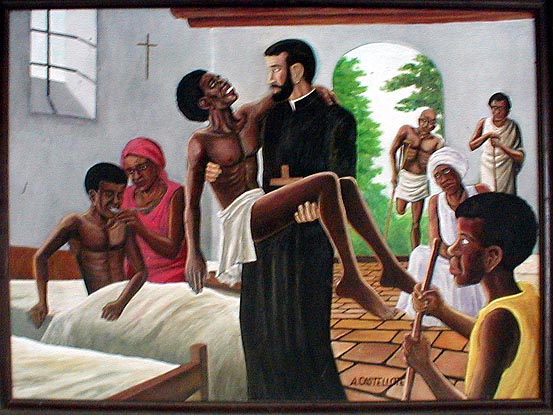
Though this was his principal industry, he also spent many days in the nearby lazaretto — a refuge for lepers — and in the hospitals of the region. No infirmity repelled him; the Brother who accompanied him had several times a day to clean his cloak, on which he would lay the sick while he arranged their poor beds. It never ceased to emit a heavenly fragrance. He slept only two or three hours at night, and ate almost nothing. The poor were his beloved children and he their beloved father, whose visits were anxiously awaited and were always too short. Those who resisted him did not do so indefinitely; one man insulted him for twenty-two years, but at the end of that time fell on his knees and begged his pardon. The vision of his charity is certainly reserved for heaven; his biographers scarcely find words adequate to describe his heroic life. Pope Pius IX, who beatified Saint Peter in 1851, commented that never had he read a life of a Saint which so moved him.
After Saint Peter contracted the plague in his declining years, he was left infirm and partially paralyzed. He then had himself tied to a donkey and in that way went about begging and distributing provisions. He had a rude servant who often neglected him and mistreated him, but when his brethren offered him another, asked to be allowed to keep that one, who treated him far better than he deserved. Two years after his death at the age of seventy-four, his body was found intact, despite the humidity of the burial site and the live caustic covering it. Miracles proliferated there and elsewhere by the invocation of his name. A large church was built in Carthagena in his honor, and he became the second patron of his adopted land, Colombia.
Peter Claver understood that concrete service like the distributing of medicine, food or brandy to his black brothers and sisters could be as effective a communication of the word of God as mere verbal preaching. As Peter Claver often said, "We must speak to them with our hands before we try to speak to them with our lips."
Monday, September 8, 2008
Karan Thapar's editorial about the Orissa Situation
Please find below an article by Karan Thapar which was published in the Hindustan Times, Mumbai, Aug 31, 2008

Please click on the image above so that it can be read in its entirety in a bigger font.

Please click on the image above so that it can be read in its entirety in a bigger font.
Mount Mary Basilica Bandra Mumbai India

(Edifice of Our Lady of the Mount Basilica)
When I was a little boy one of the big churches we went to on the 8th Of September was the Basilica of Our Lady of the Mount commonly referred to as Mount Mary.
Although the current church edifice is just 100 years old, the history behind the current statue of Our Lady goes back to the 16th century when Jesuit priests from Portugal brought the statue to the current location and constructed a chapel. In 1700 Arab pirates interested in the gilt-lined object held in the hand disfigured the statue by cutting off the right hand.
In 1760, the church was rebuilt and the statue was substituted with a statue of Our Lady of Navigators in St. Andrew's church nearby. This statue has an interesting legend. It goes that a Koli fisherman dreamt that he would find a statue in the sea. The statue was found floating in the sea between 1700 and 1760. A Jesuit Annual Letter dated to 1669 and published in the book St. Andrew's Church, Bandra (1616–1966) supports this claim.
The shrine was renovated and given most of the present day features in 1904 as part of the golden jubilee of Pope Pius IX’s Declaration of the Immaculate Conception in 1854. The National Marian Congress, 1954, Pope Pius XII designated the shrine as a Minor Basilica.
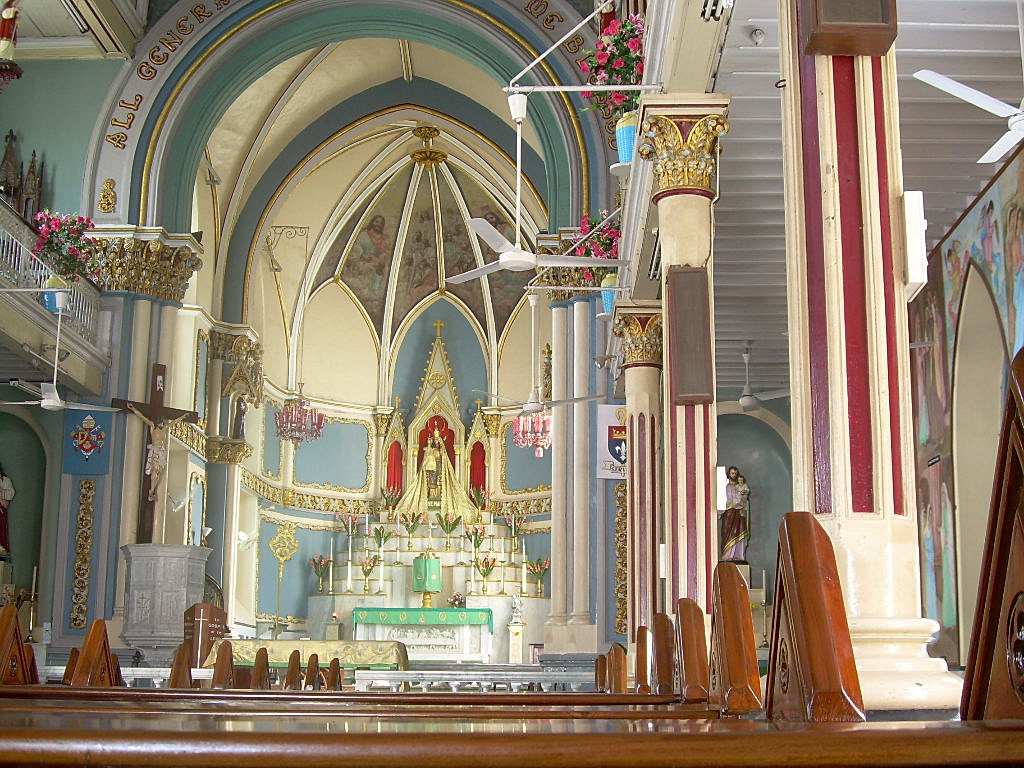
(Interior view of the Basilica)
Every year before the 8th of September there is a Novena to the Immaculate Conception. 100 of thousands of people both Catholic and non catholic attend the novena in honour of Our Lady. Indeed, in India is is common to see many non-Catholics attend festivals of Our Lady. As a little boy I loved going for the novena when I could and attend the big mass on the 8th of September which was usually a holiday in our Catholic schools so that we could go for mass at Mount Mary. After this we would all go for the Bandra Fair but that is another story and another post.
Saturday, September 6, 2008
Update on Orissa 6th September 2008
The following are some excerpts from a news article at Compass Direct on the situation in Orissa.
Asserting that most area Hindus are tolerant and peaceable, victims of ongoing anti-Christian violence in the eastern state of Orissa blamed the Vishwa Hindu Parishad (World Hindu Council or VHP) and other extremist groups for the terror of the past two weeks.
“The mobs that attacked our parishes and institutions were largely composed of extremists from the VHP and its youth wing, Bajrang Dal,” said Bishop Sarat Chandra Nayak of the Behrampore Catholic diocese.
At least four parishes, a presbytery and a youth hostel were destroyed in Munniguda town in Rayagada district under the Behrampore diocese in the spate of violence that began following the killing of a VHP leader, Laxmanananda Saraswati, and four of his associates in Kandhamal district on August 23. Christian leaders say more than 100 lives have been lost and thousands of houses, churches and institutions damaged or destroyed in the violence.
Father Mathew Puthyadam, a Catholic priest in Phulbani town in Kandhamal district, told Compass that local Hindu families gave him shelter.
As mob of around 4,000 people was carrying the body of Saraswati in a procession outside his church on the night of August 24, he said, he first sought shelter with Christians.
“When the mob was destroying my parish [Christ the King Church], I went to the house of parish workers nearby and hid in a broken bathroom,” Fr. Puthyadam said. “The mob somehow came to know that the house belonged to Christians, and they launched an attack on it. They beat up the two boys who live there, but they managed to escape. Thankfully, they did not come to the bathroom.”
About an hour after the mob left, Fr. Puthyadam came out to the street to see if it was safe for him to leave.
“A Hindu lady told me some extremists were still roaming around,” he said. “She asked me to hide in her kitchen and gave me food to eat.”
Later, Fr. Puthyadam fled to a forest, and finally came to the Archbishop’s House in the state capital, Bhubaneswar.
Some Orissa locals believe the extremists meant to create a rift between Christian missionaries and lower-caste tribal peoples known as “Other Backward Classes” (OBCs).
Prabhu Kalyan Mahapatra, a local Hindu and freelance journalist, told Compass that he did not think the violence was the result of what media are portraying as a Hindu-Christian “clash.”
In Kandhamal, there are OBCs who are lower castes but not “outcasts,” Mahapatra said, noting that the OBCs were mainly traders, while Dalits and tribal peoples were laborers and the poorest of the poor. He said the OBCs exploited Dalit and tribal people.
“However, Christian missionaries provided education to Dalits and tribals, which was not liked by the OBCs for obvious reasons,” he said, pointing out that several people from Dalit and tribal backgrounds had risen to become bureaucrats and members of parliament because of education provided by Christian institutions. “And the VHP took advantage of the situation and created a rift between OBCs and Christian missionaries.”
Mahapatra said that locals’ tolerance for Christian converts made Hindu-Christian conflict an unlikely reason for the violence. A Christian convert, Madhusudan Das, was recognized by the people of all local communities as the “father of modern Orissa,” he said.
Das, a lawyer, social reformer and patriot, worked for the political, social and economical uplift of people of eastern India, especially Orissa, and contributed numerous articles and poems both in Oriya and English.
“If the people of these communities respect a convert [Das], how can you say the Hindus of Orissa are not tolerant?” he asked.
Mahapatra explained how the VHP extended Saraswati’s funeral procession to incite violence.
“The funeral was taken from Saraswati’s ashram [religious center] in Jalespeta to his other ashram in Chakapada in Kandhamal, covering around 134 kilometers, when the distance between the two ashrams is merely 70 kilometers,” he said.
The attacks on Christians began during the funeral procession, he added.
Asserting that most area Hindus are tolerant and peaceable, victims of ongoing anti-Christian violence in the eastern state of Orissa blamed the Vishwa Hindu Parishad (World Hindu Council or VHP) and other extremist groups for the terror of the past two weeks.
“The mobs that attacked our parishes and institutions were largely composed of extremists from the VHP and its youth wing, Bajrang Dal,” said Bishop Sarat Chandra Nayak of the Behrampore Catholic diocese.
At least four parishes, a presbytery and a youth hostel were destroyed in Munniguda town in Rayagada district under the Behrampore diocese in the spate of violence that began following the killing of a VHP leader, Laxmanananda Saraswati, and four of his associates in Kandhamal district on August 23. Christian leaders say more than 100 lives have been lost and thousands of houses, churches and institutions damaged or destroyed in the violence.
Father Mathew Puthyadam, a Catholic priest in Phulbani town in Kandhamal district, told Compass that local Hindu families gave him shelter.
As mob of around 4,000 people was carrying the body of Saraswati in a procession outside his church on the night of August 24, he said, he first sought shelter with Christians.
“When the mob was destroying my parish [Christ the King Church], I went to the house of parish workers nearby and hid in a broken bathroom,” Fr. Puthyadam said. “The mob somehow came to know that the house belonged to Christians, and they launched an attack on it. They beat up the two boys who live there, but they managed to escape. Thankfully, they did not come to the bathroom.”
About an hour after the mob left, Fr. Puthyadam came out to the street to see if it was safe for him to leave.
“A Hindu lady told me some extremists were still roaming around,” he said. “She asked me to hide in her kitchen and gave me food to eat.”
Later, Fr. Puthyadam fled to a forest, and finally came to the Archbishop’s House in the state capital, Bhubaneswar.
Some Orissa locals believe the extremists meant to create a rift between Christian missionaries and lower-caste tribal peoples known as “Other Backward Classes” (OBCs).
Prabhu Kalyan Mahapatra, a local Hindu and freelance journalist, told Compass that he did not think the violence was the result of what media are portraying as a Hindu-Christian “clash.”
In Kandhamal, there are OBCs who are lower castes but not “outcasts,” Mahapatra said, noting that the OBCs were mainly traders, while Dalits and tribal peoples were laborers and the poorest of the poor. He said the OBCs exploited Dalit and tribal people.
“However, Christian missionaries provided education to Dalits and tribals, which was not liked by the OBCs for obvious reasons,” he said, pointing out that several people from Dalit and tribal backgrounds had risen to become bureaucrats and members of parliament because of education provided by Christian institutions. “And the VHP took advantage of the situation and created a rift between OBCs and Christian missionaries.”
Mahapatra said that locals’ tolerance for Christian converts made Hindu-Christian conflict an unlikely reason for the violence. A Christian convert, Madhusudan Das, was recognized by the people of all local communities as the “father of modern Orissa,” he said.
Das, a lawyer, social reformer and patriot, worked for the political, social and economical uplift of people of eastern India, especially Orissa, and contributed numerous articles and poems both in Oriya and English.
“If the people of these communities respect a convert [Das], how can you say the Hindus of Orissa are not tolerant?” he asked.
Mahapatra explained how the VHP extended Saraswati’s funeral procession to incite violence.
“The funeral was taken from Saraswati’s ashram [religious center] in Jalespeta to his other ashram in Chakapada in Kandhamal, covering around 134 kilometers, when the distance between the two ashrams is merely 70 kilometers,” he said.
The attacks on Christians began during the funeral procession, he added.
Friday, September 5, 2008
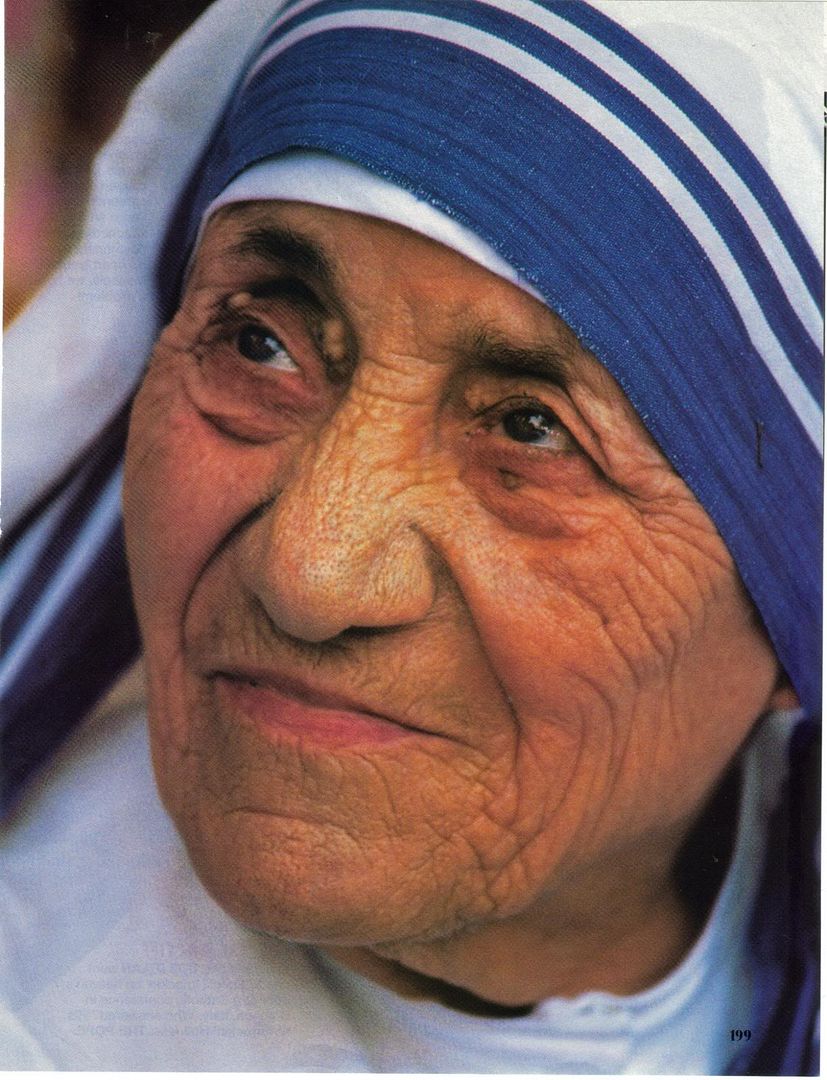
Bl. Teresa of Calcutta - 5th September 2008
Today we celebrate the feast of Blessed Teresa of Calcutta. Mother Teresa is a saint of our times. A lot has been said and written about her over the past few years. Today we will contemplate some of the words of this saint.

"Yesterday is gone. Tomorrow has not yet come. We have only today. Let us begin."
"Like Jesus we belong to the world living not for ourselves but for others. The joy of the Lord is our strength."
"There are so many religions and each one has its different ways of following God. I follow Christ:
Jesus is my God,
Jesus is my Spouse,
Jesus is my Life,
Jesus is my only Love,
Jesus is my All in All;
Jesus is my Everything."
Make us worthy, Lord, to serve those people throughout the world who live and die in poverty and hunger. Give them through our hands, this day, their daily bread, and by our understanding love, give them peace and joy.
I heard the call to give up all and follow Christ into the slums to serve Him among the poorest of the poor. It was an order.
I was to leave the convent and help the poor while living among them.
When a poor person dies of hunger, it has not happened because God did not take care of him or her.
It has happened because neither you nor I wanted to give that person what he or she needed.
You and I, we are the Church, no? We have to share with our people. Suffering today is because people are hoarding, not giving, not sharing.
Jesus made it very clear. Whatever you do to the least of my brethren, you do it to me.
Give a glass of water, you give it to me. Receive a little
child, you receive me.
Everybody today seems to be in such a terrible rush, anxious for greater developments and greater riches and so on, so that children have very little time for their parents. Parents have very little time for each other, and in the home begins the disruption of peace of the world.
If we really want to love we must learn how to forgive.
"Yesterday is gone. Tomorrow has not yet come. We have only today. Let us begin."
"Like Jesus we belong to the world living not for ourselves but for others. The joy of the Lord is our strength."
"There are so many religions and each one has its different ways of following God. I follow Christ:
Jesus is my God,
Jesus is my Spouse,
Jesus is my Life,
Jesus is my only Love,
Jesus is my All in All;
Jesus is my Everything."
Make us worthy, Lord, to serve those people throughout the world who live and die in poverty and hunger. Give them through our hands, this day, their daily bread, and by our understanding love, give them peace and joy.
I heard the call to give up all and follow Christ into the slums to serve Him among the poorest of the poor. It was an order.
I was to leave the convent and help the poor while living among them.
When a poor person dies of hunger, it has not happened because God did not take care of him or her.
It has happened because neither you nor I wanted to give that person what he or she needed.
You and I, we are the Church, no? We have to share with our people. Suffering today is because people are hoarding, not giving, not sharing.
Jesus made it very clear. Whatever you do to the least of my brethren, you do it to me.
Give a glass of water, you give it to me. Receive a little
child, you receive me.
Everybody today seems to be in such a terrible rush, anxious for greater developments and greater riches and so on, so that children have very little time for their parents. Parents have very little time for each other, and in the home begins the disruption of peace of the world.
If we really want to love we must learn how to forgive.
Thursday, September 4, 2008
History and comments about Orissa religious violence

"Faith Under Fire" is a book that documents the systematic attacks on Indian Catholics in the Kandhamals district of the eastern state of Orissa that exploded over Christmas 2007, and the abysmal lack of any attempt by the Indian state to protect its citizens or try and bring them to justice.
The book was prepared by the Justice, Peace and Development Commission of the Catholic Church in Orissa and is published by Media House publishers in Delhi earlier this year.
The nearly 400 page volume is divided into five sections:
* The facts on the situation in Kandhamals, with essays and reports that try to establish what occurred
* Statements and responses from members of the Christian community in Orissa, including Archbishop Cheenath of Cuttack-Bhubaneshwar and Sr. Nirmala MC (of the Missionaries of Charity)
* Essays that give a background to the rise of sectarian violence, including the heinous Graham Staines murder. (In Indian English, such incidents are described as "communal" and "communalism" means "sectarian" or "promoting sectarian hatred.")
* An examination of the Wadhwa Commission Report (which investigated the Staines murder and has continued to be perceived by Indian Christians as being distorted and unfair), as well as essays that examine the controversy surrounding conversion.
* A section that documents several first hand reports of the violence, including first person accounts of riot victims.
* Two appendices that include the text of a United Nations report on the Freedom of Religion in India and the report of the National Commission of Minorities on the Kandhamals violence, as well as color photographs that document the violence, and a section with fact sheets about the region.
The following is from the foreword by Teesta Setalvad, prominent (secular and Leftist) Indian human rights activist (especially relating to violence against religious minorities and in the name of religion) and co-editor of Communalism Combat,
Any reflection on the bleak and bloody Christmas suffered by fellow Indian Christians in the eastern Indian state of Orissay in December 2007, requires the interrogation of several issues. The muted political response across the political spectrum, the absence of political outrage or any sustained campaigns and statements (two bland questions in Parliament during the first half of the budget session reflects how far removed debates in the lower house of the Indian Parliament are to the political reality of India). The message is loud and clear. India's tiny ... Christian religious minority are too minuscule to matter. With all the power and prestige that Christian institutes of learning and education enjoy, with all the quantitative and qualitative services that Christian institutes of health and nurturing provide, Indian democracy, laced as it is today with the ... racist power of hate, has been reduced to a game of numbers.
To take the interrogation further, no spontaneous suo moto judicial action followed the violent attacks on Christian villages in Kandhamal district that rendered 30,000 citizens overnight into refugees living in camps, 101 churches destroyed and properties worth lakhs ("lakh" or "lac" = 100,000) of rupees destroyed. Despite Articles 14 and 21 (of the Indian Constitution), the right to life and equality under the law are fundamental rights guaranteed under the Indian Constitution being serious under threat and attack. [sic]
Most depressing in this all pervasive climate of complicity, was the deafening silence from India's conscience, its citizenry, you and me, as humanitarian relief was actually denied by a calculating Orissa state government, and a mute and impotent Central dispensation looked on.
For a link to the current news about the goings on in Orissa refer to
http://dayofwrathdiesirae.blogspot.com/2008/09/update-on-orissa-4th-septmebr-2008.html
http://dayofwrathdiesirae.blogspot.com/2008/09/update-on-orissa-religious-riots-4th.html
http://dayofwrathdiesirae.blogspot.com/2008/08/religious-riots-in-india.html
(Post is courtesy of this blog)
Update on Orissa 4th September 2008
This is a summary of the goings on in Orissa as of today the 4th September 2008.
Christian victims of Hindu extremist violence who have fled to the capital of the eastern state of Orissa said state police have been mere spectators as mayhem continued a 12th consecutive day.
Among those who have fled to Bhubaneswar was Father Prabodha Kumar, a Catholic priest who reached the Catholic Archbishop’s House in the capital after a seven-day journey from Onjamundi village in Kandhamal. He was among other fearful sojourners at the house whose mobile phones constantly rang with news of more attacks from their relatives, friends and church members in interior villages of Kandhamal.
Fr. Kumar looked deeply troubled after one such phone call yesterday.
“My brother has been forced to ‘reconvert’ to Hinduism, as he was told that if he did not do so, his house would be destroyed,” he said.
Asked why he did not report the abuse to the police, the priest told Compass that if police officers could “witness Christians being brutally attacked,” why would they do anything to save his brother?
A few minutes later, Fr. Kumar’s phone rang once again. This time, it was about Christians in Kanpada village in Balliguda Block (Kandhamal district) being told to “reconvert” if they did not want their houses to be burned.
Shortly thereafter, another victim at the Archbishop’s House received a phone call reporting that at least 19 houses and churches were burned down that morning in Lujurmunda village, under Tikabali police station jurisdiction in Kandhamal.
State Inaction
That police did nothing to protect Christians is the assertion of most of the victims of Orissa violence.
Ravindranath Pradhan, a 45-year-old former soldier for the Indian Army, told Compass that two policemen came to him in his village, Gadragaon – also under the jurisdiction of Tikabali police station in Kandhamal – on August 24 and asked if he had heard the news about Saraswati’s killing. The officers told him to be “cautious,” but when he said police should protect him and his family, they said they didn’t have enough force to do so and left the village.
A little while later, he said, a mob of around 50 Hindu extremists stormed into the village and burned 31 houses belonging to Christians. The mob burned and killed his brother, Rasanand Pradhan, who suffers from paralysis, as he lay on his bed in a room that was set on fire.
Ravindranath Pradhan, along with more than 100 Christians – including women, children and babies from his village, walked to reach Bhubaneswar, covering more than 300 kilometers (186 miles). He walked and used various means of transport, halting in numerous forests, before he was able to reach the state capital on Tuesday (Sept. 2).
For more details about state and police inaction, please read this link on Compass Direct
Christian victims of Hindu extremist violence who have fled to the capital of the eastern state of Orissa said state police have been mere spectators as mayhem continued a 12th consecutive day.
Among those who have fled to Bhubaneswar was Father Prabodha Kumar, a Catholic priest who reached the Catholic Archbishop’s House in the capital after a seven-day journey from Onjamundi village in Kandhamal. He was among other fearful sojourners at the house whose mobile phones constantly rang with news of more attacks from their relatives, friends and church members in interior villages of Kandhamal.
Fr. Kumar looked deeply troubled after one such phone call yesterday.
“My brother has been forced to ‘reconvert’ to Hinduism, as he was told that if he did not do so, his house would be destroyed,” he said.
Asked why he did not report the abuse to the police, the priest told Compass that if police officers could “witness Christians being brutally attacked,” why would they do anything to save his brother?
A few minutes later, Fr. Kumar’s phone rang once again. This time, it was about Christians in Kanpada village in Balliguda Block (Kandhamal district) being told to “reconvert” if they did not want their houses to be burned.
Shortly thereafter, another victim at the Archbishop’s House received a phone call reporting that at least 19 houses and churches were burned down that morning in Lujurmunda village, under Tikabali police station jurisdiction in Kandhamal.
State Inaction
That police did nothing to protect Christians is the assertion of most of the victims of Orissa violence.
Ravindranath Pradhan, a 45-year-old former soldier for the Indian Army, told Compass that two policemen came to him in his village, Gadragaon – also under the jurisdiction of Tikabali police station in Kandhamal – on August 24 and asked if he had heard the news about Saraswati’s killing. The officers told him to be “cautious,” but when he said police should protect him and his family, they said they didn’t have enough force to do so and left the village.
A little while later, he said, a mob of around 50 Hindu extremists stormed into the village and burned 31 houses belonging to Christians. The mob burned and killed his brother, Rasanand Pradhan, who suffers from paralysis, as he lay on his bed in a room that was set on fire.
Ravindranath Pradhan, along with more than 100 Christians – including women, children and babies from his village, walked to reach Bhubaneswar, covering more than 300 kilometers (186 miles). He walked and used various means of transport, halting in numerous forests, before he was able to reach the state capital on Tuesday (Sept. 2).
For more details about state and police inaction, please read this link on Compass Direct
St. Rose of Viterbo - 4th September 2008
Saint Rose was born in the spring of 1235 at Viterbo, capital of the patrimony of Saint Peter. In those days the emperor Frederick II was oppressing the Church, and many were faithless to the Holy See. The German emperor Frederic II and his allies, called the "Ghibellines" were in armed conflict with the Pope and his allies, called the "Guelphs."
But this infant at once seemed filled with grace; she never cried; with tottering steps she sought Jesus in His tabernacle; she knelt before sacred images and listened to sermons and pious conversation, retaining all she heard, and this when she was scarcely three years old. One coarse habit covered her flesh; fasts and disciplines were her delight.
At the age of seven she wished to enter a monastery of nuns; but God had other designs for her, and she resolved to create a solitude in her father’s house, where she would forever spend all her days. Her mortifications there seem incredible to our time of laxity; she gave herself the discipline three times a day until she fainted from fatigue and loss of blood, and she scarcely ate at all. To those who urged her to mitigate her austerities, she explained so perfectly that happiness consists in suffering for God, that no one could doubt this was so for her.
Nonetheless she fell ill and nearly died of consumption. She was close to the final agony when suddenly she beheld the Mother of God, and said to those attending her: “All of you here, why do you not greet the Queen of the world? Do you not see Mary, the August Mother of my God, coming forward? Let us go to meet Her, and prostrate ourselves before Her majesty!” Everyone turned toward the door and knelt down, and the Mother of God spoke to Rose, telling her she must enter the Third Order of Saint Francis, then go out to “reprove, convince, exhort and bring back the erring to the paths of salvation. If your endeavors bring upon you sarcasm and mockery, persecution and labor, you must bear them patiently... Those who assist you will be enriched with all the graces of the Lord.”
To defend the Church’s rights was already Rose’s burning wish. When hardly ten years old, she arose after her reception into the Franciscan habit, went down to the public square at Viterbo, called upon the inhabitants to be faithful to the Sovereign Pontiff, and vehemently denounced all his opponents. She returned to her house only to redouble her flagellations and macerations; she saw her Saviour on the Cross and nothing could arrest her ardor thereafter. So great was the power of her word and of the miracles which accompanied it, that at the end of several months the Imperial party, after threatening her in vain to stop her preaching, in fear and anger drove her from the city.
Saint Rose and her parents moved to Soriano, a fortified city, where she continued to do as she had been told by the Mother of God. Then Rose went on by herself to Vitorchiano, where she had understood there was need for her, and continued to win souls by her aspect as much as by her words. She went barefoot and wore a poor tunic at all times, until after some eighteen months, when the emperor had died, she and her parents returned to Viterbo. Innocent IV was brought back in triumph to Rome and the cause of God was won.
A number of young girls came to her for instruction at Viterbo, and she taught them the principles of modest prudence and faithful love of God. Rose fell ill again and recognized that her end was approaching; she prepared, rejoicing, in solitude for her glorious destiny, and died in her eighteenth year. Not long afterward, she appeared in glory to Alexander IV, and bade him to translate her intact body. He found it fragrant and beautiful, as if still in life. For more than 700 years it has remained supple and unchanged, save for its color, darkened after a fire in the chapel where it reposed.
But this infant at once seemed filled with grace; she never cried; with tottering steps she sought Jesus in His tabernacle; she knelt before sacred images and listened to sermons and pious conversation, retaining all she heard, and this when she was scarcely three years old. One coarse habit covered her flesh; fasts and disciplines were her delight.
At the age of seven she wished to enter a monastery of nuns; but God had other designs for her, and she resolved to create a solitude in her father’s house, where she would forever spend all her days. Her mortifications there seem incredible to our time of laxity; she gave herself the discipline three times a day until she fainted from fatigue and loss of blood, and she scarcely ate at all. To those who urged her to mitigate her austerities, she explained so perfectly that happiness consists in suffering for God, that no one could doubt this was so for her.
Nonetheless she fell ill and nearly died of consumption. She was close to the final agony when suddenly she beheld the Mother of God, and said to those attending her: “All of you here, why do you not greet the Queen of the world? Do you not see Mary, the August Mother of my God, coming forward? Let us go to meet Her, and prostrate ourselves before Her majesty!” Everyone turned toward the door and knelt down, and the Mother of God spoke to Rose, telling her she must enter the Third Order of Saint Francis, then go out to “reprove, convince, exhort and bring back the erring to the paths of salvation. If your endeavors bring upon you sarcasm and mockery, persecution and labor, you must bear them patiently... Those who assist you will be enriched with all the graces of the Lord.”
To defend the Church’s rights was already Rose’s burning wish. When hardly ten years old, she arose after her reception into the Franciscan habit, went down to the public square at Viterbo, called upon the inhabitants to be faithful to the Sovereign Pontiff, and vehemently denounced all his opponents. She returned to her house only to redouble her flagellations and macerations; she saw her Saviour on the Cross and nothing could arrest her ardor thereafter. So great was the power of her word and of the miracles which accompanied it, that at the end of several months the Imperial party, after threatening her in vain to stop her preaching, in fear and anger drove her from the city.
Saint Rose and her parents moved to Soriano, a fortified city, where she continued to do as she had been told by the Mother of God. Then Rose went on by herself to Vitorchiano, where she had understood there was need for her, and continued to win souls by her aspect as much as by her words. She went barefoot and wore a poor tunic at all times, until after some eighteen months, when the emperor had died, she and her parents returned to Viterbo. Innocent IV was brought back in triumph to Rome and the cause of God was won.
A number of young girls came to her for instruction at Viterbo, and she taught them the principles of modest prudence and faithful love of God. Rose fell ill again and recognized that her end was approaching; she prepared, rejoicing, in solitude for her glorious destiny, and died in her eighteenth year. Not long afterward, she appeared in glory to Alexander IV, and bade him to translate her intact body. He found it fragrant and beautiful, as if still in life. For more than 700 years it has remained supple and unchanged, save for its color, darkened after a fire in the chapel where it reposed.
Update on Orissa Religious Riots - 4th September 2008
This is an update on the situation in Orissa.
1) NUN BURNT ALIVE: A nun was burnt to death on 25th, Monday, after an orphanage was torched in at Phutpali in Bargarh district in Orissa during a bandh called by Hindu nationalist parties.Twenty children, who were at the orphanage, managed to escape but a priest suffered serious burn injuries in the attack.
2) RASANANDA PRADHAN TORCHED ALIVE: Another person, Rasananda Pradhan, was burnt to death when his house was set ablaze at Rupa village in Kandhamal district.
3) INFLAMMATORY SPEECHES TARGET CHRISTIANS: During the bandh inflammatory speeches spreading hatred against the Christian workers and the community were given by the VHP leaders. To gain the mass support,the activists have also carried the body of Swamiji throughout the town.
4) CHURCHES BURNT ALL ACROSS ORISSA STATE: Churches were attacked in Khurda, Bargarh, Sundergarh, Sambalpur, Koraput, Boudh, Mayurbhanj, Jagatsinghpur and Kandhamal districts as also in the state capital, police sources said, adding 40 houses were set ablaze in Phulbani town.
5) BUSES AND VEHICLES TORCHED: Mr. Mishra Digal was beaten up, while the motorcycles of Mr. R. K. Digal and Jitendra were burnt. Several buses at Gee Udaigiri in Baliguda were burnt.
6) PULBANI CHURCH RANSACKED: The Church at Phulbani,and several other churches at Phiringia were attacked and ransacked. Pastor D. Tatson's house was vandalized and his property burnt.
7) KAKRIGUMA CHURCHES VANDALISED: Churches in Kakriguma have been targeted by the mob that reportedly damaged the Assembly Of God Church and the Philadelphia Church.
8) WORLD VISION STAFF FLED FOR SAFETY: World Vision India office ransacked and the Staff has also fled to jungle for protection.
9) CHRISTIANS TAKE SHELTER IN FOREST FOR PROTECTION: A police camp at Barakhama was also attacked by the Hindu fundamentalists. With several houses being burnt down and people being made homeless, many Christians,particularly from Nua Sahi, Munda Sahi and Suna Tonga have fled into forests for their lives.
10) NUN RAPED: A young Catholic Nun of the Cuttack Bhubaneswar diocese working Jan Vikas Kendra, the Social Service Centre at Nuagaon in Kandhamal was reportedly gang raped on 24th August 2008 by groups of Hindutva extremists before the building itself was destroyed.
11) SENIOR PRIEST AND NUN INJURED: Fr Thomas, director of the Diocesan Pastoral Centre in Kanjimendi, less than a kilometer away from the Social Service Centre, and another Nun were injured when the centre was attacked. They were taken to the police station in a disheveled state as the armed mob bayed for their blood. The Pastoral centre was then set afire.
12) BALLIGUDA CHURCH BUILDINGS DESTROYED AGAIN: On 24th August 2008 evening lynch mobs at the block headquarters of Balliguda, in the very heart of Kandhamal district, which had seen much violence between 24th and 26th December 2007, attacked and destroyed a Presbytery, convent and hostel damaging the properties.
13) CHRISTIAN BOYS HEADS TONSURED: The mobs in Balliguda caught hold of two boys of the Catholic hostel and tonsured their heads.
14) PHULBANI CHURCH DAMAGED: On 25th august 2008 morning followers of the late Lakshmanananda Saraswati damaged the Catholic Church in Phulbani, the district headquarter town.
15) MOTHER TERESA BROTHERS ASHRAM ATTACKED: Mobs attacked the Mother Teresa Brothers' residence and hospital in Srasanada, destroyed once before and rebuilt two months ago, and beat up the patients.
16) BHUBANESWAR BISHOP'S HOUSE ATTACKED: On the morning of 25th August 2008, violent mobs made several attempts to enter the compounds of Catholic Church and Archbishop's house in the heart of the Capital of the State of Orissa. They could not enter because of the police presence. They threw stones at the guesthouse of Archbishop's House, damaging windows.
17) DUBURI PARISH: Another group of fundamentalists entered presbytery in Duburi parish, managed by the SVDs and destroyed and damaged property. Two priests of the parish are missing.
18) Mr. Jamaj Pariccha, Director of Gramya Pragati, is attacked and his property damaged, vehicle looted and burnt.
19) A Baptist Church in Akamra Jila in Bhubaneswar is also damaged.
20) Christian institutions like St. Arnold's School (Kalinga Bihar) and NISWASS report some damage.
21) BOUDH DISTRICT [Adjoining Kandhamal]: Fundamentalists enter the Catholic parish church and destroy property. People are fleeing to safer places. But nothing seems safe.
22) MUNIGUDA: Muniguda Catholic Fathers and Nuns' residence have been damaged.
23) SAMBALPUR: HM Sister's residence (Ainthapalli) has suffered damage.
24) PADANPUR: One priest is attacked and admitted to a hospital. Hostel boys and the in charge have moved away from the place.
25) MADHUPUR: Madhupur Catholic Church currently under attack.
26) SMALL CHURCHES: Attempted violence on small churches in various districts, including Padampur, Sambalpur near GM College, Talsera, Dangsoroda, Narayanipatara, Muniguda, Tummiibandh, Tangrapada, Phulbani, Balliguda, Kalingia, Chakapad, Srasanranda.
27) VILLAGE CHRISTIAN HOUSES ATTACKED: Houses attacked on forest hamlets of Balliguda, Kanjamandi Nuaguam (K.Nuaguam), Tiangia (G.Udayagiri), Padangiri, Tikabali.
28) KALAHANDI DISTRICT: Houses burnt even though the district is more than 300 kilometers from the place where Swami Lakshmanananda was killed.
29) PASTORS' HOUSE BURNT: Pastor Sikandar Singh of the Pentecostal Mission beaten up and his house burnt in Bhawanipatna.
30) KHARIHAR: 3 Christian shops were looted and burnt. Pastor Alok Das and Pastor I M Senapati beaten up.
31) AAMPANI: Pastor David Diamond Pahar, Pastor Pravin Ship, Pastor Pradhan and Pastor Barik beaten up and chased away with their families.
32) NAKTIKANI: Mob surrounds village to attack Christians.
The government has sent forces, it is reported. A delegation of Christian leaders under the leadership of Archbishop Vincent Concessao, the President of National United Christian Forum of CBCI, NCCI and EFI, met the Home Minister Shri Shiv Raj Patil and submitted a memorandum. The Home Minister assured the delegation all necessary steps have been taken to maintain peace and harmony and protect the innocent. He also expressed his helplessness by stating that police protection cannot be given in all villages.
[This list is compiled with assistance from Archbishop's House, Bhubaneswar, John Dayal, Light Foundation and EFI News reporters and other sources
Please pass this message to your friends
St. Joseph's College
2 Tashkent Road
Allahabad - 211 001
U.P., India
Ph: 0 94153 48688
0532 - 2600001, 2601875
1) NUN BURNT ALIVE: A nun was burnt to death on 25th, Monday, after an orphanage was torched in at Phutpali in Bargarh district in Orissa during a bandh called by Hindu nationalist parties.Twenty children, who were at the orphanage, managed to escape but a priest suffered serious burn injuries in the attack.
2) RASANANDA PRADHAN TORCHED ALIVE: Another person, Rasananda Pradhan, was burnt to death when his house was set ablaze at Rupa village in Kandhamal district.
3) INFLAMMATORY SPEECHES TARGET CHRISTIANS: During the bandh inflammatory speeches spreading hatred against the Christian workers and the community were given by the VHP leaders. To gain the mass support,the activists have also carried the body of Swamiji throughout the town.
4) CHURCHES BURNT ALL ACROSS ORISSA STATE: Churches were attacked in Khurda, Bargarh, Sundergarh, Sambalpur, Koraput, Boudh, Mayurbhanj, Jagatsinghpur and Kandhamal districts as also in the state capital, police sources said, adding 40 houses were set ablaze in Phulbani town.
5) BUSES AND VEHICLES TORCHED: Mr. Mishra Digal was beaten up, while the motorcycles of Mr. R. K. Digal and Jitendra were burnt. Several buses at Gee Udaigiri in Baliguda were burnt.
6) PULBANI CHURCH RANSACKED: The Church at Phulbani,and several other churches at Phiringia were attacked and ransacked. Pastor D. Tatson's house was vandalized and his property burnt.
7) KAKRIGUMA CHURCHES VANDALISED: Churches in Kakriguma have been targeted by the mob that reportedly damaged the Assembly Of God Church and the Philadelphia Church.
8) WORLD VISION STAFF FLED FOR SAFETY: World Vision India office ransacked and the Staff has also fled to jungle for protection.
9) CHRISTIANS TAKE SHELTER IN FOREST FOR PROTECTION: A police camp at Barakhama was also attacked by the Hindu fundamentalists. With several houses being burnt down and people being made homeless, many Christians,particularly from Nua Sahi, Munda Sahi and Suna Tonga have fled into forests for their lives.
10) NUN RAPED: A young Catholic Nun of the Cuttack Bhubaneswar diocese working Jan Vikas Kendra, the Social Service Centre at Nuagaon in Kandhamal was reportedly gang raped on 24th August 2008 by groups of Hindutva extremists before the building itself was destroyed.
11) SENIOR PRIEST AND NUN INJURED: Fr Thomas, director of the Diocesan Pastoral Centre in Kanjimendi, less than a kilometer away from the Social Service Centre, and another Nun were injured when the centre was attacked. They were taken to the police station in a disheveled state as the armed mob bayed for their blood. The Pastoral centre was then set afire.
12) BALLIGUDA CHURCH BUILDINGS DESTROYED AGAIN: On 24th August 2008 evening lynch mobs at the block headquarters of Balliguda, in the very heart of Kandhamal district, which had seen much violence between 24th and 26th December 2007, attacked and destroyed a Presbytery, convent and hostel damaging the properties.
13) CHRISTIAN BOYS HEADS TONSURED: The mobs in Balliguda caught hold of two boys of the Catholic hostel and tonsured their heads.
14) PHULBANI CHURCH DAMAGED: On 25th august 2008 morning followers of the late Lakshmanananda Saraswati damaged the Catholic Church in Phulbani, the district headquarter town.
15) MOTHER TERESA BROTHERS ASHRAM ATTACKED: Mobs attacked the Mother Teresa Brothers' residence and hospital in Srasanada, destroyed once before and rebuilt two months ago, and beat up the patients.
16) BHUBANESWAR BISHOP'S HOUSE ATTACKED: On the morning of 25th August 2008, violent mobs made several attempts to enter the compounds of Catholic Church and Archbishop's house in the heart of the Capital of the State of Orissa. They could not enter because of the police presence. They threw stones at the guesthouse of Archbishop's House, damaging windows.
17) DUBURI PARISH: Another group of fundamentalists entered presbytery in Duburi parish, managed by the SVDs and destroyed and damaged property. Two priests of the parish are missing.
18) Mr. Jamaj Pariccha, Director of Gramya Pragati, is attacked and his property damaged, vehicle looted and burnt.
19) A Baptist Church in Akamra Jila in Bhubaneswar is also damaged.
20) Christian institutions like St. Arnold's School (Kalinga Bihar) and NISWASS report some damage.
21) BOUDH DISTRICT [Adjoining Kandhamal]: Fundamentalists enter the Catholic parish church and destroy property. People are fleeing to safer places. But nothing seems safe.
22) MUNIGUDA: Muniguda Catholic Fathers and Nuns' residence have been damaged.
23) SAMBALPUR: HM Sister's residence (Ainthapalli) has suffered damage.
24) PADANPUR: One priest is attacked and admitted to a hospital. Hostel boys and the in charge have moved away from the place.
25) MADHUPUR: Madhupur Catholic Church currently under attack.
26) SMALL CHURCHES: Attempted violence on small churches in various districts, including Padampur, Sambalpur near GM College, Talsera, Dangsoroda, Narayanipatara, Muniguda, Tummiibandh, Tangrapada, Phulbani, Balliguda, Kalingia, Chakapad, Srasanranda.
27) VILLAGE CHRISTIAN HOUSES ATTACKED: Houses attacked on forest hamlets of Balliguda, Kanjamandi Nuaguam (K.Nuaguam), Tiangia (G.Udayagiri), Padangiri, Tikabali.
28) KALAHANDI DISTRICT: Houses burnt even though the district is more than 300 kilometers from the place where Swami Lakshmanananda was killed.
29) PASTORS' HOUSE BURNT: Pastor Sikandar Singh of the Pentecostal Mission beaten up and his house burnt in Bhawanipatna.
30) KHARIHAR: 3 Christian shops were looted and burnt. Pastor Alok Das and Pastor I M Senapati beaten up.
31) AAMPANI: Pastor David Diamond Pahar, Pastor Pravin Ship, Pastor Pradhan and Pastor Barik beaten up and chased away with their families.
32) NAKTIKANI: Mob surrounds village to attack Christians.
The government has sent forces, it is reported. A delegation of Christian leaders under the leadership of Archbishop Vincent Concessao, the President of National United Christian Forum of CBCI, NCCI and EFI, met the Home Minister Shri Shiv Raj Patil and submitted a memorandum. The Home Minister assured the delegation all necessary steps have been taken to maintain peace and harmony and protect the innocent. He also expressed his helplessness by stating that police protection cannot be given in all villages.
[This list is compiled with assistance from Archbishop's House, Bhubaneswar, John Dayal, Light Foundation and EFI News reporters and other sources
Please pass this message to your friends
St. Joseph's College
2 Tashkent Road
Allahabad - 211 001
U.P., India
Ph: 0 94153 48688
0532 - 2600001, 2601875
Tuesday, September 2, 2008
Abortions Nationwide
I saw this chart and I had to post it. This is a grim reality of the world we live in.
What i find extremely disturbing is that a first world nations like the USA has almost double the amount of abortions that a third world nation like India. Yes people in India are poor compared to the USA but they seem to have a better concept of the value of life.
refer to this link
http://www.johnstonsarchive.net/policy/abortion/wrjp338sd.html
What i find extremely disturbing is that a first world nations like the USA has almost double the amount of abortions that a third world nation like India. Yes people in India are poor compared to the USA but they seem to have a better concept of the value of life.
refer to this link
http://www.johnstonsarchive.net/policy/abortion/wrjp338sd.html
Blessed John Francis Burté and Companions - 2 September 2008
Today we celebrate the feasts of these two blessed priests.
These priests were victims of the French Revolution. Though their martyrdom spans a period of several years, they stand together in the Church’s memory because they all gave their lives for the same principle. The Civil Constitution of the Clergy (1791) required all priests to take an oath which amounted to a denial of the faith. Each of these men refused and was executed.
John Francis Burté became a Franciscan at 16 and after ordination taught theology to the young friars. Later he was guardian of the large Conventual friary in Paris until he was arrested and held in the convent of the Carmelites.
Appolinaris of Posat was born in 1739 in Switzerland. He joined the Capuchins and acquired a reputation as an excellent preacher, confessor and instructor of clerics. Sent to the East as a missionary, he was in Paris studying Oriental languages when the French Revolution began. Refusing the oath, he was swiftly arrested and detained in the Carmelite convent.
Severin Girault, a member of the Third Order Regular, was a chaplain for a group of sisters in Paris. Imprisoned with the others, he was the first to die in the slaughter at the convent.
These three plus 182 others—including several bishops and many religious and diocesan priests—were massacred at the Carmelite house in Paris on September 2, 1792. They were beatified in 1926.
John Baptist Triquerie, born in 1737, entered the Conventual Franciscans. He was chaplain and confessor of Poor Clare monasteries in three cities before he was arrested for refusing to take the oath. He and 13 diocesan priests were guillotined in Laval on January 21, 1794. He was beatified in 1955.
Comment:
"Liberty, Equality, Fraternity" was the motto of the French Revolution. If individuals have "inalienable rights," as the Declaration of Independence states, these must come not from the agreement of society (which can be very fragile) but directly from God. Do we believe that? Do we act on it?
Quote:
“The upheaval which occurred in France toward the close of the 18th century wrought havoc in all things sacred and profane and vented its fury against the Church and her ministers. Unscrupulous men came to power who concealed their hatred for the Church under the deceptive guise of philosophy.It seemed that the times of the early persecutions had returned. The Church, spotless bride of Christ, became resplendent with bright new crowns of martyrdom” (Acts of Martyrdom).
These priests were victims of the French Revolution. Though their martyrdom spans a period of several years, they stand together in the Church’s memory because they all gave their lives for the same principle. The Civil Constitution of the Clergy (1791) required all priests to take an oath which amounted to a denial of the faith. Each of these men refused and was executed.
John Francis Burté became a Franciscan at 16 and after ordination taught theology to the young friars. Later he was guardian of the large Conventual friary in Paris until he was arrested and held in the convent of the Carmelites.
Appolinaris of Posat was born in 1739 in Switzerland. He joined the Capuchins and acquired a reputation as an excellent preacher, confessor and instructor of clerics. Sent to the East as a missionary, he was in Paris studying Oriental languages when the French Revolution began. Refusing the oath, he was swiftly arrested and detained in the Carmelite convent.
Severin Girault, a member of the Third Order Regular, was a chaplain for a group of sisters in Paris. Imprisoned with the others, he was the first to die in the slaughter at the convent.
These three plus 182 others—including several bishops and many religious and diocesan priests—were massacred at the Carmelite house in Paris on September 2, 1792. They were beatified in 1926.
John Baptist Triquerie, born in 1737, entered the Conventual Franciscans. He was chaplain and confessor of Poor Clare monasteries in three cities before he was arrested for refusing to take the oath. He and 13 diocesan priests were guillotined in Laval on January 21, 1794. He was beatified in 1955.
Comment:
"Liberty, Equality, Fraternity" was the motto of the French Revolution. If individuals have "inalienable rights," as the Declaration of Independence states, these must come not from the agreement of society (which can be very fragile) but directly from God. Do we believe that? Do we act on it?
Quote:
“The upheaval which occurred in France toward the close of the 18th century wrought havoc in all things sacred and profane and vented its fury against the Church and her ministers. Unscrupulous men came to power who concealed their hatred for the Church under the deceptive guise of philosophy.It seemed that the times of the early persecutions had returned. The Church, spotless bride of Christ, became resplendent with bright new crowns of martyrdom” (Acts of Martyrdom).
Sunday, August 31, 2008
For those Catholics who think that the mothers life is more importnat than the baby
I have come across some Catholics who have told me that if the mothers life is at rick it is ok to kill the child. WRONG. These Catholics went on to say if the mother was saved she could have more babies in the future. This warped logic is beyond understanding. I said it is wrong then and I repeat it is wrong now. No life is greater than the other. If any of my readers can find me the canonized saint a mother who died so that the unborn child could be born please send me a link. For now lets read this.

Rome, Jun 16, 2008 (CNA).- Thousands of Poles lined up to say their final goodbyes to Agata Mroz, a young volleyball star who died on June 4 after postponing a bone marrow transplant in order to allow her daughter to be born.
At the age of 17, Agata was diagnosed with leukemia. She battled the disease and ended up becoming one of the top athletes in Poland, winning the European Volleyball Championship twice with her country’s team. She joined the professional volleyball team CAV in Murcia, Spain, where she also led the team to title wins.
Her struggle against leukemia forced her to take a sabbatical year during which she received many blood transfusions. Thousands of Poles donated blood for her cause. On June 9, 2007, she married Jacek Olszewski. She was too weak to travel away for a honeymoon but soon afterwards she became pregnant. A few weeks later, doctors discovered her cancer had progressed. She decided to postpone a bone marrow transplant until after the baby’s birth, set for April 4.
Agata told the Polish daily Dziennik that she never regretted her pregnancy. “The news I was going to be a mother made me feel fortunate. I was so happy because I would know what it was like to be a mother and I would give my husband something good from myself,” she said.
Agata underwent the transplant after the birth but she contracted a deadly infection. Her funeral Mass was celebrated in the same church that she was married in one year earlier to the day. She was remembered for her heroism and her decision to confront her illness.
Bishop Marian Florczyk of Kielce presided at the Mass and said Agata gave Poland a witness of “love, motherhood, the desire to give life and the heroic love for an unborn child.”
Rome, Jun 16, 2008 (CNA).- Thousands of Poles lined up to say their final goodbyes to Agata Mroz, a young volleyball star who died on June 4 after postponing a bone marrow transplant in order to allow her daughter to be born.
At the age of 17, Agata was diagnosed with leukemia. She battled the disease and ended up becoming one of the top athletes in Poland, winning the European Volleyball Championship twice with her country’s team. She joined the professional volleyball team CAV in Murcia, Spain, where she also led the team to title wins.
Her struggle against leukemia forced her to take a sabbatical year during which she received many blood transfusions. Thousands of Poles donated blood for her cause. On June 9, 2007, she married Jacek Olszewski. She was too weak to travel away for a honeymoon but soon afterwards she became pregnant. A few weeks later, doctors discovered her cancer had progressed. She decided to postpone a bone marrow transplant until after the baby’s birth, set for April 4.
Agata told the Polish daily Dziennik that she never regretted her pregnancy. “The news I was going to be a mother made me feel fortunate. I was so happy because I would know what it was like to be a mother and I would give my husband something good from myself,” she said.
Agata underwent the transplant after the birth but she contracted a deadly infection. Her funeral Mass was celebrated in the same church that she was married in one year earlier to the day. She was remembered for her heroism and her decision to confront her illness.
Bishop Marian Florczyk of Kielce presided at the Mass and said Agata gave Poland a witness of “love, motherhood, the desire to give life and the heroic love for an unborn child.”
Friday, August 29, 2008
Baptism - Grace from above
This Sunday the 31st August 2008, twins will be baptized into our extended family circle. This is a perfect time to contemplate the writings of the early Church on such a great sacrament and the Graces confirmed on the recipient of this Sacrament.
Clement of Alexandria
"When we are baptized, we are enlightened. Being enlightened, we are adopted as sons. Adopted as sons, we are made perfect. Made perfect, we become immortal . . . ‘and sons of the Most High’ [Ps. 82:6]. This work is variously called grace, illumination, perfection, and washing. It is a washing by which we are cleansed of sins, a gift of grace by which the punishments due our sins are remitted, an illumination by which we behold that holy light of salvation" (The Instructor of Children 1:6:26:1 [A.D. 191]).
Cyril of Jerusalem
"If any man does not receive baptism, he does not have salvation. The only exception is the martyrs, who, even without water, will receive baptism, for the Savior calls martyrdom a baptism [Mark 10:38]. . . . Bearing your sins, you go down into the water; but the calling down of grace seals your soul and does not permit that you afterwards be swallowed up by the fearsome dragon. You go down dead in your sins, and you come up made alive in righteousness" (Catechetical Lectures 3:10, 12 [A.D. 350]).
Basil the Great
"For prisoners, baptism is ransom, forgiveness of debts, the death of sin, regeneration of the soul, a resplendent garment, an unbreakable seal, a chariot to heaven, a royal protector, a gift of adoption" (Sermons on Moral and Practical Subjects 13:5 [A.D. 379]).
Lastly, Adam and Eve were created in a state of original grace or spiritual life. As long as they remained in God’s friendship, that original grace remained. But as soon as they sinned, they lost this precious gift, without which we cannot enjoy friendship with God or eternal life in heaven.
Adam and Eve could not pass on to their children a spiritual gift they no longer had. Through the sacrament of baptism, sanctifying grace is restored to the soul. This is why babies are baptized. The sacrament restores sanctifying grace to the soul, makes them children of God, and enables them to inherit heaven.
Clement of Alexandria
"When we are baptized, we are enlightened. Being enlightened, we are adopted as sons. Adopted as sons, we are made perfect. Made perfect, we become immortal . . . ‘and sons of the Most High’ [Ps. 82:6]. This work is variously called grace, illumination, perfection, and washing. It is a washing by which we are cleansed of sins, a gift of grace by which the punishments due our sins are remitted, an illumination by which we behold that holy light of salvation" (The Instructor of Children 1:6:26:1 [A.D. 191]).
Cyril of Jerusalem
"If any man does not receive baptism, he does not have salvation. The only exception is the martyrs, who, even without water, will receive baptism, for the Savior calls martyrdom a baptism [Mark 10:38]. . . . Bearing your sins, you go down into the water; but the calling down of grace seals your soul and does not permit that you afterwards be swallowed up by the fearsome dragon. You go down dead in your sins, and you come up made alive in righteousness" (Catechetical Lectures 3:10, 12 [A.D. 350]).
Basil the Great
"For prisoners, baptism is ransom, forgiveness of debts, the death of sin, regeneration of the soul, a resplendent garment, an unbreakable seal, a chariot to heaven, a royal protector, a gift of adoption" (Sermons on Moral and Practical Subjects 13:5 [A.D. 379]).
Lastly, Adam and Eve were created in a state of original grace or spiritual life. As long as they remained in God’s friendship, that original grace remained. But as soon as they sinned, they lost this precious gift, without which we cannot enjoy friendship with God or eternal life in heaven.
Adam and Eve could not pass on to their children a spiritual gift they no longer had. Through the sacrament of baptism, sanctifying grace is restored to the soul. This is why babies are baptized. The sacrament restores sanctifying grace to the soul, makes them children of God, and enables them to inherit heaven.
Feast of St. John the Baptist - 29th August 2008
Today is the feast of St. John the Baptist the cousin of Our Lord and Saviour Jesus
Christ. Let us read the commentary about this saint by Dr. Plinio.

St. John the Baptist
Prof. Plinio Correa de Oliveira
It would be interesting to analyze the aspects of St. John the Baptist's life that characterize him as a perfect Apostle of the Last Times, as described by St. Louis Grignion de Monfort. Not because his times were the last times, but because they were the last times of that era.
St. John the Baptist was the person sent by God to lay straight the way of the Lord, to prepare for the coming of Jesus Christ, to act in the last times before the Messiah. The Apostle of the Last Times also must prepare for the coming of Our Lord; he will also have to act in the last times before the second coming of the Messiah. There is a parallel between these two men, just as there is a parallel between the first and the second coming of the Messiah.
The parallel between the time of Christ and the last times is very clear in the Gospel when Our Lord spoke about the fall of the Temple of Jerusalem from two different perspectives. First He spoke about the material destruction of the Temple of Jerusalem, a prophecy that was fulfilled historically by Titus in the year 70. He also spoke of the destruction of the Temple from a symbolic perspective, referring to the end of world, of which the Temple was a symbol.
There are two destruct ions of the Temple, two comings of Our Lord, two men sent by God to prepare the way of the Lord. The first was St. John the Baptist and the last will be Elias, the Prophet. These two men are the models, the paradigms, the prototypes of the Apostles of the Last Times.
In one part of the Fiery Prayer by St. Louis Grignion de Monfort, he describes the Apostles of the Last Times, pointing to those men who will live in a tragic situation: 'Ah, let me cry out everywhere: Fire! Fire! Fire! Help! Help! Help! Fire even within the sanctuary'
The same kind of warning was given by St. John the Baptist, a prophet who pictured the moral situation of his time as extremely bad. He did not fear to tell the truth to the Scribes and Pharisees. He was not afraid to censure the Jewish people for the moral decadence into which they had fallen. He did not tremble to spell out to Herod the evil he had done and this would be the cause of his death.
St. John the Baptist was a man who accomplished his duty of telling the truth about the situation in which he lived, the entire truth, completely, fearlessly, even to his death.
During his whole life St. John the Baptist was also a polemicist. His life was but one long polemic to prepare the way of Our Lord.
In a parallel way, one can consider how his mission was well grounded in reality. St. John the Baptist fully measured the defects of men. He had a complete understanding of the effects of original sin. This is why he was always warning people about those defects and inviting them to penitence and to change their lives. Metanoia is the Greek word that means a total conversion, a complete changing of ones life; it summarizes well the goal of St. John the Baptist's preaching. When one reads St. Louis de Monfort describing man as vainer than toads, more ferocious than tigers, falser than serpents, and so on, one hears something of the preaching of the Apostles of the Last Times, and also the preaching of St. John the Baptist.
The humility of the Apostles of the Last Times described by St. Louis in the Fiery Prayer can also be compared with the extreme humility of St. John the Baptist. He had that wonderful saying: There cometh after me, one mightier than I, the latchet of whose sandals I am not worthy to stoop down and loose, referring to Our Lord. And also this one: He must increase, but I must decrease.
His mission was to announce the Messiah. Therefore, once the Lamb of God had arrived, the prophecy of St. John Baptist was fulfilled, and his public mission decreased as he headed toward his martyrdom. On the contrary, Our Lord would increase until the complete fulfillment of His divine mission. The humility of St. John the Baptist was rewarded. After his martyrdom, his name was covered with glory. Our Lord said that no man born from woman was greater than he. It is impossible to have a higher praise or more honorable glorification. But this glory had as its foundation his most profound humility. Also, the humility of the Apostles of the Last Times will be rewarded, since the men who will fight the last battle against the Antichrist will be considered so great that Our Lord will permit them to pass directly to Heaven, without experiencing death.
In these points, therefore, one can see a parallel between the mission of St. John the Baptist and the Apostles of the Last Times, namely Elias, the greatest of them. You could ask me: Where is the devotion of St. John Baptist to Mary? What place did Our Lady have in his preaching?
Only later would Our Lady become manifest to the piety of the faithful. Her action in the Church intensified only after Our Lord ascended to Heaven and left her here to influence the destiny of the Church. The mission of St. John Baptist was not to preach directly about Our Lady. But in his life, there was an important event. When Our Lady went to visit St. Elizabeth, he had the great fortune to hear the voice of Our Lady and feel a joy from within the womb of St. Elizabeth. The latter, after hearing the salutation of Mary, told her that her infant had leaped with joy in her womb. He was, therefore, a soul intensely turned toward Mary. Hearing her voice, he understood her, loved her and leaped with joy.
There is a solid tradition in the Church that says St. John Baptist was purified of original sin shortly after he was conceived, while still in the womb of St. Elizabeth. So, this episode of the Gospel referring to the child in the womb hearing Our Lady's voice, understanding her words and loving her is completely creditable.
It is probable that as a relative of Our Lady, St. Elizabeth would have gone to visit her many times, bringing her child along with her. Also, after the death of St. Elizabeth, it is probable that St. John Baptist would often have visited Jesus and Mary.
Then, it is also probable that every time he heard the voice of Our Lady, he would have experienced the same joy he felt the first time. It would be a continuation of that same exultation. It is probable that he never forgot that elation and that it always remained in his soul as a kind of permanent consolation.
Let us venerate St. John Baptist as a model of the perfect devotee of Our Lady, as a model of the Apostles of the Last Times, and as a man of fight. Let us ask him to grant us graces to fulfill our vocation, which is similar in so many ways with that of those Apostles. Principally we should ask him the grace to always exult when Our Lady speaks some word in the interior of our souls inviting us to be closer to her.
Christ. Let us read the commentary about this saint by Dr. Plinio.
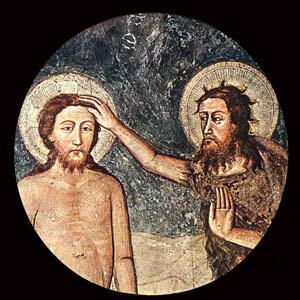
St. John the Baptist
Prof. Plinio Correa de Oliveira
It would be interesting to analyze the aspects of St. John the Baptist's life that characterize him as a perfect Apostle of the Last Times, as described by St. Louis Grignion de Monfort. Not because his times were the last times, but because they were the last times of that era.
St. John the Baptist was the person sent by God to lay straight the way of the Lord, to prepare for the coming of Jesus Christ, to act in the last times before the Messiah. The Apostle of the Last Times also must prepare for the coming of Our Lord; he will also have to act in the last times before the second coming of the Messiah. There is a parallel between these two men, just as there is a parallel between the first and the second coming of the Messiah.
The parallel between the time of Christ and the last times is very clear in the Gospel when Our Lord spoke about the fall of the Temple of Jerusalem from two different perspectives. First He spoke about the material destruction of the Temple of Jerusalem, a prophecy that was fulfilled historically by Titus in the year 70. He also spoke of the destruction of the Temple from a symbolic perspective, referring to the end of world, of which the Temple was a symbol.
There are two destruct ions of the Temple, two comings of Our Lord, two men sent by God to prepare the way of the Lord. The first was St. John the Baptist and the last will be Elias, the Prophet. These two men are the models, the paradigms, the prototypes of the Apostles of the Last Times.
In one part of the Fiery Prayer by St. Louis Grignion de Monfort, he describes the Apostles of the Last Times, pointing to those men who will live in a tragic situation: 'Ah, let me cry out everywhere: Fire! Fire! Fire! Help! Help! Help! Fire even within the sanctuary'
The same kind of warning was given by St. John the Baptist, a prophet who pictured the moral situation of his time as extremely bad. He did not fear to tell the truth to the Scribes and Pharisees. He was not afraid to censure the Jewish people for the moral decadence into which they had fallen. He did not tremble to spell out to Herod the evil he had done and this would be the cause of his death.
St. John the Baptist was a man who accomplished his duty of telling the truth about the situation in which he lived, the entire truth, completely, fearlessly, even to his death.
During his whole life St. John the Baptist was also a polemicist. His life was but one long polemic to prepare the way of Our Lord.
In a parallel way, one can consider how his mission was well grounded in reality. St. John the Baptist fully measured the defects of men. He had a complete understanding of the effects of original sin. This is why he was always warning people about those defects and inviting them to penitence and to change their lives. Metanoia is the Greek word that means a total conversion, a complete changing of ones life; it summarizes well the goal of St. John the Baptist's preaching. When one reads St. Louis de Monfort describing man as vainer than toads, more ferocious than tigers, falser than serpents, and so on, one hears something of the preaching of the Apostles of the Last Times, and also the preaching of St. John the Baptist.
The humility of the Apostles of the Last Times described by St. Louis in the Fiery Prayer can also be compared with the extreme humility of St. John the Baptist. He had that wonderful saying: There cometh after me, one mightier than I, the latchet of whose sandals I am not worthy to stoop down and loose, referring to Our Lord. And also this one: He must increase, but I must decrease.
His mission was to announce the Messiah. Therefore, once the Lamb of God had arrived, the prophecy of St. John Baptist was fulfilled, and his public mission decreased as he headed toward his martyrdom. On the contrary, Our Lord would increase until the complete fulfillment of His divine mission. The humility of St. John the Baptist was rewarded. After his martyrdom, his name was covered with glory. Our Lord said that no man born from woman was greater than he. It is impossible to have a higher praise or more honorable glorification. But this glory had as its foundation his most profound humility. Also, the humility of the Apostles of the Last Times will be rewarded, since the men who will fight the last battle against the Antichrist will be considered so great that Our Lord will permit them to pass directly to Heaven, without experiencing death.
In these points, therefore, one can see a parallel between the mission of St. John the Baptist and the Apostles of the Last Times, namely Elias, the greatest of them. You could ask me: Where is the devotion of St. John Baptist to Mary? What place did Our Lady have in his preaching?
Only later would Our Lady become manifest to the piety of the faithful. Her action in the Church intensified only after Our Lord ascended to Heaven and left her here to influence the destiny of the Church. The mission of St. John Baptist was not to preach directly about Our Lady. But in his life, there was an important event. When Our Lady went to visit St. Elizabeth, he had the great fortune to hear the voice of Our Lady and feel a joy from within the womb of St. Elizabeth. The latter, after hearing the salutation of Mary, told her that her infant had leaped with joy in her womb. He was, therefore, a soul intensely turned toward Mary. Hearing her voice, he understood her, loved her and leaped with joy.
There is a solid tradition in the Church that says St. John Baptist was purified of original sin shortly after he was conceived, while still in the womb of St. Elizabeth. So, this episode of the Gospel referring to the child in the womb hearing Our Lady's voice, understanding her words and loving her is completely creditable.
It is probable that as a relative of Our Lady, St. Elizabeth would have gone to visit her many times, bringing her child along with her. Also, after the death of St. Elizabeth, it is probable that St. John Baptist would often have visited Jesus and Mary.
Then, it is also probable that every time he heard the voice of Our Lady, he would have experienced the same joy he felt the first time. It would be a continuation of that same exultation. It is probable that he never forgot that elation and that it always remained in his soul as a kind of permanent consolation.
Let us venerate St. John Baptist as a model of the perfect devotee of Our Lady, as a model of the Apostles of the Last Times, and as a man of fight. Let us ask him to grant us graces to fulfill our vocation, which is similar in so many ways with that of those Apostles. Principally we should ask him the grace to always exult when Our Lady speaks some word in the interior of our souls inviting us to be closer to her.
Update on Religious Riots in Orrisa
I received the following update on the religious riots in Orrisa in my inbox.
This past Saturday (August 23rd) a very prominent Hindu Guru (i.e. spiritual leader) was found murdered in the city of Bhubaneshwar, Orissa (which is about 275 miles away from the city of Calcutta--which is where I'm staying right now). This spiritual leader was a very outspoken critic of conversions--which was happening for quite a while now in the state of Orissa. The Catholic Church has been growing steadily for quite a while now in Orissa, mainly due to the really awesome work of Mother Teresa's Missionaries of Charity and many other groups working in the region. Catholics have started schools, hospitals, clinics, leper colonies, etc. that all serve the poorest of the poor--the low-caste untouchables who are treated as "outcasts" in Hindu circles. Many low-caste untouchables living in the state of Orissa have witnessed the love of Christ, and have subsequently given their lives over to Christ, by joining the Catholic Church.
Although no one knows who killed this spiritual leader or what was the motive behind the murder, Hindu extremists have declared that Christians (especially Catholics) must have been behind the act because this particular spiritual leader was an outspoken critic of Hindus converting to Christianity. However, there is absolutely no evidence for this, and the government of India is saying that Maoists (i.e. Communists) are behind the murder. But nevertheless, the rumors that Christians have been behind the murder is spreading like wildfire, and in the past three days, mobs of militant Hindus have been burning/bombing churches, beating/killing priests, nuns, and members of the lay faithful. The Catholic Church which has the largest presence among the Christian denominations in the region has sadly taken the brunt of this violence. As we speak, the violence is escalating. Yet, news reports are not really reporting the whole story--because news sources are often heavily biased (often favoring the Hindu viewpoint). Sadly, no one knows what the real situation is regarding Christians in Orissa right now.
However, I have learned of some information regarding the situation through the Missionaries of Charity sisters here in Calcutta. Some of the of the Missionary of Charity sisters (hereafter abbreviated as MC sisters) who are in Orissa have sent word to Sister Nirmala Joshi (the successor of Mother Teresa in the Missionaries of Charity) regarding the current sitation. MC sisters in the region have witnessed truckloads of militant Hindus swarming into Christian villages, and slitting throats of innocent Catholic Christians (of all ages) as they run for their life. Many MC sisters, brothers, and consecrated religious have abandoned their convents and fled to the jungles to go into hiding. Hindus have swarmed into Catholic (and other Christian) schools and burned teachers, principals, etc. to death. This breaks my heart. Please pray for an end to this madness. All because of ridiculous rumors that Christians killed this spiritual guru (and there's no evidence for that at all!).
In an interesting twist however, one leper colony run by the Missionaries of Charity was spared destruction. The MC sisters were afraid for their lives, and for the lives of all of the lepers who were staying in the colony. Yet, the lepers told the sisters that they would lay down their lives for these MC sisters, because the MC sisters have given the lepers hope and love. When truckloads of militant Hindus (mainly members of the Vishwa Hindu Parishad--a fundamentalist worldwide Hindu association) came to roundup and kill all of the MC sisters, the lepers told the Hindu militants to see the good work that the sisters were doing. When the militants saw all of the good work the Missionaries of Charity were doing, they actually turned and left--sparing the lives of the sisters. So God saved the lives of this group of sisters!!! And the poor people actually came to the help of the sisters!
The bishops of India have pleaded with the Catholic faithful to NOT retaliate and to be strong, and courageous in the face of great persecution. As of yet, the Christians have NOT retaliated (thanks be to God). The bishops have declared a statement saying that the Church condemns the murder of this famous Hindu spiritual leader. Yet, this statement has not calmed tensions. The bishops all over India are asking Christians everywhere to pray ardently to God, Our Father, for an end to the violence. Hundreds of parishes all over India have begun 24 hour nonstop Eucharistic Adoration to ask the Lord for healing for ALL groups hurt by this. Many parishes in Calcutta have begun nonstop Eucharistic Adoration for peace in India, and for end to this communal conflict.
Please pray that the violence ends, and does not spread to the rest of India. Please pray for our Protestant brothers and sisters as well (they are also suffering greatly in this anti-Christian uprising... Protestant Churches are also being targeted and burned, but I unfortunately do not know about the exact situation of Protestants right now, because the only news I'm getting is from the MCs who only really know about what's happening to Catholic parishes). Christians in general are a small minority in India, and because we're small, and we're "different," such persecution does happen. And last of all, please pray for the Hindus who are obviously hurt and angered over the death of their prominent spiritual leader, and who are good people deep down inside, but are just blinded by emotions right now. We are all children of God, and it breaks God's heart to see us fighting like this.
In addition to this email I received a second email that elaborated on the damage:
Number of Deaths district wise
Kandhamal District -12
Barakhama 6
Tiangia 2 (2 seriously injured)
Petapanga 1 (Raikia)
Tikaballi 1
Bodimunda 1
Bakingia 1
Bargard District- 1
Padanpur 1(Kantapali)
Number of Church destroyed
Petapanga Church
Mondakia Church
Catholic Church Rotangia
Believers church Ratingia
Diocese Church Ratingia
Believers Church Gimangia
Diocese Church Gimangia
Mdahukia Church
Catholic Church Raikia
Catholic Church Badimunda
Pentocastal Church Badimunda
Catholic Church Breka
Pentocastal Church Breka
Catholic Church Pobingia
Catholic church Srasanaanda
Catholic Church, Phulbani
Catholic Church, Betticola
Catholic Church Balliguda
Catholic Church Sankrakhol
R.C. Church Kanjamedi
Diocese Church Kanjamedi
Pentecostal Church Kanjamedi
Pentecostal Church Jugapadar, Nuagam
Baptist Church Tumudiband
Pentecostal Church Tumudiband
Two Churches in Narayani patna
Catholic Church Muniguda
Catholic Church Padanpur
Church in Dhanpur
Catholic Church Tiangia
Baptist Church Tiangia
Catholic Church Gabindapali
Catholic Church Padua
Catholic Church Maliput
Catholic Church Duburi
Pentecostal Church, Tiangia
Catholic Church Modhupur
Catholic Church Nilungia
Pentecostal Church Nilungia
Catholic Church Boipariguda
Houses damaged
1. Balliguda Mundasahi
2. Raikia-17 houses
3. Badimunda- 9
4. Gimangia-3
5. Gumagarh-25
6. Tiangia-Pdisuballi, Majumaha, Budedipada, Kolanaju, Mundanaju, Sipaeju, Laburi 160
7. Beticola-10
8. Nilungia – 15
9. Balliguda Dumudisahi
10. Balliguda Hatpada Sahi
11. Raikia, Chunipalli
12. Mondakia, Bakingkia
13. Breaka (Sukanda)
14. Bodimunda
15. Rotingia
16. Sankharkhole
17. Tikaballi
Convents
St. Joseph’s Convent, Sankharkhole
St. Anne’s Convent, Pobinga
Mt. Carmel Convent, Balliguda
St. Anne’s Convent, Padangi
Hostels
Padangi 2
Pobigia -2
Balliguda Convent -1
Institutions
Pastoral Centre, Konjamendi
Janavikas
Poly Shree, Paburia
Gramya Pragati, Balliguda
Ajka, Raikia
Xavier Institution of Mangament
NISWASS, Bhubaneswar & Phulbani
Lastly the as a mark of protest all Catholic schools and institutions across the country will be closed on Friday the 29th August 2008. In addition to this the Bombay Catholic Sabah is organizing a protest rally and meeting at the St. Micheal Auditorium in Mahim on the 29th August 2008 at 6:30 pm
This past Saturday (August 23rd) a very prominent Hindu Guru (i.e. spiritual leader) was found murdered in the city of Bhubaneshwar, Orissa (which is about 275 miles away from the city of Calcutta--which is where I'm staying right now). This spiritual leader was a very outspoken critic of conversions--which was happening for quite a while now in the state of Orissa. The Catholic Church has been growing steadily for quite a while now in Orissa, mainly due to the really awesome work of Mother Teresa's Missionaries of Charity and many other groups working in the region. Catholics have started schools, hospitals, clinics, leper colonies, etc. that all serve the poorest of the poor--the low-caste untouchables who are treated as "outcasts" in Hindu circles. Many low-caste untouchables living in the state of Orissa have witnessed the love of Christ, and have subsequently given their lives over to Christ, by joining the Catholic Church.
Although no one knows who killed this spiritual leader or what was the motive behind the murder, Hindu extremists have declared that Christians (especially Catholics) must have been behind the act because this particular spiritual leader was an outspoken critic of Hindus converting to Christianity. However, there is absolutely no evidence for this, and the government of India is saying that Maoists (i.e. Communists) are behind the murder. But nevertheless, the rumors that Christians have been behind the murder is spreading like wildfire, and in the past three days, mobs of militant Hindus have been burning/bombing churches, beating/killing priests, nuns, and members of the lay faithful. The Catholic Church which has the largest presence among the Christian denominations in the region has sadly taken the brunt of this violence. As we speak, the violence is escalating. Yet, news reports are not really reporting the whole story--because news sources are often heavily biased (often favoring the Hindu viewpoint). Sadly, no one knows what the real situation is regarding Christians in Orissa right now.
However, I have learned of some information regarding the situation through the Missionaries of Charity sisters here in Calcutta. Some of the of the Missionary of Charity sisters (hereafter abbreviated as MC sisters) who are in Orissa have sent word to Sister Nirmala Joshi (the successor of Mother Teresa in the Missionaries of Charity) regarding the current sitation. MC sisters in the region have witnessed truckloads of militant Hindus swarming into Christian villages, and slitting throats of innocent Catholic Christians (of all ages) as they run for their life. Many MC sisters, brothers, and consecrated religious have abandoned their convents and fled to the jungles to go into hiding. Hindus have swarmed into Catholic (and other Christian) schools and burned teachers, principals, etc. to death. This breaks my heart. Please pray for an end to this madness. All because of ridiculous rumors that Christians killed this spiritual guru (and there's no evidence for that at all!).
In an interesting twist however, one leper colony run by the Missionaries of Charity was spared destruction. The MC sisters were afraid for their lives, and for the lives of all of the lepers who were staying in the colony. Yet, the lepers told the sisters that they would lay down their lives for these MC sisters, because the MC sisters have given the lepers hope and love. When truckloads of militant Hindus (mainly members of the Vishwa Hindu Parishad--a fundamentalist worldwide Hindu association) came to roundup and kill all of the MC sisters, the lepers told the Hindu militants to see the good work that the sisters were doing. When the militants saw all of the good work the Missionaries of Charity were doing, they actually turned and left--sparing the lives of the sisters. So God saved the lives of this group of sisters!!! And the poor people actually came to the help of the sisters!
The bishops of India have pleaded with the Catholic faithful to NOT retaliate and to be strong, and courageous in the face of great persecution. As of yet, the Christians have NOT retaliated (thanks be to God). The bishops have declared a statement saying that the Church condemns the murder of this famous Hindu spiritual leader. Yet, this statement has not calmed tensions. The bishops all over India are asking Christians everywhere to pray ardently to God, Our Father, for an end to the violence. Hundreds of parishes all over India have begun 24 hour nonstop Eucharistic Adoration to ask the Lord for healing for ALL groups hurt by this. Many parishes in Calcutta have begun nonstop Eucharistic Adoration for peace in India, and for end to this communal conflict.
Please pray that the violence ends, and does not spread to the rest of India. Please pray for our Protestant brothers and sisters as well (they are also suffering greatly in this anti-Christian uprising... Protestant Churches are also being targeted and burned, but I unfortunately do not know about the exact situation of Protestants right now, because the only news I'm getting is from the MCs who only really know about what's happening to Catholic parishes). Christians in general are a small minority in India, and because we're small, and we're "different," such persecution does happen. And last of all, please pray for the Hindus who are obviously hurt and angered over the death of their prominent spiritual leader, and who are good people deep down inside, but are just blinded by emotions right now. We are all children of God, and it breaks God's heart to see us fighting like this.
In addition to this email I received a second email that elaborated on the damage:
Number of Deaths district wise
Kandhamal District -12
Barakhama 6
Tiangia 2 (2 seriously injured)
Petapanga 1 (Raikia)
Tikaballi 1
Bodimunda 1
Bakingia 1
Bargard District- 1
Padanpur 1(Kantapali)
Number of Church destroyed
Petapanga Church
Mondakia Church
Catholic Church Rotangia
Believers church Ratingia
Diocese Church Ratingia
Believers Church Gimangia
Diocese Church Gimangia
Mdahukia Church
Catholic Church Raikia
Catholic Church Badimunda
Pentocastal Church Badimunda
Catholic Church Breka
Pentocastal Church Breka
Catholic Church Pobingia
Catholic church Srasanaanda
Catholic Church, Phulbani
Catholic Church, Betticola
Catholic Church Balliguda
Catholic Church Sankrakhol
R.C. Church Kanjamedi
Diocese Church Kanjamedi
Pentecostal Church Kanjamedi
Pentecostal Church Jugapadar, Nuagam
Baptist Church Tumudiband
Pentecostal Church Tumudiband
Two Churches in Narayani patna
Catholic Church Muniguda
Catholic Church Padanpur
Church in Dhanpur
Catholic Church Tiangia
Baptist Church Tiangia
Catholic Church Gabindapali
Catholic Church Padua
Catholic Church Maliput
Catholic Church Duburi
Pentecostal Church, Tiangia
Catholic Church Modhupur
Catholic Church Nilungia
Pentecostal Church Nilungia
Catholic Church Boipariguda
Houses damaged
1. Balliguda Mundasahi
2. Raikia-17 houses
3. Badimunda- 9
4. Gimangia-3
5. Gumagarh-25
6. Tiangia-Pdisuballi, Majumaha, Budedipada, Kolanaju, Mundanaju, Sipaeju, Laburi 160
7. Beticola-10
8. Nilungia – 15
9. Balliguda Dumudisahi
10. Balliguda Hatpada Sahi
11. Raikia, Chunipalli
12. Mondakia, Bakingkia
13. Breaka (Sukanda)
14. Bodimunda
15. Rotingia
16. Sankharkhole
17. Tikaballi
Convents
St. Joseph’s Convent, Sankharkhole
St. Anne’s Convent, Pobinga
Mt. Carmel Convent, Balliguda
St. Anne’s Convent, Padangi
Hostels
Padangi 2
Pobigia -2
Balliguda Convent -1
Institutions
Pastoral Centre, Konjamendi
Janavikas
Poly Shree, Paburia
Gramya Pragati, Balliguda
Ajka, Raikia
Xavier Institution of Mangament
NISWASS, Bhubaneswar & Phulbani
Lastly the as a mark of protest all Catholic schools and institutions across the country will be closed on Friday the 29th August 2008. In addition to this the Bombay Catholic Sabah is organizing a protest rally and meeting at the St. Micheal Auditorium in Mahim on the 29th August 2008 at 6:30 pm
Thursday, August 28, 2008
Doctors in Ontario may be forced to go against beliefs
The College of Physicians and Surgeons of Ontario (CPSO) has a new draft which if implemented will be the first province in Canada to change its regulations on medical conscience.
The document outlines that doctors should place the needs of a patient first, and "there are times when it may be necessary for physicians to set aside their personal beliefs in order to ensure that patients or potential patients are provided with the medical services they require."
Ontario doctors currently are allowed to opt out of performing abortions or prescribing birth control pills if it goes against their religious or moral beliefs.
But if the new rules being proposed are approved next month, this, along with ending a doctor-patient relationship based on religious or moral conscience, might be considered professional misconduct.
I am of the opinion that this is laying the ground work for the introduction of laws relating to euthanasia in this province and then across the nation.
Also suspect is the timing of the introduction of this draft during summer when most doctors are on vacation.
For more details refer to the following LINK
Please pray that this draft does not pass especially for the few practicing Catholic doctors left in the province.
The document outlines that doctors should place the needs of a patient first, and "there are times when it may be necessary for physicians to set aside their personal beliefs in order to ensure that patients or potential patients are provided with the medical services they require."
Ontario doctors currently are allowed to opt out of performing abortions or prescribing birth control pills if it goes against their religious or moral beliefs.
But if the new rules being proposed are approved next month, this, along with ending a doctor-patient relationship based on religious or moral conscience, might be considered professional misconduct.
I am of the opinion that this is laying the ground work for the introduction of laws relating to euthanasia in this province and then across the nation.
Also suspect is the timing of the introduction of this draft during summer when most doctors are on vacation.
For more details refer to the following LINK
Please pray that this draft does not pass especially for the few practicing Catholic doctors left in the province.
Religious Riots in India
Indian being my first home, I get upset when I read news like this.
The killing of a Hindu leader on Saturday sparked the violence.
Christians have suffered retaliatory attacks, despite police saying Maoist rebels were to blame for the killing.
So far monasteries, churches and an orphanage has been burnt. Persecution against Christians in India has been an ongoing theme despite the fact that Christians only make up less than 2% of the population.
A bandh was called by the Vishwa Hindu Parishad and the Bajrang Dal in protest against the killing of VHP leader Swami Lakshmanananda.
Protesters burnt alive a 20-year-old woman in an orphanage at Khuntpalli village in Bargarh district. In Kandhamal district, where the Swami and four others were killed by suspected Maoists on Saturday night, a villager was burnt to death.
This is a terrible state of affairs. I ask that all my readers pray for persecuted Christians in my native land.

(Picture of burnt orphanage)
The killing of a Hindu leader on Saturday sparked the violence.
Christians have suffered retaliatory attacks, despite police saying Maoist rebels were to blame for the killing.
So far monasteries, churches and an orphanage has been burnt. Persecution against Christians in India has been an ongoing theme despite the fact that Christians only make up less than 2% of the population.
A bandh was called by the Vishwa Hindu Parishad and the Bajrang Dal in protest against the killing of VHP leader Swami Lakshmanananda.
Protesters burnt alive a 20-year-old woman in an orphanage at Khuntpalli village in Bargarh district. In Kandhamal district, where the Swami and four others were killed by suspected Maoists on Saturday night, a villager was burnt to death.
This is a terrible state of affairs. I ask that all my readers pray for persecuted Christians in my native land.

(Picture of burnt orphanage)
Feast of St. Augustine 28 August 2008
Today we celebrate the fest of St. Augustine. I like St. Augustine, because as a saint he shows the mercy and goodness of God. St. Augustine before his conversion was a very worldly man. He has an illegitimate son, was an intellectual giant and was generally having what we 20th century moderns call a good time.
If one reads the Confessions one will realize that despite having a mighty good time deep inside he was seeking the truth. Most of us go through this. I like At Augustine because he seems so human and yet after his conversion we see the greatness of his transformation all because of the mercy and love of God.
At times of despair one need only think of what St. Augustine was pre conversion to what he became post conversion and realize what God is capable of if only we let him and this is enough to lift one out of the despair.
Let us now consider the words of Dr. Plinio.

Comments of Prof. Plinio:
Reading the works of St. Augustine is one of the greatest pleasures a man can have. The Confessions is a wonderful and highly edifying book from many points of view. In it, St. Augustine describes the moral abysses of pride and sensuality into which he had fallen and narrates how he turned away from his innumerable sins. Then he relates his first contacts with St. Ambrose and how the light of the Catholic Religion began to enter his soul through the presence of St. Ambrose.
He expresses his enthusiasm for the Bishop of Milan and his visits to him. St. Augustine could not speak often with St. Ambrose since the Bishop was usually busy writing and studying, but he would remain there just to watch St. Ambrose at his work. The latter knew that his presence was making a better apostolate with St. Augustine than his words would do.
You can imagine the scene. St. Ambrose, the great Doctor of the Church, writing in an infolio, his features those of a venerable old man, placid, enlightened by the grace of God, wise, recollected, sublime in his judgments. Once in a while, he would stop to make a short interior prayer, then he would return to his thinking until he reached the final conclusion. Observing him was St. Augustine, whose face still reflected the turbulence of the crisis through which he was passing. But the grace of God was entering the soul of St. Augustine and transforming his personality through his admiration for St. Ambrose.
And so he goes on to narrate his interior crisis, the peace he experienced upon entering the church and hearing the sacred music, the psalms, the beauty of God’s worship. Then his strong movements of repentance and the voice he heard ordering him: Tolle et lege – take it and read. He took up Sacred Scriptures and the page opened to a verse that applied perfectly to his past life ["Not in riots and drunken parties, not in eroticisms and indecencies, not in strife and rivalry, but put on the Lord Jesus Christ and make no provision for the flesh in its lusts" (Romans 13:13-14)]. He received a decisive grace that completed his conversion.
Further on he describes the famous colloquium at Ostia with St. Monica, his mother. She was a very holy woman, while he had been a very bad son. When they were in Carthage preparing for a voyage to Rome, St. Monica went to a church and spent the night praying there. Augustine took advantage of the opportunity to flee from her and embarked for Rome by himself, leaving her alone.
Afterward she followed him, always weeping and praying for his conversion. Once she went to the Bishop of Milan, St. Ambrose, to ask him if her son would ever convert. He replied to her with those famous words: “Woman, the child of so many tears shall never perish." That is, she would see his rebirth through her intense and profound suffering.
You can imagine her joy when her son converted. St. Augustine and his mother spent some months together as he prepared for his Baptism. Then they planned to return to Africa. Before embarking on the voyage, they stayed at an inn in Ostia, a port city near Rome on the Mediterranean Sea. Standing at a window watching the sea, they began to converse about heavenly things.
One who reads this conversation between the saintly mother and son realizes they were experiencing a supernatural ecstasy. This gave him strength for the fights ahead he would have to face. For her it was a pre-taste of Heaven, because she would die there in Ostia, before the ship departed. He describes movingly how he assisted at her funeral. Then he went to Africa and became the Bishop of Hippo.
In Hippo, he wrote another of his great books The City of God. The theme of that extraordinary work is the perpetual and irreconcilable fight that takes place between the two cities in History – the city he speaks of comes from the Latin, civitas, and should be understood more as a state. These two cities are the City of God and the City of the Devil. He conceives all History as a battle between the Catholic Church and the power of darkness. The struggle results from two different loves. In the City of God there is the love of God to the oblivion of oneself; in the city of man, or City of the Devil, there is the love of oneself to the oblivion of God.
To live for self is to consider oneself the minuscule center of the universe, with everything turned toward one’s own pleasures and interests. This egotism is the starting point for every bad thing. On the contrary, to love God is to turn oneself entirely toward the transcendent realities we find in Revelation. It is to have a metaphysical spirit, a religious spirit turned toward the highest things. This is to live for God. With these two principles, he summarizes all of History.
An analogous philosophy of History is taught by St. Louis Grignion de Monfort. He argues that everything God does is good. Since the enmity between Our Lady and the serpent, and therefore between her spiritual descendents and those of the serpent, was decreed by God, this enmity is also good. It is the same thesis of St. Augustine, with more combativeness.
Because of this unequivocal presentation of good and evil, Progressivism attacks St. Augustine today by saying that he was Manichean. According to this stupid accusation everyone who admits that there is good and evil would be a Manichean. It is nonsensical because the Magisterium of the Catholic Church has always admitted the existence of good and evil, as have all of her Saints. If this were the only criterium, then they would all be Manichean. It is absurd!
In passing, let me say that Manichaeism was a Gnostic doctrine that appeared in the first centuries of the Church proposing that there would be two gods equal in origin and power, a good one and a bad one, in constant struggle against each other. Catholic doctrine says something completely different. It says that there is only one God, Eternal and Omnipotent, and that the Devil, a mere creature, revolted against Him and fights Him throughout History.
The heresy of Manichaeism supposes a different order of being than what Catholic doctrine teaches. For the former, the fight is on the ontological level; for the latter it is in the moral sphere. Also according to Manichaeism the fight will never end; in Catholic doctrine the fight ends at the Last Judgment when God will eternally triumph over his infinitely inferior enemy. Progressivism is aware of these differences, but still continues to spread that anyone who doesn’t support its ecumenism is a Manichaean. It is an absurd affirmation and a manifestation of bad faith.
There is a very beautiful point to consider about St. Augustine. He wrote his books as the Roman Empire of the West was falling, when everything pointed to the probability that the Catholic Religion would be swept from the earth after the barbarian invasions. In fact, Hippo and Carthage in North Africa were so devastated that almost nothing was left of these cities and the Catholic Religion did not re-establish itself in that area. Notwithstanding, St. Augustine serenely wrote his books for a future that was uncertain. He died as the Vandals were entering his city.
The world he knew fell; the Middle Ages came. And then it was the works of St. Augustine that inspired the medieval conception of State, Empire, and Christendom. Charlemagne used to listen to the reading of the City of God during his meals, and the Empire he founded was inspired directly by St. Augustine. The Middle Ages, in a certain way is a lily born from the works of St. Augustine. Centuries after his death, his confidence was rewarded.
There is a lesson for us in this. In our times when the new Vandals are destroying both the cultural values and material buildings of Christian Civilization, we should carry on our work with faith and confidence, knowing that it will serve to build the Reign of Mary when God so decides.
If one reads the Confessions one will realize that despite having a mighty good time deep inside he was seeking the truth. Most of us go through this. I like At Augustine because he seems so human and yet after his conversion we see the greatness of his transformation all because of the mercy and love of God.
At times of despair one need only think of what St. Augustine was pre conversion to what he became post conversion and realize what God is capable of if only we let him and this is enough to lift one out of the despair.
Let us now consider the words of Dr. Plinio.
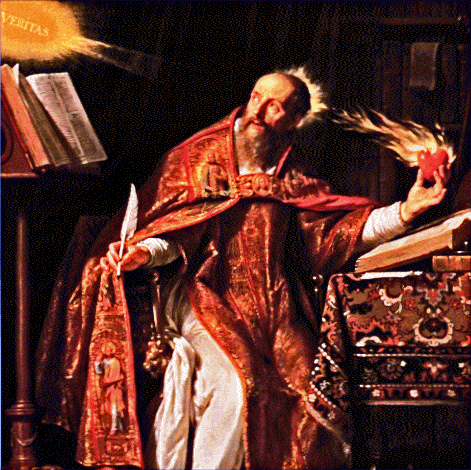
Comments of Prof. Plinio:
Reading the works of St. Augustine is one of the greatest pleasures a man can have. The Confessions is a wonderful and highly edifying book from many points of view. In it, St. Augustine describes the moral abysses of pride and sensuality into which he had fallen and narrates how he turned away from his innumerable sins. Then he relates his first contacts with St. Ambrose and how the light of the Catholic Religion began to enter his soul through the presence of St. Ambrose.
He expresses his enthusiasm for the Bishop of Milan and his visits to him. St. Augustine could not speak often with St. Ambrose since the Bishop was usually busy writing and studying, but he would remain there just to watch St. Ambrose at his work. The latter knew that his presence was making a better apostolate with St. Augustine than his words would do.
You can imagine the scene. St. Ambrose, the great Doctor of the Church, writing in an infolio, his features those of a venerable old man, placid, enlightened by the grace of God, wise, recollected, sublime in his judgments. Once in a while, he would stop to make a short interior prayer, then he would return to his thinking until he reached the final conclusion. Observing him was St. Augustine, whose face still reflected the turbulence of the crisis through which he was passing. But the grace of God was entering the soul of St. Augustine and transforming his personality through his admiration for St. Ambrose.
And so he goes on to narrate his interior crisis, the peace he experienced upon entering the church and hearing the sacred music, the psalms, the beauty of God’s worship. Then his strong movements of repentance and the voice he heard ordering him: Tolle et lege – take it and read. He took up Sacred Scriptures and the page opened to a verse that applied perfectly to his past life ["Not in riots and drunken parties, not in eroticisms and indecencies, not in strife and rivalry, but put on the Lord Jesus Christ and make no provision for the flesh in its lusts" (Romans 13:13-14)]. He received a decisive grace that completed his conversion.
Further on he describes the famous colloquium at Ostia with St. Monica, his mother. She was a very holy woman, while he had been a very bad son. When they were in Carthage preparing for a voyage to Rome, St. Monica went to a church and spent the night praying there. Augustine took advantage of the opportunity to flee from her and embarked for Rome by himself, leaving her alone.
Afterward she followed him, always weeping and praying for his conversion. Once she went to the Bishop of Milan, St. Ambrose, to ask him if her son would ever convert. He replied to her with those famous words: “Woman, the child of so many tears shall never perish." That is, she would see his rebirth through her intense and profound suffering.
You can imagine her joy when her son converted. St. Augustine and his mother spent some months together as he prepared for his Baptism. Then they planned to return to Africa. Before embarking on the voyage, they stayed at an inn in Ostia, a port city near Rome on the Mediterranean Sea. Standing at a window watching the sea, they began to converse about heavenly things.
One who reads this conversation between the saintly mother and son realizes they were experiencing a supernatural ecstasy. This gave him strength for the fights ahead he would have to face. For her it was a pre-taste of Heaven, because she would die there in Ostia, before the ship departed. He describes movingly how he assisted at her funeral. Then he went to Africa and became the Bishop of Hippo.
In Hippo, he wrote another of his great books The City of God. The theme of that extraordinary work is the perpetual and irreconcilable fight that takes place between the two cities in History – the city he speaks of comes from the Latin, civitas, and should be understood more as a state. These two cities are the City of God and the City of the Devil. He conceives all History as a battle between the Catholic Church and the power of darkness. The struggle results from two different loves. In the City of God there is the love of God to the oblivion of oneself; in the city of man, or City of the Devil, there is the love of oneself to the oblivion of God.
To live for self is to consider oneself the minuscule center of the universe, with everything turned toward one’s own pleasures and interests. This egotism is the starting point for every bad thing. On the contrary, to love God is to turn oneself entirely toward the transcendent realities we find in Revelation. It is to have a metaphysical spirit, a religious spirit turned toward the highest things. This is to live for God. With these two principles, he summarizes all of History.
An analogous philosophy of History is taught by St. Louis Grignion de Monfort. He argues that everything God does is good. Since the enmity between Our Lady and the serpent, and therefore between her spiritual descendents and those of the serpent, was decreed by God, this enmity is also good. It is the same thesis of St. Augustine, with more combativeness.
Because of this unequivocal presentation of good and evil, Progressivism attacks St. Augustine today by saying that he was Manichean. According to this stupid accusation everyone who admits that there is good and evil would be a Manichean. It is nonsensical because the Magisterium of the Catholic Church has always admitted the existence of good and evil, as have all of her Saints. If this were the only criterium, then they would all be Manichean. It is absurd!
In passing, let me say that Manichaeism was a Gnostic doctrine that appeared in the first centuries of the Church proposing that there would be two gods equal in origin and power, a good one and a bad one, in constant struggle against each other. Catholic doctrine says something completely different. It says that there is only one God, Eternal and Omnipotent, and that the Devil, a mere creature, revolted against Him and fights Him throughout History.
The heresy of Manichaeism supposes a different order of being than what Catholic doctrine teaches. For the former, the fight is on the ontological level; for the latter it is in the moral sphere. Also according to Manichaeism the fight will never end; in Catholic doctrine the fight ends at the Last Judgment when God will eternally triumph over his infinitely inferior enemy. Progressivism is aware of these differences, but still continues to spread that anyone who doesn’t support its ecumenism is a Manichaean. It is an absurd affirmation and a manifestation of bad faith.
There is a very beautiful point to consider about St. Augustine. He wrote his books as the Roman Empire of the West was falling, when everything pointed to the probability that the Catholic Religion would be swept from the earth after the barbarian invasions. In fact, Hippo and Carthage in North Africa were so devastated that almost nothing was left of these cities and the Catholic Religion did not re-establish itself in that area. Notwithstanding, St. Augustine serenely wrote his books for a future that was uncertain. He died as the Vandals were entering his city.
The world he knew fell; the Middle Ages came. And then it was the works of St. Augustine that inspired the medieval conception of State, Empire, and Christendom. Charlemagne used to listen to the reading of the City of God during his meals, and the Empire he founded was inspired directly by St. Augustine. The Middle Ages, in a certain way is a lily born from the works of St. Augustine. Centuries after his death, his confidence was rewarded.
There is a lesson for us in this. In our times when the new Vandals are destroying both the cultural values and material buildings of Christian Civilization, we should carry on our work with faith and confidence, knowing that it will serve to build the Reign of Mary when God so decides.
Wednesday, August 27, 2008
CRTC strikes yet again
I was looking at the news this morning in Google and this hit my eye.
'The CRTC approved a Canadian pay-television pornography channel called Northern Peaks last week on the basis that 50 per cent of its pornographic content would be produced in Canada, which in turn, will also lead to the creation of a pornography industry in Canada.'
..... towards the end of this article
Consider writing to your own cable provider (name and address available on your monthly bill) and advise it that if it includes this pornographic channel on its service list, you will immediately switch providers. If the cable provider believes that doing so will harm business -- the company will refuse the pornography channel.
In addition, write to the CRTC, Ottawa, Ont. K1A 0N2, Fax: 819-994-0218, raising your objections to its approval of this channel -- Canadian content or not.
Fred Henry is the Catholic bishop of Calgary.
This irks me no end. The CRTC would not allow a Catholic Radio station to open up in Toronto. Their reasoning was that the material on the radio station was one sided and not balanced and would also be offensive to certain sections of communities (fornicators, homosexuals, abortionists etc). Yet the CRTC would allow this abomination.
I serious suggest that all Catholics in Canada should mass boycott all cable television in this country. The only way these companies are going to learn a lesson is when we hit them where it hurts the most namely the pocket book. I also urge you all to write to the CRTC.
'The CRTC approved a Canadian pay-television pornography channel called Northern Peaks last week on the basis that 50 per cent of its pornographic content would be produced in Canada, which in turn, will also lead to the creation of a pornography industry in Canada.'
..... towards the end of this article
Consider writing to your own cable provider (name and address available on your monthly bill) and advise it that if it includes this pornographic channel on its service list, you will immediately switch providers. If the cable provider believes that doing so will harm business -- the company will refuse the pornography channel.
In addition, write to the CRTC, Ottawa, Ont. K1A 0N2, Fax: 819-994-0218, raising your objections to its approval of this channel -- Canadian content or not.
Fred Henry is the Catholic bishop of Calgary.
This irks me no end. The CRTC would not allow a Catholic Radio station to open up in Toronto. Their reasoning was that the material on the radio station was one sided and not balanced and would also be offensive to certain sections of communities (fornicators, homosexuals, abortionists etc). Yet the CRTC would allow this abomination.
I serious suggest that all Catholics in Canada should mass boycott all cable television in this country. The only way these companies are going to learn a lesson is when we hit them where it hurts the most namely the pocket book. I also urge you all to write to the CRTC.
Tuesday, August 26, 2008
The Importance of Suffering
Dr. Plinio on Suffering
There is a valuable deposition from the canonization of Saint Therese of the Child Jesus, given by her sister Celine. It reveals aspects of the saint’s life about which few are aware and to which, even less give due importance.
The information contained in this document is ironclad. Not only was Celine closer to Saint Therese than anyone else, but she gave this testimony in an official Church inquiry. Thus, it is scrupulously accurate. A part of this document states:
"The servant of God followed a path of simple confidence and total abandonment to God. She named this her little way of spiritual infancy. She continually corresponded to grace and performed generous acts. This is how she formed herself and her novices."
This shows the role that correspondence to grace plays in the little way. Most people are very familiar with the sweetness of Saint Therese’s spirituality, but neglect the roles of correspondence and suffering.
However, doing so denies almost every page of Saint Therese’s writings. In fact, she prized suffering so much that it became an integral part of who she was. Celine shows how this sweetness and suffering coexisted in the life of Saint Therese.
She says that Saint Therese always corresponded to grace. This correspondence is an act of the will. It consists in accepting the invitation to grace. This requires sacrifice, because frequently it forces one to behave contrary to his desires. Though Saint Therese was not the saint of great sacrifices, she constantly accepted little, simple and unpretentious ones.
Since these were unceasing, they weighed more heavily on her than great sufferings would have. At least these would have come in waves with periods of respite in between. Saint Therese’s life of constant sacrifice demonstrates the great-little suffering of her way.
Celine continues:
One day, I read a passage on the Eucharist that said Our Lord’s mercy will be granted to each according to the merit of his works. I asked the servant of God why mercy would be given according to the merit of one’s works. She was emphatic and immediately responded that confidence in God is nourished on sacrifice.
Pay close attention to her response. Saint Therese sustained herself on sacrifice.
She went on to say that each should give himself entirely and constantly renounce himself. In a single word, he should prove his love in every way and always do every good work that he can. This is the desire of little souls who run along the way of spiritual infancy. She finished: “I intentionally said that these souls run, because they never lag behind.”
Thus, the spirit of sacrifice is key to the little way. It means constantly offering little sufferings, and at times big ones, in a spirit of spiritual infancy, abandonment and confidence in God.
Saint Therese exemplified this spirit. She resolved always to ask for nothing and accept everything. Once, a nun was helping her arrange her habit and inadvertently stuck a pin through her flesh. Faithful to this spirit, Saint Therese never complained and left the pin where it was until she retired for the evening.
So, the relationship between the little way and suffering is clear. Nevertheless, there is still something mysterious about it, because Saint Therese’s life and writings, which are filled with affliction, are also imbued with a perfume of roses.
When one reads the Spiritual Exercises of the great Saint Ignatius, who I hold in highest esteem, it makes one’s hair stand on end. However, when Saint Therese writes the same thing, somehow it comes with a smile.
There is a valuable deposition from the canonization of Saint Therese of the Child Jesus, given by her sister Celine. It reveals aspects of the saint’s life about which few are aware and to which, even less give due importance.
The information contained in this document is ironclad. Not only was Celine closer to Saint Therese than anyone else, but she gave this testimony in an official Church inquiry. Thus, it is scrupulously accurate. A part of this document states:
"The servant of God followed a path of simple confidence and total abandonment to God. She named this her little way of spiritual infancy. She continually corresponded to grace and performed generous acts. This is how she formed herself and her novices."
This shows the role that correspondence to grace plays in the little way. Most people are very familiar with the sweetness of Saint Therese’s spirituality, but neglect the roles of correspondence and suffering.
However, doing so denies almost every page of Saint Therese’s writings. In fact, she prized suffering so much that it became an integral part of who she was. Celine shows how this sweetness and suffering coexisted in the life of Saint Therese.
She says that Saint Therese always corresponded to grace. This correspondence is an act of the will. It consists in accepting the invitation to grace. This requires sacrifice, because frequently it forces one to behave contrary to his desires. Though Saint Therese was not the saint of great sacrifices, she constantly accepted little, simple and unpretentious ones.
Since these were unceasing, they weighed more heavily on her than great sufferings would have. At least these would have come in waves with periods of respite in between. Saint Therese’s life of constant sacrifice demonstrates the great-little suffering of her way.
Celine continues:
One day, I read a passage on the Eucharist that said Our Lord’s mercy will be granted to each according to the merit of his works. I asked the servant of God why mercy would be given according to the merit of one’s works. She was emphatic and immediately responded that confidence in God is nourished on sacrifice.
Pay close attention to her response. Saint Therese sustained herself on sacrifice.
She went on to say that each should give himself entirely and constantly renounce himself. In a single word, he should prove his love in every way and always do every good work that he can. This is the desire of little souls who run along the way of spiritual infancy. She finished: “I intentionally said that these souls run, because they never lag behind.”
Thus, the spirit of sacrifice is key to the little way. It means constantly offering little sufferings, and at times big ones, in a spirit of spiritual infancy, abandonment and confidence in God.
Saint Therese exemplified this spirit. She resolved always to ask for nothing and accept everything. Once, a nun was helping her arrange her habit and inadvertently stuck a pin through her flesh. Faithful to this spirit, Saint Therese never complained and left the pin where it was until she retired for the evening.
So, the relationship between the little way and suffering is clear. Nevertheless, there is still something mysterious about it, because Saint Therese’s life and writings, which are filled with affliction, are also imbued with a perfume of roses.
When one reads the Spiritual Exercises of the great Saint Ignatius, who I hold in highest esteem, it makes one’s hair stand on end. However, when Saint Therese writes the same thing, somehow it comes with a smile.
Monday, August 25, 2008
St. Louis IX, King of France, August 25
Today we also celebrate the Feast of St Louis IX King of France. A true indication that Church and State can work together. Let us contemplate the life of this great saint.
St. Louis IX, King of France, August 25
Prof. Plinio Corrêa de Oliveira
Biographical selection:
The following text from the Book of Wisdom is habitually applied to St. Louis:
“Hear, therefore, ye kings, and understand; learn, ye that are judges of the ends of the earth. Give ear, you that rule the people, and that please yourself in the multitude of nations: For power is given you by the Lord, and strength by the Most High, who will examine your works, and search out your thoughts ...
“To you, therefore, O kings, these are my words, that you may learn wisdom, and not fall from it. For they that have kept just things justly, shall be justified: and they that have learned these things, shall find what to answer.
"Covet ye, therefore, my words, and love them, and you shall have instruction. Wisdom is glorious, and never fadeth away, and is easily seen by them that love her, and is found by them that seek her” (6:2-4; 10-12).
St. Louis was a wise King in the full sense of the word, because the truly wise one is not the scientist who knows many facts, but the saint.
What is wisdom? It is the fundamental virtue by which man knows the most profound aspect of things, the ultimate reality of things. It is the virtue that allows one to penetrate and understand not only this or that subject, but the whole universe, the cosmos. It is wisdom that permits one to understand the meaning of one’s own existence, the meaning of human life in general, and the meaning of the ensemble of other created things.
How does one understand the ultimate reality of things? It is to know what the things are, what they represent, what they exist for. But wisdom is not just to understand. It is to understand in order to lead one’s life and order one’s actions in accordance with the answer one finds to these questions.
There is, then, an opposition between the wise and the foolish spirits. The foolish man is the one who is not concerned about these things. He only wants to enjoy himself. He doesn’t want to know the ultimate reason of things, the reality that is behind appearances. He doesn’t want to adapt his life to principles. He just wants to enjoy a good life. Not necessarily an immoral life, but a life where he doesn’t have to think about anything profound. To live a life like this is a complete absence of wisdom.
How many good ladies do you know who take reasonable care of their family duties, assist at Mass, go to confession, receive Holy Communion, but do not have wisdom? Certainly there are many. They do all these good things, but afterwards they are immersed in their little mediocre lives without any deep thought.
In his Treatise on Eternal Wisdom St. Louis de Montfort explains that wisdom is a presupposition for the Faith. Without wisdom the Faith can exist, but it lacks a foundation. Our Lady was the Seat of the Wisdom and was always seeking to increase her knowledge, love and service of God.
This virtue is demanded of kings, governors, and anyone who exercises some form of power. A king without wisdom loses his people. When he has wisdom, he saves his people, and is the glory of his people. For a man without wisdom, power becomes an instrument of his perdition.
Hence, we can understand the magnificent eulogy Scriptures made of the wise king. He leads peoples and things to their last end, which is God. This is the ultimate meaning of his kingship.
What we admire in St. Louis, King of France, is the model of a wise man placed on the throne to govern his kingdom.
We should ask him to give us the precious virtue of wisdom.
St. Louis IX, King of France, August 25
Prof. Plinio Corrêa de Oliveira
Biographical selection:
The following text from the Book of Wisdom is habitually applied to St. Louis:
“Hear, therefore, ye kings, and understand; learn, ye that are judges of the ends of the earth. Give ear, you that rule the people, and that please yourself in the multitude of nations: For power is given you by the Lord, and strength by the Most High, who will examine your works, and search out your thoughts ...
“To you, therefore, O kings, these are my words, that you may learn wisdom, and not fall from it. For they that have kept just things justly, shall be justified: and they that have learned these things, shall find what to answer.
"Covet ye, therefore, my words, and love them, and you shall have instruction. Wisdom is glorious, and never fadeth away, and is easily seen by them that love her, and is found by them that seek her” (6:2-4; 10-12).
St. Louis was a wise King in the full sense of the word, because the truly wise one is not the scientist who knows many facts, but the saint.
What is wisdom? It is the fundamental virtue by which man knows the most profound aspect of things, the ultimate reality of things. It is the virtue that allows one to penetrate and understand not only this or that subject, but the whole universe, the cosmos. It is wisdom that permits one to understand the meaning of one’s own existence, the meaning of human life in general, and the meaning of the ensemble of other created things.
How does one understand the ultimate reality of things? It is to know what the things are, what they represent, what they exist for. But wisdom is not just to understand. It is to understand in order to lead one’s life and order one’s actions in accordance with the answer one finds to these questions.
There is, then, an opposition between the wise and the foolish spirits. The foolish man is the one who is not concerned about these things. He only wants to enjoy himself. He doesn’t want to know the ultimate reason of things, the reality that is behind appearances. He doesn’t want to adapt his life to principles. He just wants to enjoy a good life. Not necessarily an immoral life, but a life where he doesn’t have to think about anything profound. To live a life like this is a complete absence of wisdom.
How many good ladies do you know who take reasonable care of their family duties, assist at Mass, go to confession, receive Holy Communion, but do not have wisdom? Certainly there are many. They do all these good things, but afterwards they are immersed in their little mediocre lives without any deep thought.
In his Treatise on Eternal Wisdom St. Louis de Montfort explains that wisdom is a presupposition for the Faith. Without wisdom the Faith can exist, but it lacks a foundation. Our Lady was the Seat of the Wisdom and was always seeking to increase her knowledge, love and service of God.
This virtue is demanded of kings, governors, and anyone who exercises some form of power. A king without wisdom loses his people. When he has wisdom, he saves his people, and is the glory of his people. For a man without wisdom, power becomes an instrument of his perdition.
Hence, we can understand the magnificent eulogy Scriptures made of the wise king. He leads peoples and things to their last end, which is God. This is the ultimate meaning of his kingship.
What we admire in St. Louis, King of France, is the model of a wise man placed on the throne to govern his kingdom.
We should ask him to give us the precious virtue of wisdom.
Sunday, August 24, 2008
Saint Joseph Calasanz - 25th August 2008
Today we celebrate the Feast of St. Joseph Calasanz. An important lesson we can learn from him is submission to the authority of the Church even when he was wrongly accused.

He was born September 11, 1556, at the castle of Calasanza near Petralta de la Sal in Aragon; died August 25, 1648, at Rome. His parents, Don Pedro Calasanza and Donna Maria Gastonia, gave Joseph, the youngest of five children, a good education at home and then at the school of Petralta. After his classical studies at Estadilla he took up philosophy and jurisprudence at Lerida and merited the degree of Doctor of Laws, and then with honors completed his theological course at Valencia and Alcalá de Henares.
He was ordained priest December 17, 1583, by Hugo Ambrose de Moncada, Bishop of Urgel. Joseph began his labors as priest in the Diocese of Albarracin, where Bishop della Figuera appointed him his theologian and confessor, synodal examiner, and procurator, and when the bishop was transferred to Lerida his theologian followed him to the new diocese.
In 1586 della Figuera was sent as Apostolic visitator to the Abbey of Montserrat, and Joseph accompanied him as secretary. The bishop died the following year and Joseph left, though urgently requested to remain. He hurried to Calasanza only to be present at the death of his father. He was then called by his Bishop of Urgel to act as vicar-general for the district of Trempe.
In 1592 he embarked for Rome, where he found a protector in Cardinal Marcantonio Colonna who chose him as his theologian and instructor to his nephew. Rome offered a splendid field for works of charity, especially for the instruction of neglected and homeless children, many of whom had lost their parents.
Joseph joined a Confraternity of Christian Doctrine and gathered the boys and girls from the streets and brought them to school. The teachers, being poorly paid, refused to accept the additional labor without remuneration. The pastor of St. Dorotea, Anthony Brendani, offered him two rooms and promised assistance in teaching, and when two other priests promised similar help, Joseph, in November, 1597, opened the first public free school in Europe.
Pope Clement VIII gave an annual contribution and many others shared in the good work, so that in a short time Joseph had about a thousand children under his charge. In 1602 he rented a house at S. Andrea della Valle and commenced a community life with his assistants and laid the foundation of the Order of Piarists. In 1612 the school was transferred to the Torres palace adjoining S. Pantaleone. Here Joseph spent the remaining years of his life in his chosen calling. He lived and died a faithful son of the church, a true friend of forsaken children. His body rests in S. Paltaleone. His beatification was solemnized on August 7., 1748, and his canonization by Clement XIII, July 16, 1767.
A combination of various prejudices and political ambition and maneuvering caused the institute much turmoil. Some did not favor educating the poor, for education would leave the poor dissatisfied with their lowly tasks for society! Others were shocked that some of the Piarists were sent for instruction to Galileo (a friend of Joseph) as superior, thus dividing the members into opposite camps. Repeatedly investigated by papal commissions, Joseph was demoted; when the struggle within the institute persisted, the Piarists were suppressed. Only after Joseph’s death were they formally recognized as a religious community.
No one knew better than Joseph the need for the work he was doing; no one knew better than he how baseless were the charges brought against him. Yet if he were to work within the Church, he realized that he must submit to its authority, that he must accept a setback if he was unable to convince authorized investigators. While the prejudice, the scheming, and the ignorance of men often keep the truth from emerging for a long period of time, Joseph was convinced, even under suppression, that his institute would again be recognized and authorized. With this trust he joined exceptional patience and a genuine spirit of forgiveness.
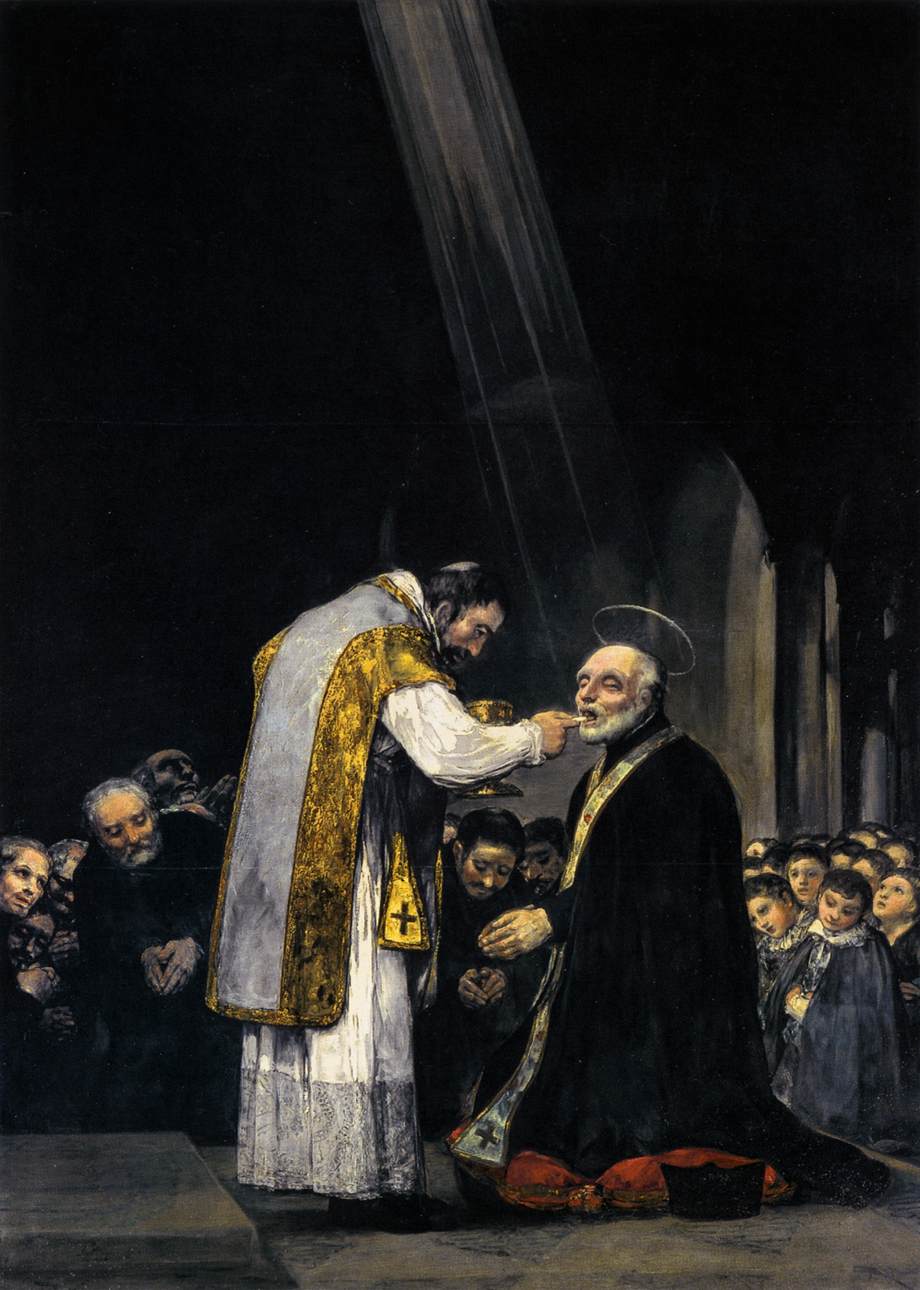
He was born September 11, 1556, at the castle of Calasanza near Petralta de la Sal in Aragon; died August 25, 1648, at Rome. His parents, Don Pedro Calasanza and Donna Maria Gastonia, gave Joseph, the youngest of five children, a good education at home and then at the school of Petralta. After his classical studies at Estadilla he took up philosophy and jurisprudence at Lerida and merited the degree of Doctor of Laws, and then with honors completed his theological course at Valencia and Alcalá de Henares.
He was ordained priest December 17, 1583, by Hugo Ambrose de Moncada, Bishop of Urgel. Joseph began his labors as priest in the Diocese of Albarracin, where Bishop della Figuera appointed him his theologian and confessor, synodal examiner, and procurator, and when the bishop was transferred to Lerida his theologian followed him to the new diocese.
In 1586 della Figuera was sent as Apostolic visitator to the Abbey of Montserrat, and Joseph accompanied him as secretary. The bishop died the following year and Joseph left, though urgently requested to remain. He hurried to Calasanza only to be present at the death of his father. He was then called by his Bishop of Urgel to act as vicar-general for the district of Trempe.
In 1592 he embarked for Rome, where he found a protector in Cardinal Marcantonio Colonna who chose him as his theologian and instructor to his nephew. Rome offered a splendid field for works of charity, especially for the instruction of neglected and homeless children, many of whom had lost their parents.
Joseph joined a Confraternity of Christian Doctrine and gathered the boys and girls from the streets and brought them to school. The teachers, being poorly paid, refused to accept the additional labor without remuneration. The pastor of St. Dorotea, Anthony Brendani, offered him two rooms and promised assistance in teaching, and when two other priests promised similar help, Joseph, in November, 1597, opened the first public free school in Europe.
Pope Clement VIII gave an annual contribution and many others shared in the good work, so that in a short time Joseph had about a thousand children under his charge. In 1602 he rented a house at S. Andrea della Valle and commenced a community life with his assistants and laid the foundation of the Order of Piarists. In 1612 the school was transferred to the Torres palace adjoining S. Pantaleone. Here Joseph spent the remaining years of his life in his chosen calling. He lived and died a faithful son of the church, a true friend of forsaken children. His body rests in S. Paltaleone. His beatification was solemnized on August 7., 1748, and his canonization by Clement XIII, July 16, 1767.
A combination of various prejudices and political ambition and maneuvering caused the institute much turmoil. Some did not favor educating the poor, for education would leave the poor dissatisfied with their lowly tasks for society! Others were shocked that some of the Piarists were sent for instruction to Galileo (a friend of Joseph) as superior, thus dividing the members into opposite camps. Repeatedly investigated by papal commissions, Joseph was demoted; when the struggle within the institute persisted, the Piarists were suppressed. Only after Joseph’s death were they formally recognized as a religious community.
No one knew better than Joseph the need for the work he was doing; no one knew better than he how baseless were the charges brought against him. Yet if he were to work within the Church, he realized that he must submit to its authority, that he must accept a setback if he was unable to convince authorized investigators. While the prejudice, the scheming, and the ignorance of men often keep the truth from emerging for a long period of time, Joseph was convinced, even under suppression, that his institute would again be recognized and authorized. With this trust he joined exceptional patience and a genuine spirit of forgiveness.
Historical Basis for Reception of Communion on the tongue.

According to certain modern historians and progressive theologians, Holy Communion on the tongue became the norm in the Middle ages. Following below is their version of history.
During the Middle Ages certain distortions in the faith and/or in approaches to it gradually developed. These included an excessive fear of God and an over-concern about sin, judgment and punishment, as well as an over-emphasis on Christ's divinity-- so emphasized as to down-play His sacred humanity or virtually deny it; also an over-emphasis on the priest's role in the sacred liturgy, and a loss of the sense of the community which the Church, in fact, is. In particular, because of excessive emphasis on adoring Christ in the Holy Eucharist and an over-strict approach to moral matters, Holy Communion became more and more rare. It was considered enough to gaze upon the Sacred Host during the elevation. (In fact, in certain critics' minds the elevation, exposition and benediction of the Blessed Sacrament find their origins during the 'unfortunate' Middle Ages, a period whose liturgical practices we would do well-- so they think-- to rid ourselves of.) It was in this atmosphere and under these circumstances, they argue, that the practice of Communion in the hand began to be restricted. The practice of the priest placing the consecrated Bread directly into the mouth of the communicant thus developed and, they think, was unwisely imposed.
These progressivist theologians and historians would love to do away with the past discourage the Communion-on-the-tongue practice whereby the faithful are not allowed to "take and eat," and should return to the pristine usage of the Fathers and Apostles, namely, Communion in the hand.
It is a compelling story.Too bad that it is not true.
Here are some actual Historical examples which speak the truth.
The sacred Council of Trent declared that the custom whereby only the priest-celebrant gives Communion to himself (with his own hands), and the laity receive It from him, is an Apostolic tradition.
Pope St. Leo the Great(440-461) is an early witness of the traditional practice. In his comments on the sixth chapter of St. John's Gospel he speaks of Communion in the mouth as the current usage: "One receives in the mouth what one believes by faith." The Pope does not speak as if he were introducing a novelty, but as if this were a well established thing.
Pope St. Gregory the Great (died in 604) is another witness. In his dialogues he relates how Pope St. Agapitus performed a miracle during Mass, after having placed the Body of the Lord into someone's mouth.
In his article on "Communion" in the Dictionaire d'Archeologiae Chretienne, Leclerq declares that the peace of Constantine in 313 A.D.served toward bringing the practice of Communion in the hand to an end. After persecution had ceased, evidently the practice of Communion in the hand persisted here and there. Church authority apparently judged that it invited abuse and deemed it contrary to the custom of the Apostles.
Thus the Synod of Rouen, France, in about 878 directed: "Do not put the Eucharist in the hands of any layman or laywomen, but only in their mouths"
A non-ecumenical Council of Constantinople known as "In Trullo" in 692 A.D. prohibited the faithful from giving Communion to themselves (which is of course what happens when the Sacred Particle is placed in the hand of communicants), and decreed a censure against those who would do so in the presence of a bishop, priest or deacon.
Is it not a form of clericalism to allow the priest to touch the Sacred Host and to forbid the laity to do the same? Even priests were not allowed to touch the Blessed Sacrament except out of some need to do so.In fact, other than the celebrant of the Mass itself, no one else receiving Communion, not even a priest, could receive It in the hand. Hence in the traditional liturgical practice of the Roman Rite, if a priest were assisting at Mass (and not celebrating) and if he wished to receive Holy
Communion, he did not do so by his own hand; he received on the tongue from another priest. When Pope St. Pius X was on his deathbed in August of 1914, and Holy Communion was brought to him as Viaticum, he did not and was not allowed to receive in the hand. He received on the tongue according to the law and practice of the
Catholic Church.
Holy Communion on the Tongue
When I received my First Holy Communion, I received it on my tongue. About 4 years after that in India the novelty of receiving Holy Communion in the hand began.
There are a lot of voices in the Vatican which are calling for a return to receiving Holy Communion on the tongue.
I would just like to clarify that at no point ever was it mandatory to receive communion in the hand. Individual Bishop Conferences may have made it mandatory for their nations like the USCCB (US conference of Catholic Bishops) but the Vatican has never made it mandatory.
On the 26th June 2008 Pope Benedict XVI made the following statement; "that the distribution of Communion on the hand continues to remain, from the juridical standpoint, an exception (indult) to the universal law, conceded by the Holy See to those bishops' conferences who have requested it."
I urge my readers to go back to kneeling and reecving Holy Communion on the tounge.
There are a lot of voices in the Vatican which are calling for a return to receiving Holy Communion on the tongue.
I would just like to clarify that at no point ever was it mandatory to receive communion in the hand. Individual Bishop Conferences may have made it mandatory for their nations like the USCCB (US conference of Catholic Bishops) but the Vatican has never made it mandatory.
On the 26th June 2008 Pope Benedict XVI made the following statement; "that the distribution of Communion on the hand continues to remain, from the juridical standpoint, an exception (indult) to the universal law, conceded by the Holy See to those bishops' conferences who have requested it."
I urge my readers to go back to kneeling and reecving Holy Communion on the tounge.
Catholic Sense
Developing a Catholic Sense
Written by Plinio Corrêa de Oliveira
Catholic doctrine is one thing and Catholic sense another. There are several points where Catholic doctrine is applied with great advantage when it is aided by Catholic sense.
Catholic doctrine does not condemn priestly marriage. But Catholic sense, profoundly identified with the thought of the Church, understands that in the real world, the grandeur of the priesthood demands priestly celibacy.
Catholic doctrine is perfectly compatible with the early organization of the Church, in which some ecclesiastical posts were filled through election by the faithful among themselves. But Catholic sense, while understanding the advantage of this system in other times, today intransigently defends the present organization of the Church, the only one compatible with the circumstances of our times.
Catholic doctrine does not oblige the Holy Father to surround himself in the Vatican with all the splendor of the papal court. But Catholic sense perfectly understands the need for this splendor as the human manifestation of the hallowed dignity of the Holy Pontiff.
In short, knowledge of Catholic doctrine is for us as necessary as it is, for a navigator, to know the position of the stars as he watches the skies to orient his route. For its part, Catholic sense represents the practical knowledge of the pilot who, mindful of the treacherous reefs and sandbanks, turns his eyes not only to the skies but also to the sea, looking for the dangers he must avoid.
Without both things, that is, knowledge of the stars and the obstacles hidden in the sea, navigation is impossible.
Likewise, without a serious knowledge of Catholic doctrine and a keen Catholic sense, it is impossible to navigate safely through this stormy ocean in which we sail.
Therefore, it is not sufficient to respect minimal points of Catholic doctrine. It is necessary for Catholic sense to permeate everything so as to enable us, in its own way, to resolve our multiple difficulties. (Legionario, October 1, 1933)
Written by Plinio Corrêa de Oliveira
Catholic doctrine is one thing and Catholic sense another. There are several points where Catholic doctrine is applied with great advantage when it is aided by Catholic sense.
Catholic doctrine does not condemn priestly marriage. But Catholic sense, profoundly identified with the thought of the Church, understands that in the real world, the grandeur of the priesthood demands priestly celibacy.
Catholic doctrine is perfectly compatible with the early organization of the Church, in which some ecclesiastical posts were filled through election by the faithful among themselves. But Catholic sense, while understanding the advantage of this system in other times, today intransigently defends the present organization of the Church, the only one compatible with the circumstances of our times.
Catholic doctrine does not oblige the Holy Father to surround himself in the Vatican with all the splendor of the papal court. But Catholic sense perfectly understands the need for this splendor as the human manifestation of the hallowed dignity of the Holy Pontiff.
In short, knowledge of Catholic doctrine is for us as necessary as it is, for a navigator, to know the position of the stars as he watches the skies to orient his route. For its part, Catholic sense represents the practical knowledge of the pilot who, mindful of the treacherous reefs and sandbanks, turns his eyes not only to the skies but also to the sea, looking for the dangers he must avoid.
Without both things, that is, knowledge of the stars and the obstacles hidden in the sea, navigation is impossible.
Likewise, without a serious knowledge of Catholic doctrine and a keen Catholic sense, it is impossible to navigate safely through this stormy ocean in which we sail.
Therefore, it is not sufficient to respect minimal points of Catholic doctrine. It is necessary for Catholic sense to permeate everything so as to enable us, in its own way, to resolve our multiple difficulties. (Legionario, October 1, 1933)
Subscribe to:
Posts (Atom)


