Evil triumphs when good men do nothing - Edmund Burke

Tuesday, November 24, 2009

What is the mass and consequently what is not the mass.

The other day after the mass, someone very dear to me called the mass a communal celebration.

This whole post is to specify what the mass is becasue since Vatican II there has been an infiltration of protestant ideology about how and what the mass should be.

The Council of Trent taught that the Mass is the same as Calvary, "only the manner of offering being changed" from bloody to unbloody. Similarly Vatican II (On the Liturgy #10) said that the Mass is the renewal of the new covenant. Thus the mass is first and foremost a Sacrifice.

A sacrifice as Catholics understand it (in contrast to some pagan concepts) has two elements: the outward sign and the interior dispositions.

At the Last Supper, the outward sign was the seeming separation of body and blood, with the two species. This was a dramatized way of saying to the Father: "I know the command you have given me, I am to die tomorrow. Very good, I turn myself over to death - expressed by the seeming separation - I accept, I obey." On the next day He did as He pledged, but then the outward sign was the physical separation of body and blood, while the interior remained the same. In the Mass, by the agency of a human priest who acts "in the person of Christ" (Vatican II, Lumen Gentium # 10) Christ continues and repeats His offering. The external sign is multiplied as many times as there are Masses. But the interior disposition of Christ is not multiplied, it is continued from that with which He died. For death makes permanent the attitude of will with which one leaves this world.


At the Last Supper Christ ordered, "Do this in memory of me". Since we were not there, Christ wants us to join our dispositions to His. The great Liturgy Encyclical of Pius XII, Mediator Dei, explains well that the people can be said to exercise their royal priesthood, to offer the Mass with the priest: first, "from the fact that the priest at the altar in offering a sacrifice in the name of all His members, does so in the person of Christ," whose members they are.

Secondly the people can be said to offer sacrifice since: "The people join their hearts in praise, petition, expiation and thanksgiving with the prayers or intention of the priest, in fact, of the High Priest Himself, so that in the one and same of offering of the Victim... they may be presented to God the Father "(Acta Apostolicae Sedis, 39:556). Vatican II explains (LG # 10) that this is what it means for them to "offer spiritual sacrifices".

These spiritual sacrifices consist of their obedience to the will of the Father, already carried out, and planned for the future (Cf. LG #34). This includes their works, their bearing the troubles of life, their prayers, their apostolic efforts, their living out the duties of their state in life, even their relaxation of body and mind if all these things are done as part of the Father's plan, to enable them to serve Him better. Jesus Himself spent about 30 out of 33 years in family life, to show how greatly the Father values this if done precisely because it part of His plan.

It would be good to take a moment before each Mass to see what one has to join with the obedience of Christ, soon to be offered on the altar.It is good to recall too that His Mother Mary shared in this sacrifice by her obedience (cf. our comments on the Third Article of the Creed) on Calvary, and now, as John Paul II taught (Angelus Homily of Feb. 12, 1984) she "is at every altar" because "she was present at the original sacrifice", sharing in it, and now from heaven, she still joins her will to His, as He offers the flesh and blood He received from her.

The principal priest in every Mass is Jesus Christ, who offers to His heavenly Father, through the ministry of His ordained priest, His body and blood which were sacrificed on the cross. The Mass is the same sacrifice as the sacrifice of the cross. It is now in the New Law, the sacrifice that is acceptable to God.

As we can clearly see from this the Mass is not a communal celebration it is a one to one sacrifice involving Christ who is the Priest and sacrifice, the preist who acts in the person of Christ (In persona Christi) and if present the people who also offer spiritual sacrifices.

A mass can be offered alone by the priest without any people present at all.

The priest is not the chief performer as the mass is not a performance. And the people are definitely not the most important factor for a mass to take place.


For more about what the mass is please click here

National day of remembrance for the modern Indian martyrs of

The Church in India is proposing to institute a national day of remembrance for the modern martyrs of the nation, scheduling it for the last Sunday in August, in memory of the 2008 violence in the state of Orissa.

That conflict erupted after a Hindu leader was killed and fanatics blamed his death on Christians. At least 80 people died in the violence and dozens of Church properties were destroyed. Thousands fled the area.

The Indian episcopal conference's Commission for Ecumenism is proposing a remembrance day in honor of the priests, religious and laypeople who "sacrificed their lives because of their faith in Christ," the Fides news agency reported.

They are the "modern martyrs" of today's India, the commission stated.

The proposal has the agreement of all Christian confessions in India. If the proposal is approved, it will be celebrated as an ecumenical event, drawing in all Christian faithful.

Bishop Anil Couto of Jullundur, president of the Commission for Ecumenism, emphasized that martyrdom is the highest form of love.

He said that it is important to remember "all those who died in the name of the Lord Jesus."

"It is a memory we wish to confirm and continue for the benefit of the new generations," the bishop said. And he added that celebrating the martyrs in an ecumenical event reinforces Christian unity in India.

Meanwhile, delegates from an Indian Catholic youth movement are making an appeal for an end to the violence.

More than 500 young people of the group took part in a demonstration for peace, which was held in Mangalore.

The Christian community has criticized the delay of justice: Only a small percentage of those arrested for the Orissa violence have been sentenced. And those who have been released are considered a new threat to eye-witnesses of the violence.

Saints Andrew Dung-Lac and his Companions - 24th November 2009

The evangelization of Vietnam began in the 16th century and was formally established with the setting up of two Vicariates Apostolic in 1659. There are now about 6 million Catholics in Vietnam, some 10% of the population.

This growth comes partly from the fact that since the earliest times the seed of the Faith has been watered by the blood of the martyrs of Vietnam – the missionary clergy, the local clergy and the ordinary Christian people. They have all shared the labour of apostolic work and have together faced death to bear witness to the truth of the Gospel. In the course of the 17th, 18th and 19th centuries no less than 53 decrees, signed by the lords and emperors of the country from 1625 to 1886, launched one persecution of Christians after another, each one more savage than the last. Over the whole territory of Vietnam about 130,000 Christians were killed in these persecutions. Over the centuries the names of most of them have been lost, but their memory is still alive in the Catholic community.

Since the beginning of the 20th century 117 of these heroes (those whose sufferings were cruellest and best documented) were beatified, in four groups. They were all canonized together by Pope John Paul II on 19 June 1988.

Each one of them was a soul individually created and loved by God, with a life and gifts uniquely his or her own; but with such a huge crowd one can only classify. By nationality, there were 96 Vietnamese, 11 Spanish and 10 French. By status, there were 8 bishops, 50 priests, and 59 laymen and women. By mode of death, 75 were beheaded, 22 strangled, 6 burned alive, 5 torn to pieces while still alive, and 9 died of torture in prison.

For the life of Saint Andrew Dung-Lac click over his name for last years post.

For a history of the church of Vietnam click here

Monday, November 23, 2009

A Call to Repentance

The following is the test from the Letter of Pope St. Clement to the Church of Corinth.


These things, beloved, we write unto you, not merely to admonish you of your duty, but also to remind ourselves. For we are struggling on the same arena, and the same conflict is assigned to both of us. Wherefore let us give up vain and fruitless cares, and approach to the glorious and venerable rule of our holy calling. Let us attend to what is good, pleasing, and acceptable in the sight of Him who formed us. Let us look steadfastly to the blood of Christ, and see how precious that blood is to God which, having been shed for our salvation, has set the grace of repentance before the whole world. Let us turn to every age that has passed, and learn that, from generation to generation, the Lord has granted a place of repentance to all such as would be converted unto Him. Noah preached repentance, and as many as listened to him were saved. Jonah proclaimed destruction to the Ninevites; Jonah iii but they, repenting of their sins, propitiated God by prayer, and obtained salvation, although they were aliens [to the covenant] of God.

The ministers of the grace of God have, by the Holy Spirit, spoken of repentance; and the Lord of all things has himself declared with an oath regarding it, "As I live, says the Lord, I desire not the death of the sinner, but rather his repentance;" Ezekiel 33:11 adding, moreover, this gracious declaration, "Repent, O house of Israel, of your iniquity." Ezekiel 18:30 Say to the children of my people, Though your sins reach from earth to heaven, and though they be redder Isaiah 1:18 than scarlet, and blacker than sack-cloth, yet if you turn to me with your whole heart, and say, Father! I will listen to you, as to a holy people. And in another place He speaks thus: "Wash you and become clean; put away the wickedness of your souls from before my eyes; cease from your evil ways, and learn to do well; seek out judgment, deliver the oppressed, judge the fatherless, and see that justice is done to the widow; and come, and let us reason together. He declares, Though your sins be like crimson, I will make them white as snow; though they be like scarlet, I will whiten them like wool. And if you be willing and obey me, you shall eat the good of the land; but if you refuse, and will not hearken unto me, the sword shall devour you, for the mouth of the Lord has spoken these things." Isaiah 1:16-20 Desiring, therefore, that all His beloved should be partakers of repentance, He has, by His almighty will, established [these declarations].

(From New Advent)

Pope St. Clement I - 23rd November 2009

St Clement, the son of Faustinus, a Roman by birth, was of Jewish extraction; for he tells us himself that he was of the race of Jacob. He was converted to the faith by St. Peter or St. Paul, and was so constant in his attendance on these apostles, and so active in assisting them in their ministry, that St. Jerome and other fathers call him an apostolic man; St. Clement of Alexandria styles him an apostle; and Rufinus, almost an apostle. Some authors attribute his conversion to St. Peter, whom he met at Cesarea with St. Barnabas; but he attended St. Paul at Philippi in 62, and shared in his sufferings there. We are assured by St. Chrysostom that he was a companion of the latter, with SS. Luke and Timothy, in many of his apostolic journeys, labours, and dangers. St. Paul (Phil. iv, 3) calls him his fellow-labourer, and ranks him among those whose names are written in the book of life; a privilege and matter of joy far beyond the power of commanding devils. (Luke x. 17) St. Clement followed St. Paul to Rome, where he also heard St. Peter preach, and was instructed in his school, as St. Irenaeus and Pope Zosimus testify. Tertullian tells us that St. Peter ordained him bishop, by which some understand that he made him a bishop of nations, to preach the gospel in many countries; others, with Epiphanius, that he made him his vicar at Rome, with an episcopal character to govern that church during his absence in his frequent missions. Others suppose he might at first be made bishop of the Jewish church in that city. After the martyrdom of SS. Peter and Paul, St. Linus was appointed Bishop of Rome, and after eleven years, succeeded by St. Cletus. Upon his demise in 89, or rather in 91, St. Clement was placed in the apostolic chair. According to the Liberian Calendar he sat nine years, eleven months, and twenty days.

At Corinth, an impious and detestable division, as our saint called it, happened amongst the faithful, like that which St. Paul had appeased in the same church; and a party rebelled against holy and irreproachable priests and presumed to depose them. It seems to have been soon after the death of Domitian in 96, that St. Clement, in the name of the church of Rome, wrote to them his excellent epistle, a piece highly extolled and esteemed in the primitive church as an admirable work, as Eusebius calls it. It was placed in rank next to the canonical books of the holy scriptures, and with them read in the churches. Whence it was found in the very ancient Alexandrian manuscript copy of the Bible, which Cyril Lucaris sent to our King James I, from which Patrick Young, the learned keeper of that king's library, published it at Oxford in 1633. St. Clement begins his letter by conciliating the benevolence of those who were at variance, tenderly putting them in mind how edifying their behaviour was when they were all humble-minded, not boasting of anything, desiring rather to be subject than to govern, to give than to receive, content with the portion God had dispensed to them, listening diligently to his word, having an insatiable desire of doing good, and a plentiful effusion of the Holy Ghost upon all of them. At that time they were sincere, without offence, not mindful of injuries, and all sedition and schism was an abomination to them. The saint laments that they had then forsaken the fear of the Lord, and were fallen into pride, envy, strife, and sedition; and pathetically exhorts them to lay aside all pride and anger, for Christ is theirs who are humble and not theirs who exalt themselves. The sceptre of the majesty of God, our Lord Jesus Christ, came not in the show of pride, though he could have done so; but with humility. He bids them look up to the Creator of the world, and think how gentle and patient he is towards his whole creation; also with what peace it all obeys his will, and the heavens, earth, impassable ocean, and worlds beyond it, are governed by the commends of this great master. Considering how near God is to us, and that none of our thoughts are hid from him, how ought we never to do anything contrary to his will, and honour them who are set over us! showing with a sincere affection of meekness, and manifesting the government of our tongues by a love of silence. "Let your children," says the saint, "be bred up in the instruction of the Lord, and learn how great a power humility has with God, how much a pure and holy charity avails with him, and how excellent and great his fear is."

It appears by what follows, that some at Corinth boggled at the belief of a resurrection of the flesh, which the saint beautifully shows to be easy to the Almighty power, and illustrates by the vine which sheds its leaves, then buds, spreads its leaves, flowers, and afterwards produces first sour grapes, then ripe fruit; by the morning rising from night; and corn brought forth from seed. The saint adds a strong exhortation to shake off all sluggishness and laziness, for it is only the good workman who receives the bread of his labour. "We must hasten," says he, "with all earnestness and readiness of mind, to perfect every good work, labouring with cheerfulness; for even the Creator and Lord of all things rejoices in his own works." The latter part of this epistle is a pathetic recommendation of humility, peace, and charity. "Let every one," says the saint, "be subject to another, according to the order in which he is placed by the gift of God. Let not the strong man neglect the care of the weak; let the weak see that he reverence the strong. Let the rich man distribute to the necessity of the poor, and let the poor bless God who give :h him one to supply his want. Let the wise man show forth his wisdom, not in words, but in good works. Let him that is humble, never speak of himself, or make show of his actions. Let him that is pure in the flesh, not grow proud of it, knowing that it was another who gave him the gift of continence. They who are great cannot yet subsist without those that are little; nor the little without the great. In our body, the head without the feet is nothing; neither the feet without the head. And the smallest members of our body are yet both necessary and useful to the whole." Thus the saint teaches that the lowest in the church may be the greatest before God, if they are most faithful in the discharge of their respective duties. St. Clement puts pastors and superiors in mind that, with trembling and humility, they should have nothing but the fear of God in view, and take no pleasure in their own power and authority. "Let us," says he, "pray for all such as fall into any trouble or distress; that being endued with humility and moderation, they may submit, not to us, but to the will of God." Fortunatus, who is mentioned by St. Paul, was come from the church of Corinth to Rome, to inform that holy see of their unhappy schism. St. Clement says, he had dispatched four messengers to Corinth with him, and adds, "Send them back to us again with all speed in peace and joy, that they may the sooner acquaint us with your peace and concord, so much prayed for and desired by us; and that we may rejoice in your good order."

We have a large fragment of a second epistle of St. Clement to the Corinthians, found in the same Alexandrian manuscript of the Bible; from which circumstance it appears to have been also read like the former in many churches, which St. Dionysius of Corinth expressly testifies of that church, though it was not so celebrated among the ancients as the other. In it our saint exhorts the faithful to despise this world and its false enjoyments, and to have those which are promised us always before our eyes; to pursue virtue with all our strength, and its peace will follow us with the inexpressible delights of the promise of what is to come. The necessity of perfectly subduing both the irascible and concupiscible passions of our souls, he lays down as the foundation of a Christian life, in words which St. Clement of Alexandria enforces and illustrates. Besides these letters of St. Clement to the Corinthians, two others have been lately discovered, which are addressed to spiritual eunuchs or virgins. Of these St. Jerome speaks, when he says of certain epistles of St. Clement, "In the epistles which Clement, the successor of the Apostle Peter, wrote to them, that is, to such eunuchs, almost his whole discourse turns upon the excellence of virginity." These two letters were found in a manuscript copy of a Syriac New Testament, by John James Westein, in 1752, and printed by him with a Latin translation at Amsterdam in 1752, and again in 1757. A French translation of them has been published, with short critical notes. These letters are not unworthy this great disciple of St. Peter; and in them the counsels of St. Paul concerning celibacy and virginity are explained, that state is pathetically recommended, without prejudice to the honour due to the holy state of marriage; and the necessity of shunning all familiarity with persons of a different sex, and the like occasions of incontinence is set in a true light.

St. Clement with patience and prudence got through the persecution of Domitian. Nerva's peaceable reign being very short, the tempest increased under Trajan, who, even from the beginning of his reign, never allowed the Christian assemblies. It was in the year 100 that the third general persecution was raised by him, which was the more afflicting, as this reign was in other respects generally famed for justice and moderation. Rufin, Pope Zosimus, and the council of Bazas in 452, expressly styles St. Clement a martyr. In the ancient canon of the Roman mass, he is ranked among the martyrs. Eusebius tells us, that St. Clement departed this life in the third year of Trajan, of Christ 100. From this expression some will have it that he died a natural death; but St. Clement says of St. Paul, who certainly died a martyr, that "he departed out of the world."[1] It is also objected, that St. Irenaeus gives the title of martyr only to St. Telesphorus among the popes before St. Eleutherius. But it is certain that some others were martyrs, whatever was the cause of his omission. St. Irenaeus mentions the epistle of St. Clement yet omits those of St. Ignatius, though in some places he quotes him. Shall we hence argue, that St. Ignatius wrote none? When the Emperor Lewis Debonnair founded the great abbey of Cava, in Abruzzo, four miles from Slaerno, in 872, he enriched it with the relics of St. Clement, pope and martyr, which Pope Adrian sent him, as is related at length in the chronicle of that abbey, with a history of many miracles. These relics remain there to this day. The ancient Church of St. Clement in Rome, in which St. Gregory the Great preached several of his homilies, still retains part of his relics. It was repaired by Clement XI, but still shows entire the old structure of Christian churches, divided into three parts: the narthex, the ambo, and the sanctuary.

St. Clement inculcates,[2] that the spirit of Christianity is a spirit of perfect disengagement from the things of this world. "We must," says he, "look upon all the things of this world, as none of ours, and not desire them. This world and that to come are two enemies. We cannot, therefore, be friends to both; but we must resolve which we would forsake, and which we would enjoy. And we think, that it is better to hate the present things, as little, short-lived, and corruptible; and to love those which are to come, which are truly good and incorruptible. Let us contend with all earnestness, knowing that we are now called to the combat. Let us run in the straight road, the race that is incorruptible. This is what Christ saith: keep your bodies pure and your souls without spot, that ye may receive eternal life."

(Courtesy EWTN)


Sunday, November 22, 2009

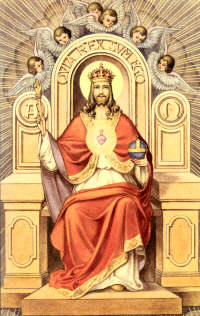
Summary of Papal Encyclical Qua Primas of the Feast of Christ the King

Summary of Papal Encyclical Qua Primas of the Feast of Christ the King

We remember saying that these manifold evils in the world were due to the fact that the majority of men had thrust Jesus Christ and his holy law out of their lives; that these had no place either in private affairs or in politics: and we said further, that as long as individuals and states refused to submit to the rule of our Savior, there would be no really hopeful prospect of a lasting peace among nations. Men must look for the peace of Christ in the Kingdom of Christ

It has long been a common custom to give to Christ the metaphorical title of "King," because of the high degree of perfection whereby he excels all creatures. So he is said to reign "in the hearts of men," both by reason of the keenness of his intellect and the extent of his knowledge, and also because he is very truth, and it is from him that truth must be obediently received by all mankind. He reigns, too, in the wills of men, for in him the human will was perfectly and entirely obedient to the Holy Will of God, and further by his grace and inspiration he so subjects our free-will as to incite us to the most noble endeavors. He is King of hearts, too, by reason of his "charity which exceedeth all knowledge." And his mercy and kindness[1] which draw all men to him, for never has it been known, nor will it ever be, that man be loved so much and so universally as Jesus Christ. But if we ponder this matter more deeply, we cannot but see that the title and the power of King belongs to Christ as man in the strict and proper sense too. For it is only as man that he may be said to have received from the Father "power and glory and a kingdom,"[2] since the Word of God, as consubstantial with the Father, has all things in common with him, and therefore has necessarily supreme and absolute dominion over all things created.

This kingdom is spiritual and is concerned with spiritual things. This kingdom is opposed to none other than to that of Satan and to the power of darkness. It demands of its subjects a spirit of detachment from riches and earthly things, and a spirit of gentleness. They must hunger and thirst after justice, and more than this, they must deny themselves and carry the cross.

It would be a grave error, on the other hand, to say that Christ has no authority whatever in civil affairs, since, by virtue of the absolute empire over all creatures committed to him by the Father, all things are in his power. Nevertheless, during his life on earth he refrained from the exercise of such authority.

When once men recognize, both in private and in public life, that Christ is King, society will at last receive the great blessings of real liberty, well-ordered discipline, peace and harmony.

For the rest of the Encyclical click here

Feast of Christ the King - 22Nd November 2009


Thy Kingdom Come

The coming of the kingdom of God, says our Lord and Saviour, does not admit of observation, and there will be no-one to say “Look here! Look there!” For the kingdom of God is within us and in our hearts. And so it is beyond doubt that whoever prays for the coming of the kingdom of God within himself is praying rightly, praying for the kingdom to dawn in him, bear fruit and reach perfection. For God reigns in every saint, and every saint obeys God’s spiritual laws — God, who dwells in him just as he dwells in any well-ordered city. The Father is present in him and in his soul Christ reigns alongside the Father, as it is said: We will come to him and make our dwelling with him.
Therefore, as we continue to move forward without ceasing, the kingdom of God within us will reach its perfection in us at that moment when the saying in the Apostle is fulfilled, that Christ, His enemies all made subject to Him, shall deliver the kingdom to God the Father that God may be All in All.
For this reason let us pray without ceasing, our souls filled by a desire made divine by the Word Himself. Let us pray to our Father in heaven: hallowed be thy name; thy kingdom come.
There is something important that we need to understand about the kingdom of God: just as righteousness has no partnership with lawlessness, just as light has nothing in common with darkness and Christ has no agreement with Belial, so the kingdom of God and a kingdom of sin cannot co-exist.
So if we want God to reign within us, on no account may sin rule in our mortal body but let us mortify our earthly bodies and let us be made fruitful by the Spirit. Then we will be a spiritual garden of Eden for God to walk in. God will rule in us with Christ who will be seated in us on the right hand of God — God, the spiritual power that we pray to receive — until he makes his enemies (who are within us) into his footstool and pours out on us all authority, all power, all strength.
This can happen to any one of us and death, the last enemy may be destroyed, so that in us Christ says Death, where is your sting? Death, where is your victory? So let our corruptibility be clothed today with holiness and incorruption. With Death dead, let our mortality be cloaked in the Father’s immortality. With God ruling in us, let us be immersed in the blessings of regeneration and resurrection.

(From the Office of Readings)

Saturday, November 21, 2009

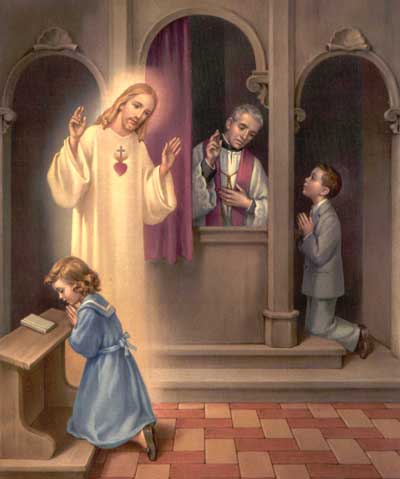
When did you last go for Confession

It will soon be Advent 2009, when was the last time you went for confession.


The next time you feel like GOD can't use you, just remember...
Noah was a drunk
Abraham was too old
Isaac was a daydreamer
Jacob was a liar
Leah was ugly
Joseph was abused
Moses had a stuttering problem
Gideon was afraid
Samson had long hair and was a womanizer
Rahab was a prostitute
Jeremiah and Timothy were too young
David had an affair and was a murderer
Elija h was suicidal
Isaiah preached naked
Jonah ran from God
Naomi was a widow
Job went bankrupt
Peter denied Christ (3 times!)
The Disciples fell asleep while praying
Martha worried about everything
Mary Magdalene was the Samaritan woman who was divorced, more than once...
Zaccheus was too small
Paul was too religious
Timothy had an ulcer... AND
Lazarus was dead!

Now! No more excuses!
God can use you to your full potential.
Besides, you aren't the message, you are just the messenger.
And one more thing...
Share this with a friend or two...
In the Circle of God's love, God is waiting to use your full potential.

(Another email gem from mummy)

A Sikh Boy who became a Catholic Priest


From devout Sikh to Catholic priest. This is the story of Jaideep Singh, who recently became a Maryknoll missionary, a societies of apostolic life founded in the United States in the early 1900s. Today he is Fr. Stephen James Taluja.

Born in 1981, the youngest child of an important Indian Sikh family, the only male eagerly awaited by his parents after three daughters. Fr. Stephen talks to AsiaNews about his unique and personal story that revolves around his discovery that Christ is the Mighty God "in weakness" and the certainty that "God is faithful."

"My mother was a very devout woman who introduced me to the teachings of the Guru Granth Sahib educated us at home in the prayer and recitation of the hymns of the sacred scriptures. My father accompanied me to the Gurdwara, the Sikh temple, and he raised me in the faith of the almighty. My parents instilled in us children love for God and a sense of service to the community".

The young Jaideep studied at St Stephen's School in Chandigarh, the capital of Punjab. Harold Carver, dean and founder of the institute remembers the young Sikh who "excelled in sports and played in the under 19 national soccer team of the state, loved music and sang in the school choir".

Because of the quality of his singing the little Jaideep was invited to sing at midnight Mass on Easter Eve in the local church of St. Sebastian. He was 13 years old and attending the 7th class. It was the first time he had set foot in a Catholic church making the unusual occasion even more special for the young Sikh. Today, he says: "In that night I have vivid memories of the crucifix hanging on the wall and all the people on their knees praying. I did not understand how people could pray to a weak and dying God. For me, God had to emanate strength and power. And that God was just the opposite. " Fr. Stephen remembers "the charm of the Liturgy of the Eucharist, common prayer and the unveiling of a totally new way for me." He left the Mass with the image of "the cross and crucified Lord" in his head as well as "emerging questions about the meaning of life."

After that night Jadeep began a long journey. "My mother had noticed that there was something new in me and caught my initial interest in Christianity, but did not say anything." Jaideep turned to the rector Carver, putting his questions to him. Which become more insistent, even after the events in the family life of the boy.

The sudden death of his mother made even more urgent the need to understand the meaning of life and death. Fr. Stephen speaks today of the "darkness of soul" recalling that time. "I wondered where God was in all that was happening to me, what was the meaning of life." The patient company of Harold Carver marks the "days of torment" of the young Sikh who recalls: "At some point I began to see the connection between life and death, realizing that Jesus died and rose was the model for us."

The memory of that period, in which anguish was followed by the emergence of faith, is for Fr Stephen motive for "pride and gratitude". "My family had planted in my soul the seed of religion, dean Carver the seed of Catholicism and of a life spent in witness of the Gospel."

Jaideep decides to speak with his father about becoming a Christian. "All hell broke loose. He was annoyed, angry and offended. He called my sisters to ask them for information about my new faith". The young priest now says: "They were really heavy and unsettling days for the whole family ... thus began my personal participation in the passion and crucifixion of Christ."

On March 1, 1999 Jaideep was baptized and chose the name of his school Stephen James. "I became a Catholic in secret and for 3-4 years my family knew nothing. I did not want to hurt them even more, because my father loved me so much and yet did not understand my choices".

The year after Stephen leaves for the United States to study computer science. He lives in New York. To earn some money he works at night at a gas station. Every morning he goes to Mass in the parish named after St. Elizabeth Ann Seton in Shrub Oak. Even there, he sings in the choir and one day the director Patti Copeland introduced Stephen to the Maryknoll missionaries. The young man remembers: "Their stories of aid to the poor around the world were impressed on my young 20 year old mind".

"For some time I felt emerge in me the innate desire to communicate with God, to devote all of myself to contemplation." Stephen believes the roots of this impulse lie in the education he received in his home: "Being Indian, and having received from my mother and our culture a deep sense of divinity I was fascinated by the mystical life in the early days of New York and I had thought of becoming a Trappist monk”.

In 2001, the young Indian was invited to an Easter spiritual retreat and he realises he is being called to consecrated life. Stephen enters the seminary, but does not say nothing yet to his father and sisters, "worried about the pain and stress that the decision might cause to my family."

"It was a period of anxiety in my life," says the boy. "I knew that my father and members of my family were mocked, scorned and humiliated for my decision to become Catholic." Sikh culture attaches great importance to the one male in the family circle. "You have the responsibility to carry on the name of your race, to take care of parents when they grow old - said Stephen - all this and I could no longer do so because of the decision I had taken."

The days of priestly formation pass accompanied by the torture of hurting his loved ones and especially his father. "But God is faithful," says the young man. "I suffered, but I knew that God would give my father a reward far greater than I could hope for."

Stephen studied at St. Xavier University in Chicago, attended the Maryknoll's Language Institute in Cochabamba, Bolivia, and for two years lived and worked in the mission of Aymara, on the Peruvian High Planes.

(Deacon Taluja prostrates himself before the altar during his ordination ceremony. Kindly note that the mass is being said Ad Orientem)

On 30 May 2009 he was ordained to the priesthood. Stephen’s three sisters arrive in New York: Anu, Manpreet and Jaipreet, who live in Europe and America. U.S. authorities will not grant a visa to the father. "But it was one of the happiest days of my life," says the young priest. "My dad wanted to be with me and through my sisters gave me his blessing and the sign of his support for my choice. He wanted me to know that he was proud of me and he had reconciled with my vocation. "

On becoming a priest of the Maryknoll missionaries, the young priest began a new life and on the day of his ordination, officiated by Msgr. Timothy Dolan, Archbishop of New York, he received messages of congratulations from hitherto unknown people who had learned of his story through friends or other missionaries. "They wrote that they prayed for me, as I became a priest during his Year for Priests - says Fr Stephen - and I felt honoured and privileged to be a Catholic priest, blessed by the prayers of so many people around the world. All this has made me all the stronger in my desire to be a holy priest and a missionary who serves God by serving his people".

(I received this in my email from mum, I verified it at this website )

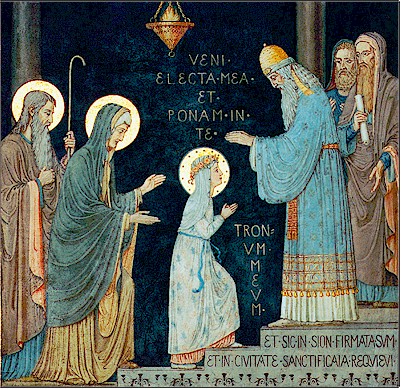
Presentation of the Virgin Mary

Many of the celebrations in honor of Mary are based in historical fact. The Sacred Scriptures tell of her acceptance of God's invitation to be the mother of the Savior at the Annunciation. We know of her maternity and of her faithfulness to her son, Jesus, even standing at the side of his cross.

The Scriptures tells us nothing of Mary's hidden life. The inspired Word of God gives us no word about her Presentation in the Temple, the feast which we celebrate each year on November 21st. However, we do have the testimonies of tradition which are based on accounts which come to us from apostolic times. That which is known about the Presentation of the Blessed Virgin Mary in the Temple is found in the Apocrypha, principally in chapter seven of the Protoevangelium of James, which has been dated by historians prior to the year 200 AD.

This book gives us a detailed account in which Mary's father, Joachim, tells Anna his wife that he wishes to bring their child to the Temple of the Lord. Anna responds that they should wait until the child is three years old lest she yearn for her parents. When the day arrived, the undefiled daughters of the Hebrews were invited to accompany Mary with their lamps burning to the Temple. There the priest received her, blessed her, and kissed her in welcome. He proclaimed, "The Lord has magnified thy name in all generations. In thee, the Lord will manifest His redemption to the sons of Israel." Mary was placed on the third step of the Temple and there danced with joy and all the house of Israel loved her. It was there that she was nurtured and her parents returned, glorifying the Almighty.

This story is a legend with no foundation in history and the point of the story is to show that even in her childhood Mary was completely dedicated to God. However, it is from this very account that arose the feast of Mary's Presentation.

Historians tell us that the Emperor Justinian built a splendid church dedicated to Mary in the Temple area in Jerusalem. It was dedicated on November 21, 543 but was destroyed by the Persians within a century. Many of the early church Fathers such as St. Germanus, Patriarch of Constantinople (+730) and St. John Damascene, his contemporary, preached magnificent homilies on this feast referring to Mary as that special plant or flower which was being nurtured for better things." She was planted in the House of God, nourished by the Holy Spirit and kept her body and soul spotless to receive God in her bosom. He Who is all-holy rests among the holy."

We know that in the Byzantine Church this feast is considered one of the twelve great feasts of the liturgical year, called the Dodecaorton. Scholars believe that Mary's Presentation in the Temple is considered a major feast for the Eastern churches celebrating the same values that the Western church celebrates in the feast of the Immaculate Conception.

It appears that this feast was not celebrated in Rome at the time of Pope St. Sergius (+701) who established four other principle feasts dedicated to Mary. By the ninth century it is celebrated in the monasteries of southern Italy which had been influenced by the traditions of the Byzantine churches. By the fourteenth century it had spread to England and it is recorded that it was celebrated in Avignon, France in 1373. Its acceptance is considered very slow and it was not until the year 1472 that Pope Sixtus IV extended its celebration to the universal church.

Pope Paul VI in the 1974 encyclical Marialis Cultus, n.8, wrote of this feast that "despite its apocryphal content, it presents lofty and exemplary values and carries on the venerable traditions having their origins in the Eastern churches."


(Courtesy http://campus.udayton.edu/mary/meditations/Nov21.html )

Friday, November 20, 2009

By faith she believed; by faith, conceived


(The following text is from the Office of Readings)


Stretching out his hand over his disciples, the Lord Christ declared: Here are my mother and my brothers; anyone who does the will of my Father who sent me is my brother and sister and my mother. I would urge you to ponder these words. Did the Virgin Mary, who believed by faith and conceived by faith, who was the chosen one from whom our Saviour was born among men, who was created by Christ before Christ was created in her – did she not do the will of the Father? Indeed the blessed Mary certainly did the Father’s will, and so it was for her a greater thing to have been Christ’s disciple than to have been his mother, and she was more blessed in her discipleship than in her motherhood. Hers was the happiness of first bearing in her womb him whom she would obey as her master.

Now listen and see if the words of Scripture do not agree with what I have said. The Lord was passing by and crowds were following him. His miracles gave proof of divine power. and a woman cried out: Happy is the womb that bore you, blessed is that womb! But the Lord, not wishing people to seek happiness in a purely physical relationship, replied: More blessed are those who hear the word of God and keep it. Mary heard God’s word and kept it, and so she is blessed. She kept God’s truth in her mind, a nobler thing than carrying his body in her womb. The truth and the body were both Christ: he was kept in Mary’s mind insofar as he is truth, he was carried in her womb insofar as he is man; but what is kept in the mind is of a higher order than what is carried in the womb.

The Virgin Mary is both holy and blessed, and yet the Church is greater than she. Mary is a part of the Church, a member of the Church, a holy, an eminent – the most eminent – member, but still only a member of the entire body. The body undoubtedly is greater than she, one of its members. This body has the Lord for its head, and head and body together make up the whole Christ. In other words, our head is divine – our head is God.
Now, beloved, give me your whole attention, for you also are members of Christ; you also are the body of Christ. Consider how you yourselves can be among those of whom the Lord said: Here are my mother and my brothers. Do you wonder how you can be the mother of Christ? He himself said: Whoever hears and fulfils the will of my Father in heaven is my brother and my sister and my mother. As for our being the brothers and sisters of Christ, we can understand this because although there is only one inheritance and Christ is the only Son, his mercy would not allow him to remain alone. It was his wish that we too should be heirs of the Father, and co-heirs with himself.

Now having said that all of you are brothers of Christ, shall I not dare to call you his mother? Much less would I dare to deny his own words. Tell me how Mary became the mother of Christ, if it was not by giving birth to the members of Christ? You, to whom I am speaking, are the members of Christ. Of whom were you born? “Of Mother Church,” I hear the reply of your hearts. You became sons of this mother at your baptism, you came to birth then as members of Christ. Now you in your turn must draw to the font of baptism as many as you possibly can. You became sons when you were born there yourselves, and now by bringing others to birth in the same way, you have it in your power to become the mothers of Christ.

Saint Felix of Valois -20 November 2009

Saint Felix was the son of the Count of Valois. His mother carried him to Saint Bernard at his monastery of Clairvaux, to offer him there to God, when he was three years old; she kept him, however, under her own care and took particular care of him, permitting him, still young, to distribute the alms she was pleased to give to the poor. When the exiled Pope Innocent II sought refuge in France, the Count of Valois, father of Felix, offered his castle of Crepy to the Pontiff, who often blessed the young child whom he saw being trained in virtue. One day when Felix gave away his own habits to a poor beggar, he found them that evening neatly laid on his bed; and he thanked God for this sign of His divine goodness, proving that one loses nothing when one gives to the poor.

When he was ten years old he obtained grace for a prisoner condemned to death, by means of his prayer and his pleadings with his uncle, a lord of whom the man was the subject. Felix had a presentiment that this man would become a saint; and in fact, he retired into a deep solitude where he undertook severe penance and died the death of the just.

The unfortunate divorce of the parents of Felix, and the excommunication of his father, who had remarried and whose condemnation raised serious troubles on his domains, caused to mature in the young man a long-formed resolution to leave the world. Confiding his mother to her pious brother, Thibault, Count of Champagne, Felix took the Cistercian habit at Clairvaux. His rare virtues drew on him an admiration such that, with Saint Bernard’s consent, he fled from it to Italy, where he began to live an austere life with an aged hermit in the Alps. For this purpose he had departed secretly, and the servants his uncle sent believed him dead, being unable to trace him; they published the rumor of his death. About this time the old hermit procured the ordination of his disciple as a priest.

After his elderly counselor died in his arms, Saint Felix returned to France. He built a cell in the diocese of Meaux in an uninhabited forest; this place was later named Cerfroid. Amid savage beasts he led an angelic life of perpetual fasting. Here God inspired him with the desire of founding an Order for the redemption of Christian captives. The Lord also moved Saint John of Matha, a young nobleman of Provence, to seek out the hermit and join him. The two applied themselves to the practice of all virtues. It was John who overtly proposed to Saint Felix the project of an Order for the redemption of captives, when his preceptor was already seventy years old. The latter gladly offered himself to God for that purpose, and after praying for three days the two solitaries made a pilgrimage to Rome in the middle of winter. They were kindly received by the Pope, after he read the recommendation which the Bishop of Paris had given them. He too prayed and became convinced that the two Saints were inspired by the Holy Spirit, and he gave his approbation to the Trinitarian Order

Within forty years the Order would have six hundred monasteries. Saint John, who was Superior General, left to Saint Felix the direction of the convents in France, exercised from the monastery which the founders had built at Cerfroid. There Saint Felix died in November of 1212, at the age of eighty-five, only about six weeks before his younger co-founder. It is a constant tradition in the Trinitarian Order that Saint Felix and Saint John were canonized by Urban IV in 1260, though no bull has ever been found. In 1219 already the feast of Saint Felix was kept in the entire diocese of Meaux. In 1666 Alexander VI declared that veneration of the servant of God was “immemorial”.

Thursday, November 19, 2009

St. Raphael Kalinowski - 19 November 2009

Father Raphael of Saint Joseph Kalinowski, was born at Vilna, 1st September 1835, and at baptism received the name Joseph. Under the teaching of his father Andrew, at the Institute for Nobles at Vilna, he progressed so well that he received the maximum distinction in his studies. He then went for two years (1851-1852) to the school of Agriculture at Hory-Horky. During the years 1853-1857, he continued his studies at the Academy of Military Engineering at St Petersburg, obtaining his degree in Engineering, and the rank of Lieutenant. Immediately afterwards he was named Lecturer in Mathematics at the same Academy. In 1859, he took part in the designing of the Kursk-Kiev-Odessa railway.

In 1863 the Polish insurrection against their Russian oppressors broke out. He resigned from the Russian forces, and accepted the post of Minister of War for the region of Vilna, in the rebel army. On 24th March 1864, he was arrested and condemned to death, a penalty that was mitigated to 10 years hard labour in Siberia. With an admirable strength of spirit, patience, and love for his fellow exiles, he knew how to instill into them the spirit of prayer, serenity and hope, and to give material help together with a word of encouragement.

Repatriated in 1874, he accepted the post of tutor to the Venerable Servant of God, Augusto Czartoryski, living mostly in Paris. His influence on the young prince was such, that Augusto discovered his true vocation as priest and religious. He was received into the Salesians by their founder, Saint John Bosco, in 1887. On the other hand, Joseph Kalinowski entered the Discalced Carmelites at Graz in Austria, and received the religious name of Brother Raphael of Saint Joseph. He studied theology in Hungary, and was ordained Priest at Czerna near Krakow, 15th January 1882.

Afire with apostolic zeal, he did not spare himself in helping the faithful, and assisting his Carmelite brothers and sisters in the ascent of the mountain of perfection.

In the sacrament of Reconciliation, he lifted up many from the mire of sin. He did his utmost for the work of reunification of the Church, and bequeathed this mission to his Carmelite brothers and sisters. His superiors entrusted him with many important offices, which he carried out perfectly, right until the time of his death.

Overcome by fatigue and suffering, and held in great respect by all the people, he gave his soul to God, 15th November 1907, at Wadowice in the monastery founded by himself. He was buried in the monastery cemetery, at Czerna, near Krakow.

During his life and after death, he enjoyed a remarkable fame for sanctity, even on the part of the most noble and illustrious of people, such as the Cardinals Dunajewski, Puzyna, Kakowski and Gotti. The Ordinary Process for his eventual beatification, was set in motion in the Curia of Krakow during the years 1934-1938, and later taken to Rome where in 1943 was issued the Decree concerning his writings. His cause was introduced in 1952. From 1953-1956 the Apostolic Process was carried out, and the Congregation proceeded to the discussion on his virtues.

Pope John Paul II, on the 11th October 1980, promulgated the Decree on the heroicity of his virtues. After the approval of the miraculous healing of the Reverend Mis, the Holy Father beatified Father Raphael Kalinowski at Krakow on 22nd June 1983.

As the fame of his miracles was increasing, the Curia of Krakow in 1989, set in motion the Canonical Process to investigate the extraordinary healing of a young child. The discussions of the doctors, theologians and cardinals, were brought to a happy conclusion. On the 10th July 1990, the Holy Father John Paul II, approved the miracle for the canonization.

In the Consistory of 26th November 1990, Pope John Paul together with the Cardinals, decided to canonize Blessed Raphael Kalinowski. They set the ceremony for Sunday, 17th November 1991.
Pope John Paul II, today canonizes him, and presents him as a model to all Christians in the universal Church.


Wednesday, November 18, 2009

Dedication of Sts. Peter and Sts. Paul Basilicas

AS the commemorative feast of the dedication of the archbasilica of the Lateran is kept by the whole Western church, so also is that of the other greater patriarchal basilicas at Rome, St Mary Major on August 5, and St Peter's and St Paul's together on this day, November 18th. Amongst all the places which the blood of martyrs has rendered illustrious, that part of the Vatican Hill which was consecrated with the blood and enriched with the relics of the Prince of the Apostles has always been the most venerable. "The sepulchres of those who have served Christ crucified", says St John Chrysostom, "surpass the palaces of kings ; not so much in the greatness and beauty of the buildings (though in this also they go beyond them) as in other things of more importance, such as the multitude of those who with devotion and joy repair to them. For the emperor himself, clothed in purple, goes to the tombs of the saints and kisses them ; humbly prostrate on the ground he beseeches the same saints to pray to God for him ; and he who wears a royal crown looks on it as a great privilege from God that a tentmaker and a fisherman, and these dead, should be his protectors and defenders, and for this he begs with great earnestness." The martyrdom of St Peter took place according to tradition at the circus of Caligula in Nero 's gardens on the Vatican Hill, and he was buried nearby. It is held by some that in the year 258, to avoid desecration during the persecution of Valerian, the relics of St Peter, together with those of St Paul were translated for a time to the obscure catacomb now called St Sebastian's ; but they came back to their original resting-place, and in 323 the Emperor Constantine began the building of the basilica of St Peter over the tomb of the Apostle. For nearly twelve hundred years this magnificent church remained substantially the same, a great papal establishment gradually growing up between it and the Vatican Hill. This was made the permanent residence of the popes on their return from the exile at Avignon, and by the middle of the fifteenth century the old church was found to be inadequate. In 1506 Pope Julius II inaugurated a new building designed by Bramante, whose erection was carried on over a period of a hundred and twenty years, undergoing many alterations, additions and modifications at the hands of various popes and architects, especially Paul V and Michelangelo. The new basilica of St Peter, as we see it today, was consecrated by Pope Urban VIII on November 18, 1626, the day of its original dedication. The high altar was set up over the Apostle's resting-place, which until 1942 had been inaccessible for many centuries. Though St Peter's must always yield in dignity to the cathedral of St John Lateran, it has nevertheless for long been the most important church of the world, both in fact and in the hearts of Catholic Christians.

The martyrdom of St Paul took place some seven miles from that of St Peter at Aquae Salviae (now called Tre Fontane) on the Ostian Way. He was buried about two miles therefrom, on the property of a lady named Lucina, in a small vault. Early in the third century, according to Eusebius (Hist. eccl., ii, 25, 7), a Roman priest, Caius, refers to the tombs of SS. Peter and Paul : " I can show you the trophies [tombs] of the apostles. If you go to the Vatican or on the road to Ostia you will see the trophies of those who founded this church." Constantine is said to have begun a basilica here too, but the great church of St Pauloutside-the-Walls was principally the work of the Emperor Theodosius I and Pope St Leo the Great. It remained in its primitive beauty and simplicity till the year 1823, when it was consumed by fire. The whole world contributed to its restoration, non-Christians as well as non-Catholics sending gifts and contributions. During the course of the work the fourth-century tomb was found, with the inscription PAULO APOST MART : To Paul, apostle and martyr ; it was not opened. The new basilica, on the lines of the old one, was consecrated by Pope Pius IX on December 10, 1854, but the annual commemoration was appointed for this day, as the Roman Martyrology records. " We do not ", says St Augustine, " build churches or appoint priesthoods, sacred rites and sacrifices to the martyrs, because, not the martyrs, but the God of the martyrs, is our God. Who among the faithful ever heard a priest, standing at the altar set up over the body of a martyr to the honour and worship of God, say in praying : We offer up sacrifices to thee, Peter, or Paul, or Cyprian ? We do not build churches to martyrs as to gods, but as memorials to men departed this life, whose souls live with God. Nor do we make altars to sacrifice on them to the martyrs, but to their God and our God."

Tuesday, November 17, 2009

St Elizabeth of Hungary - 17th November 2009

Elizabeth of Hungary lived for only a short while during the early part of the thirteenth century, yet experienced life as only few can; she was a child, princess, mother, queen, widow, exile, and one of the most pious women to ever live. She was able to simultaneously balance the role of prosperous sovereign with humble servant of God. Even after her exile by her in-laws, in the years following her husband’s death, she remained strong in her faith and never wavered in her devotion to the poor. She was an extraordinary woman who lived for less than a quarter of a century during the early portion of the 13th century, but made more of an impact on an entire country then most people who live three times as long as she did. She is still remembered in Germany as "dear St. Elizabeth" and her feast is celebrated on November 17 in the Roman Catholic Church.

While most sources refer to her as Saint Elizabeth of Hungary, she is more accurately referred to as Elizabeth of Thuringia and Hesse as she married into the Thuringian family line from Hesse and consequently spent more of her time in her husband's territory. Born in 1207 at the castle at Pressburg (modern day Bratislava, the capital city of Slovakia) she was the second child of Alexander/ Andreas/ Andrew (different sources give diverse names) II and Queen Gertrude of Hungary. As a royal daughter, the issue of marriage became an important one, even in her infancy. Ultimately, an offer was accepted and she was betrothed to Landgrafin Hermann I of Thuringia.

Elizabeth was an outstanding child who directed all of her actions and intentions to God. She was intelligent, well-educated, and a willful young girl who practiced penance regularly, refused to go to Mass in embroidered sleeves or gloves (as she felt that these luxuries were unnecessary and gaudy), and regularly gave alms to the poor. She was often being lost in prayer and at an early age, put herself under the protection of the Blessed Virgin and Saint John.

While most children are off frolicking and making trouble, Elizabeth was married between the ages of thirteen and fourteen. Hermann I had died on December 31, 1216; so instead, she married his brother, Ludwig. The match proved to be a happy one. Ludwig loved her deeply and was a kind-hearted husband. He was generous and wary of misusing his power. His ultimate goal was the service of God, and therefore their philosophies and personal morals intertwined perfectly.

Ludwig spent his reign, as he spent his life, acting for the will of God. As ruler, he traveled to Italy on behalf of the empire and emperor. In his absence, he left control of his finances and household to Elizabeth who in turn disseminated alms, including state robes and ornaments, to all parts of the territory. In addition, she built a twenty-eight-bed hospital below the Wartburg and visited the residents daily to attend to their wants. The following year, after a brief return to Germany, Ludwig left yet again, this time on a crusade to Palestine in conjunction with Emperor Frederick II. He died shortly after leaving for Palestine, on 11 September 1227 en route to the crusade for God against the infidels.

Thus, Elizabeth was left with three children, a widow at the age of twenty. She was deeply upset at the loss of her beloved husband. Yet, she turned to God for aid and found it in the guidance of Caesarius of Speyer. With newfound hope, she built a monastery for the Franciscan order in 1225 at Eisenach.

However, trouble was not far behind. In 1227, she felt compelled to leave Wartburg for moral reasons and instead took up residence at Marburg. Ludwig’s brother, Heinrich Raspe, was a cruel and harsh man compared to his brother, and offered to provide her with enough to subsist her each day, but nothing more. She did not agree to these terms and ultimately, his callous and uncooperative manner drove her out of Warburg; without extra money, she could not provide for the poor of the community and her conscience would not permit her to act without regard for others. She found final refuge on Good Friday, 1228 with the Franciscans at Eisenach. Here, she formally relinquished worldly possessions and then proceeded to become one of the first tertiaries of Germany, a member of the Third Order of St. Francis. Her last act of the outside world was the completion of the Franciscan hospital at Marburg in the summer of 1228. After this, she devoted her heart and soul to the aid of the poor and sick, especially the most severely afflicted. She died only a few years later, at the age of twenty-four.

Saint Elizabeth of Hungary, or Thuringia, is the first royal Franciscan tertiary to be canonized. At only twenty-four years old, Elizabeth of Hungary died and the world lost of one of the most pious women to ever live. Within only four years, Pope Gregory IX named her a Saint (in May of 1235). She is most remembered for her gentle, charitable nature and complete devotion to God’ s will. Her popularity was immediate, with most of her followers living in the regions in and around Germany and Hungary. While she is still remembered today for her many works of charity, Elizabeth's popularity has declined due to the historical distance that today's society possesses from the 12th century.

St. Margaret of Scotland - 16th November 2009

Margaret was born in 1046 and was a member of an ancient English royal family. She was a direct descendant of King Alfred and was the granddaughter of King Edmund Ironside of England through his son Edward.

Along with her family Margaret had been exiled to the eastern continent when King Canute and his Danish army had overrun England. Beautiful and devout she was also intelligent receiving her formal education in Hungary.

Margaret and her family returned to England towards the end of the reign of her great-uncle, Edward the Confessor, as her younger brother Edgar the Aetheling, had a very strong claim to the English throne. The English nobility had other ideas however and elected Harold Godwin as Edward’s successor.

All of this political manoeuvring proved irrelevant when William, Duke of Normandy, otherwise known as ‘The Conqueror’ arrived with his army near Hastings in 1066, but that’s another story.

As some of the last remaining Saxon Royals in England, Margaret and her family’s position was precarious and fearing for their lives they fled northwards, in the opposite direction to the advancing Normans. They were heading back to the continent from Northumbria when their ship was blown off course and landed in Fife.

The Scottish King, Malcolm III, known as Malcolm Canmore (or Great Head) offered his protection to the royal family.

Malcolm was particularly protective towards Margaret! She initially refused his proposals of marriage, preferring, according to one account, a life of piety as a virgin. Malcolm however was a persistent king, and the couple finally married in Dunfermline in 1069.

Their union was exceptionally happy and fruitful for both themselves and the Scottish nation. Margaret brought with her some of the finer points of current European manners, ceremony and culture to the Scottish Court, which highly improved its civilised reputation.

Queen Margaret was renown for her moderating and good influence on her husband and also for her devout piety and religious observance. She was a prime mover in the reform of the Church in Scotland.

Under Queen Margaret's leadership Church councils promoted Easter communion and, much to joy of the working-class, abstinence from servile work on a Sunday. Margaret founded churches, monasteries and pilgrimage hostels and established the Royal Mausoleum at Dunfermline Abbey with monks from Canterbury. She was especially fond of Scottish saints and instigated the Queen's Ferry over the Forth so that pilgrims could more easily reach the Shrine of St. Andrew.

Mass was changed from the many dialects of Gaelic spoken throughout Scotland to the unifying Latin. By adopting Latin to celebrate the Mass she believed that all Scots could worship together in unity, along with the other Christians of Western Europe. Many people believe that in doing this, it was not only Queen Margaret's goals to unite the Scots, but also Scotland and England in an attempt to end the bloody warfare between the two countries.

In setting the agenda for the church in Scotland Queen Margaret also ensured the dominance of the Roman Church over the native Celtic Church in the north of the country.


Margaret and Malcolm had eight children, all with English names. Alexander and David followed their father to the throne, whilst their daughter, Edith (who changed her name to Matilda upon her marriage), brought the ancient Anglo-Saxon and Scottish Royal bloodline into the veins of the Norman Invaders of England when she married and bore children to King Henry I.

Margaret was very pious and cared especially for the poor and orphans. It was this piety that caused considerable damage to her health with the repeated fasting and abstinence. In 1093, as she lay on her deathbed after a long illness, she was told that her husband and eldest son had been ambushed and treacherously killed at the Battle of Alnwick in Northumbia. She died shortly after aged just forty-seven.

She was buried alongside Malcolm in Dunfermline Abbey and the reported miracles that took place in and around her tomb supported her canonization in 1250 by Pope Innocent IV.

At the Reformation St. Margaret’s head somehow passed into the possession of Mary Queen of Scots, and was later secured by the Jesuits at Douai, where it is believed to have perished during the French Revolution.

The feast of St. Margaret was formerly observed by the Roman Catholic Church on 10th June but is now celebrated each year on the anniversary of her death, 16th November.


Monday, November 16, 2009

Democracy cannot exist without values


Democracy is classically defined as a government of, for and by the people. The people have a set of values based on which they elect representatives who form the government.The government passes laws based on the values of the people as the government shares the same values as the people.


Democracies have achieved greatness because they were based on the values of the people which they represented. However the edifice of democracy breaks down when the value system of the people changes.


Western democracy was based on Judeo-Christian values. These values laid the foundation of society and laws were based around these values. However as the people moved away from these values their elected representatives also passed laws which reflected these new values.


For example, society frowned upon adultery and laws were passed against adultery. However as people accepted adultery government had to pass laws which not only allowed divorces, but also recognized common law spouses and common law spousal benefits. Now a negative value - adultery - gets rewarded with the same benefits as monogamy and the value of monogamy is diminished.


Progressing on the same example, as adultery becomes more and more acceptable in society and loses all its stigma, fornication also becomes acceptable and soon all forms of sexuality becomes acceptable. Soon homosexuality is common and the government which is elected by people whose values now include support for a perverse sexuality passes law in support of such perversion. Homosexual unions are given the status of marriage and education systems are forced to teach sexual perversion as part of curriculum.


As the values of the people move further away from the Judeo-Christian value system each of the 10 commandments is broken and anti-values come to the fore, rights of choice (abortion and euthanasia) triumph of right to life. Government passes laws supporting abortion and euthanasia, the right to chose is taught in schools and any from of dissent is punished legally via human right tribunals.


As relativism grows a democracy fails and is replaced by a tyrannical government which makes laws to allow anti-values and punish real values. This is already seen in Canada and many parts of western Europe.


The United States of America faces this situation today. Religion and values have been pushed far into the background. As a consequence of this generations have grown up with a warped if not non-existent value system. the prevailing value is to be happy at all costs and be rich at all costs. The American democracy is at stake and if USA wishes not to become like Canada, then a return to Judeo-Christian values is essential.

Tuesday, November 10, 2009

Dedication of the Basilica of St. John Lateran - 10th november 2009

We celebrate today the Dedication of the Basilica of St. John Lateran in Rome because it is the head and mother church of all churches in the world. On the façade of the basilica there is an inscription in Latin which reads, “the mother and mistress of all churches of Rome and the world.” One might think St. Peter’s Basilica is the head of all the churches but in fact it is the Basilica of St. John Lateran. Every bishop has a cathedral and the Pope’s cathedral is the Basilica of St. John Lateran not the Basilica of St. Peter.

You may ask “Why is the Basilica of St. John Lateran the Pope’s cathedral and not the Basilica of St. Peter since he lives next to St. Peter's Basilica?” History gives us the answer. In the early centuries Christianity was outlawed in Rome and many Christians in Rome suffered martyrdom. The Emperor Constantine converted to Christianity and the famous Edict of Milan in 313 AD allowed Christians to practice their religion in public. Constantine had been given the palace in Rome that belonged to the Laterani and after his conversion to Christianity he gave it to the Pope. The Lateran Palace was then adapted to become a church and was dedicated on 9th November 324 and the Pope then lived in the Lateran Palace as it was called for the next 1000 years and the basilica was his cathedral. It was first called the Basilica of the Savior but later was also dedicated to St. John the Baptist and St. John the Evangelist and so it acquired the name Basilica of St. John Lateran. When the Papacy transferred to Avignon for about a century the condition of the Lateran deteriorated so much that when the Papacy returned to Rome the Pope lived in two other locations before finally settling adjacent to St. Peter's Basilica where he now lives.

Perhaps we could say that the many times the Basilica suffered destruction of some kind is a symbol of the attacks on the Church and the hatred of some for the Church. The Basilica was attacked by the Vandals twice in 408 and 455. It was almost totally destroyed by an earthquake in 896 and it was destroyed by fire in 1308 and 1360. The Basilica is visited by huge numbers of pilgrims every year also symbolizing the love of so many people for the Church.

Those who visit the Basilica on pilgrimage visit it not just because it is the head of all churches and the Pope’s cathedral. The wooden altar on which St. Peter celebrated Mass while in Rome is inside the main altar. The heads of Sts Peter and Paul were once believed to be inside busts above the main altar. Part of the table on which the Last Supper was celebrated is said to be behind a bronze depiction of the Last Supper. At one time the Holy Stairs which is nearby was also in the Lateran, the stairs in Pilate's house on which Jesus is said to have walked during his trial. It is a marble stairs and is now covered with wood to protect it. Pilgrims ascend the stairs on their knees contemplating Jesus’ Passion and on the way up drops of blood may be seen on the marble stairs beneath protective glass. The stairs was brought to Rome by Constantine’s mother St. Helena.

Celebrating the dedication of the Pope’s cathedral today shows our unity with the Pope and our love and respect for him. Not only that, but it shows that we are united with each other in the Church. St. Paul described this unity in the Church in his first letter to the Corinthians as the Body of Christ.

For as with the human body which is a unity although it has many parts – all the parts of the body, though many, still making up one single body – so it is with Christ. We were baptized into one body in a single Spirit, Jews as well as Greeks, slaves as well as free men, and we were all given the same Spirit to drink. (1 Cor 12:12-13)…Now Christ’s body is yourselves, each of you with a part to play in the whole. (1 Cor 12:27)

In our first reading today we heard Ezekiel’s vision of a river flowing from the Temple in Jerusalem and bringing life everywhere it went. We could see it as a vision of the Church receiving life-giving grace from Jesus. In the Letter to the Ephesians we read,

You are built upon the foundations of the apostles and prophets, and Christ Jesus himself is the cornerstone. Every structure knit together in him grows into a holy temple in the Lord; and you too in him are being built up into a dwelling-place of God in the Spirit.

In our second reading today we have a similar idea, “You are God’s building…the foundation…is Jesus Christ.” These passages from Scripture remind us to make Jesus the foundation stone and corner stone of our lives because there is a life-giving river flowing from him to fill us with his grace.

As we celebrate today the dedication of the “the mother and mistress of all churches of Rome and the world” let us pray also for those who have got lost going through life that they find the Church as a true mother to them and that Jesus may become the foundation stone and corner stone of their lives.

From http://www.frtommylane.com/homilies/years_abc/dedication_basilica_john_lateran.htm

Thursday, November 5, 2009

St. Sylvia - 5th November 2009

Mother of Pope St. Gregory the Great, born about 515 (525?); died about 592.

There is unfortunately no life of Silvia and a few scanty notices are all that is extant concerning her. Her native place is sometimes given as Sicily, sometimes as Rome. Apparently she was of as distinguished family as her husband, the Roman regionarius, Gordianus. She had, besides Gregory, a second son.

Silvia was noted for her great piety, and she gave her sons an excellent education. After the death of her husband she devoted herself entirely to religion in the "new cell by the gate of blessed Paul" (cella nova juxta portam beati Pauli). Gregory the Great had a mosaic portrait of his parents executed at the monastery of St. Andrew; it is minutely described by Johannes Diaconus (P.L., LXXV, 229-30). Silvia was portrayed sitting with the face, in which the wrinkles of age could not extinguish the beauty, in full view; the eyes were large and blue, and the expression was gracious and animated.

The veneration of St. Silvia is of early date. In the ninth century an oratory was erected over her former dwelling, near the Basilica of San Saba. Pope Clement VIII (1592-1605) inserted her name under 3 November in the Roman Martyrology. She is invoked by pregnant women for a safe delivery.

Wednesday, November 4, 2009

St. Charles Borromeo - 4th November 2009

Born to a wealthy, noble family, the third of six children, son of Count Giberto II Borromeo and Margherita de’ Medici. Nephew of Pope Pius IV. Suffered with a speech impediment. Studied in Milan, and at the University of Pavia, studying at one point under the future Pope Gregory XIII. Civil and canon lawyer at age 21. Cleric at Milan, taking the habit on 13 October 1547. Abbot commendatario of San Felino e San Graziano abbey in Arona, Italy, on 20 November 1547. Abbot commendatario of San Silano di Romagnano abbey on 10 May 1558. Prior commendatario of San Maria di Calvenzano abbey on 8 December 1558. Protonotary apostolic participantium and referendary of the papal court to Pope Pius IV on 13 January 1560. Member of the counsulta for the administration of the Papal States on 22 January 1560. Appointed abbot commendatario of Nonatola, San Gallo di Moggio, Serravalle della Follina, San Stefano del Corno, an abbey in Portugal, and an abbey in Flanders, Belgium on 27 January 1560. Created cardinal on 31 January 1560 at age 22.

Apostolic administrator of Milan, Italy on 8 February 1560. Papal legate to Bologna and Romandiola for two years beginning on 26 April 1560. Deacon on 21 December 1560. Vatican Secretary of State. Governor of Civita Castellana,Italy in 1561. Governor of Ancona on 1 June 1561. Made an honorary citizen of Rome, Italy on 1 July 1561. Founded the Accademia Vaticana in 1562. Governor of Spoleto, Italy on 1 December 1562. Ordained on 4 September 1563. Helped re-open the Council of Trent, and participated in its sessions during 1562 and 1563. Named prince of Orta in 1563. Member of the Congregation of the Holy Office. Bishop of Milan on 7 December 1563. President of the commission of theologians charged by the pope to elaborate the Catechismus Romanus. Worked on the revision of the Missal and Breviary. Member of a commission to reform church music. Archbishop of Milan on 12 May 1564. Governor of Terracina, Italy on 3 June 1564. Archpriest of the patriarchal Liberian basilica in Rome in October 1564. Count of the Palatine in 1564. Prefect of the Tridentine Council from 1564 until September 1565. Papal legate in Bologna, Romandiola, legate a latere, and vicar general in spiritualibus of all Italy on 17 August 1565. Grand penitentiary on 7 November 1565. Participated in the conclave of cardinals in 1565 to 1566 that chose Pope Pius V; he asked the new pope to take the name. Protector of the Swiss Catholic cantons; he visited them all several times worked for the spiritual reform of both clergy and laymen. Due to his enforcement of strict ecclesiastical discipline, some disgruntled monks in the Order of the Humiliati hired a lay brother to murder him on the evening of 26 October 1569; he was shot at, but was not hit. Participated in the conclave in 1572 that chose Pope Gregory XIII. Member of the Apostolic Penitentiary in May 1572. Worked with the sick, and helped bury the dead during the plague outbreak in Milan in 1576. Established the Oblates of Saint Ambrose on 26 April 1578. Teacher, confessor and parish priest to Saint Aloysius Gonzaga, giving him his first communion on 22 July 1580. To help the Swiss Catholics he founded the Collegium Helveticum.

Saint Charles spent his life and fortune in the service of the people of his diocese. He directed and fervently enforced the decrees of the Council of Trent, fought tirelessly for peace in the wake of the storm caused by Martin Luther, founded schools for the poor, seminaries for clerics, hospitals for the sick, conducted synods, instituted children’s Sunday school, did great public and private penance, and worked among the sick and dying, leading his people by example.

Tuesday, November 3, 2009

St. Martin of Porres - 3rd November 2009s

St. Martin de Porres was born out of wedlock in Lima, Peru, on December 9, 1579 to Don Juan de Porres, a Spanish nobleman and adventurer, and Ana Velasquez, a freed daughter of slaves from Panama. His father abandoned the family when Martin and his sister, Juana, were very young. Ana Velasquez supported her children by taking in laundry. Martin's childhood poverty did not embitter him but made him sensitive to the plight of the poor, and especially the orphans to whom he would devote much of his time and resources. Even as a child, Martin would give the family's scarce resources to the beggars whom he saw as less fortunate than himself.

When Martin turned eight, his father had a change of heart and decided to claim his two mulatto children in spite of the gossip to which it subjected him. He made sure that both were afforded a good education and had enough money for the family not to suffer privation.

At the age of twelve, Martin began an apprenticeship with a barber/surgeon named Marcel de Rivero. He proved extremely skillful at this trade and soon customers, who at first were skeptical of the young black lad, came to prefer and ask for him.

After leaving home, Martin took a room in the house of Ventura de Luna. Always a devoted Catholic who spent much time in church, Martin begged his landlady for some candle stubs. She was curious about his activities and one night spied on him through a keyhole and witnessed Martin in a vigil of ecstatic prayer -- a practice he would continue throughout his life.

Martin de Porres joined the Dominican Order of Preachers as a donado (lay helper or tertiary). The donados were the lowest-ranking Dominicans, performing the heaviest chores in the Order. He was eventually elevated to brother but never did become a full priest.

Martin continued to practice his old trades of barbering and healing and performed many, many miraculous cures. He also took on kitchen work, laundry, and cleaning. His relationship with his brothers was tinged by their curiosity and occasional pranks. For example, just before the meal was to be served, they would hide the potholders and Martin would have to lift the scalding pots with his bare hands. Yet never once did his fingers get burned!

Martin often challenged his brothers on their racial attitudes. In one story, Martin came upon a group of Indians sweeping the floor under the watchful eye of one of the Dominican brothers. When told that they were cleaning to repay a meal they had received, Martin pointed out that the brother had fed some white people the previous day without forcing them to clean. After Martin's firm but gentle challenge, the brother took up the broom himself.

Martin frequently insisted on performing such hard and menial tasks as caring for the Order's horses in the evenings, even when informed that servants were available for these chores. He would argue that the servants were tired from their day's work while he, Martin, had done very little. He also extended his healing gifts -- going to the servants' quarters and treating their ailments.

Martin's spiritual practices were legendary. He would often fast for extensive periods of time on bread and water. He loved all-night vigils, frequently praying by lying down as if crucified, sometimes kneeling but, miraculously, a foot or more off the floor. He would "take the discipline", scourging himself with chains, three times a day: for the souls in Purgatory, for unrepentant sinners, and, finally, for his own soul.

Equally legendary was his love of animals. He would feed a and heal all animals that came into his vicinity and they understood and obeyed him. St. Martin is often portrayed with mice because, according to one story, the monastery was tired of their rodent problems and decided to set traps. Martin was so distressed that he spoke to the mice and cut a deal with them that if they would leave the monastery, he would feed them at the back door of the kitchen. From that day forward, no mouse was seen in the monastery.

However, it is St. Martin de Porres' charity that made him the patron saint of social justice. Martin fed, sheltered and doctored hundreds of families. He also provided the requisite dowry of 4,000 pesos to enable at least 27 poor young women to marry. Last, but not least, he established the Orphanage and School of the Holy Cross which took in boys and girls of all classes and taught them trades or homemaking skills. Over much criticism, he insisted that the school staff be well-paid so that they would give their best service.

St. Martin de Porres died on November 3rd, 1639. He died surrounded by his brothers and reciting the Credo, his life ending with the words "et homo factus est". His funeral was attended by thousands of Peruvians from all walks of life who vied to get a piece of St. Martin's habit as a relic. These pieces of the saint's habit have been associated with innumerable miraculous cures.

St. Martin de Porres was declared "Blessed" by Pope Gregory XVI and his feast day was set for November 5th. He was canonized by Pope John XXIII on May 6th, 1962 before a crowd of 40,000 people. St. Martin de Porres continues to be greatly revered, especially in the Americas, for his commitment to racial and social justice.

Monday, November 2, 2009

All Souls Day - 2nd November 2009

All Souls Day follows All Saints Day, and commemorates the faithful departed, those who die in God's faith and friendship. However, Catholics believe that not all those who die in God's grace are immediately ready for the Beatific vision, i.e. the reality and goodness of God and heaven, so they must be purified of "lesser faults," and the temporal effects of sin. The Catholic Church calls this purification of the elect, "purgatory." The Catholic teaching on Purgatory essentially requires belief in two realities: 1. that there will be a purification of believers prior to entering heaven and 2. that the prayers and masses of the faithful in some way benefit those in the state of purification. As to the duration, place, and exact nature of this purification, the Church has no official dogma, although Saint Augustine and others used fire as a way to explain the nature of the purification. Many faithful Catholics, including Pope Benedict XVI, grant that Purgatory may be an existential state as opposed to a temporal place. In other words, Purgatory may be something we experience instantaneously, because it is outside of the confines of created time and space. Many non-Catholics, including C.S. Lewis, have believed in Purgatory, and the official dogma of Purgatory is hardly offensive, even if the popular understanding of it has led to confusion. As a more everyday explanation, many liken Purgatory to a place to "clean up" oneself before going into the presence of Almighty God.

All Souls is the day to remember, pray for, and offer requiem masses up for these faithful departed in the state of purification. Typically Christians will take this day to offer prayers up on behalf of their departed relatives and friends. Others may remember influential individuals that they never knew personally, such as presidents, musicians, etc. This may be done in the form of the Office of the Dead (Defunctorum officium), i.e. a prayer service offered in memory of departed loved ones. Often this office is prayed on the anniversary (or eve) of the death of a loved one, or on All Souls' Day.

There are many customs associated with All Souls Day, and these vary greatly from culture to culture. In Mexico they celebrate All Souls Day as el dia de los muertos, or "the day of the dead." Customs include going to a graveyard to have a picnic, eating skull-shaped candy, and leaving food out for dead relatives. The practice of leaving food out for dead relatives is interesting, but not exactly Catholic Theology. If all of this seems a little morbid, remember that all cultures deal with death in different manners. The Western aversion to anything related to death is not present in other cultures. In the Philippines, they celebrate "Memorial Day" based loosely on All Souls Day. Customs include praying novenas for the holy souls, and ornately decorating relatives' graves. On the eve of All Souls (i.e. the evening of All Saints Day), partiers go door-to-door, requesting gifts and singing a traditional verse representing the liberation of holy souls from purgatory. In Hungary the day is known as Halottak Napja, "the day of the dead," and a common custom is inviting orphans into the family and giving them food, clothes, and toys. In rural Poland, a legend developed that at midnight on All Souls Day a great light shone on the local parish. This light was said to be the holy souls of departed parishioners gathered to pray for their release from Purgatory at the altars of their former earthly parishes. After this, the souls were said to return to scenes from their earthly life and work, visiting homes and other places. As a sign of welcome, Poles leave their windows and doors ajar on the night of All Souls Day. All of these customs show the wide variety of traditions related to All Souls Day.

Christians have been praying for their departed brothers and sisters since the earliest days of Christianity. Early liturgies and inscriptions on catacomb walls attest to the ancientness of prayers for the dead, even if the Church needed more time to develop a substantial theology behind the practice. Praying for the dead is actually borrowed from Judaism, as indicated in 2 Maccabees 12:41-42. In the New Testament, St Paul prays for mercy for his departed friend Onesiphorus (2 Timothy 1:18). Early Christian writers Tertullian and St. Cyprian testify to the regular practice of praying for the souls of the departed. Tertullian justified the practice based on custom and Tradition, and not on explicit scriptural teaching. This demonstrates that Christians believed that their prayers could somehow have a positive effect on the souls of departed believers. Closely connected to the ancient practice of praying for the dead is the belief in an explicit state called purgatory. The New Testament hints at a purification of believers after death. For example, Saint Paul speaks of being saved, "but only as through fire" (1 Corinthians 3:15). Over time, many Church Fathers, including St. Augustine, e.g. in Enchiridion of Faith, Hope, and Love and City of God, further developed the concept of a purgation of sins through fire after death.

In the early days, departed Christians' names were placed on diptychs. In the sixth century, Benedictine communities held commemorations for the departed on the feast of Pentecost. All Souls' Day became a universal festival largely on account of the influence of Odilo of Cluny in AD 998, when he commanded its annual celebration in the Benedictine houses of his congregation. This soon spread to the Carthusian congregations as well. The day was celebrated on various days, including October 15th in 12th century Milan. Today all Western Catholics celebrate All Souls' Day on November 2, as do many Anglicans and Lutherans. Initially many Protestant reformers rejected All Souls' Day because of the theology behind the feast (Purgatory and prayers/masses for the dead), but the feast is now being celebrated in many Protestant communities, in many cases with a sub-Catholic theology of Purgatory. Some Protestants even pray for the dead; many Anglican liturgies include such prayers. While the Eastern Churches lack a clearly defined doctrine of Purgatory, they still regularly pray for the departed.

Sunday, November 1, 2009

All Saints Day - 1St November 2009

Solemnity celebrated on the first of November. It is instituted to honour all the saints, known and unknown, and, according to Urban IV, to supply any deficiencies in the faithful's celebration of saints' feasts during the year.

In the early days the Christians were accustomed to solemnize the anniversary of a martyr's death for Christ at the place of martyrdom. In the fourth century, neighbouring dioceses began to interchange feasts, to transfer relics, to divide them, and to join in a common feast; as is shown by the invitation of St. Basil of Caesarea (397) to the bishops of the province of Pontus. Frequently groups of martyrs suffered on the same day, which naturally led to a joint commemoration. In the persecution of Diocletian the number of martyrs became so great that a separate day could not be assigned to each. But the Church, feeling that every martyr should be venerated, appointed a common day for all. The first trace of this we find in Antioch on the Sunday after Pentecost. We also find mention of a common day in a sermon of St. Ephrem the Syrian (373), and in the 74th homily of St. John Chrysostom (407). At first only martyrs and St. John the Baptist were honoured by a special day. Other saints were added gradually, and increased in number when a regular process of canonization was established; still, as early as 411 there is in the Chaldean Calendar a "Commemoratio Confessorum" for the Friday after Easter. In the West Boniface IV, 13 May, 609, or 610, consecrated the Pantheon in Rome to the Blessed Virgin and all the martyrs, ordering an anniversary. Gregory III (731-741) consecrated a chapel in the Basilica of St. Peter to all the saints and fixed the anniversary for 1 November. A basilica of the Apostles already existed in Rome, and its dedication was annually remembered on 1 May. Gregory IV (827-844) extended the celebration on 1 November to the entire Church. The vigil seems to have been held as early as the feast itself. The octave was added by Sixtus IV (1471-84).