Evil triumphs when good men do nothing - Edmund Burke

Sunday, December 6, 2009

St. Nicholas - 6th December 2009

Saint Nicholas, the patron Saint of Russia, has won the warmest of praises from other Saints such as Saint John Chrysostom and Saint Peter Damian, who called him the glory of young men, the honor of the elderly, the splendor of priests and the light of Pontiffs. All the world was filled with his praises, Saint Peter added. The universal Church, in the Collect of his office, claims that God made known his nobility by an infinite number of miracles.

He was born during the third century, nephew of the Archbishop of Myra. He had lost his parents while still very young, and he desired not to conserve his rich heritage. Gradually he gave away everything of which he could dispose, establishing dowries for poor maidens and seeking out the needy wherever they could be found. The Archbishop, his uncle, already aware of his vocation to sanctity, ordained Saint Nicholas priest and appointed him Abbot of the monastery of Holy Sion near Myra. He undertook a pilgrimage to the Holy Land, resurrecting a sailor who fell from a mast during the voyage; he prayed for the frightened passengers in a near-fatal tempest and calmed it. He visited Saint Anthony of the Desert and healed many sick persons in Alexandria during a stopover in Egypt.

On the death of the Archbishop of Myra, he was elected to the vacant see. Immediately after the pontifical Mass, he resurrected an infant who had fallen into a fire.

A persecution broke out under the emperor Licinius; Saint Nicholas was banished and kept in chains. He suffered from severe mistreatment but returned to his church when Constantine the Great defeated Licinius, and in 313 then put a definitive end to the persecutions. Saint Nicholas labored in his domains to stop the worship of false gods, still practiced there as elsewhere. With his own hands he cut down a huge tree, site of a sacrilegious cult of the goddess Diana. During a famine his prayers multiplied the provisions of wheat which he had ordered for the port of Myra, to such an extent that what would have sufficed for his people for only a few days, was found to be sufficient for more than two years. He rescued from death, just before they were hanged, three innocents condemned by a judge who had been corrupted by money, reprehended the latter for his crime and sent these liberated ones home, entirely exonerated.

Throughout his life he retained the bright and simple manners of his early years; no one could converse with him without finding himself spiritually renewed. Saint Nicholas was the special protector of the innocent and the wronged. He is usually represented at the side of a container in which a cruel butcher had concealed the bodies of three young persons, whom he had killed and was intending to use in his commerce, but who were restored to life by the Saint. This miracle was reported by Saint Bonaventure in a sermon.

Saint Nicholas rejoiced when God made known to him that the end of his pilgrimage was near. He retired to his Monastery of Holy Sion, and after a short but intense episode of fever, died in the year 342. He is the patron of schoolchildren, sailors, travelers and pilgrims, prisoners and many others. His relics were translated in 1087 to Bari, Italy, where a church was built in their honor. And there, after fifteen centuries, the manna of Saint Nicholas still flows from his bones and heals all kinds of illnesses.

Saturday, December 5, 2009

St. Sabas - 5th December 2009

Saint Sabas, one of the most renowned patriarchs of the monks of Palestine, was born in the year 439, near Caesarea. At the age of fifteen, in the absence of his parents, he suffered under the conduct of an uncle, and weary of the world’s problems decided to forsake the world and enter a monastery not far from his family home. After he had spent ten years in religious life, his two uncles and his parents attempted to persuade him to leave the monastery to which he had migrated in Palestine. He replied: “Do you want me to be a deserter, leaving God after placing myself in His service? If those who abandon the militia of earthly kings are severely punished, what chastisement would I not deserve if I abandoned that of the King of heaven?”

When he was thirty years old, desiring greater solitude, he began to live an angelic life so far above nature that he seemed no longer to have a body. The young sage, as he was called by Saint Euthymius, Abbot of a nearby monastery, dwelt in a cavern on a mountain near Jerusalem, where he prayed, sang Psalms and wove baskets of palm branches. He was forty-five years old when he began to direct those who came to live as hermits, as he did, and he gave each of them a place to build a cell; soon this was the largest monastery of Palestine. He left the region when certain agitators complained of him, for he considered himself incapable of maintaining good discipline. The Patriarch of Jerusalem, Sallustus, did not easily credit the complaints, and instead ordained Sabas a priest, that he might say Mass for his disciples — for they had been displeased by his lack of desire for that honor. He was at that time fifty-three years old. The Patriarch presented him to them as their father, whom they should obey and honor, and made him Superior of all the Palestine monasteries. But several monks remained obstinate, and Saint Sabas again went elsewhere, to a cavern near Scythopolis.

As the years passed, he was in charge of seven monasteries; but his influence was not limited to Palestine. The heresies afflicting religion were being sustained by the emperor of Constantinople, who had exiled the Catholic Patriarch of that city, Elias. Saint Sabas converted the one who had replaced Elias, and wrote to the emperor that he should cease to persecute the Church of Jerusalem, and to impose taxes on the cities of Palestine which they were unable to pay. In effect, the people were reduced to extreme misery. The emperor died soon afterwards, and the pious Justin replaced him. Justin restored the true faith by an edict and recalled the exiles, re-establishing the exiled prelates in their sees.

When Saint Sabas was ninety-one years old, he made the long journey to Constantinople to ask Justinian, successor to Justin, not to act with severity against the province of Palestine, where a revolt had occurred by the non-submission of a group of Samaritans. The emperor honored him highly and wished to endow his monasteries with wealth, but the holy Patriarch asked him to use the riches he was offering to build a hospice for pilgrims in Jerusalem, to decorate the unfinished Church of the Blessed Virgin, to build a fortress where the monks could take refuge when barbarians invaded the land, and finally, to re-establish preaching of the true Faith, by edicts proscribing the various errors being propagated. The holy Abbot lived to be ninety-two years old, and died in 531, in the arms of the monks of his first monastery.

Friday, December 4, 2009

Marian Prayer of St. John Damascene

Today, the root of Jesse has produced its shoot:
she will bring forth a Divine flower for the world.
Today, the Creator of all things,
God the Word,
composes a new book:
a book issuing from the heart of his Father
and written by the Holy Spirit,
who is the tongue to God.

O daughter of King David and Mother of God,
the universal King;
O Divine and living object
whose beauty has charmed God the Creator;
your whole soul is completely open
to God’s action and attentive to God alone.

All your desires are centered
only on what merits to be sought
and is worthy of love.
You harbour anger only for sin and its author.
You will have a life superior to nature,
but not for your own sake.
For it has not been created for you
but has been entirely consecrated to God,
who has introduced you into the world
to help bring about our salvation
in fulfillment of his plan,
the Incarnation of his Son
and the Divinization of the human race.

Your heart will find nourishment in the words of God,
like the tree planted near the living waters of the Spirit,
like the tree of life
that has yielded its fruit in due time,
the incarnate God who is the life of all things.

Your ears will be ever attentive to the Divine words
and the sounds of the harp of the Spirit,
through whom the Word has come to take on our flesh.
Your nostrils will inhale the fragrance of the Bridegroom,
the Divine fragrance with which He scented His humanity.

Your lips will savour the words of God
and will rejoice in their Divine sweetness.
Your most pure heart,
free from all stain,
will ever see the God of all purity
and will experience ardent desire for Him.

Your womb will be the abode
of the one whom no place can contain.
Your milk will provide nourishment for God,
in the little Infant Jesus.
Your hands will carry God,
and your knees will serve
as a throne for Him
that is more noble
than the throne of the Cherubim.

Your feet, led by the light of the Divine Law,
will follow Him along an undeviating course
and guide you to the possession of the Beloved.

You are the temple of the Holy Spirit,
the city of the living God,
made joyous by abundant flowers,
the sacred flowers of Divine grace.
You are all-beautiful
and very close to God,
above the Cherubim
and higher than the Seraphim,
right near God Himself!

I miss Christmas as it was

I moved to a new country 5 years ago. I moved in the month of October and the first big Catholic feast was Christmas. I have to say that I have never enjoyed Christmas at my newly adopted home and country. For some reason it is not the same it feels empty something is missing. While I have a more prayerful attitude to the incarnation and the whole God almighty coming down as a human and this is something i love thinking about, I still miss something from back home.
I feel empty on Christmas day its like a holiday but not Christmas. While back home we would all wonder what a white Christmas would be like, here where I have a white Christmas I dont feel like it is Christmas.
Back home we would chop down a branch of a tree, let it dry so the leave would fall and then wrap up the tree in cotton so that it would look like the branch of the tree was covere with snow we would then decorate the snow covered tree. Here we have snow and real conifer trees and yet I dont feel like its Christmas.
I dont know the failing I will admit is mine.
I do have a special treat for all of you who read my blog as we come to the last week of advent.

St. John Damascene - 4th December 2009

Biographical selection:

St. John Damascene, 8th century, was the grand vizir of the Caliph of Damascus. While he was holding this office, Emperor Leo the Isaurian began a campaign to destroy the Catholic statues, the beginning of the iconoclast heresy. In 726 he issued his first edict against the veneration of images.

John Damascene immediately took up his pen to defend this ancient practice of Catholics, just as before he had attacked the heresies of his time. Because of this defense, the hand that wrote it was chopped off , but the Virgin Mary appeared and reattached the hand.

He retired to the monastery of St. Sabas southeast of Jerusalem and died there as a monk dedicated to prayer and study. He wrote numerous works and beautiful verses. His style was vigorous and polemic. For example, writing against the Emperor he called him a new Mahomet, an enemy of Christ, and despiser of the Saints. He also attacked the sycophant Bishops, calling them slaves of their stomachs, disposed to compromise and lie.

Writing about the holy statues, he said:

“Regarding the Most Holy Mother of God, I confess her holier than the Seraphim and Cherubim, more sublime than Heaven, more elevated than all creatures, for she brought to light of day Christ our God.

“As for the Saints who combated for Him, I honor and venerate them, kissing their precious relics. In the Bible the sacred writer gives an account of the Incarnation of Christ. The sculptor pictures the glory of the Church from the first Adam to the birth of Christ. The writer and artist concur on the same truth. The Church benefits from both, but you, O heretic, venerate the book and destroy the statue. What an extravagance!

“If some ignorant person commits some excess in this matter, it is your fault. If someone makes the mistake of taking the image of Christ for Christ Himself, you should instruct him. This is why you are Bishops, priests and deacons. The true Shepherds and Doctors, the shining lights of times past, dedicated themselves to instructing the people for their good and salvation. But the Bishops of this century are preoccupied with horses, cows, sheep, flocks, fields and gold. They care only about accruing and spending money. They are very concerned about the body, but neglect their people and their own souls. It is as Scriptures says: The shepherds became wolves.

“Who should we follow now, St. Basil the Thaumaturge, or Bastilas the murderer of souls? The doctor or penance and salvation St. John Chrysostom or the doctor of disorder and perdition Tricarcade? Or perhaps Gregory, the profane patriarch of Constantine, plague of the people, who along with the head of the Empire cast out the venerable statues and holy doctrine of the Holy Church?

"To whom should we listen? The ensemble of venerable Patriarchs who spoke at the first six Councils or these hypocrite prelates who introduced adulterous dogmas in the Church, which were never confirmed by any Patriarch and are proscribed by the Letters of Synods?”

Comments of Prof. Plinio:

Some prior observations will help us to better understand this selection. In the Muslim world, the Caliph was a mixture of pope and emperor. He was a religious leader who at the same time exercised temporal power. The grand vizir was the equivalent of a prime minister. He was the man appointed by the caliph to administer the government. Normally the caliphs would not deign to associate with the people, who were considered unworthy to even be in their presence. It was the grand vizirs who represented them; they were the face of the caliph for the public.

St. John Damascene, then, was the grand vizir of the Caliph of Damascus. At that time the caliphs permitted Catholics to practice their religion and hold important public offices in that Muslim state. There was, therefore, this paradox: a Saint who was protected by a Muslim Caliphate and who attacked a heretic who was head of the Catholic Byzantine Empire.

Emperor Leo the Isaurian was the one who initiated the campaign against the statues. It was the Iconoclast heresy, which means those who destroy icons and statues. Leo the Isaurian was a pre-figure of the Protestants. Among other errors, he sustained that it was wrong to venerate statues. On his orders, the heretics burned and destroyed countless statues in the Byzantine churches.

In this most beautiful text of St. John Damascene, you see the indignation of a soul of fire against error. The excerpt demonstrates that the indignation of St. John Damascene was filled with love for the truth. He vigorously proclaims the truths he defends.

In this text there are some very valuable arguments. For example, when he addresses the Iconoclasts, he points out the inconsistency of their position of destroying the statues but venerating the Bible. The Bible, he argues, describes personages in words, that is, it gives a literary representation of the person. The artist, taking his inspiration from that description, paints a picture or sculpts a statue. Therefore, if one takes a stand against the statues of persons, he should also be against the Bible that describes them. Otherwise his position is contradictory. He would accept the literary description but condemn the artistic figure representing the former. It is a simple but iron-tight argument presented with great literary beauty.

In another argument against the heretic bishops and clergy, he says: “If an ignorant person commits some excess in this matter, it is your fault. If someone makes the mistake of taking the image of Christ for Christ Himself, you should instruct him. This is why you are bishops, priests and deacons.”

You can see that the heretics of those times used the same sophism of Protestants who would later affirm that Catholics adore statues and Our Lady. When the heretic bishops and clergy asserted that the statues should be destroyed to avoid such excesses, St. John Damascene replied: “You are in charge of the instruction of the people. If there is some excess in the veneration of statues, it is because you did not fulfill your duty. Therefore, to be consistent, if you want to condemn someone, you should condemn yourselves, and instead of censuring and breaking the statues, you should correct yourselves.” Again, it is a simple, strong logic that leaves no exit for the adversary.

We should not be surprised that the heretic Emperor ordered the hand of St. John Damascene to be chopped off. The heretic could not face this iron logic of the Saint, so Leo the Isaurian took this violent measure to stop the Saint from attacking him. But Our Lady – who is the destroyer of all heresies - restored his hand so that he could continue to write against the enemies of the Church.

A final important consideration is that St. John Damascene - with this spirit of fire and Catholic mentality - was chosen by the Caliph to be his grand vizir. The Caliph was a Muslim and an enemy of the Catholic Church; notwithstanding, he had the good sense to admire the honesty and capacity of St. John Damascene and appointed him to govern his temporal possessions.

Now let me ask you this: Do you imagine it would be possible today for a man with the mentality of St. John Damascene to ever be made prime minister of Russia? Or even a head of one of our Western States? Could he be prime minister of England or president of the United States? He would certainly not be accepted. Why?

Because the revolutionary mentality of the people today is much worse than the mentality of the enemies of the Church was in the 8th century. This comparison makes us understand how low we have sunk and how bad the revolutionary mentality is. Normally we are blinded by this revolutionary mentality and we do not realize how perverse it really is.

This example shows how hostile the modern world is to the Catholic cause, and how bad the progressivists are who are trying to adapt the Church to this world.

Let us pray to St. John Damascene and ask him to give us the mentality he had in order to destroy the Revolution just as he destroyed the Iconoclast heresy in his time.

Thursday, December 3, 2009

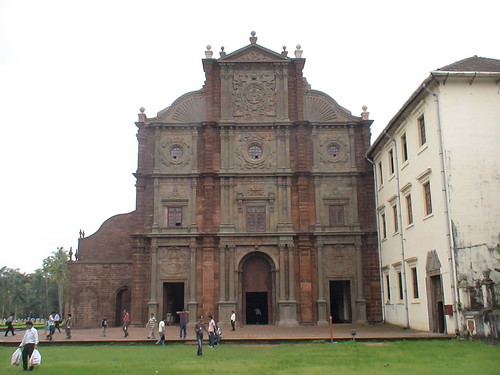
Basilica of Bom Jesus - Goa India


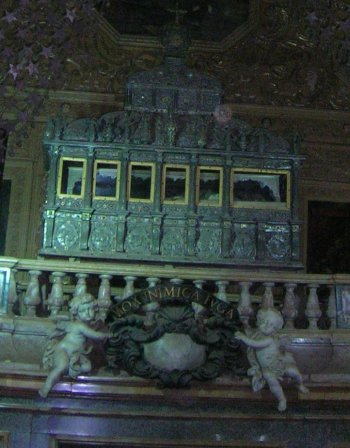
Old Goa, built in 1605, and now declared a World Heritage Monument. The church houses the sacred relics of St. Francis Xavier, patron saint of Goa, who died while on a sea voyage to China on December 2,1552. The following year, while transferring his remains to Goa, in accordance with his wishes, it was found that the saint's body was as fresh as the day it was buried. This miraculous phenomenon continues to attract the devout of all lands and an Exposition or public viewing of his body every ten years attracts lakhs of pilgrims. During the 450 years of Portuguese rule in Goa, St. Francis Xavier was believed to have afforded protection to the rulers who handed over their symbols of office to the saint during every changeover of the office of Governor General. The Saint had miraculous healing powers, which were experienced by the erstwhile Nizam of Hyderabad when he came for the Exposition of 1878.


St. Francis Xavier - 3rd December 2009


Not many of my readers know this but St. Francis Xavier is one of my favourite saints. He is buried in India in Goa which is where my ancestors come from. In addition to this, I did my university studies at St. Xavier's in Bombay which was run by the Jesuits. Thus I am very fond of St. Francis Xavier.


Francis Xavier, Apostle of India and Japan and perhaps the greatest missionary of the Church since Saint Paul, was born on April 7, 1506 near Sanguesa in Spain. After completing his preliminary studies in his own country, he went to Paris, France in 1525 and entered the College of Sainte-Barbe. In 1526, he met Pierre Favre and a warm friendship sprang between them. Ignatius Loyola, the founder of the Society of Jesus (Jesuits) resided at this same college. He won the confidence of the two young men and they were the first to join with him in the formation of the religious order. They made their vows on August 15, 1534, binding themselves to the service of God.
Francis Xavier went to Venice, Italy and there he was ordained to the priesthood on June 24, 1537. After ordination, he served for a brief period in Rome.
On April 7, 1541, Francis departed for India as the Jesuits’ first foreign missionary. He landed in Goa and immediately began to learn the language, preach, minister to the sick and compose a catechism. His success there was most notable. Multitudes flocked to hear him, and he won many converts to the faith. He also faced many hardships. He had less success with the Brahman sect and a years’ worth of work among them resulted in only one convert. Francis Xavier’s converts in India were persecuted mercilessly and were often abused by the Protégées officials and merchants.
On April 17, 1549, he set sail for Japan filled with great zeal at the prospect f introducing Christianity to this country. After an apostolate of two years and three months, the Christian community in that nation numbered some two thousand and continued to grow rapidly.
He then set his sights on China. He arranged passage there on a merchant ship in August of 1552. The ship reached the desolate island of Sancian (Shang-chwan) near the Chinese coast not far from Canton. While there, Francis was seized with a fever on November 21, 1552. He grew weaker and died on December 3, 1552. He was buried the following day. After more than two months, the grave and coffin were opened and his body found incorrupt. His body was taken back to Goa, India and is enshrined in the Church of the Good Jesus.
Francis Xavier was beatified in 1619 and canonized a saint of the Catholic Church in 1622. In 1748 he was named the Patron Saint of the Orient. In 1904 he was declared the patron saint for the Propagation of the Faith and in 1927 named the patron of missions. Francis Xavier is also the Patron Saint of all Navigators.

Wednesday, December 2, 2009

Blessed Rafal Chylinski - 2nd December 2009

Blessed Rafal Chylinski was pious youth, his family nicknamed him "the little monk." After graduating the Jesuit college in Poznan, Melchior joined the cavalry, and was made an officer within three years. In 1715, against the advice of his brothers in arms, Melchior joined the Conventual Franciscans in Kraków, took the name Rafal, and was ordained in 1717. He was known for simple and candid sermons, generosity, and as a great confessor. He was born in 1694 at Buk, Poznan, Poland as Melchior Chylinski, and died in 1741 at Lagiewniki, Poland; the Conventual church there became a place of pilgrimage.

The sermons preached by Rafal were powerfully reinforced by the living sermon of his life. The Sacrament of Reconciliation can help us bring our daily choices into harmony with our words about Jesus’ influence in our life

During the beatification homily, Pope John Paul II said, "May Blessed Rafal remind us that every one of us, even though we are sinners, has been called to love and to holiness" (L'Osservatore Romano, 1991, vol. 25, number 19).

Tuesday, December 1, 2009

Advent reflections for Week 1

The twofold coming of Christ by St. Cyril of Jerusalem

We do not preach only one coming of Christ, but a second as well, much more glorious than the first. The first coming was marked by patience; the second will bring the crown of a divine kingdom.
In general, whatever relates to our Lord Jesus Christ has two aspects. There is a birth from God before the ages, and a birth from a virgin at the fullness of time. There is a hidden coming, like that of rain on fleece, and a coming before all eyes, still in the future.
At the first coming he was wrapped in swaddling clothes in a manger. At his second coming he will be clothed in light as in a garment. In the first coming he endured the cross, despising the shame; in the second coming he will be in glory, escorted by an army of angels.
We look then beyond the first coming and await the second. At the first coming we said: Blessed is he who comes in the name of the Lord. At the second we shall say it again; we shall go out with the angels to meet the Lord and cry out in adoration: Blessed is he who comes in the name of the Lord.
The Saviour will not come to be judged again, but to judge those by whom he was judged. At his own judgement he was silent; then he will address those who committed the outrages against him when they crucified him and will remind them: You did these things, and I was silent.
His first coming was to fulfil his plan of love, to teach men by gentle persuasion. This time, whether men like it or not, they will be subjects of his kingdom by necessity.
The prophet Malachi speaks of the two comings. And the Lord whom you seek will come suddenly to his temple: that is one coming.
Again he says of another coming: Look, the Lord almighty will come, and who will endure the day of his entry, or who will stand in his sight? Because he comes like a refiner’s fire, a fuller’s herb, and he will sit refining and cleansing.
These two comings are also referred to by Paul in writing to Titus: The grace of God the Saviour has appeared to all men, instructing us to put aside impiety and worldly desires and live temperately, uprightly, and religiously in this present age, waiting for the joyful hope, the appearance of the glory of our great God and Saviour, Jesus Christ. Notice how he speaks of a first coming for which he gives thanks, and a second, the one we still await.
That is why the faith we profess has been handed on to you in these words: He ascended into heaven, and is seated at the right hand of the Father, and he will come again in glory to judge the living and the dead, and his kingdom will have no end.
Our Lord Jesus Christ will therefore come from heaven. He will come at the end of the world, in glory, at the last day. For there will be an end to this world, and the created world will be made new.

Prayer to the Holy Name of Jesus

Since, then, O my Jesus! Thou art the Saviour Who hast given Thy Blood and Thy life for me, I pray Thee to write Thine adorable name on my poor heart; so that having it always imprinted in my heart by love, I may also have it ever on my lips, by invoking it in all my necessities. If the devil tempts me, Thy name will give me strength to resist him; if I lose confidence, Thy name will animate me to hope; if I am in affliction, Thy name will comfort me, by reminding me of all Thou hast endured for me. If I find myself cold in Thy love, Thy name will inflame me by reminding me of the love Thou hast shown me. Hitherto I have fallen into so many sins, because I did not call on Thee; from henceforth Thy name shall be my defense, my refuge, my hope, my only consolation, my only love. Thus do I hope to live, and so do I hope to die, having Thy name always on my lips.
Most holy Virgin, obtain for me the grace of invoking the name of thy Son Jesus in all my necessities, together with thine own, my Mother Mary; but let me invoke them always with confidence and love, so that I may be able also to say to thee as did the devout Alphonsus Rodriguez: "Jesus and Mary, may I suffer for You; may I die for You; may I be wholly Yours, and in nothing my own!" O my beloved Jesus! O Mary, my beloved Lady! give me the grace to suffer and to die for Thy love, I will be no longer mine own, but altogether Thine; Thine in life, and Thine in death, when I hope by Thy help to expire saying, Jesus and Mary, help me!

Jesus and Mary, I recommend myself to Thee; Jesus and Mary, I love Thee, and I give and deliver up to Thee my whole soul.


St John Of Vercelli - 1st December 2009

John was born near Vercelli in northwest Italy in the early 13th century. Little is known of his early life. He entered the Dominican Order in the 1240s and served in various leadership capacities over the years. Elected sixth master general of the Dominicans in 1264, he served for almost two decades.
Known for his tireless energy and his commitment to simplicity, John made personal visits—typically on foot—to almost all the Dominican houses, urging his fellow friars to strictly observe the rules and constitutions of the Order.

He was tapped by two popes for special tasks. Pope Gregory X enlisted the help of John and his fellow Dominicans in helping to pacify the States of Italy that were quarreling with one another. John was also called upon to draw up a framework for the Second Council of Lyons in 1274. It was at that council that he met Jerome of Ascoli (the man who would later become Pope Nicholas IV), then serving as minister general of the Franciscans. Some time later the two men were sent by Rome to mediate a dispute involving King Philip III of France. Once again, John was able to draw on his negotiating and peacemaking skills.

Following the Second Council of Lyons, Pope Gregory selected John to spread devotion to the name of Jesus. John took the task to heart, requiring that every Dominican church contain an altar of the Holy Name; groups were also formed to combat blasphemy and profanity.

Toward the end of his life John was offered the role of patriarch of Jerusalem, but declined. He remained Dominican master general until his death.

Monday, November 30, 2009

St. John Damascene - 4th December 2009

Prayer to St. Andrew the Apostle

O glorious St. Andrew, you were the first to recognize and follow the Lamb of God. With your friend, St. John, you remained with Jesus for that first day, for your entire life, and now throughout eternity. As you led your brother, St. Peter, to Christ and many others after him, draw us also to Him. Teach us to lead others to Christ solely out of love for Him and dedication in His service. Help us to learn the lesson of the Cross and to carry our daily crosses without complaint so that they may carry us to Jesus. Amen.

Saturday, November 28, 2009

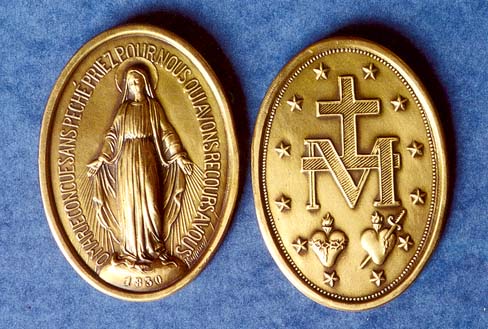
The Miraculous Medal

The Miraculous Medal was revealed to St. Catherine Laboure

The front side of the Medal: messages and symbolism

On the front side of the medal we see the Blessed Virgin Mary as the Victorious Woman of Genesis. God Himself put enmities between the Woman and the serpent, a battle to be carried on "in that ‘monumental struggle against the powers of darkness’ which continues throughout human history." (Mother of the Redeemer, #47, p.67; Pope John Paul II; March 25, 1987)

On the medal we see Mary Immaculate with her foot crushing the head of the serpent. "She who as the one ‘Full of Grace’ was brought into the Mystery of Christ in order to be His Mother and thus the Holy Mother of God . . . remains in that mystery as ‘the Woman’ spoken of by the Book of Genesis (3:15) at the beginning . . . " (Mother of the Redeemer, #24, p.23; Pope John Paul II; March 25, 1987). In many other official documents of the Church and writings of Saints we find Mary referred to as this Victorious Woman of Genesis destined to crush the proud head of the devil.

"The Bible is replete with the mystery of the Savior, and from Genesis to the Book of Revelation, also contains clear references to her who was the Mother and Associate of the Savior." (Marialis Cultus, #30, p.28; Pope Paul VI; Feb.2, 1974).

The year 1830 was shown inscribed on the globe at the base of the Medal, so it is clearly meant to convey some message. It can very well indicate the year which begins the final stages of the battle between the Woman and the serpent, between good and evil. It could be Heaven’s way of indicated the year opening the Marian Era.

Our Lady is standing on the globe of the world. Catherine could distinguish France in particular. In this we can see Mary both as the Victorious Woman and as the Queen of Heaven and Earth.

Mary’s hands are shown showering a cascade of brilliant rays on the world, as if she found them too heavy with graces and was eager to pour them on us. We can see her as our "Advocate, Auxiliatrix, Adjutrix and Mediatrix. Of this intercession of hers for the People of God with the Son, the Church has been persuaded ever since the first centuries . . . " (The Great Sign, Part I, p.4; Pope Paul VI; May 13, 1967).

Around the oval frame of the medal we read the words, "O Mary, conceived without sin, pray for us who have recourse to you." In this brief prayer we find the truth of (a) the Immaculate Conception of Mary, and (b) Mary’s intercessory power with God for us who ask for her aid.


The reverse side of the Medal

On the reverse side of the Medal we see a Cross, the symbol of Christ’s Redeeming Sacrifice on Mount Calvary for the salvation of the world.

At the base of the Cross is a bar, which symbolizes the foot of the Cross. Intertwined with the bar is the letter "M" symbolizing the Mary’s intimate involvement at the foot of the Cross with her Son’s Redemptive Sacrifice. We see the "M" is below the line or foot of the Cross, signifying Mary’s subordinate role to that of Jesus. "This union of the Mother and her Son in the work of Redemption (cf. Lumen Gentium, #57) reaches its climax on Calvary, where Christ ‘offered Himself as the perfect Sacrifice to God’ (Hebrew 9:14), and where Mary stood by the Cross (cf. John 19:25), ‘suffering grievously with her only-begotten Son. There she united herself with a maternal Heart to His Sacrifice, and lovingly consented to the immolation of this Victim which she herself had brought forth’ (II Vatican Council, Dogmatic Constitution on the Church Lumen Gentium, #58), and also was offering to the Eternal Father." (Marialis Cultus, #20, p.19, Pope Paul VI, Feb.2, 1974)

It was also at the foot of the Cross that Jesus gave us, in the person of the Beloved Disciple, His own Mother to be our Mother. "Woman, behold your son; son, behold your Mother" (John 19, 25-27). And the beloved disciple gives us an example to follow, so that we learn to take Mary into our homes, into our lives, into our hearts, as do loving children.

So the "M" stands not only for Mary, but also for Mother. "The new Motherhood of Mary, generated by faith, is the fruit of the ‘new’ love which came to definite maturity in her at the foot of the Cross, through her sharing in the Redemptive Love of her Son. Thus we find ourselves at the very center of the fulfilment of the promise contained in the Proto-gospel . . . (Gen. 3:15)" (Mother of the Redeemer, #23-24; p.33; Pope John Paul II; March 25, 1987). "Mary’s mediation is intimately linked with her Motherhood." (ib. #39; p.54)

Since the Cross is the symbol of Christ’s Redemptive Sacrifice, we can also see a Eucharistic symbolism on the Medal. "To perpetuate down the centuries the Sacrifice of the Cross, the Divine Savior instituted the Eucharistic Sacrifice [the Mass], the Memorial of His Death and Resurrection, and entrusted it to His Spouse the Church" (cf. II Vatican Council, Sacrosanctum Concilium, #47), which the Church continues to do "in union with the Saints in Heaven, and in particular with the Blessed Virgin." (Marialis Cultus, #20, p.19-20; Pope Paul VI; Feb. 2, 1974). In every Eucharistic Liturgy the Church involves the Blessed Virgin Mary, so befitting to her who stood heroically at the foot of the Cross uniting her sufferings to the Sacrifice of her Son, filling up in her body those things that are wanting to the sufferings of Christ, for the sake of His Mystical Body, the Church. (cf. Col. 1:24). In all of the approved apparitions of Our Lady there is a Eucharistic thrust. She usually asked for a church to be built, in which the Eucharistic Sacrifice and the Blessed Sacrament always have prime place. Mary always leads us to Jesus, and Jesus is especially present in the Eucharist.

On the Medal beneath the Cross and the "M" we see the two Hearts, the Sacred Heart of Jesus encircled with a crown of thorns, and the Immaculate Heart of Mary pierced with a sword. We see the prophesy of Holy Simeon fulfilled: the Son who was destined for the sign of contradiction, dying on the Cross, and the Mother pierced with a sword of sorrow beneath the Cross "so that the thoughts of many hearts may be revealed" (Luke 2, 34-35). The union of the two Hearts foreshadows the message of Fatima: "The Sacred Heart of Jesus wants the Immaculate Heart of Mary to be venerated at His side." (Lucia Speaks, III Memoir, World Apostolate of Fatima, Washington, NJ: 1976; p.137). "God wishes to establish in the world devotion to my Immaculate Heart." (ib. p.126)

The two Hearts are surmounted by flames, symbolizing the burning love with which Jesus and Mary accomplished the work of Redemption, each in their proper way. No greater love does one have than to lay down one’s life. (cf. John 15:13). "Christ loved the Church and gave Himself up for her . . . " (Ephesus 5:25-27)

Around the oval frame of the Medal, encircling the Cross, the "M," and the two Hearts, we see a crown of twelve stars. This can be seen as a reference to the "the Great Sign" in the Book of Revelation/Apocalypse; the "Woman clothed with the sun, with the moon beneath her feet, and on her head a crown of twelve stars." The Woman engaged in battle with the "huge red Dragon . . . the ancient serpent, who is called the devil, or Satan" (Rev./Apoc. 12:3 & 9) is the Queen of the Apostles, the Mother of the Church. "The enmity, foretold at the beginning, is confirmed in the Apocalypse (the book of the final events of the Church and the world), in which there recurs the sign of the ‘Woman,’ this time ‘clothed with the sun’ (Rev. 12:1). Mary, Mother of the Incarnate Word, is placed at the very center of that enmity, that struggle which accompanies the history of humanity on earth and the history of Salvation itself." (Mother of the Redeemer, #11; p.16; Pope Johne Paul II, March 25, 1987)

We can see then in the Miraculous Medal a symbol of the whole history of salvation from Genesis to Apocalypse, and we can see the vital role that the Victorious Woman is destined in the final defeat of the devil. It is amazing how in such a small medal God can give us so many profound lessons. As is the case with all of God’s graces, it is up to us to humbly accept what He offers, as Mary did (cf. Luke 1:38), and to cherish and ponder it in our hearts, as Mary did. (cf. Luke 2:19 & 51)

(Courtesy Here)

St. Catherine Labouré - 28th November 2009

The following is a commentary by Dr. Pilnio about St. Catherine Laboure

Biographical selection:

Zoé Labouré, the future Catherine, was born on May 2, 1806 , the ninth of eleven children born to a farm family in Fain-les-Moutiers, Côte d’Or, France. She never learned to read or write. At age 8, her mother died and she was put in charge of running the house and helping her father. Her father allowed her at age 22 to enter the convent of the Daughters of Charity of St. Vincent of Paul.

In religion she took the name of Catherine and was sent to the convent at Rue du Bac, Paris. At half past 11 o’clock on the night of July 18, 1830, she was awakened by the vision of a child who led her to the chapel where Our Lady spoke to her for more than two hours. She told Catherine that God wished to charge her with a mission.

On November 27 of that same year, Our Lady appeared to her a second time in the chapel. She held a globe in her hands upon which the word France was written. Our Lady told St. Catherine that it represented the entire world, but that she wanted to help France in particular.

Then, the vision changed and she saw Our Lady standing on a globe crushing the serpent under her feet, with rays of light streaming from her hands. These words in French surrounded the vision: “O Mary conceived without sin, Pray for us who have recourse to thee.” Then Catherine saw another picture with a capital M with a cross above it, and below it, two hearts, one thorn-crowned and the other pierced with a sword. The Virgin spoke, this time giving a direct order: "Have a medal struck as I have shown you. All who wear it will receive great graces."

She told only her confessor Fr. Father Jean Marie Aladel about these visions, and at first he did not believe her. No one but he and the Archbishop of Paris knew that it was she who received the revelations. In 1832 the first medals were issued and many miracles were worked because of them. In a few years the fame of the Miraculous Medal of Our Lady spread all over France and Europe.

In 1842 the Jew Alphonse Ratisbonne was visiting Rome. He was wearing the medal when he received a vision of Our Lady in the Church of St. Andrea delle Frate in Rome. This was the cause of his conversion, and later he founded the Congregation of the Sisters of Sion for the conversion of the Jews. This incident contributed significantly to the dissemination of the Miraculous Medal.

In the convent where St. Catherine lived, not even the Superior Mother knew who had received the revelations. St. Catherine was transferred to the convent of Enghien-Reuilly and lived there for over 40 years unknown, carrying out the humble functions as gate-keeper, head of the poultry yard, and caring for the aged in the convent’s hospice. Only eight months before her death did she receive permission from her confessor to reveal to her Superior, Mother Dufès, that she was the one who had received the apparitions of Our Lady. She died on December 31, 1876. Soon after her funeral miracles were worked through her intercession.

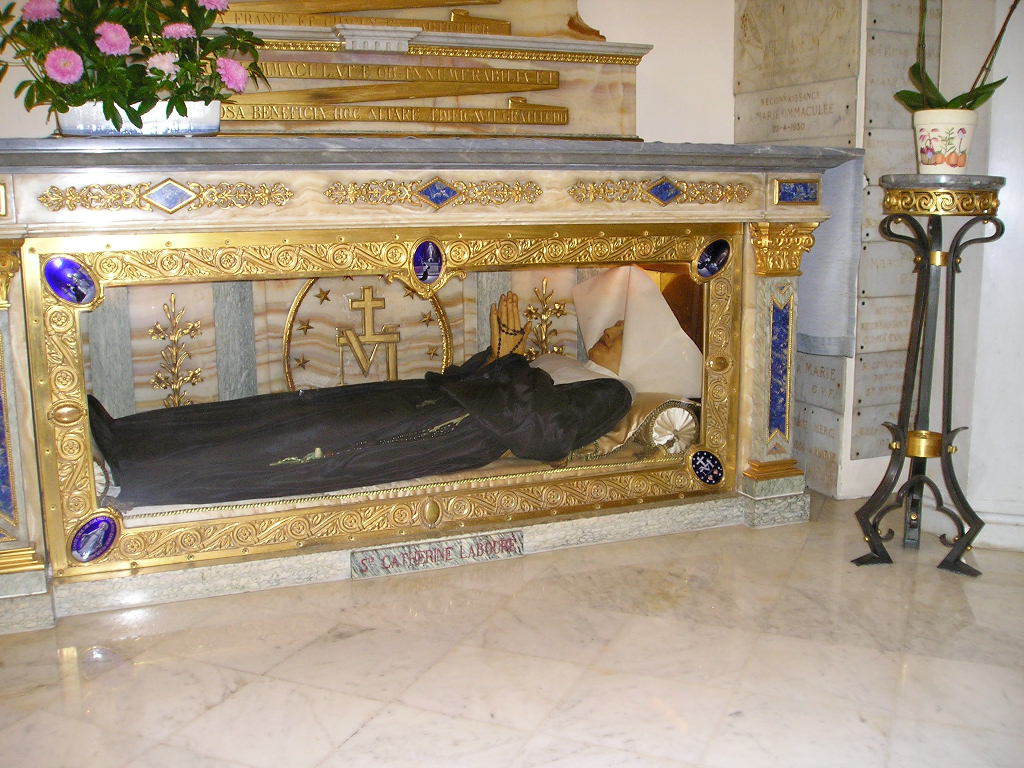
When her body was exhumed in 1933 it was found completely fresh and supple. Her incorrupt body is encased in glass beneath the side altar at 140 Rue du Bac, Paris, beneath one of the spots where our Lady appeared to her.


Comments of Prof. Plinio:

Given the extraordinary diffusion of the Miraculous Medal, I think we can say that St. Catherine Labouré was the woman who played the greatest role in History in spreading devotion to Our Lady. The greatest man was St. Louis Grignion de Monfort. However, their lives and how they spread Marian devotion were profoundly different.

St. Louis de Montfort
was a founder of two religious Congregations, a missionary, a pilgrim walking from one place to another, fighting, preaching, writing books, being attacked and counter-attacking in his turn. Therefore, he was constantly appearing in public in those few French provinces where he was allowed to preach by the Jansenist Bishops who had infiltrated the Catholic Church in France at that time. In those places his public example of virtue and continuous preaching about Our Lady caused his life and devotion to make a mark on History. His name appears wherever one speaks of true devotion to Our Lady.

The life of St. Catherine Labouré was the exact opposite. She was so unknown, so humble, so useless that the very sisters of her order did not know it was she who had received those revelations. Even her religious Superiors were unaware of this. They knew that some sister of their order had received revelations from Our Lady, but they did not know which one it was. Notwithstanding, she was the cause of an enormous diffusion of devotion to Our Lady. Our Lady wanted this devotion of the Miraculous Medal to be spread through St. Catherine, but in opposition to the life of St. Louis de Montfort, St. Catherine remained completely unknown.

She was also different from St. Bernadette Soubirous since everyone knew that St. Bernadette was the one who had seen Our Lady. St. Catherine’s vocation was only to report the revelations and the order for the medal to be struck. The miracles that immediately began to take place did all the rest.

There are many other comments that could be made about the different ways God acts in accordance with the various psychologies of His saints. But here I want to highlight only one general facet of the life of St. Catherine.

Let me point out that it is appropriate for a woman to live in obscurity when she enters a religious order. When she lives in the world, it is appropriate for her to remain within the limits of the family. Normally women do not have a public mission to fulfill. It is an exception to the rule when women are known in the Church for the public missions they exercised during their lives. Even when Divine Providence wants to use them for a mission of great relevance, they generally continue to live in the seclusion of their convents, away from the eyes of the public.

This is in accordance with the moral characteristics of a woman, with her role in the general plan of creation. In the life of St. Catherine Labouré, which is permeated with the supernatural in the accomplishment of a sublime mission, God was faithful to the general rule He established. He kept her in obscurity.

This leads us to see how mistaken modern civilization is in pushing women to have a public life either in the civil or religious sphere, entrusting them with tasks that normally should be given to men. What the Revolution presents as the emancipation of women is actually to enslave them to many kinds of work that are not according to their nature.

St. Catherine Labouré shows us the healthy characteristics of a woman. Being reserved and living in the obscurity of her religious order, she accomplished a work incomparably superior to that of I don’t know how many social leaders, business women and public representatives in Congress. God wanted her to remain entirely feminine, because to each sex God has a plan proper to its nature.

As counter-revolutionaries, we must highlight such aspects in the lives of the saints. Otherwise, we remain in the realm of common pious and respectable comments that do not prevent the Revolution from going forward. We must show the counter-revolutionary aspects of the Saints; otherwise we do not accomplish the mission Divine Providence gave us.

Friday, November 27, 2009

Having Faith when some one is sick


For me one of the toughest times to have faith that God is in charge is when some one I care for is sick. I think this goes back to when I was a kid and my grandma was in hospital in intensive care. It was my birthday and I went to see her. I don't remember what birthday it was, what I do remember is a my nana lying on this bed connected to all sorts of machines one of them was a kind of a canister with water in it and a solitary bubble in it (some of my nurse friends care to explain to me what this was.) and the bracelet my mum made me wear that day. Soon after nana passed away. Since then I cannot bear hospitals. They smell anitiseptic and in my mind people who go there die. I rarely go to hospitals or doctors when anyone is sick and least of all when I am ill.
I cannot bear to see people who I love for sick, this is becasue there is nothing I can do for them, I am not in control of the situation. It is difficult for me to see the hand of God in such situations becasue my faith is obviusly not at that level. It is hard to watch a person struggle with a debilitating disease knowing that they may well not make it. I guess for me the lesson is to learn to see God's hand in such situations.

Thursday, November 26, 2009

The Little Number of Those Who Are Saved - Sermon by St Leonard of Port Maurice

(Domenico di Michelino paints Dante's Inferno)


The Little Number of Those Who Are Saved by St. Leonard of Port Maurice

The Teaching of the Fathers of the Church

It is not vain curiosity but salutary precaution to proclaim from the height of the pulpit certain truths which serve wonderfully to contain the indolence of libertines, who are always talking about the mercy of God and about how easy it is to convert, who live plunged in all sorts of sins and are soundly sleeping on the road to hell. To disillusion them and waken them from their torpor, today let us examine this great question: Is the number of Christians who are saved greater than the number of Christians who are damned?

Pious souls, you may leave; this sermon is not for you. Its sole purpose is to contain the pride of libertines who cast the holy fear of God out of their heart and join forces with the devil who, according to the sentiment of Eusebius, damns souls by reassuring them. To resolve this doubt, let us put the Fathers of the Church, both Greek and Latin, on one side; on the other, the most learned theologians and erudite historians; and let us put the Bible in the middle for all to see. Now listen not to what I will say to you – for I have already told you that I do not want to speak for myself or decide on the matter – but listen to what these great minds have to tell you, they who are beacons in the Church of God to give light to others so that they will not miss the road to heaven. In this manner, guided by the triple light of faith, authority and reason, we will be able to resolve this grave matter with certainty.

Note well that there is no question here of the human race taken as a whole, nor of all Catholics taken without distinction, but only of Catholic adults, who have free choice and are thus capable of cooperating in the great matter of their salvation. First let us consult the theologians recognized as examining things most carefully and as not exaggerating in their teaching: let us listen to two learned cardinals, Cajetan and Bellarmine. They teach that the greater number of Christian adults are damned, and if I had the time to point out the reasons upon which they base themselves, you would be convinced of it yourselves. But I will limit myself here to quoting Suarez. After consulting all the theologians and making a diligent study of the matter, he wrote, "The most common sentiment which is held is that, among Christians, there are more damned souls than predestined souls."

Add the authority of the Greek and Latin Fathers to that of the theologians, and you will find that almost all of them say the same thing. This is the sentiment of Saint Theodore, Saint Basil, Saint Ephrem, and Saint John Chrysostom. What is more, according to Baronius it was a common opinion among the Greek Fathers that this truth was expressly revealed to Saint Simeon Stylites and that after this revelation, it was to secure his salvation that he decided to live standing on top of a pillar for forty years, exposed to the weather, a model of penance and holiness for everyone. Now let us consult the Latin Fathers. You will hear Saint Gregory saying clearly, "Many attain to faith, but few to the heavenly kingdom." Saint Anselm declares, "There are few who are saved." Saint Augustine states even more clearly, "Therefore, few are saved in comparison to those who are damned." The most terrifying, however, is Saint Jerome. At the end of his life, in the presence of his disciples, he spoke these dreadful words: "Out of one hundred thousand people whose lives have always been bad, you will find barely one who is worthy of indulgence."

The Words of Holy Scripture

But why seek out the opinions of the Fathers and theologians, when Holy Scripture settles the question so clearly? Look in to the Old and New Testaments, and you will find a multitude of figures, symbols and words that clearly point out this truth: very few are saved. In the time of Noah, the entire human race was submerged by the Deluge, and only eight people were saved in the Ark. Saint Peter says, "This ark was the figure of the Church," while Saint Augustine adds, "And these eight people who were saved signify that very few Christians are saved, because there are very few who sincerely renounce the world, and those who renounce it only in words do not belong to the mystery represented by that ark." The Bible also tells us that only two Hebrews out of two million entered the Promised Land after going out of Egypt, and that only four escaped the fire of Sodom and the other burning cities that perished with it. All of this means that the number of the damned who will be cast into fire like straw is far greater than that of the saved, whom the heavenly Father will one day gather into His barns like precious wheat.

I would not finish if I had to point out all the figures by which Holy Scripture confirms this truth; let us content ourselves with listening to the living oracle of Incarnate Wisdom. What did Our Lord answer the curious man in the Gospel who asked Him, "Lord, is it only a few to be saved?" Did He keep silence? Did He answer haltingly? Did He conceal His thought for fear of frightening the crowd? No. Questioned by only one, He addresses all of those present. He says to them: "You ask Me if there are only few who are saved?" Here is My answer: "Strive to enter by the narrow gate; for many, I tell you, will seek to enter and will not be able." Who is speaking here? It is the Son of God, Eternal Truth, who on another occasion says even more clearly, "Many are called, but few are chosen." He does not say that all are called and that out of all men, few are chosen, but that many are called; which means, as Saint Gregory explains, that out of all men, many are called to the True Faith, but out of them few are saved. Brothers, these are the words of Our Lord Jesus Christ. Are they clear? They are true. Tell me now if it is possible for you to have faith in your heart and not tremble.

For the rest of the sermon click here


St. Leonard Of Port Maurice - 26th Novemer 2009

St. Leonard was born in 1676 at Port Maurice, a seaport near Genoa, the son of Dominic Casanova, a ship captain. Two brothers and a sister, besides himself, entered the Franciscan Order.

When thirteen years old, he went to the renowned Roman college where St. Aloysius once pursued his studies. There he so distinguished himself with piety, diligence, and good works that he was called another Aloysius. On completing his studies, he contemplated entering the medical profession, but during a visit to the Franciscan convent of St. Bonaventure in Rome, he received his call to the priesthood. He entered the Order on October 2, 1697 and soon became the glory of his convent. His exact observance of the rule was admirable; likewise were his fervor at prayer, his burning love of Jesus and Mary, his rigorous penance, his humility, and his tireless charity toward his neighbor.

Ardently he desired to preach the Gospel in China, but his delicate constitution for a while prevented even his preaching at home. Consumption seemed to have claimed him, but at the intercession of the Blessed Virgin, he was miraculously restored to health. He then devoted himself with renewed zeal to parish missions, and during twenty-four years he covered every section of Italy and the island of Corsica, which latter was notorious for lawless inhabitants. He scourged himself without compassion to obtain mercy for his sins and those of others, and the power of his words made a deep impression because of the austerity of his life. Thus he was able to convert innumerable sinners.

He caused to be built a retreat house for missionaries at Incontro near Florence, where preachers could withdraw a time in order to prepare themselves through a life of seclusion and penance for future activities. In Rome he founded several pious confraternities, most notably that of the Sacred Heart, whose compassion he taught the people to request with the little ejaculation: "My Jesus, mercy!" Wherever he went, he spread devotion to the Way of the Cross and perpetual adoration of the Blessed Sacrament. He fostered also devotion to the Immaculate Conception of the Blessed Virgin by way of a pious obligation of gratitude, since he attributed to her mediation all the good he had ever received or done in his life.

Returning to Rome from a mission in Bologna, St. Leonard died in the convent of St. Bonaventure on November 26, 1751. God glorified him with miracles in his life, but more so after his death. Pope Pius VI, who had known him personally, beatified him in 1796; Pope Pius IX canonized him June 29, 1867. Pope Pius XI appointed him Patron of all missionaries. His Feast is celebrated in the Church calendar on November 26.

Wednesday, November 25, 2009

St. Catherine of Alexandria - 25th November 2009

From the tenth century onwards veneration for St. Catherine of Alexandria has been widespread in the Church of the East, and from the time of the Crusades this saint has been popular in the West, where many churches have been dedicated to her and her feast day kept with great solemnity, sometimes as a holy-day of obligation. She is listed as one of the Fourteen Holy Helpers of mankind among the saints in Heaven; she is the patroness of young women, philosophers, preachers, theologians, wheelwrights, millers, and other workingmen. She was said to have appeared with Our Lady to St. Dominic and to Blessed Reginald of Orleans; the Dominicans adopted her as their special protectress. Hers was one of the heavenly voices heard by St. Joan of Arc.

(Michelangelo Merisi da Caravaggio - St Catherine of Alexandria)

Artists have painted her with her chief emblem, the wheel, on which by tradition she was tortured; other emblems are a lamb and a sword. Her name continues to be cherished today by the young unmarried women of Paris.

Yet in spite of this veneration, we have few facts that can be relied on concerning Catherine's life. Eusebius, "father of Church history," writing around the year 320, had heard of a noble young Christian woman of Alexandria whom the Emperor ordered to come to his palace, presumably to become his mistress, and who, on refusing, was punished by banishment and the confiscation of her estates. The story of St. Catherine may have sprung from some brief record such as this, which Christians writing at a later date expanded. The last persecutions of Christians, though short, were severe, and those living in the peace which followed seem to have had a tendency to embellish the traditions of their martyrs that they might not be forgotten.

According to the popular tradition, Catherine was born of a patrician family of Alexandria and from childhood had devoted herself to study. Through her reading she had learned much of Christianity and had been converted by a vision of Our Lady and the Holy Child. When Maxentius began his persecution, Catherine, then a beautiful young girl, went to him and rebuked him boldly for his cruelty. He could not answer her arguments against his pagan gods, and summoned fifty philosophers to confute her. They all confessed themselves won over by her reasoning, and were thereupon burned to death by the enraged Emperor. He then tried to seduce Catherine with an offer of a consort's crown, and when she indignantly refused him, he had her beaten and imprisoned. The Emperor went off to inspect his military forces, and when he got back he discovered that his wife Faustina and a high official, one Porphyrius, had been visiting Catherine and had been converted, along with the soldiers of the guard. They too were put to death, and Catherine was sentenced to be killed on a spiked wheel.

When she was fastened to the wheel, her bonds were miraculously loosed and the wheel itself broke, its spikes flying off and killing some of the onlookers. She was then beheaded. The modern Catherine-wheel, from which sparks fly off in all directions, took its name from the saint's wheel of martyrdom. The text of the of this illustrious saint states that her body was carried by angels to Mount Sinai, where a church and monastery were afterwards built in her honor. This legend was, however, unknown to the earliest pilgrims to the mountain. In 527 the Emperor Justinian built a fortified monastery for hermits in that region, and two or three centuries later the story of St. Catherine and the angels began to be circulated.


Tuesday, November 24, 2009

Church Forced Open, Desecrated; Cash, Valuables Missing in India

It seems that persecution of the Catholic church continues in India and is still under reported.

This is from the Catholic Bishops Conference of India Web site

St. Anthony’s Church at Kavalbyrasandra was found forced open early November 9 morning, and cash and valuables missing.

The tabernacle had been desecrated and a cupboard ransacked.

The incident triggered a massive protest by the local Christians who feared another attack on a church in the state. Last month, vandals had uprooted statues of Jesus and Mary at a church at Hebbagodi on the outskirts of Bangalore.

Parish priest Father Arokiadas had closed the church Saturday, November 7, and retired to his first-floor room on the church premises.

Before Sunday Mass, Devadas, the sacristan, who assists in the preparation for Mass, came to the church around 5 a.m. to clean up the place and found the main door forcibly opened.

He immediately informed the priest about the incident.

The Holy Communion was removed from the tabernacle and spilled all over the floor.

Three dumb boxes containing cash offerings were found damaged and sacred vessels missing.

Devadas said: “I was shocked to see the front door of the church open. Somebody had forced the door and entered the church.”

Father Das told newspersons: “This is a deliberate act done to hurt our religious sentiments. What has hurt us deeply is the desecration of the Holy Communion.

“We renovated the church recently but we have never had any problem with the people of the area,” he added.

When the news of the attack spread, over 1,000 people gathered at the church in the morning.

Archbishop Bernard Moras of Bangalore and senior police officials, including the additional commissioner of police, M.R. Pujar, and joint commissioner, Alok Kumar, rushed to the spot at 6.30 a.m.

The archbishop later told the media that he had spoken to Karnataka Home Minister V.S. Acharya over the phone and expressed his deep anxiety over another attack on a church in the city. He said the home minister, who was in New Delhi, had assured him that he would ask the police to act immediately.

The archbishop also spoke to police commissioner Shankar Bidari seeking his immediate intervention.

A dog squad, finger-print experts and several police officers were deployed at the church.

In a complaint to the police, the church authorities have stated that they suspected three men who were roaming about the area November 7 night.

Meanwhile, the police ruled out vandalism. “It must have been a thief who tried to rob cash and valuables and failed, as the church staff had already deposited the offering money in the bank.

Preliminary investigation indicates that it is a case of theft and not of vandalism,” said a police official said. Further investigation is on.

What is the mass and consequently what is not the mass.

The other day after the mass, someone very dear to me called the mass a communal celebration.

This whole post is to specify what the mass is becasue since Vatican II there has been an infiltration of protestant ideology about how and what the mass should be.

The Council of Trent taught that the Mass is the same as Calvary, "only the manner of offering being changed" from bloody to unbloody. Similarly Vatican II (On the Liturgy #10) said that the Mass is the renewal of the new covenant. Thus the mass is first and foremost a Sacrifice.

A sacrifice as Catholics understand it (in contrast to some pagan concepts) has two elements: the outward sign and the interior dispositions.

At the Last Supper, the outward sign was the seeming separation of body and blood, with the two species. This was a dramatized way of saying to the Father: "I know the command you have given me, I am to die tomorrow. Very good, I turn myself over to death - expressed by the seeming separation - I accept, I obey." On the next day He did as He pledged, but then the outward sign was the physical separation of body and blood, while the interior remained the same. In the Mass, by the agency of a human priest who acts "in the person of Christ" (Vatican II, Lumen Gentium # 10) Christ continues and repeats His offering. The external sign is multiplied as many times as there are Masses. But the interior disposition of Christ is not multiplied, it is continued from that with which He died. For death makes permanent the attitude of will with which one leaves this world.


At the Last Supper Christ ordered, "Do this in memory of me". Since we were not there, Christ wants us to join our dispositions to His. The great Liturgy Encyclical of Pius XII, Mediator Dei, explains well that the people can be said to exercise their royal priesthood, to offer the Mass with the priest: first, "from the fact that the priest at the altar in offering a sacrifice in the name of all His members, does so in the person of Christ," whose members they are.

Secondly the people can be said to offer sacrifice since: "The people join their hearts in praise, petition, expiation and thanksgiving with the prayers or intention of the priest, in fact, of the High Priest Himself, so that in the one and same of offering of the Victim... they may be presented to God the Father "(Acta Apostolicae Sedis, 39:556). Vatican II explains (LG # 10) that this is what it means for them to "offer spiritual sacrifices".

These spiritual sacrifices consist of their obedience to the will of the Father, already carried out, and planned for the future (Cf. LG #34). This includes their works, their bearing the troubles of life, their prayers, their apostolic efforts, their living out the duties of their state in life, even their relaxation of body and mind if all these things are done as part of the Father's plan, to enable them to serve Him better. Jesus Himself spent about 30 out of 33 years in family life, to show how greatly the Father values this if done precisely because it part of His plan.

It would be good to take a moment before each Mass to see what one has to join with the obedience of Christ, soon to be offered on the altar.It is good to recall too that His Mother Mary shared in this sacrifice by her obedience (cf. our comments on the Third Article of the Creed) on Calvary, and now, as John Paul II taught (Angelus Homily of Feb. 12, 1984) she "is at every altar" because "she was present at the original sacrifice", sharing in it, and now from heaven, she still joins her will to His, as He offers the flesh and blood He received from her.

The principal priest in every Mass is Jesus Christ, who offers to His heavenly Father, through the ministry of His ordained priest, His body and blood which were sacrificed on the cross. The Mass is the same sacrifice as the sacrifice of the cross. It is now in the New Law, the sacrifice that is acceptable to God.

As we can clearly see from this the Mass is not a communal celebration it is a one to one sacrifice involving Christ who is the Priest and sacrifice, the preist who acts in the person of Christ (In persona Christi) and if present the people who also offer spiritual sacrifices.

A mass can be offered alone by the priest without any people present at all.

The priest is not the chief performer as the mass is not a performance. And the people are definitely not the most important factor for a mass to take place.


For more about what the mass is please click here

National day of remembrance for the modern Indian martyrs of

The Church in India is proposing to institute a national day of remembrance for the modern martyrs of the nation, scheduling it for the last Sunday in August, in memory of the 2008 violence in the state of Orissa.

That conflict erupted after a Hindu leader was killed and fanatics blamed his death on Christians. At least 80 people died in the violence and dozens of Church properties were destroyed. Thousands fled the area.

The Indian episcopal conference's Commission for Ecumenism is proposing a remembrance day in honor of the priests, religious and laypeople who "sacrificed their lives because of their faith in Christ," the Fides news agency reported.

They are the "modern martyrs" of today's India, the commission stated.

The proposal has the agreement of all Christian confessions in India. If the proposal is approved, it will be celebrated as an ecumenical event, drawing in all Christian faithful.

Bishop Anil Couto of Jullundur, president of the Commission for Ecumenism, emphasized that martyrdom is the highest form of love.

He said that it is important to remember "all those who died in the name of the Lord Jesus."

"It is a memory we wish to confirm and continue for the benefit of the new generations," the bishop said. And he added that celebrating the martyrs in an ecumenical event reinforces Christian unity in India.

Meanwhile, delegates from an Indian Catholic youth movement are making an appeal for an end to the violence.

More than 500 young people of the group took part in a demonstration for peace, which was held in Mangalore.

The Christian community has criticized the delay of justice: Only a small percentage of those arrested for the Orissa violence have been sentenced. And those who have been released are considered a new threat to eye-witnesses of the violence.

Saints Andrew Dung-Lac and his Companions - 24th November 2009

The evangelization of Vietnam began in the 16th century and was formally established with the setting up of two Vicariates Apostolic in 1659. There are now about 6 million Catholics in Vietnam, some 10% of the population.

This growth comes partly from the fact that since the earliest times the seed of the Faith has been watered by the blood of the martyrs of Vietnam – the missionary clergy, the local clergy and the ordinary Christian people. They have all shared the labour of apostolic work and have together faced death to bear witness to the truth of the Gospel. In the course of the 17th, 18th and 19th centuries no less than 53 decrees, signed by the lords and emperors of the country from 1625 to 1886, launched one persecution of Christians after another, each one more savage than the last. Over the whole territory of Vietnam about 130,000 Christians were killed in these persecutions. Over the centuries the names of most of them have been lost, but their memory is still alive in the Catholic community.

Since the beginning of the 20th century 117 of these heroes (those whose sufferings were cruellest and best documented) were beatified, in four groups. They were all canonized together by Pope John Paul II on 19 June 1988.

Each one of them was a soul individually created and loved by God, with a life and gifts uniquely his or her own; but with such a huge crowd one can only classify. By nationality, there were 96 Vietnamese, 11 Spanish and 10 French. By status, there were 8 bishops, 50 priests, and 59 laymen and women. By mode of death, 75 were beheaded, 22 strangled, 6 burned alive, 5 torn to pieces while still alive, and 9 died of torture in prison.

For the life of Saint Andrew Dung-Lac click over his name for last years post.

For a history of the church of Vietnam click here

Monday, November 23, 2009

A Call to Repentance

The following is the test from the Letter of Pope St. Clement to the Church of Corinth.


These things, beloved, we write unto you, not merely to admonish you of your duty, but also to remind ourselves. For we are struggling on the same arena, and the same conflict is assigned to both of us. Wherefore let us give up vain and fruitless cares, and approach to the glorious and venerable rule of our holy calling. Let us attend to what is good, pleasing, and acceptable in the sight of Him who formed us. Let us look steadfastly to the blood of Christ, and see how precious that blood is to God which, having been shed for our salvation, has set the grace of repentance before the whole world. Let us turn to every age that has passed, and learn that, from generation to generation, the Lord has granted a place of repentance to all such as would be converted unto Him. Noah preached repentance, and as many as listened to him were saved. Jonah proclaimed destruction to the Ninevites; Jonah iii but they, repenting of their sins, propitiated God by prayer, and obtained salvation, although they were aliens [to the covenant] of God.

The ministers of the grace of God have, by the Holy Spirit, spoken of repentance; and the Lord of all things has himself declared with an oath regarding it, "As I live, says the Lord, I desire not the death of the sinner, but rather his repentance;" Ezekiel 33:11 adding, moreover, this gracious declaration, "Repent, O house of Israel, of your iniquity." Ezekiel 18:30 Say to the children of my people, Though your sins reach from earth to heaven, and though they be redder Isaiah 1:18 than scarlet, and blacker than sack-cloth, yet if you turn to me with your whole heart, and say, Father! I will listen to you, as to a holy people. And in another place He speaks thus: "Wash you and become clean; put away the wickedness of your souls from before my eyes; cease from your evil ways, and learn to do well; seek out judgment, deliver the oppressed, judge the fatherless, and see that justice is done to the widow; and come, and let us reason together. He declares, Though your sins be like crimson, I will make them white as snow; though they be like scarlet, I will whiten them like wool. And if you be willing and obey me, you shall eat the good of the land; but if you refuse, and will not hearken unto me, the sword shall devour you, for the mouth of the Lord has spoken these things." Isaiah 1:16-20 Desiring, therefore, that all His beloved should be partakers of repentance, He has, by His almighty will, established [these declarations].

(From New Advent)

Pope St. Clement I - 23rd November 2009

St Clement, the son of Faustinus, a Roman by birth, was of Jewish extraction; for he tells us himself that he was of the race of Jacob. He was converted to the faith by St. Peter or St. Paul, and was so constant in his attendance on these apostles, and so active in assisting them in their ministry, that St. Jerome and other fathers call him an apostolic man; St. Clement of Alexandria styles him an apostle; and Rufinus, almost an apostle. Some authors attribute his conversion to St. Peter, whom he met at Cesarea with St. Barnabas; but he attended St. Paul at Philippi in 62, and shared in his sufferings there. We are assured by St. Chrysostom that he was a companion of the latter, with SS. Luke and Timothy, in many of his apostolic journeys, labours, and dangers. St. Paul (Phil. iv, 3) calls him his fellow-labourer, and ranks him among those whose names are written in the book of life; a privilege and matter of joy far beyond the power of commanding devils. (Luke x. 17) St. Clement followed St. Paul to Rome, where he also heard St. Peter preach, and was instructed in his school, as St. Irenaeus and Pope Zosimus testify. Tertullian tells us that St. Peter ordained him bishop, by which some understand that he made him a bishop of nations, to preach the gospel in many countries; others, with Epiphanius, that he made him his vicar at Rome, with an episcopal character to govern that church during his absence in his frequent missions. Others suppose he might at first be made bishop of the Jewish church in that city. After the martyrdom of SS. Peter and Paul, St. Linus was appointed Bishop of Rome, and after eleven years, succeeded by St. Cletus. Upon his demise in 89, or rather in 91, St. Clement was placed in the apostolic chair. According to the Liberian Calendar he sat nine years, eleven months, and twenty days.

At Corinth, an impious and detestable division, as our saint called it, happened amongst the faithful, like that which St. Paul had appeased in the same church; and a party rebelled against holy and irreproachable priests and presumed to depose them. It seems to have been soon after the death of Domitian in 96, that St. Clement, in the name of the church of Rome, wrote to them his excellent epistle, a piece highly extolled and esteemed in the primitive church as an admirable work, as Eusebius calls it. It was placed in rank next to the canonical books of the holy scriptures, and with them read in the churches. Whence it was found in the very ancient Alexandrian manuscript copy of the Bible, which Cyril Lucaris sent to our King James I, from which Patrick Young, the learned keeper of that king's library, published it at Oxford in 1633. St. Clement begins his letter by conciliating the benevolence of those who were at variance, tenderly putting them in mind how edifying their behaviour was when they were all humble-minded, not boasting of anything, desiring rather to be subject than to govern, to give than to receive, content with the portion God had dispensed to them, listening diligently to his word, having an insatiable desire of doing good, and a plentiful effusion of the Holy Ghost upon all of them. At that time they were sincere, without offence, not mindful of injuries, and all sedition and schism was an abomination to them. The saint laments that they had then forsaken the fear of the Lord, and were fallen into pride, envy, strife, and sedition; and pathetically exhorts them to lay aside all pride and anger, for Christ is theirs who are humble and not theirs who exalt themselves. The sceptre of the majesty of God, our Lord Jesus Christ, came not in the show of pride, though he could have done so; but with humility. He bids them look up to the Creator of the world, and think how gentle and patient he is towards his whole creation; also with what peace it all obeys his will, and the heavens, earth, impassable ocean, and worlds beyond it, are governed by the commends of this great master. Considering how near God is to us, and that none of our thoughts are hid from him, how ought we never to do anything contrary to his will, and honour them who are set over us! showing with a sincere affection of meekness, and manifesting the government of our tongues by a love of silence. "Let your children," says the saint, "be bred up in the instruction of the Lord, and learn how great a power humility has with God, how much a pure and holy charity avails with him, and how excellent and great his fear is."

It appears by what follows, that some at Corinth boggled at the belief of a resurrection of the flesh, which the saint beautifully shows to be easy to the Almighty power, and illustrates by the vine which sheds its leaves, then buds, spreads its leaves, flowers, and afterwards produces first sour grapes, then ripe fruit; by the morning rising from night; and corn brought forth from seed. The saint adds a strong exhortation to shake off all sluggishness and laziness, for it is only the good workman who receives the bread of his labour. "We must hasten," says he, "with all earnestness and readiness of mind, to perfect every good work, labouring with cheerfulness; for even the Creator and Lord of all things rejoices in his own works." The latter part of this epistle is a pathetic recommendation of humility, peace, and charity. "Let every one," says the saint, "be subject to another, according to the order in which he is placed by the gift of God. Let not the strong man neglect the care of the weak; let the weak see that he reverence the strong. Let the rich man distribute to the necessity of the poor, and let the poor bless God who give :h him one to supply his want. Let the wise man show forth his wisdom, not in words, but in good works. Let him that is humble, never speak of himself, or make show of his actions. Let him that is pure in the flesh, not grow proud of it, knowing that it was another who gave him the gift of continence. They who are great cannot yet subsist without those that are little; nor the little without the great. In our body, the head without the feet is nothing; neither the feet without the head. And the smallest members of our body are yet both necessary and useful to the whole." Thus the saint teaches that the lowest in the church may be the greatest before God, if they are most faithful in the discharge of their respective duties. St. Clement puts pastors and superiors in mind that, with trembling and humility, they should have nothing but the fear of God in view, and take no pleasure in their own power and authority. "Let us," says he, "pray for all such as fall into any trouble or distress; that being endued with humility and moderation, they may submit, not to us, but to the will of God." Fortunatus, who is mentioned by St. Paul, was come from the church of Corinth to Rome, to inform that holy see of their unhappy schism. St. Clement says, he had dispatched four messengers to Corinth with him, and adds, "Send them back to us again with all speed in peace and joy, that they may the sooner acquaint us with your peace and concord, so much prayed for and desired by us; and that we may rejoice in your good order."

We have a large fragment of a second epistle of St. Clement to the Corinthians, found in the same Alexandrian manuscript of the Bible; from which circumstance it appears to have been also read like the former in many churches, which St. Dionysius of Corinth expressly testifies of that church, though it was not so celebrated among the ancients as the other. In it our saint exhorts the faithful to despise this world and its false enjoyments, and to have those which are promised us always before our eyes; to pursue virtue with all our strength, and its peace will follow us with the inexpressible delights of the promise of what is to come. The necessity of perfectly subduing both the irascible and concupiscible passions of our souls, he lays down as the foundation of a Christian life, in words which St. Clement of Alexandria enforces and illustrates. Besides these letters of St. Clement to the Corinthians, two others have been lately discovered, which are addressed to spiritual eunuchs or virgins. Of these St. Jerome speaks, when he says of certain epistles of St. Clement, "In the epistles which Clement, the successor of the Apostle Peter, wrote to them, that is, to such eunuchs, almost his whole discourse turns upon the excellence of virginity." These two letters were found in a manuscript copy of a Syriac New Testament, by John James Westein, in 1752, and printed by him with a Latin translation at Amsterdam in 1752, and again in 1757. A French translation of them has been published, with short critical notes. These letters are not unworthy this great disciple of St. Peter; and in them the counsels of St. Paul concerning celibacy and virginity are explained, that state is pathetically recommended, without prejudice to the honour due to the holy state of marriage; and the necessity of shunning all familiarity with persons of a different sex, and the like occasions of incontinence is set in a true light.

St. Clement with patience and prudence got through the persecution of Domitian. Nerva's peaceable reign being very short, the tempest increased under Trajan, who, even from the beginning of his reign, never allowed the Christian assemblies. It was in the year 100 that the third general persecution was raised by him, which was the more afflicting, as this reign was in other respects generally famed for justice and moderation. Rufin, Pope Zosimus, and the council of Bazas in 452, expressly styles St. Clement a martyr. In the ancient canon of the Roman mass, he is ranked among the martyrs. Eusebius tells us, that St. Clement departed this life in the third year of Trajan, of Christ 100. From this expression some will have it that he died a natural death; but St. Clement says of St. Paul, who certainly died a martyr, that "he departed out of the world."[1] It is also objected, that St. Irenaeus gives the title of martyr only to St. Telesphorus among the popes before St. Eleutherius. But it is certain that some others were martyrs, whatever was the cause of his omission. St. Irenaeus mentions the epistle of St. Clement yet omits those of St. Ignatius, though in some places he quotes him. Shall we hence argue, that St. Ignatius wrote none? When the Emperor Lewis Debonnair founded the great abbey of Cava, in Abruzzo, four miles from Slaerno, in 872, he enriched it with the relics of St. Clement, pope and martyr, which Pope Adrian sent him, as is related at length in the chronicle of that abbey, with a history of many miracles. These relics remain there to this day. The ancient Church of St. Clement in Rome, in which St. Gregory the Great preached several of his homilies, still retains part of his relics. It was repaired by Clement XI, but still shows entire the old structure of Christian churches, divided into three parts: the narthex, the ambo, and the sanctuary.

St. Clement inculcates,[2] that the spirit of Christianity is a spirit of perfect disengagement from the things of this world. "We must," says he, "look upon all the things of this world, as none of ours, and not desire them. This world and that to come are two enemies. We cannot, therefore, be friends to both; but we must resolve which we would forsake, and which we would enjoy. And we think, that it is better to hate the present things, as little, short-lived, and corruptible; and to love those which are to come, which are truly good and incorruptible. Let us contend with all earnestness, knowing that we are now called to the combat. Let us run in the straight road, the race that is incorruptible. This is what Christ saith: keep your bodies pure and your souls without spot, that ye may receive eternal life."

(Courtesy EWTN)


Sunday, November 22, 2009

Summary of Papal Encyclical Qua Primas of the Feast of Christ the King

Summary of Papal Encyclical Qua Primas of the Feast of Christ the King

We remember saying that these manifold evils in the world were due to the fact that the majority of men had thrust Jesus Christ and his holy law out of their lives; that these had no place either in private affairs or in politics: and we said further, that as long as individuals and states refused to submit to the rule of our Savior, there would be no really hopeful prospect of a lasting peace among nations. Men must look for the peace of Christ in the Kingdom of Christ

It has long been a common custom to give to Christ the metaphorical title of "King," because of the high degree of perfection whereby he excels all creatures. So he is said to reign "in the hearts of men," both by reason of the keenness of his intellect and the extent of his knowledge, and also because he is very truth, and it is from him that truth must be obediently received by all mankind. He reigns, too, in the wills of men, for in him the human will was perfectly and entirely obedient to the Holy Will of God, and further by his grace and inspiration he so subjects our free-will as to incite us to the most noble endeavors. He is King of hearts, too, by reason of his "charity which exceedeth all knowledge." And his mercy and kindness[1] which draw all men to him, for never has it been known, nor will it ever be, that man be loved so much and so universally as Jesus Christ. But if we ponder this matter more deeply, we cannot but see that the title and the power of King belongs to Christ as man in the strict and proper sense too. For it is only as man that he may be said to have received from the Father "power and glory and a kingdom,"[2] since the Word of God, as consubstantial with the Father, has all things in common with him, and therefore has necessarily supreme and absolute dominion over all things created.

This kingdom is spiritual and is concerned with spiritual things. This kingdom is opposed to none other than to that of Satan and to the power of darkness. It demands of its subjects a spirit of detachment from riches and earthly things, and a spirit of gentleness. They must hunger and thirst after justice, and more than this, they must deny themselves and carry the cross.

It would be a grave error, on the other hand, to say that Christ has no authority whatever in civil affairs, since, by virtue of the absolute empire over all creatures committed to him by the Father, all things are in his power. Nevertheless, during his life on earth he refrained from the exercise of such authority.

When once men recognize, both in private and in public life, that Christ is King, society will at last receive the great blessings of real liberty, well-ordered discipline, peace and harmony.

For the rest of the Encyclical click here

Feast of Christ the King - 22Nd November 2009


Thy Kingdom Come

The coming of the kingdom of God, says our Lord and Saviour, does not admit of observation, and there will be no-one to say “Look here! Look there!” For the kingdom of God is within us and in our hearts. And so it is beyond doubt that whoever prays for the coming of the kingdom of God within himself is praying rightly, praying for the kingdom to dawn in him, bear fruit and reach perfection. For God reigns in every saint, and every saint obeys God’s spiritual laws — God, who dwells in him just as he dwells in any well-ordered city. The Father is present in him and in his soul Christ reigns alongside the Father, as it is said: We will come to him and make our dwelling with him.
Therefore, as we continue to move forward without ceasing, the kingdom of God within us will reach its perfection in us at that moment when the saying in the Apostle is fulfilled, that Christ, His enemies all made subject to Him, shall deliver the kingdom to God the Father that God may be All in All.
For this reason let us pray without ceasing, our souls filled by a desire made divine by the Word Himself. Let us pray to our Father in heaven: hallowed be thy name; thy kingdom come.
There is something important that we need to understand about the kingdom of God: just as righteousness has no partnership with lawlessness, just as light has nothing in common with darkness and Christ has no agreement with Belial, so the kingdom of God and a kingdom of sin cannot co-exist.
So if we want God to reign within us, on no account may sin rule in our mortal body but let us mortify our earthly bodies and let us be made fruitful by the Spirit. Then we will be a spiritual garden of Eden for God to walk in. God will rule in us with Christ who will be seated in us on the right hand of God — God, the spiritual power that we pray to receive — until he makes his enemies (who are within us) into his footstool and pours out on us all authority, all power, all strength.
This can happen to any one of us and death, the last enemy may be destroyed, so that in us Christ says Death, where is your sting? Death, where is your victory? So let our corruptibility be clothed today with holiness and incorruption. With Death dead, let our mortality be cloaked in the Father’s immortality. With God ruling in us, let us be immersed in the blessings of regeneration and resurrection.

(From the Office of Readings)